
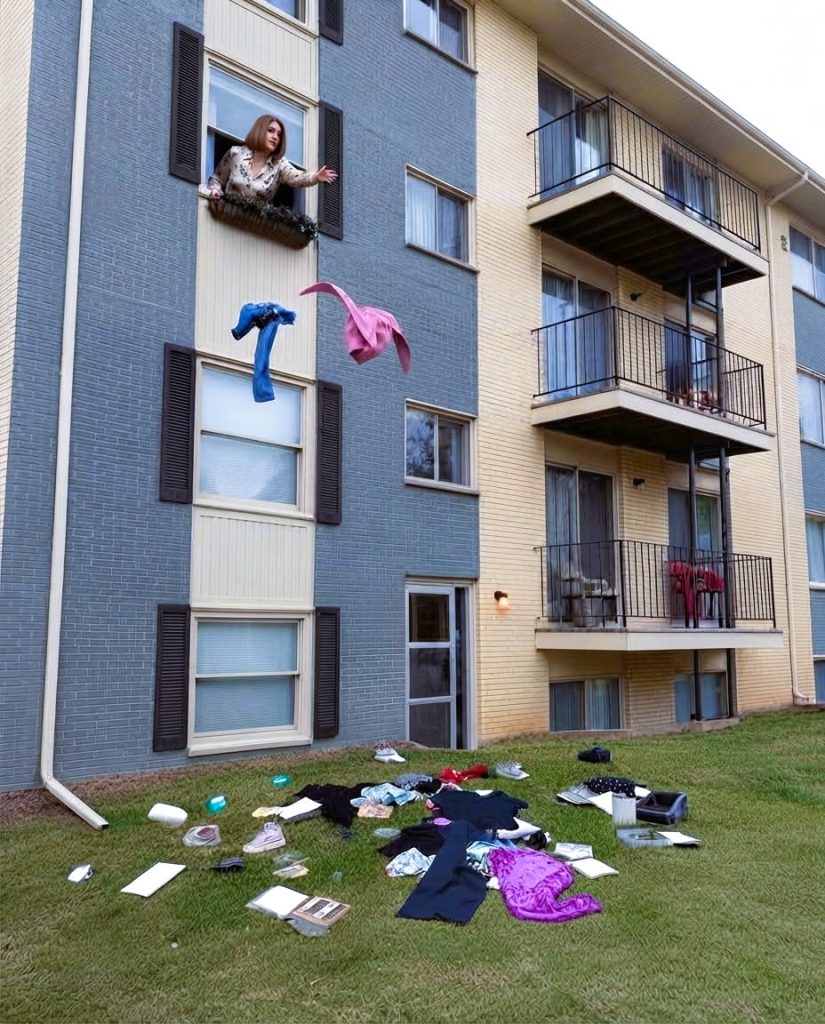
Eric placed the yellow box on the hood of his car. Margaret hurried toward him so quickly she nearly stepped on one of my sweaters. She didn’t even look down. Didn’t notice my textbooks scattered across the grass.
Didn’t notice the broken photograph of my father pressed against my chest. All she could see was that box. Her smile became almost girlish.
“Oh, Eric,” she whispered. “You didn’t have to.” He looked at her for a long moment. Then he untied the red ribbon.
Every neighbor watching from the balconies seemed to lean forward at once.
Margaret tucked her hair behind one ear.
I could practically hear the fantasy forming in her head.
A ring.
A proposal.
A new beginning.
A replacement life assembled before my father’s grave flowers had even wilted.
Eric lifted the lid.
And Margaret’s smile disappeared.
Inside the box were not roses.
Not champagne.
Not an engagement ring.
There were three things.
A set of house keys.
A thick folder of legal papers.
And a small velvet jewelry box.
Margaret stared at them.
“What is this?”
Eric picked up the velvet box first.
For one terrible second, I thought I had been wrong.
Maybe he really was going to propose to her in front of me.
He opened it.
A diamond ring glittered inside.
Margaret gasped.
Her face transformed instantly.
“I knew it.”
She reached toward it.
Eric closed the box.
“No.”
Her hand stopped.
“What?”
“This was for you.”
The entire courtyard went quiet.
Eric looked toward me.
Then toward my clothes scattered across the grass.
“Past tense.”
Margaret stared at him.
“You’re joking.”
“No.”
“Eric.”
He put the ring back into the yellow box.
Her face tightened.
“Why are you doing this in front of everyone?”
He gave a small, humorless laugh.
“That’s interesting.”
“What?”
“You’re worried about being embarrassed in front of the neighbors.”
He pointed toward me.
“Yet you threw an eighteen-year-old girl’s belongings out of a third-floor window.”
Margaret’s eyes flashed.
“This has nothing to do with you.”
“It has everything to do with me if you expected me to move into that room.”
He looked at me.
“I was told you had already moved out.”
I blinked.
“What?”
Margaret stepped between us.
“Eric, don’t listen to her.”
He ignored her.
“She told me you had decided to live near your university.”
My stomach turned.
“I never said that.”
“I believe you.”
Margaret’s voice rose.
“Eric.”
He finally looked at her.
“You told me she wanted independence.”
“She does.”
“I asked for a week.”
Margaret spun toward me.
“You’re eighteen!”
“And grieving!”
The words tore out of me before I could stop them.
My voice echoed against the apartment walls.
For three weeks I had barely allowed myself to cry in front of anyone.
Now my hands were shaking.
“My father died three weeks ago.”
Margaret stared at me.
“I know when your father died.”
“Then why are my clothes on the lawn?”
She opened her mouth.
Nothing came out.
Eric looked toward the broken photograph in my hands.
He crouched and carefully took the frame from me.
“I’m sorry,” he said.
His voice was quiet.
He began pulling the remaining pieces of glass away from the picture.
Margaret scoffed.
“For heaven’s sake, it’s just a photograph.”
That sentence changed something in Eric.
He stood.
Slowly.
I saw the exact moment whatever feelings he had for her collapsed.
He stared at Margaret.
“Just a photograph?”
She rolled her eyes.
“You know what I mean.”
“No. I don’t think I do.”
He held up my father’s picture.
“This man died less than a month ago.”
She folded her arms.
“And?”
“And his daughter is sitting on the ground holding his broken photograph while you’re worried about whether I brought you jewelry.”
Margaret’s face hardened.
“You don’t understand what living with her has been like.”
I looked at her in disbelief.
I had barely spoken since Dad died.
I woke up.
Went to college.
Came home.
Ate whatever I could force myself to swallow.
Then sat in my room trying to understand how one day my father could be laughing over breakfast and twenty-four hours later be gone forever.
I had not caused trouble.
I had barely existed.
Eric shook his head.
“You told me she was difficult.”
“She is.”
“You told me she was rude to you.”
“She can be.”
“You told me she chose to leave.”
Margaret said nothing.
Eric pointed toward the third-floor window.
“Which one of those things explains this?”
A neighbor above us finally spoke.
“None of them.”
Margaret looked up.
Mrs. Brennan from apartment 3C was leaning over her balcony railing.
“I saw the whole thing.”
Margaret’s face flushed.
“You should mind your own business.”
Mrs. Brennan didn’t flinch.
“I’ve minded my own business for thirty-two years. Today I’m taking a vacation.”
Someone on another balcony laughed.
Margaret looked around furiously.
Then back at Eric.
“You came here to move in with me.”
“I did.”
“Then stop making a fool of yourself and bring your boxes upstairs.”
“No.”
Her expression changed.
“What did you say?”
“I’m not moving in.”
She stared at him.
“You already ended your lease.”
“I’ll find somewhere else.”
“You can’t do this to me.”
Eric looked at my suitcase lying open on the grass.
“Interesting choice of words.”
Margaret stepped closer.
“After everything I’ve done for you?”
He sighed.
“I met you eight months ago.”
Eight months.
My entire body went cold.
I stared at her.
Dad had been alive eight months ago.
Eric immediately saw my expression.
He looked confused.
“What?”
I turned toward Margaret.
“You said you met him after Dad died.”
Her face changed.
Barely.
But enough.
Eric looked from her to me.
“She told you that?”
I nodded.
Margaret’s voice became sharp.
“This is not the place for this conversation.”
Eric laughed without humor.
“You’re right.”
He glanced at the clothes covering the lawn.
“You apparently prefer having private conversations from third-floor windows.”
She grabbed his arm.
“Eric, please.”
He pulled away.
“When did your husband know about us?”
Margaret froze.
“He didn’t.”
My stomach dropped.
Eric’s face went pale.
“You told me you were separated.”
Margaret said nothing.
“You told me you and Thomas lived in the same apartment because selling the place would be complicated.”
I felt as though someone had punched me in the chest.
Dad’s name sounded strange coming out of this stranger’s mouth.
Eric continued.
“You said the marriage had been over for two years.”
Margaret lowered her voice.
“It was.”
“No, it wasn’t.”
“You don’t know that.”
“I know he apparently didn’t.”
“He and I had problems.”
“That isn’t the same thing.”
Margaret looked toward me.
“This is exactly why I wanted her gone.”
I stared at her.
“So you could erase Dad faster?”
“Don’t be dramatic.”
Something snapped.
Not loudly.
Inside me.
For weeks I had let her tell me how to grieve.
I had let her take Dad’s shirts to charity without asking.
I had let her remove family photographs because they were “too depressing.”
I had even allowed her to move his chair out of the living room because she said seeing it empty was unhealthy.
But now I understood.
She had not been trying to move forward.
She had been clearing space.
For Eric.
For a relationship that had already existed while my father was alive.
I stood.
My legs were shaking, but I stood.
“You cheated on him.”
Margaret looked at me.
“I did not say that.”
“You didn’t have to.”
Eric looked sick.
“I never would have gotten involved with you if I knew.”
She turned on him.
“Oh, stop pretending you’re some saint.”
“I’m not pretending anything.”
“You loved me yesterday.”
“I loved the person you told me you were.”
That silenced her.
For a few seconds, nobody moved.
Then Eric reached into the yellow box and picked up the folder.
“This also came today.”
Margaret stared at it.
“What?”
He looked almost embarrassed.
“This is actually why I came earlier than planned.”
He handed the folder toward her.
She did not take it.
“What is it?”
“Paperwork from the property attorney.”
Her eyes narrowed.
“What property attorney?”
“The one handling this apartment.”
I frowned.
Margaret’s face became instantly defensive.
“There is no property attorney.”
Eric looked at me.
“Do you know a man named Samuel Greene?”
My heart jumped.
“Yes.”
Margaret turned toward me.
“You do?”
“He was Dad’s attorney.”
Eric nodded.
“That explains it.”
Margaret reached for the folder.
Eric pulled it back.
“Careful.”
“What is in there?”
“Something you probably should have read before you changed the locks.”
Her face went white.
I stared at him.
“What are you talking about?”
He hesitated.
Then handed me the folder.
“Your name is on the first page.”
My hands started shaking again.
I opened it.
Across the top were words I did not understand at first.
THE THOMAS CARTER FAMILY RESIDENCE TRUST.
Below that was my father’s full name.
Then mine.
Beneficiary: Anna Carter.
I read it twice.
Then a third time.
Margaret lunged forward.
“Give me that.”
Eric stepped between us.
“No.”
“That belongs to me.”
“No,” he said. “It very clearly doesn’t.”
I looked at him.
“What does this mean?”
He sighed.
“I’m not an attorney.”
“Then why did you have it?”
“Margaret asked me to help arrange a renovation loan.”
I looked at her.
She would not meet my eyes.
Eric continued.
“She wanted to renovate the apartment after I moved in.”
Of course she did.
He nodded toward the folder.
“The bank requested proof of ownership. Margaret gave them an old deed showing your father’s name.”
“I told you the transfer paperwork wasn’t finished,” Margaret snapped.
Eric ignored her.
“The bank ran a title search.”
He pointed to the folder.
“That came back.”
I stared down at the document.
My father had created the trust eighteen months earlier.
The apartment had been transferred into it.
Margaret had not inherited the property outright.
She had what the paperwork called a temporary right of occupancy.
I read the paragraph slowly.
Then stopped.
My heart began pounding.
I read it again.
Margaret must have recognized the section because she suddenly said,
“That document is outdated.”
Eric looked at her.
“The attorney’s cover letter is dated yesterday.”
“What does it say?” I whispered.
He hesitated.
I read it myself.
Margaret Carter shall retain the right to occupy the residence following the death of Thomas Carter, provided that Anna Carter remains entitled to reside in the home while enrolled in secondary or post-secondary education, or until her twenty-third birthday, whichever occurs first.
I looked up.
Margaret was completely still.
There was more.
I continued reading.
Any deliberate attempt to exclude, evict, lock out, or otherwise deny Anna Carter reasonable access to the residence shall terminate Margaret Carter’s occupancy rights upon written notice by the trustee.
The world seemed to become very quiet.
I heard Mrs. Brennan whisper from the balcony.
“Oh my.”
Eric looked toward the third-floor door.
“You changed the locks.”
Margaret recovered quickly.
“She’s eighteen.”
“The trust specifically addresses that.”
“She was going to leave anyway.”
“No, I wasn’t.”
Margaret glared at me.
Eric pointed to my possessions scattered across the lawn.
“That doesn’t look voluntary.”
She looked around.
For the first time all afternoon, she seemed frightened.
Not angry.
Frightened.
“Who is the trustee?”
I turned the page.
Samuel Greene.
Dad’s lawyer.
Below his name was another sheet.
A letter.
Anna,
If you are reading this, then I am probably not there to explain it myself.
My vision blurred immediately.
Dad’s handwriting.
Not typed.
Scanned onto the page.
I pressed my fingers against my lips.
Margaret tried to step closer.
Eric stopped her.
I read.
I never want you to feel that my remarriage means you have lost your place in this family or in this home.
You were here first, kiddo.
You will always have somewhere to land.
I had to stop.
My knees weakened.
I sat down on the edge of my suitcase.
For three weeks, I had been desperate to hear my father’s voice again.
And suddenly there he was.
On a sheet of paper.
Calling me kiddo.
Exactly as he always had.
I continued.
Margaret will be protected if something happens to me because I do not believe in leaving someone homeless after sharing a life with them. But protecting her should never require displacing you. Finish school. Take your time. Build your life properly. Do not let grief rush you into becoming an adult faster than you need to.
Love,
Dad.
I could not breathe.
I pressed the letter against my chest.
The courtyard blurred.
Mrs. Brennan was crying above me.
Even Eric looked away.
Margaret was the only person who showed no emotion.
Her voice came out cold.
“Thomas never told me about that.”
Eric turned toward her.
“I’m beginning to understand why.”
She glared.
“You think you know him now?”
“No.”
He gestured toward me.
“But I know what he was trying to protect.”
Margaret stared at the papers.
Then suddenly snatched her phone from her pocket.
“I’m calling Samuel.”
She walked several feet away.
We could hear almost everything.
“Samuel, it’s Margaret.”
A pause.
“Yes, I’m looking at the trust paperwork.”
Another pause.
Her face tightened.
“No, Anna has not been evicted.”
Several neighbors actually laughed.
Margaret turned red.
“She misunderstood.”
Mrs. Brennan shouted down,
“I have video!”
Margaret whipped around.
Mrs. Brennan held up her phone.
“I record the courtyard when packages arrive.”
Margaret looked murderous.
Then Samuel must have said something because she turned away again.
“No. Listen to me.”
Pause.
“I changed the locks because—”
Another pause.
Her shoulders dropped.
“What do you mean you’re coming here?”
My heart began racing.
Ten minutes later, another car entered the courtyard.
A gray sedan.
Samuel Greene stepped out.
He had attended Dad’s funeral.
Tall.
Silver hair.
Always wearing the same navy suit.
He took one look at the lawn and closed his eyes.
“Margaret.”
She hurried toward him.
“Samuel, thank God.”
He held up one hand.
“Please do not say anything until I understand what happened.”
“She’s trying to create drama.”
Samuel looked toward me.
I still held Dad’s letter.
“Anna?”
I pointed toward the third floor.
“She changed the locks.”
He looked at Margaret.
She sighed.
“For one night.”
“And threw her belongings outside?”
“I was helping her move.”
Samuel stared at her.
“Did she agree to move?”
Margaret said nothing.
“Margaret.”
“No.”
Samuel’s face became very tired.
“Did you read the estate documents I gave you after Thomas died?”
“Of course.”
“Then you knew Anna had residency rights.”
“I thought that ended when she turned eighteen.”
“It does not.”
“I’m his wife.”
“Was.”
Margaret flinched.
Samuel immediately softened his tone.
“I’m not saying that cruelly.”
“You’re treating me like a criminal.”
“No.”
He glanced toward my books lying in the grass.
“I’m treating you like someone who just violated a trust agreement.”
Her face hardened.
“What happens now?”
Samuel looked at me.
Then back at her.
“That depends partly on Anna.”
Margaret turned toward me.
For the first time since Dad died, she looked at me as though my opinion mattered.
I hated that it took legal paperwork.
Samuel continued.
“The trust authorizes termination of your occupancy rights if Anna is deliberately excluded.”
Margaret’s lips parted.
“You’re saying she can throw me out?”
“No.”
Samuel shook his head.
“The trustee makes that determination.”
“And who is that?”
“I am.”
Her expression collapsed.
“How long?”
“If I issue formal notice, thirty days.”
Margaret stared at him.
“This is my home.”
Samuel looked toward me.
“No.”
He said it gently.
“It was Thomas’s home. Now it belongs to the trust for Anna’s benefit.”
Margaret looked as if she had aged ten years in one minute.
She turned toward Eric.
“Say something.”
He picked up the ring box.
“I don’t think you want me to.”
“You were moving in with me today.”
“Not anymore.”
“Eric.”
“I’m done.”
Her face twisted.
“You’re abandoning me because of one argument?”
“No.”
He looked toward the apartment.
“I’m leaving because you lied to me about your marriage, lied about your stepdaughter, lied about owning this place, and apparently thought throwing a grieving teenager’s belongings out of a window was reasonable behavior.”
He placed the ring box in his jacket pocket.
“The woman I planned to marry doesn’t exist.”
That hurt her.
I saw it.
For once, Margaret had no cruel answer ready.
Eric walked to his car.
I thought he was leaving.
Instead, he opened the trunk and removed two empty storage bins.
He carried them toward me.
“Let’s get your things off the ground.”
I stared at him.
“You don’t have to.”
“I know.”
He started collecting my books.
Mrs. Brennan came downstairs.
Then Mr. Lewis from the second floor.
Then a young couple from across the courtyard.
Within minutes, people were helping.
They folded clothes.
Picked up shoes.
Gathered notebooks.
Someone found the cap from my shampoo bottle.
Someone else carried my suitcase upstairs after Samuel instructed Margaret to open the door.
She did.
But she stood beside it looking as though every returning item was another piece of her victory being taken away.
When I reached my bedroom, I stopped.
The room was empty.
Dad’s old bookshelf was gone.
My desk chair had been moved.
There were cardboard boxes near the wall labeled ERIC.
I stared at them.
Then looked at Margaret.
“You packed his things before mine were even out.”
She said nothing.
I looked toward Samuel.
“I don’t want her kicked out tonight.”
Margaret blinked.
Samuel studied me.
“Are you certain?”
I nodded.
“She gets thirty days.”
Margaret looked almost relieved.
Then I added,
“But she does not control the house anymore.”
Her face tightened.
Samuel nodded.
“That can be arranged.”
“The locks get changed again.”
“To keys you control.”
“Yes.”
“And she cannot enter my room.”
Samuel nodded.
“I’ll document it.”
Margaret scoffed.
“You’re enjoying this.”
I turned toward her.
“No.”
She seemed surprised.
“I’m not.”
And I meant it.
Watching her lose control did not bring Dad back.
It did not repair his photograph.
It did not give me the three weeks of mourning she had poisoned.
Justice rarely feels as exciting as people imagine.
Sometimes it just feels necessary.
That evening, Eric left.
Before he did, he handed me a business card.
“If you ever need someone to confirm what happened today, call me.”
I took it.
“Thank you.”
He looked embarrassed.
“I should have asked more questions.”
“She lied to you too.”
He nodded.
“That doesn’t mean I shouldn’t have noticed things.”
Then he drove away.
The engagement ring went with him.
So did the moving boxes.
Margaret watched from the window.
For the next thirty days, we lived in the same apartment almost like strangers.
She stopped speaking to me unless necessary.
I did not mind.
Samuel helped me open a bank account Dad had left in trust for my education.
There was enough to finish college without taking loans.
Not millions.
Not some ridiculous fortune.
Dad had simply planned.
Tuition.
Living expenses.
Emergency money.
He had done what he always did.
Made sure I had enough.
Margaret challenged the trust.
Of course she did.
Her attorney argued that Dad had never intended to remove her from the apartment.
Samuel agreed.
Then calmly explained that Dad had not removed her.
She had removed herself by violating the one condition designed to protect me.
Mrs. Brennan provided the courtyard video.
It showed my clothes falling from the window.
It showed Margaret shouting down that I was not coming back inside.
It showed me trying the locked front door.
There was not much left to argue.
Thirty-one days after the yellow box arrived, Margaret moved out.
No one threw her belongings from the window.
I made sure of that.
A moving company carried everything carefully downstairs.
Furniture.
Clothes.
Boxes.
Photographs.
She stood in the doorway with her purse over one shoulder.
For a moment, she looked almost exactly as she had the day she married Dad.
Smaller.
Nervous.
Human.
She turned toward me.
“I suppose you’re happy now.”
I shook my head.
“I’m tired.”
She looked away.
“I loved your father.”
I did not answer.
Then she said,
“Things were bad between us before he died.”
“That may be true.”
“He was always worried about you.”
“I was his daughter.”
“He put you first.”
I looked at her.
“Then maybe you should have married someone who didn’t have a child.”
She flinched.
I immediately wished I had said it more gently.
But I did not take it back.
She stared at the floor.
“I was jealous.”
That confession surprised me.
“Of me?”
She nodded.
“You and Thomas had your own language. Your jokes. Your memories. Sometimes I felt like I walked into a story halfway through.”
For the first time, I understood something about her.
Understanding was not forgiveness.
But it made her cruelty less mysterious.
“You could have made new memories with us.”
“I know.”
She wiped beneath one eye.
“I kept thinking if you moved out, maybe the house would finally feel like mine.”
I looked around.
The apartment still smelled faintly like Dad’s coffee.
His favorite lamp remained beside the sofa.
A scratch from when I rode my bicycle inside at age six was still visible near the hallway baseboard.
“It was never going to feel like yours by erasing me.”
She nodded.
“No.”
The mover called her name.
Margaret picked up her handbag.
At the door, she turned.
“For what it’s worth, Eric never spoke to me again.”
I did not know what to say.
So I simply nodded.
Then she left.
I locked the door.
Not because I hated her.
Because it was my home.
Two years later, I graduated.
Samuel sat beside Mrs. Brennan at the ceremony.
Eric sent a card.
I had almost forgotten about him.
Inside, he wrote:
Your father would have been proud.
I hope you kept the pink sweater.
I laughed.
I had.
The photograph of Dad had been repaired too.
A framing shop replaced the glass and restored one damaged corner.
It now sits on the bookshelf in the living room.
Sometimes people ask whether I ever forgave Margaret.
The answer is complicated.
Eventually, yes.
But forgiving someone does not always mean letting them return to the place where they hurt you.
We speak occasionally.
Birthday messages.
Christmas cards.
Once, years later, we had coffee.
She apologized without excuses.
That mattered.
But we never became family again.
Some things, once broken, can be repaired.
Others can only be handled carefully afterward.
The apartment remained mine through the trust.
When I turned twenty-three, full ownership transferred to me.
Samuel handed me the deed in the same courtyard where my suitcase had once burst open.
I stood there holding the papers and remembered myself at eighteen.
Kneeling in the grass.
Surrounded by clothes.
Thinking I had lost everything.
The truth was, I had lost my father.
That was everything.
The apartment was only walls.
The money was only security.
The legal victory was only protection.
What mattered most was the message Dad had left inside that folder.
You will always have somewhere to land.
For years, I thought he meant the apartment.
Eventually, I understood he meant something larger.
He had spent my whole childhood teaching me that home was not the person who happened to hold the keys.
Home was knowing your value.
Knowing when someone crossed a line.
Knowing that grief did not make you weak.
And knowing you were allowed to protect yourself even from someone who called themselves family.
Margaret believed throwing my belongings from a third-floor window would prove she controlled my future.
Instead, every item lying across that courtyard became evidence.
She believed changing the locks made the apartment hers.
Instead, the click of that new lock triggered the exact protection my father had quietly put in place.
And she believed Eric was driving into the courtyard to begin her new life.
He was.
Just not with her.
Sometimes karma does not arrive loudly.
Sometimes it pulls into the courtyard in an ordinary car with moving boxes in the back.
Sometimes it carries a yellow gift box.
And sometimes, when that box opens, what falls out is not revenge.
It is the truth.
THE END! THANKS FOR READING!