

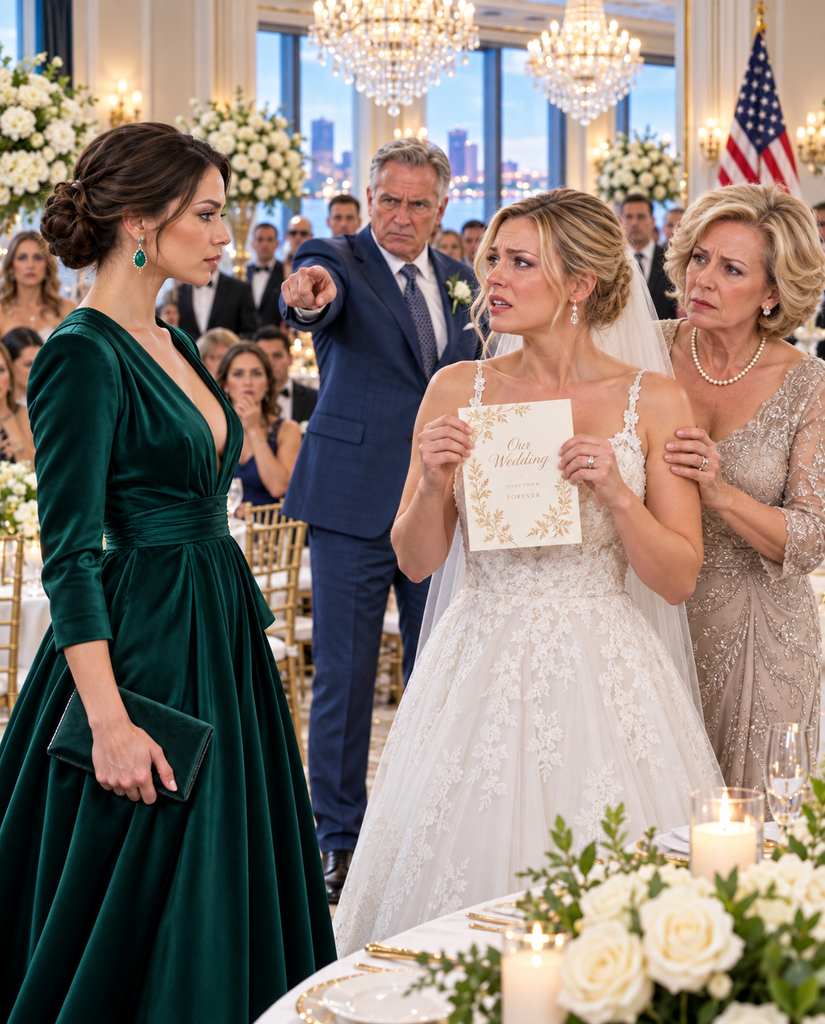
After I paid for nearly everything connected to my sister’s wedding, she stood in front of almost fifty relatives, tore my invitation in half, and told me I would ruin her perfect day.
My parents clapped in agreement. “If she doesn’t want you here,” my father said, “then leave.” “So be it,” I answered. I picked up my coat and walked out before anyone noticed I was smiling.
They still believed every payment, every vendor, every reservation, and every luxury detail belonged to my sister.
They were wrong. And early the next morning, the venue manager called her. That was when the wedding she thought she owned finally met the paperwork she had never bothered to read.
The night before, we were gathered in a private dining room at an upscale Minnesota country club for the rehearsal dinner. Nearly fifty relatives filled the room. Crystal glasses caught the glow from the chandeliers. White linen covered the tables. Small arrangements of winter roses sat between silver candleholders. Everyone looked polished, happy, and expensive.
My sister Ashley stood at the front of the room in a fitted cream dress.
She looked beautiful.
She always had.
At thirty-two, Ashley had the kind of appearance people noticed immediately. Blonde hair styled perfectly. Bright smile. Elegant posture. She had always understood how to enter a room and become the center of it.
I was nine years older.
At forty-one, I had long ago stopped caring whether I was the person people noticed first.
I was usually the person they called afterward when something went wrong.
Ashley stood across from me with one hand pressed dramatically against her collarbone.
“I can’t do this anymore,” she said.
The conversations around us stopped.
At first, I thought she was talking about something involving the wedding planner.
We had already dealt with three emergencies that day.
A floral delivery had arrived with the wrong shade of roses.
A cousin had decided at the last minute to bring two additional children.
The limousine company needed confirmation about pickup times.
I had solved all three problems before lunch.
But Ashley was looking directly at me.
“Your energy,” she continued. “The way you look at me. The way you judge every decision I make. I don’t want that around me tomorrow.”
The room became very quiet.
I stared at her.
“What are you talking about?”
“You know exactly what I’m talking about.”
“No, Ashley. I don’t.”
She gave a small laugh and looked around the room as though she wanted witnesses to what came next.
“You’ve spent the last six months trying to control my wedding.”
I actually thought I had misheard her.
“Control it?”
“Yes.”
She reached toward the place setting beside her and picked up an envelope.
My invitation.
She held it up.
“This is supposed to be the happiest day of my life, and I refuse to spend it wondering what you’re criticizing.”
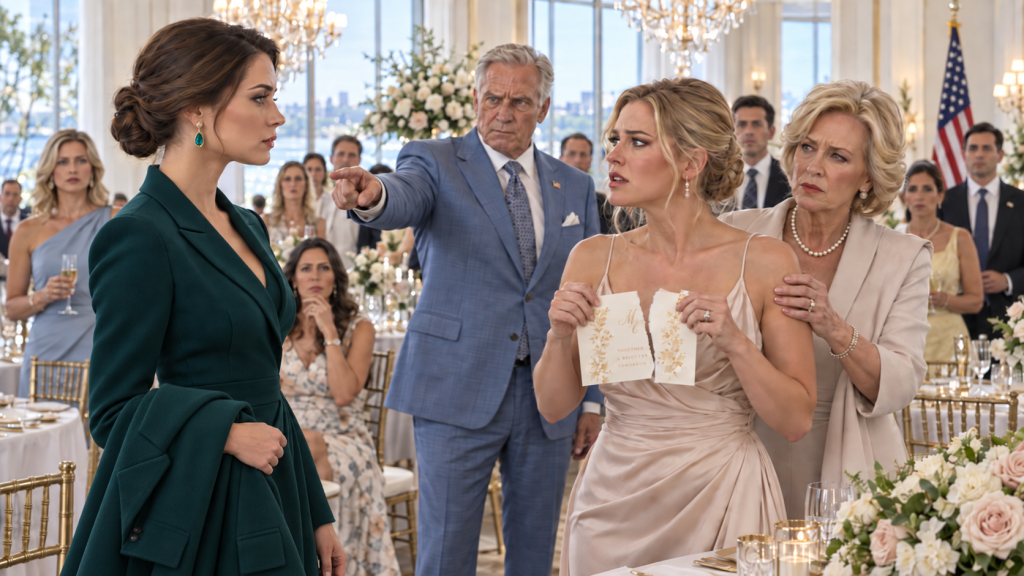
Then she tore the invitation in half.
Someone gasped.
My mother immediately moved to Ashley’s side.
“Ashley, sweetheart.”
But she did not sound shocked.
She sounded comforting.
That was when I understood.
My mother already knew.
Maybe my father did too.
Ashley dropped the torn pieces onto the table.
“You’ll only ruin my perfect day.”
For several seconds, I did not speak.
I looked at my mother.
“Mom?”
She avoided my eyes.
Instead she placed a hand on Ashley’s shoulder.
“Your sister has been under tremendous stress.”
I stared at her.
“I know. I’ve been handling most of it.”
“That’s exactly the problem,” Ashley snapped.
My father pushed back his chair and stood.
He had been drinking bourbon all evening. Not enough to be drunk, but enough to give his face that familiar red color around his cheeks.
He straightened his silk tie.
“If Ashley doesn’t want you here,” he said, “leave.”
I looked at him.
“Excuse me?”
“This is her wedding.”
“I know whose wedding it is.”
“Then respect her wishes.”
My aunt Linda started clapping.
I will never forget that sound.
Three slow claps at first.
Then another relative joined her.
Then two more.
“Good for you, Ashley,” someone said.
I looked around the room.
People I had known my entire life were watching me as though Ashley had finally defeated some bully.
My cousin Danielle stared down at her plate.
Uncle Paul looked uncomfortable but said nothing.
My mother stroked Ashley’s arm.
My father remained standing.
No one asked what I had actually done.
No one asked why Ashley had waited until the rehearsal dinner to remove me from the wedding.
No one mentioned that I had spent six months solving every crisis connected to that wedding.
I lowered my eyes.
The torn invitation lay beside the bread basket.
Heavy ivory card stock.
Fourteen dollars per invitation.
Three dollars extra for gold foil.
I knew the exact cost because I had approved the invoice.
Just like I had approved the imported orchids.
The dinner package.
The room blocks.
The transportation.
The custom menus.
The photography.
The jazz ensemble.
The late-night dessert station.
And one very important contract that nobody in that room had ever bothered to read.
I didn’t cry.
I didn’t yell.
I did not beg Ashley to reconsider.
Instead, I stood.
I reached behind my chair for my wool coat.
Then I looked at my sister.
“So be it.”
My father gave a satisfied nod.
Ashley’s mouth lifted into the smallest smile.
Victory.
That was what she thought she had achieved.
She believed she had put me in my place.
No one followed me when I walked out.
The heavy oak doors closed behind me.
Outside, the Minnesota air was sharp enough to sting my face.
Snow covered the parking lot in a thin white layer. My boots made a soft crunching sound as I walked toward my car.
Halfway across the lot, I stopped.
And smiled.
Not because I wanted Ashley’s wedding destroyed.
Not because I wanted revenge.
I smiled because something had finally become clear.
For most of my life, my family had mistaken my reliability for an obligation.
If Claire could handle something, Claire should handle it.
If Claire had money, Claire could pay.
If Claire had a connection, Claire could make a call.
If Claire was hurt, Claire would recover on her own because Claire was strong.
Ashley was different.
Ashley needed help.
Ashley needed understanding.
Ashley needed patience.
When we were teenagers, Ashley got a new car because she was “going through a difficult phase.”
I received a bus pass because Dad said I was “responsible enough to manage.”
When Ashley failed two college classes, Mom called professors and complained that Ashley was under emotional pressure.
When I graduated near the top of my class while working nights, my parents said, “We always knew you would.”
When Ashley lost her first job, Mom stayed with her for almost a week.
When I was hospitalized with pneumonia at twenty-seven, Mom sent me a text asking if I needed anything.
Three hours later, she called because Ashley needed help moving a sofa.
For years, I told myself being dependable was something to be proud of.
It took me until forty-one to understand that my family wasn’t proud.
They were comfortable.
There is a difference.
Before I reached my car, my phone lit up.
Ashley.
A text message.
“Leave your gift check with the valet before you drive away. Don’t make this harder than it has to be.”
I stared at the screen.
Then I laughed.
Just once.
I blocked her number.
Then I blocked Mom.
Then Dad.
I drove home.
The highway toward Minneapolis was nearly empty. Snow drifted across the lanes in pale ribbons.
Behind me, my family stayed in that warm dining room, probably congratulating Ashley for “setting boundaries.”
They believed the wedding belonged to her.
They believed the estate had given her a luxury package because she was the bride.
They believed all the vendors had been contracted in her name.
They were about to learn otherwise.
Six months earlier, Ashley had arrived at my apartment carrying three bridal magazines.
She spread them across my kitchen island and pointed to a photograph.
The Weisetta Historic Estate.
A luxury property west of Minneapolis with lake views, stone terraces, a glass ballroom, private guest cottages, and enormous oak trees that looked beautiful in every season.
“That one,” Ashley said.
“For what?”
“My wedding.”
I looked at her.
She smiled.
“I’m serious.”
I knew the venue.
My company had negotiated events there.
“A Saturday wedding there can cost well over a hundred thousand dollars.”
“I know.”
“Ashley, you manage a boutique.”
She rolled her eyes.
“I know what I do for work, Claire.”
“Connor makes decent money, but not enough for this.”
“Mom and Dad can help.”
“Not this much.”
She leaned over the counter.
“But you know people there.”
That sentence should have been enough for me to say no.
Instead, I asked, “What exactly are you asking?”
“Just talk to them.”
“Ashley.”
“Please. It’s my dream venue.”
At the time, I was a senior partner at Bellmere Hospitality Strategy.
We advised luxury hotels and corporate clients on large events, retreats, conferences, and partnership agreements.
One of our biggest negotiations that year was with Northstar Heritage Hospitality, the company that owned Weisetta Estate.
I had worked with Northstar’s general manager, Marcus Hall, for almost six years.
I called him.
Not to demand a favor.
To ask whether any legitimate corporate partnership benefits might apply.
Marcus explained that Northstar occasionally offered discretionary event courtesies to senior corporate clients as part of broader business relationships.
The arrangement was legal, documented, and common in our industry.
But there were conditions.
The event would remain under the corporate host’s account.
The corporate representative would be listed as host of record.
Complimentary venue components could not simply be transferred to another person.
And if the corporate host withdrew, the wedding could continue only as a normal private event at market rates.
I understood every clause.
I explained the basics to Ashley.
Her response was, “So we can have it?”
“That isn’t what I said.”
“But basically yes?”
“Basically, the venue rental may be covered if everything is approved.”
Her eyes lit up.
She hugged me.
“You’re the best sister in the world.”
Those words lasted about three days.
Then the upgrades began.
The venue package included beautiful standard flowers.
Ashley wanted imported orchids.
It included a four-piece jazz quartet.
Ashley wanted twelve musicians.
It included premium food.
Ashley wanted a five-course plated menu.
Then she wanted a champagne wall.
Connor wanted a whiskey lounge.
Mom wanted personalized welcome baskets for every out-of-town guest.
Dad wanted private transportation for relatives arriving from Chicago.
Ashley wanted two photographers.
Then a videographer.
Then drone footage.
Then custom linens.
Then hand-painted menus.
Then a late-night dessert bar.
Every time the price increased, someone said the same thing.
“Claire can handle it.”
So I handled it.
Some expenses were covered through the corporate partnership.
Many were not.
I paid those personally.
Eight thousand dollars became twenty.
Twenty became forty.
By the final week before the wedding, I had personally spent more than seventy-three thousand dollars.
I also had a twenty-five-thousand-dollar check prepared as a wedding gift.
Ashley knew about the gift.
Apparently, that was why she thought she could order me to leave it with the valet after throwing me out.
My parents knew I was helping.
But I had never sat them down and announced exactly how much.
That was my mistake.
I thought generosity did not need an audience.
My silence allowed them to create their own story.
In their version, Dad had “covered the wedding.”
I had simply used professional connections.
Ashley had done the planning.
Mom had helped coordinate.
My contribution became invisible because I never demanded recognition.
When I reached home after the rehearsal dinner, I removed my coat and stood in my silent apartment.
For several minutes, I did nothing.
Then I poured a glass of water.
I did not want wine.
I wanted a clear head.
I opened my laptop.
I found the wedding contract.
I read every page.
Then I read it again.
I wanted to be certain that whatever I did next was legal, ethical, and calm.
I found the host-withdrawal clause.
If the corporate host withdrew before the event, Northstar could convert the booking into a standard private reservation.
Nothing automatically canceled.
Ashley could still have her wedding.
She could still use the estate.
She could still keep the flowers, rooms, menu, music, and transportation.
She would simply have to pay for them.
That distinction mattered to me.
I did not want to ruin her wedding.
I wanted to stop paying for a wedding I had been banned from attending.
I closed the laptop.
Then I slept peacefully for the first time in weeks.
At 6:15 the next morning, I was already dressed.
By 6:40, I was inside my downtown office.
The building was nearly empty.
I brewed black coffee and opened the encrypted event file.
At 6:42, I called Marcus.
“Good morning,” he said. “Final headcount issue?”
“No.”
My voice was steady.
“I need to change the event account.”
His tone shifted.
“What happened?”
“I was removed from the wedding.”
“Removed?”
“I was told last night that I’m not welcome.”
He was silent.
“Claire, are you withdrawing as corporate host?”
“Yes.”
“Do you want to cancel the event?”