

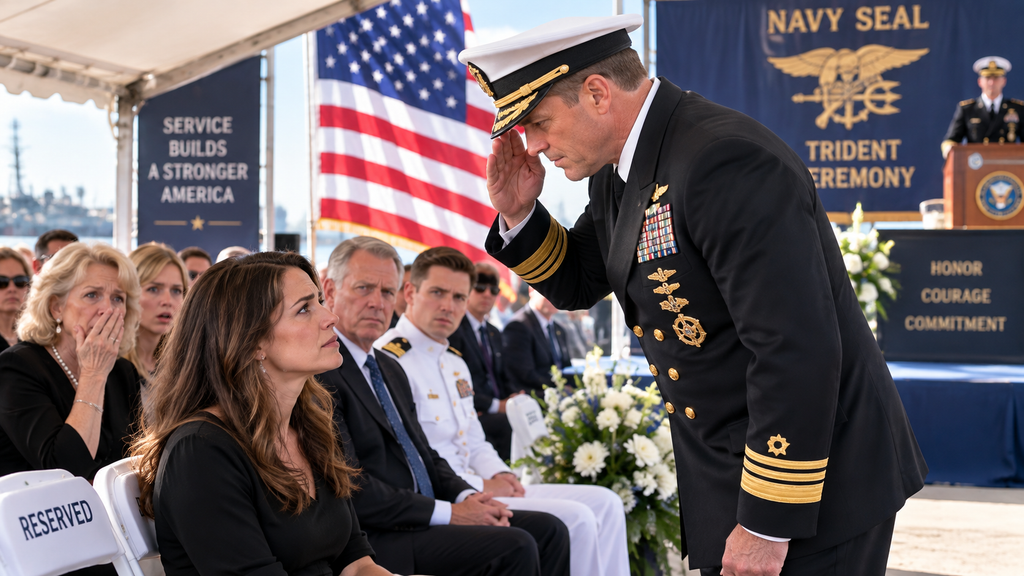
The morning sun over Naval Amphibious Base Coronado was already hot. My brother Ryan stood twenty feet away in dress whites, his new gold Trident catching the light. He looked at me once and said, “Don’t embarrass me today, Emily.”
So I folded my hands in my lap. And stayed quiet.
My family always hated that most.
Not my arguments.
Not my tears.
My silence.
Because silence meant I had already decided how little of myself they deserved.
Mom tugged at her pearls.
“She wore black,” she whispered to Aunt Patricia, loud enough for several rows to hear. “To her own brother’s proudest day.”
I looked down at my plain black dress.
No jewelry except a narrow silver watch.
No explanation for the dark circles under my eyes after driving six hours through the night.
They knew almost nothing about my life.
To them, I was still Emily Carter—the daughter who left college, disappeared for long stretches, missed holidays, and came home with scars nobody dared ask about.
Ryan was different.
He was the golden son.
Football captain.
Homecoming king.
Now a Navy SEAL.
Dad loved telling people, “Ryan serves the country.”
Then he would glance at me.
“Emily is still figuring things out.”
That morning, even security had hesitated over my name.
My visitor pass had been marked in a different section from the family seats.
Mom immediately stepped forward.
“She’s just his sister. Not important.”
I could have corrected her.
I could have shown the protocol email on my phone.
I could have explained why my full name and rank appeared in a separate column.
Instead, I sat down.
Then my cousin Madison twisted around.
“Emily, why are you even here? This section is for supportive family.”
“I am family.”
“I said supportive.”
Aunt Patricia laughed.
Dad said nothing.
Ryan heard it.
And the corner of his mouth moved.
That hurt more than the joke.
Then Dad leaned toward me.
“After this, don’t come to the private reception unless Ryan invites you. It’s a military crowd. People will ask questions.”
“What questions?”
“What you do. Where you’ve been. Why you never talk about it.”
Mom gave a little laugh.
“Today is about Ryan. Don’t make it strange.”
“I drove here for Ryan.”
Ryan finally looked directly at me.
“No. You drove here to be seen.”
For one ugly second, I wanted to pull the folded invitation from my purse and place it in my father’s lap.
I didn’t.
I simply turned toward the stage.
That was when Commander Nathaniel Hayes stopped speaking.
His eyes moved across the family section.
Once.
Twice.
Then they locked on me.
Mom noticed first.
Her smile disappeared.
Commander Hayes looked toward the empty reserved chair beside the stage.
Then at the security guard.
Then back at me.
Ryan’s expression changed.
The commander stepped away from the podium.
The senior chiefs moved with him.
Every conversation under the tent faded as he walked straight toward the woman my family had spent the morning humiliating.
He stopped in front of my chair.
Brought his heels together.
Raised his right hand in a sharp salute.
And said, loud enough for my entire family to hear:
“Ma’am, we’ve been waiting for you.”
For three seconds, nobody moved.
Not my mother.
Not my father.
Not Ryan.
Not even me.
Then training took over.
I rose from the folding chair, straightened my shoulders, and returned the salute.
“At ease, Commander.”
The words came out quietly.
They always did.
I had learned a long time ago that authority rarely needed volume.
Hayes lowered his hand.
“Captain Carter, your seat is waiting.”
My mother made a sound behind me.
Not quite a gasp.
Not quite a word.
I turned.
Her face had gone completely still.
Dad stared at Commander Hayes.
Then at me.
Then back at Hayes.
“Captain?” he said.
Hayes glanced at him politely.
“Yes, sir.”
Ryan took one step closer.
His new Trident seemed brighter now, almost painfully bright against his uniform.
“Captain of what?”
I looked at my brother.
For most of our lives, Ryan had asked questions only when he believed he already knew the answer.
This time, he didn’t.
Commander Hayes answered before I could.
“Captain Carter is a United States Navy intelligence officer assigned to Joint Special Operations Command.”
The air seemed to disappear from my family’s section.
Aunt Patricia’s mouth actually fell open.
Madison stopped smiling.
Mom blinked.
Dad laughed once, but there was no humor in it.
“That’s impossible.”
Hayes’s expression did not change.
“Sir?”
“She left college.”
I felt something old and tired shift inside my chest.
Of course that was Dad’s first response.
Not pride.
Not curiosity.
Not even disbelief at the rank.
Correction.
He needed the room to understand that his version of me still mattered more than reality.
I looked at him.
“I left Western State University.”
He stared back.
“Yes.”
“I didn’t stop studying.”
“What does that mean?”
“It means I finished my degree somewhere else.”
Ryan shook his head.
“No. You would’ve told us.”
I almost smiled.
Would I?
The same family who had spent years turning every conversation into a comparison?
The same parents who had made Ryan’s accomplishments into family holidays and mine into inconveniences?
When I was twenty, I had been studying political science at Western State.
I was good at languages.
Very good.
Arabic first.
Then Farsi.
Then Pashto.
I had an ear for accents, patterns, details other people missed.
A professor recommended me for a Department of Defense language scholarship.
That led to another program.
Then another.
I transferred.
Finished my degree.
Commissioned.
My parents received an invitation to the ceremony.
They didn’t come.
Ryan had a regional football championship that weekend.
Mom mailed me a card three weeks later.
Inside she had written:
Sorry we missed your work thing. So proud of Ryan!
I kept that card for eleven years.
Not because I was angry.
Because sometimes you need physical evidence that you are not imagining the way people treat you.
Commander Hayes gestured toward the stage.
“Ma’am?”
I picked up my purse.
Mom grabbed my forearm.
“Emily.”
I looked at her hand until she released me.
“What?”
“Why didn’t you tell us?”
I glanced at Ryan.
Then Dad.
Then Aunt Patricia.
Then at the chair I had been told I barely deserved to occupy.
“I did.”
Mom frowned.
“No, you didn’t.”
“Yes,” I said. “For years.”
Then I walked toward the front.
Every step felt louder than it should have.
Hundreds of eyes followed me.
I hated that.
People assume secretive work teaches you to enjoy mystery.
It doesn’t.
Mostly, it teaches you the value of not being noticed.
The empty chair beside the stage had a small printed card on it.
CAPT EMILY CARTER
JSOC
SPECIAL GUEST
I sat down.
Behind me, my family said nothing.
Commander Hayes returned to the podium.
He cleared his throat.
“Ladies and gentlemen, thank you for your patience.”
A few people laughed softly.
Hayes glanced toward me.
“Before we continue, I need to acknowledge a guest whose presence today carries special meaning for several members of Naval Special Warfare.”
My stomach tightened.
That had not been in the program.
I gave him a warning look.
He ignored it.
Of course he did.
“Captain Carter has spent the better part of sixteen years serving in assignments that most Americans will never hear about.”
I stared straight ahead.
“Some of the specifics remain classified. They may remain classified for decades. But I have been authorized to say this much.”
The tent became completely silent.
“Four years ago, a joint special operations element was compromised during an overseas mission. Enemy forces had obtained information about our planned extraction corridor. Our people were heading directly toward an ambush.”
I heard Ryan inhale behind me.
Hayes continued.
“Captain Carter identified the compromise through an intelligence anomaly most analysts had dismissed as insignificant.”
I remembered that night.
A room with no windows.
Bad coffee.
Three monitors.
A series of intercepted phrases that bothered me because the grammar was wrong.
Not incorrect.
Wrong.
Someone was using a regional dialect they should not have known.
I had stared at the transcript for nearly twenty minutes before calling the operations floor.
The officer on duty told me the mission was already in progress.
I told him to reroute them.
He asked for certainty.
I said I didn’t have certainty.
I had pattern recognition.
He refused.
So I called his superior.
Then his superior.
I made enough noise that eventually someone listened.
Hayes’s voice pulled me back.
“She fought to redirect that team despite significant resistance.”
He paused.
“I know because I was leading that team.”
My family shifted behind me.
“We changed course eleven minutes before reaching the original extraction point.”
Hayes looked across the new SEALs.
“Satellite imagery later confirmed what Captain Carter believed. More than two dozen armed fighters were waiting along our original route.”
Nobody laughed now.
Nobody whispered.
Hayes continued.
“She did not save a spreadsheet. She did not save a mission report. She saved fourteen American lives.”
My throat tightened.
I hated when people said it that way.
Because intelligence was never one person.
There were analysts who collected the intercepts.
Linguists who processed fragments.
Technicians who maintained systems.
Pilots who redirected assets.
Operators who trusted an unexpected order.
But Hayes had always insisted I stop minimizing my part.
That night fourteen men came home.
Three months later, one of them mailed me a Christmas card.
It showed his wife and two daughters standing beside a tree.
He had written:
You don’t know us, but we know we still have him because you wouldn’t stop arguing.
I still had that card too.
Hayes rested both hands on the podium.
“That was not the last time Captain Carter’s work affected Naval Special Warfare.”
He looked at Ryan.
“Some of you standing here today trained using doctrine shaped in part by intelligence lessons from operations she supported.”
Ryan’s face changed.
Not dramatically.
Ryan was too disciplined for that now.
But I knew my brother.
I saw it.
The embarrassment.
The confusion.
And beneath both, something more painful.
Recognition.
He was realizing that while he had spent years treating me as the family failure, he had entered a community where people already knew my name.
Hayes smiled slightly.
“Captain Carter asked me not to mention any of this.”
A ripple of laughter moved through the audience.
“That request has been respectfully denied.”
Even I smiled at that.
“Captain, thank you for joining us.”
Applause began somewhere on the left.
Then spread.
Within seconds, hundreds of people were standing.
I wanted the ground to open beneath me.
Instead, I stood.
Nodded once.
And sat down as quickly as dignity allowed.
Behind me, I heard my mother crying.
I didn’t turn around.
The ceremony continued.
Names were called.
Tridents awarded.
Families cheered.
When Ryan’s name came, I stood with everyone else.
Whatever had happened between us, he had earned that Trident.
Nobody could survive the training for him.
Nobody could endure Hell Week for him.
Nobody could carry the boats, make the swims, fight through cold and exhaustion on his behalf.
Ryan had earned his moment.
So when his name echoed through the tent, I clapped.
Hard.
He looked toward our parents.
Then toward me.
For the first time that morning, he didn’t look smug.
He looked unsure.
After the ceremony, the lawn filled with families taking photographs.
Parents hugged sons.
Girlfriends cried.
Children tugged at uniforms.
My mother came toward me first.
“Emily.”
I pretended not to hear.
“Emily!”
I stopped.
She reached me breathlessly.
Dad followed.
Aunt Patricia and Madison hovered several feet behind them, suddenly fascinated by everything except my face.
Mom grabbed both my hands.
“My God.”
I gently pulled them free.
“Please don’t.”
Her smile faltered.
“What?”
“Don’t do this.”
“Do what?”
“Act like the last hour erased the last twenty years.”
Dad’s jaw tightened.
“That’s unfair.”
I looked at him.
“Is it?”
“We didn’t know.”
“You didn’t ask.”
“That’s not true.”
“Dad, name my job.”
He opened his mouth.
Nothing came out.
I nodded.
“Name the city where I’ve lived for the last three years.”
His face hardened.
“That’s ridiculous.”
“Name one of my commanding officers.”
“Emily—”
“Name the degree I earned.”
Silence.
“Name where I was last Christmas.”
Mom looked wounded.
“You said you couldn’t come.”
“I was in Walter Reed.”
That stopped her.
Dad frowned.
“Why?”
I touched the side of my abdomen without meaning to.
The scar still pulled sometimes.