

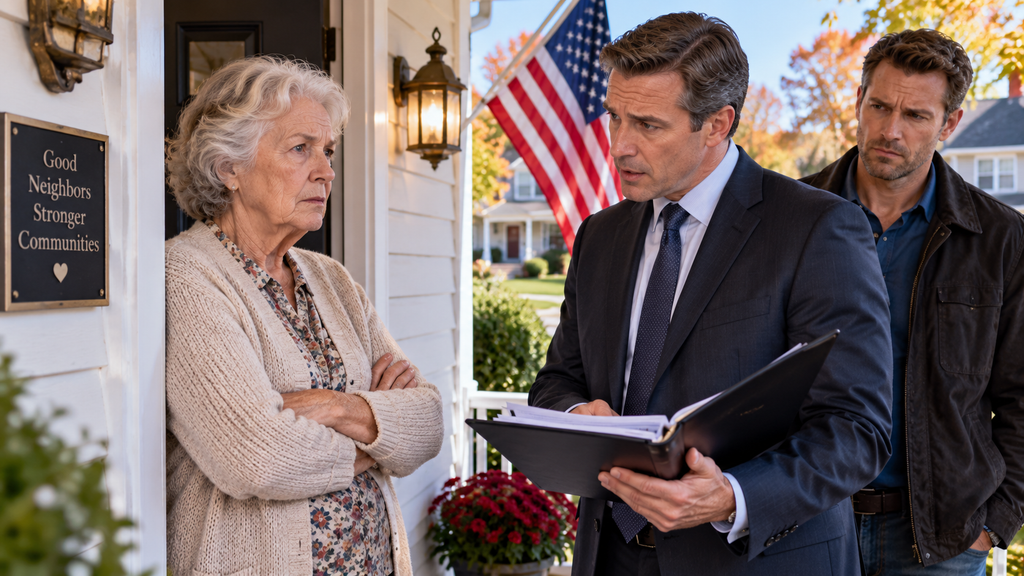
For six years, I quietly paid the water bill for the house next door. Ruth never knew. Her son found out the morning after the funeral, and he showed up at my door with a lawyer and a theory about what I had wanted in return. “Mrs. Doyle,” the lawyer said. “May we come in?” “You may stand there,” I said.
My name is Margaret Doyle. I am seventy-one years old, and by the time Gerald Hayes came to my porch with a lawyer, I had already lived on Maple Street for forty-three years.
Long enough to know which house made too much noise in winter.
Which neighbors salted the sidewalk before dawn.
Which children grew up and left.
Which ones came back only when someone died.
Ruth lived next door.
She was eighty-four when she passed.
She had been in that house since Eisenhower.
Same kitchen.
Same hydrangeas.
Same cracked birdbath beside the driveway.
Her husband, Frank, died in 2009.
After that, things changed slowly.
The lawn got a little longer every summer.
The porch light stopped coming on at dusk.
The curtains stayed closed some mornings.
Nothing dramatic.
Age rarely announces itself dramatically.
It just removes little things until one day you realize somebody has stopped doing half the life they used to do without thinking.
I noticed the water shut-off notice in the spring of 2019.
Bright orange.
Taped to Ruth’s front door.
Anybody walking past could read it.
ACCOUNT PAST DUE.
SERVICE SUBJECT TO DISCONNECTION.
I hated the color of it.
That sounds ridiculous, but I did.
There was something humiliating about orange paper shouting somebody’s financial trouble to the street.
I took it down.
Not because I planned anything.
Not because Ruth had asked me.
Because I knew Ruth.
If I knocked on her door with that notice in my hand and offered money, she would have stood straighter, thanked me politely, and refused until the water actually stopped running.
She had been raised by people who considered accepting help a character defect.
So I went home.
Called the county utility office.
Asked whether a third party could make payment.
The woman said yes.
The balance was sixty-three dollars.
I paid it.
Then I asked the monthly average.
Twenty-nine dollars.
Some months twenty-seven.
Some thirty-two.
I put the account on my card.
Not in my name.
Just the automatic payment.
The county kept billing Ruth.
I quietly paid before the late date.
That was all.
Twenty-nine dollars a month.
I did not tell my daughter.
Did not tell Ruth.
Did not mention it at church.
I did not consider myself generous.
I spent more than that on coffee and birdseed.
The next week Ruth stood by the mailbox and complained about squirrels digging in her flower beds.
She looked me straight in the eye.
No embarrassment.
No gratitude.
Exactly what I wanted.
So I kept paying.
Six years.
Twenty-nine dollars a month.
Sometimes less.
Sometimes more.
I barely thought about it.
Until Gerald found out.
Gerald lived in Charlotte.
About two and a half hours away.
He came at Christmas.
Sometimes July.
Never stayed long.
He always arrived in a clean SUV and parked halfway into the driveway like he was dropping off a package.
He would bring Ruth flowers or a grocery bag.
Stay three hours.
Leave before dinner.
Ruth never complained.
Mothers protect children even from criticism they have earned.
“Gerald is busy,” she would say.
“He travels.”
“He has responsibilities.”
I would say, “Of course.”
That was easier than pointing out that she had spent fifty years making time for his responsibilities.
The year before Ruth died, I started helping more.
Nothing formal.
Mail.
Pharmacy.
Changing light bulbs.
Driving her to appointments when Gerald could not come.
She still cooked.
Still balanced her checkbook.
Still corrected my grammar.
But her memory occasionally slipped.
Names.
Dates.
Where she put the kettle.
Then she would become furious with herself.
“Don’t you start looking at me like I’m helpless,” she told me once.
“I’m not.”
“You are.”
“I’m looking at you like you left your glasses in the refrigerator.”
She stared.
Then laughed so hard she had to sit down.
That was Ruth.
She could forgive age if you made it funny.
Her death was not dramatic.
She had been declining for several months.
Heart failure.
Breathing trouble.
More weakness.
Then one Monday morning, I brought her mail over and found her sitting in her favorite chair.
Still.
Peaceful.
The television was on low.
Her hands rested in her lap.
I knew before I touched her shoulder.
The paramedics came.
Then the funeral home.
Then Gerald.
He arrived that afternoon with his wife and two suitcases.
I stood in my driveway while he unlocked Ruth’s house.
He looked shattered.
Whatever else is true about a person, grief can still be real.
He hugged me.
“Thank you for looking after her.”
“I was her neighbor.”
“You were more than that.”
I almost told him about the water then.
I am glad I didn’t.
The funeral was three days later.
Small church.
White flowers.
Ruth had chosen the hymns years before because she said funerals were too important to leave to relatives with bad musical taste.
Gerald cried during the second hymn.
I cried during the first.
Afterward we ate ham biscuits in the fellowship hall.
Then I went home.
The next morning at 9:10, Gerald knocked on my door.
He was not alone.
The man beside him wore a dark suit and carried a leather folder.
That was when I knew gratitude had expired.
“Mrs. Doyle,” the lawyer said. “My name is Stephen Vance. I represent Mr. Hayes regarding his mother’s estate.”
“You may stand there.”
Gerald looked annoyed.
“Margaret, we need to talk.”
“Then talk.”
The lawyer took over.
“Mr. Hayes recently discovered that you paid certain household expenses for Mrs. Hayes over an extended period.”
“Her water bill.”
“For approximately six years?”
“Yes.”
“Without reimbursement?”
“Yes.”
“Without a written agreement?”
“Yes.”
“Without informing her son?”
“He never asked.”
Gerald’s jaw tightened.
“You understand how this looks.”
“Tell me.”
“Six years of unexplained payments to an elderly woman with early cognitive decline.”
“Twenty-nine dollars a month.”
“That isn’t the point.”
“Then what is?”
He glanced at the lawyer.
“And then a will that gets changed in 2021.”
That stopped me.
“Ruth changed her will?”
“Don’t.”
His face hardened.
“Please don’t do the surprised thing.”
I looked at him for a long moment.
“Gerald, when did you last speak to your mother?”
“That’s not relevant.”
“June.”
His expression shifted.
“You called on her birthday. You stayed on the phone four minutes because I was sitting in the room and watched the clock.”
The lawyer looked at Gerald.
He said nothing.
“She fell in February,” I continued. “Did you know?”
His face changed.
“What?”
“She was on the kitchen floor about forty minutes before I came over with the mail.”
“She never told me she fell.”
“No.”
That hurt him.
I saw it.
“She didn’t.”
“Why?”
“Maybe she was embarrassed.”
“Why didn’t you tell me?”
“I asked her if I should.”
“What did she say?”
“No.”
He looked furious.
“So you decided that?”
“No. She did.”
“She was confused.”
“Not that day.”
The lawyer cleared his throat.
“Mrs. Doyle, our concern is whether financial support may have created influence over Mrs. Hayes’s estate planning.”
I laughed.
Not because it was funny.
Because the phrase was so much bigger than twenty-nine dollars.
“What did Ruth leave me?”
Gerald stared.
I looked at the lawyer.
“What did she leave me?”
He did not answer.
That told me something.
Maybe nothing.
Maybe everything.
Gerald said, “We’ll be filing for undue influence.”
The lawyer continued carefully.
“Any transfers of value from you to the decedent create a pattern of financial entanglement.”
“Twenty-nine dollars a month.”
“It establishes a relationship.”
“We lived next door forty years.”
“Yes.”
“So did the fence.”
The lawyer almost smiled.
Gerald did not.
Then I said, “All right.”
I stepped inside.
“Wait here.”
Gerald called after me.
“What are you doing?”
“Getting the rest of it.”
I came back carrying a manila envelope.
I had kept it in the top drawer of my dining-room buffet for eleven days.
Ruth gave it to me in October.
Five months before she died.
She had come over after lunch carrying the envelope and a grocery bag with canned peaches.
She sat at my kitchen table.
“Margaret.”
“What?”
“If Gerald ever appears with a lawyer, give this to the lawyer.”