

For six years, I secretly paid my eighty-four-year-old neighbor’s water bill. Twenty-nine dollars a month. Sometimes twenty-seven. Once thirty-three. I never told her. I was certain Martha Sterling had no idea. Then Martha died.
The morning after her funeral, her son appeared at my front door with a lawyer, accused me of manipulating a vulnerable elderly woman, and demanded to know what I had expected in return.
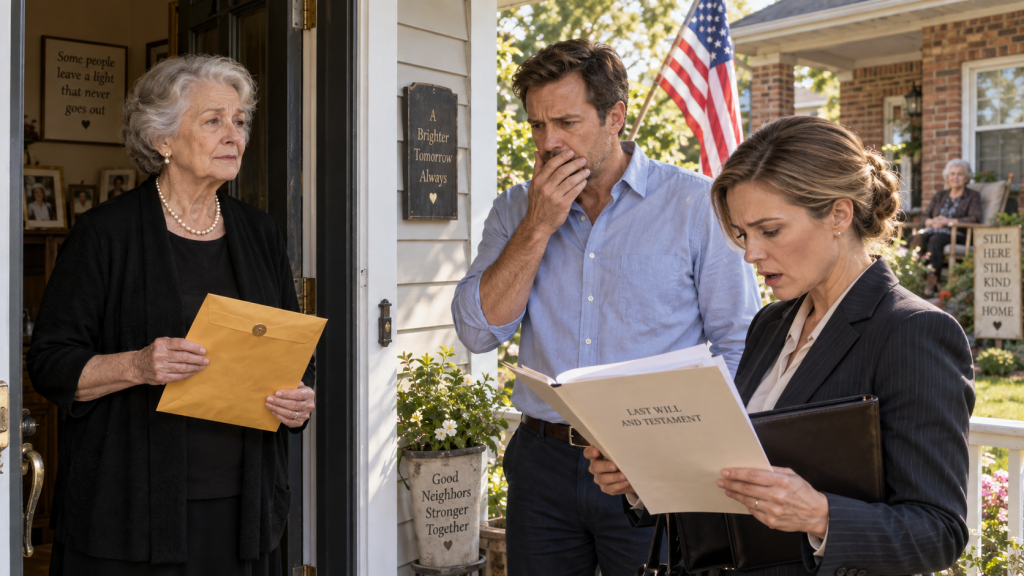
That was when he mentioned Martha had changed her will.
I quietly went into my house, retrieved the sealed envelope Martha had ordered me never to open, and handed it directly to his attorney.
The lawyer read the first page.
Then read it again.
Finally, he looked at Martha’s son and asked one question that wiped every trace of anger from his face.
“Arthur, did you have financial authority over your mother’s accounts?”
My name is Clara Jenkins.
I was seventy when Martha died.
By then, we had been neighbors for almost thirty-two years.
Our houses stood side by side on a quiet street in Richmond, Virginia.
Mine was pale yellow.
Hers was faded brick with blue shutters that needed repainting for at least a decade.
Martha had lived there since 1972.
She raised three children in that house.
Buried one husband.
Hosted countless Thanksgiving dinners.
Watched grandchildren run through the yard.
And then slowly watched nearly everyone move farther away.
Her husband, Walter, died in 2009.
That was when the house began changing.
Not suddenly.
Age rarely arrives suddenly.
The roses grew wild because Martha stopped kneeling in the garden.
The porch steps sagged because Walter was no longer there to repair them.
The light beside the front door stopped working, and Martha decided she did not need it because she rarely went out after dark anyway.
But she remained fiercely independent.
She still walked to the mailbox every morning.
Still ironed pillowcases.
Still clipped coupons from the Sunday newspaper even after learning that most stores had stopped accepting half of them.
She also had opinions about everything.
Television.
Politics.
Neighbors’ dogs.
The proper thickness of pancake batter.
Nobody could spend ten minutes with Martha and mistake her for helpless.
That was why I never told her about the water bill.
It began in April 2019.
I was walking over with a container of chicken soup when I saw a bright orange notice taped to her door.
FINAL NOTICE.
PAST DUE.
SERVICE SUBJECT TO DISCONNECTION.
I stopped on the walkway.
There is something cruel about those notices.
Not because companies should not collect money.
Because humiliation does not need fluorescent paper.
Anybody walking past could read it.
The mail carrier.
A delivery driver.
Neighbors.
Martha herself.
I looked through the window.
She was sitting in her recliner watching an old detective show.
I removed the notice.
Put the soup down.
Went home.
Then called the city utility department.
I explained that I wanted to pay another person’s account without changing ownership.
The woman told me about their guest-payment system.
The overdue balance was $61.42.
I paid it.
Then I asked what the normal monthly bill usually was.
“About twenty-nine dollars.”
That seemed almost insulting.
Twenty-nine dollars.
A dinner out.
Two bags of decent coffee.
A few unnecessary things from the drugstore.
For Martha, apparently, it had become the difference between having running water and not.
So I put the account on automatic payment.
I did not tell her.
That was the whole point.
If I had knocked on her door with money, she would have refused.
If I had insisted, she would have become embarrassed.
Then every future conversation at the mailbox would have changed.
She would have wondered whether I was thinking about the bill.
I would have watched her try to repay me with casseroles or cash she could not spare.
No.
I wanted Martha to keep one thing untouched.
Her dignity.
The next morning, she met me outside.
“Clara, did you know squirrels are digging up my geraniums?”
I almost laughed.
“No.”
“Criminal animals.”
That was it.
No mention of water.
I thought my secret was safe.
For six years, money quietly left my account.
Twenty-nine dollars.
Twenty-nine dollars.
Twenty-nine dollars.
I barely noticed.
Some months I forgot completely.
Meanwhile, Martha’s son Arthur lived in Charlotte.
He was fifty-eight when she died.
Successful.
Good suits.
Expensive SUV.
Owned a residential renovation company that had done well for years.
At least that was what Martha told people.
Arthur visited twice a year if schedules cooperated.
Christmas.
Sometimes her birthday.
He called more often, but even those conversations rarely lasted long.
Martha always defended him.
“Arthur is busy.”
“He has employees depending on him.”
“He travels constantly.”
“He has a family of his own.”
I never criticized him to her.
What purpose would that serve?
Parents already know when their children are absent.
Pointing it out only makes the empty chair louder.
Martha’s daughter Laura lived in Florida.
Her younger son, Michael, had not spoken to the family regularly in years after some old argument nobody could remember clearly enough to solve.
So most ordinary things fell to me.
Mail.
Pharmacy pickups.
Changing ceiling bulbs.
Driving to appointments.
Checking on her after storms.
I never considered myself her caregiver.
Martha would have hated that word.
I was her neighbor.
Sometimes her friend.
Frequently her unwilling card-game opponent.
She cheated at gin rummy.
Shamelessly.
“You had three queens five minutes ago,” I once told her.
“You’re imagining things.”
“I watched you put one under your newspaper.”
“Then you should have stopped me.”
That was Martha.
Sharp.
Stubborn.
Funny.
She did become forgetful.
There is no reason to pretend otherwise.
Once she put her glasses in the refrigerator.
Another time she called me because she could not find her purse.
It was hanging from her shoulder.
We laughed until she had tears in her eyes.
But forgetfulness is not the same thing as incompetence.
That distinction became very important later.
In February of her final year, Martha fell in the kitchen.
I found her because I had accidentally received one of her magazines with my mail.
I knocked.
No answer.
Tried the door.
Unlocked.
“Martha?”
Then I heard:
“Back here.”
She was lying beside the kitchen table.
Not injured badly.
Embarrassed more than anything.
“How long have you been down?”
“Five minutes.”
The clock told me that was a lie.
Her tea was cold.
The kettle had cooled.
Probably forty minutes.
I helped her sit up.
Called her doctor.
Stayed with her.
When I asked if she wanted me to call Arthur, her answer was immediate.
“No.”
“He should know.”
“He’ll start talking about assisted living.”
“Martha.”
“No.”
She pointed one crooked finger at me.
“My floor. My hip. My decision.”
So I did not call.
That decision would be used against me later.
By summer, Martha was weaker.
Still mentally herself most days.
Physically tired.
She slept more.
A home nurse came twice a week.
Arthur called on her birthday.
June 18.
I remember because I was there.
Martha had bought a small chocolate cake from the grocery store.
Three candles.
“I am not setting eighty-four candles on fire in my dining room,” she said.
Arthur called at 7:12.
I know because Martha looked at the clock and said:
“There’s my boy.”
She put the phone on speaker because her hearing was poor.
“Happy birthday, Mom.”
“Thank you, darling.”
“How are you?”
“Old.”
Arthur laughed.
They talked about the weather.
His company.
His daughter’s college application.
Then Arthur said:
“Mom, I’m boarding soon. I’ll call this weekend.”
“Of course.”
“Love you.”
“You too.”
Call ended.
7:16.
Four minutes.
Martha held the phone for a little while after the screen went dark.
Then she put it down.
“He’s very busy.”
I cut the cake.
“Yes.”
She looked at me.
“You don’t have to say it like that.”
“Like what?”
“Like you swallowed a lemon.”
We laughed.
But it hurt me.
Not because Arthur was evil.
Because he had no idea how valuable those four minutes were to his mother.
In October, Martha came to my house carrying a manila envelope.
That was unusual already.
She rarely walked farther than her mailbox by then.
“What are you doing here?”
“Visiting.”
“You hate visiting.”
“I do not.”
“You complain whenever anyone comes to your house.”
“Because they move things.”
She sat at my kitchen table.
The envelope rested in her lap.
After coffee, she pushed it toward me.
“Keep this.”
“What is it?”
“Something boring.”
“Martha.”
“Do not open it.”
That got my attention.
“Why am I keeping something I’m not allowed to open?”
“Because I trust you not to.”
“What’s inside?”
“Papers.”
“What kind?”
“The kind that make lawyers stop talking nonsense.”
I stared.
She smiled.
Then became serious.
“Clara, if Arthur ever comes to your door after I’m gone with an attorney because he doesn’t like something I did, give the envelope directly to the attorney.”
My stomach tightened.
“What did you do?”
“I made decisions.”
“What decisions?”
“Mine.”
That was all she would say.
I asked if she had spoken to an estate lawyer.
Yes.
Was she changing her will?
She looked at me.
“None of your business.”
Fair enough.
I put the envelope in the top drawer of my dining-room cabinet.
And forgot about it.
Almost.
Martha died the following March.
Quietly.
Her home nurse found her one morning in bed.
No crisis.
No ambulance.
She had apparently gone to sleep and never woken.
Arthur arrived that afternoon.
I watched him stand in his mother’s driveway for almost ten minutes before going inside.
That moment changed how I saw him.
Because he looked devastated.
Grief complicates judgment.
The person who failed to call enough can still love deeply.
The person who stayed away can regret every mile.
At the funeral, Arthur cried through the first hymn.
His wife held his arm.
Laura flew in from Florida.
Michael did not come.
The service was modest.
Martha had planned most of it herself.
She had even chosen the flowers.
No lilies.
“They smell like funeral homes,” she once told me.
Afterward, Arthur hugged me.
“Thank you for everything you did for Mom.”
“She was my friend.”
“You were more family to her than most of us.”
I thought he meant it.
Maybe he did in that moment.
Then the will arrived.
The morning after the funeral, there was a knock at my door.
Arthur stood outside.
Beside him was a man in a navy suit holding a leather folder.
“Mrs. Jenkins?”