

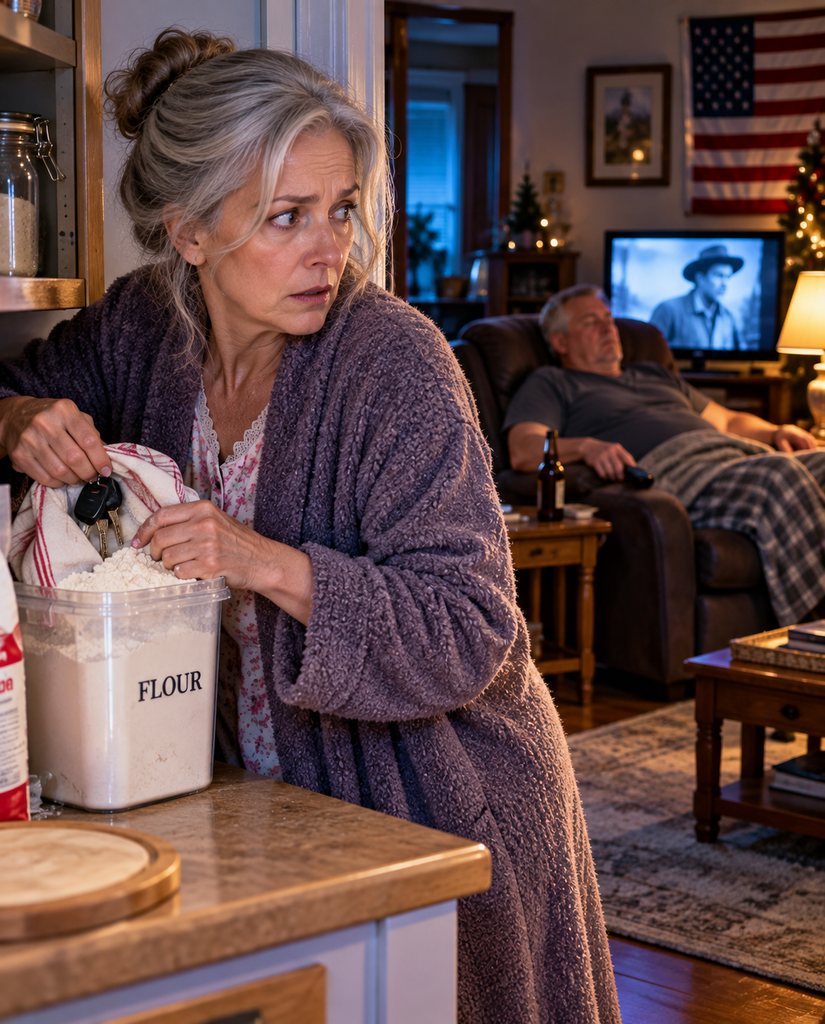
The three knocks came again. Hard. Measured. Not the impatient rapping of someone who had forgotten a key. Not the soft, uncertain tapping of a neighbor.
Three knocks. Then silence. I stood in the pantry with my right hand buried inside the flour bag. My fingers were wrapped around the dish towel.
Inside it were my car keys.
For thirty-eight years, I had known exactly what Leonard sounded like when he was angry.
The scrape of his chair.
The way his breathing changed.
The silence that came before his voice.
But that night, for the first time, I realized I had also learned what fear sounded like inside my own body.
My pulse thudded in my ears.
My mouth went dry.
My knees felt weak enough to fold.
From the living room came the squeak of Leonard’s recliner.
Then his voice.
“Gloria?”
I didn’t answer.
The television kept muttering.
Some preacher was talking about forgiveness.
I remember that because even then, standing there terrified in my own kitchen, I almost laughed at the cruelty of it.
Forgiveness.
People had been telling women like me to forgive for as long as I could remember.
Forgive his temper.
Forgive the drinking.
Forgive the words.
Forgive the apologies that never changed anything.
Forgive because marriage was difficult.
Forgive because nobody was perfect.
Forgive because thirty-eight years was too much history to throw away.
Nobody ever asked what forgiveness costs when the person you’re forgiving keeps sending you the bill.
The hallway floor creaked.
Leonard was coming toward me.
One step.
Then another.
His shadow passed beneath the pantry door.
I stopped breathing.
Then—
Knock.
Knock.
Knock.
Leonard froze.
“Who the hell is that?”
I heard him turn.
His footsteps moved toward the back door.
I slowly pulled my hand from the flour.
The dish towel came with it.
White powder covered my fingers.
My keys were inside.
Leonard reached the door.
I heard the deadbolt slide.
Then a woman’s voice said:
“Mr. Harris?”
Everything inside me stopped.
I knew that voice.
Mrs. Alvarez.
Leonard opened the door only a few inches.
“What do you want?”
“I’m sorry to bother you.”
“It’s two in the morning.”
“I know.”
“Then what do you want?”
There was a pause.
Then she said the strangest thing.
“I think my cat got into your yard.”
Leonard said nothing.
Mrs. Alvarez didn’t own a cat.
She hated cats.
She had told me so dozens of times because neighborhood strays dug in her flower beds.
Leonard knew that.
For several seconds, nobody spoke.
Then he said slowly:
“You don’t have a cat.”
“No,” Mrs. Alvarez replied.
“I suppose I don’t.”
My hand tightened around the towel.
That was when I understood.
She wasn’t there because of a cat.
She was there because of me.
Leonard understood too.
“What are you doing here, Maria?”
Her voice changed.
Only slightly.
But I heard it.
“I saw your kitchen light.”
“So?”
“So I wanted to make sure Gloria was all right.”
The silence afterward was terrible.
Then Leonard laughed.
Not loudly.
That was worse.
“Gloria is asleep.”
I closed my eyes.
Mrs. Alvarez answered immediately.
“No, she isn’t.”
I heard Leonard inhale.
“Excuse me?”
“I saw her shadow.”
My eyes opened.
There was a narrow kitchen window above the sink.
I hadn’t even thought about it.
Mrs. Alvarez’s house faced ours.
She had seen me.
Maybe she had been watching every night.
Maybe she had noticed the Buick disappearing at 2:13.
Maybe she had seen more than I ever realized.
Leonard’s voice became colder.
“Go home, Maria.”
“Let me speak to Gloria.”
“My wife doesn’t need permission from you to sleep.”
“I didn’t say she did.”
“Then leave.”
I heard the door begin to close.
Mrs. Alvarez spoke before it could.
“Gloria?”
She said my name loudly.
“Gloria, if you can hear me, my porch light is on.”
Leonard slammed the door.
The sound shook the kitchen.
Then there was silence.
I heard him lock it.
Once.
Twice.
He stood there for several seconds.
Then he turned.
“Gloria.”
I didn’t move.
“Come out.”
My fingers tightened around the keys.
He walked toward the pantry.
“Now.”
The knob turned.
The door opened.
Leonard stood beneath the yellow kitchen light wearing an old white undershirt and gray sweatpants.
His hair stuck up on one side from sleeping in the recliner.
His eyes moved immediately to my flour-covered hand.
Then to the dish towel.
Then back to my face.
“What are you doing?”
“Getting flour.”
“At two in the morning?”
I looked at him.
Thirty-eight years.
Thirty-eight years of learning when to lower my eyes.
That night, I didn’t.
“No.”
His face changed.
“What’s in the towel?”
I said nothing.
He stepped closer.
“Give it to me.”
“No.”
It was the smallest word I had ever said.
One syllable.
Two letters.
But saying it felt like lifting a car off my chest.
Leonard stared at me.
“What did you say?”
“No.”
His jaw tightened.
He reached for the towel.
I stepped backward.
“Don’t.”
“Gloria, give me the damn towel.”
“No.”
He grabbed my wrist.
Hard.
Pain shot toward my elbow.
And something strange happened.
For years, that grip had ended arguments.
It had made me apologize.
It had made me stop speaking.
It had made me change clothes, cancel lunches, return purchases, delete phone numbers, and once sit through Thanksgiving dinner with a bruise hidden beneath my sleeve.
But that night I looked down at his hand around my wrist and thought:
This is the last time.
Not I hope this is the last time.
Not maybe.
Not if I can.
The last time.
I screamed.
“MARIA!”
Leonard’s eyes widened.
I screamed again.
“MARIA!”
He released me.
“What the hell is wrong with you?”
Then someone began pounding on the back door.
“GLORIA!”
Mrs. Alvarez.
Another voice joined hers.
A man’s voice.
Then another.
Leonard looked toward the door.
“What did you do?”
I backed toward the counter.
He stared at me.
“What did you do?”
“Nothing.”
“Who is out there?”
“I don’t know.”
That was partly true.
Then blue light flashed across the kitchen wall.
Once.
Twice.
Red.
Blue.
Red.
Blue.
Leonard went completely still.
I will remember his face until I die.
Not because he looked angry.
Because he looked afraid.
And I had never seen Leonard afraid before.
“What did you do?”
His voice was quieter now.
I looked through the window.
A police cruiser had stopped outside Mrs. Alvarez’s house.
Another vehicle pulled behind it.
Mrs. Alvarez had not simply knocked.
She had called for help.
Leonard stepped toward me.
I raised my hand.
“Don’t touch me.”
Maybe it was the flashing lights.
Maybe it was my voice.
Maybe it was the realization that there were witnesses outside.
Whatever it was, he stopped.
There was another knock.
This one came with a voice.
“Police. Mr. and Mrs. Harris, please open the door.”
Leonard looked at me.
“You planned this.”
“No.”
“You lying—”
“Don’t.”
He stared at me.
I had never interrupted him like that.
Not once in thirty-eight years.
“Don’t finish that sentence.”
His mouth stayed open.
Then the police knocked again.
“Open the door, please.”
Leonard pointed at me.
“You tell them we’re fine.”
I looked at his finger.
Then at his face.
“No.”
“Gloria.”
“No.”
“Think about what you’re doing.”
That sentence almost broke me.
Because I had thought about nothing else.
I had thought about it while buying groceries.
While folding his shirts.
While sitting beside him at church.
While lying awake listening to him snore.
While driving 11.6 miles through dark streets at 2:13 every morning.
I had thought about it until fear became routine.
I had thought about it until the route to the shelter felt more familiar than the route to my own doctor’s office.
“I have been thinking about it,” I said.
“Every night.”
He stared at me.
Then he understood.
“The gas receipt.”
I said nothing.
“You’ve been going somewhere.”
Silence.
“Where?”
I looked at him.
“Somewhere you can’t follow me.”
His face twisted.
Then the police knocked again.
Leonard opened the door.
Mrs. Alvarez stood on her porch in a pink robe with her arms crossed tightly against her chest.
Two officers were outside.
One was a woman around my daughter’s age, if I had ever had a daughter.
The other was an older man.
The woman looked past Leonard.
Her eyes found me immediately.
“Ma’am, are you Gloria Harris?”
I nodded.
“Are you safe right now?”
Leonard answered for me.
“She’s fine.”
The officer didn’t look at him.
She looked at me.
“Mrs. Harris?”
That tiny courtesy nearly made me cry.
She waited for my answer.
I looked at Leonard.
Then I looked at her.
“No.”
The word barely came out.
But she heard it.
The officer stepped inside.
Leonard’s face turned red.
“This is ridiculous. My wife gets emotional. She’s been having problems lately.”
“What problems?” the officer asked.
“Memory. Confusion.”
I almost smiled.
Of course.
There it was.
The next cage he had already started building.
Maybe he thought my age would help him.
Maybe he thought gray hair made a woman unreliable.
Maybe he thought thirty-eight years of silence meant I had forgotten how to tell the truth.
The officer turned to me.
“Would you like to speak somewhere privately?”
“Yes.”
Leonard moved.
“She’s my wife.”
The older officer stepped between us.
“Sir, stay here.”
“You don’t understand.”
“I said stay here.”
The female officer led me toward the dining room.
I still had flour on my hands.
I remember staring at it.
White powder covered my fingers and the sleeve of my robe.
I must have looked absurd.
Then she asked:
“Do you have somewhere safe you want to go tonight?”
My mouth opened.
Nothing came out.
She waited.
That kindness almost destroyed me.
Finally I whispered:
“There’s a shelter.”
“Do you know where?”
“Yes.”
“Can you get there?”
I looked toward the kitchen.
“My keys.”
Leonard heard.
“That car is in my name too.”
I turned toward him.
For years, statements like that had worked.
The house is mine too.
The money is mine too.
The insurance is mine too.
The bank account is mine too.
The furniture is mine too.
Everything became a reason I couldn’t move.
The female officer looked at me.
“Do you have identification?”
“Yes.”
“Medication?”
“In my bag.”
“Phone?”
I nodded.
“Then we’ll help you leave safely.”
Leonard laughed.
It sounded forced.
“She’s not leaving.”
Nobody answered him.
He looked at me.
“Gloria.”
I walked toward the pantry.
I picked up the canvas bag I had packed.
He stared at it.
The birth certificate.
The Medicare card.
Celia’s photograph.
The $480.
Two blouses.
Underwear.
Toothbrush.
Medication.
Thirty-eight years reduced to one canvas bag.
“You packed?”
His voice cracked slightly.
I nodded.
“When?”
“This afternoon.”
He looked stunned.
Maybe that hurt him more than shouting would have.
I had made a decision without asking him.
I had planned a future in which he wasn’t consulted.
For a man like Leonard, that was betrayal.
“You were going to sneak out.”
“I was going to survive.”
His face changed.
“Survive?”
He laughed.
“Listen to yourself. I’ve never put you in the hospital.”
The room went quiet.
The female officer looked at him.
I looked at him too.
And suddenly I heard how horrifying that sentence was.
Not I never hurt you.
Not I never frightened you.
Not I never controlled you.
I’ve never put you in the hospital.
As if that were the standard.
As if anything short of an ambulance counted as love.
I picked up my bag.
Leonard pointed toward me.
“She’ll be back tomorrow.”
I walked toward the door.
“You hear me, Gloria? You’ll be back.”
I stopped.
For one second, the old instinct told me to stay silent.
Don’t provoke him.
Don’t embarrass him.
Don’t make things worse.
Then I remembered something Celia had told me two weeks before she died.
She was lying in a hospital bed, thin as paper, and I was complaining about Leonard getting angry because I’d spent too long visiting her.