

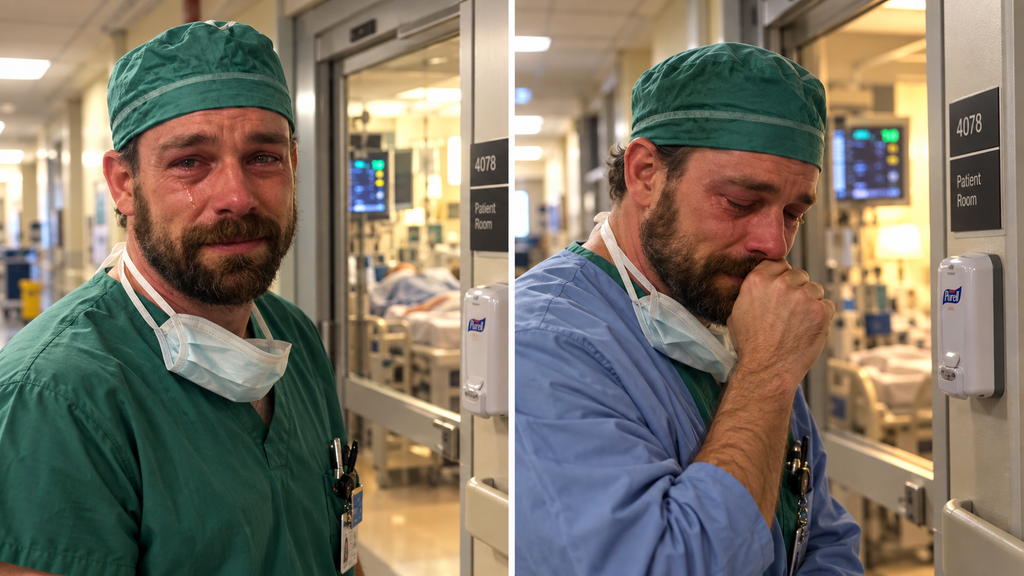
The alarm screamed again. Arnold dropped the lunch bag. My carefully packed sandwich, the apple pie, and the little handwritten note I had tucked beneath the fork hit the polished hospital floor.
I barely noticed. Arnold was already running. “Ben!” I ran after him. The ICU doors flew open. Everything beyond them happened too quickly and somehow not quickly enough.
Nurses rushed past us.
A crash cart appeared from nowhere.
Someone shouted a blood pressure.
Someone else yelled for medication.
And through the open doorway at the end of the hall, I saw a pair of bare feet beneath a hospital blanket.
I knew those feet.
I knew the scar on the left ankle from when Ben had fallen off his bicycle at fourteen.
I knew the way his second toe bent slightly inward.
I knew my husband.
“BEN!”
A nurse caught me around the shoulders.
“Ma’am, you can’t go in there.”
“That’s my husband!”
“I know.”
“No, you don’t understand. That’s my husband!”
My voice cracked so violently that I hardly recognized it.
“He left our house this morning! He kissed our daughter! He told me he was going to work!”
Arnold caught up behind me.
“Claire.”
I turned on him.
“What is happening?”
His face was wet with tears.
“Tell me!”
“Claire, please—”
“Six months?”
The words tore out of me.
“You said six months. You said he’s known for six months.”
Arnold closed his eyes.
“Yes.”
“And all of you knew?”
He didn’t answer.
That was answer enough.
I looked through the glass again.
Doctors surrounded Ben’s bed.
One of them was squeezing air into his lungs.
Another stared at the monitor.
I could hear my heartbeat louder than the alarms.
“You all knew,” I whispered.
“Claire—”
“You watched me walk into this hospital carrying his lunch like an idiot.”
“You are not an idiot.”
“You watched me ask where he was.”
“I’m sorry.”
“You watched me stand there talking about surprising my husband while my husband was lying in intensive care.”
Arnold lowered his head.
“I’m sorry.”
I shoved his chest.
It wasn’t hard.
I didn’t have enough strength left to make it hard.
“You should have told me.”
“I wanted to.”
“You should have told me!”
“Ben begged us not to.”
“He is my husband!”
“I know.”
“I am his wife!”
“I know!”
Arnold’s voice broke.
“And he was terrified.”
That stopped me.
Not because it made sense.
Because I had never heard anyone describe Ben that way.
Ben was many things.
Stubborn.
Quiet.
Protective.
Occasionally infuriating.
But terrified?
No.
Ben was the man who held other people’s lives in his hands.
The man who could walk into an operating room while an entire family prayed outside and remain steady.
The man who once stitched our daughter’s chin at the kitchen table because she was screaming too hard to let anyone at urgent care touch her.
The man who stood beside me when my father died and handled every phone call because I couldn’t speak without crying.
Ben wasn’t terrified.
At least that was what I had believed.
Then I remembered the night I had awakened and found him sitting on the edge of our bed.
His shoulders shaking.
“Rough night,” he had said.
Go back to sleep.
My knees weakened.
Arnold grabbed my arm.
“What does he have?”
He hesitated.
“Tell me.”
“A glioblastoma.”
I stared at him.
The word meant nothing for half a second.
Then it meant everything.
Because I had heard Ben mention it before.
Years ago.
At dinner.
He had been talking about one of his patients.
A young father.
Thirty-nine years old.
Ben had barely touched his food that night.
I remembered asking why.
He had said only four words.
“Some tumors don’t negotiate.”
Now that sentence came back to me.
Some tumors don’t negotiate.
“How bad?”
Arnold looked toward Ben’s room.
“Claire…”
“How bad?”
“They originally estimated twelve to eighteen months.”
Originally.
That word frightened me more than anything else he had said.
“Originally?”
“The tumor progressed faster than expected.”
“How long?”
He said nothing.
I grabbed his coat.
“HOW LONG?”
“Ben was told last week that without another intervention…”
His voice disappeared.
I waited.
“Say it.”
“Weeks.”
The corridor vanished around me.
Weeks.
Not years.
Not months.
Weeks.
My husband had been dying beside me.
Sleeping beside me.
Drinking coffee across from me.
Kissing our daughter goodbye.
Leaving his shoes beside the back door.
Complaining that I bought the wrong toothpaste.
Asking whether we had paid the electricity bill.
Doing ordinary things while carrying the knowledge that there might be almost no ordinary days left.
And he had said nothing.
I slid down the wall.
Arnold crouched beside me.
“Why?”
I whispered it.
Then louder.
“Why?”
Arnold looked at me for a long time.
“Because of Emma.”
Our daughter’s name made me look up.
“What about Emma?”
“He couldn’t figure out how to tell her.”
“That doesn’t explain lying to me.”
“No.”
“Then explain it.”
Arnold sat on the floor beside me.
Doctors and nurses continued moving around us, but neither of us cared anymore.
“He kept saying he needed time.”
“For what?”
“To fix things.”
“What things?”
“Everything he thought would fall apart after he was gone.”
I stared at him.
“He increased his life insurance.”
My mouth opened.
“He reorganized your mortgage.”
I said nothing.
“He moved money into an education account for Emma. He updated his will. He recorded messages.”
My heart stopped.
“What messages?”
Arnold looked away.
“For birthdays.”
I couldn’t breathe.
“What?”
“For Emma.”
“No.”
“Claire…”
“No.”
“He recorded one for her ninth birthday. Her tenth. Her thirteenth. Sixteenth. Eighteenth.”
“Stop.”
“Her graduation.”
“Stop.”
“Her wedding, if she ever—”
“STOP!”
The word echoed down the ICU hallway.
Everyone turned.
I covered my mouth.
A sob tore through me.
Arnold put his hand over his eyes.
“He recorded one for you too.”
I stared at him through tears.
“He did what?”
“He said he knew you’d be angry.”
“Angry?”
I laughed.
It came out broken.
“I’m going to kill him.”
Arnold almost smiled.
“That’s approximately what he predicted.”
“I’m serious.”
“I know.”
“I’m going to kill him if he doesn’t die first.”
The second the words left my mouth, I wished I could take them back.
Arnold looked down.
Neither of us spoke.
Then the alarm stopped.
The sudden silence was worse.
I stood so quickly that I nearly fell.
“What happened?”
The door opened.
A doctor stepped out.
I knew him vaguely.
Dr. Patel.
Ben had mentioned him before.
He removed his gloves.
“Mrs. Carter?”
I hated how gently he said my name.
“Yes.”
“Your husband had a seizure followed by respiratory compromise.”
“Is he alive?”
“Yes.”
My knees nearly gave way.
“He’s alive?”
“Yes.”
“Can I see him?”
“In a moment.”
“What does ‘in a moment’ mean?”
“We’ve stabilized him, but there’s significant swelling around the tumor.”
“Then operate.”
Dr. Patel’s expression changed.
“Operate.”
“We need to discuss that.”
“There’s nothing to discuss. You said there’s swelling. Ben is a surgeon. You’re surgeons. Fix it.”
“Claire…”
“Don’t say my name like that.”
Dr. Patel nodded slowly.
“There is an experimental procedure.”
Arnold stood beside me.
I saw something pass between them.
“You knew about this too.”
Arnold said nothing.
I looked at Dr. Patel.
“What procedure?”
“The tumor is positioned near areas responsible for speech and motor function. Standard resection carries substantial risk. Ben previously underwent a limited procedure, but the tumor has infiltrated tissue we couldn’t safely remove.”
“Previously?”
I felt the floor tilt again.
“What do you mean previously?”
Dr. Patel looked at Arnold.
Then back at me.
“When was my husband operated on?”
“Four months ago.”
I stared at him.
Four months.
I searched my memory.
Four months earlier, Ben had supposedly attended a three-day surgical conference in Boston.
He had called me each evening.
Short calls.
He said the hotel was terrible.
He complained about the coffee.
He told Emma he would bring her a snow globe.
He had returned home wearing a baseball cap.
He said he hadn’t slept because his flight had been delayed.
I remembered teasing him.
“You look like you had brain surgery.”
He had smiled.
I actually remembered saying those words.
You look like you had brain surgery.
And he had smiled.
My stomach turned.
“The conference.”
Arnold closed his eyes.
“There was no conference.”
I slapped him.
The sound cracked through the corridor.
For a moment, nobody moved.
My hand burned.
Arnold didn’t touch his cheek.
He simply nodded.
“I deserved that.”
“No,” I whispered. “Ben deserved it.”
Then I started crying again.
“I would have been there.”
“I know.”
“I would have sat beside him.”
“I know.”
“I would have held his hand.”
“I know.”
“He woke up from brain surgery alone?”
“No.”
I looked at Arnold.
“I was there.”
That somehow made it hurt more.
Arnold’s eyes filled again.
“I sat beside him all night.”
I couldn’t speak.
“He asked for you when he woke up.”
My anger faltered.
“What?”
“He was confused from the anesthesia. He kept saying your name.”
Arnold swallowed.
“Then he remembered.”
“Remembered what?”
“That he hadn’t told you.”
I covered my face.
Arnold continued softly.
“He cried.”
The image destroyed me.
Ben waking in a hospital bed.
Confused.
Hurting.
Calling for me.
Then remembering that he had chosen to keep me away.
“He made me promise,” Arnold said. “He said if the surgery worked, he’d tell you after Emma’s birthday.”
“Her birthday was two months ago.”
“I know.”
“He missed it.”
“Yes.”
“Why?”
Arnold looked toward Ben’s room.
“Because he was here.”
I stared at him.
“No.”
“He had another seizure that night.”
My chest tightened.
Ben had called at 7:14 p.m.
I remembered because Emma had been staring at the birthday cake, trying not to cry.
Ben’s voice had sounded strange.
Weak.
He said he had been pulled into emergency surgery.
He apologized.
He sang half of “Happy Birthday” over the phone.
Emma had forced a smile.
Afterward she had gone upstairs and cried.
And I had been furious with him.
I had sent a message.
YOUR DAUGHTER ONLY TURNS EIGHT ONCE.
He had replied:
I know. I’m sorry. Tell her Daddy loves her more than anything.
I had not answered.
I sank into the chair beside the wall.
“He wasn’t working.”
“No.”
“He was sick.”
“Yes.”
“And I was angry at him.”
“You didn’t know.”
“But he knew I was angry.”
“Yes.”
A terrible thought came to me.
“Did he see my message?”
Arnold hesitated.
“Yes.”
“What did he say?”
Arnold’s eyes filled.
“He said, ‘Good. Let her be angry.’”
I stared at him.
“What?”
“He said anger would be easier for you than fear.”
I shook my head.
“No.”
“He thought if you were angry at him…”
“No.”
“…you would begin learning to live without him before you actually had to.”
“No!”
“He was wrong.”
“He was an idiot!”
“Yes.”
“A brilliant, selfish, arrogant idiot!”
“Yes.”
“I didn’t need practice losing him!”
“I know.”
“I needed my husband!”
My voice broke.
“I needed every day he stole from me.”
Arnold lowered his head.
“I know.”
The door opened again.
Dr. Patel stepped out.
“He’s awake.”
I stopped breathing.
“Can I see him?”
“Yes.”
I walked toward the room.
Then stopped at the doorway.
For the first time in eleven years, I was afraid to look at my husband.
Ben had always seemed too large for hospital beds.
Even asleep at home, he occupied space with certainty.
Now he looked small.
There was tape against his cheek.
An IV in his arm.
Wires across his chest.
His hair had grown enough to hide most of the surgical scar, but now that I knew where to look, I could see it.
A pale line curving above his ear.
How had I missed it?
How had I slept beside this man and missed it?
His eyes opened.
They found me immediately.
For several seconds, neither of us spoke.
Then Ben whispered:
“Hi.”
I walked to the bed.
He attempted a smile.
“You brought lunch?”
I hit him.
Not hard.
Just my palm against his shoulder.
Then again.
And again.
“You liar.”
“Claire—”
“You unbelievable liar.”
“I know.”
“Six months!”
“I know.”
“Brain surgery?”
“I know.”
“You let me believe you were at a conference!”
“I’m sorry.”
“You missed Emma’s birthday!”
His eyes closed.
“I know.”
“She cried.”
A tear slipped from the corner of his eye.
“I know.”
“She thought you chose this hospital over her.”
“I know.”
“I thought you chose this hospital over us.”
“I know.”
“And you let me.”
“Yes.”
I stared at him.
“Why?”
His lips trembled.
For the first time since I had known him, Benjamin Carter looked afraid of me.
“I didn’t know how to come home and tell my eight-year-old daughter that her father was dying.”
My anger collapsed.
I sat down.
Ben stared at the ceiling.
“I’ve told families their loved ones were dying hundreds of times.”
His voice was barely audible.
“I know exactly what words to use. I know where to sit. I know not to stand over them. I know when to stop talking.”
He looked at me.
“But I couldn’t tell you.”
“Why?”
“Because then it would be real.”
“It was already real.”
“Not at home.”
I shook my head.
“Our house was the only place where I wasn’t dying.”
That sentence went straight through me.
“At home, I was still your annoying husband who left socks on the floor.”
“You do leave socks everywhere.”
“I know.”
“And coffee cups.”
“I know.”
“And wet towels.”
A faint smile.
“Those too.”
I started crying.
He reached for my hand.
His fingers were weak.
“At home, Emma still yelled, ‘Daddy!’ when I walked through the door.”
His voice cracked.
“She didn’t look at me like a patient.”
“Neither would I.”
“Yes, you would.”
“No.”
“You would have watched me.”
I couldn’t deny it.
“You would have noticed every headache. Every time I forgot a word. Every time my hand shook.”
“So?”
“And Emma would have noticed you noticing.”
I looked down.
“I wanted a few more normal days.”
“You didn’t give us normal days, Ben.”
He went still.
“You gave us confusing days.”
His face tightened.
“You gave Emma nights wondering why her father didn’t come home.”
“I know.”
“You gave me months wondering what I had done wrong.”
His eyes snapped to mine.
“Nothing.”
“I wondered if you didn’t love me anymore.”
“Claire…”
“I wondered if there was someone else.”
“There never was.”
“I know that now.”
He squeezed my hand.
“I’m sorry.”
“You should be.”
“I am.”
“I hate you.”
“I know.”
“I love you.”
His face broke.
“I know.”
I leaned forward until my forehead rested against his.
“And I am so angry with you.”
“I know.”
We cried together.
No dramatic music.
No perfect speech.
Just two people who had loved each other for eleven years discovering that love could exist alongside fury.
After a while, Ben whispered:
“There’s something else.”
I pulled back.
“No.”
He blinked.