

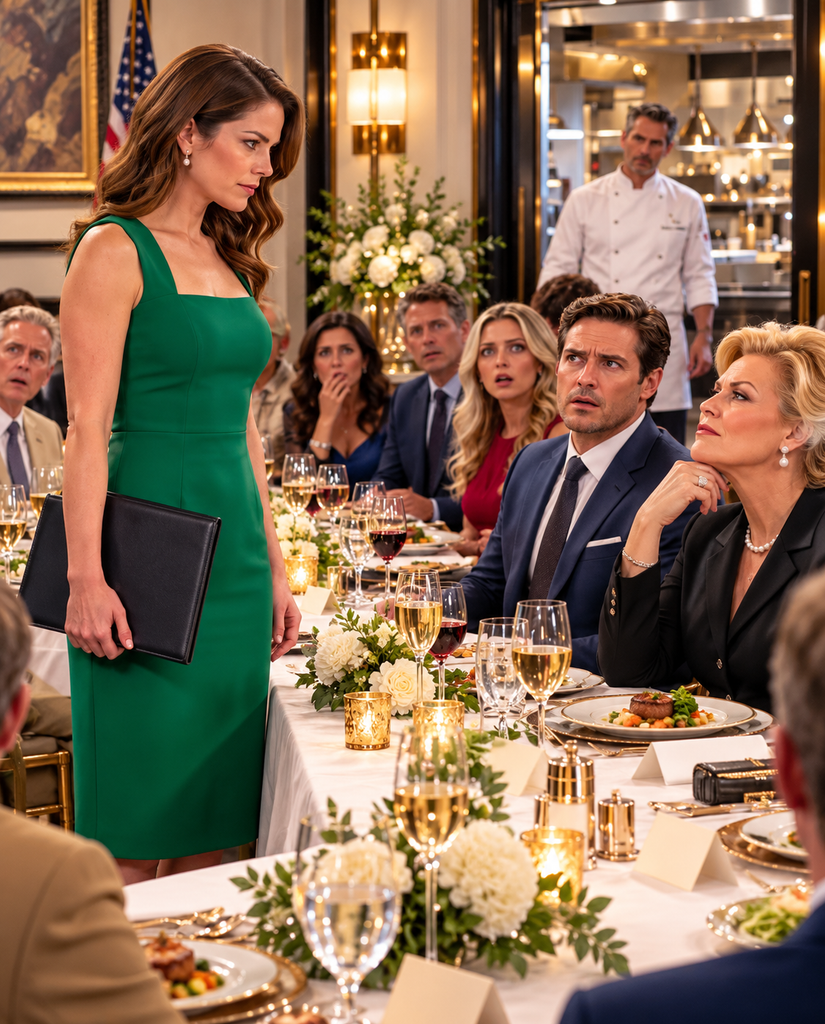
My mother-in-law arranged a dinner at an exclusive restaurant, but when I arrived there was no seat reserved for me; she smirked: “Maybe a budget place suits you better!” I burst out laughing and asked the owner for a seat, because the owner was…
He barely looked at it.
“Mom probably ran out of room.”
“There’s a 2-in margin, Daniel.”
He kissed my forehead before leaving.
“She didn’t mean it like that.”
That sentence had become a loadbearing wall in our marriage.
Diane didn’t mean it when she cropped me out of the family Christmas photo.
She didn’t mean it when she introduced me to her garden club as Daniel’s little helper at the office.
She didn’t mean it when she told the caterer at our anniversary party I could eat in the kitchen because I’d feel more comfortable there.
Daniel had a gift for repackaging cruelty as carelessness.
And for six years, I let him.
Not because I believed him.
Because I was busy running the company that paid for all of it—the foil invitations, the Savannah stationary, the client happy hours.
Nobody at that dinner table knew that yet.
And the word guest was about to cost the Marshes more than they could afford.
I started washing dishes at a seafood shack called Mullers the summer I turned 16.
Minimum wage.
No air conditioning.
Grease burns covered both forearms by August.
The head cook was Sal Pcelli, 60 years old, with a voice like a blown speaker and hands capable of breaking down a halibet in 45 seconds.
He watched me clear tables for 3 weeks without speaking to me.
Then one night after closing, he placed an 8 in chef’s knife on the prep counter and slid it toward me.
“You don’t flinch,” he said. “That’s half the job.”
The knife came inside a canvas roll held shut by a rubber band.
Chipped rosewood handle.
A blade sharpened so often its spine had become thinner than a butter knife.
I still own it.
I carried it through culinary school, my first sue chef job at 21, and years managing kitchens in three cities.
Along the way, I learned everything cooking shows ignored—vendor contracts, leases, labor compliance, health inspections, insurance claims.
At 25, I filed the paperwork for Keystone Hospitality Group, an LLC with my name on the operating agreement and my savings in the capital account.
Keystone didn’t build restaurants.
We developed them.
Concept.
Financing.
Buildout.
Staffing.
Launch.
I took failing locations, rebuilt menus, renegotiated leases, recruited talent, and returned profitable kitchens to operators within 14 months.
I specialized in invisible work.
The work keeping the lights on while somebody else accepted the praise.
That habit would eventually cost me.
At the time, it simply felt like the right way to build.
The Marshes lived inside a frame they had constructed around a picture that no longer existed.
25 years earlier, Gerald Marsh, Daniel’s father, ran a development company that bet everything on a resort project outside Hilton Head.
It collapsed publicly.
The kind of failure covered by the local business journal.
The kind where neighbors know before the children do.
Gerald drank himself into a quiet disappearance afterward.
He died before Daniel turned 20.
Diane was left with two children, a last name that used to open doors, and enough anger to rebuild its reputation.
She rebuilt it through performance.
The right country club.
The right lunchon circuit.
The right vocabulary.
Intimate instead of small.
Curated instead of cheap.
She taught Daniel and Whitney that looking wealthy could last longer than actual wealth.
For years, she was right.
Everyone still believed the Marshes were the Marshes.
Nobody checked.
Diane’s problem wasn’t that she was simply mean.
Mean people are predictable.
Diane was strategic.
Every insult was calculated.
Every exclusion deniable.
She never screamed.
She just rearranged the room until you were outside it, then acted surprised to find you there.
She decided what I was the first night Daniel brought me home.
I was 28, still carrying fryer oil beneath my perfume, discussing food cost ratios instead of vacation homes.
To Diane, I wasn’t a threat to Daniel.
I threatened the story.
A daughter-in-law who started as a dishwasher didn’t fit the frame.
And Diane would rather break me than resize it.
Daniel was charming the way a hotel lobby is charming—polished, climate-controlled, designed to welcome you without ever letting you behind the desk.
He had his mother’s jaw and his father’s talent for speaking confidently about things he barely understood.
When we met, he managed a bar three months from shutting down.
Over one weekend, I restructured its lease, replaced the supplier, and rebuilt the cocktail program.
Daniel watched me with dazzled admiration.
I mistook admiration for respect.
We married when I was 28.
By then, Keystone was producing real revenue, and I needed someone who could serve as its public face.
Someone for investor dinners and ribbon cuttings.
Daniel fit perfectly.
Diane had trained him for performance.
I made him Keystone’s managing partner on salary and gave him a 10% equity stake from my own holdings.
Harrove Capital Partners already held 20% from a growth round I had pitched in Charlotte the year before our marriage.
That left me with 70% as majority member.
My attorney, Francis Doyle, insisted the agreement include a managing partner removal clause.
“Insurance,” she called it.
I told her she was being dramatic.
The arrangement worked because I let myself remain invisible.
Daniel attended conferences.
Daniel took meetings.
Daniel’s name appeared on business cards my capital paid to print.
Everyone assumed he had built Keystone.
I never corrected them.
That was my weakness.
Not naivity.
Not people pleasing.
I was isolated inside my own competence.
I believed good work should speak for itself.
I carried everything because asking for recognition felt too much like asking permission.
But the work never spoke.
It simply kept working.
And my silence allowed a false story to harden until everyone accepted it as truth.
The Marshes held Sunday dinners at Dian’s house.
Cream tablecloth.
Matching napkins.
Seasonal centerpiece.
Everyone had an assigned seat.
Daniel sat on Diane’s right.
Whitney and her husband Brad sat across from him.
Gerald’s chair remained empty at the head of the table, a monument to grief Diane had never processed.
My seat was at the short end, beyond the good flatear and wine glasses, where the kitchen draft hit my neck whenever someone opened the door.
I never complained.
I brought dessert.
Cleared dishes.
Asked about Whitney’s Pilates and Diane’s Garden Club.
For 6 years, I played the perfect daughter-in-law in every way except the one that counted.
They never treated me as family.
The worst moment came at Diane’s 62nd birthday in front of 11 people.
A photographer arrived for a family portrait.
Diane, Daniel, Whitney, Brad.
They gathered before the fireplace.
I stood to join them.
Diane raised one hand, smiled toward the camera, and said the sentence that stayed with me for the next 14 months.
“You’re staff, dear, not family.”
Nobody reacted.
Daniel coughed.
Whitney adjusted an earring.
The photographer took six pictures.
I returned to the kitchen and wrapped leftovers in foil.
Later that night, Daniel insisted she was joking.
“You know Mom. She’s got a dry sense of humor.”
I understood dry humor.
I grew up in kitchens where line cooks roasted one another professionally.
Diane wasn’t joking.
She was filing me into the category she needed so her frame wouldn’t crack.
3 weeks before the dinner at Salen, I secured the largest letter of intent Keystone had ever received.
Signed, pending final contract.
Howerin Hotel Group wanted a flagship restaurant inside its new downtown property.
200 seats.
A rooftop bar.
A tasting room.
More than $4 million for buildout alone.
I had pursued them for 11 months.
Twice, I flew to their Atlanta headquarters.
I built the pitch deck, proforma, staffing model, and sourced the architect.
When the LOI arrived, it was addressed to Keystone Hospitality Group LLC.
Attention: Athena Exley, managing member.
Daniel’s contribution had been a handshake during the first meeting and a follow-up email sent from his phone while watching golf.
Yet Dian’s invitation read, “Celebrating Daniel’s landmark partnership with Howerin Hotel Group.”
His partnership.
His landmark.
The morning it arrived, Daniel called Diane to thank her.
I heard him from the hallway.
“Mom, it means a lot. Really. This is the one that changes everything for us.”
Us meant the Marshes.
Not Athena.
The invitation named Sen, a restaurant with a threemonth waiting list and a prefix beginning at $240 ahead.
Exactly the kind of room where Diane could perform status before an audience willing to believe her.
What she didn’t know was how Sen’s owner had started.
Or who had given him his first kitchen.
Some questions answer themselves when you pay attention.
The Marshes rarely paid attention to anything that didn’t already carry their name.
The morning of the dinner, I drove to Francis Doyle’s office on King Street.
Francis wore reading glasses on a beaded chain and dismantled liability clauses like a surgeon removing splinters—quietly, precisely, without drama.
I hired her 9 years earlier to draft Keystone’s operating agreement.
She had insisted on protections I thought I’d never use.
A managing partner removal clause triggered by majority member vote.
A 12-month non-compete cooling period.
Annual capital account reconciliations requiring every member’s signature.
Daniel had signed them every year.
He had never read them.
I handed Francis the Navy folder.
Soft leather.
Midnight blue.
Keystone’s logo embossed in one corner.
Inside were the operating agreement, Daniel’s signed acknowledgements, the capital contribution ledger, and the Howerin LOI.
“You want me to have this notorized today?” Francis said.
“Not a question. I want originals certified and a duplicate set locked in your office.”
She looked over her glasses.
“You’re sure about the timeline?”
“Monday,” I said. “After the dinner.”
“After,” she repeated.
For a moment, I thought she might ask why.
Instead, she opened a drawer, removed her notary stamp, and started working.
I sat across from her with the folder on my lap.
It weighed almost nothing.
A few papers.
Some signatures.
Several numbers.
The entire structure of the life the Marshes believed they controlled fit inside my tote bag.
When Francis finished, I zipped it closed and drove home.
Whitney called that afternoon.
“Just confirming the headcount for tonight,” she said with the particular brightness that meant she was managing something. “Diane wants to keep it intimate. Close family only.”
“I’m close family,” I said.
“Of course you are. I just mean it’s a small table. We had to be selective.”
Selective.
I pictured her rehearsing the word before dialing.
“Is there a seat for me, Whitney?”
Silence.
3 seconds.
Long enough to hear her swallow.
“I’m sure Daniel can figure something out. He’s so good at that.”
She disconnected before I answered.
I stood alone in the kitchen holding the phone.
Something in my chest became completely still.
Not anger.
Not sadness.
Recognition.
I had stood here before.
Outside the frame.
Beyond the good flatear.
Beyond the photographer’s lens.
The Marshes had a system.
For 6 years, I had cooperated because carrying the weight seemed easier than setting it down and seeing what collapsed.
Whitney’s call didn’t surprise me.
It confirmed everything.
Close family.
I would remember those words.
I texted Daniel: Whitney says, “The table is full. Is there a seat for me?”
Three dots appeared.
Vanished.
Appeared again.
20 minutes later:
I’ll talk to mom.
He wouldn’t.
I knew it the way I knew a kitchen was failing before tickets started backing up.
The rhythm changes.
Everything gets strangely quiet.
And suddenly you realize nobody is running the pass.
Daniel wasn’t running anything.
He was waiting for somebody else to fix it.
As always.
Sen had dominated the city’s food scene for four years.
Visionary.
Unmissable.
Transcendent roasted carrots.
Its chef-owner, Declan Hail, was 39, Irish American, built like a middleweight, with a pairing-knife tattoo on his left wrist and a James Beard nomination on the wall.
Every profile told the same origin story.
Declan Hail, self-taught prodigy who opened his first restaurant at 27 through grit and vision.
I had read those profiles.
I never corrected them.
The missing part—one Declan also left out because I asked him to—was that he wasn’t self-taught.
At 22, he had been my line cook.
He burned stocks and overcooked rado in a kitchen I managed when I was barely older than him.
I taught him proteins.
I taught him mislass.
When he was ready to open his own place, I co-signed his first commercial lease because no bank would finance a 27year-old without collateral.
That lease became a restaurant.
The restaurant became a reputation.
The reputation became Sen.
When Daniel casually said over breakfast, “Mom booked Sen. Can you believe it?” something flickered behind my sternum.
Not nostalgia.
Not concern.
Recognition.
Like a forgotten card suddenly turning face-up.
“Nice,” I said, pouring coffee.
Two days before dinner, I tried once more.
Daniel stood in our bedroom choosing between ties.
Navy silk.
Diane’s taste.
I sat on the bed holding the invitation.
“Can you call your mother and ask her to add a seat for me?”
He never looked up.
“It’s handled.”
“How is it handled?”
“I mentioned it. She said the table’s already set.”
“Then I’ll call the restaurant myself and add a chair.”
He turned around.
For a second, I thought he might finally say something honest.
Then he straightened the tie against his chest and chose cowardice instead.
“Athena, don’t make it weird. It’s one dinner. Mom’s been planning it for weeks. I don’t want to rock the boat.”
The boat.
I had built it.
Waterproofed its hull.
Replaced the engine.
Charted the course.
And my husband, wearing a tie his mother chose, was asking me not to rock it.
“I won’t make it weird,” I said.
Relief spread across his face.
“That’s my girl.”
He kissed the top of my head and left.
I remained on the bed.
Not crying.
Not even planning.
Just feeling the specific weight of being somebody’s girl instead of somebody’s partner.
My phone buzzed.
A calendar reminder.
Francis, notary appointment, 9:00 a.m. Friday.
I turned the phone face down.
I wasn’t going to make anything weird.
I was going to make it permanent.
Whitney preferred operating in the margins.