

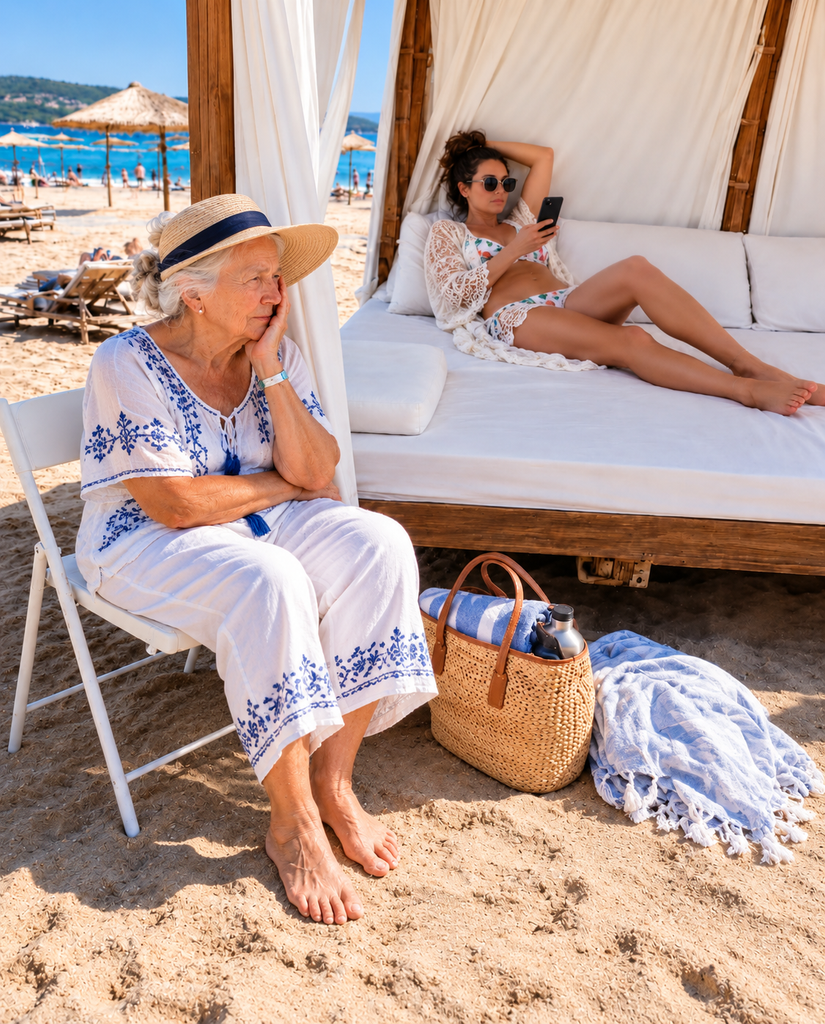
A rude woman threw my ninety-year-old grandmother out of the VIP cabana I had reserved for her birthday, saying, “Old people don’t need the best view.” Fifteen minutes later, she wished she had never opened her mouth.
For eight months, I saved every extra dollar to rent that beachfront cabana for Grandma’s ninetieth birthday. I skipped morning coffee. I packed lunches instead of buying them.
I sold old baby clothes online, picked up extra weekend shifts at the dental office, and tucked every spare bill into a little envelope hidden inside my sock drawer.
It wasn’t just a cabana.
It was shade.
It was comfort.
It was a soft place for my grandmother to sit while she watched the waves roll in, something she had been dreaming about since the stroke that nearly took her from us in 2023.
Before the stroke, Grandma Evelyn had been unstoppable.
She baked pies for every neighbor on our block.
She walked two miles every morning with her sunhat pinned under her chin.
She taught my kids how to plant tomatoes, how to fold napkins into fans, and how to say thank you even when life gave them less than they hoped for.
Then one November evening, she collapsed in her kitchen.
By the time I reached the hospital, her left side was weak, her words came slowly, and her eyes were full of fear she tried to hide from me.
The doctors said we were lucky.
I hated that word at first.
Lucky sounded cruel when the woman who had raised me could no longer button her own cardigan without help.
But over time, I understood.
She was alive.
She could still smile.
She could still squeeze my hand.
She could still whisper stories to my children at bedtime when I had to work late.
But she had barely left the house since then.
Loud places overwhelmed her.
Long walks tired her.
Heat made her dizzy.
And pride, the strongest thing she had left, kept her from asking for too much.
So when I asked what she wanted for her ninetieth birthday, I expected her to say dinner at home or chocolate cake from Miller’s Bakery.
Instead, she looked out the window toward a sky she could not see beyond the rooftops and whispered, “I just want to feel the ocean air one more time.”
That sentence stayed with me.
One more time.
Not someday.
Not when things got easier.
One more time.
So I made it happen.
I booked a VIP cabana at Harbor Point Beach, the same beach where Grandma had taken me every summer after my parents divorced.
Cabana Seven sat right near the water, close enough to hear every wave, but far enough back that the tide would not reach her feet.
It had soft cushions, a ceiling fan, cold water, fruit trays, and a reserved attendant.
To most people, maybe it was just an overpriced beach rental.
To me, it was a thank-you note I could finally afford.
On the morning of her birthday, Grandma wore a pale blue blouse, white linen pants, and the pearl earrings my grandfather had bought her fifty years earlier.
Her silver hair was brushed neatly beneath a wide straw hat.
When I helped her into the passenger seat, she patted my hand.
“You did too much, Claire,” she said.
“No,” I replied, fastening her seat belt gently. “I did almost enough.”
My two children, Lily and Noah, climbed into the back seat carrying handmade cards and a small cooler full of sandwiches.
Lily was eight and had drawn Grandma as a queen standing beside the ocean.
Noah, who was five, had drawn a large blue blob and proudly announced it was “the biggest wave in America.”
Grandma laughed so hard she had to dab her eyes.
The ride to the beach took forty minutes.
The closer we got, the more she changed.
Her shoulders relaxed.
Her face turned toward the open window.
The ocean smell slipped into the car, salty and bright, and she closed her eyes like she was listening to an old song.
When we reached Harbor Point, I parked near the accessibility ramp and helped her into her wheelchair.
“Ready?” I asked.
Grandma looked at the blue line of ocean beyond the boardwalk.
Her lips trembled.
“I thought I might never see it again,” she said.
I had to look away for a moment so my kids would not see me crying.
The attendant at the cabana check-in was a young man named Marcus.
He checked my reservation, smiled warmly at Grandma, and placed the VIP bracelet around her wrist himself.
“Happy birthday, ma’am,” he said. “Ninety looks wonderful on you.”
Grandma blushed like a schoolgirl.
“Flatterer,” she said.
He laughed and led us down the path to Cabana Seven.
It was even prettier than the pictures online.
White curtains moved softly in the breeze.
There were thick cream cushions, a low wooden table, towels folded like fans, and a beautiful view of the water glowing under the late morning sun.
Grandma touched the side of the sofa before sitting down.
“Oh, Claire,” she whispered. “This is too fine for me.”
“No such thing,” I said.
I arranged her cushion behind her back, tucked a light blanket over her knees in case the breeze bothered her, and placed her water bottle within reach.
Lily gave her the birthday card.
Noah gave her a seashell he had found in the parking lot and insisted it was rare.
Grandma held both like treasures.
For the first half hour, everything was perfect.
My grandmother watched the waves.
My children built a sandcastle near the entrance of the cabana.
I took photos of Grandma smiling, real smiling, the kind I had not seen in months.
She looked peaceful.
Not sick.
Not frail.
Not trapped inside the story of what had happened to her body.
Just peaceful.
Around noon, the kids started asking for lemonade from the boardwalk stand.
I hesitated.
The stand was visible from the cabana path, but the line was long, and I did not like leaving Grandma alone.
“I’m fine,” she said, reading my face. “Go. I have my water, my hat, and the best seat in the world.”
“I’ll be quick.”
“Claire, I raised three children, survived one husband, two floods, and a stroke. I can sit in a chair for twenty minutes.”
I laughed despite myself.
“Keep your bracelet visible,” I said.
She lifted her wrist. “Yes, boss.”
I took Lily and Noah by the hands and walked toward the boardwalk.
The lemonade line took longer than expected.
A family ahead of us could not decide what flavor everyone wanted.
Then the machine ran out of ice.
Then Noah dropped his sandal and cried like the world had ended.
I kept glancing back toward the cabanas, but the curtains blocked most of my view.
Still, I told myself everything was fine.
Grandma was safe.
She was in a reserved cabana.
She had a bracelet.
There were attendants nearby.
What could possibly happen?
When we finally returned, carrying three lemonades and a small cup of shaved ice for Grandma, my stomach dropped so hard I almost stumbled.
Our bags were not inside the cabana.
They had been thrown onto the hot sand.
Grandma was not on the sofa.
She was sitting several yards away in a cheap plastic chair beneath the blazing June sun.
Her hat had slipped sideways.
Her cheeks were flushed red.
Her hands trembled in her lap.
And she was crying quietly.
Not loudly.
Not dramatically.
Just silently, in that terrible way older people cry when they are trying not to be a burden.
“Grandma?” I called.
She looked up, and the shame in her eyes made something inside me turn cold.
I rushed to her, dropping the lemonade into the sand.
“What happened? Are you hurt?”
She shook her head, but her chin trembled.
Lily froze beside me.
Noah pressed himself against my leg.
“Grandma, talk to me,” I said, kneeling in front of her.
She lifted one shaking hand and pointed toward our cabana.
A younger woman in a designer swimsuit was stretched out on the sofa I had paid for, sipping a cocktail and laughing with three friends.
Her oversized sunglasses covered half her face.
A gold chain rested against her collarbone.
Her beach bag, bright red and expensive-looking, sat where Grandma’s sweater had been.
“She told me to leave,” Grandma whispered.
My chest tightened.
“What?”
“She said this cabana was too nice for me.” Grandma swallowed, struggling to speak clearly. “She said old people don’t need the best view.”
For a moment, the beach sounds faded.
All I could hear was my own heartbeat.
Grandma wiped her cheek with the back of her hand.
“She threw my bag out. When I showed her my bracelet, she laughed. She said I probably found it in the trash.”
Lily gasped.
Noah looked confused, but he knew enough to understand someone had hurt his great-grandmother.
“Where was the attendant?” I asked.
“She called one over,” Grandma said. “Not Marcus. A girl I didn’t know. She told her I was confused. She said my family had probably abandoned me, and I had wandered into the wrong cabana.”
My hands clenched.
Grandma’s voice cracked.
“Her friends laughed, Claire.”
Those words did it.
Not the cabana.
Not the money.
Not even the lie.
Her friends laughed.
At my grandmother.
At a ninety-year-old woman who had survived grief, illness, and more pain than that rude woman would ever understand.
I looked at the woman lounging in our cabana.
Then I looked at my grandmother’s red, shaking hands.
“Stay with the kids,” I said softly.
Grandma grabbed my wrist.
“Don’t make a scene.”
I turned back to her.
My voice was calm.
Too calm.
“I won’t make a scene, Grandma. She already did.”
Then I stood and walked straight toward the cabana.
The woman saw me coming.
She did not sit up.
She did not look embarrassed.
She lowered her sunglasses just enough to inspect me with a bored smile.
“Can I help you?” she asked.
“Yes,” I said. “You’re sitting in the cabana I reserved.”
Her friends went quiet for half a second.
Then one of them snorted.
The woman took a slow sip of her cocktail.
“This cabana is occupied.”
“I know,” I said. “By my grandmother. Until you threw her belongings onto the sand.”
Her smile sharpened.
“Oh, you’re with the old lady.”
I felt heat rise behind my eyes, but I kept my voice even.
“That old lady is my grandmother. Today is her ninetieth birthday. I reserved this cabana eight months ago.”
“How sweet,” she said, in a tone that meant the opposite.
I pulled out my phone and opened the reservation confirmation.
“Cabana Seven. Twelve p.m. to six p.m. Under Claire Bennett. VIP birthday package.”
She glanced at the screen for less than a second.
“Anyone can fake a screenshot.”
One of her friends laughed again, but it sounded weaker this time.
“I’m not asking for your opinion,” I said. “I’m telling you to leave.”