

My son removed me from the family group chat, and when I asked him why, he replied, “Mom, it was for working adults. You don’t understand anything we talk about.” A week later, all twelve of them arrived at my farm with suitcases, meat, and coolers, convinced that I would leave the key under the flowerpot one more time.
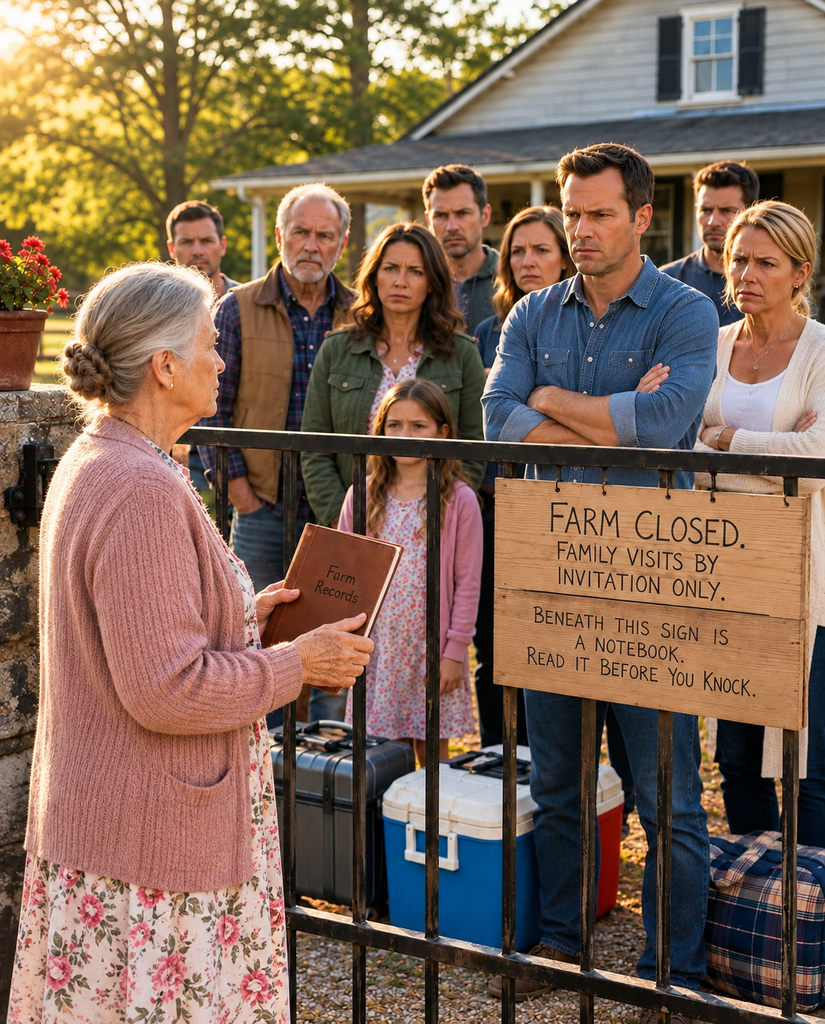
But that night, by the closed gate, a sign and a notebook were waiting for them. A notebook they never should have despised. It wasn’t the moment Charlie removed me from the family group that hurt the most. It was the phrase that came after.
“Mom, it was for working adults. You don’t understand anything we talk about.”
I stared at that message for a long time.
My thumb hovered over the screen, but I didn’t know what to say.
I am seventy-six years old.
I have buried a husband, raised three children, survived droughts, debt, hospital bills, and winters so cold the pipes froze beneath the kitchen.
But somehow, in my son’s eyes, I was no longer an adult.
I was just old.
Just slow.
Just someone to visit when they needed fresh sheets, a stocked fridge, and a free place to stay.
The farm had been mine and Joe’s dream.
We bought it when the roof leaked, the barn leaned to one side, and the fields were more weeds than soil.
People laughed at us.
Joe only smiled and said, “Give us ten years.”
It took fifteen.
Fifteen years of farmer’s markets, broken tractors, late payments, and savings hidden in glass jars behind flour bags.
But we made it beautiful.
Apple trees along the fence.
Lemon trees near the kitchen window.
A pond where the grandchildren used to catch frogs.
A porch wide enough for rocking chairs and Sunday coffee.
After Joe died, the farm became the place everyone came back to.
At first, I loved it.
I cooked big meals.
I made beds.
I filled jars with jam and pickles.
I left the key under the big blue flowerpot by the side door because family should never feel locked out.
But slowly, they stopped calling first.
Then they stopped asking.
Then they stopped helping.
They arrived with coolers, children, dogs, laundry, empty gas tanks, and big smiles.
They left with leftovers, muddy floors, stained towels, and promises to visit “properly next time.”
Next time never came.
So when my daughter-in-law Lauren texted me one week after I was removed from the group chat, I already knew something inside me had changed.
“Barbara, leave the key in the usual spot. We’re coming Friday with the kids.”
No please.
No thank you.
No how are you, Mom?
Twelve people were coming to my home.
And apparently, I was the last person to know.
I drove to the farm on Thursday morning.
John, the caretaker, was repairing a fence near the barn when I arrived.
He had worked for Joe and me for more than twenty years.
He knew the farm almost as well as I did.
When he saw my face, he took off his hat.
“Mrs. Barbara,” he said softly, “something happen?”
I shook my head.
“Not yet.”
Inside the house, everything looked the same.
Joe’s chair still sat beside the fireplace.
The clock still ticked above the kitchen door.
And on the dining table sat the old brown leather notebook.
Joe had sewn the cover himself.
Inside, we had written everything.
The cost of the well.
The year we planted each tree.
The price of roof repairs.
The names of neighbors who helped us during storms.
The money we owed.
The money we paid back.
The dreams we had.
That notebook was not valuable to anyone else.
But to me, it was proof that this farm had not appeared by magic.
It had been earned.
I was still sitting there when Charlie arrived Friday afternoon.
He walked in without knocking.
He did not hug me.
He did not ask why I was there early.
He only frowned.
“Mom? What are you doing here?”
I looked at him carefully.
“I live here, Charlie.”
He sighed like I had made things difficult.
“You know what I mean. We planned a weekend.”
“No,” I said. “You planned a weekend.”
He crossed his arms.
“Mom, don’t start.”
“Why was I removed from the family group?”
His expression tightened.
“It wasn’t personal.”
“It felt personal.”
“It was just easier. We talk about schedules, work, adult things.”
There it was again.
Adult things.
I looked at my son, my first baby, the boy I once carried through fever nights.
“Charlie, I am your mother.”
He gave a small laugh.
“That’s not what I meant. You just don’t understand half of what we talk about anymore.”
Then his eyes landed on the notebook.
He picked it up and flipped through the pages.
“What is this old thing still doing here?”
“That is your father’s notebook.”
Charlie barely looked at it.
“Mom, these things just gather dust.”
Then he tossed it into the trash.
Not placed.
Not set aside.