

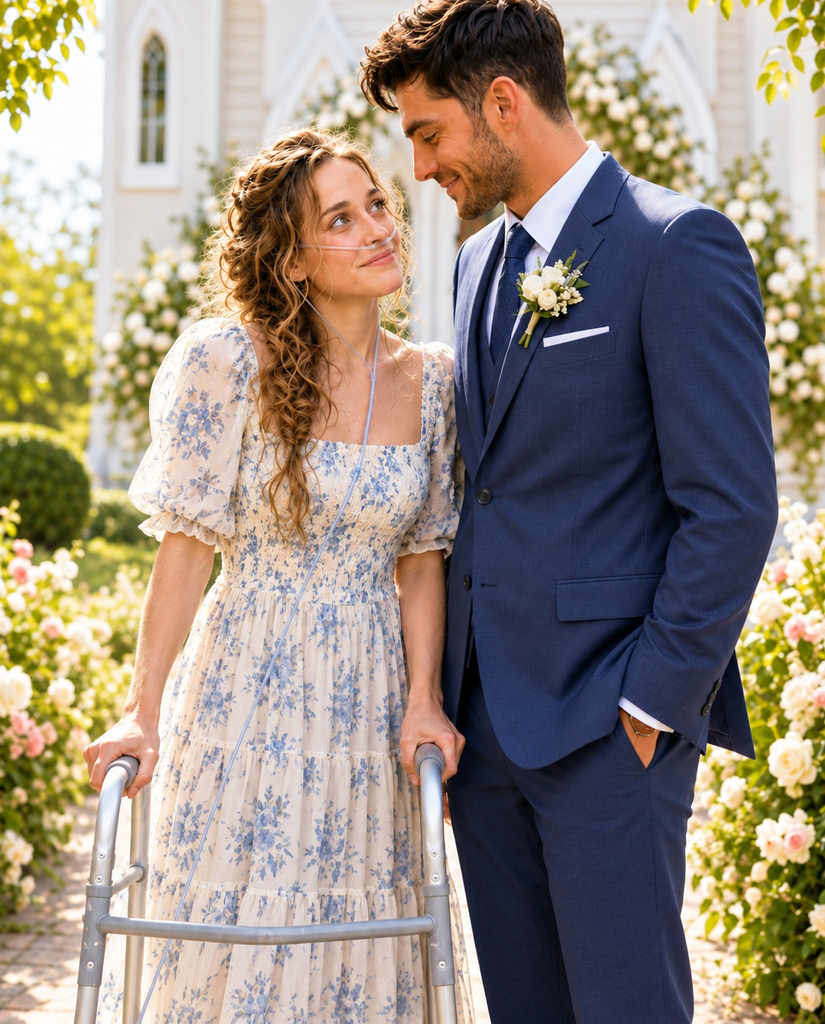
My fiancé left me after I was told I did not have much time left — so I hired a stranger to stand beside me at the altar as my last wish. For nearly a year, my fiancé had helped me plan the wedding I had dreamed about for most of my life. His name was Aaron.
He had proposed to me under a row of white lights in my parents’ backyard, with my mother crying into both hands and my father pretending he had something in his eye. Aaron had knelt in the grass, held up my grandmother’s ring, and told me he wanted every ordinary day with me.
At the time, I believed him.
I believed the way his voice shook.
I believed the way he looked at me.
I believed the promise in front of our families when he said, “I choose you, Clara. For everything.”
Everything.
That word became cruel later.
My father had already paid for the venue, the flowers, the dress, the catering for one hundred and twenty guests, the string quartet, the photographer, even the little white candles my mother insisted would make the reception feel softer.
The invitations had been sent.
Relatives from three states had booked flights.
My bridesmaids had their dresses hanging in garment bags.
My mother had cried during my final fitting when I stepped out in ivory lace and asked, “Is it too much?”
She had touched her mouth and whispered, “No, sweetheart. It is exactly you.”
I remember laughing that day.
I remember thinking I was lucky.
Then my doctor said one word that changed everything.
Terminal.
The word did not sound real at first.
It sounded like a word from someone else’s life. A word on a medical drama. A word whispered in hospital hallways by families who were not mine.
But Dr. Benson sat across from me in a bright, freezing exam room, her hands folded gently over my test results, and said it again in a softer way.
“The cancer has progressed faster than we hoped.”
Aaron sat beside me.
I reached for his hand before she finished speaking.
My fingers wrapped around his so tightly my knuckles turned pale. I thought he would squeeze back harder. I thought he would tell me we would fight. I thought he would ask about options, treatments, miracles, anything.
Instead, his hand went still.
Not away.
Not yet.
Just still.
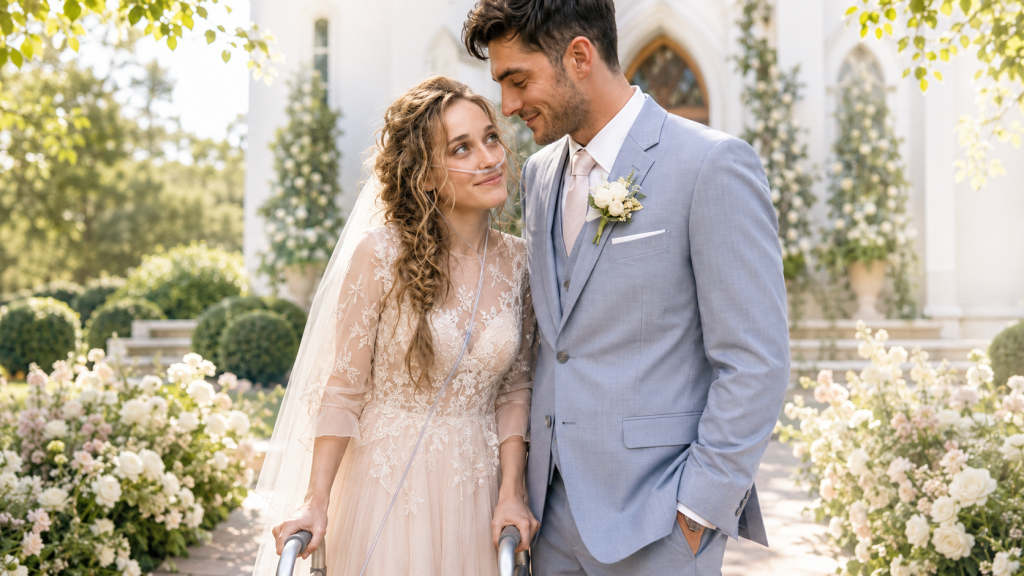
Dr. Benson spoke carefully after that. There were treatments to slow things down. There were medications for comfort. There were guesses, not promises. Months, maybe less, maybe more if my body responded.
I stared at a poster on the wall showing a smiling woman drinking tea beside a window.
Aaron stared at the floor.
When we left the hospital, the sky was painfully blue.
People were walking their dogs. A woman pushed a stroller past us. Somewhere nearby, someone laughed into a phone.
The world had no respect for my disaster.
Aaron drove us home without music.
At a red light, I turned to him and tried to smile.
“Well,” I whispered, “this is not exactly what we planned.”
He did not smile back.
He just nodded, his jaw tight.
I told myself he was scared.
I told myself anyone would be scared.
For two days, he stayed close but distant. He made me soup I did not ask for. He answered my mother’s calls in the other room. He sat beside me on the couch but did not touch me unless I touched him first.
On the second evening, I woke from a nap to the sound of a zipper.
At first, I thought he was looking for something.
Then I walked into the kitchen and saw the suitcase beside the door.
Aaron stood by the counter with red, swollen eyes. His hair was messy, like he had been pulling at it. In one hand, he held his car keys.
I stopped in the doorway.
“What are you doing?”
He looked at me, and I saw it before he said anything.
The answer.
The leaving.
“I’m sorry,” he said quietly.
My heart gave one dull, heavy beat.
“For what?”
He swallowed.
“I can’t do this.”
I blinked at him.
For one ridiculous second, I thought he meant the wedding. Maybe he meant we should move it up. Maybe he meant he could not stand waiting. Maybe he meant he was overwhelmed.
“What do you mean?” I asked.
He looked toward the suitcase.
“I thought I could be strong enough. I wanted to be. I really did. But I can’t watch you disappear, Clara. I can’t marry you knowing I’m going to lose you.”
The room tilted.
“You’re going to lose me anyway,” I said.
His face twisted.
“I know.”
“So you would rather lose me by walking away?”
He covered his mouth with one shaking hand.
“I’m sorry.”
At first, I thought he meant he could not handle the illness.
Then I realized the truth.
He meant he could not handle me.
Not the hospital visits. Not the pain. Not the thin version of me that might come later. Not the fear. Not the responsibility of standing beside a woman who might not make it to old age with him.
I was no longer a bride to him.
I was a tragedy.
And he did not want to be trapped inside it.
I laughed once, but it sounded broken.
“You promised everything.”
He closed his eyes.
“I know.”
“You stood in my parents’ yard and said you chose me for everything.”
“I know.”
“Then say it honestly,” I whispered. “Say you only meant the easy parts.”
His eyes opened.
He looked at me like I had slapped him.
But he did not deny it.
That was the worst part.
He picked up the suitcase.
I stood there, too weak to scream, too stunned to cry.
At the door, he turned back.
“I will always love you,” he said.
I shook my head slowly.
“No. You will always love the version of me who did not need you.”
His mouth opened, but nothing came out.
Then he left.
The door clicked shut behind him with the softness of a final breath.
For a while, I did not move.
I stared at the empty place where his suitcase had been.
Then I sank to the kitchen floor.
My mother found me there an hour later after I failed to answer her calls. She had a key, thank God. She came in calling my name and stopped when she saw me.
I was sitting with my back against the cabinets, holding my engagement ring in my palm.
“Oh, Clara,” she whispered.
I did not tell her everything.
I did not have to.
She sat on the floor beside me, pulled me into her arms, and rocked me the way she had when I was little and feverish.
My father arrived ten minutes later.
He did not cry at first.
He walked through the house once, as if Aaron might be hiding somewhere and he could drag him back by the collar.
Then he came into the kitchen, saw the suitcase gone, and his face changed.
I had seen my father angry before.
I had never seen him look betrayed for me.
“He left?” he asked.
I nodded.
My father’s hands curled into fists.
My mother said softly, “Tom.”
He looked down at me, and the anger broke into grief.
He knelt in front of me.
“I am so sorry, sweetheart.”
That was when I cried.
Not because Aaron had left.
Not only because of that.
I cried because my father’s apology made the whole thing real.
The man who was supposed to stand beside me at the altar had decided my ending was too heavy for him to carry.
The wedding was supposed to be three weeks later.
For three days, everyone spoke around the subject in gentle voices.
Cancel the venue.
Call the guests.
Return what could be returned.
Donate the flowers.
Sell the dress.
My mother moved through the house making lists with trembling hands. My father spoke to vendors in a voice so controlled it scared me.
I sat in my bedroom and watched dust float in the sunlight.
I was tired.
Sick tired.
Heartbroken tired.
Humiliated tired.
Every time my phone buzzed, I hoped it was Aaron.
Every time it was not, I hated myself for hoping.
On the fourth night, I opened the closet and unzipped the garment bag.
My wedding dress hung there like a ghost.
Ivory lace.
Tiny pearl buttons.
A neckline my mother said made me look graceful.
I touched the sleeve and remembered all the years I had imagined wearing it.
As a child, I had wrapped bedsheets around myself and walked down the hallway pretending it was an aisle. My father would hum wedding music badly, and my mother would toss tissues like flower petals.
When I was thirteen, my grandmother told me, “The wedding is not the prize, Clara. The marriage is.”
I knew she was right.
Of course I knew.
But I also knew I might not get the marriage now.
Maybe not with anyone.
Maybe not ever.
And if my time was truly running out, why did I have to let Aaron take the day too?
He had already taken the future I imagined.
Why should he take the one beautiful memory that was already paid for, planned, and waiting?
Maybe it was silly.
Maybe it was pathetic.
Maybe anyone sensible would have canceled everything.
But grief does not always make sensible requests.
That night, a strange thought came to me.
The wedding did not have to disappear.
I only needed someone to stand at the altar.
Not a real husband.
Not a legal marriage.
Just someone kind enough to play the part long enough for me to walk down the aisle in the dress my mother cried over.
Someone to let my father give me away.
Someone to let me have one day where people did not look at me like I was dying.
I opened my laptop.
My hands shook as I searched for local acting agencies.
The first few websites looked too expensive. Some actors had glossy headshots and dramatic reels. Some specialized in commercials, theater, corporate events.
I felt ridiculous.
I typed an email three times and deleted it twice.
Finally, I wrote the truth.
My name is Clara Whitmore. I am supposed to get married on June 14. My fiancé left after I received a terminal diagnosis. The wedding has already been paid for, and my family cannot bear to cancel it. I know this sounds strange, but I am looking to hire someone to stand in as the groom for a symbolic ceremony only. No legal documents. No deception for money. I just want one beautiful day before things get worse. I understand if this request is impossible.
I sent it to the cheapest actor listed as available on my date.
His name was Daniel Hayes.
His headshot showed a man in his early thirties with dark hair, steady eyes, and a small scar near his eyebrow. His resume said he did community theater, voiceover work, and occasional background roles in films shot locally.