
 Reading Time: 33 minutes
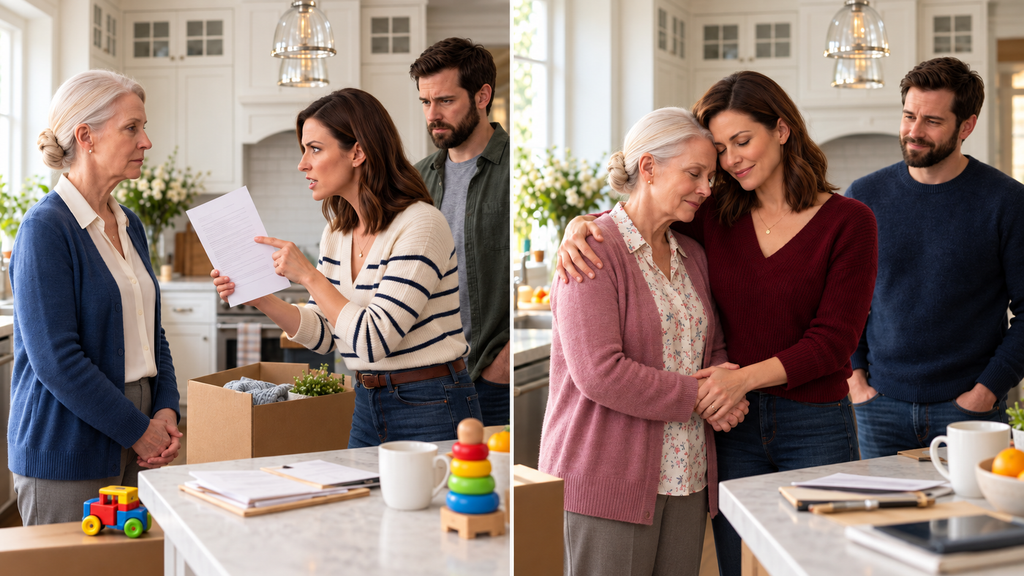
Melissa stared at me as if I had just announced that the floor beneath her feet belonged to someone else. For several seconds, nobody moved.
The thirty-day notice lay on the dining table between the remains of Carol’s chocolate cake and Linda’s half-empty wineglass. Daniel was standing beside the doorway.
His face had gone pale.
Melissa’s had gone red.
“You changed the will?”
Her voice was quieter this time.
That was how I knew I had finally frightened her.
Not with shouting.
Not with threats.
With information.
“Yes,” I said.
“When?”
“Two months ago.”
Daniel’s eyes snapped toward me.
“Two months?”
“Yes.”
“That was before we moved in.”
“Correct.”
His expression changed.
There was something almost childlike in it.
Confusion.
Hurt.
Maybe even betrayal.
“Mom, you already decided I wasn’t getting the house?”
I looked at my son.
“No, Daniel. You decided that.”
His brow furrowed.
“What does that even mean?”
“It means you stopped treating this as my home and started treating it as your future property.”
Melissa gave a short laugh.
“Oh, please.”
Janice leaned back in her chair.
Nobody had invited her into the argument, but Janice had never required an invitation for anything in her life.
“Oh, I wouldn’t ‘please’ her right now,” she said.
Melissa glared at her.
“This is a family matter.”
Janice calmly lifted her wineglass.
“Then perhaps you shouldn’t have turned it into dinner theater.”
“Janice,” I said.
She raised one hand.
“I’m quiet.”
She was not quiet.
But I loved her for trying.
Daniel picked up the notice.
His eyes moved over the first page.
Then the second.
His hands tightened.
“You actually had an attorney prepare this?”
“Yes.”
“Why?”
“Because I suspected a conversation might not be enough.”
Melissa folded her arms.
“You planned this.”
“No. You planned it.”
Her eyes narrowed.
I pointed toward the staircase.
“You moved into my house and within a week began deciding when I could watch television, when I could eat, who I could invite over, and when I was expected to disappear into my bedroom.”
“That was about the children.”
“No, it wasn’t.”
“You don’t understand what it’s like having children on a schedule.”
“I raised one.”
Daniel flinched.
Melissa opened her mouth.
I didn’t let her interrupt.
“And somehow I managed to do it without ordering the owner of the house to go to bed at eight.”
Linda looked down quickly, but I saw her shoulders shake.
She was trying not to laugh.
Melissa saw it too.
“This is unbelievable.”
“No,” I said. “What’s unbelievable is that you thought it would work.”
Daniel put the papers down.
“Mom, can we talk privately?”
I looked around my dining room.
My three best friends were suddenly fascinated by their plates.
“All right.”
Daniel followed me into the kitchen.
The moment the door swung closed behind us, his voice dropped.
“Please don’t do this.”
I turned around.
“Do what?”
“Throw us out.”
“I’m asking you to find another place to live.”
“Melissa is pregnant.”
“I know.”
“We have nowhere to go.”
“You had somewhere to go before you moved here.”
“Our lease ended.”
“Then find another lease.”
“My hours were cut.”
“And I sympathized with you. That is why I opened my home.”
Daniel rubbed both hands over his face.
“Mom, thirty days isn’t enough.”
“You told me you only needed a month or two.”
“That was before everything got complicated.”
“No, Daniel. Everything became complicated because you allowed your wife to behave as though I were a guest in my own house.”
His jaw tightened.
“You know how Melissa is.”
I stared at him.
That sentence.
I had heard versions of it for years.
You know how she is.
She doesn’t mean it like that.
She’s stressed.
She’s tired.
She’s hormonal.
She’s protective.
She has strong opinions.
Every excuse was another brick in the wall Daniel had built between himself and responsibility.
“Yes,” I said quietly. “I know exactly how Melissa is.”
“Then why provoke her?”
Something inside me went still.
“Excuse me?”
He realized immediately that he had chosen the wrong words.
“I didn’t mean—”
“You think I provoked her?”
“No.”
“You think inviting three friends to dinner in the house I own was provoking your wife?”
“Mom, that’s not what I’m saying.”
“It is exactly what you’re saying.”
He lowered his voice further.
“I’m just asking you to keep the peace.”
I almost laughed.
Instead, I looked at my son and felt something far sadder.
For years, Daniel had used that phrase whenever Melissa crossed a line.
Keep the peace.
What it really meant was:
Mom, absorb the discomfort so I don’t have to.
Mom, surrender because confronting my wife is difficult.
Mom, make yourself smaller so my marriage feels easier.
I had mistaken his avoidance for kindness.
It wasn’t kindness.
It was cowardice dressed as diplomacy.
“Daniel,” I said, “whose peace?”
He blinked.
“What?”
“Whose peace have I been keeping?”
He didn’t answer.
“Because it certainly hasn’t been mine.”
“Mom…”
“I lost your father six years ago.”
His face softened.
“Don’t bring Dad into this.”
“I’ll bring him into any conversation I choose. This was his home too.”
Daniel looked away.
I continued.
“After your father died, do you know how long it took before I could sleep through the night?”
He said nothing.
“Fourteen months.”
His eyes came back to mine.
“I would wake up at two in the morning and reach across the bed before remembering he wasn’t there.”
My throat tightened, but I kept going.
“I learned how to live alone in this house. I learned how to eat at the table without him. I learned how to mow the lawn because I refused to pay someone seventy dollars to do something I was perfectly capable of doing.”
Despite himself, Daniel almost smiled.
His father had complained about lawn-service prices for twenty years.
“I learned how to be Margaret again,” I said. “Not somebody’s wife. Not somebody’s mother. Me.”
“Mom…”
“And then you moved in.”
His expression hardened again.
“So this is because we disrupted your routine?”
“No.”
I stepped closer.
“This is because I opened my door to my son when he said he needed help, and within days his wife was telling me when I was allowed to eat.”
Silence.
“That should have bothered you before it bothered me.”
He swallowed.
I saw the shame then.
Not enough.
But some.
From the dining room came the muffled sound of Melissa’s voice.
Then Janice said something I couldn’t make out.
Daniel closed his eyes.
“God.”
“You should probably go rescue your wife from my seventy-one-year-old friend.”
“Janice scares everybody.”
“She should.”
That almost broke the tension.
Almost.
Then Daniel looked at the notice again.
“Is there anything I can say that will change your mind?”
“Yes.”
Hope flashed across his face.
I hated what I had to say next.
“You could have said something seven days ago.”
His hope disappeared.
I opened the kitchen door.
Melissa was standing beside the dining table.
My friends were still seated.
Carol had apparently decided that if a family explosion was happening, she was not going to let perfectly good cake go to waste.
She was cutting herself another slice.
Melissa pointed toward the envelope.
“I’m not leaving.”
I walked back into the room.
“That is not your decision.”
“It is if this is my legal residence.”
Linda’s fork stopped halfway to her mouth.
Daniel came through the door behind me.
“Melissa.”
“No. She thinks she can humiliate us in front of her friends and throw us into the street because she’s having some kind of late-life independence crisis.”
Carol slowly put down her fork.
Janice looked at me.
I could see the question in her eyes.
Do you want me to handle this?
I gave the slightest shake of my head.
This one was mine.
I walked toward Melissa.
“My husband died at sixty-eight.”
Her expression shifted.
“I know.”
“He spent forty-two years working. Thirty-seven of them at the same engineering company.”
“I don’t see what—”
“He saved. We saved. We paid off this house. We replaced the roof twice. We refinished those floors ourselves one summer because Daniel was starting college and tuition was expensive.”
Daniel stared at the floor.
I pointed around the room.
“Every chair, every wall, every crack in this ceiling belongs to a life your father-in-law and I built.”
Melissa’s face remained hard.
“And you walked into it and gave me a bedtime.”
Nobody spoke.
I picked up the notice and handed it back to her.
“You have thirty days.”
She took it.
Then tore it in half.
Carol gasped.
Melissa tore it again.
And again.
She dropped the pieces onto my dining table.
“There.”
I looked down at them.
Then back at her.
“That was your copy.”
Janice laughed so suddenly she nearly spilled her wine.
Melissa spun toward her.
“You think this is funny?”
Janice wiped the corner of her mouth.
“Very.”
“Get out.”
That changed everything.
Janice’s smile vanished.
Linda’s chair scraped backward.
Carol stared at Melissa.
I spoke very softly.
“What did you just say?”
Melissa turned toward me.
“I said your friends need to leave.”
“You told my guest to get out of my house?”
“I am trying to have a private conversation with my family.”
“You don’t get to remove people from my home.”
“We live here too.”
“Temporarily.”
“This is our residence.”
“Temporarily.”
“Our children sleep here.”
“Temporarily.”
Melissa stepped toward me.
“So what? You want your grandchildren homeless?”
Daniel finally moved between us.
“Enough.”
Melissa looked at him.
For one hopeful second, I thought he had found his spine.
Then he turned toward me.
“Mom, maybe the girls should go.”
The girls.
We were all women in our late sixties and early seventies, but Daniel had called them “the girls” since he was ten.
Janice’s face changed.
Linda looked hurt.
Carol simply stared at him.
I felt something inside me break cleanly.
Not loudly.
Not dramatically.
Just cleanly.
I nodded.
“All right.”
Daniel exhaled.
“Thank you.”
I turned to my friends.
“Ladies, would you mind giving us a moment?”
Linda stood first.
She came over and squeezed my hand.
“Call me.”
Carol hugged me.
Janice was last.
She walked past Melissa without looking at her.
Then stopped beside Daniel.
“When your father died,” she said, “your mother didn’t eat properly for almost two weeks.”
Daniel looked uncomfortable.
Janice continued.
“We took turns bringing her meals.”
“Janice—”
“No, Margaret.”
Her eyes stayed on Daniel.
“She didn’t want to bother you because you were newly married and she said you had your own life.”
Daniel’s face changed.
“She has spent your entire adulthood trying not to be a burden.”
Janice glanced toward the torn notice.
“And you rewarded her by making her one in her own house.”
She walked out.
The front door closed.
For a moment, I wished she had stayed.
Then I remembered something my husband, Robert, used to say.
A person eventually has to stand in their own doorway.
So I did.
Melissa sat down.
Daniel remained standing.
I gathered the pieces of the torn notice.
“You’ll receive another copy tomorrow.”
Melissa laughed.
“From who?”
“My attorney.”
“Good. Then I’ll get one too.”
“That would be sensible.”
“You think I’m joking?”
“No.”
“I know tenant law.”
“Wonderful.”
That surprised her.
She had expected me to panic.
“I have already discussed the situation with my attorney,” I said. “I’m going to follow the legal process exactly.”
Daniel looked exhausted.
“Can we stop talking about lawyers?”
Melissa ignored him.
“If you try to force us out, I will fight you.”
“I assumed you might.”
Her eyes narrowed.
Something about my answer bothered her.
Good.
Because there was something I had not told either of them.
Not yet.
Two months earlier, when I changed my estate plan, my attorney, Susan Keller, had asked me a strange question.
“Margaret, has Daniel ever asked you to add his name to the deed?”
At the time, I said no.
But the question stayed with me.
Because three days later, Daniel called and casually asked whether the property taxes were becoming “too complicated” for me.
A week after that, Melissa sent me an article about transferring property to adult children to “avoid probate.”
Then Daniel asked where I kept my important documents.
Individually, none of it seemed alarming.
Together, it bothered me enough to make copies of everything.
The deed.
Insurance.
Tax records.
Bank information.
My revised will.
Power-of-attorney documents.
I moved the originals into a safe-deposit box.
I had not told Daniel.
I certainly had not told Melissa.
And looking at her now, I was glad.
That night, I locked my bedroom door for the first time since they moved in.
At 10:43, someone tried the handle.
Once.
Then again.
I sat up in bed.
My heart began pounding.
“Who is it?”
Silence.
Then Daniel’s voice.
“Mom?”
“What do you need?”
“I wanted to talk.”
“At eleven o’clock?”
“I couldn’t sleep.”
“Neither can I now.”
A pause.
“Can I come in?”
“No.”
Another pause.
“Okay.”
His footsteps disappeared.
I stayed awake for almost an hour.
At 12:07, I heard movement downstairs.
Cabinet doors.
A drawer.
Then another drawer.
I got out of bed.
Slowly.
Quietly.
I opened my door.
The hallway was dark.
A thin stripe of light stretched from the kitchen across the floor.
I moved toward the staircase.
Then I heard Melissa whisper.
“It has to be somewhere.”
Daniel answered.
“Stop.”
“Where else would she keep it?”
“I said stop.”
My hand tightened around the banister.
Melissa again.
“If she really changed everything, we need to know exactly what she did.”
“That doesn’t mean we go through her stuff.”
“We’re already being thrown out.”
“Then we find an apartment.”
“With what money?”
Silence.
I leaned closer.
Melissa’s voice dropped.
“You told me this house was basically yours.”
My heart stopped.
Daniel whispered something I couldn’t hear.
Melissa answered more sharply.
“You said she’d leave it to you.”
“I thought she would.”
“You said we could stay here until things improved and eventually this would all be ours.”
“I said probably.”
“No. You didn’t say probably.”
There was a long silence.
Then she said something that changed the entire shape of the argument.
“You said we wouldn’t have to worry about the mortgage because we could borrow against this place.”
I gripped the railing.
Borrow against my house?
Daniel’s voice came low and angry.
“I never said we could do that now.”
“You said once she transferred it.”
“I thought she might.”
“You promised me.”
“I was trying to calm you down!”
“By lying?”
“Keep your voice down.”
My stomach turned.
Suddenly, the conversations of the previous months rearranged themselves in my memory.
Daniel asking whether I ever considered putting him on the deed.
Melissa talking about estate taxes.
Daniel mentioning that “keeping property in the family” was smarter.
Their sudden desperation when their lease ended.
The rules.
The control.
It wasn’t simply entitlement.
They had built a future around an asset they did not own.
My home had become a number on somebody else’s spreadsheet.
I stepped backward.
One floorboard creaked.
The kitchen went silent.
“Mom?”
Daniel.
I didn’t move.
Footsteps approached the stairs.
I stepped into view.
Daniel looked up.
Melissa stood behind him holding a folder.
My folder.
A blue folder from the desk in my study.
I stared at it.
Then at her.
“What are you doing?”
Melissa immediately put it on the counter.
“I was looking for the kids’ vaccination paperwork.”
“At midnight?”
“They need records for preschool.”
“In my study?”
“I thought you might have copies.”
“You thought I kept your children’s vaccination records with my financial documents?”
Her face tightened.
Daniel stepped forward.
“Mom, it’s not what it looks like.”
I almost smiled.
“Daniel, I have reached an age where I no longer accept that sentence from anyone.”
He stopped.
I walked downstairs.
Melissa moved away from the folder.
I opened it.
Bank statements.
An old insurance policy.
Property-tax bills.
Nothing critical.
The important papers were safely elsewhere.
Still, my hands trembled.
Not because I was afraid.
Because they had searched my desk.
There is something uniquely violating about realizing someone has opened drawers they had no right to touch.
They had gone through the private corners of my life while believing I was asleep upstairs.
I closed the folder.
“Tomorrow morning,” I said, “I’m having locks installed on my bedroom and study.”
Melissa rolled her eyes.
“Here we go.”
“And cameras in the downstairs hallway.”
That stopped her.
“You can’t record us without permission.”
“I said cameras. I did not say where, how, or whether they would record audio. My attorney will advise me on what is lawful.”
Daniel looked at Melissa.
“Why were you in Mom’s office?”
“I told you.”
“No. You told her some nonsense about vaccination records.”
Her mouth opened.
He stared at her.
“What were you looking for?”
She looked at me.
Then back at him.
“The will.”
Daniel’s face went blank.
“You were looking for her will?”
“I wanted to know whether she was telling the truth.”
“You went through my mother’s papers?”
“Oh, don’t suddenly become righteous.”
“I told you to stop.”
“And then you stood there while I looked.”
That shut him up.
Because it was true.
I picked up the folder.
“Thirty days just became very generous.”
Then I went upstairs.
The next morning, I called Susan at 7:15.
She answered on the fourth ring.
“Margaret?”
“I’m sorry.”
“Is everything all right?”
“No.”
I told her what happened.
She listened without interrupting.
When I finished, she asked one question.
“Are you safe?”
“Yes.”
“Are you sure?”
I looked toward my bedroom door.
“Yes.”
“All right. Don’t argue about the law with them. Don’t threaten. Don’t touch their belongings. Don’t shut off utilities. Don’t do anything impulsive. We follow the proper process.”
“I understand.”
“And Margaret?”
“Yes?”
“Document everything.”
So I did.
Dates.
Times.
Comments.
The rules Melissa had printed.
The torn notice.
The midnight search.
Everything.
At 9:30, a locksmith arrived.
Melissa came downstairs wearing a robe.
“What’s he doing here?”
“Changing a few interior locks.”
“You’re locking us out?”
“No. I’m securing private rooms.”
She crossed her arms.
“This is hostile.”
I looked at her.
“So is searching through someone’s financial records while she sleeps.”
She said nothing.
Daniel left early that morning.
He didn’t tell me where he was going.
At noon, I received a text.
Mom, can we talk tonight? Just us.
I answered:
Yes.
At 6:00, he came home alone.
“Where’s Melissa?” I asked.
“Her sister’s.”
“Children?”
“With her.”
I nodded.
He sat across from me at the kitchen table.
For a while, neither of us spoke.
Finally, he said, “I owe you an apology.”
I waited.
He rubbed his palms together.
“I let things get out of control.”
“Yes.”
“I should have said something about the rules.”
“Yes.”
“I should have stopped her last night.”
“Yes.”
He gave me a tired smile.
“You’re not making this easy.”
“I spent years making things easy for you.”
That wiped away the smile.
“I know.”
I studied his face.
He looked older than he had a month earlier.
“Tell me about the house.”
He went still.
“What?”
“Last night I heard Melissa say you told her we could eventually borrow against my house.”
He looked down.
“Daniel.”
“I messed up.”
“How?”
He took a breath.
“When Dad died, I assumed…”
He stopped.
“Say it.”
“I assumed you’d leave the house to me.”
“That part I know.”
“And when things got bad financially, I told Melissa that eventually we’d have equity.”
“Eventually?”
“After…”
He couldn’t say it.
“After I died?”
His eyes filled with shame.
“Yes.”
I sat back.
The word hurt more than I expected.
Not because death frightened me.
At seventy-one, I had made peace with the fact that my life had more pages behind me than ahead.
What hurt was discovering that my son had already started spending money from a chapter in which I no longer existed.
“How bad are your finances?”
He rubbed his forehead.
“Bad.”
“How bad?”
“We have about forty-eight thousand dollars in debt.”
I stared at him.
“What?”
“Credit cards. Personal loan. Medical bills. Some other stuff.”
“Some other stuff?”
He looked toward the window.
“Melissa started an online boutique.”
I remembered.
Expensive baby clothes.
Decorative blankets.
Handmade nursery signs.
It had lasted six months.
“I thought she closed that.”
“She did.”
“How much?”
“About nineteen thousand.”
I closed my eyes.
“And you?”
“I made some investments.”
That word sounded wrong.
“What kind of investments?”
“Crypto. A couple of stocks.”
“How much?”
He whispered the number.
“Eleven thousand.”
I stared at him.
“You lost eleven thousand dollars?”
“Most of it.”
“And instead of telling me you were in trouble, you moved into my house.”
“I was embarrassed.”
“You weren’t too embarrassed to let me pay for your moving truck.”
He winced.
“That’s fair.”
“No. Fair would have been telling me the truth.”
“I know.”
“And Melissa believed the solution was my house.”
“She believed eventually—”
“Stop saying eventually.”
My voice cracked.
Daniel looked up.
“Eventually means after I’m dead.”
His eyes filled.
“Mom…”
“Every time you say eventually, that is what you mean.”
“I never wanted you to die.”
“I know.”
And I did know.
That was the hardest part.
My son was not a monster.
He loved me.
But love does not automatically make people honorable.
Sometimes people love you and still use you.
Sometimes they love you and still choose themselves.
Sometimes they love you while quietly counting what will be theirs when you are gone.
“I was scared,” he said.
“So you made promises with my property.”
“Yes.”
“And Melissa believed them.”
“Yes.”
“Did she move here because she thought I would eventually give you the house?”
He hesitated.
That hesitation told me everything.
“Daniel.”
“She thought once we were here, you might agree to put me on the deed.”
I stood.
I had to.
Sitting suddenly felt impossible.
I walked toward the sink.
Outside, the backyard was turning gold in the evening light.
Robert had planted the maple tree near the fence when Daniel was twelve.
It was enormous now.
For some reason, looking at it nearly made me cry.
“How?”
Daniel sounded confused.
“What?”
“How were you going to convince me?”
“We hadn’t planned anything.”
“Don’t lie to me again.”
Silence.
Then:
“Melissa thought you might agree if we helped take care of the house.”
I turned around.
“She has been here eight days.”
“I know.”
“She hasn’t taken care of anything.”
“I know.”
“She put labels on my pantry.”
“I know.”
“She threw away my coffee.”
“She said it was expired.”
“It was three weeks old.”
“I know.”
Despite everything, I laughed.
One sharp, humorless laugh.
Then I covered my face.
Daniel stood.
“Mom.”
“Don’t.”
He stopped.
I lowered my hands.
“Did you know about the rules before she gave them to me?”
His silence was answer enough.
“You did.”
“She showed them to me.”
“And?”
“I told her the bedtime thing was too much.”
I stared at him.
“The bedtime thing?”
He looked ashamed.
“You thought the rest was reasonable?”
“No.”
“But you let her hand them to me.”
“I didn’t want another fight.”
There it was again.
Peace.
His peace.
Bought with my dignity.
“You need to leave,” I said.
His eyes lifted.
“Tonight?”
“No. I am not throwing you into the street tonight. But the notice stands.”
He nodded slowly.
“And Daniel?”
“Yes?”
“You need to stop using women to protect you from uncomfortable conversations.”
He frowned.
“What?”
“You used me to avoid fighting with Melissa. You used Melissa’s pregnancy to make me feel guilty. You used your children as an excuse for staying here. And I suspect you’ve used your wife to avoid admitting how much of this financial mess belongs to you.”
He stared at me.
“You’re right.”
I hadn’t expected him to say it.
He sat down again.
Then, quietly:
“I don’t know how to fix my life.”
That sentence finally sounded like my son.
Not the frightened husband.
Not the entitled heir.
My son.
I sat across from him.
“You start by fixing what actually belongs to you.”
He looked at me.
“Your debt.”
I pointed toward the ceiling.
“Your marriage.”
Then toward myself.
“And what you’ve done to me.”
His eyes filled.
I reached across the table.
Not to solve it.
Not to forgive everything.
Just to touch his hand.
“You are my son,” I said. “I love you.”
He squeezed my fingers.
“But loving you does not require me to surrender my home.”
He nodded.
“I know.”
That might have been the beginning of healing.
Unfortunately, Melissa came home forty minutes later.
And she had brought someone with her.
A man in a gray suit.
I was in the living room when the door opened.
Melissa entered first.
The man followed carrying a leather briefcase.
Daniel stood immediately.
“Who is this?”
Melissa removed her coat.
“This is Aaron Pike.”
The man extended his hand toward me.
“Mrs. Reynolds.”
I did not take it.
“And you are?”
“An attorney.”
Daniel stared at his wife.
“You hired a lawyer?”
“I consulted one.”
Aaron cleared his throat.
“I’m here primarily to facilitate a conversation.”
I looked at Melissa.
“Then you wasted his evening.”
She smiled.
“We’ll see.”
Aaron sat.
I remained standing.
“Mrs. Reynolds, my understanding is that my client and her family were invited to establish residence here.”
“For a temporary stay.”
“There may be disagreement about the terms.”
“There is no disagreement from me.”
He gave a professional smile.
“I understand.”
“No, I don’t think you do.”
I took out my phone.
“I have an attorney too.”
Melissa rolled her eyes.
“Of course you do.”
“Yes. The same woman who prepared the notice you tore up.”
Aaron’s eyes moved toward Melissa.
“You tore up a notice?”
“It was dramatic nonsense.”
His expression told me that Melissa had neglected to mention that detail.
I called Susan.
She answered.
“Susan, I have a lawyer named Aaron Pike sitting in my living room.”
There was a pause.
Then:
“Put me on speaker.”
I did.
Aaron introduced himself.
The next ten minutes were the most satisfying legal conversation I had ever heard, primarily because I understood almost none of it and did not need to.
Susan did.
Aaron did.
And slowly, Melissa realized that whatever she had imagined would happen was not happening.
At the end, Aaron stood.
“I think it would be better if counsel communicated directly from this point.”
“Agreed,” Susan said through the phone.
Melissa stood.
“That’s it?”
Aaron looked uncomfortable.
“We’ll discuss options privately.”
“What options?”
“Privately.”
He left.
Melissa closed the door behind him.
Then turned on me.
“You embarrassed me.”
I almost admired the audacity.
“You brought a lawyer into my living room.”
“Because you’re trying to make us homeless.”
“No. I’m requiring you to find housing.”
“We can’t afford housing.”
“That does not make my house yours.”
“You have four bedrooms!”
“And I could have forty. They would still be mine.”
Daniel stepped between us.
“Stop.”
Melissa rounded on him.
“Whose side are you on?”
For the first time, he answered immediately.
“My mother’s house belongs to my mother.”
The silence afterward was enormous.
Melissa looked as if he had slapped her.
“What?”
“I said Mom’s right about the house.”
“You’re choosing her?”
“No. I’m saying we crossed a line.”
“We?”
“Yes.”
She laughed.
“You unbelievable coward.”
Daniel flinched.
“You told me we would have this house.”
“I told you I thought I would inherit it someday.”
“You promised.”
“And I was wrong.”
“No, you’re weak.”
“Melissa.”
“You let her humiliate me.”
“She didn’t make you hand her rules.”
“She needs boundaries.”
Daniel stared at her.
“It’s her house.”
“She’s seventy-one!”
The words rang through the room.
Nobody moved.
Melissa realized too late what she had said.
I spoke quietly.
“And?”
Her mouth opened.
Nothing came out.
“What exactly does my age mean, Melissa?”
“I didn’t mean—”
“Finish the sentence.”
“I’m saying you don’t need all this space.”
There it was.
Not as ugly as the first version.
But close.
“Who does?”
She looked at Daniel.
Then at me.
“A family.”
I smiled sadly.
“I had a family here.”
She frowned.
“I raised my son here. I buried my husband while living here. My friends sit at that dining table. My grandchildren play in that backyard.”
I stepped closer.
“You seem to believe a widow stops being a family because the house gets quieter.”
Her eyes shifted away.
“I didn’t say that.”
“You didn’t have to.”
Daniel looked at his wife.
“Why are you doing this?”
She turned toward him.
“Because somebody has to think about our future.”
“Not with her property.”
“Our children need stability.”
“So does my mother.”
Melissa stared at him.
And then something changed.
The anger drained from her face.
In its place came fear.
Real fear.
“Daniel…”
He saw it too.
“What?”
She sat down.
“I need to tell you something.”
My stomach tightened.
Daniel didn’t move.
“What?”
“The debt is worse.”
He stared.
“How much worse?”
Melissa looked at me.
“This should be private.”
I immediately turned toward the stairs.
“Mom,” Daniel said.
I stopped.
He looked at Melissa.
“No more secrets.”
She closed her eyes.
“How much?”
Her answer was almost a whisper.
“About thirty-two more.”
Daniel stared.
“Thirty-two thousand?”
She nodded.
He sat down as though his knees had stopped working.
“Where?”
“Credit cards.”
“You said those were included.”
“Not all of them.”
“What else?”
She began crying.
Not dramatic tears.
Not angry tears.
Terrified ones.
“I took out another personal loan.”
Daniel looked sick.
“In whose name?”
She didn’t answer.
His face changed.
“Melissa.”
“Ours.”
“What does ours mean?”
She whispered:
“Yours.”
The room went cold.
Daniel stood.
“You took out a loan in my name?”
“I had access to the information.”
“How much?”
“Twelve thousand.”
“When?”
“Last year.”
He backed away from her.
“You forged my signature?”
“I didn’t forge anything. It was online.”
“That’s not an answer.”
“We needed money.”
“You took twelve thousand dollars in my name?”
“I was going to pay it back.”
“With what?”
She looked toward me.
And there it was.
The answer.
My house.
Not directly.
Not immediately.
But eventually.
Daniel saw it too.
“Oh my God.”
“I thought if your mom helped us—”
“My mother?”
“I thought once we were here, we could talk to her.”
“You took out debt in my name because you thought my mother would rescue us?”
“I was trying to save our family!”
Daniel laughed.
But there was nothing funny in it.
“You lied to me for a year.”
“You lied too!”
“About what?”
“You told me this house was coming to us!”
“Someday!”
“Exactly!”
I slammed my palm against the table.
Both of them stopped.
“No.”
My voice shook.
“Not exactly.”
I looked at Melissa.
“I was not your financial plan.”
Then at Daniel.
“My death was not a maturity date.”
He closed his eyes.
Melissa began crying harder.
For the first time, I did not feel anger toward her.
I felt something colder.
Clarity.
She was drowning.
And instead of admitting she could not swim, she had climbed onto everyone around her.
Daniel.
Me.
Perhaps even her children.
That did not excuse what she had done.
But it explained the desperation.
I looked at my son.
“You need professional financial advice.”
He nodded numbly.
“And legal advice.”
His eyes moved toward Melissa.
“Yes.”
Melissa stood.
“Daniel, please.”
He shook his head.
“I can’t talk to you right now.”
“You can’t just walk away.”
“I need to think.”
“We have children.”
“I know.”
“I’m pregnant.”
“I know.”
She reached for him.
He stepped back.
That tiny movement broke her.
She sank onto the sofa and covered her face.
Daniel walked upstairs.
I remained in the room with her.
For several minutes, the only sound was her crying.
Then she looked up.
Her makeup had streaked beneath her eyes.
“You hate me.”
“No.”
She laughed bitterly.
“Don’t lie.”
“I don’t hate you.”
“You’re throwing me out.”
“I am asking you to leave my home.”
“Same thing.”
“No.”
I sat across from her.
“Hate requires more energy than I want to give you.”
Her eyes hardened.
“There she is.”
“Who?”
“The cold old woman who thinks she won.”
I stared at her.
“You think this is winning?”
She said nothing.
“My son may have discovered that his wife secretly put debt in his name. My grandchildren are caught between two parents who have been lying to each other. My relationship with Daniel may take years to repair.”
My voice broke.
“And you think I’m sitting here enjoying myself because I get to keep my own kitchen?”
Her expression shifted.
“I…”
“No.”
I stood.
“You wanted me weak because that would have made your problems easier.”
“That’s not fair.”
“Fair?”
I almost shouted.
Then I lowered my voice.
“You handed me a list telling me when I could eat.”
Her eyes dropped.
“That was stupid.”
“Yes.”
“I was stressed.”
“Yes.”
“I thought if we could make this house feel more like ours…”
She stopped.
I finished for her.
“…then eventually it would become yours.”
She didn’t deny it.
That hurt more than if she had.
The next two weeks were strange.
The house became quiet.
Not peaceful.
Quiet.
There is a difference.
Daniel slept in the guest room.
Melissa stayed in the room with the children.
They barely spoke.
I refused to become their mediator.
For the first time in Daniel’s adult life, I allowed him to have a problem without trying to solve it.
He met with a financial counselor.
Then an attorney.
He pulled his credit reports.
The numbers were worse than he expected.
But they were not impossible.
He sold his expensive SUV.
Melissa sold several designer handbags.
They canceled subscriptions.
Daniel picked up weekend work with a former colleague.
The online boutique inventory was sold at a loss.
And one afternoon, something happened I did not expect.
Melissa knocked on my study door.
She did not enter.
She knocked.
I noticed that.
“Yes?”
She remained in the doorway.
“Can I talk to you?”
“You may.”
She came inside.
Then stood awkwardly.
“You can sit.”
She did.
For a moment, she stared at her hands.
“I owe you an apology.”
I waited.
“I was horrible to you.”
Still I waited.
“I kept telling myself I was trying to create structure for the children.”
She shook her head.
“That wasn’t true.”
“What was true?”
“I was scared.”
I nodded.
“Daniel’s hours were cut. We had debt. I was pregnant. I had hidden money problems from him.”
She swallowed.
“And then we came here.”
I said nothing.
“This house is beautiful.”
I looked around.
“It needs new gutters.”
That surprised a laugh out of her.
A small one.
Then she became serious.
“I walked in and saw stability.”
I understood.
“Something you didn’t have.”
She nodded.
“And I wanted it.”
“So you tried to control it.”
“Yes.”
It was the first completely honest thing I had heard from her.
“I thought if I controlled the routines, the kitchen, the kids, everything, then maybe I wouldn’t feel like my life was falling apart.”
“That doesn’t explain why I needed permission to have visitors.”
Her face flushed.
“I didn’t like your friends.”
“I know.”
“Especially Janice.”
“Nobody likes Janice at first.”
From somewhere in my memory, I heard Robert laughing.
Melissa smiled despite herself.
Then the smile disappeared.
“Your friends made me uncomfortable because they knew you before me.”
I frowned.
“So?”
“They made this feel like your house.”
I stared at her.
“It is my house.”
“I know.”
She looked embarrassed.
“That’s the point. I didn’t want to feel like a guest.”
“And your solution was to make me one.”
“Yes.”
Silence.
“I’m sorry.”
I believed she meant it.
But an apology is not a time machine.
It does not undo everything.
“Thank you,” I said.
Her eyes filled with hope.
“But the notice still stands.”
The hope vanished.
“I understand.”
That was the first time she said those words without an argument afterward.
On day twenty-three, Daniel found an apartment.
Small.
Two bedrooms.
Second floor.
No yard.
Twenty minutes away.
He showed me photographs on his phone.
“It’s not great.”
“It has walls?”
“Yes.”
“Roof?”
“Yes.”
“Indoor plumbing?”
He laughed.
“Yes.”
“Sounds luxurious.”
He smiled.
Then his expression softened.
“Dad would hate the carpet.”
I looked at the picture.
Brown shag.
“Oh, your father would have filed a complaint with Congress.”
Daniel laughed.
And suddenly, for just a second, he was twenty years old again.
My boy.
I missed him.
Maybe he missed me too.
“Mom?”
“Yes?”
“I’m sorry.”
“I know.”
“No. I mean really.”
He put down the phone.
“I’ve been thinking about what Janice said.”
“That is dangerous.”
He smiled.
Then became serious.
“I made you feel disposable.”
My throat tightened.
“You made me feel inconvenient.”
He nodded.
“That might be worse.”
I looked at him.
“When did you become so afraid of conflict?”
He thought about it.
“I don’t know.”
“I do.”
He looked at me.
“When you were nine, you broke the neighbor’s window playing baseball.”
He frowned.
“What does that have to do with anything?”
“Your father wanted you to go apologize.”
“I remember.”
“You cried.”
“I was nine.”
“And I went with you.”
“So?”
“I did the talking.”
Daniel went quiet.
“I told Mrs. Peterson you were sorry. I offered to pay. I explained it was an accident.”
I smiled sadly.
“You stood behind me.”
His eyes dropped.
“I kept doing that.”
“Mom…”
“Every time something became uncomfortable, I stepped in.”
“You were helping.”
“I thought I was.”
I reached for his hand.
“Maybe I taught you that peace means someone else absorbs the consequences.”
His eyes filled.
“That’s not on you.”
“Not entirely.”
We sat quietly.
Then he asked:
“Are you really leaving the house to charity?”
“The proceeds, yes. Mostly.”
“And the trust for the kids?”
“Yes.”
He nodded.
“I think that’s good.”
I studied him.
“You do?”
“Yeah.”
A faint smile touched his mouth.
“It means I have to build something myself.”
“That was the idea.”
“I wish you’d told me earlier.”
“I wish you’d asked instead of assuming.”
“Fair.”
Three days before they were scheduled to move out, I woke to the smell of smoke.
Not heavy smoke.
Burning plastic.
I sat up immediately.
The clock read 2:17 a.m.
Then the smoke alarm screamed.
I ran into the hallway.
“Daniel!”
A child began crying.
I rushed toward the stairs.
Smoke was coming from the kitchen.
Daniel burst from his room.
“Mom, get outside!”
“What happened?”
“Outside!”
Melissa appeared carrying their daughter while Daniel grabbed their son.
I hurried down the stairs.
The smell was stronger.
A small appliance on the kitchen counter was burning.
Flames licked up the cabinet.
Daniel grabbed the fire extinguisher beneath the sink.
“Outside!”
This time, I listened.
We stood in the driveway while Daniel extinguished the flames.
The fire department arrived minutes later.
The damage was limited.
A cabinet.
Part of the wall.
Smoke.
A ruined toaster oven.
Nobody was hurt.
At 3:30 in the morning, we sat wrapped in blankets in the living room while a firefighter finished checking the kitchen.
He walked toward us.
“Looks electrical.”
I nodded.
“Old wiring?”
“Possibly the appliance itself.”
Melissa stared at the floor.
Then whispered:
“I left it plugged in.”
Daniel looked at her.
“What?”
“The toaster oven.”
“That doesn’t cause a fire by itself.”
“I know.”
Her hands began shaking.
“I used it earlier.”
“For what?”
She looked at me.
“I warmed one of the kids’ craft projects.”
We all stared at her.
“You did what?”
“There was wax on it.”
Daniel closed his eyes.
“Melissa.”
“I forgot the tray inside.”
The firefighter asked what kind of tray.
She explained.
Apparently, part of the craft material had melted onto the heating element.
The appliance had later malfunctioned.
It was an accident.
A foolish accident.
But still an accident.
Melissa began sobbing.
“I almost burned down your house.”
I looked at the blackened kitchen doorway.
Then at her.
Nobody had been hurt.
That mattered more than cabinets.
“Everyone is safe.”
She shook her head.
“After everything I did…”
“Melissa.”
She looked at me.
“Everyone is safe.”
Something in her face collapsed.
She covered her mouth.
And then, unexpectedly, she leaned into me.
For a second, I stood stiffly.
Then I put my arms around her.
Not because everything was forgiven.
Not because boundaries disappeared.
Because she was the mother of my grandchildren.
Because she was frightened.
Because compassion and surrender are not the same thing.
It took me seventy-one years to understand that.
You can love someone and still tell them no.
You can forgive someone and still change the locks.
You can understand why someone hurt you without volunteering to be hurt again.
They moved out three days later.
Janice came over to help.
Of course she did.
She arrived wearing gardening gloves.
I stared at them.
“Why are you wearing those?”
“I’m not touching Melissa’s boxes with my good hands.”
“You garden with those.”
“Exactly.”
Carol brought sandwiches.
Linda brought coffee.
Daniel carried boxes downstairs.
Melissa carried smaller ones.
Nobody argued.
Nobody issued rules.
Nobody told me what time dinner should be.
At noon, Daniel loaded the final suitcase.
The children ran around the front yard.
My grandson stopped beside the maple tree.
“Grandma?”
“Yes?”
“Are we still allowed to come here?”
The question hit me harder than anything the adults had said.
I crouched in front of him.
“Of course.”
“Even though Mommy said we have to move?”
“Yes.”
“Can I still sleep in my room?”
I looked toward the upstairs window.
“It won’t be your room anymore.”
His face fell.
“But whenever you stay with Grandma, we’ll make a special room for you.”
“Can it have dinosaurs?”
“As many dinosaurs as the law allows.”
He smiled.
I hugged him.
When I stood, Melissa was watching.
Her eyes were wet.
She mouthed:
Thank you.
I nodded.
Daniel came to me last.
The moving truck was packed.
His car was running.
For a moment, we stood on the front porch where I had taken pictures of him before his first day of kindergarten.
His prom.
College.
His wedding.
So many versions of my son had stood on those steps.
“I guess this is it,” he said.
“No.”
He looked at me.
“This is you moving twenty minutes away.”
He smiled.
“Right.”
I hugged him.
He held on longer than I expected.
“I love you, Mom.”
“I love you too.”
“I’m going to fix this.”
“Your marriage?”
“Myself.”
I pulled back.
“That’s a better place to start.”
He nodded.
Then walked toward the car.
Melissa remained on the porch.
She held out a small envelope.
I stared at it.
“What’s this?”
“Not another set of rules.”
I laughed.
She did too.
I opened it.
Inside was a handwritten note.
Margaret,
I came into your home afraid and acted as though controlling you would make me safer.
It didn’t.
It only hurt you.
You helped us when you did not have to, and I repaid your kindness with disrespect.
I am sorry.
I don’t expect you to forget.
I hope someday I can become someone you are comfortable inviting back.
Melissa
I read it twice.
Then folded it.
“Thank you.”
She nodded.
She turned to leave.
“Melissa.”
She stopped.
“You don’t need to wait for someday.”
She looked at me.
“You can come for Sunday dinner.”
Her eyes widened.
“Really?”
“Yes.”
Then I added:
“Six-thirty.”
She smiled.
“And when do we have to leave?”
I pretended to think.
“Eight-oh-five.”
For half a second, she stared at me.
Then she laughed.
A real laugh.
I laughed too.
From the driveway, Janice shouted:
“Don’t get sentimental! She still owes you for the toaster oven!”
Melissa covered her face.
I looked at Janice.
“You are never helping me move.”
“I’m putting it in your will.”
Daniel drove away a few minutes later.
I stood on the porch until their car disappeared around the corner.
Then the house became quiet.
Very quiet.
I went inside.
Boxes had left pale rectangles on the carpets.
The upstairs rooms smelled faintly of baby powder and laundry detergent.
The refrigerator was nearly empty.
For the first time in weeks, I had nowhere I needed to be.
No argument waiting.
No tension behind a closed door.
I walked into the dining room.
The original list of rules was still inside the drawer where I had put it.
I took it out.
Eat after us.
Be in your room by eight.
No visitors without permission.
I read it once.
Then carried it into the kitchen.
I considered tearing it up.
Instead, I framed it.
Yes.
Framed it.
A small black frame.
I hung it inside the pantry door.
Underneath it, I taped a handwritten card.
HOUSE RULES
- Everyone eats together unless they don’t want to.
- Friends are welcome.
- Nobody has a bedtime.
- Respect belongs to everyone.
- The owner of the house is still very much alive.
When Janice saw it the following Friday, she laughed so hard she had to sit down.
“You forgot number six.”
“What?”
“Never annoy a widow with a lawyer.”
I added it.
Three months passed.
Daniel and Melissa stayed in the apartment.
They started counseling.
Not just marriage counseling.
Financial counseling too.
Daniel called me every Sunday.
Not because I demanded it.
Because he wanted to.
Sometimes he complained about work.
Sometimes we talked about the children.
Sometimes we talked about nothing.
Melissa slowly became different around me.
Not transformed.
People rarely transform overnight.
She still had opinions about everything.
She still rearranged things without thinking.
Once, during Sunday dinner, I caught her moving my spice rack.
She froze.
We stared at each other.
Then she slowly put the oregano back.
“Sorry.”
I pointed toward the dining room.
“Go sit down.”
“Yes, ma’am.”
We both laughed.
Trust returned more slowly.
That was fine.
Some things should return slowly.
Six months after they moved out, Daniel came over alone.
He carried a folder.
I eyed it suspiciously.
“Should I call Susan?”
He laughed.
“No.”
We sat at the dining table.
He opened the folder.
Inside were financial statements.
“I paid off the personal loan.”
I looked up.
“The one Melissa took out?”
“Yes.”
“How?”
“Sold the SUV. Extra shifts. Tax refund. We threw everything at it.”
“That must feel good.”
“It does.”
He paused.
“Melissa gave me complete access to everything.”
“That sounds wise.”
“And she froze the cards.”
“Also wise.”
He slid another page toward me.
“We made a budget.”
I stared at it.
“You came here to show your mother a budget?”
He grinned.
“I thought you’d appreciate it.”
“Your father would rise from the grave to inspect it.”
Daniel laughed.
Then he became serious.
“Mom, there’s something else.”
I waited.
“I talked to Susan.”
My eyebrows lifted.
“My attorney?”
“Only because I wanted to ask something.”
“What?”
“I wanted to make sure I wasn’t listed anywhere on the house.”
I stared at him.
“And?”
“I’m not.”
“No.”
“I asked her to keep it that way.”
That surprised me.
“You didn’t need to do that.”
“I know.”
He looked around the dining room.
“But I needed to say it.”
His eyes came back to mine.
“This house is yours.”
A lump formed in my throat.
“Daniel…”
“I don’t want it.”
I smiled.
“It’s a very nice house.”
“I know.”
“Four bedrooms.”
“Mom.”
“Good neighborhood.”
He laughed.
“I mean it.”
“So do I.”
He reached across the table.
“I want you to spend your money.”
I stared at him.
“Excuse me?”
“Travel.”
“Travel?”
“Go somewhere.”
“Are you trying to get rid of me?”
“No.”
He laughed.
“I’m saying Dad worked his whole life. You worked too. Why are you saving everything?”
“Because I’m responsible.”
“You’re seventy-one.”
I narrowed my eyes.
“Careful.”
He grinned.
“I mean you should enjoy it.”
That conversation stayed with me.
Two weeks later, I called Linda.
“Do you still want to see Italy?”
She screamed so loudly I had to move the phone away from my ear.
Carol joined.
Janice insisted she was coming because, according to her, “Europe has been waiting long enough.”
We booked twelve days.
Rome.
Florence.
Venice.
I used money I had spent years being afraid to touch.
At first, guilt followed me everywhere.
Robert and I had saved that money.
Then, one evening in Florence, I stood beside the Arno River while the sun turned the buildings gold.
And I thought about my husband.
Robert had wanted to come to Italy.
We always said later.
After retirement.
After Daniel finished school.
After we replaced the roof.
After this.
After that.
Later eventually became never.
I stood beside the river and whispered:
“I made it.”
Linda slipped her arm through mine.
“You okay?”
I nodded.
“Yes.”
And I was.
When I returned home, Daniel picked me up from the airport.
He stared at my luggage.
“You left with one suitcase.”
“I bought things.”
“I can see that.”
“I’m supporting the European economy.”
“Dad would be horrified.”
“Your father bought a fishing boat he used eleven times.”
“Fair.”
In the car, he asked me something unexpected.
“Do you regret changing the will?”
I looked out the window.
“No.”
“Good.”
“You really don’t mind?”
He thought for a moment.
“I minded at first.”
“I know.”
“I thought inheritance was proof Dad and you had taken care of me.”
I turned toward him.
“And now?”
“Now I think maybe you already did.”
I smiled.
He continued.
“You gave me an education. You helped with my first apartment. Dad gave me money for the wedding. You watched the kids. You let us move in when we were broke.”
He shook his head.
“How many times are parents supposed to take care of their grown children before they’re allowed to take care of themselves?”
I looked at him.
“That is a surprisingly intelligent thing for my son to say.”
“Thanks.”
“Don’t get used to it.”
He laughed.
A year passed.
Then another.
Melissa had the baby.
A girl.
They named her Grace.
When I held Grace for the first time, Melissa sat beside me in the hospital.
“Margaret?”
“Yes?”
“We gave her Robert as a middle name.”
I looked up.
She smiled.
“Grace Roberta.”
My eyes filled immediately.
“Oh.”
“I hope that’s okay.”
I looked down at the tiny sleeping face.
Robert would have pretended not to cry.
Then cried in the garage.
“It’s more than okay.”
Melissa squeezed my hand.
We never became mother and daughter.
That would be dishonest.
But we became something real.
Something earned.
Family with boundaries.
Which, I discovered, is often healthier than family without them.
Daniel and Melissa eventually bought a modest townhouse.
They saved for the down payment themselves.
The first time I visited, Melissa met me at the door.
“Before you come in, we have rules.”
I stopped.
Daniel, standing behind her, looked horrified.
“Melissa.”
She held up a sheet of paper.
I stared at it.
Then at her.
Slowly, I took it.
RULES FOR GRANDMA
- Eat whenever you want.
- Stay as late as you want.
- Bring Janice only with advance warning.
- Spoiling grandchildren is permitted within reason.
- You never need permission to visit.
I started laughing.
Daniel leaned against the wall.
“You two are never going to let this die, are you?”
“No,” Melissa and I said together.
Years later, I still lived in my house.
The maple tree grew taller.
The kitchen cabinets were replaced after the fire.
I painted them pale green.
Melissa hated the color.
She wisely said nothing.
The grandchildren left toys everywhere when they visited.
My friends still came every Friday.
And nobody—absolutely nobody—ever told me to go to my room at eight.
One evening, long after the worst of it was over, Daniel and I sat on the back porch.
He looked toward the maple tree.
“Mom?”
“Yes?”
“Can I ask you something?”
“You usually do.”
“If Melissa hadn’t made those rules, would you have changed the will back?”
I thought about it.
“No.”
He nodded.
“Why?”
“Because the rules weren’t the reason.”
He looked at me.
“They were just the thing that finally made me understand what had already changed.”
“What changed?”
“You.”
His expression tightened.
I touched his hand.
“And me.”
He waited.
“I had spent my whole life believing being a good mother meant leaving you as much as possible.”
I looked toward the yard.
“Money. Property. Security.”
“And now?”
“Now I think being a good mother sometimes means refusing to give your child something he has started believing he deserves.”
Daniel was quiet.
Then he smiled.
“That lesson sucked.”
I laughed.
“I imagine it did.”
“But I needed it.”
“Yes.”
He looked at me.
“And you?”
“What about me?”
“Did you need it too?”
That surprised me.
I thought for a long moment.
“Yes.”
Because I had.
I needed to learn that age did not erase ownership.
That motherhood did not require endless surrender.
That generosity without boundaries eventually becomes permission.
That keeping the peace can sometimes mean destroying your own.
And most importantly, I needed to learn that there is a difference between being needed and being respected.
For years, I had confused the two.
Daniel needed me when his lease ended.
Melissa needed my house.
They needed my money.
My space.
My patience.
But respect only appeared after I was willing to say no.
I squeezed my son’s hand.
“You know what your father would have said about all this?”
Daniel smiled.
“What?”
“He would have thrown those rules into the fireplace.”
Daniel laughed.
“No. Dad would have laminated them first.”
I stared at him.
Then started laughing too.
He was right.
Robert loved preserving evidence.
For a while, neither of us said anything.
The evening sun moved through the maple leaves.
Somewhere inside, my granddaughter Grace began calling for me.
“Grandma!”
Daniel stood.
“Duty calls.”
I remained seated.
“Let her wait thirty seconds.”
He looked surprised.
I smiled.
“I’m retired.”
He laughed and went inside.
I stayed on the porch.
My porch.
My chair.
My house.
But that wasn’t really the important part anymore.
The important part was that my life belonged to me.
That was what Melissa had accidentally reminded me.
A home is not merely a building you own.
It is the place where you are allowed to exist without asking permission.
And if someone enters that place and starts telling you when you may eat, when you may speak, whom you may invite, or how small you must become to keep them comfortable, the problem is not that you have failed to keep the peace.
The problem is that peace has already left.
Sometimes getting it back requires an uncomfortable conversation.
Sometimes it requires an attorney.
Sometimes it requires a thirty-day notice.
And sometimes it requires inviting three loud women over for dinner at exactly 6:30.
I still have that original rule sheet.
It remains framed inside my pantry.
The paper has yellowed slightly.
The corners curl.
Visitors sometimes ask about it.
I tell them the truth.
“That is the most valuable piece of paper in this house.”
They usually look confused.
It isn’t valuable because Melissa wrote it.
It is valuable because of what it taught me.
For six years after Robert died, I believed the bravest thing I had ever done was learning how to live without him.
I was wrong.
The bravest thing was learning that I could still disappoint people I loved and survive it.
I could say no.
I could close a door.
I could change my will.
I could invite my friends.
I could protect what Robert and I had built.
And I could do all of that without becoming cruel.
That last part mattered.
Because revenge would have been easy.
I could have humiliated Melissa.
I could have cut Daniel out of my life.
I could have used money to punish them.
I could have reminded them forever of the night they searched my study.
I didn’t.
I gave them consequences.
Then I gave them the opportunity to become better.
Whether they took it was their choice.
They did.
Mostly.
Melissa still occasionally tries to reorganize things.
And Janice still watches her like a security camera whenever she enters my kitchen.
Last Christmas, I caught Melissa moving the gravy boat.
Janice pointed at her from across the room.
“Put it back.”
Melissa froze.
Everyone stared.
Then Melissa slowly returned the gravy boat to exactly where it had been.
“Yes, ma’am.”
The whole table erupted in laughter.
Even me.
Especially me.
And as I sat there surrounded by my son, my daughter-in-law, my grandchildren, and the three women Melissa once tried to ban from my house, I looked around the table and understood something I wish I had learned much earlier.
A boundary does not always destroy a family.
Sometimes it is the only thing that gives a family a chance to become healthy.
Daniel raised his glass.
“To Mom.”
Everyone lifted theirs.
I narrowed my eyes.
“Why?”
He smiled.
“For keeping the peace.”
The table exploded with laughter.
I pointed at him.
“Careful.”
“I’m kidding.”
“You’d better be.”
Melissa lifted her glass.
“To Margaret.”
I looked at her.
She smiled.
“The woman whose house has absolutely no bedtime.”
I laughed.
“I’ll drink to that.”
We touched glasses.
And later, long after everyone had gone home, I walked through the quiet rooms turning off the lights.
Dining room.
Kitchen.
Hallway.
Living room.
At the foot of the stairs, I stopped.
The clock read 10:47 p.m.
I thought about that first ridiculous rule.
Be in your room by eight.
I smiled.
Then I walked into the kitchen, cut myself an enormous slice of leftover chocolate cake, carried it into the living room, turned on the television far louder than necessary, and called Janice.
She answered immediately.
“Margaret? It’s almost eleven.”
“I know.”
“What are you doing?”
“Breaking the rules.”
She laughed.
“What rule?”
I took a bite of cake.
“All of them.”
And for the first time in a very long time, the house did not feel empty.
It felt free.
💬THE END! THANK YOU FOR READING! ❤️🙏