
I slept with my ex-wife three years after our divorce, and when I woke up, she was gone. Her wedding ring was sitting in the middle of my pillow.
For a long time, I simply stared at it.
The morning light came through the bedroom curtains in thin gray lines, touching the brass headboard, the empty side of the mattress, and the ring I had placed on Rachel’s finger twenty-five years earlier.
I told myself it was goodbye.
Two weeks later, a nurse from a hospital in Tulsa called me and asked one question that made me understand why Rachel had really signed those divorce papers.
My name is Daniel Whitmore, though nearly everyone has called me Danny since I was old enough to answer to anything.
Rachel and I did not end in fire.
There was no screaming match, no broken glass, no affair discovered through a careless text message. After twenty-two years of marriage, we ended in quiet.
That was what made it so difficult to explain.
She started going to bed earlier.
I began staying later at Whitmore Auto Repair, the small shop my father had left me.
Our conversations grew shorter without either of us noticing. We still asked whether the electric bill had been paid and whether we needed milk. We still sat together on Sunday mornings, but she read while I watched television with the sound turned low.
One evening, I looked across the kitchen table and realized we had become two polite people sharing a coffee maker.
I thought it was a phase.
Rachel had always needed periods of silence. She had worked for years as an elementary school librarian, and sometimes after spending all day surrounded by children, she came home wanting nothing but a hot bath and a quiet room.
Then she began losing weight.
I noticed her dresses hanging loosely and asked whether she was eating enough.
“I’m fine,” she said.
She started driving to Tulsa more often to visit her older sister, Elaine. Sometimes she stayed for several days. When she returned, she looked tired but always claimed the drive had worn her out.
I believed her because marriage teaches you to trust familiar answers.
Then, one rainy Thursday evening, Rachel asked me to sit with her at the kitchen table.
She had prepared coffee, but she did not drink hers. She wrapped both hands around the cup as if she needed its warmth.
“I think we should get divorced,” she said.
I thought I had misheard her.
Outside, rain tapped steadily against the window over the sink. The old refrigerator hummed. Somewhere in the living room, the clock my mother gave us chimed seven times.
Rachel reached across the table and held my hand.
Who asks for a divorce while holding the other person’s hand?
“What happened?” I asked.
“Nothing happened.”
“Is there someone else?”
“No.”
“Then why?”
Her eyes filled with tears, but she did not look away.
“You deserve a full life, Danny.”
It was such a strange answer that I almost laughed.
“I have a full life.”
“No,” she whispered. “Not anymore.”
I asked whether I had neglected her. I apologized for working too much. I offered counseling. I said we could take a trip, sell the house, move somewhere new, or start over in any way she wanted.
She shook her head at every suggestion.
“I’ve made my decision.”
I slept on the couch that night, not because she asked me to, but because I could not bear to lie beside her without understanding what had happened.
The papers arrived two weeks later.
Rachel asked for almost nothing. She let me keep the house, the shop, and most of our savings. She took her car, her clothes, several boxes of books, and the china set her mother had left her.
Our attorney called it the simplest divorce he had handled in years.
There was no battle over property.
No accusations.
No courtroom humiliation.
Rachel signed her name, squeezed my hand under the table, and quietly said, “I’m sorry.”
Then she moved into Elaine’s home in Tulsa.
I stood in our driveway as her car disappeared down the road, and I remember thinking that people should not be allowed to leave a marriage so gently.
Anger would have been easier.
Anger gives you somewhere to place the pain.
Her kindness left me nowhere to put mine.
For the first year, I called her too often.
Sometimes she answered, and we spoke about ordinary things. She asked about the shop, my aching knee, and the oak tree in the backyard that needed trimming. Whenever I asked why she had left, she became quiet.
“You know why,” she would say.
But I did not.
Eventually, I stopped calling.
I learned to cook three meals well enough to survive. I kept the kitchen clean because Rachel had always hated crumbs on the counters. I slept on my side of the bed even though the other half remained empty.
Every morning, I made coffee for two.
For three years, I poured the second cup before remembering there was no one to drink it.
Then our godson, Matthew, got married.
His mother, Karen, had been Rachel’s closest friend since college. Karen had never accepted our divorce. She believed all broken relationships could be repaired with enough food, music, and strategic seating arrangements.
At the reception, she placed Rachel and me at the same table.
When I saw the name cards, I looked across the room and found Karen watching us.
She smiled innocently.
Rachel laughed.
It was the same laugh I remembered from our first date, when I had spilled an entire glass of iced tea into my lap and tried to pretend nothing had happened.
That laugh had not aged a day, even if we had.
“You look well,” she said as I pulled out her chair.
She did not look well.
She was thinner than before. Her cheekbones were sharper, and faint shadows rested beneath her eyes. She wore a dark blue dress that once would have fit her closely but now hung loosely around her shoulders.
“You look beautiful,” I said.
“You were always a bad liar.”
“I’m not lying.”
She studied my face.
“It’s still my favorite thing about you.”
We talked through dinner.
At first, the conversation was cautious. We discussed Matthew’s childhood, Karen’s obsession with flower arrangements, and the repair shop. Then, little by little, the years between us seemed to soften.
Rachel asked whether I still burned toast.
I asked whether she still organized books alphabetically in her own house.
She admitted Elaine had banned her from rearranging the kitchen.
We laughed until the people at our table began smiling at us.
During the speeches, Rachel’s hand rested on the table near mine. More than once, our fingers nearly touched.
Then the band played the song from our wedding.
I turned toward Karen.
She raised her glass and pretended not to notice.
Rachel looked at me.
“One dance,” she said. “For the old days.”
I led her onto the floor.
The first time we danced to that song, we were twenty-five years old. I had thick hair, a borrowed suit, and eighty-seven dollars in my bank account. Rachel had daisies pinned into her hair and believed I could do anything.
Three decades later, she rested her head against my chest exactly as she had then.
“You’re trembling,” I whispered.
“I’m tired.”
“Do you want to sit down?”
“No. Not yet.”
I held her more tightly.
She felt too light in my arms.
After the song ended, we remained standing there while another began.
“Danny,” she said softly, “do you ever hate me?”
I looked down at her.
“I tried.”
“And?”
“I was never good at it.”
Her eyes filled with tears.
She looked away before anyone else could notice.
When the reception ended, Rachel said Elaine had already gone home with friends and asked whether I could drive her back to her hotel.
Instead, somehow, we ended up at the house.
Our house.
She stood in the kitchen and touched the old coffee maker as if it were a grave marker.
“You kept it,” she said.
“It still works.”
“It was already old when I left.”
“So was I.”
She smiled, but the smile did not reach her eyes.
She walked slowly through the living room, touching the edge of the mantel, the back of the sofa, and the porch door. I realized she was not simply remembering the house.
She was saying goodbye to it.
I should have understood then.
Instead, I asked whether she wanted coffee.
“At eleven at night?”
“I’ve made worse decisions.”
“That is true.”
We sat at the kitchen table until after midnight.
For the first time, Rachel spoke about our divorce without giving me the same empty explanation.
“I thought you would remarry,” she said.
“I didn’t.”
“You should have.”
“I didn’t want to.”
“You deserved someone who could stay.”
“You never told me why you couldn’t.”
She looked down at her hands.
“Some reasons don’t improve when they’re spoken aloud.”
“That sounds like something from one of your novels.”
“It probably is.”
I reached across the table.
“Rachel, what happened to us?”
Her face crumpled.
Not dramatically. Rachel had never done anything dramatically.
One tear slipped down her cheek.
“I loved you badly,” she whispered.
“No. You left me badly.”
She nodded as if accepting a deserved punishment.
Then she stood, walked around the table, and kissed me.
I do not have to explain the rest in detail.
Two people who spent twenty-two years learning each other do not need a map.
That night did not feel like a mistake. It felt like a sentence someone had finally finished after leaving it unfinished for three years.
Rachel slept with her head against my shoulder.
At some point before dawn, she whispered my name.
I thought she was dreaming.
When I opened my eyes the next morning, she was gone.
Her dress was no longer hanging over the chair. Her shoes had disappeared from beside the bed. The house was silent.
In the center of my pillow lay her wedding ring.
The simple gold band was worn thin along the bottom from decades of use. There was a small scratch near the edge from the time she caught it on the garden gate.
I picked it up and closed my hand around it.
I called her.
Voicemail.
I called again.
Then I sent a message.
Rachel, please call me. At least tell me you’re safe.
There was no response that day.
None the next.
On the third evening, a message appeared.
Please don’t make this harder, Danny. Be happy. That’s the only thing I ever asked of the both of us.
I read it repeatedly.
Then, God forgive me, I let her go.
I told myself she had needed one final night to close the door properly. I placed the ring in the top drawer of my nightstand and returned to work.
For two weeks, I tried to believe that explanation.
Then my phone rang at 6:40 on a Tuesday morning.
The number was from Tulsa.
“Is this Daniel Whitmore?” a woman asked.
“Yes.”
“My name is Rebecca Lane. I’m a nurse at Saint Anne’s Medical Center. You’re listed as the emergency contact for Rachel Whitmore.”
The wrench in my hand fell onto the shop floor.
“What happened?”
“She was admitted during the night. Are you able to come in?”
“Is she alive?”
There was a pause.
“Yes, sir. But her condition is serious.”
I do not remember locking the shop.
I barely remember the ninety-mile drive to Tulsa.
I remember gripping the steering wheel so tightly that my fingers hurt. I remember taking the wrong exit and shouting at myself. I remember every strange thing Rachel had said returning in pieces.
You deserve a full life.
You deserved someone who could stay.
Some reasons don’t improve when they’re spoken aloud.
A young nurse met me near the reception desk and led me down a quiet hallway.
“Are you her husband?” she asked.
“Ex-husband.”
She stopped walking.
She looked at the clipboard in her hands and then at me.
“Her chart lists you as her husband.”
“We divorced three years ago.”
The nurse frowned.
“She updated her emergency contact information herself last month. She listed Daniel Whitmore, spouse.”
My heart began pounding.
“I don’t understand.”
She glanced toward the closed door at the end of the hall.
“Mr. Whitmore, Rachel has been receiving treatment here for several years. Her first surgery in this file was four years ago.”
Four years.
We had divorced three years earlier.
I stood in that hallway and did the math a man should never have to do.
Every strange thing she had said rearranged itself into one terrible sentence.
She had not stopped loving me.
She had been getting me out of the building before the fire.
“What treatment?” I asked.
The nurse hesitated.
“The physician will explain everything. I’m sorry.”
“Does she have cancer?”
The woman’s expression answered before her voice did.
“Yes.”
My knees weakened.
I leaned against the wall.
“What kind?”
“It began in her ovaries. It later spread.”
I closed my eyes.
Rachel’s mother had died from ovarian cancer at fifty-eight. Rachel had always feared the same illness, but after years of normal examinations, we had stopped speaking about it.
“She knew before the divorce.”
“I believe so.”
“Why didn’t anyone tell me?”
“She requested privacy.”
I wanted to be angry at the hospital, Elaine, the doctors, and every person who had allowed Rachel to carry the truth alone.
Mostly, I was angry at myself.
How had I slept beside her without seeing it?
How had I mistaken fear for distance?
The nurse touched my arm.
“There is something you need to read before you go inside.”
She removed a sealed envelope from her folder.
My name was written across the front in Rachel’s handwriting.
In the corner was a date.
The same week she had asked me for the divorce.
“She keeps this with her chart,” the nurse said. “She told us that if a man ever arrived saying he was her husband, we should give him this first.”
My hands shook so badly that I tore the envelope unevenly.
Inside were six handwritten pages.
Danny,
If you are reading this, then either I became too weak to stop someone from calling you, or you ignored my instructions and came anyway.
Part of me hopes you never see this letter.
A larger part of me has prayed for three years that you would.
Four years ago, I went to the doctor because I was tired and losing weight. They found cancer. By the time they operated, it had already spread farther than they expected.
The doctors offered treatment. They also explained what the future might look like.
You once spent eleven nights sleeping in a hospital chair when I had pneumonia. You missed work, forgot to eat, and argued with every nurse who tried to make you go home.
I knew exactly what you would do if I told you.
You would close the shop.
You would sell the house if treatment required it.
You would spend every remaining day trying to keep me alive, even if it destroyed the life we built together.
I could not allow that.
You will say it should have been your choice.
You will be right.
I was afraid.
Not of dying. I was afraid of becoming the only thing left in your life.
I thought if I made you believe our marriage had simply ended, you would grieve and eventually begin again. I thought you would meet someone kind. I imagined you traveling, laughing, and becoming more than a man sitting beside a hospital bed.
So I asked for the divorce.
Every time I held your hand during that process, I nearly told you.
Every time you asked what had happened, I almost confessed.
But I kept seeing your face when your father died. I remembered how you stopped living while you cared for him. I could not let you disappear with me.
Elaine helped me because I begged her. Do not blame her.
The divorce was not freedom for me.
It was the hardest thing I have ever done.
I loved you on the day I signed the papers.
I loved you when I moved out.
I loved you through every treatment, every surgery, and every night I nearly called.
If you ever find your way to this hallway, please know that leaving was never proof that I did not love you.
It was proof that I did not understand that love without trust can become its own kind of cruelty.
Forgive me if you can.
And if you cannot, at least believe this:
You were the happiest part of my life.
Rachel
By the time I finished, the ink had blurred beneath my tears.
The nurse stood several feet away, pretending not to watch.
I folded the letter carefully.
“Can I see her?”
The nurse looked through the small window in the door.
Then she turned back to me.
“Before you go in, there’s something else you should know.”
I waited.
“She is scheduled for surgery this morning. The doctors believe there is a complication from the cancer and previous treatment. The operation is high risk.”
“How high?”
“I’m not qualified to give percentages.”
“But you know.”
Her silence told me enough.
“She asked us not to call you,” the nurse continued. “Last night, when her condition worsened, she became confused. She kept saying your name. That’s why I checked the emergency contact.”
“Does she know I’m here?”
“Not yet.”
I placed the letter inside my jacket.
“Tell her.”
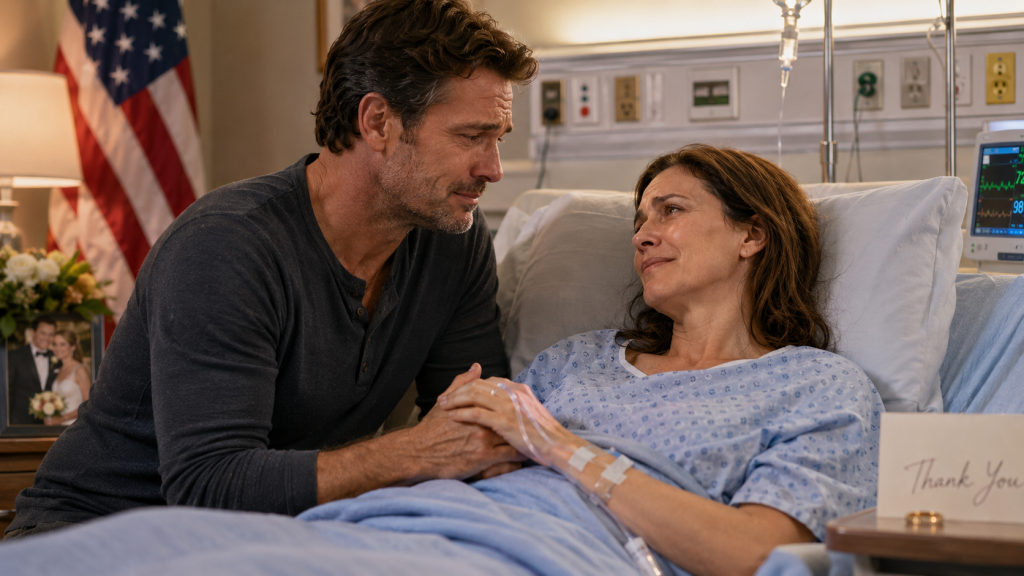
Rachel lay in a private room beneath a thin white blanket.
Machines surrounded her. Tubes ran into her arm. Her skin looked almost transparent beneath the hospital lights.
For a moment, I could not move.
This was what she had hidden from me.
Not one illness, not one operation, but years of appointments, medications, fear, and pain.
She had endured all of it believing she was protecting me.
Her eyes opened slowly.
When she saw me, tears gathered immediately.
“You weren’t supposed to come,” she whispered.
I walked to her bedside.
“You put my name in your chart.”
“I forgot.”
“No, you didn’t.”
A weak smile touched her mouth.
“No. I didn’t.”
I sat down and took her hand.
It felt small and cold inside mine.
“Why, Rachel?”
“You read the letter.”
“I want to hear you say it.”
She looked toward the window.
“I wanted you to have a life.”
“You were my life.”
“That was the problem.”
“No. The problem was you decided what I could survive without asking me.”
Her eyes closed.
“I know.”
“You let me believe I failed you.”
“I’m sorry.”
“You let me believe our marriage had died because I stayed too late at work and stopped paying attention.”
“I’m sorry.”
“You spent three years alone.”
“So did you.”
Her answer broke whatever anger remained in me.
I bowed my head over her hand.
For several minutes, neither of us spoke.
Finally, Rachel whispered, “I saw pictures of you sometimes.”
“What pictures?”
“Karen sent them. Birthdays. Church dinners. Matthew’s graduation.”
“Did I look happy?”
She shook her head.
“No.”
“Neither did you.”
“I tried to believe you would become happy eventually.”
“You should have come home.”
“I was ashamed.”
“Of being sick?”
“Of lying.”
I reached into my pocket and removed her wedding ring.
Rachel stared at it.
“You left this on my pillow.”
“I thought it was goodbye.”
“It was a cruel goodbye.”
“I know.”
I slid the ring onto her finger.
It fit loosely but still belonged there.
Rachel began crying.
“You divorced me,” I said, “but you never stopped being my wife.”
“Danny, the surgery—”
“I know.”
“You don’t know what happens next.”
“Neither do you.”
“You could still leave.”
“I already did that once. I let you go because I thought it was what you wanted. I’m not doing it again.”
She gripped my fingers.
“I’m scared.”
It was the first honest thing she had said about her illness.
I leaned forward and pressed my forehead against hers.
“So am I.”
A doctor entered shortly afterward.
He explained the surgery, the risks, and the possibility that Rachel might not survive it. I listened carefully. I asked questions. I signed nothing because legally I was no longer her husband, but Rachel insisted that I be allowed to remain.
Before they wheeled her away, she looked at me.
“If I don’t come back—”
“You’re coming back.”
“Danny.”
“I’ll be here either way.”
She nodded.
The doors closed behind her.
Elaine arrived twenty minutes later.
She stopped when she saw me.
For three years, I had blamed her for encouraging the divorce. Now I saw how exhausted she looked, how many years of Rachel’s secret she had carried.
“I’m sorry,” she said.
“I’m angry with you.”
“I know.”
“But not today.”
She sat beside me.
For six hours, we waited.
Karen came next, then Matthew and his new wife. The waiting room filled with people who loved Rachel and had known pieces of the truth but never the whole of it.
I walked the hallway until my legs ached.
I drank bad coffee.
I read Rachel’s letter so many times that I memorized entire paragraphs.
When the surgeon finally appeared, I stood so quickly that the chair fell behind me.
“The procedure was successful,” he said.
I closed my eyes.
Successful did not mean cured.
The doctor made that clear.
The cancer was advanced. Recovery would be difficult. More treatment might be possible, but no one could promise how much time Rachel had.
For that day, survival was enough.
Rachel spent nine days in the hospital.
I slept in the chair beside her bed.
The first night, a nurse suggested I go to a hotel.
Rachel managed a tired smile.
“Don’t bother. He’s impossible.”
I stayed.
When she returned to Elaine’s house, I moved into the guest room.
Rachel protested for exactly three minutes.
Then she asked me to make coffee.
I made two cups.
Over the following months, we rebuilt something that did not need a legal name.
Some days were good. We sat on the porch, played cards, and argued about old movies.
Some days were terrible. Treatment left Rachel weak and nauseated. I held the basin, managed her medication, and helped her walk to the bathroom.
She apologized constantly.
Every time, I told her to stop.
One afternoon, she asked, “Do you regret coming?”
I looked at her as if she had spoken in another language.
“Not for one second.”
“But this is what I wanted to spare you.”
“You didn’t spare me. You made me suffer somewhere else.”
She absorbed that quietly.
“I thought love meant protecting you from pain.”
“Love means letting me stand beside you while it hurts.”
She reached for my hand.
“I understand that now.”
Six months after the surgery, Rachel felt strong enough to travel back to our house.
She stood in the kitchen again, touching the coffee maker.
This time, it was not a grave.
It was simply home.
We remarried on the back porch two weeks later.
There were twelve guests.
Karen arranged the flowers and cried louder than anyone. Elaine stood beside Rachel. Matthew served as my witness.
Rachel wore a pale blue dress and the same gold ring.
When the minister asked whether I took her as my wife, I said yes before he finished the question.
Everyone laughed.
Rachel looked at me with that same unaged laugh in her eyes.
We were given fourteen more months together.
Some people might call that a tragedy.
I do not.
Fourteen months was enough time for Rachel to return to the shop and sit behind the old desk while I worked.
Enough time to watch autumn leaves cover the yard.
Enough time to celebrate one last Christmas.
Enough time for hundreds of cups of coffee.
Enough time for apologies, forgiveness, and the ordinary silence of two people who no longer mistook quiet for emptiness.
Rachel died on a Sunday morning with her hand in mine.
The radio was playing softly.
Her wedding ring remained on her finger.
Before her breathing stopped, she opened her eyes and whispered, “Full life.”
I understood.
She had once believed a full life meant one without the burden of her illness.
In the end, we learned something different.
A full life is not a life without pain.
It is a life in which love is allowed to remain present through the pain.
Three years after our divorce, Rachel left her ring on my pillow because she thought goodbye was the greatest gift she could give me.
She was wrong.
The greatest gift was the hospital call that brought me back.
It gave us truth.
It gave us forgiveness.
And it gave us fourteen months in which neither of us ever had to wake up wondering why the other one had disappeared.
I still make coffee for two every morning.
The second cup sits across from me while the sun rises through the kitchen window.
Some habits are not signs that a man cannot move on.
Sometimes they are how love continues to sit at the table.
THE END. THANK YOU FOR READING.