
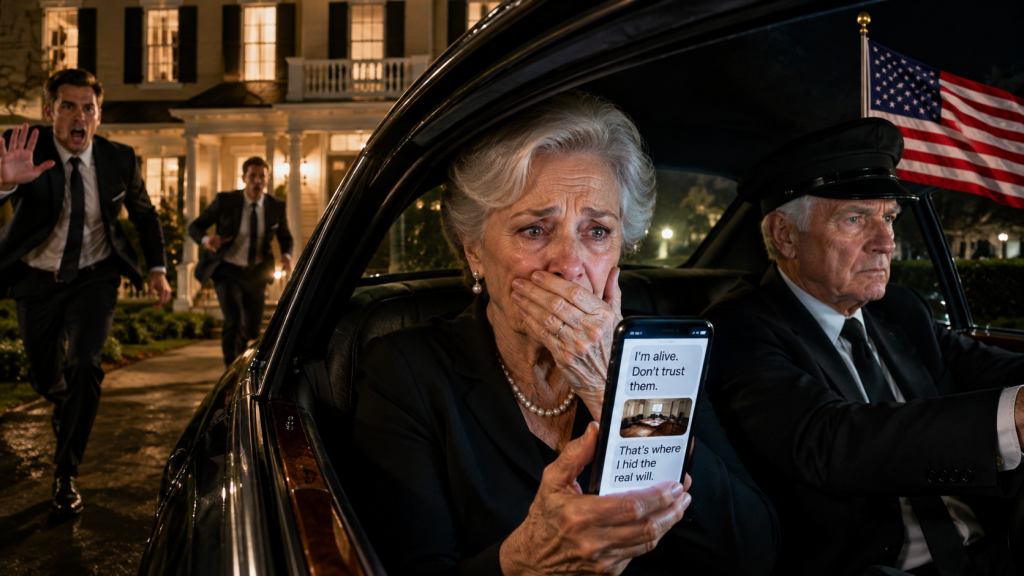
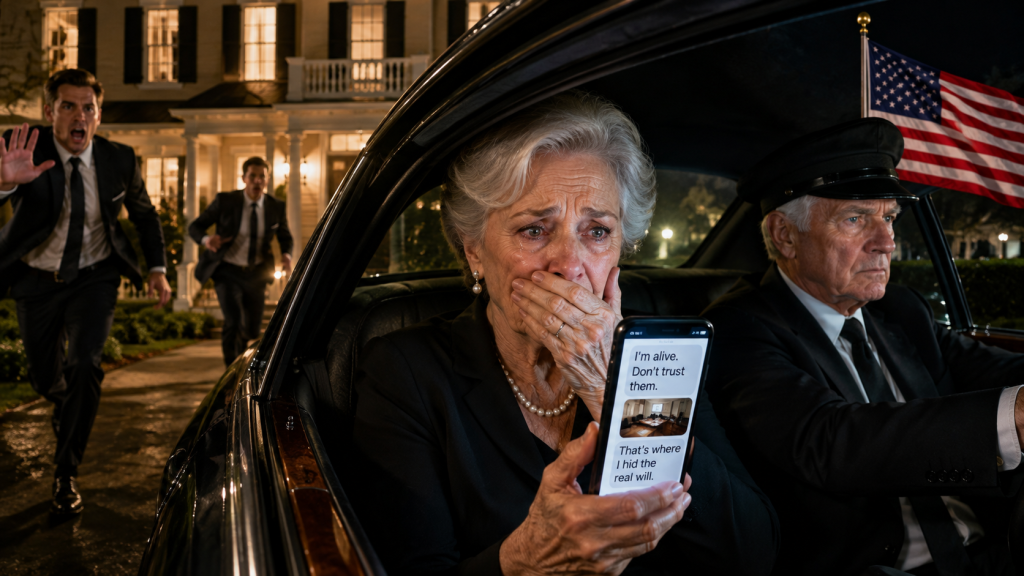
Right in the middle of my husband’s funeral, while my sons feigned tears next to the casket, a message reached my phone: “I’m alive. Don’t trust them.” I thought it was a sick joke… until the second message came with a photo of Richard’s desk and read: “That’s where I hid the real will.”
“If you want to know who died in my place, go to the farmhouse in the Shenandoah Valley and ask for the son William and Thomas believed they buried when he was a newborn.”
I read the message three times inside the car. I didn’t understand. Or I didn’t want to understand. Mr. Henderson drove without turning on the radio, both hands steady on the wheel. Left behind was Greenwich, my home, my sons, the closed casket, and forty-three years of marriage turned into an impossible question.
“Mr. Henderson,” I whispered, “is Richard alive?”
The old chauffeur looked through the rearview mirror. “Yes, Mrs. Margaret.”
I covered my mouth. My weeping came out strange. It wasn’t a clean relief. It was rage, fear, love, and betrayal all twisted together.
“And the man in the casket?”
Mr. Henderson took entirely too long to answer. “He needs to be the one to tell you that.”
We drove all night. We left Connecticut while the drizzle battered the windshield. We passed the dark interstates, the semi-trucks with red taillights, and the closed diners where the scent of burnt coffee still lingered. Inside my purse, I carried the letter, the USB drive, the empty vial, and Richard’s revolver. I had never felt so old. Nor so wide awake.
At dawn, the Shenandoah Valley appeared with its clear sky, its rolling hills, and that earth that smells different after the rain. Mr. Henderson took a dirt road between old oak trees, tall grass, and weathered stone walls. The farmhouse wasn’t elegant. It was a low, white house with hydrangeas and a well in the center of the courtyard.
And there was Richard. Alive.
Sitting on a wooden chair, with a few days’ stubble, a bandage on his arm, and eyes full of guilt. I got out of the car without knowing whether to run toward him or hit him.
He stood up. “Maggie.”
I slapped him. Not hard. Just enough for him to understand that a woman doesn’t mourn her husband in front of a casket as part of a strategy and then hug him as if nothing happened.
“I wept for you in front of your sons,” I said. “I wept for you in front of a casket.”
Richard lowered his head. “Forgive me.”
“Don’t start with that. Speak.”
We walked into the kitchen. A woman from the farm served us coffee, but nobody touched it. Richard placed a folder on the table. His hands were trembling.
“William and Thomas wanted to declare you incompetent,” he said. “They already had a doctor willing to testify that your grief had altered your mind. They wanted to control your accounts, sell the house, and present a forged will.”
I felt a wave of nausea. “I overheard them.”
“They were also drugging me.”
I looked at the vial in my purse. “With this?”
He nodded. “Small doses. Sedatives. Just enough to make me seem confused, slow, tired. They told me it was just old age. I started to suspect something when William insisted on bringing me coffee every single night.”
I remembered my son walking into the study with a smile. “Dad, rest. You can’t handle all of this anymore.” My eyes burned.
“And you faked your death?”
“Not from the beginning. My plan was to leave the house, file a police report, and protect you. But then Gabriel died.”
The name pierced right through me. Gabriel. My firstborn son. The baby who, according to everyone, died just two days after he was born. They told me he was born weak. They sedated me. When I woke up, Richard was crying by my bedside, and my mother-in-law was saying that God knew why He did things. I never saw the body. Only a tiny white box.
“No,” I said.
Richard closed his eyes. “Gabriel didn’t die back then.”
I stood up so fast the chair fell backward. “What did you say?”
“My mother gave him away.”
The air in the room turned to poison.
“Your mother?”
“She said the boy was born sick, that we would spend our entire lives in hospitals, that you wouldn’t survive the strain. I was young. I was desperate. I believed he died because they told me the same lie they told you. Eight months ago, Gabriel found me.”
I gripped the edge of the table. “You knew him for eight months and you didn’t tell me?”
Richard wept. “He didn’t want me to. He grew up believing we had abandoned him. By the time he learned the truth, his heart was already failing. He was terrified of showing up only to die all over again in your arms.”
I felt something ancient rip open deep inside me. A pain that didn’t belong to a widow. It belonged to a robbed mother.
“I had the right to hold him.”
“Yes.”
“I had the right to know his voice.”
“Yes.”
“I had the right to say goodbye.”
Richard didn’t defend himself. That only infuriated me more.
He led me to a small bedroom. There was a made bed, a candle, a folded shirt, and a portrait. Gabriel. Nearly forty years old. Richard’s eyes. My mouth. My exact way of tilting his head. I approached the portrait and completely broke down.
“My boy…”
On the table lay a letter. “Momma Maggie.” I opened it with useless, trembling hands.
“Forgive me for arriving late. They told me you didn’t want me because I was born sick. When I met Dad, I understood that we had been robbed too. I didn’t want to make you suffer, but I needed you to know that I lived. That I felt fear. That I dreamed of your voice even though I couldn’t remember it. If you ever read this, don’t think I died without a mother. I imagined you my entire life.”
I collapsed onto the bed. I wept for the baby I never got to cradle. For the boy I never saw walk. For the man who died calling me Momma on a piece of paper. Richard stayed by the door. He was smart to do so. If he had stepped closer, I would have hated him. If he had walked away, I would have hated him just the same.
When I could finally breathe, I asked: “How did he end up in that casket?”
Richard sat across from me. “Gabriel died here, three days ago. The doctor signed his death certificate with his real name. But William and Thomas didn’t know I had fled the Greenwich house. They entered my study at night. They believed they found me dead on the daybed because Gabriel looked so much like me. Thinner, with a beard, covered up. Mr. Henderson let them get confused.”
“You let them bury our son under your name?”
“They weren’t going to bury him. They were going to cremate him tomorrow morning. Fast. To erase all the evidence.”
Rage dried my tears instantly.
“We are going back today.”
“Yes.”
“And this time, you don’t send me messages like a ghost. This time, you walk right beside me.”
Richard nodded.
Attorney Preston arrived before noon—an old notary public and long-time friend of Richard’s. He brought certified copies, videos, DNA test records, the authentic will, and a flash drive containing recordings.
“Mrs. Margaret,” he said, “your sons didn’t just try to alter the estate succession. There are clear indicators of chemical tampering and financial elder abuse. And regarding you, an attempt to forcibly compromise your legal capacity through fraudulent deception.”
I looked at Richard. “The will?”
Preston opened the folder. “The family estate is left entirely to you with total control and life estate rights. The primary bank accounts as well. William and Thomas were only designated to receive a portion if they respected your explicit will and didn’t attempt to declare you incompetent, pressure you, or forge documents. Since they violated those terms, they are entirely disinherited.”
“They violated them.”
“Then they have lost far more than money.”
I tucked Gabriel’s letter safely against my chest. “Let’s go.”
We returned to Connecticut before nightfall. I didn’t go hiding in the shadows. I sat straight up in the backseat, with the black veil stuffed inside my purse and a heart turned into a solid, unyielding ruin.
When we arrived at the funeral home, William was aggressively arguing with the director. “My father wanted an immediate cremation,” he was saying. “My mother is not in the proper mental condition to make these decisions.”
Thomas was speaking into his phone nearby. “Yes, doctor. As soon as she returns, we’ll sedate her. She’s completely delusional.”
I walked right into the room. “Delusional about what, son?”
Thomas whirled around. He turned ghostly white. William stepped toward me with a well-rehearsed expression of deep concern.
“Mom, where were you? You had us half to death with worry.”
Then Richard walked in right behind me. William’s entire face collapsed. Thomas stumbled backward until he crashed right into a standing floral arrangement.
“Dad…”
Richard looked at them as if he were seeing them for the very first time in his life. “You certainly were in a desperate hurry to burn me.”
William opened his mouth, but absolutely nothing came out. Preston’s legal assistant spoke directly to the director. The cremation was immediately suspended. The funeral home staff, who minutes before had been obeying my sons with compliant smiles, were now demanding identifications, legal forms, and verified authorizations.
The police arrived without their sirens blaring. The fraudulent doctor tried to slip out through a side corridor, but Mr. Henderson pointed him out to the officers. Inside his briefcase, they discovered blank prescription pads, heavy sedatives, and a pre-drafted psychological evaluation bearing my name.
“Severe cognitive decline.” “Requires permanent structural supervision.” “Presents a high risk for independent asset management.”
I almost laughed. Not out of amusement. Out of pure horror. “They even wanted to forge my old age,” I said coldly.
William tried to step closer. “Mom, you don’t understand. Dad was going to leave us with absolutely nothing for the sake of a complete stranger.”
I slapped him across the face. The sharp crack silenced the entire room.
“Gabriel was not a stranger. He was my son.”
Thomas threw his hands over his head, panicked. “That man was dead!”
“No,” I fired back. “He was hidden away. Just like the truth.”
Richard took a definitive step toward them. “You chose money over your own mother.”
William grit his teeth, his eyes flashing with bitterness. “You chose a dead man over your living children.”
Richard looked at him with a profound, crushing sadness. “No. You chose to become dead to me.”
Gabriel was buried in the Shenandoah Valley under his true legal name. There was no grand society service. There were no corporate executives, no high-society friends from Greenwich, no expensive custom wreaths. Just oak trees, damp earth, the private doctor who had cared for him, Mr. Henderson, Preston, Richard, and me.
I placed white roses flat onto his grave. “Forgive me for arriving late, my son.”
The wind rustled through the branches. Nothing more. But that afternoon, at the very least, my son finally had his mother standing before his earth.
After that, the legal warfare commenced. William and Thomas ceased to be my sons; they became criminal case numbers. Grand fraud. Forgery of legal documents. Attempted grand larceny of property. Financial elder abuse. Unlawful administering of chemical substances. Conspiracy to fraudulently manipulate legal competency. I mastered terms that no mother ever wants to learn in connection to her own flesh and blood.
The authentic will was formally read at a law office in Manhattan, with video cameras rolling, corporate attorneys present, and my two sons sitting across from me looking like men who still foolishly believed they could negotiate their way out of the truth.
Preston read the provisions clearly: “Any act directed toward pressuring, legally incapacitating, sedating, displacing, or administering care against the explicit will of my wife, Margaret Harrington, shall result in the immediate and total exclusion of any and all inheritance benefits.”
William clenched his jaw tightly. Thomas broke into a wave of desperate tears.
“Mom, please…”
I didn’t offer a single word in response. The notary public continued: “A prominent portion of the estate assets shall be permanently allocated to the Gabriel Harrington Foundation, designated for the specialized cardiac medical care of infants and children across rural communities in Virginia.”
I closed my eyes tightly. Gabriel didn’t receive our resources in time. Other children would.
When the reading concluded, William bolted upright from his chair. “You stripped us of everything.”
Richard, sitting firmly by my side, answered him: “No. You emptied yourselves.”
William never once begged for my forgiveness. He sent defense attorneys. He sent legal threats. He sent bitter letters claiming Richard was completely manipulating my mind. I filed every single one of them away in a cardboard box without reading past the first two lines.
Thomas did return once. Months later, he surfaced in the estate gardens—thinner, with a neglected beard, holding a bouquet of grocery-store flowers purchased out of sheer guilt. I met him outside on the porch steps. I didn’t invite him into the living room.
“Mom,” he choked out, “William pressured me into all of it.”
“You were a grown man long before your brother ever learned how to lie better than you.”
He lowered his head. “Forgive me.”
I looked at him the way you look at a child you still carry love for, but realize you can no longer save from himself. “Forgiveness doesn’t hand back the keys, Thomas.”
He wept. “I know.”
“Then start by actually knowing it for real.”
I didn’t pull him into an embrace. Nor did I scream and drive him away. Sometimes a mother doesn’t know if that boundary is an act of mercy or just absolute exhaustion.
Richard and I never returned to who we used to be. How could we? He had saved me from my own sons. But he had also hidden my firstborn child from me for months. He made me mourn him under a false pretense and bury Gabriel under another identity. We slept in separate bedrooms for months. The estate in Greenwich, with its high security walls and manicured gardens, no longer felt elegant. It smelled of poisoned coffee, of dark secrets, of drawers pried open by greedy hands.
I had every single lock terminal changed. I threw the ceramic coffee mug where the vial had been hidden straight into the trash. But I kept the mahogany desk. Every single morning, I would walk up and press the bottom left molding of the secret compartment—even though it remained completely empty—just to remind myself that a woman must always know exactly where she guards her truths.
One night, I found Richard sitting alone out on the dark patio.
“I don’t deserve for you to stay under this roof,” he murmured.
I took a seat right beside him. “I didn’t stay because you deserve it, Richard. I stayed because forty-three years of history cannot fit inside a single lie. But they can’t be magically cured by a single truth, either.”
He wept silently into his hands. “Gabriel possessed your exact mouth, Maggie.”
“I know.”
“I should have driven you straight to him.”
“Yes, you should have.”
“I should have told you the truth.”
“Yes, you should have.”
“Are you ever going to forgive me?”
I looked past the trees at the cold, distant lights of the city skyline. “Perhaps on the day I finally stop waking up feeling like I am burying you twice.”
He didn’t say another word. He was smart not to.
The Gabriel Foundation opened its very first mobile pediatric clinic two years later. We traveled deep into the rural counties, where mothers walked for miles carrying their infants wrapped tightly in warm blankets. I watched a pediatric cardiologist carefully examine a baby while his mother bowed her head, praying in a low whisper. I reached out and took her hand.
“We are right here,” I told her gently. And in that quiet room, I felt that Gabriel was right there alongside us, too.
Richard died for real five years later. There was no closed casket mystery. There was no theatrical display. There were no frantic text messages sent from unknown numbers. There were no sons standing by the pew feigning tears. I laid him to rest with a profound, clean sadness. Not a flawless history—but a clean grief. I placed a single flower onto his grave and whispered:
“This time, I know exactly where you are.”
Then I walked over to Gabriel’s headstone and left another. The mother of a stolen child. The wife of a man who both saved me and deeply wounded me. The survivor of two living sons who learned entirely too late that a mother is not a trembling signature to be exploited.
Today, I am eighty years old, and I still reside independently in my home. Upstairs in the study, the mahogany desk remains firmly in its place. Inside the secret compartment, I no longer store wills or financial trusts. I store letters. Gabriel’s letter. A letter Richard wrote to me right before he passed, begging for my peace. And a letter of my own, drafted for the day I am no longer here. It begins with these exact words:
“To whoever attempts to make decisions on my behalf when I no longer possess the voice to speak: Margaret was never a confused widow, nor a mother easily erased from her own history, nor an old woman waiting around for a permission slip to exist.”
Sometimes my cell phone vibrates in my palm in the quiet of the afternoon, and I still feel that sudden, icy chill wash over my skin. I remember the funeral parlor. The reverend reciting the prayers. William and Thomas standing rigid beside the casket. The text message: “I’m alive. Don’t trust them.”
I thought it was a sick, twisted joke. It was a cruel resurrection. But it was also the door. I discovered my husband wasn’t inside that box. I discovered my lost child had actually existed in this world. I discovered my living sons could operate like cold strangers. And I discovered something far more important: a woman can weep in front of a sealed casket, and still possess the absolute, unyielding strength to split open a desk, a will, a massive lie, and her own destiny.
Richard left me an asset of warning. Gabriel left me a legacy of love. William and Thomas left me a scar. But I left myself the most critical asset of all: the absolute refusal to ever obey those who labeled my confinement as care.
That is why, whenever people ask me how I managed to survive that funeral, I always deliver the exact same response: It wasn’t because Richard was alive. It was because I had finally woken up, too.
THE END! THANKS FOR READING!