
 Reading Time: 40 minutes
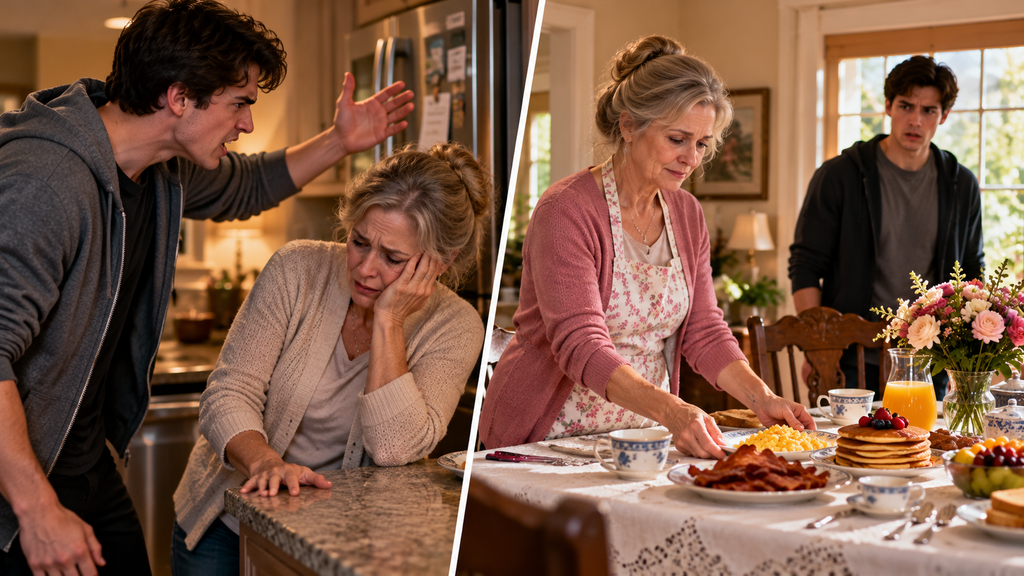
“Son, there’s something you need to know about the money you’ve been taking…” David’s voice was quiet. Too quiet for the kind of truth he was about to reveal.
Jason stood frozen in the doorway of my dining room, wearing the same gray sweatpants and black T-shirt he had worn the night before.
His hair was messy.
His eyes were still heavy with sleep.
And for the first time in years, my son looked uncertain.
Not angry.
Not arrogant.
Uncertain.
He glanced at his father.
Then at the uniformed police officer standing beside the window.
Then at the woman in the dark blue suit sitting across from his untouched breakfast.
Finally, he looked at me.
“Mom?”
I didn’t answer.
He swallowed.
“What is this?”
I stood at the head of the table with my hands resting on the back of my mother’s old wooden chair.
The white embroidered tablecloth lay perfectly smooth beneath the breakfast dishes.
The pancakes were still warm.
The coffee was fresh.
Everything smelled exactly as it had on the mornings when Jason was a little boy and the worst thing he could do was sneak chocolate chips out of the pantry.
But nothing about that morning was ordinary.
David took a step forward.
“Jason, sit down.”
Jason laughed nervously.
“Are you serious?”
“Sit down.”
“No. I’m not sitting down until somebody tells me why there’s a cop in my mother’s dining room.”
The officer spoke calmly.
“My name is Officer Bennett. Your mother requested assistance after an incident last night.”
Jason’s expression changed immediately.
He looked at me.
Then he laughed.
A short, disbelieving laugh.
“You called the police?”
“Yes,” I said.
“On me?”
“Yes.”
He stared.
“Over an argument?”
I felt my jaw tighten.
“It wasn’t an argument, Jason.”
He rolled his eyes.
“Oh, come on.”
“You hit me.”
His face flushed.
“I barely touched you.”
The words hung in the room.
Nobody moved.
Nobody spoke.
And in that terrible silence, I heard something I had spent years teaching myself not to hear.
The truth.
My son had just admitted what he had done.
But he still believed it wasn’t serious.
He still expected everyone to move on.
He still expected breakfast, forgiveness, and another chance.
David’s expression hardened.
“You struck your mother?”
Jason looked at him.
“Dad, stay out of it.”
“Answer me.”
“She was screaming at me.”
“I wasn’t screaming,” I said.
Jason spun toward me.
“Don’t start changing the story!”
Officer Bennett stepped forward.
“Lower your voice, please.”
Jason looked at him with disbelief.
“You don’t get to come into my house and tell me how to talk.”
I took a slow breath.
“Jason.”
He turned.
“This isn’t your house.”
For a moment, he looked genuinely confused.
Then he smirked.
“Right. Here we go again.”
“No,” I said. “Not again.”
I reached for the folder beside my plate.
“This time, we’re finishing the conversation.”
I opened it.
Inside were photographs of my swollen cheek.
A medical report from an urgent care clinic that had examined me early that morning.
Copies of messages Jason had sent over the previous six months.
Bank statements.
A written notice terminating his permission to live in my home, subject to the legal process required.
And beneath everything else was a document Jason had never seen.
A document bearing his father’s signature.
David looked at it.
His eyes filled with something I couldn’t immediately identify.
Shame, perhaps.
Or regret.
Maybe both.
“Jason,” he said, “for the last three years, I’ve been sending money to help you.”
Jason stiffened.
I looked at David.
Even though he had explained part of this to me during our conversation before dawn, hearing it aloud still made my stomach twist.
David continued.
“Not a little money. A lot.”
Jason crossed his arms.
“So?”
“So I believed that money was paying for your rent, classes, insurance, and living expenses.”
Jason looked away.
David’s voice grew sharper.
“You told me you were renting an apartment with two roommates.”
Silence.
“You told me your mother knew you were living there.”
Jason said nothing.
“You told me you had gone back to college.”
My heart sank.
I had known about the money.
But I hadn’t known about the college.
David reached into his briefcase.
He placed a stack of transfer confirmations on the table.
“I sent you fifteen hundred dollars every month.”
The room became completely still.
I stared at the papers.
Fifteen hundred dollars.
Every month.
For three years.
Jason had been living with me for almost two of those years.
Eating my food.
Using my electricity.
Borrowing my car.
Demanding money for gasoline and insurance.
And all that time, his father had been sending him fifteen hundred dollars every month.
David looked at our son.
“That’s fifty-four thousand dollars, Jason.”
Jason’s jaw tightened.
“I know how much money you’ve sent me.”
“Then tell me where it went.”
“It’s none of your business.”
David’s voice broke.
“It’s my business when you lie to me about why you need it.”
Jason laughed bitterly.
“Oh, now you’re both going to gang up on me?”
I stared at him.
Not because he was shouting.
Not because he was angry.
But because he was standing in front of the people who had tried to help him and still saw himself as the victim.
And then he said something that made the room feel colder.
“You’re acting like I stole it.”
David looked devastated.
“Jason, you told me you would be homeless if I stopped paying.”
Jason shrugged.
“Things were expensive.”
“You were living here for free!”
“So what?”
David pressed both hands against the table.
“So you lied to me about your address. You lied about school. You lied about working. And you let your mother believe you had nothing.”
Jason pointed at me.
“She doesn’t need the money!”
The words came out so naturally that I almost laughed.
Not because anything was funny.
But because suddenly I understood how he had justified everything.
His father’s money belonged to him because his father owed him for leaving.
My money belonged to him because I was his mother.
The house belonged to him because he had grown up in it.
And anything we kept for ourselves was, in his mind, something we were stealing from him.
I finally spoke.
“Jason, look at me.”
He didn’t.
“Look at me.”
His eyes met mine.
For one brief moment, I saw the little boy who used to bring injured birds into our garage.
Then his expression hardened again.
“What?”
“I want you to tell me something.”
He sighed dramatically.
“Fine.”
“When you hit me last night, what did you think would happen this morning?”
He blinked.
“What?”
“Did you think I would make breakfast, apologize for upsetting you, and hand you the money?”
His silence answered for him.
I nodded slowly.
“That’s what I thought.”
He glanced toward the pancakes.
Then back at me.
“Mom, you’re being ridiculous.”
“No, Jason.”
My voice trembled.
But I didn’t look away.
“I’ve spent years being ridiculous. This morning, I’m finally being reasonable.”
He opened his mouth.
I raised my hand.
“I’m not finished.”
To my surprise, he stopped.
“Last night, you hit me because I said no. And afterward, you told me I made you do it.”
I touched my cheek.
It was still tender.
“Do you know what frightened me most?”
He looked irritated.
“The fact that you hit me wasn’t the most frightening part.”
I swallowed.
“It was that you walked away believing you had taught me a lesson.”
Something shifted in his face.
For the first time, he looked at the breakfast differently.
At the white tablecloth.
At the good china.
At the people waiting for him.
“Mom…”
“This is the last breakfast I will make for you while you live in this house.”
His head snapped up.
“What?”
“You cannot continue living here.”
He stared.
Then he laughed.
“You can’t kick me out.”
“The legal process has started.”
He looked toward the attorney.
She spoke for the first time.
“Mr. Miller, my name is Rebecca Lawson. I’m representing your mother. This notice explains the next steps regarding your occupancy. The process will follow the applicable housing laws. Nobody is asking you to surrender rights you may have under those laws.”
Jason snatched up the paper.
His eyes moved quickly across it.
Then he slammed it onto the table.
“This is insane!”
Rebecca remained calm.
“Your mother has also documented last night’s assault. She has requested that the matter be investigated and that appropriate safety measures be considered.”
Jason looked at Officer Bennett.
“You can’t arrest me because my mother got emotional.”
The officer answered evenly.
“An allegation of assault is not something we dismiss because the people involved are family.”
For one second, Jason looked afraid.
Then the anger returned.
He turned toward David.
“Tell her she’s crazy.”
David didn’t move.
“Dad?”
David looked at him with tears in his eyes.
“Your mother isn’t crazy.”
“Come on!”
“She’s afraid of you.”
Jason recoiled.
It was the first accusation that seemed to reach him.
He turned to me.
“Are you actually afraid of me?”
I thought about lying.
Even then.
Even with the officer standing in my dining room.
Even with the medical report on the table.
Even with my cheek still swollen.
Part of me wanted to protect him.
Part of me wanted to soften the words so they wouldn’t hurt.
But I had spent too many years doing that.
“Yes,” I said.
Jason went still.
“I am afraid of you.”
He stared at me.
And then, very quietly, he said:
“Good.”
David stood so suddenly that his chair scraped against the floor.
Officer Bennett moved closer.
But I didn’t flinch.
I simply looked at my son.
Because in that instant, something inside me finally stopped arguing with the truth.
I couldn’t save Jason by allowing him to destroy me.
And no amount of love could make that sentence less true.
The next thirty seconds changed the course of our lives.
Jason looked around the dining room, breathing heavily.
“You planned all of this?”
I said nothing.
“You made me breakfast just to humiliate me?”
“No.”
“Then why?”
“Because I wanted one last moment to remind myself that I can love you and still say no.”
He shook his head.
“You’re unbelievable.”
Then he grabbed the nearest plate.
My mother’s china.
A delicate white plate decorated with tiny blue flowers.
He lifted it.
For one terrible second, I thought he was going to throw it at me.
Officer Bennett stepped forward.
“Jason. Put the plate down.”
Jason’s fingers tightened.
“Back off.”
“Put it down.”
David raised his hands.
“Son, please.”
Jason looked at each of us.
His breathing grew faster.
Then he hurled the plate against the wall.
It shattered.
The sound was enormous.
I jumped.
And suddenly I was standing in the kitchen again, hearing the crack of his hand against my face.
The officer gave a firm command.
Jason shouted something in reply.
Then he shoved the chair away from him.
Within moments, Officer Bennett had restrained him and radioed for assistance.
Jason struggled.
Not for long.
But long enough to make me understand how much worse the night before could have become.
“Mom!” he yelled.
I stood beside the table.
“Mom, tell him to let me go!”
I couldn’t speak.
“Mom!”
My throat burned.
He looked directly at me.
“You’re really going to let them do this?”
I wanted to tell him I hadn’t caused this.
I wanted to tell him he had made his own choices.
I wanted to explain that consequences weren’t the same as cruelty.
But no words seemed large enough.
So I said the only thing I knew was true.
“I love you, Jason.”
For half a second, his face softened.
Then he spat out:
“If you loved me, you wouldn’t do this.”
I felt tears rise.
“That’s what I’ve believed for years,” I whispered.
The officer guided him toward the hallway.
Jason twisted around one last time.
“You’re going to regret this!”
I watched my son leave the house.
The front door closed.
And for the first time in nearly two years, the house was silent.
Not the tense silence that followed one of his outbursts.
Not the silence of waiting for another demand.
Real silence.
Safe silence.
I stood in the dining room with shattered porcelain scattered beneath the window.
The pancakes were getting cold.
The coffee had stopped steaming.
David was staring at the doorway.
Rebecca quietly gathered the papers.
And I realized my hands were shaking so badly that I could barely hold the back of the chair.
Then my knees gave way.
David caught me before I hit the floor.
“Sarah.”
I shook my head.
“I’m okay.”
He helped me sit.
“Sarah, you’re not okay.”
I looked at the broken plate.
And then I began to cry.
Not softly.
Not gracefully.
I cried the way people cry when they’ve held themselves together for too long and suddenly have no reason to pretend.
I cried for the son I had raised.
For the boy who had once fallen asleep against my shoulder.
For the young man who had turned our home into a place where I measured every word.
I cried because I was relieved he was gone.
And I cried because admitting that relief made me feel like the worst mother in the world.
David knelt beside me.
“Sarah, listen to me.”
I couldn’t look at him.
“He’s our son.”
“I know.”
“He’s our baby.”
“I know.”
I covered my face.
“What happened to him?”
David didn’t answer.
Because neither of us knew.
And perhaps that was the hardest truth of all.
There wasn’t one terrible event we could point to.
One moment when Jason had become someone we barely recognized.
There had been hundreds of moments.
Excuses.
Little lies.
Threats.
Money handed over to prevent arguments.
Apologies accepted without changed behavior.
And years of hoping that the next chance would finally be the one he needed.
That morning, surrounded by broken china and cold breakfast, I understood that love hadn’t been absent from Jason’s life.
But accountability had been.
And we had helped create that absence.
I thought the worst part of the morning was over.
I was wrong.
Rebecca waited until David had brought me a glass of water.
Then she sat opposite me and opened a second folder.
“Sarah,” she said gently, “there’s something else we need to discuss.”
I looked up.
David’s expression changed.
He knew.
I could see it.
“What?” I asked.
Rebecca hesitated.
“The financial records you asked me to examine raised a concern.”
My stomach tightened.
“What kind of concern?”
She slid a bank statement across the table.
I recognized the account immediately.
It was my savings account.
Not the account I used to pay bills.
Not the joint account David and I had closed after our divorce.
This was the account I had opened twelve years earlier.
The account where I kept emergency money.
Money I had saved from years of working at the elementary school.
Birthday checks from my mother.
Small tax refunds.
Every extra dollar I could put aside.
It wasn’t a fortune.
But it was my safety net.
I stared at the statement.
At first, nothing looked unusual.
Then I saw the withdrawals.
Eight hundred dollars.
Twelve hundred dollars.
Five hundred dollars.
Nine hundred and fifty dollars.
The dates stretched across several months.
My heart began to pound.
“I didn’t make these.”
Rebecca nodded.
“That’s what you told me when we reviewed the recent activity.”
I counted again.
There were eleven transfers.
The total was $9,450.
I gripped the edge of the table.
“No.”
David sat down.
“Sarah…”
“No, Jason didn’t have access to this account.”
Rebecca spoke carefully.
“We don’t yet know who initiated every transaction. But the preliminary information suggests the transfers were made using online access associated with a device that had been used in your home.”
I felt cold.
I remembered a night several months earlier when Jason had offered to help me update my banking app.
He had been unusually patient.
“Mom, you’re always getting locked out. Let me fix it.”
I had handed him my phone.
He had sat beside me on the couch.
He had smiled.
He had said, “See? Easy.”
My stomach turned.
“Oh, God.”
David looked at me.
“What?”
I whispered:
“I gave him my password.”
Rebecca leaned forward.
“Sarah, don’t assume anything before the bank completes its investigation.”
But in my heart, I already feared I knew.
Jason hadn’t simply been taking money when I handed it to him.
Someone had been accessing my savings without my knowledge.
I looked toward the empty doorway.
For years, Jason had accused me of keeping score.
And all that time, I hadn’t even known the score.
By noon, my house had become a place of phone calls, reports, and decisions I had never imagined making.
I contacted my bank.
Changed my passwords.
Reviewed every account.
Requested new cards.
Asked the bank’s fraud department to investigate the disputed transfers.
Rebecca helped me organize the records and understand the steps ahead.
A locksmith arrived that afternoon to discuss changing the locks when legally permitted and ensuring emergency access arrangements complied with the necessary orders.
I hated every part of it.
Every call felt like another admission that my son had become someone I needed protection from.
At three o’clock, my phone rang.
It was David.
He had driven to the police station to provide his statement.
“Sarah?”
His voice sounded strange.
“What happened?”
A pause.
Then:
“They found something in Jason’s car.”
My heart stopped.
“What?”
“Receipts.”
I frowned.
“Receipts for what?”
David exhaled.
“Hotels. Restaurants. A casino resort. Expensive stores.”
I closed my eyes.
“How much?”
“Thousands.”
I sat on the edge of my bed.
“David, I don’t understand.”
“Neither did I.”
He hesitated.
“Until I spoke to someone.”
“Who?”
“Jason’s old friend, Marcus.”
Marcus.
I remembered him.
A quiet boy with freckles who used to spend summer afternoons playing video games in our basement.
Jason and Marcus had been inseparable through high school.
Then, sometime after Jason returned home, their friendship ended.
Jason had told me Marcus was jealous.
Jealous of what, he never explained.
“What did Marcus say?”
David was silent for a moment.
Then he said:
“Sarah, Jason has been telling people he’s a successful real estate investor.”
I stared at the wall.
“What?”
“He’s been pretending he owns rental properties.”
“That doesn’t make sense.”
“He’s been borrowing money from people. Promising investments. Saying he can double their savings.”
My hand tightened around the phone.
“No.”
“Marcus says Jason owes him nearly six thousand dollars.”
I felt physically sick.
David continued.
“He isn’t the only one.”
I thought of the weekends Jason disappeared.
The expensive jacket.
The nights he came home intoxicated.
The money he could never explain.
The sudden demands.
The anger whenever I refused.
Pieces of a picture began fitting together.
A picture I desperately didn’t want to see.
“How many people?” I asked.
“We don’t know yet.”
“And the three hundred dollars he wanted last night?”
David’s voice dropped.
“Marcus thinks Jason owed someone money and had promised to pay it yesterday.”
I closed my eyes.
That meant the argument hadn’t begun when I said no.
Jason had arrived in my kitchen already desperate.
Already looking for someone to blame.
But desperation did not excuse what he had done.
Nothing did.
“Sarah,” David said, “there’s one more thing.”
I gripped the phone.
“What?”
“Jason didn’t tell Marcus you were his mother.”
I blinked.
“What are you talking about?”
“He told Marcus you were his landlord.”
I couldn’t speak.
“And he said you were a wealthy widow who had agreed to finance his business.”
I felt as if the floor had shifted beneath me.
A wealthy widow.
A landlord.
A business partner.
Was that who I had become in my son’s stories?
Not the woman who had packed his lunches.
Not the woman who had worked overtime to pay for his braces.
Not the mother who had sat beside his hospital bed when he broke his arm at eleven.
Just another source of money.
I stared at the framed photograph on my dresser.
Jason at eight years old.
Missing his front teeth.
Holding a handmade Mother’s Day card that said:
I LOVE YOU MORE THAN ALL THE STARS.
My voice cracked.
“David, what happened to our son?”
He answered very quietly.
“I think we’ve been asking the wrong question.”
“What do you mean?”
“We keep asking what happened to him.”
A pause.
“Maybe we need to start asking what he’s been doing.”
That evening, I found an envelope beneath Jason’s bedroom door.
I nearly walked past it.
His room was at the end of the upstairs hallway, the same room he had slept in since he was four.
The posters had changed.
The toys were gone.
The blue walls had been painted gray.
But the door still had a faint mark near the handle from the time he had tried to bring his bicycle inside when he was nine.
I had gone upstairs to retrieve my grandmother’s photograph from the linen closet.
Nothing more.
I had no intention of entering his room.
Then I saw the envelope.
Plain white.
My name written across the front.
MOM.
I stopped.
My first thought was that Jason had written an apology before coming downstairs.
Maybe he had slipped it there after hitting me.
Maybe he had planned to tell me he was sorry.
I wanted that to be true so badly that I almost opened it immediately.
Instead, I photographed the envelope and called Rebecca.
She advised me to preserve it and let the investigators know about it before disturbing anything further.
When it was eventually opened as part of the investigation, its contents shocked all of us.
There was no apology.
There was a handwritten list.
At the top were four words:
MOM — MONEY AND ASSETS.
Beneath them were details about my house.
My car.
My salary.
My approximate retirement savings.
My insurance.
Even the name of the bank where I kept my emergency account.
At the bottom, written in thick black ink, was a sentence I will never forget.
She’ll give in if I push hard enough.
I read those words again.
And again.
Until they blurred.
For years, I had thought Jason’s demands were impulsive.
He needed money.
He became frustrated.
He shouted.
Then he apologized.
But this was different.
This suggested calculation.
He had studied me.
My finances.
My habits.
My fear of losing him.
And somewhere along the way, he had begun treating my love as a weakness he could exploit.
Rebecca placed the paper back into its protective sleeve.
“Sarah, are you all right?”
I shook my head.
“No.”
For once, I didn’t pretend.
Three days later, a woman knocked on my door.
She was perhaps twenty-five.
Long brown hair.
A beige coat.
Dark circles beneath her eyes.
She stood on my porch holding a small handbag with both hands.
“Mrs. Miller?”
“Yes?”
“My name is Emily Carter.”
I recognized the name.
Emily.
Jason’s former girlfriend.
The young woman he had once described as selfish and disloyal.
The one he had insisted was responsible for their breakup.
I opened the door a little wider.
“Emily?”
She nodded.
“I’m sorry to come here unannounced.”
“Is something wrong?”
Her eyes filled with tears.
“I heard what happened.”
My stomach tightened.
“How?”
“Marcus told me.”
I hesitated.
She looked past my shoulder into the hallway.
“Is Jason here?”
“No.”
Relief flooded her face so quickly that I felt ashamed I hadn’t noticed her fear sooner.
“Would you like to come inside?” I asked.
She nodded.
We sat in the living room.
The same room where Jason used to bring Emily flowers.
Where they had watched movies together.
Where I had once teased him because he always cleaned his room before she visited.
I made tea.
My hands shook while I carried the cups.
Emily noticed.
“Mrs. Miller, I’m so sorry.”
I sat opposite her.
“Please call me Sarah.”
She nodded.
For a moment, we simply looked at each other.
Then she said:
“Jason told me you hated me.”
I blinked.
“What?”
“He said you thought I wasn’t good enough for him.”
My mouth fell open.
“Emily, I never said anything like that.”
A tear slid down her cheek.
“I know that now.”
I put down my cup.
“He told me you cheated on him.”
She closed her eyes.
“I didn’t.”
“He said you took money from him.”
She gave a bitter laugh.
“It was the other way around.”
The room seemed to shrink.
Emily opened her handbag.
She removed several folded papers.
Bank transfer records.
Screenshots.
Messages.
She placed them on the coffee table.
“Jason owed me almost eight thousand dollars when I left.”
I stared at her.
Eight thousand.
Another person.
Another lie.
Emily wiped her eyes.
“He convinced me to help him start a business. He said he needed money for licensing, equipment, and a deposit on a small office.”
“What business?”
She shook her head.
“There wasn’t one.”
I felt sick.
“He kept saying the money would come back. Then he started getting angry whenever I asked about it.”
I looked at her hands.
She was twisting a silver ring around her finger.
“Did he hurt you?”
Emily’s eyes dropped.
And that was enough.
I whispered:
“Emily.”
She swallowed.
“He never punched me.”
I waited.
“But he grabbed my arm. Once he blocked the door when I tried to leave. Another time he threw my phone against the wall.”
I closed my eyes.
I remembered Jason punching the hole in his bedroom door.
Kicking the chair.
Raising his voice.
I had seen the warning signs.
But I had never imagined he was doing the same things to someone else.
Or perhaps I had simply refused to imagine it.
Emily looked at me.
“I thought if I loved him enough, he’d stop.”
My eyes filled.
I knew those words.
Not because Jason had said them.
But because I had lived them.
She continued.
“He could be so sweet, Sarah.”
I nodded.
“I know.”
“He would apologize. Cry. Tell me he hated himself for getting angry. He’d promise he’d change.”
“I know.”
“And then it happened again.”
We sat in silence.
Two women separated by decades.
Connected by the same person.
The same promises.
The same fear.
Finally, Emily said something I wasn’t prepared to hear.
“He told me you were afraid of being alone.”
I looked up.
She hesitated.
“He said that’s why you always gave him money.”
I stared at her.
“He said you wouldn’t risk losing him because your husband already left.”
Her voice broke.
“I thought he was just being cruel when he said it.”
I looked away.
For years, I had told Jason that his father leaving had hurt him.
And it had.
But I had never admitted how much the divorce frightened me too.
I had lost my marriage.
Our family home had become quieter.
Holidays became complicated.
Every other weekend, Jason disappeared into his father’s world.
Then David moved away.
And I worried that if I was too strict, too demanding, too unwilling to forgive, my son would leave me too.
So I made myself indispensable.
I cooked.
I cleaned.
I paid.
I forgave.
I tried to become the parent Jason would never want to abandon.
But somewhere along the way, I stopped being his mother and became his safety net without boundaries.
Emily reached across the table.
“Sarah, I didn’t come here to make you feel worse.”
“Then why did you come?”
She took a shaky breath.
“Because there’s something else you need to know.”
My heart sank.
“What?”
“Jason told me that when you retired, he would get the house.”
I frowned.
“He always assumed I’d leave it to him someday.”
Emily shook her head.
“No.”
Her voice dropped.
“He said you were going to sign it over while you were still alive.”
I felt cold.
“When?”
“He said soon.”
I stared.
“Why?”
“He told me you were getting forgetful.”
My mouth went dry.
“Forgetful?”
“He said he was helping you manage your finances because you were having trouble remembering things.”
For several seconds, I couldn’t speak.
Then I thought about the banking app.
The passwords.
The list of assets.
The way Jason occasionally laughed when I misplaced my glasses.
“Mom, you’re getting old.”
“Mom, you never remember anything.”
“Mom, let me handle it.”
Emily continued.
“He showed me a document once.”
“What document?”
“I don’t know exactly. It had something about property and authorization.”
My hands began trembling again.
“Did you sign anything?”
She shook her head.
“No. He wanted me to witness something, but I refused.”
I looked at her.
“Why?”
“Because your signature was already on one of the pages.”
I stopped breathing.
Emily’s eyes filled.
“And Sarah, it didn’t look right.”
I called Rebecca before Emily even left the house.
By the following morning, my attorney had helped me begin reviewing county property records, banking authorizations, and any documents that might have been submitted using my name.
I had expected bad news.
But nothing prepared me for what we found.
A document had been drafted seeking to give Jason authority over certain financial decisions.
It had not become legally effective.
There was no completed transfer of my home.
No valid deed changing ownership.
But the draft contained personal information Jason had no reason to collect.
My birth date.
My identification details.
My account information.
A signature purporting to be mine.
A signature I did not recognize as one I had written.
Rebecca studied it for a long time.
Then she looked at me.
“Sarah, this needs to be reviewed by the appropriate authorities.”
I felt my chest tighten.
“Are you saying my son tried to take my house?”
“I’m saying we have evidence of a document that raises serious concerns. We shouldn’t draw conclusions before it’s investigated.”
I looked out the window.
The maple tree in my front yard was beginning to lose its leaves.
Jason had climbed that tree when he was little.
At twelve, he had fallen from the lowest branch and scraped both knees.
He had cried so hard I thought he’d broken a bone.
I had carried him into the house.
Bandaged him.
Made him hot chocolate.
He had looked up at me and whispered:
“Mom, you’ll always take care of me, right?”
And I had promised.
Of course I had promised.
How could I have known that one day keeping that promise would mean refusing to give him what he wanted?
A week after the breakfast, I received a phone call that almost destroyed my resolve.
Jason was being released under conditions while the case continued.
David had agreed to help him arrange temporary accommodation, but he had made it clear that the monthly payments were ending.
There would be no more fifteen hundred dollars.
No secret rescue.
No cash handed over to make the next crisis disappear.
David offered to pay directly for an initial assessment with a qualified counselor and to help Jason access employment resources.
Jason refused.
Then he called me.
The number appeared on my phone at 7:43 p.m.
I stared at it.
My heart began racing.
I knew I didn’t have to answer.
I knew that communication needed to comply with the protective arrangements and any applicable restrictions.
So I let the call go unanswered and saved the record for my attorney.
Minutes later, a voicemail appeared.
I sat at the kitchen table and listened with Rebecca on the phone.
At first, Jason sounded angry.
“Mom, seriously? You’re still doing this?”
There was a pause.
Then his voice changed.
“Look, I know things got out of hand.”
My eyes filled.
“I shouldn’t have hit you.”
I covered my mouth.
For a brief moment, hope rushed through me so strongly it almost hurt.
He had finally said it.
He had finally admitted what he’d done.
Then he continued.
“But you embarrassed me in front of everyone. Dad thinks I’m some kind of monster now. Marcus won’t talk to me. Emily’s telling people lies. You’ve basically ruined my entire life.”
My hope faded.
“I can’t believe you’re doing this to your own son.”
A long silence.
Then:
“Anyway, I need some of my stuff. And I’m short on money for a place. If you can send me five hundred dollars, we can talk about fixing this.”
I closed my eyes.
There it was.
The apology.
The blame.
The request.
The same pattern, wrapped in slightly different words.
Only this time, I recognized it.
Rebecca remained silent until the message ended.
Then she asked gently:
“Sarah, what are you thinking?”
I wiped my cheek.
“That I miss him.”
“I understand.”
“And that I want to help him.”
She waited.
“But I won’t give him money.”
My voice shook.
“I can’t keep paying him to stay the same.”
The next month was harder than I expected.
People sometimes imagine that standing up to someone abusive creates immediate peace.
They imagine a dramatic moment.
A powerful speech.
A door closing.
And then freedom.
But real life is rarely that clean.
I still woke at night expecting to hear Jason shouting from the hallway.
I still caught myself buying his favorite cereal.
I still cooked too much pasta because I was used to feeding two people.
Sometimes I passed his empty bedroom and felt such overwhelming grief that I had to sit on the stairs.
Other times, I felt relief so intense it frightened me.
I no longer listened for his car pulling into the driveway.
I no longer checked my bank account before coming home, wondering what demand would greet me.
I no longer rehearsed explanations for why I couldn’t spare another hundred dollars.
For the first time in years, I could say no without bracing for the sound of something breaking.
And yet I mourned him.
Not because he was dead.
But because the relationship I thought we had was gone.
One afternoon, I went into his room with two cardboard boxes.
I had been advised how to handle his belongings lawfully, and arrangements would be made for him to retrieve them safely.
I wasn’t there to throw anything away.
I only wanted to find a set of family photographs that belonged to me.
His room smelled faintly of old laundry and the cologne he liked.
On his desk were empty energy-drink cans.
A broken phone charger.
Receipts.
A photograph of him and Emily.
The picture was turned facedown.
I picked it up.
They were smiling on a beach.
Jason had his arm around her shoulders.
She looked happy.
He looked happy.
I wondered whether either of them had imagined where things would end.
Then I noticed something behind his bookshelf.
A small shoebox.
Blue.
Dusty.
I recognized it immediately.
It was the box where Jason used to keep his childhood treasures.
Stones.
Baseball cards.
Little plastic animals.
A broken watch he had found at a flea market.
I hadn’t seen it in years.
I opened it carefully.
Inside were photographs, birthday cards, and old school drawings.
There was a picture of David and Jason fishing.
A medal from a youth soccer tournament.
A Valentine’s Day card I had given him when he was nine.
And at the bottom was a folded piece of yellow construction paper.
I opened it.
In uneven handwriting, Jason had written:
MY MOM IS MY HERO BECAUSE SHE ALWAYS HELPS PEOPLE AND NEVER GIVES UP.
I sat down on the edge of his bed.
And I broke.
I held that paper against my chest and cried until my throat hurt.
Because the little boy who wrote those words had been real.
His kindness had been real.
His love had been real.
And the man who struck me had also been real.
For so long, I had believed accepting the second truth meant betraying the first.
But it didn’t.
I could remember the child without denying the adult’s choices.
I could grieve what had changed without pretending nothing had happened.
I could love my son without giving him permission to hurt me.
I folded the paper.
Placed it back in the box.
And carried the box downstairs.
Two months after that terrible breakfast, David came to see me.
It was a Sunday afternoon.
The air was cool.
I had just finished making tea when his car pulled into the driveway.
He looked older than he had at our last meeting.
Tired.
There were new lines beside his eyes.
We sat on the back porch.
For a while, neither of us said much.
Then David looked at me.
“I owe you an apology.”
I shook my head.
“David…”
“No. Please.”
He rested his elbows on his knees.
“After the divorce, I felt guilty.”
I looked at him.
“I know.”
“I hated that Jason thought I abandoned him. I hated missing birthdays, school events, all those ordinary things fathers are supposed to be there for.”
His voice tightened.
“So whenever he called asking for money, I sent it.”
I nodded slowly.
“He told me he was struggling.”
“I know.”
“And every time I sent money, I felt like I was doing something good.”
He looked down.
“But I wasn’t being his father. I was buying relief from my guilt.”
I swallowed.
David continued.
“And I left you to deal with everything else.”
“You didn’t know.”
“I didn’t ask.”
That stopped me.
He looked at me.
“I knew Jason had a temper. I knew he was having trouble keeping jobs. But I never called you and asked what life was really like.”
I looked away.
“I wouldn’t have told you.”
“Maybe not.”
He sighed.
“But I should have tried.”
For the first time since our divorce, we talked honestly about our mistakes.
Not the mistakes that ended our marriage.
The mistakes we made afterward.
I admitted that I had hidden Jason’s behavior because I didn’t want David to judge him.
David admitted that he had sent money because he didn’t want Jason to hate him.
We had both been so afraid of losing our son that we stopped asking whether our choices were helping him.
And Jason had learned to live in the space between us.
If I said no, he called David.
If David asked questions, Jason blamed me.
If either of us challenged him, he brought up the divorce.
He knew exactly where the old wounds were.
And he pressed them.
David stared at the backyard.
“Do you think he’ll change?”
I watched the wind move through the trees.
“I don’t know.”
He nodded.
“I keep thinking about when he was little.”
“Me too.”
“He used to cry when he saw someone hurt.”
“I remember.”
David looked at me.
“Where did that boy go?”
I thought for a long time.
Then I answered:
“Maybe he’s still somewhere inside him.”
David’s eyes filled.
“But he’s the only one who can decide whether he wants to find his way back.”
The legal proceedings continued.
The investigators reviewed the alleged unauthorized transfers.
The financial documents.
The evidence from Emily and Marcus.
The circumstances surrounding the assault.
Not every accusation could be resolved immediately.
Some required records.
Some required witnesses.
Some depended on whether prosecutors believed the evidence supported charges.
The uncertainty was exhausting.
But Rebecca kept reminding me of something important.
I didn’t have to predict the outcome of every investigation to protect myself.
I didn’t have to prove every lie Jason had ever told before deciding he could no longer live in my home.
And I didn’t have to wait for a judge to tell me that being struck by my adult son was unacceptable.
That part was already clear.
One afternoon, Rebecca called with news about the attempted financial authorization.
“Sarah, the document appears not to have been properly executed. It did not give Jason control over your property.”
I released a breath I hadn’t realized I was holding.
“So the house is safe?”
“Based on what we’ve verified, the title remains in your name. We’ll continue the necessary checks and address the suspicious signature.”
I closed my eyes.
“Thank God.”
Then she said:
“There’s something unusual about the draft.”
My relief faded.
“What?”
“The date.”
I looked at the calendar.
“What about it?”
“The document was prepared almost six months before the assault.”
I went still.
Six months.
Long before that night in the kitchen.
Long before I finally said no.
Jason’s plans hadn’t begun when I refused him three hundred dollars.
The argument hadn’t created the problem.
It had exposed it.
Rebecca continued.
“There’s also a note attached to one version.”
I whispered:
“What does it say?”
She hesitated.
Then read:
“Transfer should be completed before mother changes retirement plans.”
I stared at the wall.
Retirement plans.
I had mentioned retiring early just once.
At a family dinner.
I had said I was thinking about selling the house in a few years and moving closer to my sister, Anne.
Somewhere smaller.
Somewhere easier to maintain.
Jason had been at that dinner.
He had laughed.
“Why would you sell my childhood home?”
I told him it was too big for one person.
He had shrugged.
“We’ll figure something out.”
Now I wondered what those words had meant.
Had he been afraid of losing the house he expected to inherit?
Had he assumed my retirement savings would eventually become his?
Had he already decided that my future was something he could manage for his own benefit?
I felt a fresh wave of grief.
Then anger.
Not explosive anger.
Not the kind that makes you scream or throw things.
A colder kind.
The anger that comes when you realize how much of your life someone else has quietly claimed.
I had worked for decades.
Paid bills.
Maintained the house.
Saved carefully.
And my own son had apparently begun treating my future as though it belonged to him.
For the first time, I allowed myself to say something I had been ashamed to think.
“I deserve to enjoy the rest of my life.”
Rebecca’s voice softened.
“Yes, Sarah.”
I looked out at the front yard.
“I really do.”
Three months after Jason left, I received a letter.
It arrived on a Thursday.
Plain envelope.
My name written in a handwriting I could recognize anywhere.
Jason’s.
I sat at the kitchen table holding it for several minutes.
I wanted to open it.
I dreaded opening it.
Eventually, I called Rebecca and arranged for it to be reviewed in a way consistent with the protective arrangements.
When I finally read it, my heart began to ache.
It was five pages long.
The first page was exactly what I feared.
Accusations.
Excuses.
Complaints about his father.
Complaints about the police.
Complaints about Emily and Marcus.
He wrote that everyone had turned against him.
That he couldn’t find work because of the situation.
That he had lost friends.
That his reputation had been destroyed.
I almost stopped reading.
Then, halfway through the third page, something changed.
The handwriting became uneven.
And the words became different.
Mom, I keep remembering your face that night.
I stopped.
My hands began to shake.
I told myself you were exaggerating because I didn’t want to admit what I did.
I read the sentence twice.
Then continued.
When Dad asked me why I hit you, I told him you made me angry. He said that wasn’t an answer. I hated him for saying it.
My eyes filled.
I have been angry at both of you for so long that I don’t remember what I was angry about first.
I took a shaky breath.
I know Dad moved away. I know you got divorced. I know I felt like neither of you cared enough to keep our family together. But I am twenty-three now. I can’t keep blaming what happened when I was fifteen for everything I’ve done since.
I stared at those words.
Then I read the next paragraph.
I lied about school. I lied about the apartment. I spent the money Dad sent me. I took money from you without asking. I told myself I’d pay it back before you noticed. Then I kept doing it.
Tears slid down my cheeks.
I tried to get you to put the house in my name because I thought I deserved it. I know how ugly that sounds. I don’t have a better way to say it.
I pressed a hand against my mouth.
When you said no that night, I wasn’t thinking about you. I was thinking about what I wanted.
Then came the sentence that made me put the letter down.
I hit you because I chose to hit you. You didn’t make me do it.
I began sobbing.
Not because that erased anything.
It didn’t.
Not because I believed everything was fixed.
It wasn’t.
But because those were the first words I had heard from Jason that sounded like genuine responsibility.
No excuse.
No blame.
No demand.
Just a terrible truth.
I picked up the letter again.
I’m not asking you to forgive me. I don’t think I deserve that right now. Dad helped me get into a counseling program. I didn’t want to go, but I went. I am also getting help for my drinking and gambling.
I paused.
Gambling.
There it was.
A word that explained some of the missing money.
Not all the cruelty.
Not the violence.
But part of the chaos.
I owe a lot of people money. I can’t fix that in one day. I know I have to face the consequences of what I did.
Then:
I miss being your son. I know that sounds stupid because I still am. But I mean the kind of son who could come home and have breakfast with you without you being afraid.
My chest tightened.
I don’t know if we’ll ever have that again.
There was a long space.
Then one final paragraph.
I found an old picture of you holding me when I was a baby. You looked so happy. I keep wondering when I stopped caring whether you were happy too. I’m sorry, Mom. Not because I want money or a place to stay. I’m sorry because I hurt you.
At the bottom, he had written:
Jason.
No request for cash.
No demand to come home.
No threat.
Just his name.
I held the letter against my chest.
And for the first time since the assault, I allowed myself to hope.
Carefully.
Quietly.
Without making promises to myself.
Hope, I learned, is not the same as trust.
That lesson became important sooner than I expected.
Two weeks later, David called.
“Sarah, have you got a minute?”
I was watering the plants in the backyard.
“Of course.”
He sounded worried.
“Jason missed two counseling appointments.”
My stomach sank.
“Oh.”
“He says the sessions are pointless.”
I closed my eyes.
David continued.
“And he asked me for money yesterday.”
“How much?”
“Eight hundred.”
I gripped the phone.
“What did you say?”
“No.”
I opened my eyes.
David let out a tired breath.
“He was furious.”
I could imagine it.
The raised voice.
The accusations.
The insistence that nobody understood.
“What happened?”
“He hung up.”
I stared at the rosebush beside the porch.
For a moment, I felt foolish.
I had read Jason’s letter so many times that the pages were beginning to soften along the folds.
I had allowed myself to believe he was changing.
And perhaps he was trying.
But a letter was not a life.
An apology was not a pattern.
One honest moment did not erase years of dishonesty.
“Sarah,” David said gently, “I don’t want you to lose hope.”
I swallowed.
“I’m not.”
“Good.”
“But I’m not going to confuse hope with evidence anymore.”
He was quiet.
Then he said:
“Neither am I.”
The months passed.
Winter arrived.
The maple tree lost its leaves.
The house became quiet in ways I was still learning to appreciate.
I started seeing a counselor.
At first, I felt embarrassed.
I was fifty-six years old.
I had worked with children for decades.
I was supposed to understand behavior.
I was supposed to recognize warning signs.
Yet I had spent years excusing my own son’s escalating aggression.
During our third session, I told my counselor:
“I keep thinking I should have stopped this earlier.”
She asked:
“What would you say to a mother who came into the school library and told you her adult child had assaulted her?”
I answered immediately.
“I’d tell her she deserved to be safe.”
She nodded.
“And what would you tell her if she said she felt guilty for protecting herself?”
I looked down.
“I’d tell her she didn’t cause the violence.”
My voice cracked.
The counselor waited.
I covered my face.
“Why is it so much harder to believe that about myself?”
She answered gently.
“Because you have spent years measuring your worth as a mother by how much pain you’re willing to absorb.”
I sat very still.
Then I cried.
Again.
I seemed to do a lot of that.
But slowly, the tears changed.
At first, I cried because I was frightened.
Then because I was grieving.
Later, I cried because I was beginning to understand how much I had lost while trying to keep someone else comfortable.
And eventually, I cried because I was learning how to live differently.
I joined a weekend walking group.
I started visiting my sister Anne twice a month.
I took a pottery class at the community center.
My first bowl was so lopsided that the instructor gently suggested I call it abstract art.
I laughed harder than I had in years.
One Saturday morning, Anne took me to a small café overlooking the river.
We sat by the window eating blueberry muffins.
She watched me for a moment.
Then smiled.
“What?”
I asked.
“You look different.”
I touched my hair.
“Did I do something wrong?”
She laughed.
“No.”
“Then what?”
“You look peaceful.”
I stared at her.
Peaceful.
Such a simple word.
Such an unfamiliar feeling.
I looked down at my coffee.
“I think I am.”
Anne reached across the table and squeezed my hand.
And I realized that for the first time in a very long while, I wasn’t waiting for my phone to ring with another emergency.
Six months after the assault, the case reached an important turning point.
Jason had admitted responsibility for striking me.
He also acknowledged taking funds from my account without permission.
The legal consequences would include court-supervised requirements, restitution obligations, and conditions designed to protect me, subject to the court’s final orders.
Other financial allegations remained separate and required their own review.
I attended the hearing.
David sat beside me.
Rebecca was on my other side.
The courtroom was smaller than I expected.
Plain wooden benches.
Fluorescent lights.
A clock above the door that seemed impossibly loud.
Jason sat near his attorney.
He wore a white shirt.
His hair was neatly combed.
He looked thinner.
Older.
Not because much time had passed.
But because something in his face had changed.
When he saw me, he lowered his eyes.
My heart ached.
I wanted to hug him.
That instinct was still there.
I wondered whether it ever truly disappears.
But I remained seated.
When the judge addressed him, Jason answered quietly.
He acknowledged that he had harmed me.
He did not blame me for refusing money.
He did not describe the assault as a misunderstanding.
And when he was given an opportunity to speak, he said:
“I thought being angry meant I was allowed to hurt people.”
The room was silent.
He swallowed.
“I was wrong.”
I pressed my hands together.
Jason glanced toward me.
Then looked back at the judge.
“My mother spent years helping me. I took advantage of that. And when she stopped giving me what I wanted, I punished her for it.”
My eyes filled.
“I don’t expect her to trust me,” he continued. “I know I haven’t earned that.”
He paused.
“But I’m trying to become someone who doesn’t scare the people who love him.”
I looked down.
A tear fell onto my hand.
David passed me a tissue.
I whispered:
“Thank you.”
The hearing continued.
There were consequences.
Real ones.
The judge made clear that Jason’s choices were his responsibility.
His participation in treatment and repayment would be monitored under the conditions imposed.
The rules about contacting me and approaching my home remained governed by the applicable orders.
Nothing about it was easy.
Nothing was magically repaired.
But for the first time, Jason was being required to face his behavior without having either parent rush in to erase the consequences.
And I realized that this, too, was a form of love.
Not the soft, comforting kind.
The difficult kind.
The kind that refuses to rescue someone from the truth.
After the hearing, David and I sat in his car for a long time.
Neither of us spoke.
Finally, he turned toward me.
“Did you believe him?”
I looked through the windshield.
“Some of it.”
David nodded.
“Me too.”
I wiped my face.
“I want to believe all of it.”
“I know.”
I watched a woman cross the parking lot holding a little boy’s hand.
The child skipped beside her.
She laughed at something he said.
My throat tightened.
“David?”
“Yes?”
“Do you ever wonder if we ruined him?”
He looked at me for a long time.
Then shook his head.
“I think we made mistakes.”
I nodded.
“Big ones.”
“Yes.”
He glanced toward the courthouse.
“But Jason made choices too.”
I swallowed.
“He did.”
“And if he changes, it has to be because he chooses to.”
I rested my head against the seat.
For years, we had treated Jason’s life like a problem we were supposed to solve.
His jobs.
His relationships.
His bills.
His anger.
His excuses.
Every consequence became another emergency for his parents to manage.
Now, for the first time, the work belonged to him.
And we had to let it.
Nearly a year after the night Jason hit me, I received another letter.
This one was shorter.
Only two pages.
The handwriting was neater.
There were no dramatic declarations.
No promises that everything would be perfect.
Jason wrote that he had been attending treatment consistently for several months.
He was working at a warehouse.
It wasn’t glamorous.
The hours were long.
The pay was modest.
But he was showing up.
He had begun making small payments toward the money he owed.
Not enough to fix everything.
Not enough to undo the damage.
But enough to show that he was trying to take responsibility.
Then he wrote something that made me smile through tears.
I made pancakes last Sunday.
I stared at the sentence.
They were terrible. I burned the first batch and somehow made the second batch raw in the middle. I don’t know how you made breakfast for me every morning before school and still got to work on time.
I laughed softly.
Then continued.
I used to think all the things you did were easy because you never complained. I understand now that easy and loving aren’t the same thing.
I pressed the paper against my chest.
The last paragraph read:
I’m not asking to come home. I know that home has to be safe for you. I just wanted you to know I’m still trying. I hope you’re happy, Mom. Even if I can’t be part of your life the way I used to be.
I sat quietly for a long time.
Then I took out a pen.
And for the first time, after consulting about the proper channels for contact, I wrote him a letter in return.
It took me three attempts.
The first was too angry.
The second was too forgiving.
The third finally sounded like me.
I wrote:
Dear Jason,
I received your letter. I’m glad you’re working, attending treatment, and taking responsibility for your debts. Those are important steps.
I want you to know that I love you. That has never changed.
But love does not mean pretending the past didn’t happen. I am still healing. I am learning to feel safe again. And I need you to respect the boundaries that make that possible.
I hope you continue getting help, not to win me back or make your father proud, but because you deserve the chance to become a better man.
You cannot undo what happened. Neither can I.
But you can decide what kind of person you will be tomorrow.
I hope you choose carefully.
Love, Mom.
I folded the letter.
Placed it in an envelope.
And cried for a while.
Then I mailed it.
Not because everything was forgiven.
Not because everything was forgotten.
But because I wanted my son to know that accountability and love could exist in the same sentence.
Spring came.
The maple tree bloomed.
I turned fifty-seven.
Anne organized a small birthday dinner for me at a restaurant downtown.
David came.
So did two friends from the school library.
We ate pasta.
Shared dessert.
Laughed about old stories.
At one point, the waiter brought a tiny chocolate cake with a single candle.
Everyone began singing.
I covered my face, laughing.
“Please don’t!”
They sang louder.
And for a moment, I felt something I hadn’t experienced in years.
Joy without dread.
I wasn’t worried about Jason calling to demand money.
I wasn’t wondering whether he would arrive angry.
I wasn’t planning how to keep him calm.
I was simply celebrating my birthday.
After dinner, David walked me to my car.
He smiled.
“You look happy.”
“I am.”
He nodded.
“Good.”
Then he reached into his jacket pocket.
“I almost forgot.”
He handed me a small envelope.
My heart jumped.
“What’s this?”
“A birthday card.”
I looked at him.
“From you?”
He shook his head.
“From Jason.”
I froze.
David continued quickly.
“He asked me to give it to you only if you wanted it. I told him I couldn’t promise anything.”
I stared at the envelope.
For a moment, I was back in my dining room.
The white tablecloth.
The shattered plate.
The officer guiding Jason toward the door.
Then I looked at David.
“Does he know it’s my birthday?”
David smiled sadly.
“He remembers.”
I took the envelope.
But I didn’t open it until I got home.
Inside was a simple card.
No money.
No gift.
No dramatic speech.
Just a handwritten message.
Happy Birthday, Mom.
I hope this year brings you peace.
Love, Jason.
I read it twice.
Then I placed it on the mantel beside a photograph of my parents.
It wasn’t reconciliation.
Not yet.
But it was a birthday card that asked for nothing.
And that mattered.
A few weeks later, Rebecca called to tell me the property matter had finally been resolved as far as the suspicious paperwork was concerned.
My home remained mine.
The disputed authorization had not taken effect.
The bank had addressed the unauthorized activity through its investigation and the applicable recovery process.
Jason’s obligations concerning the money remained part of the legal arrangements.
When I hung up, I walked through the house.
Slowly.
Room by room.
The living room where Jason had taken his first steps.
The kitchen where I had taught him to scramble eggs.
The hallway where we marked his height on the doorframe every birthday.
The dining room where everything had changed.
I stopped beside the table.
For months, I had avoided using my mother’s white embroidered tablecloth.
It reminded me of that morning.
Of Jason’s smirk.
Of the words, “So you finally learned.”
Of the broken plate.
Of the moment I finally admitted I was afraid of my own son.
I went to the linen cabinet.
Took out the tablecloth.
And carried it into the dining room.
I spread it carefully over the table.
Smoothed the wrinkles.
Then I opened the china cabinet.
There were only five matching plates now.
The sixth had shattered that morning.
For a moment, I stared at the empty space.
Then I smiled sadly.
I didn’t need to replace it.
Some things break.
Some things cannot be made exactly as they were.
But that doesn’t mean everything beautiful is lost.
I set the table for one.
Made myself breakfast.
Scrambled eggs.
Toast.
Fresh fruit.
Coffee.
Then I sat down.
Outside, sunlight poured through the windows.
Birds were singing in the maple tree.
The house was quiet.
And I realized something extraordinary.
I was no longer afraid of the silence.
Eighteen months after that terrible night, I saw Jason in person again.
The contact was carefully arranged after the relevant restrictions had been reviewed, and only after I decided I was ready.
We met at a family counseling office.
Neutral ground.
Safe boundaries.
No surprise visit.
No pressure.
A counselor sat nearby to guide the conversation.
I arrived early.
My hands trembled as I waited.
I kept thinking about what I would say.
Would I recognize him?
Would he be angry?
Would I cry?
Would he expect everything to return to normal?
Then the door opened.
Jason stepped inside.
And my heart nearly stopped.
He looked so different.
Not dramatically.
Not like someone in a movie who had suddenly become an entirely new person.
He was still tall.
Still had David’s dark eyes.
Still had the small scar above his eyebrow from falling off his bicycle at twelve.
But his shoulders were different.
He wasn’t swaggering.
He wasn’t looking around as if the room belonged to him.
He looked nervous.
Almost frightened.
“Hi, Mom.”
Two words.
So ordinary.
So painful.
I swallowed.
“Hello, Jason.”
He sat across from me.
For a moment, neither of us spoke.
Then he looked at my face.
His eyes filled.
“I still think about what I did.”
I nodded.
“So do I.”
He looked down.
“I know.”
The counselor gently invited him to continue.
Jason clasped his hands together.
“I used to tell myself I had a right to be angry.”
He swallowed.
“I thought Dad leaving meant everyone owed me something. And every time Mom helped me, I started believing she had to.”
I listened.
He continued.
“When she finally said no, I felt like she was taking something from me.”
His voice broke.
“But it wasn’t mine.”
I looked at him.
He was crying now.
“I know that.”
I wanted to reach across the table.
To wipe his tears.
To tell him not to cry.
But I stayed still.
Because I had learned that his pain wasn’t always mine to fix.
Jason took a deep breath.
“I don’t want to be that person anymore.”
I nodded slowly.
“I hope you won’t be.”
He looked at me.
“Do you think you’ll ever forgive me?”
The question I had been dreading.
I looked down at my hands.
Then back at my son.
“I think forgiveness is something I’m still learning about.”
He nodded.
“I understand.”
“But I want you to hear this clearly.”
He sat straighter.
“I love you.”
His face crumpled.
“I love you too, Mom.”
“Yet loving you doesn’t mean I can trust you the way I used to.”
He wiped his face.
“I know.”
“And if we have a relationship again, it has to be built differently.”
He nodded.
“No money demands. No yelling. No threats. No showing up without permission.”
“Yes.”
“And if I say no?”
He looked at me.
“Then the answer is no.”
For a moment, I couldn’t speak.
Because those words were so simple.
And they had cost us so much.
I nodded.
“That’s where we begin.”
We didn’t hug that day.
Some people might find that strange.
A mother seeing her son after so long.
Tears.
Apologies.
Years of memories.
Surely there should have been an embrace.
But I wasn’t ready.
And Jason, to his credit, didn’t ask.
At the end of the session, he stood.
“Can I say one more thing?”
I nodded.
He swallowed.
“I’ve been thinking about that breakfast.”
My chest tightened.
He looked ashamed.
“When I came downstairs, I thought you’d cooked everything because you were scared of me.”
I looked down.
He continued.
“I thought I’d won.”
My eyes filled.
“And then I saw Dad and the officer and the papers.”
His voice shook.
“I was so angry because I realized I couldn’t control what happened next.”
I looked at him.
He wiped his eyes.
“But I’ve thought about it a lot.”
He took a deep breath.
“You made my favorite breakfast on the morning you stopped letting me hurt you.”
A tear slid down my cheek.
“And I think that was the first time you showed me what being a parent really meant.”
I shook my head.
“Jason…”
“No, Mom. Let me finish.”
He looked directly at me.
“You loved me enough to tell me no.”
I covered my mouth.
“And I’m sorry it took me so long to understand that.”
Then he left.
Quietly.
Without asking for anything.
I sat in the counseling room for several minutes after he was gone.
The counselor asked whether I was all right.
I thought about it.
Then nodded.
“Yes.”
And for once, I meant it.
Our relationship did not return to what it had been.
I don’t think it ever will.
There were phone calls.
Short ones at first.
There were messages on birthdays.
Updates about his work.
Occasional conversations about the books he was reading and the meals he was learning to cook.
Some weeks were better than others.
There were moments when his old defensiveness appeared.
Moments when I heard irritation creeping into his voice.
But now, when that happened, I ended the conversation.
Calmly.
Without arguing.
And gradually, Jason learned that my boundaries weren’t invitations to negotiate.
They were part of the relationship.
He continued working.
Continued making payments.
Continued attending counseling.
Not perfectly.
Not without setbacks.
But consistently enough that his actions began to matter more than his promises.
David and I remained united in one important decision.
We would support healthy change.
We would not finance avoidance.
We would listen.
But we would not rescue him from every difficult feeling or consequence.
And for the first time, Jason began building a life that didn’t depend on one of us solving his problems.
Two years after that morning, I hosted Thanksgiving dinner.
It was the first time in years I had felt excited about a holiday.
Anne came with her husband.
David brought a pie.
Two friends from work joined us.
The house smelled of roasted turkey, cinnamon, and freshly baked rolls.
I used my mother’s embroidered white tablecloth.
The good china.
The silver candlesticks.
Everything looked beautiful.
But there was one difference.
I no longer set a place automatically for Jason.
He had not been invited that year.
We were still rebuilding trust.
And I wasn’t yet comfortable having him back in the house.
It was a decision we had discussed in counseling.
Jason had been disappointed.
But he accepted it.
Instead of arguing, he sent a message.
Hope dinner goes well, Mom. Happy Thanksgiving.
No guilt.
No accusation.
No threat.
Just kindness.
I read it and smiled.
Then I put my phone away and joined my guests.
Halfway through dinner, Anne raised her glass.
“To Sarah.”
I laughed.
“Oh, no.”
She grinned.
“Oh, yes.”
Everyone chuckled.
Anne looked around the table.
“To a woman who has spent her life taking care of everyone else.”
My cheeks warmed.
“And who has finally learned that she deserves to be taken care of too.”
My eyes filled.
David lifted his glass.
“To Sarah.”
Everyone repeated it.
I looked around the room.
At my sister.
At my friends.
At the man who had once been my husband and was now, in a different way, still part of my family.
At the warm lights.
The beautiful table.
The people who were there because they loved me, not because they needed something from me.
And I realized how wrong Jason had been that morning.
He had looked at the pancakes.
Smiled.
And said:
“So you finally learned.”
He was right about one thing.
I had learned.
But not what he thought.
I had learned that forgiveness without boundaries can become permission.
That guilt is not a good reason to surrender your safety.
That love cannot force someone to change.
That a mother’s sacrifice should never become her child’s entitlement.
And that sometimes the most loving thing you can do is close a door and refuse to open it again until the person on the other side has learned how to knock.
There is one final thing I want to tell you.
Something I didn’t understand until much later.
For years, I thought being a good mother meant making sure Jason never felt abandoned.
I thought my job was to protect him from disappointment.
To soften every consequence.
To prove, over and over, that I would always be there.
But children do not become responsible adults simply because someone loves them enough.
They need honesty.
They need boundaries.
They need the freedom to make choices.
And they need to experience the consequences of those choices.
Jason’s father leaving hurt him.
Our divorce hurt him.
We made mistakes.
But none of those things made it acceptable for him to hurt another person.
And none of them gave him the right to control me.
I still love my son.
I love the little boy who brought injured birds into our garage.
I love the teenager who struggled through his parents’ divorce.
And I love the adult man who is now working to confront the harm he caused.
But I no longer believe that loving all those versions of him requires me to sacrifice myself.
I am his mother.
Not his bank.
Not his servant.
Not his excuse.
And certainly not his punching bag.
Last Sunday, I woke early.
The house was filled with soft morning light.
I made coffee.
Then pancakes.
Not because anyone demanded them.
Not because I was trying to prevent an argument.
Simply because I wanted pancakes.
I set one plate on the dining table.
The plate was white with tiny blue flowers.
One of the five remaining pieces from my mother’s china set.
I sat down.
Took a bite.
And smiled.
My phone buzzed.
A message from Jason.
Morning, Mom. Just wanted to say I love you. No need to reply. Hope you’re having a good day.
I looked at the screen for a long time.
Then typed:
Good morning, Jason. I love you too.
I placed the phone facedown.
Finished my breakfast.
And watched the sunlight move slowly across the tablecloth.
For so long, I had believed peace would come when Jason finally changed.
When he got a job.
When he stopped asking for money.
When he apologized.
When he became the son I remembered.
But I had been wrong.
My peace began the morning I stopped waiting for someone else’s behavior to give me permission to live my own life.
The morning I covered the table with my mother’s best cloth.
Cooked my son’s favorite breakfast.
And finally told the truth.
I had not stopped loving him.
I had stopped abandoning myself.
And that changed everything.
💬THE END! THANK YOU FOR READING! ❤️🙏