
 Reading Time: 55 minutes
The Call That Changed Everything The first time my son came looking for me in Oregon, he wasn’t alone. He brought his wife, his two children, and a folder filled with financial documents.
But what frightened me most wasn’t the folder. It was the expression on my nine-year-old grandson’s face when he stepped out of their car. Hugo looked at me as though he was afraid I might disappear if he blinked.
Then he ran across the driveway, threw his arms around my waist, and whispered something that made my blood run cold.
“Grandma, Mommy said you left because you don’t love us anymore.”
I stopped breathing for a moment.
Behind him, my daughter-in-law, Khloe, climbed out of the passenger seat.
My son, Theo, remained behind the steering wheel.
And in that instant, I understood something I had been too frightened to admit.
Walking away from my family had not ended the conflict.
It had only forced the truth into the open.
My name is Camila.
I am sixty-eight years old.
For most of my life, I believed that being a good mother meant giving until there was nothing left to give.
I believed a grandmother should never complain about exhaustion.
I believed that if my son needed something, I should find a way to provide it.
And for years, that was exactly what I did.
I gave Theo and Khloe my mornings, my afternoons, my savings, and more of my health than I could afford.
I paid for their leaking roof.
I covered their phone bills.
I paid for Cheyenne’s dancing lessons.
I bought groceries when their budget ran short.
I drove their children to school, cleaned their kitchen, folded their laundry, and rearranged my medical appointments whenever they needed help.
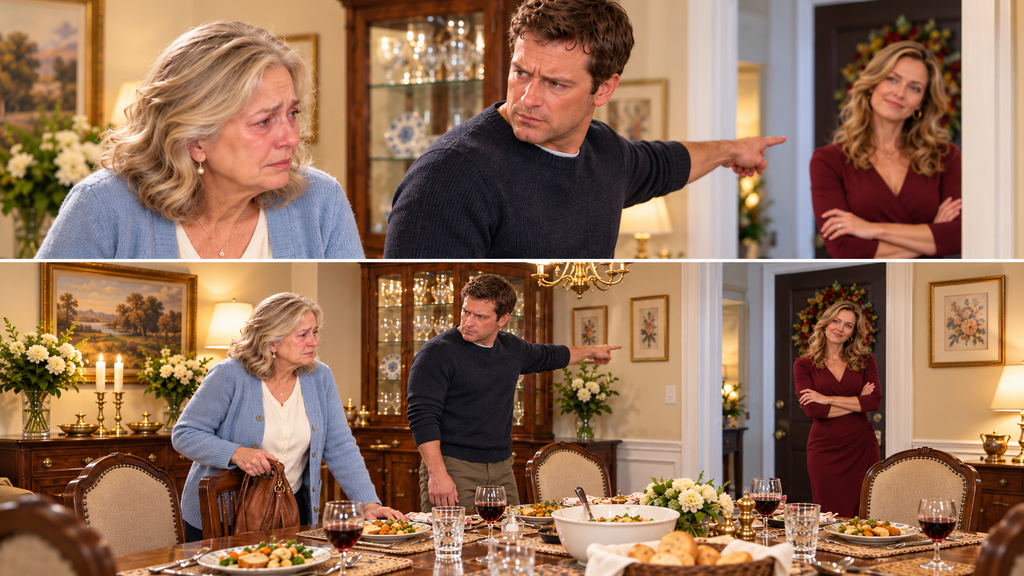
Then, one evening, my son pointed toward his front door.
“Either apologize to my wife,” he told me, “or walk out of this house and never come back.”
So I walked out.
I stopped paying the bills that were mine to stop.
I sold the house where I had spent decades raising my family.
And I moved to the Oregon coast to live near my older sister, Nora.
I thought the hardest part would be learning how to live without them.
I was wrong.
The hardest part would be discovering what they had told my grandchildren after I left.
And what my son had been hiding from me long before that terrible dinner.
A Different Kind of Morning
My first three weeks in Newport felt like stepping into someone else’s life.
I woke to the sound of seabirds instead of an alarm.
Through the bedroom window of Nora’s guesthouse, I could see tall grasses bending over the marsh and a thin strip of water reflecting the morning sky.
Nobody had left me a list of chores.
Nobody needed me to find a missing shoe.
Nobody expected breakfast at exactly seven.
The silence should have been peaceful.
Instead, it frightened me.
On my fourth morning, I woke at five-thirty and walked into the little kitchen.
Without thinking, I took six plates from the cabinet.
Then I stood there, staring at them.
Six plates.
Enough for Theo, Khloe, Hugo, Cheyenne, and whoever else might need feeding.
I was alone.
My hands began to shake.
I put five plates away.
Then I sat at the table and cried.
Not because I wanted to return to my old life.
Because I had forgotten how to live a life that belonged to me.
Nora found me there twenty minutes later.
She was wearing a blue cardigan, and her silver hair was still damp from the shower.
“What’s happened?” she asked.
I looked at the single plate on the table.
“I don’t know what to do with myself.”
She pulled out the chair opposite mine.
“Have breakfast.”
I gave a weak laugh.
“I’m serious.”
“So am I.”
“Nora, you don’t understand. Every morning for years, I knew exactly where I had to be. I knew who needed a ride, what groceries were missing, which uniform had to be washed. Now I wake up and there’s nothing.”
My sister studied me.
“Camila, there’s a difference between having nothing to do and having nobody telling you what to do.”
I looked away.
She reached across the table.
“You spent so long being useful that you started believing usefulness was the same as love.”
I wanted to argue.
Instead, I whispered, “Maybe it was.”
Nora’s eyes softened.
“No, sweetheart. It wasn’t.”
She let those words settle between us.
Then she stood, filled the kettle, and made tea.
For the first time in years, someone prepared breakfast for me.
And for reasons I couldn’t explain, that small kindness hurt more than I expected.
The Doctor’s Warning
Two days later, Nora drove me to an appointment with a specialist.
I had brought my medical records from Maple Oak, including the scans showing osteoporosis and the notes from my previous physician.
The doctor, a woman named Dr. Elaine Mercer, examined my knees, discussed my medication, and asked about the pain in my lower back.
Then she reviewed my history.
“How long have you been experiencing this level of discomfort?”
“About a year.”
“And have you been attending physical therapy?”
I hesitated.
“Not consistently.”
“Why not?”
I looked down at my hands.
“My family needed help.”
She waited.
I explained the school pickups.
The grocery shopping.
The cleaning.
The hours spent standing over a stove.
The laundry baskets I carried up and down stairs.
When I finished, she set down her pen.
“Camila, did anyone know how much pain you were in?”
“No.”
“Why didn’t you tell them?”
I swallowed.
“I didn’t want to become a burden.”
Her expression changed.
“You’re describing a situation in which you were already carrying a considerable burden.”
I tried to smile.
She didn’t.
“Your condition is manageable, but you need to take your treatment seriously. You cannot continue ignoring your limitations and expect your body to keep compensating.”
I nodded.
Then she asked a question that stayed with me long after the appointment.
“If one of your patients had described this situation to you, what would you have advised her?”
I stared at her.
For thirty-eight years, I had worked as a nurse.
I had comforted frightened patients, encouraged exhausted caregivers, and reminded older adults that accepting help wasn’t weakness.
Yet I had denied myself every kindness I offered other people.
“I would have told her to rest,” I finally admitted.
“And?”
“To stop lifting things she shouldn’t.”
“And?”
I felt tears gathering.
“To tell her family the truth.”
Dr. Mercer nodded.
“Then perhaps it’s time to follow your own advice.”
That afternoon, Nora and I stopped at a medical supply store.
I bought the supportive chair I had postponed purchasing months earlier.
It wasn’t inexpensive.
I stood beside the display for several minutes, staring at the price.
Nora noticed.
“What’s wrong?”
“I spent less time thinking about a twenty-five-thousand-dollar roof for Theo.”
She looked at the chair.
“And you’re hesitating over something your doctor recommended for you?”
I smiled sadly.
“Apparently.”
“Then buy the chair.”
I did.
That evening, I sat in it with a blanket across my knees and watched the sunset.
The sky turned pink above the marsh.
I remember thinking that Sebastian would have liked that view.
Then I remembered something he used to tell me.
“Camila, the people who love you should never require you to destroy yourself to prove it.”
When he was alive, I had always smiled at those words.
Now I understood them.
The First Message
Theo contacted me eleven days after I arrived.
It was a text.
Mom, I know you’re upset, but disappearing like this is unnecessary. We need to talk.
I stared at the screen.
Not Are you feeling better?
Not How is your treatment going?
Not even I’m sorry.
Just a complaint about my absence.
I placed the phone facedown.
Ten minutes later, another message appeared.
Khloe says you canceled the family phone plan without enough warning. Hugo’s tablet isn’t connecting properly. Can you at least fix that?
I laughed.
It wasn’t a happy sound.
It was the kind of laugh that escapes when something hurts so much that your body no longer knows what to do with it.
Nora looked up from her crossword.
“What?”
I handed her the phone.
She read both messages.
Then she gave it back.
“Are you going to answer?”
“I don’t know.”
“What do you want to say?”
I thought carefully.
Then I typed:
Theo, I am safe. I am receiving medical care and staying with Nora. I won’t be resuming the financial support or daily childcare arrangements. You and Khloe will need to manage your household responsibilities yourselves. I am willing to discuss our relationship when we can speak respectfully.
I read the message three times.
My finger hovered over the screen.
Nora said nothing.
Finally, I pressed send.
Theo answered almost immediately.
So you’re really doing this?
I didn’t reply.
Five minutes later:
You know we can’t suddenly afford everything you’ve been paying.
I looked at those words.
And for the first time, I asked myself a question I should have asked years earlier.
If they couldn’t afford their lifestyle without my money, why had they treated my contributions as though they were worthless?
The Numbers Nobody Wanted to See
The following morning, I opened the financial folder I had brought from Maple Oak.
I had reviewed the records with Preston Hail before leaving, but I had never added everything together.
Not properly.
I had been afraid to.
Nora sat beside me while I spread the papers across her dining table.
There were receipts for Cheyenne’s dance classes.
Phone statements.
Grocery purchases.
School expenses.
Clothing.
Transfers.
The roof replacement invoice.
And the documents for Theo’s truck loan.
I began with the expenses I could verify.
The roof had cost $24,860.
Cheyenne’s dance tuition, costumes, competition fees, and transportation had amounted to more than $8,000 over two years.
The phone bills added thousands more.
Groceries, clothing, school supplies, emergency payments, and household items filled page after page.
By the time I finished, the documented support over the previous two years exceeded $54,000.
That didn’t include the value of my time.
It didn’t include the fuel I used driving the children.
It didn’t include the physical therapy appointments I had postponed.
And it didn’t include the truck loan I had co-signed, because that was still a potential liability rather than money I had paid.
I pushed the calculator away.
Nora looked at the total.
“Camila.”
“I know.”
“Did you realize?”
“No.”
She sat back.
“That’s more than some people earn in a year.”
I looked at the papers.
“I thought I was helping with little things.”
“Some of them were little.”
“And then they became everything.”
Nora nodded.
I pressed my fingertips against my forehead.
“What bothers me most isn’t the amount.”
“What is it?”
“I would have given them every penny willingly if they had treated me like family.”
My sister was quiet.
Then she said, “You can love someone and still stop financing their decisions.”
I knew she was right.
But knowing something was right didn’t make it painless.
Because behind every bill was a memory.
Cheyenne twirling in her first dance costume.
Hugo smiling over his new school backpack.
Theo standing beneath the repaired roof, promising the house would finally stay dry.
I had not bought those things to control anyone.
I had bought them because seeing my family comfortable made me happy.
Somewhere along the way, they had stopped seeing the person behind the money.
And I had helped teach them that I would always be available.
That was the part I had to own.
A Visit From a Stranger
The first genuine surprise came on a rainy Thursday.
I was leaving physical therapy when an unfamiliar woman approached me in the clinic parking lot.
“Excuse me. Are you Camila?”
I stopped beside Nora’s car.
“Yes.”
The woman looked to be in her early forties.
She wore a green raincoat and carried a canvas handbag.
“My name is Rachel Bennett. I’m Cheyenne’s dance instructor.”
I recognized her immediately.
I’d seen her at competitions, recitals, and Saturday rehearsals.
“Rachel. Of course. What are you doing here?”
She looked uncomfortable.
“I was visiting my sister in Newport. I heard you’d moved here, and I hoped I might run into you.”
That sounded unlikely, but I didn’t challenge her.
“Is Cheyenne all right?”
Rachel hesitated.
“Physically, yes.”
My stomach tightened.
“What does that mean?”
She glanced toward the clinic entrance.
“Could we talk somewhere private?”
Nora, who had been waiting in the car, stepped out when she saw my expression.
We drove to a nearby café.
Rachel sat across from us, turning a paper cup between her hands.
“I probably shouldn’t get involved,” she began.
“Then why are you here?” Nora asked.
Rachel looked directly at me.
“Because Cheyenne has been crying at rehearsal.”
My heart sank.
“What happened?”
“She believes you left because you were angry with her.”
I stared at her.
“With Cheyenne?”
Rachel nodded.
“She told me her mother said you were disappointed in the family and didn’t want to see them anymore.”
I felt cold.
“That’s not true.”
“I hoped it wasn’t.”
I gripped the edge of the table.
“Did she say anything else?”
Rachel took a breath.
“She asked whether you stopped paying for dance because she wasn’t good enough.”
I closed my eyes.
My beautiful granddaughter.
The little girl who had practiced her first recital steps in my living room.
The little girl who used to say, “Grandma, watch this,” before spinning until she fell laughing onto the carpet.
She thought I had withdrawn my love because of her dancing.
I pressed a hand against my mouth.
Nora reached for mine.
Rachel continued quietly.
“I told her that adults sometimes have disagreements about money and responsibilities, and that none of it changes how much she’s loved.”
“Thank you,” I whispered.
“There’s something else.”
I looked up.
“Khloe called the studio last week. She was upset about the tuition. She said you’d promised to continue paying through the end of the year.”
“I never made that promise.”
Rachel nodded.
“I suspected there had been a misunderstanding.”
“Did she ask for a payment plan?”
“No.”
“What did she ask?”
Rachel paused.
“She asked whether we could send the overdue invoice directly to you.”
For a moment, all I could hear was rain tapping against the café window.
My daughter-in-law had told me I wasn’t welcome.
She had accused me of interfering.
She had threatened to keep my grandchildren away.
And now she was trying to redirect bills to me through someone else.
I looked at Rachel.
“Please don’t send me any invoices. Cheyenne’s parents are responsible for deciding whether they can afford her activities.”
“I understand.”
“But please tell Cheyenne one thing if she asks about me again.”
Rachel leaned forward.
“Of course.”
“Tell her I am proud of her. Tell her I love watching her dance. And tell her that none of this is her fault.”
Rachel’s eyes filled with tears.
“I will.”
After she left, I sat quietly for a long time.
Then I took out my phone.
I had not intended to contact Theo that afternoon.
But suddenly, I knew silence was no longer protecting the children.
It was giving other people room to explain my absence for me.
The Question My Son Couldn’t Answer
Theo answered on the third ring.
“Mom?”
His voice was cautious.
“Hello, Theo.”
“Where have you been? I’ve been trying to reach you.”
“I’m in Newport. I told you that.”
“Khloe thinks you’re punishing us.”
I looked at Nora.
“I’m not interested in punishing anyone.”
“Then why are you doing this?”
“Because I’m exhausted, Theo. Because I need medical treatment. Because I cannot continue financing and managing your household.”
He sighed.
“Mom, we’ve already been over this.”
“No. We’ve discussed the money. We haven’t discussed what happened to the children.”
There was silence.
“What about them?”
“Why does Cheyenne think I stopped paying for dance because I’m disappointed in her?”
He didn’t answer.
“Why does she think I don’t want to see her?”
“Mom—”
“Answer me.”
He exhaled sharply.
“Khloe has been trying to explain things in a way the kids understand.”
“By telling them their grandmother doesn’t want them?”
“That’s not what she said.”
“Then what did she say?”
Another silence.
I waited.
Finally, he muttered, “She said you needed space.”
“Space from what?”
“From the family.”
“Theo, your nine-year-old son was crying at the dinner table when you told me to leave forever. Your daughter heard every word. Did either of you sit down afterward and tell them that adults can disagree without children being responsible?”
He said nothing.
My throat tightened.
“Did you?”
“No,” he admitted.
That single word hurt more than I expected.
“Then you need to do it.”
“Mom, things have been difficult here.”
“I understand.”
“No, I don’t think you do. We had to rearrange the childcare. Khloe missed work. I’m dealing with unexpected expenses. The truck payment is due, and—”
“Theo.”
“What?”
“Do you miss me?”
The question came out before I could stop it.
He fell silent.
I waited.
For one hopeful second, I imagined him saying yes.
I imagined hearing my little boy again, the child who used to climb onto my lap when thunderstorms frightened him.
Instead, he said, “Of course I do, but you can’t expect everything to keep running without your help.”
I closed my eyes.
There it was.
He missed the things I did.
Maybe he missed me, too.
But he no longer knew how to separate the two.
“I love you,” I said.
His voice softened.
“I love you too, Mom.”
“Then I need you to understand that I am still your mother even when I’m not paying your bills.”
I ended the call before either of us could say something cruel.
Then I sat in Nora’s kitchen, shaking.
Not because I regretted speaking.
Because, for the first time in decades, I had said something true without immediately trying to make it easier for everyone else to hear.
The Letter Sebastian Left Behind
A week later, Nora found me sitting on the guesthouse floor surrounded by photographs.
I had opened a box of things I brought from Maple Oak.
There were pictures of Theo as a baby.
Pictures of Sebastian holding him on his shoulders.
A photograph from Theo’s high-school graduation.
And one from his wedding, where I stood beside Khloe wearing a blue dress Sebastian had helped me choose before he became ill.
At the bottom of the box lay a small brown envelope.
My name was written across the front.
In Sebastian’s handwriting.
I stared at it.
For six years, I had kept that envelope sealed.
He had given it to me shortly before his death.
“Read this when you need to remember who you are,” he’d whispered.
At the time, I couldn’t bear the idea of opening it.
I thought it would mean accepting that he was truly gone.
Now, sitting on the floor of a little guesthouse near the Oregon coast, I finally broke the seal.
Inside were two pages.
The first began:
My darling Camila,
If you’re reading this, I hope it means you’ve lived long enough to miss me and still find reasons to laugh.
I began crying immediately.
I could almost hear his voice.
He wrote about our first apartment.
Our terrible secondhand couch.
The winter we couldn’t afford a proper Christmas tree and decorated a houseplant instead.
He reminded me of the years we had struggled together and how proud he was of the life we built.
Then I reached the paragraph that stopped me.
There is something about you that I have always admired and sometimes worried about.
You will give away your last warm blanket if someone says they’re cold.
You will stay awake through the night helping a person who would never think to ask whether you need sleep.
That kindness is part of why I love you.
But, Camila, promise me you won’t spend your remaining years proving your love to people who already know you love them.
I covered my mouth.
The page trembled in my hands.
Our son will make his own decisions. Some will be good. Some will be mistakes. You cannot protect him from every consequence without taking away the opportunity for him to become responsible for himself.
And if you ever feel guilty for choosing a peaceful day, remember that you earned peaceful days, too.
At the bottom, he had written:
You were my wife before you were anybody’s helper.
You are a person, not a service.
Live, sweetheart.
Really live.
I read those final words again and again.
Nora found me crying.
She lowered herself carefully onto the floor beside me.
I handed her the letter.
She read it in silence.
Then she touched Sebastian’s signature.
“He knew you,” she whispered.
I nodded.
“He always knew me.”
Nora folded the pages.
“And he wanted you to be happy.”
I looked toward the window.
Outside, the evening light was fading across the marsh.
“I don’t even know what happiness looks like without them.”
“Then perhaps,” Nora said, “you finally have time to find out.”
The Truck Loan
The next complication arrived in an ordinary white envelope.
It came from the lender handling Theo’s truck loan.
Because I was a co-signer, the company was required to keep me informed about certain account matters.
The letter stated that the most recent payment had not been received by its due date.
My stomach dropped.
I immediately called the lender.
The representative verified my identity and explained the situation.
Theo was late.
Not yet in default.
But late enough that I needed to pay attention.
I asked how much remained outstanding.
She gave me the balance and explained my obligations.
I listened carefully.
Then I thanked her and ended the call.
I had never regretted helping Theo purchase the truck.
He needed reliable transportation for work, and at the time, his income seemed sufficient to support the payments.
But I had signed the agreement because I trusted him.
Now I wasn’t sure he understood what my signature meant.
A few minutes later, I called him.
He answered with a tired voice.
“Mom, I’m at work.”
“This will only take a minute.”
“What is it?”
“I received a notice about your truck payment.”
There was a pause.
“Right.”
“Is there a problem?”
“No.”
“The payment is late.”
“I know.”
“Then there is a problem.”
He sighed.
“We had a few expenses come up.”
“Theo, this loan has my name on it.”
“I haven’t forgotten.”
“I need you to make the payment and keep me informed.”
“I will.”
“When?”
“Friday.”
I looked at the calendar.
“Please send me confirmation when it’s done.”
His tone hardened.
“Do you not trust me anymore?”
I closed my eyes.
That question would once have made me apologize.
Now I answered it.
“I trust you to be capable of handling this. But I won’t pretend my legal responsibility disappears because talking about it makes you uncomfortable.”
He was silent.
Then he said, “You’ve changed.”
I looked around Nora’s little guesthouse.
At the supportive chair.
At the physical therapy exercises taped to the refrigerator.
At Sebastian’s letter resting beside my teacup.
“Yes,” I said. “I have.”
He hung up.
Friday came.
I received no confirmation.
Saturday passed.
On Monday, I called the lender again.
The payment had still not arrived.
That was when I began to suspect the problem was larger than a single overdue bill.
The Secret Behind the Comfortable House
I found out the truth from Khloe’s mother.
Her name was Denise.
For years, Denise and I had maintained a cordial relationship.
She lived about forty minutes from Theo and Khloe.
She attended birthday parties, bought Christmas gifts, and occasionally watched the children for an afternoon.
We had never been close friends, but we’d always been polite.
So when she called me one evening, I was surprised.
“Camila?”
“Hello, Denise.”
“I hope I’m not bothering you.”
“Not at all.”
She sounded unusually nervous.
“I heard you moved to Oregon.”
“Yes.”
“I hope you’re doing well.”
“I’m receiving treatment, and I’m getting stronger. Thank you.”
There was a pause.
“Can I ask you something?”
“Of course.”
“Did Theo and Khloe tell you they were planning to refinance the house?”
I sat up straighter.
“No.”
“Oh.”
“Why?”
Denise hesitated.
“I thought you knew.”
My fingers tightened around the phone.
“Knew what?”
She took a breath.
“Khloe asked me whether I’d be willing to help with a loan if their refinancing didn’t work out.”
I looked toward the window.
“What refinancing?”
“Apparently, they have quite a bit of debt.”
I didn’t speak.
Denise continued.
“I don’t know all the details. Khloe was upset and said they were trying to consolidate payments. She told me the bank wanted more documentation.”
“When was this?”
“Before you moved.”
A cold feeling spread through my chest.
“How long before?”
“About a month.”
I closed my eyes.
A month.
That meant Theo and Khloe had been struggling financially before the dinner.
Before the argument.
Before my son told me to leave forever.
“Denise, why are you telling me this?”
She exhaled.
“Because she said something that concerned me.”
“What?”
“She said they couldn’t make the numbers work without the help you’d been giving them.”
I stared at the wall.
“Did she tell you that directly?”
“Yes.”
“And what did you say?”
“I told her she needed to discuss her finances with Theo and make a realistic budget.”
I heard her shift the phone.
“Then she said you had always helped them and would eventually come around.”
Those words settled heavily in the room.
She’ll come around.
That was what they expected.
I would get lonely.
I would miss the children.
I would feel guilty.
And then I would return to the same arrangement.
Perhaps that explained why neither of them had apologized.
They didn’t believe my boundaries would last.
Denise spoke again.
“Camila, I don’t want to interfere. Khloe is my daughter, and I love her.”
“I understand.”
“But I told her something yesterday, and I think you should hear it.”
“What did you tell her?”
“That she cannot keep asking people to rescue her from choices she refuses to change.”
I felt tears sting my eyes.
For the first time, someone close to Khloe had acknowledged what was happening.
I thanked Denise.
After we hung up, I sat quietly.
The evening had turned dark.
Nora was reading in the next room.
And I realized my decision to stop paying their expenses hadn’t created their financial problems.
It had exposed problems already there.
The Visit I Didn’t Expect
Four days later, my phone rang at seven in the morning.
It was Theo.
I answered.
“Hello?”
“Mom, we’re outside.”
I sat up.
“What?”
“We’re outside Nora’s house.”
For a moment, I thought I had misheard.
I crossed the room and pulled back the curtain.
A dark SUV was parked near the driveway.
Theo stood beside it, holding his phone.
Khloe was getting out of the passenger seat.
And through the rear window, I could see two small figures.
Hugo.
Cheyenne.
My heart lurched.
“Why didn’t you tell me you were coming?” I asked.
“We wanted to surprise you.”
I looked at the children.
“You brought them?”
“Of course. They miss you.”
I closed my eyes.
It was exactly the sentence I had longed to hear.
And somehow, in that moment, it frightened me.
“Give me a minute,” I said.
I hung up and called Nora.
She answered from her bedroom.
“What’s wrong?”
“Theo is here.”
“Here?”
“With Khloe and the children.”
Nora was silent for a moment.
Then she said, “I’ll come over.”
I changed clothes and walked slowly toward the door.
My knees were stiff.
My hands were trembling.
But I was determined not to let my emotions make every decision for me.
When I stepped onto the porch, Hugo saw me.
He opened the car door before Theo could stop him.
“Grandma!”
He ran across the driveway.
I opened my arms.
He collided with me, hugging so tightly that I had to steady myself against the railing.
“Oh, sweetheart.”
I kissed his hair.
“I missed you.”
He pulled back.
His brown eyes were full of tears.
“Mommy said you left because you don’t love us anymore.”
The world seemed to stop.
Behind him, Khloe froze.
Theo looked sharply at his wife.
I crouched as much as my knees allowed.
“Hugo, listen to me.”
He stared at me.
“There is nothing you could ever do that would make me stop loving you.”
His lip trembled.
“Not even if I do something bad?”
“Not even then. I might be upset about something you did, but I would still love you.”
“Then why did you go away?”
I took his hands.
“Because Grandma wasn’t feeling well, and she needed medical care and rest.”
He glanced toward his parents.
“But Mommy said you were mad.”
I swallowed.
“I was hurt by some things the grown-ups said. But I was never angry with you or Cheyenne.”
“Promise?”
“I promise.”
Cheyenne had been standing beside the SUV.
Now she ran forward too.
I wrapped my arms around both children.
For a few precious seconds, there was no money.
No resentment.
No argument.
Just two little bodies pressed against mine.
And the familiar smell of Hugo’s shampoo.
And Cheyenne’s hair tickling my cheek.
I had missed them so much that it felt like grief.
Then Khloe spoke.
“Well, I’m glad you’ve finally decided to be reasonable.”
The words cut through the moment.
I looked up.
She stood beside Theo, her arms folded.
The same posture she had taken at that final dinner.
I slowly straightened.
“Hello, Khloe.”
She gave me a tight smile.
“Can we come inside?”
I looked at my grandchildren.
Then at Theo.
“Of course the children can come in. But first, I need to know why you’re here.”
Theo frowned.
“Mom, we drove all this way.”
“I understand.”
“Can we please talk inside?”
Nora appeared on the path behind the guesthouse.
“Good morning,” she said pleasantly.
Nobody answered.
She moved to stand beside me.
And suddenly, I felt a little stronger.
“Let’s go in,” I said.
“But the children are not going to sit through another argument.”
The Folder on the Table
I made hot chocolate for Hugo and Cheyenne.
Nora invited them into the main house to show them the little garden behind her kitchen.
Hugo asked whether there were frogs near the marsh.
Nora said there were.
Within minutes, the children were laughing as they followed her down the path.
I watched them go.
Then I turned back toward the guesthouse.
Theo and Khloe sat at my small dining table.
There was a folder between them.
I recognized the look on Khloe’s face.
It was the look she used when she wanted something but didn’t want to ask directly.
I sat across from them.
“All right,” I said. “Tell me what’s happening.”
Theo cleared his throat.
“First, I want to say that the dinner got out of hand.”
I waited.
He glanced at Khloe.
“Things were said.”
“Yes,” I answered.
“We were all upset.”
I folded my hands.
“Theo, you told me to leave your house and never come back.”
He looked down.
“I know.”
“And you said it in front of your children.”
His jaw tightened.
“Yes.”
“Do you understand why that hurt me?”
He rubbed his forehead.
“I do.”
Khloe shifted in her chair.
“Are we really going to keep going over the same thing?”
I looked at her.
“We haven’t gone over it once honestly.”
She rolled her eyes.
Theo whispered, “Khloe.”
She exhaled.
“Fine.”
I looked back at my son.
“You came all this way. Please tell me the truth.”
He placed a hand on the folder.
“We’re having financial difficulties.”
I didn’t react.
He continued.
“The household expenses are higher than we expected. With the childcare changes and the dance fees and the other payments, things have become complicated.”
“Complicated how?”
Khloe answered.
“We’re stretched thin.”
I nodded.
“And?”
Theo opened the folder.
There were printed bank statements.
A household budget.
A list of monthly obligations.
A mortgage statement.
The truck payment.
Credit card balances.
And an estimate for refinancing costs.
I stared at the pages.
Then I looked at my son.
“Why are you showing me this?”
He swallowed.
“Because we need help.”
I sat back.
There it was.
The reason they had driven all night.
The reason they had arrived without warning.
The reason they had brought the children.
I wanted desperately to believe the visit was about reconciliation.
But the folder told another story.
“How much help?” I asked.
Theo looked at Khloe.
She answered.
“Enough to get us through the next few months.”
“That isn’t a number.”
She shifted.
“We need around eighteen thousand dollars.”
I felt my breath catch.
“Eighteen thousand?”
“It’s not like we’re asking you to give it to us forever,” she said quickly. “Once we get the refinancing settled, we can figure something out.”
I looked at the papers.
Then at Theo.
“You want me to lend you eighteen thousand dollars?”
He nodded.
“Yes.”
“After telling me I wasn’t welcome in your home?”
His face reddened.
“Mom, please.”
“After telling the children I didn’t love them?”
Khloe sat forward.
“I never said it like that.”
“Hugo repeated those words to me.”
“Children misunderstand things.”
I looked directly at her.
“Then you need to correct whatever he misunderstood.”
She opened her mouth.
I raised my hand.
“Before we discuss anything else, I need to say something.”
Both of them fell silent.
“I love you. I love my grandchildren. I want you to have a stable home and a good life.”
Theo’s shoulders relaxed slightly.
“But I am not giving you eighteen thousand dollars.”
His expression changed.
Khloe stared at me.
“What?”
“I said no.”
For several seconds, nobody spoke.
Then Khloe let out a sharp laugh.
“You’re joking.”
“No.”
“You have money from selling your house.”
“Yes.”
“And you’re just going to sit on it while your family struggles?”
I felt the old familiar guilt rise.
For a moment, I could almost hear myself agreeing.
Offering half.
Offering a smaller amount.
Promising to think about it.
Anything to stop the anger.
Then I remembered Sebastian’s letter.
You are a person, not a service.
I looked at Khloe.
“That money is for my retirement, housing, and medical care.”
She shook her head.
“You don’t even have a mortgage now.”
“I also don’t have unlimited years ahead of me.”
Theo looked wounded.
“Mom, we’re not asking you to sacrifice your whole future.”
I glanced at the financial statements.
“You are asking me to risk it for expenses that you haven’t shown me how you’ll control.”
Khloe pushed back her chair.
“Unbelievable.”
I remained seated.
For once, her disappointment did not become my emergency.
The Debt They Hid
Theo began gathering the documents.
“Forget it,” he muttered.
But I stopped him.
“Wait.”
He looked up.
“What’s the outstanding mortgage balance?”
Khloe stiffened.
“Why?”
“Because you brought me the paperwork and asked for financial help. I want to understand what you’re asking me to support.”
Theo hesitated.
Then he turned the statement toward me.
I studied it.
My nursing career had not made me a financial expert, but Sebastian and I had managed our savings carefully.
I knew enough to recognize when numbers didn’t make sense.
The mortgage payment was higher than I expected.
The credit card balances were substantial.
There was an unsecured personal loan I had never heard about.
And the refinancing estimate included several debts unrelated to the house.
I looked at Theo.
“When did you take out this personal loan?”
He swallowed.
“Last year.”
“How much was it originally?”
“Twenty-two thousand.”
I looked at the current balance.
“What was it for?”
He rubbed the back of his neck.
“A few things.”
“What things?”
Khloe interrupted.
“Camila, you don’t need to interrogate us.”
I turned to her.
“You’re asking me to contribute eighteen thousand dollars. I am entitled to ask what the financial problem is.”
Her cheeks flushed.
Theo stared at the tabletop.
Finally, he said, “We made some mistakes.”
I waited.
He took a breath.
“We renovated the kitchen.”
I blinked.
“The kitchen?”
“Not all of it. Just the cabinets, counters, and appliances.”
I thought of their beautiful house.
The sparkling countertops.
The expensive refrigerator.
The dining table where my son had ordered me to leave.
“How much?”
Theo looked away.
“About thirty thousand altogether.”
My mouth went dry.
I remembered standing in their old kitchen while Khloe explained that the contractor had offered a good deal.
She’d told me the work was already paid for.
I hadn’t questioned it.
Then I remembered the roof.
The roof I had replaced because they told me they couldn’t afford the repairs.
I looked at Khloe.
“Was the kitchen renovation planned before I paid for the roof?”
She didn’t answer.
“Khloe?”
She lifted her chin.
“We’d been discussing it.”
I felt something inside me fall still.
“You told me the roof was an emergency.”
“It was.”
“And you had renovation plans?”
“The kitchen was outdated.”
I stared at her.
“An outdated kitchen is not the same thing as a leaking roof.”
Theo lowered his head.
I looked at him.
“Did you know?”
He nodded.
It was a small movement.
Barely noticeable.
But I saw it.
I felt as though I had been struck.
“Theo.”
He closed his eyes.
“Mom, we were going to tell you.”
“When?”
He didn’t answer.
I looked down at the paperwork.
Suddenly, the numbers made sense in the worst possible way.
My financial help had given them breathing room.
And instead of using that room to strengthen their finances, they had expanded their spending.
The vacations.
The expensive appliances.
The new furniture.
The upgraded vehicles.
The costs I thought were emergencies.
Some of them had been choices.
Choices they expected me to absorb.
I pushed the papers away.
“How long have you been relying on my money to cover the difference?”
Theo whispered, “A while.”
“How long?”
“Almost two years.”
I stared at him.
Two years.
Almost exactly the period during which my own medical savings had begun shrinking.
I thought of the physical therapy sessions I had canceled.
The chair I hadn’t bought.
The nights I sat in pain while wondering whether I had done enough for my family.
And I asked the question that changed everything.
“Did either of you ever consider that I might need that money myself?”
Neither answered.
I waited.
Finally, Theo whispered, “I thought you had plenty.”
I looked at him.
“My husband and I saved that money over a lifetime.”
“I know.”
“No,” I said quietly. “I don’t think you do.”
The Moment Khloe Lost Control
Khloe stood abruptly.
“This is ridiculous.”
Theo looked up.
“Khloe, sit down.”
“No. I’m tired of being treated like some criminal because we asked family for help.”
I stayed calm.
“No one called you a criminal.”
“You keep acting like we stole from you.”
“I gave the money willingly. But I gave it based on what I believed was happening.”
She crossed her arms.
“You offered.”
“Yes.”
“You insisted on helping.”
“Sometimes.”
“Then you don’t get to come back later and make us feel guilty.”
I studied her.
“Khloe, I have not asked for the roof money back. I have not demanded repayment for the groceries or the dance lessons. I am simply saying that I won’t keep paying.”
She laughed bitterly.
“That’s the same thing.”
“No,” I said. “It isn’t.”
Theo looked exhausted.
“Can we please stop fighting?”
I turned to him.
“I don’t want to fight.”
Khloe grabbed her purse.
“Well, I won’t sit here while your mother humiliates us.”
She started toward the door.
Then she turned back.
“And don’t expect us to keep bringing the children here if you refuse to act like family.”
The room went silent.
I felt an old terror rising.
The fear of losing Hugo and Cheyenne.
The fear that I would never again hear them call my name.
But something was different this time.
I had held those children in the driveway.
I had seen the confusion in their faces.
And I finally understood that giving in would not protect them from this conflict.
It would only teach the adults that the children could be used to end every disagreement.
I stood slowly.
“Khloe.”
She turned.
“You and Theo are responsible for deciding how your children spend their time. I will respect your legal role as their parents.”
She looked satisfied for a fraction of a second.
Then I continued.
“But I will not purchase access to my grandchildren.”
Her expression hardened.
“What does that mean?”
“It means I love them whether you bring them to visit or not. It means I will always welcome appropriate contact. But I won’t pay eighteen thousand dollars to prove I deserve to be their grandmother.”
Theo looked at me.
Khloe’s voice rose.
“You are unbelievable.”
Nora’s voice came from the doorway.
“Actually, I think she has been very clear.”
We all turned.
My sister stood with her arms at her sides.
She wasn’t smiling.
“The children are in the garden,” she said. “They can hear raised voices through the windows.”
Khloe’s face flushed.
For a moment, she seemed ready to argue.
Then she grabbed the folder.
“Theo, we’re leaving.”
He didn’t move.
She stared at him.
“Now.”
Theo looked at me.
Something uncertain passed across his face.
Then he said quietly, “I’ll be there in a minute.”
Khloe froze.
I had never heard my son contradict her so openly.
She looked from him to me.
Then she walked out.
The door slammed behind her.
And for the first time that morning, Theo and I were alone.
What My Son Finally Admitted
Theo sat at the table with his head in his hands.
I didn’t speak.
For a long time, neither did he.
Then he whispered, “I didn’t know how bad it had gotten.”
I studied him.
“What do you mean?”
“The money.”
I waited.
He rubbed his eyes.
“I knew things were tight, but I didn’t understand how much we were spending until the payments you covered stopped.”
I felt a painful mixture of anger and sadness.
“Theo, how could you not know?”
He gave a helpless laugh.
“I let Khloe handle most of the household budgeting.”
“And you never checked?”
“Not properly.”
I closed my eyes.
My son was forty-one years old.
He was a father.
A husband.
A man with a mortgage, a truck loan, and two children.
And he had allowed himself to remain ignorant of his own household finances.
“That has to change,” I said.
He nodded.
“I know.”
I looked at him carefully.
“There’s something else you need to understand.”
He raised his eyes.
“I was never asking you to choose between your wife and me.”
His face tightened.
“I know.”
“I wasn’t trying to run your household.”
“I know.”
“And when Khloe told me she wanted Thanksgiving with just you and the children, I could have respected that.”
Theo looked down.
“The argument wasn’t really about Thanksgiving.”
I felt my stomach tighten.
“What was it about?”
He hesitated.
Then he said, “Khloe thought you were making her look bad.”
I stared at him.
“How?”
“Because the kids always asked for you.”
I blinked.
“What?”
He looked miserable.
“When they were upset, sometimes they’d ask for Grandma. When Cheyenne had a hard day at school, she’d call you. Hugo wanted you to help with homework. Khloe felt like you were becoming the person they went to first.”
I sat very still.
“I never encouraged them to choose me over her.”
“I know.”
“Then why didn’t you tell me there was a problem?”
He looked down.
“Because it was easier to let everyone keep doing what they were doing.”
I thought about that.
It was easier.
Easier to accept my help.
Easier to ignore Khloe’s resentment.
Easier to remain silent when the arrangement began to hurt everyone.
Until the pressure exploded at dinner.
I looked at Theo.
“Your wife needed to tell me she wanted different boundaries. You needed to support those boundaries. And I needed to learn how to step back.”
He nodded.
“But none of that required humiliating me in front of your children.”
His eyes filled.
“I know.”
I waited.
Finally, he whispered, “I’m sorry, Mom.”
Those words broke something open inside me.
I had imagined hearing them so many times.
In my car outside their house.
At my kitchen table before moving.
During the long drive to Oregon.
And now that my son had finally spoken them, I discovered that an apology didn’t magically erase the pain.
It only created the possibility of something better.
I reached across the table.
He took my hand.
For a moment, I saw my little boy again.
The child who used to run to me after falling off his bicycle.
The teenager who cried quietly after his father became seriously ill.
The young man who held my shoulders at Sebastian’s funeral and promised, “I’ll take care of you, Mom.”
I squeezed his hand.
“I love you, Theo.”
He began crying.
“I love you too.”
“But things cannot return to the way they were.”
He nodded.
“I know.”
“And I need you to tell me the truth about your finances.”
He wiped his face.
“I will.”
I didn’t realize then how difficult that promise would become.
The Missing Payment
After the visit, I hoped Theo might begin taking responsibility.
He called the next evening and told me he and Khloe were going to review their expenses.
He said they would contact a financial counselor.
He promised to arrange reliable childcare and make the truck payment.
I wanted to believe him.
Then the lender called.
The truck account was further behind.
Theo had missed another payment.
I sat in my chair, listening to the representative explain the available options and the consequences for both borrower and co-signer.
I thanked her and hung up.
Then I called Theo.
He answered quietly.
“Mom.”
“The truck payment still hasn’t been made.”
He sighed.
“I know.”
“You told me you would handle it.”
“I tried.”
“What happened?”
“Khloe needed money for something else.”
I stared at the wall.
“What something else?”
He hesitated.
“She had already committed to a weekend trip with friends.”
For several seconds, I couldn’t speak.
Then I asked, “A vacation?”
“Not exactly. It was a retreat.”
“A retreat?”
“Mom—”
“Theo, you are behind on a loan that carries my signature, and your household is spending money on a retreat?”
He sounded ashamed.
“I know how it looks.”
“It looks like you are still treating obligations as optional.”
He didn’t answer.
I took a breath.
“I am going to protect my credit and my financial stability. I will speak with the lender about the options available to me. Any payment I make because of my legal obligation will be documented. This does not mean I am resuming financial support.”
“I understand.”
“Do you?”
His voice cracked.
“Mom, I’m trying.”
I softened slightly.
“Then make different choices.”
After the call, I contacted Preston Hail for guidance.
He explained that I needed to keep records of every notice, payment, and communication.
I also spoke with an attorney in Oregon who reviewed my situation and advised me to be careful about signing anything new.
I followed that advice.
No new guarantees.
No new loans.
No access to my accounts.
No promises made out of guilt.
The next day, I wrote those four rules on an index card.
I placed it inside my financial folder.
Every time I felt tempted to rescue Theo without understanding the situation, I looked at that card.
It reminded me that love did not require recklessness.
The Letter From Cheyenne
One afternoon, a large yellow envelope arrived.
My name was written across the front in crooked purple letters.
To Grandma Camila.
There were hearts around the words.
I recognized Cheyenne’s handwriting immediately.
Inside was a folded sheet of paper and a photograph.
The photograph showed Cheyenne standing onstage in her dance costume.
She was smiling, but her eyes looked uncertain.
I unfolded the letter.
Dear Grandma,
I miss you a lot.
Mommy says grown-ups are having problems, but I don’t understand why that means you can’t come to my dance.
I got moved to the back row because I missed some practices.
I still remember the steps you helped me learn.
Hugo says you’re never coming home, but I told him Grandma would never forget us.
Did I do something wrong?
Love, Cheyenne.
I read the last line three times.
Did I do something wrong?
My beautiful granddaughter had begun measuring her worth against an adult disagreement.
I pressed the paper against my chest.
Then I cried harder than I had cried since arriving in Oregon.
Nora came in when she heard me.
She read the letter.
Her face changed.
“Oh, Camila.”
“I can’t let them believe this.”
“No.”
“I have to do something.”
“Yes. But not the thing you used to do.”
I looked at her.
“What do you mean?”
“You cannot fix this by paying another bill.”
I knew she was right.
I called Theo.
He answered at once.
“Mom?”
“Cheyenne wrote me a letter.”
He went quiet.
“She asked whether she did something wrong.”
He exhaled.
“Oh, God.”
“Theo, this is hurting them.”
“I know.”
“Then please stop allowing the children to believe my absence is their fault.”
He sounded exhausted.
“Khloe says we shouldn’t involve them.”
“They are already involved. They watched you tell me to leave. They’re living with the consequences.”
He said nothing.
I took a breath.
“I want to speak with them.”
“Okay.”
I was surprised.
“Okay?”
“Yes. I’ll arrange a video call.”
“And I’d like to write back.”
“Of course.”
I hesitated.
“Thank you.”
That evening, I sat at the little desk by my window and wrote Cheyenne a letter.
I told her she was loved.
I told her I was proud of the hard work she put into dancing.
I told her that missing practice or moving to another row had nothing to do with her value.
And I told her something I hoped she would remember long after the conflict had ended.
Sometimes adults need to change the way they do things. That does not mean love has disappeared.
You never have to perform perfectly to deserve your grandmother’s love.
I sealed the envelope.
Then I wrote Hugo a letter, too.
I reminded him of the time we built a cardboard spaceship in my living room.
I told him I still had the photograph.
And I promised that he could always tell me if something worried him.
I didn’t criticize their parents.
I didn’t explain the debt.
I didn’t ask the children to take sides.
They deserved to be children.
And I was finally learning that protecting them meant refusing to make them responsible for the adults’ mistakes.
The Video Call
Theo kept his promise.
On Sunday afternoon, my phone rang with a video call.
Hugo’s face filled the screen.
“Grandma!”
I smiled so hard my cheeks hurt.
“Hello, sweetheart.”
He immediately turned the camera sideways.
“Look! I lost another tooth!”
He opened his mouth.
I laughed.
“Well, goodness. You’re going to run out of teeth at this rate.”
He giggled.
Then Cheyenne appeared.
“Grandma, did you get my picture?”
“I did.”
“Did you like it?”
“I loved it.”
She smiled shyly.
“I wasn’t in the front.”
“That doesn’t matter. I saw how beautiful your posture was.”
Her eyes brightened.
“You did?”
“Of course.”
Hugo pushed back into view.
“Grandma, do you have crabs there?”
I blinked.
“Crabs?”
“At the beach!”
I laughed.
“Yes, sweetheart. There are crabs at the beach.”
“Can you show us?”
“I can show you the shore when I’m there another day.”
“Can we come?”
I hesitated.
Then I answered honestly.
“I would love that, if your parents arrange a visit.”
He grinned.
For twenty wonderful minutes, we talked about school, dancing, seashells, and the weather.
It felt almost normal.
Then Cheyenne grew quiet.
“Grandma?”
“Yes, honey?”
“Are you sick?”
I looked at her.
“A little, sweetheart. I have some problems with my bones and joints, and I’m seeing doctors to help me stay strong.”
She frowned.
“Why didn’t you tell us?”
I felt a sharp ache in my chest.
“Because I thought I could manage everything by myself.”
She considered that.
Then she said, “You always tell us to ask for help.”
I smiled sadly.
“You’re right.”
“Then you should listen to your own rules.”
I laughed through sudden tears.
“Yes, darling. I should.”
Hugo leaned closer to the camera.
“Grandma, when you come back, I’ll carry your grocery bags.”
I covered my mouth.
“Oh, Hugo.”
“I can carry two.”
I laughed and cried at the same time.
“Thank you, sweetheart. But Grandma is learning to carry fewer bags.”
He nodded solemnly.
“That’s probably smart.”
After the call ended, I sat holding the phone.
For the first time since leaving Maple Oak, I felt something other than grief.
Hope.
Not the hope that everything would return to how it had been.
The hope that something healthier could eventually grow in its place.
A Truth I Didn’t Want to Hear
Two weeks later, Denise called again.
Her voice was strained.
“Camila, I’m sorry to bother you.”
“What’s wrong?”
“Khloe is staying with me.”
I sat up.
“What?”
“She and Theo had an argument.”
My heart sank.
“Are the children okay?”
“They’re with Theo. They’re safe.”
I exhaled.
“What happened?”
Denise hesitated.
“I think the financial situation is worse than either of them admitted.”
I looked toward the little table where my financial folder sat.
“How much worse?”
“Apparently, there were credit cards Theo didn’t know about.”
I closed my eyes.
Denise continued.
“Khloe told me she had been using them to manage expenses.”
I frowned.
“What kind of expenses?”
“Shopping. Travel. Some household things. She said she intended to pay them down.”
I was quiet.
Then Denise said, “Theo found statements while reviewing their budget.”
“Does he know the total?”
“Not yet.”
I looked out the window.
A gull was standing on the railing outside.
For a moment, I envied the simplicity of its life.
Denise spoke again.
“Camila, I need to tell you something else.”
I waited.
“Khloe said you ruined her marriage by withdrawing your help.”
I closed my eyes.
There it was again.
The familiar accusation.
If I had stayed.
If I had kept paying.
If I had continued watching the children.
If I had ignored my pain.
Then everyone else could have avoided confronting the truth.
I took a breath.
“Denise, I am sorry they’re having difficulties. But their marriage was not my responsibility to finance.”
“I know.”
“And I didn’t create their debt.”
“I know.”
She sounded tired.
“I told her the same thing.”
We spoke for several more minutes.
After hanging up, I walked to Nora’s house.
She was trimming herbs near the kitchen window.
I told her what Denise had said.
Nora listened.
Then she put down her scissors.
“Camila, you know what you’re going to want to do.”
I looked at her.
“Fix it.”
“Yes.”
I lowered my head.
“He’s my son.”
“I know.”
“He’s hurting.”
“I know.”
“And the children—”
“Are loved by two parents who need to take responsibility for their choices.”
I stared at her.
“What if they lose the house?”
“Then they will have to make a plan.”
“What if they separate?”
“Then they will have to decide how to care for their children.”
“What if Theo blames me forever?”
Nora’s expression softened.
“Then you will have to grieve that without surrendering your health or financial security.”
Tears filled my eyes.
“That sounds so hard.”
“It is.”
She took my hand.
“But Camila, you have spent years teaching your family that every problem becomes your problem. If you take it all back now, what have they learned?”
I had no answer.
Because I knew exactly what they would learn.
That I could be frightened into returning.
That the threat of losing my grandchildren would make me open my wallet.
That my needs could always be postponed.
And I could not live that way anymore.
The Knock at Midnight
The next major turning point came on a stormy night.
Rain hammered the roof of the guesthouse.
The wind rattled the windows.
I was reading in bed when my phone rang.
The screen showed Theo’s name.
It was almost midnight.
My heart raced.
I answered immediately.
“Theo? What’s wrong?”
For several seconds, all I heard was breathing.
Then he whispered, “Mom, I don’t know what to do.”
I sat up.
“Are the children safe?”
“Yes.”
“Are you hurt?”
“No.”
“Then tell me what’s happening.”
He began crying.
Not quietly.
Not with the restrained embarrassment I’d heard during our earlier conversations.
He sobbed.
I hadn’t heard my son cry like that since Sebastian died.
“Mom, I messed everything up.”
I pressed the phone against my ear.
“Theo, slow down.”
He took a shuddering breath.
“I found the rest of the statements.”
My stomach tightened.
“What statements?”
“Credit cards. Loans. Things I didn’t know existed.”
I closed my eyes.
“How much?”
He didn’t answer immediately.
Then he whispered a number.
“Forty-three thousand.”
I sat very still.
“Forty-three thousand dollars?”
“That doesn’t include the mortgage or my truck.”
I felt sick.
He continued.
“Some of it was old debt. Some was new. I don’t even know which payments are current anymore.”
I pressed a hand against my forehead.
“Where’s Khloe?”
“At her mother’s.”
“And the children?”
“Asleep upstairs.”
I looked at the clock.
“Theo, you need to write everything down. Every debt. Every payment. Every account. You can’t make decisions until you know the full situation.”
“I know.”
“Have you spoken with a financial counselor?”
“Not yet.”
“Then that’s your next step.”
He breathed unevenly.
“Mom, I thought she had everything under control.”
I was quiet.
Then I said something difficult.
“You had a responsibility to know.”
He began crying again.
“I know.”
I softened.
“Theo, I love you. I’m sorry you’re frightened.”
He whispered, “I wish Dad were here.”
That broke my heart.
I looked toward Sebastian’s photograph on the bedside table.
“So do I.”
There was a long silence.
Then my son asked the question I had been expecting.
“Could I borrow enough to get us caught up?”
I closed my eyes.
There it was.
The familiar crossroads.
My child in pain.
My savings within reach.
The old instinct telling me that a good mother would say yes.
I took a breath.
“Theo, I can help you understand your options. I can listen. I can encourage you to get professional advice. But I am not taking on your unsecured debt.”
He began to speak.
I continued gently.
“And I won’t sign another loan.”
He was silent.
For one terrible moment, I thought he might hang up.
Instead, he whispered, “Okay.”
I opened my eyes.
“Okay?”
“Yeah.”
He took another breath.
“I think I knew you’d say that.”
“I’m sorry.”
“No,” he said quietly. “Don’t apologize.”
I felt tears running down my cheeks.
Then he said something I would remember for the rest of my life.
“Mom, I think I’ve been expecting you to save me because you’ve always found a way.”
I couldn’t speak.
“And maybe,” he continued, “that’s why I never learned what to do when you couldn’t.”
I covered my mouth.
“Theo.”
“I don’t want to keep doing this.”
I closed my eyes.
For the first time, my son wasn’t asking me to make the problem disappear.
He was beginning to understand that he had to face it.
We stayed on the phone for nearly an hour.
We discussed practical steps.
Gathering statements.
Contacting creditors.
Making a realistic household budget.
Prioritizing essential expenses.
Seeking qualified financial advice.
And keeping the children out of adult arguments.
Before hanging up, Theo said, “Mom?”
“Yes?”
“I’m sorry I made you feel like you only mattered when you were helping.”
I began crying again.
“Thank you for saying that.”
“I mean it.”
“I hope you do.”
He was quiet.
Then he whispered, “I miss you.”
This time, there was no mention of bills.
No school pickup.
No request for money.
Just those three words.
And they meant more to me than all the promises he had made before.
Khloe’s Unexpected Apology
Three weeks passed.
Theo began meeting with a nonprofit credit counselor.
He contacted the truck lender and made arrangements to address the missed payments.
He and Khloe started sorting through their finances.
It was messy.
Painful.
And far from finished.
But for the first time, they were dealing with the numbers themselves.
Then Khloe called me.
I almost didn’t answer.
But I did.
“Hello?”
“Camila?”
Her voice sounded different.
Quieter.
“Yes.”
“Do you have a minute?”
I glanced at the clock.
“I do.”
There was a long pause.
Then she said, “I owe you an apology.”
I sat down.
I hadn’t expected those words.
She continued.
“I’ve been angry with you for a long time.”
“I know.”
“And I blamed you for things that weren’t your fault.”
I waited.
She took a shaky breath.
“When the children were younger, I was overwhelmed. Theo worked long hours. I was trying to manage everything, and you were always there.”
I looked down at my hands.
“You asked me to help.”
“I know.”
She sounded close to tears.
“And I was grateful. At first.”
“What changed?”
She hesitated.
“The children started looking for you whenever something happened. If Cheyenne was upset, she wanted Grandma. If Hugo was sick, he wanted Grandma.”
I remembered what Theo had told me.
Khloe continued.
“I started feeling like I wasn’t enough.”
I closed my eyes.
There it was.
Not the whole explanation.
Not an excuse.
But something human beneath all the anger.
“I never wanted you to feel that way,” I said.
“I know that now.”
She sniffed.
“But instead of telling you, I started resenting everything you did.”
I listened.
“Then I got used to you doing it anyway,” she admitted.
Her voice broke.
“I hated that I depended on you. So I acted like you were interfering.”
I felt a painful sympathy.
I had spent years hiding my exhaustion.
Khloe had spent years hiding her insecurity.
And Theo had avoided facing either one.
The result had been disastrous.
“Khloe,” I said gently, “I wish you had told me.”
“I know.”
“We could have made a different arrangement.”
“I know.”
She began crying.
“I’m sorry about what I said at dinner.”
My eyes filled.
“And I’m sorry I made the children think you didn’t love them.”
I pressed my hand against my chest.
“That hurt them, Khloe.”
“I know.”
“They should never have been told that.”
“You’re right.”
For a moment, neither of us spoke.
Then she whispered, “I was angry because I thought you’d eventually come back if I made things difficult enough.”
I looked toward the window.
The marsh grasses moved in the wind.
“Thank you for being honest.”
She exhaled.
“I don’t expect you to forgive me right away.”
I was quiet.
Then I said, “I can forgive you without pretending everything is fixed.”
She began crying harder.
“I understand.”
I took a breath.
“I want a relationship with you and the children. But it needs to be based on respect, not on what I provide.”
“I know.”
“And I need you to stop discussing my financial choices with Hugo and Cheyenne.”
“I will.”
I closed my eyes.
I wanted to believe her.
Perhaps, for the first time, she wanted to mean it.
But trust wasn’t something a single telephone call could rebuild.
It would take time.
And I had finally learned that I was allowed to take that time.
The Conversation at the Kitchen Table
A month later, Theo and Khloe asked whether they could visit again.
This time, they called ahead.
They didn’t bring financial documents.
They didn’t arrive with demands.
And they asked whether the children could spend the afternoon with Nora while we talked.
I appreciated the difference.
They came on a sunny Saturday.
Nora took Hugo and Cheyenne to a nearby aquarium.
Theo, Khloe, and I sat at the little kitchen table.
I made tea.
Then I waited.
Theo spoke first.
“Mom, we’ve made a plan.”
I nodded.
“Tell me about it.”
He explained that they had canceled several subscriptions, sold some items they no longer needed, and reduced discretionary spending.
They had begun working with a counselor to create a debt repayment plan.
Khloe had stepped away from activities they couldn’t currently afford.
Theo was looking for additional work opportunities.
They had also discussed whether keeping the house was realistic.
I listened without interrupting.
Then I asked, “How do you feel about all of this?”
Theo gave a tired smile.
“Embarrassed.”
Khloe looked down.
“Scared.”
I nodded.
“Those are understandable feelings.”
Theo rubbed his hands together.
“I wish we’d done this two years ago.”
“So do I.”
Khloe glanced at me.
“I know you may not believe me, but I don’t want your money anymore.”
I studied her.
“What do you want?”
She took a breath.
“I want the children to have their grandmother.”
My eyes filled.
“And I want us to stop treating every visit like an argument waiting to happen.”
I looked at Theo.
He nodded.
“We’ve been talking about how things got so bad.”
I waited.
He continued.
“I realized something. Dad always handled the household finances when I was young. And you handled everything else. I grew up thinking someone older would always know how to solve problems.”
I smiled sadly.
“Your father and I made plenty of mistakes.”
“I know that now.”
Khloe reached for Theo’s hand.
He took it.
Then she looked at me.
“We’d like to start over.”
I considered her words.
“Start over?”
“Not pretend nothing happened,” she said quickly. “Just try to build something better.”
I took a breath.
“Then I have some boundaries.”
They both nodded.
“I won’t provide regular financial support.”
“We understand,” Theo said.
“I won’t co-sign loans.”
He lowered his eyes.
“I understand.”
“I won’t be responsible for your childcare schedule.”
Khloe nodded.
“And I won’t accept being insulted or threatened when I say no.”
She swallowed.
“That’s fair.”
I looked at both of them.
“I also need you to understand that my health has to come first now.”
Theo’s face tightened.
“Mom, I didn’t realize how much pain you were in.”
“I know.”
“Why didn’t you tell me?”
I looked down at my teacup.
“Because I thought being needed was the only thing keeping us close.”
My son stared at me.
Then his eyes filled.
“Mom.”
I gave him a sad smile.
“I was wrong.”
He reached across the table.
“You’re my mother.”
“I know.”
“No,” he said, his voice breaking. “I mean you’re my mother even when you don’t do anything for me.”
I began crying.
He stood, came around the table, and wrapped his arms around me.
For a long time, we stayed like that.
Then Khloe came closer.
“Camila?”
I looked at her.
“May I hug you?”
I nodded.
And the three of us stood together in my little kitchen.
It wasn’t a perfect ending.
We still had difficult conversations ahead.
But it was the first time in years that I felt seen.
Not as a bank account.
Not as a babysitter.
Not as an extra pair of hands.
As Camila.
A mother.
A grandmother.
A woman who mattered.
The Decision About the House
Six weeks later, Theo told me they were considering selling their house.
The news hurt more than I expected.
I remembered helping them move in.
I remembered Sebastian’s old rocking chair sitting on their porch.
I remembered Hugo taking his first steps across the living room.
Cheyenne learning to ride a bicycle in the driveway.
And the roof I had paid to replace.
But I also remembered that a house was not a family.
It was a building.
A family was the people inside it and the way they treated one another.
Theo called one evening.
“Mom, I think we’re going to list the house.”
“Are you sure?”
He sighed.
“We’ve gone through the numbers. If we sell, we can pay off the mortgage and use what’s left to reduce the other debt.”
“Would you have enough for somewhere else?”
“We’re looking at a smaller rental.”
I considered that.
“How does Khloe feel?”
“She’s upset.”
“I imagine.”
“But she agrees.”
I smiled faintly.
“That’s important.”
He was quiet.
Then he said, “I kept thinking about what you told me.”
“What was that?”
“That I can’t keep spending money I don’t have just because I want life to look a certain way.”
I leaned back in my chair.
“I remember.”
“We were trying so hard to look successful.”
I looked toward Sebastian’s photograph.
“Your father and I lived in a tiny apartment when we were first married.”
Theo laughed softly.
“I remember the stories.”
“We had mismatched dishes and one good frying pan.”
“Yeah.”
“And we were happy.”
He was silent.
Then he whispered, “I think we’ve forgotten what that feels like.”
I felt tears gathering.
“Then perhaps this is your chance to remember.”
They listed the house the following month.
It didn’t sell immediately.
There were repairs to negotiate.
Offers to consider.
And difficult conversations about what they could afford.
But eventually, a buyer made an acceptable offer.
Theo and Khloe moved into a modest three-bedroom rental closer to the children’s school.
There was no large kitchen.
No expensive new furniture.
No enormous backyard.
But there was enough room.
And for the first time in years, Theo told me he could look at the household budget without feeling sick.
That mattered more than a granite countertop ever had.
The Last Lesson About Money
The truck loan took longer to resolve.
Because I had co-signed it, I remained legally responsible under the loan agreement.
I could not simply erase my name.
I knew that.
Theo knew it, too.
After reviewing the situation with the lender, he decided to sell the truck and replace it with a less expensive vehicle.
The sale didn’t solve every problem.
There were fees and a remaining balance to address.
But the lender explained the available payoff arrangements, and Theo worked through them.
I kept careful records.
I also consulted my financial adviser and attorney before making decisions that could affect my savings.
There were moments when I had to protect myself from consequences tied to my signature.
I did not pretend otherwise.
But I stopped turning every financial difficulty into another open-ended gift.
One afternoon, Theo called with unexpected news.
“Mom, the truck account is settled.”
I sat upright.
“Completely?”
“Yes.”
He sounded relieved.
“I have the confirmation.”
I closed my eyes.
“That’s good news.”
He was quiet.
Then he said, “I know you probably don’t want to hear this, but I’m proud of myself.”
I laughed softly.
“Why wouldn’t I want to hear that?”
“Because it’s something I should have handled a long time ago.”
“Theo, growing up doesn’t stop at eighteen.”
He laughed.
“Apparently not.”
I smiled.
“I’m proud of you, too.”
There was a pause.
Then he said, “You know what surprised me?”
“What?”
“How much better it feels to solve a problem than to keep asking someone else to make it disappear.”
I looked out over the marsh.
The sun was dropping toward the horizon.
“Your father used to say something like that.”
“What?”
“He said responsibility can be heavy, but it also gives you something to stand on.”
Theo was quiet.
Then he whispered, “I miss him.”
“So do I.”
We talked for another twenty minutes.
Not about money.
Not about debt.
Just about Sebastian.
About his terrible jokes.
His stubbornness.
His love of baseball.
The way he used to pretend not to notice when Theo stole cookies from the kitchen.
When I hung up, I realized something extraordinary.
For the first time in years, my son had called simply to share part of his life with me.
And I had not needed to give him anything except my attention.
Thanksgiving, One Year Later
The following autumn, Theo called with a question.
“Mom, would you like to spend Thanksgiving with us?”
I smiled.
“That depends.”
He laughed nervously.
“On what?”
“On whether I’m invited as a guest or expected to cook the entire meal.”
There was a brief silence.
Then he laughed.
A genuine laugh.
“Definitely as a guest.”
“Then I’d love to come.”
He hesitated.
“Actually, Khloe has another idea.”
“Oh?”
“She thought maybe we could come to Newport instead.”
I looked around my little guesthouse.
“All of you?”
“Yes. If that’s okay.”
I thought about the previous Thanksgiving.
The dinner argument.
The hurt.
The words that had changed everything.
Then I looked through the window at Nora’s home.
“Let me ask your aunt.”
Nora agreed immediately.
But she added one condition.
“Nobody is leaving us with all the cooking.”
I laughed.
“I’ll tell them.”
Thanksgiving morning arrived cold and clear.
The sky was pale blue.
The marsh grasses shimmered with frost.
Theo and Khloe drove up shortly before noon.
Hugo jumped out of the car wearing a knitted hat.
Cheyenne followed, carrying a carefully wrapped package.
“Grandma!”
I stepped onto the porch.
They ran toward me.
I hugged them tightly.
Then Cheyenne held out the package.
“This is for you.”
I smiled.
“For me?”
She nodded.
“Open it.”
Inside was a framed photograph.
It showed the four of them standing together on the beach.
Hugo was laughing.
Cheyenne was holding a seashell.
Theo had one arm around Khloe.
On the bottom of the frame, Cheyenne had written:
Family is love, not money.
I stared at the words.
My vision blurred.
“Where did you get that idea?” I asked.
She smiled.
“Daddy said it when we were talking about Thanksgiving.”
I looked at Theo.
He stood beside the car, his eyes shining.
I pressed the frame against my chest.
“Thank you, sweetheart.”
Then Hugo tugged my sleeve.
“Grandma, did you know I can make mashed potatoes now?”
I laughed.
“Can you?”
“Yes. Daddy taught me.”
“And how many potatoes do you think we’ll need?”
He looked serious.
“A hundred.”
I burst out laughing.
Nora appeared behind me.
“Well, we’d better get started.”
We spent the afternoon cooking together.
Theo peeled vegetables.
Khloe prepared the salad.
Hugo mashed potatoes with great enthusiasm.
Cheyenne helped Nora arrange flowers on the table.
And I sat when my knees began to hurt.
Nobody complained.
Nobody asked why I wasn’t doing more.
When Khloe noticed me rubbing my hands, she brought me a warm mug of tea.
“Here,” she said softly. “Sit for a while.”
I looked at her.
“Thank you.”
She smiled.
It was a small moment.
But small moments had become important to me.
Because I had spent years believing love had to be proved through enormous sacrifices.
Now I was discovering that love could also appear in a cup of tea.
A chair pulled closer to the table.
A child asking whether Grandma was comfortable.
A son carrying the heavy serving dish without being asked.
The Toast That Made Me Cry
When we finally sat down for dinner, the table was crowded.
There was turkey, stuffing, mashed potatoes, vegetables, rolls, and Nora’s famous cranberry sauce.
The children were excited.
The adults were tired.
And for the first time in a long time, I felt peaceful.
Then Theo stood.
He lifted his glass.
“Before we eat, I want to say something.”
Khloe looked at him.
I felt a small knot form in my stomach.
Theo glanced at the children.
“Last year, we had a Thanksgiving that wasn’t very good.”
Hugo looked down.
Cheyenne reached for her brother’s hand.
Theo continued.
“Some adults said things they shouldn’t have said. And we made Grandma feel like she wasn’t welcome.”
My throat tightened.
He looked at me.
“Mom, I’m sorry.”
I pressed my lips together.
He took a breath.
“You spent years helping us, and I got so used to it that I forgot to ask how you were doing.”
My eyes filled.
“You were there for us when Dad died. You helped when the kids were born. You came whenever we called.”
His voice began to shake.
“And instead of being grateful, I started acting like you owed us more.”
I covered my mouth.
Theo continued.
“When you left, I thought you were punishing us.”
He gave a sad smile.
“But the truth is, you were finally taking care of yourself.”
Nora reached for my hand.
Theo looked at Khloe.
She nodded encouragingly.
Then he turned back to me.
“I’m sorry it took losing the old arrangement for me to understand that.”
Tears slipped down my cheeks.
He raised his glass slightly.
“To Mom. For loving us enough to help when she could, and for teaching us that love doesn’t mean giving up your whole life.”
For a moment, nobody spoke.
Then Khloe stood.
“I’d like to say something, too.”
My heart tightened.
She looked directly at me.
“Camila, I spent a long time treating your kindness like an inconvenience whenever I felt insecure, and like an entitlement whenever I needed help.”
Her voice trembled.
“That wasn’t fair.”
I wiped my eyes.
She continued.
“I want you to know that the children love you because of who you are. Not because you buy things or drive them places.”
Hugo nodded enthusiastically.
“Grandma tells the best stories.”
Everyone laughed.
Khloe smiled through tears.
“Yes, she does.”
Then she said something I never expected.
“And I hope one day I can show you the kind of respect you should have received from me all along.”
I took a shaky breath.
“Thank you, Khloe.”
Theo sat down.
I looked around the table.
At my sister.
My son.
My daughter-in-law.
My grandchildren.
And the empty chair beside me where Sebastian would have sat.
I wished he could have seen that moment.
Then I remembered his letter.
Live, sweetheart. Really live.
Perhaps he had known that the life I needed would not look exactly like the life I had planned.
Perhaps love was sometimes strong enough to survive change.
I lifted my glass.
“To family,” I whispered.
And everyone repeated it.
“To family.”
The Surprise Behind the Guesthouse
After dinner, Hugo insisted that everyone go outside.
“Grandma, come see something.”
I laughed.
“Sweetheart, it’s cold.”
“Please!”
Cheyenne was giggling.
Theo looked suspiciously pleased.
Nora pretended not to know anything.
I narrowed my eyes.
“What have you all done?”
“Nothing,” Hugo said too quickly.
Everyone laughed.
I put on my coat.
Theo offered his arm.
I took it.
We walked slowly around the guesthouse toward the little garden.
There, beneath a young maple tree, stood a wooden bench.
It was simple.
Beautifully made.
A warm honey color.
On the backrest was a small brass plaque.
I stepped closer.
And read the words.
For Camila.
Who gave us love.
May she always have a place to rest.
Below that were five names.
Theo.
Khloe.
Hugo.
Cheyenne.
Nora.
I stopped walking.
My hand flew to my mouth.
For years, I had been the woman who never sat down.
The woman who moved from kitchen to laundry room to school pickup to grocery store.
The woman who kept working long after everyone else had finished.
And now my family had given me a bench.
Not another chore.
Not a responsibility.
A place to rest.
I began crying.
Theo stepped beside me.
“I built most of it,” he said.
“Hugo helped with the sanding.”
Hugo puffed out his chest.
“I did a lot.”
Cheyenne pointed to the plaque.
“I picked the words.”
Khloe smiled.
“And Nora helped us choose the spot.”
I looked at my sister.
She winked.
I ran my fingertips over the wood.
Then I sat down.
The bench was sturdy.
Comfortable.
It faced the marsh where the evening light turned the water silver.
My family gathered around me.
For a moment, I couldn’t speak.
Then I whispered, “It’s perfect.”
Hugo climbed onto the bench beside me.
“Grandma?”
“Yes?”
“Now you don’t have to stand all the time.”
I wrapped an arm around him.
“No, sweetheart.”
I kissed his forehead.
“I don’t.”
The Choice That Finally Belonged to Me
Over the following months, my life continued changing.
My physical therapy helped me regain strength and manage my discomfort.
I learned to rest before becoming exhausted.
I started walking along the coast on mornings when the weather was kind.
Nora and I joined a local book club.
I began volunteering a few hours each month at a community health program, sharing some of what I’d learned during my nursing career.
The difference was that I chose when to volunteer.
I chose how much I could manage.
And when I needed a day off, I took one.
I also made a decision that surprised Theo.
I bought a small home of my own near Nora’s property.
Nothing extravagant.
A single-story cottage with wide windows, a manageable garden, and a porch overlooking a quiet lane.
It had two bedrooms.
One for me.
And one for visiting grandchildren.
When Theo heard, he was delighted.
“Mom, that’s wonderful.”
I smiled.
“I think so.”
“Are you sure you don’t want something bigger?”
I laughed.
“Theo, I spent years taking care of rooms I hardly used. I want a house that fits my life now.”
He chuckled.
“Fair enough.”
Then he asked, “Do you need help moving?”
I froze for a moment.
The question was so simple.
So ordinary.
And yet it meant everything.
My son was offering to help me.
Not asking for something.
Not assuming I would handle it myself.
Offering.
I smiled.
“Actually, yes.”
“Then we’ll be there.”
He kept his promise.
Theo and Khloe came for the weekend.
They carried boxes.
Assembled furniture.
Hung curtains.
And helped me arrange the photographs.
Cheyenne chose the bedding for the guest room.
Hugo insisted on placing a cardboard spaceship on the bookshelf.
The same spaceship we’d made years earlier.
It was battered and missing one wing.
But he said it belonged there.
“Because this is our room when we visit Grandma.”
I smiled.
“Yes, sweetheart. It is.”
That evening, after everyone had left, I sat alone in my new living room.
The house was quiet.
But this time, the silence didn’t frighten me.
I looked at Sebastian’s photograph.
Then I placed his letter in a wooden box beside my favorite chair.
“Well, darling,” I whispered, “I think I’m finally learning.”
Outside, the wind moved gently through the trees.
And for the first time in years, I didn’t feel guilty for having nothing more to do that evening.
Three Years Later
Three years after I walked out of Theo’s house, my grandson turned twelve.
He was taller.
His voice had begun changing.
And he had developed an enormous appetite that reminded me of his father at the same age.
For his birthday, Hugo asked whether the family could spend a weekend in Newport.
He didn’t ask for an expensive present.
He didn’t ask me to pay for a trip.
He wanted to go crabbing with Theo and walk along the beach with me.
So we did.
On Saturday afternoon, Hugo and I sat on the wooden bench beside the marsh.
He had become more thoughtful with age.
Sometimes he asked questions that surprised me.
That afternoon, he watched a heron standing in the shallow water.
Then he turned to me.
“Grandma?”
“Yes?”
“Can I ask you something serious?”
I smiled.
“Of course.”
He hesitated.
“Do you remember when Dad told you to leave our house?”
My chest tightened.
“I do.”
He looked down.
“I remember crying.”
I reached for his hand.
“I remember that, too.”
He was quiet for a moment.
“At first, I thought it was because you didn’t want us anymore.”
I swallowed.
“I know.”
“But Dad told me later that he was wrong.”
I looked at him.
“He did?”
Hugo nodded.
“He said he made a grown-up mistake.”
My eyes filled.
“What else did he say?”
“He said he thought you would always do everything because you loved us.”
I pressed my lips together.
Hugo continued.
“But then he learned that love doesn’t mean somebody has to do everything.”
I smiled through tears.
“Your father learned something important.”
Hugo looked at me.
“Grandma, were you scared when you left?”
I thought about the night I drove away.
The empty road.
The tears.
The terrible silence in my car.
The fear that I would never see my grandchildren again.
“Yes,” I admitted.
“Really scared?”
“Very.”
He considered that.
“Then you were brave.”
I looked at him.
“What makes you say that?”
He shrugged.
“Dad says being brave doesn’t mean you’re not scared. It means you do the right thing even when you’re scared.”
My heart ached with love.
I put my arm around him.
“Your dad is right.”
We sat quietly.
Then Hugo leaned his head against my shoulder.
“I’m glad you came here.”
I kissed his hair.
“So am I.”
After a moment, he added, “And I’m glad you didn’t stay away forever.”
I closed my eyes.
“Me too, sweetheart.”
The Final Conversation With My Son
That evening, after the children went to bed, Theo and I sat on my porch.
The house was quiet.
Khloe and Nora were inside playing cards.
The air smelled of rain and saltwater.
Theo handed me a cup of tea.
I smiled.
“Thank you.”
He sat beside me.
For several minutes, we watched the darkness gather.
Then he said, “Mom, can I ask you something?”
“Of course.”
He looked at the yard.
“Do you ever wish you hadn’t left?”
I considered the question.
Not because I didn’t know the answer.
Because I wanted to give him the truth without making it a weapon.
“I wish things hadn’t become so painful,” I said.
He nodded.
“I wish we’d talked honestly before that dinner.”
“So do I.”
“I wish I’d told you how much I was hurting.”
He looked at me.
“I wish you’d felt you could.”
I smiled sadly.
“But do I wish I’d stayed and continued living the same way?”
I shook my head.
“No, Theo. I don’t.”
He lowered his eyes.
“I understand.”
I reached for his hand.
“Leaving wasn’t about teaching you a lesson.”
“I know that now.”
“It was about remembering I still had a life.”
He squeezed my fingers.
“I’m glad you did.”
I looked at him.
“Really?”
He nodded.
“Mom, I was angry at first because everything got harder.”
I smiled faintly.
“I imagine it did.”
“But then I realized how much you’d been doing.”
He shook his head.
“I couldn’t believe it.”
I watched him carefully.
He continued.
“I thought I was a responsible husband and father because I worked and brought home money. But I didn’t understand what it took to keep our household running.”
I nodded.
“And when you stopped, I realized I had been relying on you for things I should have been handling myself.”
I squeezed his hand.
“You’re handling them now.”
“I’m trying.”
“That’s enough for today.”
He smiled.
Then he looked at me with an expression I hadn’t seen in years.
The open, trusting face of my little boy.
“Mom?”
“Yes?”
“I’m proud of you.”
I blinked.
He continued.
“For leaving when you needed to. For taking care of yourself. For not giving up on us completely.”
My eyes filled.
“Theo.”
“I know I don’t say it enough.”
I reached for him.
He leaned forward, and I wrapped my arms around my son.
He was taller than his father had been.
His shoulders were broader.
There was gray beginning to show near his temples.
But when I held him, I could still remember the weight of him as a newborn.
The little boy I carried through feverish nights.
The teenager I comforted after heartbreak.
The man who had hurt me so deeply.
And the man who had finally begun to take responsibility for his life.
I held him for a long time.
Then I whispered, “I never stopped loving you.”
His voice cracked.
“I know, Mom.”
And this time, I believed he truly did.
The Morning I Understood
The following morning, I woke before sunrise.
Old habits sometimes remain even after a life changes.
But I didn’t rush out of bed.
I lay beneath my blanket, listening to the wind.
Then I rose slowly and walked into the kitchen.
The house smelled faintly of coffee.
Theo was standing at the stove.
Khloe was setting out plates.
Cheyenne was slicing strawberries with careful concentration.
Hugo was making toast.
Nora sat at the table, pretending to supervise everyone.
I stopped in the doorway.
“What is all this?”
Theo turned.
“Breakfast.”
I laughed.
“I can see that.”
Khloe smiled.
“We thought you should sleep in.”
I looked at the clock.
It was seven-thirty.
For decades, I had been awake and working long before that hour.
Now my family was making breakfast for me.
I walked toward the table.
Cheyenne pulled out a chair.
“Sit down, Grandma.”
I smiled.
“Are you sure you don’t need help?”
Hugo shook his head.
“Nope. We’ve got it.”
I hesitated.
Then I sat.
Theo placed a plate in front of me.
Eggs.
Toast.
Strawberries.
And a small bowl of oatmeal.
Exactly the sort of breakfast I used to make for him when he was a boy.
I looked up.
He smiled.
“Eat, Mom.”
I picked up my fork.
And suddenly, I began to cry.
Not loudly.
Just quiet tears slipping down my cheeks.
Theo looked alarmed.
“Mom? What’s wrong?”
I shook my head.
“Nothing.”
Khloe came closer.
“Are you okay?”
I nodded.
“I’m more than okay.”
Hugo frowned.
“Then why are you crying?”
I smiled at him.
“Because sometimes people cry when they’re happy.”
He considered that.
Then he nodded.
“Okay.”
And went back to eating toast.
Everyone laughed.
I looked around the table.
There were no arguments.
No demands.
No threats.
Nobody had asked me to pay for the meal.
Nobody expected me to clean the kitchen afterward.
We were simply together.
And I finally understood what had been missing from my life for so long.
It wasn’t gratitude alone.
It wasn’t money.
It wasn’t even an apology.
It was the freedom to be loved without constantly proving that I deserved it.
The Last Page of Sebastian’s Letter
Later that afternoon, after Theo and his family drove home, I sat on the bench overlooking the marsh.
Nora joined me with two cups of tea.
“Good weekend?” she asked.
I smiled.
“Very good.”
She sat beside me.
We watched the tide move slowly through the grasses.
After a while, I said, “Do you remember Sebastian’s letter?”
“Of course.”
“I read it again last night.”
Nora smiled.
“And?”
“There was one sentence I hadn’t really understood before.”
“Which one?”
I looked toward the water.
“He wrote that I should never spend my remaining years proving my love to people who already knew I loved them.”
Nora nodded.
“I remember.”
“For a long time, I thought he was warning me that people might take advantage of me.”
“Wasn’t he?”
“Partly.”
I took a sip of tea.
“But I think he was also telling me that I didn’t have to earn my place in the world.”
Nora turned toward me.
I continued.
“After he died, I was so frightened of being alone that I made myself indispensable.”
I smiled sadly.
“I thought if everyone needed me, nobody would ever leave.”
My sister reached for my hand.
“But that meant I could never stop working.”
Nora squeezed my fingers.
“No.”
“And when Theo told me to leave, I thought I’d lost everything.”
I looked at her.
“But I hadn’t.”
She smiled.
“What did you find?”
I looked toward my little house.
The flowers blooming beside the porch.
The windows glowing in the afternoon light.
The photographs of my grandchildren inside.
The supportive chair beside the window.
The books stacked on my bedside table.
The life I had built after believing I no longer had one.
Then I answered.
“Myself.”
Nora smiled through tears.
“About time, little sister.”
We both laughed.
And as the evening light settled over the marsh, I felt an extraordinary peace.
The Ending I Never Expected
I’m seventy-one now.
My knees still ache sometimes.
I still have medical appointments.
And there are days when I miss Sebastian so fiercely that the grief feels new.
But my life is no longer organized around someone else’s emergencies.
I have a home of my own.
Friends.
A sister who knows when I need company and when I need quiet.
A son who calls to ask how I’m feeling.
A daughter-in-law who has learned that respect matters more than appearances.
And two grandchildren who know their grandmother loves them, whether or not she buys them a single thing.
Theo and Khloe are still working on their finances.
They don’t live extravagantly.
They plan more carefully.
Sometimes they disagree.
Sometimes they make mistakes.
But those mistakes belong to them.
And that is how it should be.
We visit when we can.
We celebrate birthdays.
We share photographs.
Sometimes I help with something small because I want to, and because I can afford it.
But nobody assumes.
Nobody demands.
And when I say no, the world doesn’t end.
That may not sound extraordinary to everyone.
To me, it is the greatest freedom I’ve ever known.
I sometimes think back to the night Theo pointed at his front door.
I remember Hugo’s frightened eyes.
Cheyenne’s hand reaching beneath the table.
Khloe standing with her arms crossed.
And my son’s voice:
“Either apologize to my wife right now or walk out of my house and never come back.”
For a long time, I thought that was the night my family fell apart.
Now I see it differently.
That was the night I stopped pretending that love meant accepting anything.
It was the night I finally listened to the warning my own body had been giving me.
The night I began learning that being a mother didn’t require me to abandon myself.
And perhaps, in a strange way, it was also the night my son began growing into the man I had always hoped he would become.
Because the most important thing I gave Theo was not the roof.
Not the groceries.
Not the dance tuition.
Not the financial help.
It was the opportunity to stand on his own feet.
And the most important thing I gave myself was permission to rest.
Last Sunday, Hugo called me.
He had just finished a school project about family.
“Grandma,” he said, “I wrote about you.”
I smiled.
“You did?”
“Yep.”
“What did you say?”
He cleared his throat, clearly preparing to read.
“My grandma is brave because she moved away when she was unhappy, but she still loved everyone. She taught our family that people should help each other, but nobody should have to do everything alone.”
My eyes filled.
“That’s beautiful, Hugo.”
He sounded pleased.
“Do you like it?”
“I love it.”
Then he asked, “Grandma, is it true that you used to be scared to say no?”
I laughed softly.
“Yes, sweetheart.”
“Are you still scared?”
I thought about it.
“Sometimes.”
“What do you do then?”
I smiled.
“I remind myself that saying no to something I cannot do doesn’t mean I’m saying no to the people I love.”
He was quiet.
Then he said, “That makes sense.”
I heard Theo calling him for dinner.
“Got to go, Grandma.”
“All right, sweetheart.”
“Love you.”
“Love you more.”
He laughed.
“That’s impossible.”
Then the call ended.
I put down my phone and looked out toward the marsh.
The evening sun was turning the water gold.
A pair of birds lifted from the grass and flew toward the open sky.
I thought of Sebastian.
Of the woman I had been.
Of the mother who believed she had to give everything.
Of the frightened widow who kept herself busy because she couldn’t bear an empty house.
And of the sixty-eight-year-old woman who finally picked up her purse and walked through a door she thought would never open again.
I wish I could reach back through time and hold that woman’s hand.
I would tell her that she was going to cry.
That she was going to feel guilty.
That some nights would be terribly lonely.
That she would question herself more than once.
But I would also tell her something she couldn’t have imagined.
One day, her son would apologize without asking for anything.
One day, her grandchildren would understand that she had never stopped loving them.
One day, she would wake in a peaceful little house beside the coast, with nowhere she was required to be and nobody demanding that she earn her place.
And on that day, she would understand that she hadn’t lost her family by leaving.
She had given all of them the chance to build a healthier one.
Because the truth I learned at sixty-eight was something I wish I’d known at twenty-eight.
Love is not measured by how much pain you can endure for someone.
Family is not a debt you spend your whole life repaying.
And being needed is not the same as being cherished.
I still love my son with all my heart.
I still love Khloe.
I would cross an ocean to protect Hugo and Cheyenne from genuine danger.
But I will never again confuse their comfort with my obligation to sacrifice myself.
My husband once wrote that I deserved peaceful days.
It took me six years after his death to believe him.
Now, when the morning light enters my bedroom and the marsh birds begin their familiar calls, I make myself a cup of tea.
I sit by the window.
I watch the world wake up.
And I remember the night my son told me to walk out of his house and never come back.
He thought he was giving me a choice between surrendering my dignity and losing my family.
He never imagined there was a third choice.
I could leave, reclaim my life, and still keep my heart open to the people I loved—without handing them the keys to it.
And that is exactly what I did.
💬THE END! THANK YOU FOR READING! ❤️🙏