
 Reading Time: 87 minutes
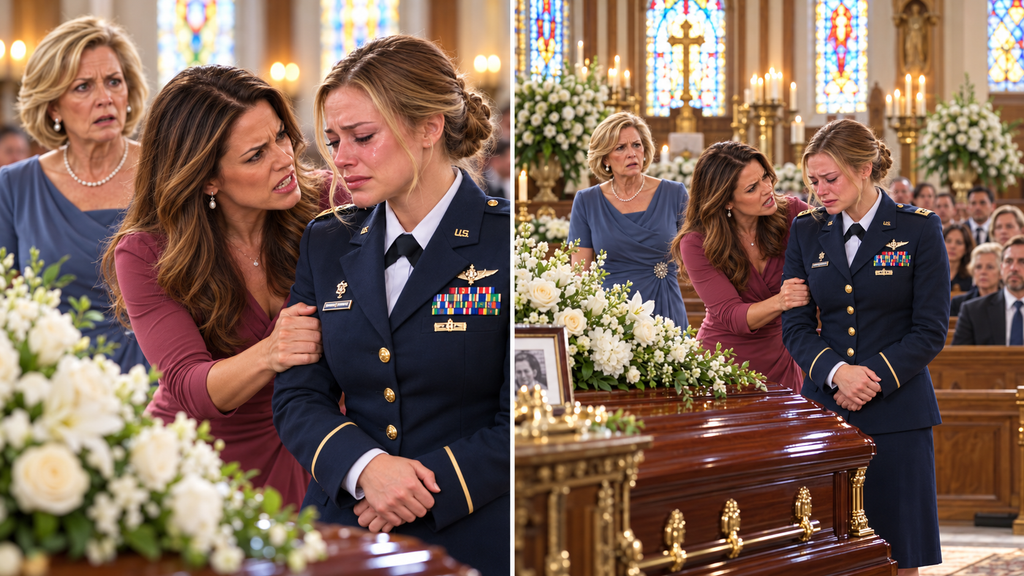
“Through a private laboratory.” Eleanor Whitmore spoke those four words with the confidence of a woman who had spent her entire life believing money could purchase the truth.
But Jonathan Sterling didn’t look impressed. He stood beside my husband’s casket, holding the DNA report between two fingers, while a cathedral full of mourners watched in uncomfortable silence.
“Which laboratory, Mrs. Whitmore?”
Eleanor lifted her chin.
“That’s confidential.”
“Confidential?” Jonathan repeated.
“Yes. David’s private affairs are none of your concern.”
Jonathan glanced down at the document.
“Considering that I am David’s attorney, and you’re using this document to accuse his pregnant widow of adultery at his funeral, I would say it is very much my concern.”
A few people shifted in their seats.
Eleanor’s lips tightened.
“You have no right to interrogate me.”
“I’m not interrogating you. I’m offering you an opportunity to explain where this document came from before the appropriate authorities begin asking the same questions.”
That changed something.
It was almost invisible.
A slight movement of her eyes.
A brief tightening of the muscles around her mouth.
But I noticed.
I had spent more than twenty years learning how to recognize the moment someone realized a situation was slipping beyond their control.
And Eleanor Whitmore had just experienced that moment.
Beside her, Chloe still held my wedding ring.
My finger throbbed where she had pulled it off.
I looked down at the empty space.
Six years earlier, David had slipped that ring onto my hand beneath an oak tree overlooking the Pacific Ocean.
He’d been shaking so badly that I’d laughed.
“You’re nervous?” I’d whispered.
“Terrified,” he’d admitted.
“David, you’ve negotiated billion-dollar contracts.”
“None of those contracts involved the possibility of losing the woman I love.”
He’d kissed my forehead.
Then he’d promised me something.
“Whatever happens, Sarah, I’ll always make sure you have a home.”
Standing beside his casket, with his mother demanding I leave that home, the memory nearly broke me.
I pressed my hand against my stomach.
Our son moved.
A strong little kick.
And somehow, that tiny movement gave me enough strength to lift my head.
“Jonathan,” I said quietly.
He turned.
“Yes, Sarah?”
“Don’t let her touch David’s casket again.”
My voice was barely above a whisper.
But everyone heard.
Jonathan nodded.
“She won’t.”
Eleanor gave a cold laugh.
“Listen to her. Still pretending to be the grieving wife.”
I looked directly at her.
“For four days, I’ve been trying to understand how I’m supposed to live without your son. And all you’ve thought about is how quickly you can take away the things he left behind.”
“You have no claim to my son’s property.”
Jonathan closed the folder.
“Actually, Mrs. Whitmore, that’s the second thing we need to discuss.”
He turned toward the woman carrying the leather briefcase.
“Rebecca, please.”
She stepped forward and opened it.
Inside were several thick envelopes, a tablet, and a small black storage device.
Jonathan removed a document bearing David’s signature.
Then he said something that made Eleanor’s face go pale.
“Three weeks before his death, David transferred the Whitmore estate into an irrevocable trust.”
Eleanor blinked.
“What?”
“The estate, its surrounding land, the guesthouses, and the associated property holdings are now controlled by the Whitmore Family Protection Trust.”
Chloe frowned.
“That doesn’t mean anything.”
“It means,” Jonathan said, “that neither of you owns that house, neither of you has the authority to evict Sarah, and neither of you can change its ownership.”
Eleanor stared at him.
“David would never do that.”
“He did.”
“Without telling me?”
“Especially without telling you.”
The words struck harder than a shout.
Eleanor’s face flushed.
“That property has belonged to the Whitmore family for generations!”
“Parts of the land have,” Jonathan replied. “The residence itself was constructed using David’s personal funds. He acquired the remaining family interests years ago. I have the deeds.”
“My husband built the Whitmore fortune!”
“Your late husband built the first company. David saved it from bankruptcy, expanded it, and eventually purchased the controlling interests. The distinction is legally significant.”
Eleanor opened her mouth.
Nothing came out.
Jonathan continued.
“The trust names Sarah Whitmore as its lifetime primary beneficiary. She has the right to occupy the main residence for the rest of her life. Upon her death, the property passes to her children, subject to the trust’s provisions.”
Chloe’s expression twisted.
“Her children?”
“Yes.”
“Even if that baby isn’t David’s?”
Jonathan looked at her.
“David specifically removed biological parentage as a condition of Sarah’s rights.”
I felt my heart stop.
“What?”
Jonathan turned toward me.
“David said he didn’t want anyone using your pregnancy as leverage against you.”
For a moment, I couldn’t speak.
Because I remembered a conversation we’d had a month earlier.
We’d been sitting on the terrace after dinner.
David had been strangely quiet.
When I asked what was wrong, he reached across the table and took my hand.
“Sarah, if anything ever happened to me, would you promise not to let my family make decisions for you?”
I’d laughed nervously.
“Why would anything happen to you?”
He hadn’t smiled.
“Just promise.”
“David—”
“Please.”
So I’d squeezed his hand.
“I promise.”
Now, standing in the cathedral, I understood.
He hadn’t been imagining some distant possibility.
He had been preparing for a threat he couldn’t explain.
And suddenly, the last four days took on an entirely different meaning.
Jonathan folded the document.
“Sarah, there’s something else.”
His expression changed.
The legal certainty remained.
But behind it, I saw genuine sadness.
“David anticipated that his mother might manufacture evidence to challenge your marriage.”
Eleanor stepped forward.
“That is outrageous!”
Jonathan ignored her.
“He also anticipated that she might attempt to discredit your unborn son.”
Chloe’s fingers closed tightly around my ring.
“You’re lying.”
Jonathan looked at her.
“David left a recorded statement.”
The cathedral became completely silent.
Even the people who had been whispering stopped.
I heard someone gasp behind me.
Eleanor stared at the small black device in Rebecca’s hand.
Then, for the first time that morning, she looked genuinely frightened.
“No,” she whispered.
Jonathan faced me.
“Sarah, he asked that you be present when this recording was played. I must warn you that hearing his voice may be difficult.”
My throat tightened.
Four days.
Four endless nights.
Four mornings waking up and reaching for a husband who would never be beside me again.
I hadn’t heard his voice since our last phone call.
The last call I’d foolishly assumed would be followed by a thousand more.
I swallowed.
“Play it.”
Jonathan hesitated.
“Are you certain?”
I looked down at my stomach.
Then at David’s casket.
“Please.”
Rebecca connected the device to the cathedral’s sound system with the funeral director’s assistance.
A faint crackle came through the speakers.
Then the screen near the altar lit up.
And there he was.
My David.
Alive.
Sitting in his office.
Wearing the navy-blue sweater I’d bought him for Christmas.
His dark hair was slightly disheveled.
His wedding ring caught the light as he folded his hands on the desk.
For one terrible second, I forgot he was dead.
My body reacted before my mind could stop it.
“David?”
The word escaped me like a prayer.
On the screen, my husband drew a slow breath.
“If you’re watching this, then something has happened to me.”
My knees weakened.
Jonathan moved closer, but I lifted one hand.
I wanted to stand.
I needed to hear every word.
David looked directly into the camera.
“Sarah, my beautiful wife, I’m sorry.”
Tears blurred my vision.
“I’m sorry I couldn’t tell you everything. I’m sorry I made you worry. And I’m sorry that the people who should have protected you may be the very people hurting you now.”
Behind me, someone began crying.
David continued.
“Mom, if you’re in the room, I need you to listen carefully.”
Eleanor stood frozen.
“I know about the laboratory.”
Her face drained of color.
“I know about the forged documents. I know about your meetings with Victor Lang. And I know you’ve been trying to find a way to remove Sarah from my estate.”
Chloe whispered something.
I didn’t catch it.
David leaned toward the camera.
“But there’s one thing you never understood, Mom.”
He paused.
And when he spoke again, his voice was stronger.
“Sarah was never after my money.”
I covered my mouth.
“She didn’t even know how much I had when she agreed to marry me. She thought I was an ordinary businessman who worked too many hours and forgot to eat lunch.”
A small, broken laugh escaped my chest.
That had been true.
When we’d met, David hadn’t introduced himself as the owner of a financial empire.
He’d been the stranger who helped me change a flat tire in the rain.
A man with rolled-up sleeves and grease on his hands.
He’d asked if I wanted coffee.
I’d told him I had a twelve-hour duty day ahead and no patience for men who used roadside emergencies as dating opportunities.
He’d grinned.
“Then I’ll have to make a better second impression.”
And he had.
Oh, God.
He had.
On the screen, David smiled faintly.
“Sarah didn’t marry my name. She married me.”
His expression darkened.
“And I won’t allow anyone to punish her for that.”
Eleanor suddenly lunged toward Rebecca.
“Turn it off!”
One of the uniformed officers stepped between them.
“Ma’am, please stand back.”
“That recording is illegal!”
Jonathan’s voice remained calm.
“David recorded it voluntarily with counsel present. It was prepared for this exact contingency.”
Eleanor looked around wildly.
“You can’t do this at my son’s funeral!”
Jonathan stared at her.
“You chose to turn your son’s funeral into a public accusation against his wife.”
The words hung in the air.
Then David’s voice returned.
“Mom, if you have presented a document claiming Sarah’s baby isn’t mine, you should know something.”
The image on the screen changed.
David picked up a sealed medical envelope.
“Sarah and I completed prenatal paternity testing through an accredited medical provider after someone anonymously sent me photographs implying she had been unfaithful.”
I gasped.
Photographs?
What photographs?
David continued.
“I never believed the accusation. But Sarah had already been subjected to enough gossip, and I wanted evidence that no one could manipulate.”
He held up the envelope.
“The results confirmed that I am the biological father of our son.”
My entire body trembled.
David’s voice softened.
“And Sarah, if you’re angry that I never told you about the anonymous photographs, you have every right to be.”
His eyes glistened.
“I didn’t want you living under the shadow of someone else’s cruelty.”
He placed the envelope on the desk.
“The authenticated report is held by my attorney, with verification information available to the appropriate medical and legal professionals.”
Eleanor suddenly grabbed the edge of a pew.
She looked as though the floor had moved beneath her feet.
Then David spoke the sentence that changed everything.
“And if my mother is holding a different DNA report today, Jonathan, please ask her one question.”
He leaned forward.
“How did she obtain a sample from a child who hasn’t been born?”
No one moved.
No one whispered.
The cathedral held its breath.
Jonathan turned toward Eleanor.
“Well, Mrs. Whitmore?”
Eleanor’s mouth trembled.
“I—”
“Who provided the fetal sample?”
“The laboratory handled it.”
“Which laboratory?”
“I already told you—”
“Then provide its name.”
Eleanor looked toward Chloe.
And Chloe looked away.
That tiny exchange told me more than a hundred words could have.
They both knew.
Whatever had happened, both women had been involved.
But I was about to discover that the forged DNA report was only the beginning.
Because David’s recording hadn’t ended.
And the next words would turn my husband’s funeral into the opening scene of a criminal investigation.
THE WARNING HIDDEN IN HIS LAST WORDS
On the screen, David’s face became grave.
“Jonathan, there’s an additional file marked Fortress.”
The attorney’s shoulders stiffened.
“That file contains documentation of financial irregularities, threats made against Sarah, and communications that I believe may relate to a larger conspiracy.”
My heart hammered.
Fortress.
I’ve secured the fortress, Sarah.
I’d thought it was one of David’s strange business expressions.
Something about protecting investments.
But now I realized it had meant something else entirely.
He had built a system of safeguards.
Not just around his wealth.
Around me.
Around our son.
And possibly around evidence someone wanted destroyed.
David continued.
“Some of the material is still under review. I don’t want accusations made without evidence. But if I die unexpectedly, that material must be delivered to the investigators I’ve designated.”
Eleanor glanced toward the cathedral doors.
Jonathan noticed.
“So,” he said, “the report, Mrs. Whitmore. Where did it come from?”
“I don’t have to answer you.”
“No. You don’t. But I strongly suggest you preserve every communication relating to it.”
Chloe suddenly spoke.
“Mom, we should leave.”
Eleanor turned sharply.
“Be quiet.”
“Mom—”
“I said be quiet!”
Her voice cracked across the cathedral.
I stared at them.
For years, Chloe had treated me like a temporary inconvenience.
She smiled politely when David was present.
Then criticized my military career the moment he left the room.
Once, during Christmas dinner, she’d announced that women who chose demanding careers shouldn’t bother having children.
David had set down his fork.
“Sarah has served this country for longer than you’ve held a job, Chloe.”
Chloe had rolled her eyes.
“I was only making conversation.”
“No,” he’d said. “You were being cruel.”
That had been David.
Gentle until someone crossed a line.
Then immovable.
And watching his sister clutch my stolen wedding ring, I felt something other than sorrow for the first time in four days.
Anger.
Not loud anger.
Not the kind that made you scream.
The quiet kind.
The kind that settles into your bones and tells you exactly what you must never allow again.
“Chloe.”
She looked at me.
“What?”
“Give me my ring.”
Her chin lifted.
“No.”
I held out my hand.
“That is my wedding ring.”
“You’re not part of this family.”
My voice shook.
“Your brother put that ring on my finger. You don’t get to erase him just because he’s dead.”
For a moment, something uncertain crossed her face.
Then Eleanor snapped, “Don’t give her anything.”
Jonathan took one step forward.
“Chloe, there are witnesses who saw you forcibly remove the ring from Sarah’s hand. Please return it.”
Chloe looked around.
The same mourners who had watched silently now stared back at her.
Some looked ashamed.
Others simply looked curious.
Finally, she opened her fist.
The ring lay in her palm.
Gold.
Small diamonds.
The inscription David had chosen hidden inside.
Every road leads me home to you.
She dropped it into my hand.
It struck my swollen finger.
I winced.
But I closed my palm around it as though it were the last warm thing David had left behind.
“Thank you,” I whispered.
Chloe stared at me.
I hadn’t thanked her because she’d done something kind.
I’d thanked her because I refused to let her decide what kind of woman I would become.
Then the screen flickered.
David looked down briefly, as though gathering his thoughts.
“There’s one more thing I need Sarah to understand.”
I stopped breathing.
His voice softened.
“Sarah, my love, if you’re hearing this, I know you’re hurting.”
A tear slid down my cheek.
“And I know you. You’ll try to be strong because you’ve spent your whole life being strong for other people.”
He smiled sadly.
“But please don’t think you have to be a general every moment of your life.”
My hand flew to my mouth.
He’d said something similar before.
On the night I received my latest promotion, I’d been sitting alone on our bedroom floor, overwhelmed by the responsibility ahead.
David had found me there.
I’d tried to wipe away my tears.
He’d simply sat beside me.
“You know,” he’d said, “you’re allowed to be human.”
“I have thousands of people depending on me.”
“And you have one very stubborn husband who loves you.”
He’d rested his head against mine.
“You can put the armor down at home.”
Now he spoke those words again.
Through a recording.
At his own funeral.
“Put the armor down when you need to, sweetheart.”
My breath broke.
“Please don’t let my death convince you that you have to carry everything alone.”
There was a pause.
Then his expression changed.
“Jonathan will give you a letter. Read it when you’re ready. Not before.”
He looked directly into the camera one last time.
“And Sarah?”
I leaned toward him involuntarily.
“I meant what I said the day we married.”
His eyes shone.
“You were my home.”
The screen went black.
For a long moment, nobody made a sound.
Then I heard myself sob.
Not the controlled crying I’d permitted myself during the previous four days.
Not the silent tears that slipped down my face when I was alone.
This was something deeper.
Something torn open.
I bent forward, one hand pressed to my stomach, the other holding my wedding ring against my heart.
David was gone.
For a few beautiful, terrible minutes, he had seemed alive again.
And then he’d disappeared a second time.
I felt Jonathan’s hand on my shoulder.
“Sarah?”
I tried to answer.
Couldn’t.
A sharp tightening gripped my lower abdomen.
I froze.
Another came a few seconds later.
Not unbearable.
But different from the movements I’d felt all morning.
I straightened slowly.
Jonathan noticed immediately.
“Are you all right?”
“I’m fine.”
He gave me a look.
“Sarah.”
“I’m fine,” I repeated.
But I wasn’t certain.
My son had been unusually active.
My heart was racing.
And I had been standing through an ordeal no eight-months-pregnant woman should have been forced to endure.
Rebecca stepped closer.
“Would you like to sit down?”
I shook my head.
“Not yet.”
Because Eleanor had begun backing toward the aisle.
And suddenly, I knew I couldn’t let this moment end without asking her something.
“Eleanor.”
She stopped.
Her back remained toward me.
I spoke quietly.
“Did you know David was afraid?”
Her shoulders stiffened.
“What?”
“Before he died. Did you know he thought something might happen to him?”
She turned.
Her eyes were cold.
“My son was under tremendous stress because of you.”
I stared at her.
“Because of me?”
“Your career. Your absences. Your refusal to behave like a proper wife.”
I felt the words land.
But they no longer had the power they once did.
David had loved the very things Eleanor resented.
My independence.
My commitment to service.
The fact that I would never abandon my values to please someone with a famous surname.
I took one slow step toward her.
“Your son called me every night I was away.”
Eleanor said nothing.
“He learned to cook my favorite meals. He sat through military ceremonies he didn’t understand. He drove three hours to surprise me on my birthday when I was working.”
My voice thickened.
“He painted the nursery himself because he wanted our baby to know his father had built something with his own hands.”
Chloe looked down.
“And you,” I whispered, staring at Eleanor, “have spent years trying to convince me that I never belonged.”
My eyes filled.
“But David never once made me feel like I needed permission to be his wife.”
For a moment, Eleanor looked old.
Not powerful.
Not elegant.
Just old.
Then her expression hardened.
“He was my son.”
“Yes,” I replied.
“And he was my husband.”
I looked at the casket between us.
“And he was going to be our little boy’s father.”
My voice broke.
“He’s gone, Eleanor. Neither of us gets him back. But you could have stood beside me today. You could have mourned him with me.”
I swallowed.
“Instead, you tried to destroy the last piece of him I have left.”
Something flashed in her eyes.
For a second, I thought she might cry.
Then she whispered something I would remember for the rest of my life.
“You have no idea what David took from me.”
Jonathan’s expression sharpened.
“What do you mean by that?”
Eleanor seemed to realize she’d said too much.
She turned abruptly.
“Chloe. We’re leaving.”
But before they could reach the doors, one of the uniformed officers stepped into the aisle.
“Mrs. Whitmore?”
She stopped.
The officer held up a phone.
“Detective Morales is requesting that you remain available. He needs to speak with you regarding the circumstances surrounding your son’s death.”
The cathedral went silent again.
Eleanor stared at him.
“His death was an accident.”
The officer’s expression didn’t change.
“That determination is still under investigation.”
A cold sensation moved through my chest.
I looked at Jonathan.
He was watching Eleanor.
And suddenly I realized that he had known something I didn’t.
Something about the crash.
Something David may have suspected before he died.
“Jonathan,” I whispered.
He turned.
“Sarah—”
“Was David murdered?”
He didn’t answer immediately.
And that silence frightened me more than anything he could have said.
THE CRASH THAT DIDN’T MAKE SENSE
The funeral ended differently from anything I had imagined.
There were no orderly lines of relatives approaching the casket.
No quiet embraces beneath the cathedral’s stained-glass windows.
Instead, police officers spoke with witnesses, Jonathan instructed Rebecca to preserve the documents and recording, and Eleanor stood near the front entrance arguing into her phone.
Chloe had disappeared into a side corridor.
I remained beside David.
I couldn’t make myself move.
The white lilies surrounding his casket filled the air with a heavy sweetness that made me feel sick.
Someone had placed a photograph of us near the altar.
Our wedding day.
David laughing.
Me holding his hand.
The Pacific Ocean stretching blue and endless behind us.
I stared at that photograph.
Six years.
How could six years contain so much happiness and still end so quickly?
“Sarah.”
Jonathan approached quietly.
“The funeral director has arranged for the family to have a few private minutes.”
I nodded.
“Thank you.”
He hesitated.
“I also need to speak with you.”
I looked at him.
“About the crash.”
“Yes.”
My stomach tightened.
“Tell me.”
“Not here.”
“Jonathan.”
He glanced at my belly.
“You’re exhausted. You need medical attention if those pains continue. And what I have to tell you isn’t something I want to discuss while people are still standing nearby.”
I studied his face.
David had trusted this man.
That meant something.
“Then tell me where.”
“David’s office at the estate. Two hours from now, if you’re feeling well enough. Detective Morales will join us.”
I shook my head.
“Why not the police station?”
“Because there’s something in the office David wanted you to see.”
My pulse quickened.
“The Fortress file?”
Jonathan didn’t answer directly.
“Part of it.”
I looked at David’s casket.
“Did he know?”
Jonathan’s eyes softened.
“He knew someone was threatening him.”
My throat closed.
“And you didn’t tell me?”
“David was my client. I urged him to involve law enforcement. He did provide information to investigators, but he didn’t want you exposed to unverified allegations.”
I stared at him.
“Exposed?”
Jonathan lowered his voice.
“Sarah, someone tried to access your medical records three times in the month before David died.”
A chill moved down my spine.
“What?”
“And two days before the crash, someone attempted to enter your military personnel information through an unauthorized private system.”
I went completely still.
That was different.
Financial disputes were one thing.
Family cruelty was another.
But unauthorized access involving military personnel records suggested a threat that extended far beyond an inheritance argument.
I drew myself upright.
“Did David know about that?”
“Yes.”
“What did he do?”
Jonathan glanced toward the cathedral doors.
“He contacted a security specialist. He also arranged for the information to be referred to the appropriate authorities.”
I gripped the edge of the casket.
“Who was trying to access my records?”
“We don’t know yet.”
I studied him.
“Jonathan, I’m asking you as David’s wife.”
“And I’m telling you as his attorney that we have evidence of attempts, but we don’t yet know who was responsible.”
He paused.
“There’s something else.”
My heart pounded.
“Of course there is.”
“David received a threatening message forty-eight hours before the crash.”
“What did it say?”
Jonathan hesitated.
Then he took a folded page from his briefcase.
“The original has been preserved for investigators. This is a copy.”
I unfolded it.
There were only eleven words.
Give us what belongs to us, or she pays the price.
My vision narrowed.
She.
Me.
I read the sentence again.
Then again.
“Who sent this?”
“An encrypted messaging account. The source is being investigated.”
I looked at him.
“David never told me.”
“He was trying to protect you.”
Anger rose through my grief.
“He should have trusted me.”
Jonathan nodded slowly.
“Perhaps he should have.”
I folded the page.
“He knew who I was.”
“Yes.”
“He knew I could protect myself.”
“Yes.”
“Then why?”
Jonathan glanced at the casket.
“Because loving someone doesn’t always make people logical, Sarah. Sometimes it makes them afraid.”
I closed my eyes.
And suddenly, I remembered the last morning David had been alive.
He’d stood in our kitchen holding two coffee cups.
One regular.
One decaffeinated.
He’d placed the decaf in front of me and rested his hand on my stomach.
“How’s our little commander?”
“Practicing his kicks on my ribs.”
David had laughed.
“That’s my boy.”
Then he’d grown serious.
“Sarah, I want you to take a few days off.”
I had raised an eyebrow.
“Are you giving orders now?”
“No. I’m making a desperate appeal as your husband.”
“What’s wrong?”
He’d kissed my forehead.
“Nothing I can’t handle.”
I’d believed him.
Because David always said that.
Nothing I can’t handle.
When the roof leaked.
When a business deal collapsed.
When his mother insulted me at dinner.
When we learned that conceiving a child might be difficult.
He would take my hand and say the same thing.
Nothing I can’t handle.
But this time, he had been wrong.
I opened my eyes.
“Jonathan.”
“Yes?”
“I want to see everything.”
He nodded.
“I thought you might.”
Then he offered me a small white envelope.
“David asked me to give you this after the recording.”
I stared at it.
My name was written across the front.
Sarah.
His handwriting.
The familiar slant.
The little flourish he always put beneath the final letter.
I took it carefully.
“Is this the letter?”
“Yes.”
I looked at the envelope for a long moment.
Then I slipped it into the inside pocket of my uniform.
“Not yet.”
Jonathan nodded.
“Whenever you’re ready.”
After he left, I stood alone beside David’s casket.
I placed my injured hand on the polished wood.
“I don’t understand what happened,” I whispered.
The cathedral was almost empty.
Sunlight filtered through the stained glass, painting the floor in patches of red and blue.
“I don’t know why you were afraid.”
My voice cracked.
“And I’m so angry with you for leaving me with questions you should have answered.”
Tears slipped down my cheeks.
“But I’m going to find out.”
I bent forward.
Pressed my forehead against the casket.
And whispered the words I’d said every time David left for a business trip.
“Come home safe.”
Only this time, there would be no answer.
THE SOLDIERS WHO STOOD BESIDE ME
By the time I stepped outside the cathedral, the sky had darkened.
Reporters were gathered beyond the police barriers.
Some had learned about the confrontation.
Others had already obtained fragments of the DNA accusation.
Cameras flashed.
Voices called my name.
“Mrs. Whitmore, is it true the child isn’t your husband’s?”
“Do you intend to contest the will?”
“Are you being investigated for fraud?”
Each question felt like a stone striking something already bruised.
I kept walking.
My hand rested over my belly.
Then a reporter called out something that made me stop.
“General Whitmore! Can you confirm the Army is investigating your husband’s death?”
The crowd went quiet.
Several heads turned.
I closed my eyes briefly.
So much for anonymity.
A few seconds later, someone spoke from behind the reporters.
“Make room.”
The voice was firm.
Familiar.
I looked up.
Standing beside a black government vehicle was Colonel Marcus Reed.
My deputy.
A man who had served beside me for eleven years.
Behind him stood Sergeant Major Angela Brooks and two members of my command staff.
All in formal uniform.
All wearing expressions that told me they knew exactly what had happened inside the cathedral.
Marcus approached.
“Ma’am.”
I shook my head slightly.
“Not today.”
His face softened.
“Sarah.”
That one word nearly undid me.
He’d called me General through deployments, disasters, crises, and ceremonies.
But now he looked at me not as his commanding officer.
As a friend.
“We heard.”
I looked away.
“Everyone heard.”
Angela stepped forward.
She was a woman of few words.
A decorated senior enlisted leader who had once dragged an injured soldier out of danger under fire and then insisted she’d merely been doing her job.
Now her eyes were wet.
“Nobody should have treated you like that.”
I swallowed.
“It was David’s funeral.”
“I know.”
“They didn’t even let me grieve.”
Angela looked toward the cathedral.
“Then they should be ashamed.”
I tried to smile.
Couldn’t.
Marcus glanced at my injured finger.
“Did someone hurt you?”
“His sister took my ring.”
Angela’s expression changed.
“She what?”
“It’s back.”
“That’s not what I asked.”
I sighed.
“Angela.”
She took one breath.
Then another.
“Understood, ma’am.”
Marcus opened the vehicle door.
“We’re taking you home.”
I glanced toward the reporters.
“I have my car.”
“You also have a medical appointment waiting if you need it, and a very stubborn colonel who’s not interested in arguing.”
Despite everything, a tiny laugh escaped me.
“That’s insubordination.”
“Then write me up tomorrow.”
He offered his hand.
I took it.
And as I stepped into the vehicle, something happened that made the reporters fall silent.
Angela turned toward me.
Then stood at attention.
And saluted.
Marcus followed.
Then the two officers behind him.
Four soldiers.
Four solemn salutes.
Not for the cameras.
Not for the headlines.
For a woman whose life had just been torn apart.
I had spent my career believing leadership meant standing strong when everyone else needed support.
That afternoon, my soldiers reminded me of something I’d forgotten.
Sometimes leadership also means allowing other people to hold you up.
I returned the salute.
Then I climbed into the vehicle and finally let myself cry.
THE HOUSE THAT NO LONGER FELT LIKE HOME
The Whitmore estate sat high above the Pacific coastline, surrounded by cypress trees and stone walls that had stood for decades.
The first time David brought me there, I’d been intimidated.
Not by the size.
Not by the marble floors or expensive artwork.
But by the silence.
It was the kind of house where every footstep seemed too loud.
I’d told him it felt like a museum.
He’d laughed.
“Then we’ll make it a home.”
And he had.
We planted roses.
Rescued an elderly golden retriever named Henry.
Filled the library with books neither of us had time to finish.
Put mismatched coffee mugs in a kitchen that had once contained nothing but imported china.
When we learned I was pregnant, David transformed the room across from ours into a nursery.
Soft blue walls.
White curtains.
A rocking chair he’d assembled himself, badly enough that I had to call a carpenter to reinforce it.
He’d insisted the uneven legs gave it character.
Now, as the vehicle approached the iron gates, I wondered whether I could bear to walk through the front door.
Marcus sat beside me.
“You don’t have to stay here tonight.”
I watched the gates open.
“It’s my home.”
“I know.”
“It’s where David is.”
Marcus didn’t correct me.
He understood what I meant.
The estate contained David’s laughter.
His coffee stains.
His books.
His ridiculous collection of vintage watches.
The little scratches on the kitchen table from the time he’d tried to repair a chair without reading the instructions.
Even the nursery.
Especially the nursery.
Everything still held some trace of him.
“I need to be here,” I whispered.
Marcus nodded.
“Then here is where you’ll be.”
But as we drove up the long driveway, I noticed something strange.
Three unfamiliar vehicles were parked near the east wing.
A moving truck stood beside the service entrance.
And several men were carrying boxes through the open doors.
My spine straightened.
“Stop the car.”
Marcus looked up.
“What is it?”
“Those aren’t our vehicles.”
The driver stopped.
I stepped out before Marcus could object.
A man wearing a gray polo shirt approached.
“Ma’am, this is a restricted property today.”
I stared at him.
“Excuse me?”
“We’re conducting an authorized removal of certain household assets.”
“Authorized by whom?”
He checked a clipboard.
“Mrs. Eleanor Whitmore.”
A cold silence settled over me.
Of course.
Before David had even been laid to rest, Eleanor had sent people to strip our home.
I looked beyond him.
Two workers were carrying a framed painting toward the truck.
I recognized it instantly.
A watercolor of the Pacific coastline.
David had purchased it on our honeymoon.
It wasn’t particularly valuable.
But he’d loved it because the artist had painted the exact beach where we’d exchanged our vows.
“Put that down,” I said.
The workers stopped.
The man with the clipboard frowned.
“Ma’am, we have paperwork.”
“So do I.”
Marcus stepped beside me.
“Would you like me to contact the attorney?”
“Yes.”
The man shifted uneasily.
“Mrs. Whitmore told us everything in the east wing belongs to her.”
I looked directly at him.
“I’m Mrs. Whitmore.”
He blinked.
“You’re—”
“Sarah Whitmore. David Whitmore’s widow. This is my residence, and no property is leaving until its ownership and the authority for removal have been verified.”
He glanced toward the truck.
Then at my uniform.
Then at Marcus.
His confidence vanished.
“Ma’am, we were told—”
“I understand what you were told.”
I lowered my voice.
“But you’re going to stop carrying things out of my home.”
Marcus had already called Jonathan.
Ten minutes later, the attorney arrived.
He examined the paperwork Eleanor had given the removal company.
Then he sighed.
“Sarah, this authorization is not valid.”
I wasn’t surprised.
“What does it say?”
“That Eleanor is the sole executor of David’s estate.”
I closed my eyes.
David’s mother had planned all of this.
The DNA report.
The public humiliation.
The eviction.
And now the removal of property.
Every piece of the plan depended on making me too shocked, too embarrassed, or too grief-stricken to resist.
But she had overlooked one thing.
David had known her.
And he’d prepared.
Jonathan turned to the moving company’s supervisor.
“Preserve the paperwork and your dispatch instructions. You’ll be contacted regarding who issued this order.”
The man nodded rapidly.
“Yes, sir.”
The workers returned the painting.
Then they began carrying the other items back inside.
I stood in the driveway watching.
A framed photograph of David and me came out of the truck.
Then a box of books.
Then a silver tray I’d inherited from my grandmother.
My grandmother.
Not Eleanor.
I almost laughed at the sheer cruelty of it.
She had intended to take everything without even asking who it belonged to.
Jonathan came to stand beside me.
“Sarah, there’s one more thing.”
I looked at him.
“What now?”
“David changed the estate’s security arrangements shortly before his death.”
“Why?”
“Because he believed someone with access to the property had been entering his private office.”
I glanced toward the house.
“Who?”
“We don’t know.”
“Was anything missing?”
“Not that we could establish.”
He hesitated.
“But there was evidence that someone had attempted to open his safe.”
A faint ringing started in my ears.
David’s office.
Fortress.
The threats.
The crash.
I looked at the large windows on the upper floor.
“Jonathan.”
“Yes?”
“Did David install cameras?”
He nodded.
“Several.”
“Inside the office?”
“Yes.”
“Then where are the recordings?”
His expression changed.
“That’s what we’re about to find out.”
THE DOOR DAVID NEVER LET ANYONE OPEN
David’s office occupied the northwest corner of the estate.
It was my favorite room after the kitchen.
Floor-to-ceiling bookshelves.
A fireplace made of pale stone.
A huge oak desk positioned near the windows.
And a leather chair that squeaked whenever he leaned back too far.
I used to tease him about that chair.
“You’re a wealthy man, David. Buy one that doesn’t sound like it’s begging for mercy.”
He’d grin.
“Never. This chair and I have survived too much together.”
Now the chair sat empty.
A pair of reading glasses lay beside his computer.
His favorite fountain pen rested on an open notebook.
For one heartbreaking instant, I expected him to walk in carrying a cup of coffee.
“Sarah?”
Marcus stood behind me.
I blinked.
“I’m okay.”
He didn’t believe me.
Neither did I.
But there were things we had to do.
Jonathan approached the bookcase on the far wall.
“David gave me instructions regarding a second security compartment.”
I frowned.
“Second?”
He nodded.
“His visible safe is behind that painting.”
I looked at the painting of an old sailing ship.
“I know.”
“But there’s another.”
Jonathan pressed a small button beneath the lowest shelf.
A soft mechanical click sounded.
Then a narrow panel slid open.
I stared.
“David never showed me that.”
“He intended to.”
“Why didn’t he?”
Jonathan looked at me sadly.
“He believed he had more time.”
Those words hurt.
More than the others.
Because they were probably true.
Whatever David had feared, some part of him must still have believed he’d survive it.
That we’d sit down one evening.
That he’d explain everything.
That I’d be furious about the secrets and he’d apologize and we’d argue and eventually we’d find our way back to each other.
He’d expected another tomorrow.
And then there hadn’t been one.
Jonathan entered a code.
The hidden compartment opened.
Inside were three objects.
A black hard drive.
A sealed envelope.
And a small velvet box.
My eyes went to the box immediately.
Jonathan noticed.
“That’s for you.”
I picked it up.
My hands trembled as I lifted the lid.
Inside was a tiny silver bracelet.
For a baby.
An engraved plate held two words.
Daddy’s Hero.
I made a sound I didn’t recognize.
David had bought our son a bracelet.
Our son.
The little boy he’d never meet.
The child whose first cry he’d never hear.
The baby he’d promised to teach how to swim, ride a bicycle, and change a tire.
I pressed the bracelet against my lips.
“Oh, David.”
There was a folded note beneath it.
I opened it carefully.
Sarah,
If you’re finding this before our son arrives, then I’ve managed to ruin another surprise.
I wanted to give him this on the day he was born.
Tell him I loved him before I ever saw his face.
Tell him his mother is the bravest person I have ever known.
And tell him that being brave doesn’t mean never being afraid.
It means loving something enough to keep going.
All my love,
Dad.
I sat down in David’s chair.
And cried.
Nobody spoke.
Marcus looked toward the window.
Jonathan lowered his head.
Rebecca quietly stepped into the hallway.
They gave me the dignity of my grief.
And for several minutes, I forgot about Eleanor.
Forgot about the DNA report.
Forgot about the investigation.
There was only the tiny bracelet in my palm and the unbearable truth that my son would grow up knowing his father through stories.
Eventually, I wiped my eyes.
Placed the bracelet back in its box.
And looked at Jonathan.
“Show me the rest.”
He nodded.
Rebecca returned with a laptop.
The hard drive was connected.
A password screen appeared.
Jonathan entered a code David had provided to him under sealed instructions.
Then a folder opened.
FORTRESS.
Inside were dozens of files.
Financial records.
Copies of emails.
Security footage.
Business contracts.
And a document titled:
IF I DIE UNEXPECTEDLY — READ FIRST.
Jonathan opened it.
David’s words filled the screen.
My name is David Whitmore. I am preparing this statement because I believe certain people close to me are attempting to gain control of assets they have no legal right to possess.
I also believe these individuals have become increasingly desperate.
I do not know whether anyone intends to harm me.
But I cannot ignore the threats.
My wife Sarah is not involved in these disputes.
She does not know the full extent of what I have uncovered.
If anything happens to me, protect her.
Do not allow my mother or sister access to the protected records.
And do not assume that the person making the loudest accusation is the person telling the truth.
I leaned forward.
“Who was he investigating?”
Jonathan opened another file.
A photograph appeared.
Eleanor sat at a restaurant table beside a man in a gray suit.
I recognized the man.
Victor Lang.
David’s longtime business partner.
A man who had attended our Christmas parties.
A man who had raised a glass at our wedding and called David the brother he’d never had.
My stomach turned.
“What does Victor have to do with this?”
Jonathan took a breath.
“David discovered that approximately forty-two million dollars had been diverted through a network of shell companies over the previous three years.”
I stared at him.
“Forty-two million?”
“Yes.”
“By Victor?”
“Records indicate that Victor authorized many of the transactions. David was also examining whether Eleanor benefited from them.”
My eyes returned to the photograph.
Eleanor.
Victor.
Sitting close together.
Their expressions serious.
“How long had David known?”
“About six weeks.”
I shook my head.
“He didn’t say a word.”
“He was gathering evidence.”
“Why not go directly to the authorities?”
“He had started cooperating with investigators. He wanted to make certain the records couldn’t be destroyed.”
I looked at Marcus.
He was standing perfectly still.
Watching the screen.
Jonathan clicked another file.
A video opened.
The date was twelve days before David’s death.
The footage came from a security camera outside his office.
At 11:43 p.m., a figure entered the hallway.
A woman.
Wearing a dark coat.
Her face partly hidden beneath a scarf.
She stopped outside the office.
Looked over her shoulder.
Then took a key from her pocket.
I leaned forward.
The woman stepped into the light.
My breath caught.
“Chloe.”
Jonathan nodded.
“Yes.”
On the video, David’s sister opened the office door.
She disappeared inside.
Seven minutes passed.
Then she emerged carrying a small black object.
I looked at Jonathan.
“What did she take?”
“We believe it was an older backup drive.”
“Was there anything on it?”
“Yes.”
“Did David know?”
“He discovered the theft the following morning.”
“And?”
Jonathan hesitated.
“Chloe claimed Eleanor had asked her to retrieve family photographs.”
I stared at the screen.
The lie was almost insulting.
Chloe had entered my husband’s locked office near midnight.
Taken a hard drive.
And expected him to believe she wanted photographs.
“Did he confront her?”
“Yes.”
“What happened?”
Jonathan clicked another file.
An audio recording began.
Chloe’s voice came through the speakers.
“David, you’re making this into something it isn’t.”
Then David.
Angry.
More angry than I’d ever heard him.
“You took confidential company records from my office.”
“I was helping Mom.”
“Helping her do what?”
“Protect the family!”
There was a sharp noise.
Something striking a table.
Then David spoke.
“Chloe, listen to me carefully. Victor has been stealing from the company. Someone helped him. I have evidence, and I’m going to turn it over.”
Chloe’s voice rose.
“You can’t!”
“Why?”
“Because you’ll destroy everything!”
“Then tell me what you know.”
A long silence followed.
Then Chloe whispered something that made my blood run cold.
“You don’t understand what Mom promised him.”
The recording ended.
I stared at the computer.
“What did she mean?”
Jonathan shook his head.
“We’ve been trying to determine that.”
Marcus leaned forward.
“Play it again.”
Jonathan did.
This time, I listened differently.
Not as a grieving wife.
Not even as a mother trying to protect her child.
As a military officer trained to recognize patterns, incentives, and concealed motives.
You don’t understand what Mom promised him.
Not what Victor promised Eleanor.
What Eleanor promised Victor.
I looked up.
“Jonathan.”
“Yes?”
“Who was supposed to inherit David’s controlling shares if he died?”
He studied me.
“Before the trust restructuring, Eleanor expected to become a major beneficiary under the older estate plan.”
“And Victor?”
“Victor held enough shares to become the dominant voting partner if the disputed family shares passed to Eleanor and she supported him.”
I felt the room grow cold.
“So if David died before changing the estate plan…”
“Victor could have gained control of the company through an alliance with Eleanor.”
“But David changed it.”
“Yes.”
“When?”
“Three weeks ago.”
“And they knew?”
“We believe they learned that some changes had been made, though not their full extent.”
I looked toward the window.
The ocean stretched endlessly beyond the cliffs.
My husband had died on a coastal road.
His mother had prepared a false DNA report.
His sister had stolen confidential files.
His business partner had allegedly diverted millions.
And someone had threatened me.
These were no longer separate pieces.
They were beginning to form a picture.
An ugly picture.
One I didn’t want to believe.
I turned back.
“Jonathan, where is Victor now?”
He checked his phone.
Then frowned.
“According to his office, he’s out of the country.”
“When did he leave?”
Jonathan made a call.
Spoke briefly.
Then looked at me.
“Early this morning.”
I felt something heavy settle in my chest.
“The day of David’s funeral.”
“Yes.”
“Where did he go?”
“We’re checking.”
A sudden knock came at the office door.
Rebecca entered.
Her face was pale.
“Jonathan, Detective Morales is here.”
She paused.
“And he says they’ve found something in David’s car.”
I stood too quickly.
Pain tightened low across my abdomen.
I caught the edge of the desk.
Marcus moved immediately.
“Sarah.”
I held up a hand.
“Tell me.”
Rebecca swallowed.
“The brake system.”
My heartbeat became a pounding roar.
“What about it?”
She looked at Jonathan.
Then at me.
“The investigators believe someone tampered with it before the crash.”
And in that moment, the last possibility I’d been desperately avoiding became terrifyingly real.
David might not have died because of an accident.
He might have died because someone wanted him gone.
THE PERSON WHO KNEW DAVID’S LAST SECRET
Detective Elena Morales arrived at the estate carrying a thin case file and the exhausted expression of someone who hadn’t slept properly in several days.
She was in her early forties, with dark hair pulled into a low ponytail and sharp eyes that missed very little.
She shook Jonathan’s hand.
Then turned toward me.
“Mrs. Whitmore, I’m sorry we’re meeting under these circumstances.”
I nodded.
“Please tell me what happened to my husband.”
She studied my face.
“Would you like to sit?”
“No.”
“Sarah,” Marcus warned gently.
“I said no.”
Detective Morales didn’t argue.
Instead, she opened the file.
“Your husband’s vehicle was recovered from the base of the cliff approximately six hours after the crash. Initial evidence suggested a loss of control on a sharp turn.”
I forced myself to listen.
“But?”
“But our mechanical examination revealed irregularities in the braking system.”
“What kind?”
“Damage inconsistent with the impact alone. The preliminary assessment suggests deliberate interference.”
I felt my chest tighten.
“You’re saying someone sabotaged his car.”
“We have reason to investigate that possibility.”
“How much reason?”
She paused.
“Enough that we’re treating his death as suspicious.”
The room seemed to tilt.
For four days, I’d tried to imagine David’s final moments.
Had he been frightened?
Had he known he was going to die?
Had he called my name?
Now a new horror opened before me.
Someone might have put him in that car knowing he would never return.
I pressed both hands against my stomach.
Our son moved again.
Detective Morales glanced down.
“Are you feeling all right?”
“I’m listening.”
She hesitated.
“There’s more.”
Of course there was.
There always seemed to be more.
“The vehicle’s onboard diagnostic system recorded an unusual braking event approximately forty seconds before it left the road.”
My throat tightened.
“Did he try to stop?”
“That’s consistent with what we’ve recovered.”
I closed my eyes.
David had known.
At least in those final seconds, he must have known something was wrong.
I imagined his hands gripping the steering wheel.
The darkness beyond the windshield.
The ocean somewhere below.
I suddenly couldn’t breathe.
“Sarah?”
Marcus’s voice sounded distant.
I put a hand against the desk.
“I’m okay.”
But I wasn’t.
I was standing in the office of a dead man who had been my entire world, learning that his last moments might have been filled with terror.
Detective Morales closed the file.
“We can stop.”
“No.”
I opened my eyes.
“No more protecting me from the truth. David tried to protect me, and look what happened.”
My voice cracked.
“Tell me everything.”
She waited a moment.
Then nodded.
“We also recovered an audio file from the vehicle’s emergency recording system.”
My heart stumbled.
“Audio?”
“Approximately the final minute before the crash.”
I stared at her.
“Have you listened to it?”
“Yes.”
“Was he speaking?”
Morales looked at Jonathan.
A terrible silence passed between them.
I understood immediately.
“He was.”
“Mrs. Whitmore—”
“Was he calling for help?”
Her eyes softened.
“He made an emergency call. Part of it was recorded.”
I gripped the desk.
“Let me hear him.”
Morales shook her head gently.
“Not yet. The file is evidence, and we’re still processing it. I don’t want you hearing an incomplete recording without the proper context.”
I wanted to argue.
Every instinct in me demanded the sound of my husband’s voice.
But I also understood evidence.
And procedures.
And the damage that could be done when grief overwhelmed judgment.
So I swallowed the protest.
“All right.”
Detective Morales watched me for another moment.
Then said, “There’s something I can tell you.”
I looked up.
“Your husband was conscious when he initiated the call.”
A tear slipped down my face.
“He was trying to get help.”
“Yes.”
“Did he say anything about me?”
Morales hesitated.
Then she reached into her file and removed a single sheet.
“His last complete sentence was directed to the dispatcher.”
I took the page.
The words were typed in black ink.
Please tell my wife I was trying to get home.
For a moment, my mind refused to understand them.
Then they broke me.
I folded over the desk.
A sound escaped my throat that seemed to come from somewhere deeper than my own body.
He’d been trying to get home.
Not thinking about his company.
Not thinking about the millions.
Not thinking about his mother or Victor Lang.
Home.
To me.
To our unborn son.
To the life we’d built.
Marcus caught me before I sank to the floor.
I clung to his sleeve.
And for the first time since the police had come to our door, I stopped trying to control my grief.
I cried until my chest hurt.
Until my voice failed.
Until there seemed to be nothing left inside me but an enormous, impossible emptiness.
Nobody told me to be strong.
Nobody said David was in a better place.
Nobody offered the cruel comfort of saying everything happened for a reason.
They simply stayed.
And when I finally raised my head, Detective Morales was waiting.
“Mrs. Whitmore,” she said quietly, “we’re going to find out who did this.”
I looked at her through my tears.
“Then I want to help.”
She nodded.
“But not by putting yourself at risk. You have a baby to think about.”
I placed a hand over my belly.
“I haven’t forgotten.”
“And your husband left evidence because he wanted it used properly.”
“I understand.”
She studied me.
Then asked, “Have you heard the name Daniel Mercer?”
I froze.
Daniel Mercer.
It took a moment for the memory to surface.
David’s former head of private security.
A broad-shouldered man with silver hair and a permanent expression of mild disapproval.
He’d worked for David for nearly ten years.
Then, about six weeks earlier, David had told me Daniel was taking an extended leave.
“Yes,” I said. “Why?”
Morales exchanged a glance with Jonathan.
“Because Mr. Mercer contacted us shortly after your husband’s death.”
My pulse quickened.
“What did he say?”
“He said David had asked him to investigate a possible internal threat.”
I stared at her.
“Daniel knew?”
“Apparently.”
“Where is he now?”
Morales closed the file.
“That’s the problem.”
A new silence settled over the room.
“Mr. Mercer was supposed to meet with investigators yesterday.”
My stomach tightened.
“He didn’t come?”
“No.”
“Did he call?”
“No.”
I looked from her to Jonathan.
“Where is he?”
Detective Morales answered quietly.
“We don’t know.”
THE MESSAGE FROM A MISSING MAN
That evening, I sat alone in the nursery.
The house had finally gone quiet.
Jonathan and Rebecca were working with the investigators downstairs.
Marcus had arranged for additional security to protect the estate.
Angela had insisted on staying in the guesthouse, telling me she had absolutely no intention of leaving a grieving pregnant woman alone with a house full of unanswered questions.
I hadn’t argued.
Outside the nursery windows, the Pacific Ocean was turning silver beneath the moon.
I sat in the rocking chair David had assembled.
The one with the uneven legs.
The one he’d promised to fix.
And held our son’s little bracelet.
“Daddy loved you,” I whispered.
My baby moved gently.
I smiled through my tears.
“He loved you so much.”
I looked at the painted stars on the ceiling.
David had done those too.
Three nights on a ladder.
Blue paint on his face.
An argument about whether the Big Dipper was positioned correctly.
He had laughed when I pointed out his mistake.
“Then our son can learn that even his father wasn’t perfect.”
I pressed my lips together.
“Oh, sweetheart,” I whispered to my belly. “I wish you could have known him.”
My phone vibrated.
I glanced at the screen.
Unknown number.
A message appeared.
Sarah, this is Daniel Mercer.
I straightened.
Another message arrived.
Do not call this number. I don’t have much time.
My pulse raced.
I read the next sentence.
David did not die because of a business disagreement. He died because he discovered who was financing the fraud.
I stared.
Financing it?
Another message.
Victor Lang wasn’t acting alone.
I immediately took a screenshot and forwarded it to Detective Morales.
Then another message appeared.
The person who ordered the sabotage is someone David trusted enough to invite into your home.
My breathing slowed.
Someone David trusted.
Victor had come into our home dozens of times.
Eleanor had a key.
Chloe had access.
But Daniel’s wording suggested something else.
Someone we hadn’t yet considered.
My phone vibrated again.
Look at the photograph taken at David’s birthday dinner. The man standing behind Eleanor.
I frowned.
David’s birthday dinner.
Three months earlier.
We had celebrated his forty-second birthday in the garden.
Twenty guests.
A private chef.
Too much cake.
David wearing a ridiculous paper crown because I’d insisted.
I opened my photographs.
Scrolled.
Found the image.
There was David.
Laughing.
His arm around me.
Eleanor standing near the table.
Chloe beside her.
Victor Lang holding a glass of champagne.
And behind Eleanor…
A tall man.
Dark suit.
Silver tie.
A face I knew.
I zoomed in.
My blood ran cold.
Dr. Nathaniel Price.
David’s personal physician.
The man who had reassured me after the crash that David couldn’t have suffered long.
The man who had been the first to suggest that grief and pregnancy hormones might be affecting my judgment.
The man who had personally recommended that I take sedatives after David’s death.
I stared at the photograph.
Dr. Price.
Why would he be involved?
My phone vibrated again.
He had access to David’s medical records, prescriptions, and private schedule.
Another message.
He was also the one who arranged the false DNA report.
I covered my mouth.
The cathedral.
Eleanor had hesitated when Jonathan asked about the laboratory.
Because she hadn’t arranged it herself.
She had been given the report.
By a doctor.
A trusted doctor.
A man who could make fraudulent medical paperwork appear credible.
I typed quickly.
Where are you? Are you safe?
A pause.
Then:
Not safe. Don’t trust anyone who asks you to take medication you haven’t personally verified.
My heart hammered.
I remembered the small amber bottle Dr. Price had left for me two days earlier.
“For sleep,” he’d said gently.
“You need rest, Sarah. This stress isn’t good for your baby.”
I hadn’t taken it.
Not because I suspected him.
But because I didn’t want anything that might interfere with my pregnancy.
Now I looked toward the bathroom adjoining the nursery.
The bottle was still in the medicine cabinet.
My skin prickled.
I wrote:
I’m contacting the detective. Stay hidden.
No answer.
Thirty seconds passed.
Then a final message appeared.
David recorded their meeting. Fortress, folder 17. Tell Jonathan the password is the name of the beach where David proposed.
I stared at the screen.
The beach.
Not where we’d married.
Where he’d proposed.
I remembered the night instantly.
The cold wind.
The dark water.
David kneeling in the sand.
The moonlight catching the ring.
El Matador.
I typed the name into my notes.
Then sent the messages to Morales and Jonathan.
Almost immediately, my phone rang.
Detective Morales.
“Sarah, where are you?”
“At home.”
“Is anyone with you?”
“Security. Angela is in the guesthouse. Marcus is downstairs.”
“Good. Stay with them. Don’t touch that medication bottle. I’ll arrange for it to be collected and tested.”
“Daniel says Dr. Price is involved.”
“I saw.”
“And there’s a recording.”
“We’re following up.”
I hesitated.
“Detective?”
“Yes?”
“Do you think Dr. Price wanted to hurt my baby?”
A long silence.
“We don’t know what he intended, Sarah.”
I looked down at my stomach.
“But we’re going to take every precaution.”
After the call ended, I sat motionless.
My hand rested over my son.
I’d thought the worst thing Eleanor could do was humiliate me.
I’d thought the worst thing Victor could do was steal David’s money.
Now I was beginning to understand something far darker.
Someone had been close enough to our family to know our routines.
Our appointments.
Our fears.
Someone had watched my pregnancy.
Had known when David drove alone.
Had known when I would be vulnerable.
And David, somehow, had discovered the danger.
I looked at the stars he’d painted.
Then whispered into the darkness.
“What were you trying to tell me, my love?”
FOLDER SEVENTEEN
At 9:18 the next morning, Jonathan called me into the office.
I hadn’t slept.
Neither had he.
Rebecca sat at the laptop, her eyes red.
Detective Morales stood near the fireplace with two investigators.
Marcus was beside the door.
Jonathan looked at me carefully.
“Sarah, we found folder seventeen.”
My pulse quickened.
“Was Daniel telling the truth?”
“We believe so.”
He gestured toward the screen.
A password field waited beneath the file name.
Rebecca typed:
EL MATADOR.
The folder opened.
Inside was a single video.
Dated sixteen days before David’s death.
Jonathan looked toward Detective Morales.
She nodded.
“We’ve preserved the original and documented the copy. You can view it.”
I took David’s chair.
Rebecca pressed play.
The video began inside a private conference room.
The camera angle was slightly elevated.
David sat at one end of the table.
Victor Lang sat opposite him.
Dr. Nathaniel Price was beside Victor.
And Eleanor Whitmore sat between them.
I went cold.
David had arranged the meeting.
He’d placed a recording device where they couldn’t see it.
He was calm.
Almost too calm.
“Let’s start with the missing money,” he said.
Victor leaned back.
“David, we have discussed this.”
“No. You’ve offered excuses. I want answers.”
Eleanor sighed.
“Must we do this again?”
David turned toward her.
“Yes, Mom. We must.”
Dr. Price folded his hands.
“David, I think you’re under an unhealthy amount of stress.”
David looked at him.
“Interesting concern from someone who received nearly four million dollars in transfers through a consulting company that has no employees.”
Price’s expression changed.
My breath caught.
Four million.
Victor leaned forward.
“Those were legitimate medical advisory payments.”
David placed a folder on the table.
“Advisory payments for what?”
Victor said nothing.
David continued.
“Your firm purchased no equipment, conducted no studies, and provided no documented services.”
Price shifted.
“This is a misunderstanding.”
“Then explain the invoices.”
Eleanor slapped her hand against the table.
“Enough!”
David looked at her.
She was trembling with fury.
“Your father built this company. Victor has devoted years to keeping it successful. And you’re treating everyone like criminals!”
“Because someone has been stealing from it.”
“That money belongs to the family!”
David’s expression hardened.
“Money belonging to a company doesn’t become your personal property because our surname is on the building.”
Eleanor stared at him.
“You’d choose that woman over your own mother?”
I flinched.
David didn’t.
“Sarah has nothing to do with this.”
“She has everything to do with it!”
Eleanor rose from her chair.
“Ever since you married her, you’ve changed. You stopped listening to me. You stopped supporting your sister. You started questioning every expense.”
David’s voice became quiet.
“I started questioning expenses because you were spending money that wasn’t yours.”
Eleanor’s face twisted.
“Your father would be ashamed of you.”
David looked down.
For a moment, I saw genuine pain.
Then he raised his eyes.
“My father taught me that our name was worth nothing without integrity.”
Eleanor opened her mouth.
David continued.
“And if he knew what you’ve done, he’d be ashamed of you.”
Silence.
Then Victor spoke.
“David, there’s still a way to resolve this privately.”
“Return the money.”
“It’s not that simple.”
“Then make it simple.”
Victor leaned forward.
“You don’t understand the commitments we’ve made.”
David’s eyes narrowed.
“What commitments?”
No answer.
“Victor?”
Victor looked toward Eleanor.
My heart began pounding.
Then Dr. Price spoke.
“Perhaps we should discuss Sarah.”
Everything inside me went still.
David’s expression changed immediately.
“What about my wife?”
Price smiled.
It was a small smile.
Almost pleasant.
“She has a very demanding position. A public one. Certain information could be embarrassing if it became widely known.”
David’s hands flattened against the table.
“What information?”
Victor reached into his briefcase.
He removed several photographs.
Spread them across the table.
I leaned toward the screen.
The photographs showed me standing beside a man outside a military facility.
Colonel Marcus Reed.
We were speaking near a parked vehicle.
In one image, Marcus held my elbow as I stepped over an uneven curb.
A completely ordinary moment.
But the photographs had been taken from angles designed to suggest intimacy.
David picked them up.
Looked at them.
Then placed them back on the table.
“You’re threatening my wife with photographs of her deputy helping her walk?”
Victor smiled faintly.
“Public perception is complicated.”
David leaned forward.
“Listen carefully. If any of you try to harm Sarah’s reputation, you’ll regret it.”
Eleanor gave a bitter laugh.
“You’re so blinded by love that you can’t see what she’s done.”
David turned toward her.
“What she’s done is marry me, build a life with me, and carry our child. Those are not crimes.”
Price spoke again.
“About the child…”
My breath stopped.
On the screen, David went completely still.
“What about my son?”
Price opened another folder.
“The family has reason to question whether the pregnancy is biologically yours.”
David stared at him.
Then laughed.
Not because he was amused.
Because he could hardly believe what he was hearing.
“You’ve fabricated another accusation?”
Price slid a document across the table.
“We have preliminary information.”
David didn’t touch it.
“From whom?”
“That’s confidential.”
“From which laboratory?”
“David—”
“Which laboratory?”
Price’s smile disappeared.
David leaned forward.
“You have no access to my wife’s medical records. You have no access to her prenatal testing. And you certainly have no right to make claims about our child.”
Victor spoke sharply.
“You’re missing the point.”
“No,” David replied. “I understand the point perfectly.”
He looked at all three of them.
“You’re attempting to pressure me into surrendering control of my company by threatening my wife and son.”
Eleanor folded her arms.
“You’re being dramatic.”
David stood.
“Then listen to this.”
He placed both hands on the table.
“I have already reported the suspected fraud to the authorities. I have retained copies of the records. I have protected Sarah’s ownership and residence rights. And every threat you’ve made will be documented.”
Victor’s face drained of color.
“You did what?”
David looked directly at him.
“The investigation doesn’t depend on me anymore.”
A long silence followed.
Then Victor whispered, “You have no idea what you’ve started.”
David’s answer was simple.
“I know exactly what I’m ending.”
He turned toward the door.
But before he left, Eleanor called after him.
“David.”
He stopped.
Her voice changed.
It became strangely gentle.
“If you walk away from this family, don’t expect us to welcome you back.”
David looked at her for a long moment.
Then he spoke.
“Mom, I spent thirty years trying to earn your approval.”
His voice cracked.
“I became the son you wanted. I built the company you wanted. I paid Chloe’s debts. I bought you every house, every car, every beautiful thing you ever asked for.”
Eleanor’s expression wavered.
“But you never asked whether I was happy.”
No one spoke.
David swallowed.
“Sarah did.”
My eyes filled.
He continued.
“She asked me who I wanted to be when nobody needed anything from me. She taught me that love isn’t a debt you spend your entire life repaying.”
He moved toward the door.
Then turned back one last time.
“I love you, Mom.”
A tear slipped down my cheek.
“But I won’t let you destroy my wife to prove that I belong to you.”
The video ended.
For several seconds, nobody moved.
I stared at the black screen.
There it was.
The truth of David’s final weeks.
He’d been fighting people he’d loved.
Trying to protect the company.
Trying to protect me.
Trying to protect our child.
And he’d been doing it almost entirely alone.
I wanted to be furious.
I wanted to shake him.
To demand why he hadn’t told me.
But mostly, I wanted to put my arms around him and tell him he didn’t have to carry that burden anymore.
Jonathan closed the laptop.
“Sarah?”
I looked up.
“Where is Dr. Price?”
Detective Morales answered.
“We’re seeking to interview him.”
“Does he know about the recording?”
“Not from us.”
“And Eleanor?”
“We’re arranging another interview.”
I looked at the detective.
“You’re going to arrest them.”
She chose her words carefully.
“We’re gathering evidence for prosecutorial review. The recording establishes threats and possible financial misconduct, but we still need to determine who interfered with David’s car.”
I nodded.
Because she was right.
Suspicion wasn’t proof.
A motive wasn’t a conviction.
And no matter how much I wanted someone to blame, I wasn’t going to destroy the investigation by demanding shortcuts.
Then Rebecca spoke.
“There’s something else in the folder.”
We all turned.
She opened a small text file attached to the video.
It contained a single instruction.
If the people in this recording deny their involvement, check the maintenance gate camera from October 11.
I stared at the screen.
October 11.
The night before David died.
Jonathan turned to Rebecca.
“Can we access it?”
She began typing.
Then stopped.
“The local copy is missing.”
Detective Morales frowned.
“Missing?”
“The index is here, but the video file isn’t.”
Jonathan looked toward the hidden safe.
“Could it be stored separately?”
Rebecca checked another directory.
Then another.
Finally, she shook her head.
“Someone deleted the local recording.”
A chill ran through the room.
The maintenance gate.
Someone had entered the estate the night before the crash.
And the video that might identify them was gone.
I looked toward the window.
Then remembered something.
“David replaced the security company.”
Jonathan turned.
“Yes.”
“Two weeks before he died.”
“That’s correct.”
“He said he didn’t trust the old contractors.”
I leaned forward.
“Did the new system use cloud backup?”
Rebecca’s eyes widened.
“Yes.”
“Then deleting the local file might not erase the remote copy.”
She turned back to the computer.
Within minutes, she located the provider information.
Jonathan contacted the security company.
The investigators prepared the necessary request for the preserved footage.
And at 11:07 that morning, a copy of the maintenance gate recording arrived.
Rebecca opened it.
The image was dark.
A narrow driveway ran between stone walls.
At 10:36 p.m., headlights appeared.
A black SUV stopped near the gate.
A man stepped out.
Tall.
Wearing a baseball cap.
He approached the keypad.
Entered a code.
The gate opened.
I leaned forward.
“Who is that?”
The figure moved toward the security camera.
His face became briefly visible beneath the brim.
Dr. Nathaniel Price.
My stomach dropped.
“That’s him.”
Detective Morales didn’t speak.
The video continued.
Price returned to the SUV.
Then another person emerged from the passenger side.
A woman.
Wearing a pale coat.
Her hair tied back.
She stepped into the camera’s light.
And I stopped breathing.
Because it wasn’t Eleanor.
It wasn’t Chloe.
It was someone I had welcomed into my home for years.
Someone who had held my hand when I learned I was pregnant.
Someone who had hugged me after David’s death.
Someone who had stood beside me in the cathedral and told me everything would be all right.
My housekeeper.
My friend.
The woman I’d trusted with a key to every room in our home.
Margaret Ellis.
THE WOMAN WHO HAD WATCHED ME CRY
Margaret had worked for David long before we married.
She was sixty-one, with soft gray hair and the gentle manner of someone who seemed born to comfort other people.
When I first moved into the estate, Eleanor had made her dislike of me obvious.
Margaret had been different.
She’d shown me how to use the ridiculous coffee machine.
Taught me which antique furniture could survive actual human use.
Quietly explained why Eleanor hated fresh flowers in the dining room.
And when I was lonely during David’s business trips, Margaret would sit with me in the kitchen and tell me stories about the estate.
She’d brought me tea when morning sickness made food unbearable.
Held my hand after a frightening ultrasound.
Helped arrange the nursery.
She’d even been the one who found me crying on the stairs after the police delivered the news of David’s death.
“Oh, sweetheart,” she’d whispered, wrapping her arms around me. “I don’t know how you’ll survive this.”
Now I stared at her image on the screen.
Standing beside Dr. Price.
At the maintenance gate.
On the night before my husband died.
“No,” I whispered.
Jonathan looked at me.
“Sarah…”
“No. There has to be an explanation.”
Detective Morales studied the image.
“Do you know why she would be meeting Dr. Price?”
I shook my head.
“Margaret knew him. He came to the house for David’s appointments. But…”
I couldn’t finish.
Because another memory surfaced.
Three nights before the crash, I’d found Margaret in David’s office.
She’d been standing near his desk, holding a cloth.
When I asked what she was doing, she’d smiled.
“Just dusting, sweetheart.”
I’d thought nothing of it.
Margaret cleaned the office.
She’d cleaned it for years.
But David had told Jonathan someone had been entering the room.
Someone had tried to open the safe.
Someone had stolen confidential files.
And Margaret had access to everything.
I looked at the recording again.
“Where is she now?”
Marcus reached for his phone.
“She left the property early this morning. Said she was visiting her sister.”
I felt my pulse accelerate.
“Did she say where?”
“No.”
Detective Morales stepped away to make a call.
I looked at Jonathan.
“She knew about the nursery.”
He frowned.
“What?”
“Margaret knew everything. David’s schedule. My schedule. When he was driving alone. When I was at the base.”
My voice grew unsteady.
“She knew where he kept his medication.”
Jonathan’s face hardened.
I continued.
“She was the one who accepted the package from Dr. Price.”
“The sedatives?”
I nodded.
“She brought them upstairs.”
The room went silent.
I looked at the detective.
“Margaret told me I should take them.”
Morales stopped speaking into her phone.
She looked at me sharply.
“What exactly did she say?”
“That Dr. Price had recommended them. That I needed sleep. That I was harming the baby by staying awake.”
I swallowed.
“She asked twice whether I’d taken a dose.”
Marcus’s expression darkened.
“Sarah, did you?”
“No.”
“Are you sure?”
“Absolutely.”
Detective Morales returned to the room.
“Good. The bottle will be tested. Until we know what’s in it, don’t take anything from that source.”
I nodded.
But my thoughts were racing.
If Margaret had been involved, it meant someone had been living inside my home while secretly working against us.
Every meal.
Every conversation.
Every frightened night.
She’d been there.
Listening.
Watching.
Waiting.
I felt suddenly exposed.
As though the walls of the house had become transparent.
And then the nursery came back to me.
Margaret had helped David hang the curtains.
She knew where we stored the baby’s clothes.
She knew the dates of my appointments.
She had even suggested a particular pediatrician.
I put both arms around my stomach.
“Jonathan, I want every staff member checked.”
He nodded.
“Already being arranged.”
“I want the security codes changed.”
“They’ve been changed.”
“And no one enters the nursery without my permission.”
Marcus stepped forward.
“Understood.”
My voice shook.
“Not Eleanor. Not Chloe. Not Margaret. Nobody.”
“Sarah,” Marcus said gently, “you’re safe here.”
I looked at him.
“Am I?”
He didn’t answer immediately.
And that was enough.
THE FIRST ATTEMPT TO TAKE MY SON
That afternoon, my obstetrician insisted on examining me.
Dr. Amelia Chen had cared for me throughout my pregnancy.
She was calm, thorough, and completely unimpressed by titles.
The first time she’d seen my military identification, she’d glanced at it and said, “That’s nice. Now sit down and tell me whether you’re taking your prenatal vitamins.”
I liked her immediately.
Now she examined me at the hospital while Angela waited outside.
“You’ve been under tremendous stress,” she said.
I stared at the ceiling.
“That’s one way to describe it.”
She gave me a sympathetic look.
“Your blood pressure is elevated. Your baby looks reassuring on monitoring, but I want you to rest and contact us immediately if you experience recurring contractions, bleeding, fluid leakage, severe headache, or reduced fetal movement.”
I nodded.
“Understood.”
She hesitated.
“Sarah, are you taking anything for sleep?”
My stomach tightened.
“No.”
“Has someone prescribed medication?”
“Dr. Nathaniel Price left something at the house.”
Her expression changed.
“Price?”
“Yes.”
“What medication?”
“I don’t know. The police have the bottle.”
She looked at me carefully.
“Good. Don’t take it. Any medication during pregnancy needs to be reviewed with your treating clinician.”
I nodded again.
Then she asked, “Who is helping you at home?”
The question almost made me laugh.
Who?
My husband was dead.
His mother hated me.
His sister had attacked me.
His physician was under investigation.
My housekeeper might have betrayed us.
And I was eight months pregnant.
“Several people,” I managed.
Dr. Chen rested a hand on my arm.
“Sarah, you don’t have to solve all of this today.”
I looked away.
“I know.”
But I didn’t feel as though I had a choice.
I was discharged after observation, with instructions to rest and return if my symptoms worsened.
Angela drove me home.
For most of the journey, neither of us spoke.
Then she glanced toward me.
“Can I ask you something?”
“Of course.”
“When was the last time you ate a proper meal?”
I blinked.
“What?”
“Food, ma’am. The kind people chew.”
I almost smiled.
“I had toast.”
“When?”
“This morning.”
“That was twelve hours ago.”
“Angela—”
“Nope.”
She shook her head.
“I have watched you stare down generals twice your size, but apparently a bowl of soup is your greatest enemy.”
Despite everything, I laughed.
A small laugh.
But real.
She smiled.
“There she is.”
My eyes filled again.
“I don’t know how to do this.”
Angela’s expression softened.
“Do what?”
“Live without him.”
She drove in silence for a moment.
Then said, “You don’t have to know how to live the rest of your life without him today.”
I turned toward her.
“Today, you just have to get through tonight.”
I stared out the window.
“And tomorrow?”
“Tomorrow, we’ll figure out tomorrow.”
I looked down at my stomach.
Our son gave a soft kick.
For the first time since David’s funeral, I allowed myself to imagine a future.
Not a happy one.
Not yet.
But a future.
A little boy learning to walk.
Tiny shoes by the front door.
Birthday candles.
School lunches.
Stories about his father.
I pressed a hand against my belly.
“One day at a time,” I whispered.
Angela nodded.
“Exactly.”
But when we reached the estate, the security officer at the gate stepped toward our vehicle.
His expression was tense.
“General, we have a situation.”
My stomach dropped.
“What happened?”
“A woman claiming to be a court-appointed representative arrived with paperwork regarding your unborn child.”
I stared at him.
“My what?”
Angela sat upright.
“Who?”
The officer handed me a copy of the document.
At the top, in bold lettering, were the words:
PETITION FOR EMERGENCY PROTECTIVE GUARDIANSHIP OF MINOR CHILD UPON BIRTH.
I read it twice.
Then a third time.
The petition alleged that I was mentally unstable because of grief.
That my military duties made me incapable of caring for an infant.
That I had exhibited erratic behavior at David’s funeral.
And that my unborn child should be placed under Eleanor Whitmore’s temporary care immediately after delivery.
My hands began shaking.
“No.”
Angela leaned toward me.
“What is it?”
I showed her.
She read the first paragraph.
Then swore under her breath.
I turned the page.
Attached was a medical statement.
Signed by Dr. Nathaniel Price.
It claimed I had suffered an acute psychological breakdown and required supervision.
I stared at the signature.
The same man who had tried to give me medication.
The same man seen entering our property before David died.
And now he was claiming I couldn’t care for my own child.
I felt something snap inside me.
Not my composure.
Something deeper.
A final thread of patience.
I looked at Angela.
“They’re not trying to take David’s money anymore.”
My voice was cold.
“They’re trying to take his son.”
THE HEARING ELEANOR NEVER EXPECTED
The emergency petition did not give Eleanor custody.
It did not give her permission to enter my home.
And it certainly did not give her the right to remove my child.
But it revealed how far she was willing to go.
Jonathan reviewed the filing that night.
He found misleading claims, unsupported medical conclusions, and references to events that had never occurred.
He also discovered something important.
The petition had been prepared before David’s funeral.
Three days before.
The same day Eleanor learned the crash was being investigated.
I stared at the date.
“So she already knew she was going to accuse me.”
Jonathan nodded.
“It appears this was part of a coordinated effort to depict you as unfit.”
I looked at the document.
“She was going to create a public scene, then use my reaction as evidence.”
“That seems to have been the intention.”
I remembered the cathedral.
The DNA report.
Chloe pulling off my ring.
Eleanor calling me an incubator.
The attendants being ordered to remove me.
Every insult designed to provoke me.
Every humiliation staged in front of witnesses.
And I had refused to give them the breakdown they wanted.
I took a slow breath.
“They planned the whole thing.”
Jonathan closed the folder.
“That’s what we’ll examine.”
The next morning, the court considered whether any immediate protective action was justified.
Because of the seriousness of the allegations, Jonathan arranged for my independent medical documentation and sworn response to be submitted.
I attended with his approval and Dr. Chen’s knowledge.
Marcus offered to accompany me.
I declined.
“This isn’t a military matter.”
He looked at me.
“No, ma’am. It’s a human one.”
In the end, Angela came with me.
She sat beside me, dressed in civilian clothes, and carried a bottle of water and enough snacks to feed an entire platoon.
When I glanced at the bag, she shrugged.
“Preparation.”
I almost laughed.
Then Eleanor entered.
She wore a cream suit.
Pearl earrings.
A diamond bracelet that had once belonged to David’s grandmother.
Her posture was perfect.
Her expression was wounded.
Anyone who didn’t know her might have believed she was simply a grieving mother desperate to protect her grandson.
Chloe walked behind her.
She avoided my eyes.
Dr. Price wasn’t there.
His attorney appeared on his behalf.
Eleanor looked at me once.
Then whispered something to Chloe.
I couldn’t hear it.
But Chloe’s shoulders stiffened.
The judge entered.
Proceedings began.
Eleanor’s attorney spoke first.
He described me as a bereaved military officer under extraordinary emotional strain.
He questioned whether my responsibilities would allow me to provide consistent care.
He referenced the confrontation at the funeral.
He described me as “agitated.”
Then he said something that made my stomach twist.
“Mrs. Whitmore’s conduct raises serious concerns regarding the welfare of this unborn child.”
Jonathan stood.
“Your Honor, we dispute the factual foundation of that statement.”
He presented documentation from Dr. Chen.
Evidence of my stable prenatal care.
Statements from people who had witnessed the funeral.
And the authenticated recording of Eleanor’s accusations.
He also submitted photographs of the injury to my finger.
The judge reviewed the materials.
Then asked Eleanor’s attorney a simple question.
“What independent medical evidence establishes that Mrs. Whitmore is presently incapable of caring for her child?”
The attorney hesitated.
“We have Dr. Price’s statement.”
“Has Dr. Price personally evaluated her psychiatric condition?”
He glanced at his notes.
“Not in a formal psychiatric assessment.”
“Does he specialize in obstetrics or psychiatry?”
“No, Your Honor.”
“Then what is the foundation for the conclusion you are asking this court to adopt?”
The attorney began explaining.
The judge interrupted.
“I am not interested in assumptions based on grief. I am interested in evidence of actual risk.”
I felt Angela’s hand close around mine.
Jonathan continued.
“Furthermore, the petitioner has no present legal custody interest in an unborn child. This emergency filing attempts to obtain sweeping future relief without a sufficient factual basis.”
The judge looked toward Eleanor.
“Mrs. Whitmore, do you understand that being a grandparent does not automatically entitle you to custody?”
Eleanor lifted her chin.
“My son is dead. Someone has to protect his child.”
The judge studied her.
“And you believe the child’s mother is incapable of doing so?”
“She’s unstable.”
“On what basis?”
Eleanor’s eyes flicked toward me.
“She has been behaving irrationally.”
The judge paused.
“How?”
Eleanor opened her mouth.
Closed it.
Then said, “She accused our family of trying to hurt her.”
Jonathan rose.
“Your Honor, the petitioner publicly accused my client of infidelity using a disputed report, attempted to remove her from her residence, and supported a petition that contains claims directly contradicted by medical records.”
The judge raised a hand.
“I’ve reviewed the submissions.”
Then she turned back to Eleanor.
“Grief is not proof of incapacity, Mrs. Whitmore. Nor is military service.”
A hush settled over the room.
The judge continued.
“This court will not issue an extraordinary emergency order based on speculative allegations and unsupported conclusions.”
My heart pounded.
She looked down at the file.
“The petition for emergency relief is denied.”
I closed my eyes.
For a moment, I couldn’t breathe.
The judge spoke again.
“That ruling does not prevent legitimate concerns from being raised through proper channels if actual evidence emerges. But this petition does not establish the grounds requested.”
Then she looked directly at Eleanor.
“And I strongly caution all parties against using legal proceedings to continue a private family dispute through harassment or intimidation.”
Eleanor’s face turned white.
Chloe stared at the floor.
Jonathan placed his hand lightly on my arm.
“It’s over.”
I shook my head.
“No.”
He looked at me.
“Sarah?”
I watched Eleanor gather her papers.
“This hearing is over.”
My voice was quiet.
“But the rest isn’t.”
Because as Eleanor stood to leave, her phone vibrated.
She glanced at the screen.
And for the first time since I’d known her, I saw genuine panic.
She turned to Chloe.
Whispered sharply.
Then hurried toward the exit.
I watched them go.
Something had happened.
Something far more serious than losing a custody petition.
And less than an hour later, I learned what it was.
Dr. Nathaniel Price had been taken into custody for questioning in connection with suspected financial offenses and evidence relating to David’s death.
But the most shocking development wasn’t his detention.
It was what investigators reportedly found among his records.
A payment schedule.
A series of coded transfers.
And a handwritten notation beside the final installment.
WHITMORE — ACCIDENT CONFIRMED.
THE PHONE CALL FROM THE DEAD MAN’S DOCTOR
That evening, Detective Morales visited the estate.
She carried a new folder.
This time, her expression was different.
Not triumphant.
Not satisfied.
Focused.
“Sarah, we’re making progress.”
I sat across from her in the library.
“Has Price confessed?”
“He’s being represented by counsel. I can’t characterize his statements as a confession.”
I nodded.
“What can you tell me?”
“We’ve identified financial transfers linking Price to a business entity controlled by Victor Lang.”
“And the notation?”
“It is part of the material being examined.”
I looked at her.
“Did someone pay him to kill David?”
“We have reason to investigate a murder-for-hire arrangement. We haven’t established every participant’s role.”
I swallowed.
“Where is Victor?”
“Authorities have located him overseas and are pursuing the appropriate legal process.”
“And Margaret?”
Morales’s expression became serious.
“We found her.”
My pulse quickened.
“Where?”
“At a motel outside Santa Barbara.”
“Did she run?”
“She initially refused contact. She has since agreed to speak with investigators.”
I sat forward.
“Was she involved?”
Morales hesitated.
“She says Dr. Price threatened her.”
I stared at her.
“What?”
“According to her account, Price discovered that her son had accumulated significant gambling debts. She says he offered to pay those debts if she provided information about David’s schedule and allowed access to certain parts of the estate.”
I closed my eyes.
Margaret had a son.
Thomas.
I’d met him twice.
He was in his thirties, quiet, polite, and always seemed embarrassed by his mother’s concern for him.
I remembered Margaret mentioning that he had been struggling financially.
I’d offered to help.
She’d refused.
“Oh, sweetheart, you’ve already done enough.”
Now I wondered whether that had been the moment she’d begun hiding something from me.
Morales continued.
“She admitted providing security access information and allowing Price onto the grounds.”
My chest tightened.
“Did she know what he intended?”
“She denies knowing anyone planned to harm David.”
“Do you believe her?”
“Some of her statements are supported by records. Others still need verification.”
I stared down at my hands.
My wedding ring was back on my finger.
The swelling had started to fade.
“She was there when the police told me David was dead.”
Morales said nothing.
“She held me.”
My voice broke.
“She told me she was sorry.”
A tear fell onto my lap.
“How could she stand there and watch me suffer if she helped the man who caused it?”
Morales’s expression softened.
“People can do terrible things while telling themselves they aren’t responsible for the consequences.”
I shook my head.
“She knew someone was threatening David.”
“We have evidence she knew there were serious disputes.”
“Then she should have told us.”
“Yes.”
I wiped my eyes.
“Did she give him access to the car?”
Morales paused.
“She says she opened the maintenance gate because Price claimed he needed to deliver urgent medical supplies and inspect equipment he’d left on the property.”
“At ten-thirty at night?”
“That’s one of the questions investigators are examining.”
I stared at her.
“And she never told David?”
“No.”
I pressed my palm against my stomach.
“Did Price tamper with the car himself?”
“We’re investigating how the interference was carried out. We have evidence placing him at the estate, but we are still establishing exactly who did what.”
I nodded.
The careful answers were frustrating.
But I respected them.
I knew what it meant to build a case that could withstand scrutiny.
Then Morales reached into her bag.
“There’s something else you should know.”
I looked up.
“Price attempted to contact you this afternoon.”
My whole body went cold.
“From custody?”
“Through his attorney. He says he has information he wants to disclose if certain conditions are met.”
“What conditions?”
“He requested a conversation with you.”
I stared at her.
“Absolutely not.”
Morales nodded.
“That was my recommendation.”
I leaned back.
The idea of sitting across from the man who might have helped kill my husband made me physically ill.
“What could he possibly want from me?”
Morales studied me.
“Perhaps to influence your understanding of events. Perhaps to pressure you. Perhaps he believes you know something useful.”
“I don’t.”
“Then there’s no reason to engage.”
I looked toward the fireplace.
David used to sit on the rug there with Henry, our elderly dog, throwing tennis balls down the hallway even though I’d told him a hundred times not to.
The house seemed haunted by small memories.
Every room.
Every object.
Every patch of sunlight.
I closed my eyes.
“Detective, can I ask you something?”
“Of course.”
“If Eleanor didn’t know about the sabotage, why was she so ready with that DNA report?”
Morales rested her hands on the table.
“We’ve recovered communications indicating the report was being prepared before David’s death.”
My eyes opened.
“Before?”
“Yes.”
“Then what was it for?”
“Possibly to exert pressure during the dispute. After David died, it appears to have been repurposed to challenge your position as his widow.”
I looked at her.
“So she may not have ordered the murder.”
“That’s correct. We can’t conclude that she did.”
“But she was ready to profit from his death.”
Morales said nothing.
She didn’t need to.
I stared toward the dark windows.
And suddenly, the cruelty of Eleanor’s actions became even more unbearable.
If she hadn’t arranged David’s death, then she’d done something almost as difficult for me to comprehend.
She’d learned that her son was dead.
And instead of grieving, she’d seen an opportunity.
An opportunity to take the house.
The company.
The child.
Everything.
I swallowed.
“Does she know Price is talking?”
“Her attorney has been informed of developments relevant to the investigation.”
I nodded slowly.
“Then she’ll be frightened.”
Morales didn’t answer.
I looked at her.
“And frightened people make mistakes.”
The detective studied me.
“Sometimes.”
THE LETTER I WAS AFRAID TO OPEN
Three nights after David’s funeral, I finally opened the envelope Jonathan had given me.
I waited until the estate was quiet.
Angela had gone to bed.
Marcus was reviewing security arrangements.
Henry lay beside the nursery door, his old body rising and falling with each breath.
I sat in the rocking chair.
The lamp cast a soft pool of light over the pale blue walls.
Our son’s bracelet rested on the table.
And David’s letter lay in my lap.
For three days, I had carried it from room to room.
I’d held it while drinking tea.
Placed it beneath my pillow.
Taken it out during the night.
But I hadn’t opened it.
Because as long as the envelope remained sealed, there was still something left of David I hadn’t heard.
One final conversation waiting for me.
I was terrified of reaching the end.
I turned the envelope over.
His handwriting looked so ordinary.
So alive.
Then I carefully broke the seal.
Inside were four handwritten pages.
I unfolded the first.
My Sarah,
If you’re reading this, then I have failed at the one thing I wanted most.
I wanted to grow old with you.
My eyes filled immediately.
I wanted to complain about my knees while you pretended not to hear me. I wanted to watch our son become a man. I wanted to sit on the terrace when we were eighty and tell you, for the thousandth time, that asking you for coffee beside that flat tire was the best decision of my life.
I laughed through my tears.
That ridiculous flat tire.
He never let me forget it.
I know you’ll be angry with me.
You should be.
I kept things from you because I convinced myself that if I handled the danger quietly, you would never have to carry it.
That was unfair.
Marriage is supposed to mean trusting each other with the hard things, not deciding alone which burdens the other person can bear.
I pressed the page to my chest.
“Oh, David.”
I wish I had told you sooner.
I wish I’d trusted your strength without trying to protect you from every frightening possibility.
But there is something I need you to know.
None of this is your fault.
Not my family’s resentment.
Not the company’s problems.
Not the choices other people have made.
You did not cause any of this by loving me.
I covered my mouth.
Because somewhere deep inside, beneath all the anger, I’d been blaming myself.
If I’d asked more questions.
If I’d noticed his fear.
If I’d insisted on driving with him that night.
If I’d been home instead of at the base.
If I’d made him tell me what Fortress meant.
A thousand imaginary alternatives.
A thousand ways to punish myself for a tragedy I couldn’t undo.
David seemed to have anticipated every one.
I know how your mind works, sweetheart.
You’ll replay our last conversation. You’ll wonder whether a different word, a different decision, or one more phone call could have changed everything.
Please don’t spend your life trying to solve a past that cannot be rewritten.
The words blurred.
I wiped my tears and kept reading.
Whatever happens with the estate, remember this: our son is not an heir before he is a child.
He does not need a mansion.
He does not need a famous name.
He needs a mother who laughs.
He needs bedtime stories, scraped knees, birthdays, ordinary Tuesdays, and people who love him without conditions.
I looked toward the tiny crib.
Please let him be little.
Let him make mistakes.
Let him know that his father was imperfect, occasionally stubborn, and terrible at assembling furniture.
I laughed.
A real laugh.
Then cried harder.
And please, Sarah, do not turn your entire life into a monument to my death.
I stopped reading.
My hands trembled.
If one day you find happiness again, don’t apologize for it.
If you laugh, laugh fully.
If you travel, see everything.
If you fall in love again someday, know that loving someone else will never erase what we had.
I shook my head.
“No.”
The word came out before I could stop it.
I couldn’t imagine loving anyone else.
Couldn’t imagine another hand holding mine.
Another voice calling me sweetheart.
Another person sleeping beside me.
But David hadn’t asked me to imagine it now.
He’d simply given me permission to live.
I looked down at the final page.
There is one last surprise.
I bought a small cottage near the ocean.
Nothing extravagant.
Just a porch, a garden, and enough room for a little boy to build sandcastles.
It’s in your name.
Not the trust’s.
Not the company’s.
Yours.
My breath caught.
A cottage?
I wanted it to be a place where nobody knew our family name.
Where we could leave the noise behind.
Where you could stop being a general, I could stop being a businessman, and we could simply be Mom and Dad.
I pressed a hand against my belly.
Jonathan has the details.
Please go there someday.
Sit on the porch.
Watch the ocean.
And know that every dream I had for us was real, even if I couldn’t stay long enough to live all of them.
By then, the pages were wet with tears.
I reached the final lines.
Sarah, I don’t know what comes after this life.
But if love leaves any trace in the world, then I know part of me will always remain wherever you and our son are laughing.
You were the best part of my life.
And if I had the chance to live it all again, even knowing how it ends, I would still stop beside that road.
I would still change your tire.
I would still ask you for coffee.
I would still choose you.
Every single time.
Forever yours,
David.
I couldn’t move.
The nursery was silent except for Henry’s breathing.
Then our son kicked.
Once.
Twice.
I placed David’s letter against my stomach.
“Your daddy was a good man,” I whispered.
Another kick.
I smiled through tears.
“He wasn’t perfect. He was stubborn. He hid things when he should have trusted me.”
I looked at the little silver bracelet.
“But he loved us.”
My voice broke.
“He loved us so much.”
For the first time since his death, I understood that the greatest thing David had left behind wasn’t the estate.
It wasn’t the fortune.
It wasn’t even the evidence that might expose his enemies.
It was the certainty that I had been loved.
Completely.
Without hesitation.
Without conditions.
And no cruel accusation could ever take that away.
THE CONFESSION THAT CHANGED EVERYTHING
At 6:42 the following morning, Detective Morales called.
I had fallen asleep in the rocking chair with David’s letter resting against my chest.
Her voice was unusually serious.
“Sarah, I need you to hear something before it reaches the news.”
I straightened.
“What happened?”
“Victor Lang has been detained overseas pending further legal proceedings.”
My heart jumped.
“And Dr. Price?”
“His attorney has approached the prosecution with information.”
“What information?”
There was a pause.
“Information about the circumstances of David’s death.”
I gripped the phone.
“Is he confessing?”
“He is offering a statement. Some details remain unverified, but what he’s disclosed is significant.”
I glanced toward the nursery window.
Morning light was beginning to appear over the ocean.
“Tell me.”
Morales took a breath.
“Price claims Victor arranged for the vehicle sabotage.”
My eyes closed.
“And Eleanor?”
“He says Eleanor knew Victor was planning to intimidate David, but claims she was not told the car would be sabotaged.”
I remained silent.
A part of me wanted to believe that.
Not because I loved Eleanor.
Not anymore.
But because David had.
Despite everything, he had loved his mother.
And the thought that she might have deliberately arranged his death was almost too monstrous to comprehend.
“Do you believe Price?”
“We’re corroborating his statements with financial records, communications, and forensic evidence.”
I nodded, though she couldn’t see me.
“What about Margaret?”
“He claims she was paid to provide access and information. Whether she knew about the planned sabotage remains under investigation.”
I pressed a hand against my stomach.
Then Morales said something unexpected.
“There’s another person we need to discuss.”
My pulse quickened.
“Who?”
“Chloe.”
I frowned.
“What about her?”
“She contacted us voluntarily last night.”
I sat forward.
“Why?”
“She says she has documents establishing that Victor and Eleanor discussed how David’s death would affect control of the company.”
I stared at the floor.
“Did she know what was going to happen?”
“She denies knowing about the sabotage. But she admits she was aware of the financial scheme and helped obtain confidential records.”
My chest tightened.
Chloe.
The woman who had ripped my wedding ring off my finger.
The woman who had stood beside Eleanor and accused me of carrying another man’s child.
Now she was talking.
“Why would she turn against her mother?”
Morales hesitated.
“Because she discovered that Victor had made plans to frame her for the financial fraud.”
I went still.
“What?”
“Documents suggest Victor intended to place responsibility for certain transactions on Chloe if the investigation became unavoidable.”
A bitter realization settled over me.
Victor had used everyone.
Eleanor’s greed.
Chloe’s insecurity.
Margaret’s fear for her son.
Dr. Price’s desire for money.
Every person had been given a reason to cooperate.
And every one of them had apparently believed they were too important to be sacrificed.
Until they weren’t.
“Does Chloe have proof?”
“She’s provided material we’re examining.”
I looked toward David’s photograph on the dresser.
He was smiling.
Standing beside me in the garden.
One hand resting on my belly.
A photograph taken only a month before he died.
I whispered, “He tried to save them.”
Morales didn’t answer.
“He gave them chances. He asked questions. He told them to stop.”
My eyes filled.
“And they kept going.”
“I’m sorry, Sarah.”
I looked down.
For a moment, I felt nothing but exhaustion.
Then I asked the question that mattered.
“Will David get justice?”
Morales spoke carefully.
“I can’t promise an outcome. But I can promise we will follow the evidence wherever it leads.”
I closed my eyes.
For the first time, that was enough.
Because justice wasn’t a dramatic speech.
It wasn’t a crowd gasping in a courtroom.
It wasn’t revenge.
Justice was the patient, difficult process of establishing what happened and making sure the people responsible could not hide behind wealth, influence, or a famous surname.
And David deserved nothing less.
MY MOTHER-IN-LAW CAME TO BEG
Two days later, Eleanor appeared at the estate.
She arrived alone.
No chauffeur.
No lawyer.
No Chloe.
Just a black sedan and a woman who suddenly looked much older than she had at the funeral.
The security team contacted me from the gate.
“Mrs. Whitmore, Eleanor Whitmore is requesting to speak with you.”
I was in the library.
David’s letter lay on the table beside me.
I looked at Marcus.
He was sitting across the room reviewing a security report.
“Tell her I’m not available.”
The guard relayed the message.
A moment later, he spoke again.
“She says it’s about David.”
I closed my eyes.
Of course it was.
Everything was always about David when Eleanor needed something.
When he was alive, she used his sense of duty.
Now that he was gone, she used his memory.
I looked toward the window.
“Let her into the courtyard. Not the house.”
Marcus raised an eyebrow.
“Are you sure?”
“No.”
I stood.
“But I need to hear what she has to say.”
He accompanied me outside and remained nearby.
Eleanor stood beside the fountain.
For once, she wasn’t wearing diamonds.
Her dark coat hung loosely around her shoulders.
Her face was pale.
When she saw me, her expression changed.
“Sarah.”
I stopped several feet away.
“Eleanor.”
She looked at my stomach.
Then at my face.
For a moment, she seemed unable to speak.
Finally, she whispered, “I need your help.”
I stared at her.
The woman who had called me an incubator.
The woman who had tried to throw me out of my home.
The woman who had attempted to take my son.
Now she needed my help.
I felt no satisfaction.
Only a deep, weary sadness.
“What do you want?”
Her lips trembled.
“The police are saying terrible things.”
I said nothing.
“They’ve searched my home. Frozen certain accounts. Taken documents.”
She swallowed.
“They think I helped kill David.”
I studied her.
“Did you?”
The question landed like a physical blow.
Eleanor recoiled.
“How dare you?”
I didn’t move.
“Did you?”
Her eyes filled.
“No.”
I watched her carefully.
“I didn’t know Victor was going to hurt him.”
A long silence followed.
I noticed what she hadn’t said.
She hadn’t said she knew nothing.
She hadn’t said she hadn’t threatened David.
She hadn’t said she hadn’t participated in the fraud.
Only that she hadn’t known Victor intended to hurt him.
“What did you think Victor was going to do?”
Eleanor looked away.
“Make David understand.”
“Understand what?”
“That he couldn’t turn his back on his family.”
I shook my head.
“David wasn’t turning his back on anyone. He was trying to stop you from stealing.”
Her expression hardened briefly.
“We were protecting what your husband built.”
“By taking money?”
“It was our family business!”
“David was your family.”
My voice cracked.
“He was your son.”
Eleanor’s eyes filled again.
I took one step closer.
“And you made him afraid in his own home.”
She looked down.
“I never wanted him dead.”
For the first time, I believed she might be telling the truth about that.
But the realization didn’t comfort me.
Because Eleanor had wanted to frighten him.
Control him.
Punish him.
She had participated in the circumstances that placed him in danger.
Whether she intended the final outcome would be determined by evidence.
But her cruelty had never depended on Victor.
That belonged to her.
“You knew about the DNA report,” I said.
She nodded weakly.
“Price gave it to me.”
“When?”
“Before the accident.”
My stomach tightened.
“What were you going to do with it?”
Eleanor’s eyes dropped.
“Show David.”
“To convince him the baby wasn’t his?”
She didn’t answer.
“To destroy our marriage?”
Her silence was enough.
I took another breath.
“And when David died, you decided to use it against me instead.”
A tear rolled down her face.
“I thought…”
She stopped.
“What?”
“I thought if the child wasn’t his, the estate would come back to the family.”
I stared at her.
“The family?”
She nodded.
I felt something inside me settle.
A painful understanding.
“Eleanor, you never considered me family.”
She opened her mouth.
I continued.
“And the child you’re talking about isn’t a piece of property.”
“I know that now.”
“No.”
My voice was quiet.
“You know you’re losing.”
She flinched.
“Sarah, please.”
I studied the woman in front of me.
For years, I’d tried to win her affection.
I’d remembered her birthday.
Bought her thoughtful gifts.
Invited her to holidays.
Sent photographs when David and I traveled.
When she was hospitalized with pneumonia, I’d visited every day I could.
I’d brought soup.
Flowers.
Books.
And every time, Eleanor accepted my kindness as though it were something she was owed.
Never something she appreciated.
I had spent six years trying to earn a place in a family that had already decided I didn’t belong.
I wouldn’t do it anymore.
“What do you want from me?” I asked.
She looked up.
“Tell the investigators I’m not capable of doing something like this.”
I stared at her.
“You want me to lie?”
“No! I want you to tell them who I am.”
I took a slow breath.
“Then I’ll tell them the truth.”
Her face tightened.
“Eleanor, I will tell them how you treated me. What you said at the funeral. How you tried to remove me from my home. How you attempted to take my child.”
She began shaking her head.
“But I will also tell them that I don’t know whether you arranged David’s death.”
Her eyes searched mine.
“Will that help?”
“I don’t know.”
I looked toward the sea.
“That’s the difference between us. I won’t invent a story just because the truth might hurt someone I dislike.”
For a moment, Eleanor seemed to shrink.
Then she whispered, “Can I see the baby when he’s born?”
My hand moved protectively across my belly.
The question was so unexpected that I couldn’t answer immediately.
She took a step toward me.
“Sarah, please. He’s David’s son.”
I looked at her.
And the memory of the funeral returned with devastating clarity.
You were just an incubator.
I felt my throat tighten.
“You called me an incubator.”
Eleanor closed her eyes.
“I know.”
“You ordered me out of my home while your son was lying in his casket.”
“I was angry.”
“You humiliated me in front of everyone who loved him.”
“I know.”
“You tried to have my son taken away before he was even born.”
She began crying.
“I know.”
I watched her tears.
They were real.
But tears weren’t the same as accountability.
And regret wasn’t the same as change.
I took one step back.
“My son will not be used to comfort you for the consequences of your own choices.”
Eleanor covered her mouth.
“Sarah…”
“If you want any future relationship with him, you will need to demonstrate that you respect his mother, his safety, and the truth.”
I swallowed.
“And that cannot begin while you’re asking me to save you from an investigation.”
Her shoulders collapsed.
For a moment, she looked like a grieving mother rather than the woman who had tormented me.
But I had finally learned that two things could be true.
Eleanor could be suffering.
And I could still need boundaries.
She whispered, “David would have wanted us to stay together.”
I looked at her for a long time.
Then answered softly.
“David wanted you to stop hurting us.”
Eleanor began to cry harder.
I didn’t move to comfort her.
Not because I enjoyed her pain.
But because compassion didn’t require me to surrender my safety.
At last, I turned toward the house.
“Goodbye, Eleanor.”
She called after me.
“Sarah!”
I stopped.
Her voice trembled.
“Do you hate me?”
I looked back.
For a moment, I considered every answer.
Yes.
No.
I don’t know.
Then I told her the only truth I had.
“I’m too busy missing David to spend the rest of my life hating you.”
And I walked inside.
THE NIGHT MY SON DECIDED TO ARRIVE
My son chose to enter the world during a thunderstorm.
It happened twelve days after David’s funeral.
The estate was quiet.
Rain struck the windows.
Thunder rolled over the coastline.
I’d spent the evening reading David’s letter again.
Not because I’d forgotten the words.
But because I liked seeing his handwriting.
At 11:17 p.m., I felt a contraction.
I set the letter down.
Waited.
Then felt another.
I looked at the clock.
A few minutes later, the tightening returned.
This time, it was stronger.
I reached for my phone.
Called Dr. Chen’s maternity service.
Described the contractions.
The nurse instructed me to come to the hospital for assessment.
Then I called Angela.
She answered on the second ring.
“Ma’am?”
“I think the baby is coming.”
For one second, there was silence.
Then I heard a crash.
“Angela?”
“I’m fine.”
Another noise.
“Did you fall?”
“No, ma’am. I dropped a lamp.”
Despite the pain, I laughed.
She sounded more frightened than she had during any military emergency I’d ever witnessed.
“Get Marcus.”
“Already calling him.”
“And my hospital bag—”
“By the door.”
“And the baby’s—”
“Also by the door.”
I breathed through another contraction.
Angela’s voice softened.
“Sarah?”
“Yes?”
“We’ve got you.”
I closed my eyes.
For the first time that night, I believed her.
The drive to the hospital felt endless.
Rain covered the windshield.
Streetlights blurred into yellow streaks.
Marcus drove.
Angela sat beside me.
I held the little velvet box containing David’s bracelet.
At one point, a powerful contraction made me grip Angela’s hand.
She winced.
“Ma’am, with respect, you’re crushing my fingers.”
I looked at her.
“Would you prefer I give a briefing instead?”
Marcus laughed from the driver’s seat.
Angela shook her head.
“No, ma’am. Crush away.”
At the hospital, the maternity staff took over.
Dr. Chen arrived.
Tests were performed.
The baby’s heartbeat was monitored.
And eventually, I was told that I was in labor.
I stared at the ceiling.
This was happening.
Our son was coming.
Without David.
The thought struck with such force that I began crying.
A nurse touched my shoulder.
“What’s wrong, Sarah?”
I shook my head.
“My husband was supposed to be here.”
She looked at the empty chair beside the bed.
“I’m sorry.”
“He promised he’d hold my hand.”
My voice broke.
“He was going to count the contractions. He watched videos. He packed snacks. He bought three different kinds of baby blankets because he couldn’t decide which one was softest.”
I began sobbing.
“He was supposed to be here.”
Angela moved to my bedside.
Without saying a word, she took my hand.
Marcus stood near the doorway, looking helpless in a way I’d never seen before.
The nurse lowered the lights.
And Angela leaned close.
“Sarah, I know I’m not David.”
I cried harder.
“I know.”
“But I’m here.”
She squeezed my hand.
“And I’m not going anywhere.”
So I held on.
Through every contraction.
Through every wave of grief.
Through the terrifying knowledge that the life I’d imagined was gone, even as a new life prepared to begin.
Hours passed.
The storm moved across the coast.
And just after dawn, my son’s first cry filled the room.
A loud, indignant, beautiful cry.
The most wonderful sound I had ever heard.
Dr. Chen smiled.
“Congratulations, Sarah. You have a son.”
Then she placed him against my chest.
Warm.
Tiny.
Perfect.
I stared down.
His cheeks were pink.
His fingers curled against my skin.
His dark hair stood up in every direction.
And when he opened his eyes, something inside me broke and healed at the same time.
He looked so much like David.
Not exactly.
Not in every feature.
But around the eyes.
The shape of his mouth.
The stubborn little frown.
I began crying.
“Hello, sweetheart.”
He moved his head.
Made a tiny sound.
I kissed his forehead.
“Oh, my beautiful boy.”
Angela stood beside the bed with tears running down her face.
Marcus turned toward the window, pretending to study the weather.
I looked down at my son.
“Your daddy would have loved you so much.”
My voice shook.
“He already did.”
Then I whispered his name.
“Daniel David Whitmore.”
Angela smiled.
“Daniel?”
I nodded.
“After Daniel Mercer.”
She looked surprised.
I stroked my son’s cheek.
“David trusted him. He tried to protect our family when things became dangerous.”
My eyes filled.
“And David for his father.”
I looked down at the tiny face.
“Daniel David Whitmore.”
My son opened his mouth and yawned.
Angela laughed through her tears.
“I think he approves.”
I held him closer.
“Welcome to the world, Danny.”
Outside, the rain had stopped.
Sunlight broke through the clouds.
And for the first time since David’s death, I felt something stronger than fear.
Hope.
Not because the pain was gone.
It wasn’t.
I knew it might never disappear completely.
But because this tiny boy was breathing against my chest.
Because David’s love had become something living.
Something warm.
Something that needed me.
I kissed Daniel’s forehead.
And whispered a promise.
“I can’t give you the life your daddy and I planned.”
My tears fell onto the blanket.
“But I can give you a life filled with love.”
I held him close.
“And I will.”
THE DNA TEST THAT NEVER MATTERED
Two days after Daniel’s birth, Jonathan visited the hospital.
He brought flowers.
A small stuffed bear.
And an expression that told me he had news.
I was sitting in bed with Daniel sleeping in my arms.
Angela had gone downstairs for coffee.
Marcus was speaking with hospital security.
Jonathan smiled when he saw the baby.
“Well,” he said softly, “David certainly left behind a handsome young man.”
I looked down at Daniel.
“He has David’s mouth.”
Jonathan nodded.
“And his expression.”
We both laughed.
Then his face became serious.
“Sarah, there’s something I wanted to show you.”
I raised an eyebrow.
“More legal paperwork?”
“Unfortunately.”
He opened his briefcase.
Inside was a certified copy of the prenatal paternity report David had obtained.
Jonathan placed it on the bedside table.
“The laboratory has verified the original record through the appropriate channels. It confirms what David said in his video.”
I looked at the document.
The probability of paternity was greater than 99.99 percent.
David was Daniel’s biological father.
I’d never doubted it.
Not for one second.
But seeing the report brought a strange sense of relief.
Not because I needed proof of my fidelity.
Because David had been right.
He’d known his mother would weaponize doubt.
And he’d made sure our son would never have to grow up beneath that lie.
I picked up the document.
Then set it down.
“Jonathan?”
“Yes?”
“Do you know what hurts the most?”
He waited.
“Eleanor looked at me during the funeral and said my baby wasn’t David’s.”
My eyes filled.
“And everyone believed her.”
Jonathan’s expression softened.
“I know.”
“Nobody asked how she got the report. Nobody asked whether it made sense. They just looked at me like I was a stranger.”
I stroked Daniel’s back.
“For six years, I thought those people were my family.”
Jonathan sat quietly.
Then said, “Sarah, people sometimes reveal their character when they’re invited to judge someone who cannot immediately defend themselves.”
I looked down at my son.
“What if he’d been born and somehow wasn’t biologically David’s?”
Jonathan frowned.
“What do you mean?”
“What if we’d adopted? Or used a donor? Or become parents another way?”
My voice thickened.
“Would Eleanor have loved him less?”
Jonathan didn’t answer.
I looked at the medical report again.
“This proves David was his father.”
Then I pressed my lips against Daniel’s head.
“But David had already decided to love him.”
Jonathan smiled sadly.
“Yes.”
“And he protected us regardless of the result.”
“Yes.”
I put the report back in its envelope.
“Then that’s what I want my son to remember.”
Jonathan nodded.
“Not a laboratory number?”
“No.”
I looked at Daniel.
“That his father chose him long before he was born.”
THE TRUTH ABOUT MARGARET
A week after Daniel’s birth, Margaret Ellis wrote me a letter.
It arrived through her attorney.
I almost threw it away.
For several minutes, I sat at the kitchen table staring at the envelope.
Then I opened it.
Her handwriting was unsteady.
Dear Sarah,
I don’t deserve the right to call you sweetheart anymore.
I know what I did.
I know that I betrayed your trust.
And I know that because of my choices, David may still be alive only in memories.
I stopped reading.
My eyes blurred.
After a moment, I continued.
Dr. Price told me that Thomas owed money to dangerous people.
He showed me photographs of my son’s apartment.
He knew where Thomas worked.
He said if I didn’t cooperate, my son could be hurt.
Then he offered to make the debt disappear.
I told myself I was only giving him information.
I told myself David was wealthy and powerful and could handle whatever business dispute was happening.
I told myself that allowing the doctor through the gate wasn’t the same as hurting anyone.
A tear fell onto the page.
But I knew David was frightened.
He had asked me whether anyone had been entering his office.
I lied.
He asked whether I’d seen Victor on the property.
I lied again.
And when he died, I knew my lies had helped leave him unprotected.
I pressed a hand against my mouth.
Sarah, I watched you collapse when the police came.
I held you.
And I hated myself.
I wanted to tell you.
But I was afraid.
I kept choosing fear.
Even after David was gone.
The final paragraph was shorter.
I am cooperating with the investigators.
I will accept whatever consequences come from what I did.
I don’t ask you to forgive me.
I only ask that one day, when Daniel is old enough to understand, you tell him his father was a kind man.
David once paid for Thomas’s medical treatment without telling anyone.
He never asked for repayment.
And I betrayed him anyway.
I’m sorry.
Margaret.
I folded the letter.
Sat quietly.
And cried.
Because betrayal is painful in a way that anger cannot explain.
It changes the meaning of old memories.
Every kind word becomes something you question.
Every embrace becomes suspect.
Every moment of comfort makes you wonder whether the person holding you was hiding a knife.
I didn’t know whether Margaret had understood how dangerous Price was.
The investigation would determine what could be established.
But she had admitted enough.
She’d lied to David.
She’d opened the gate.
She’d placed her loyalty to a threat above her duty to the people who trusted her.
And my husband was dead.
I picked up my phone.
Opened a message to Jonathan.
Please tell Margaret’s attorney that I received her letter.
I paused.
Then added:
I won’t interfere with the investigation. I am not prepared to meet with her or discuss forgiveness.
I sent it.
Then looked toward the cradle where Daniel slept.
For a long time, I’d believed forgiveness meant pretending pain no longer mattered.
David had taught me otherwise.
You could understand why someone had done wrong.
You could feel sorrow for their suffering.
And still refuse to let them hurt you again.
I folded Margaret’s letter.
Placed it in a drawer.
And went to hold my son.
SIX MONTHS LATER — THE COURTROOM
The investigation lasted months.
There were searches.
Interviews.
Financial examinations.
Expert reports.
And days when nothing seemed to happen at all.
I learned that justice moves differently from grief.
Grief is immediate.
It crashes over you without warning.
It wakes you in the night.
It turns ordinary objects into unbearable reminders.
Justice, by contrast, is slow.
It asks for records.
Dates.
Proof.
Corroboration.
It doesn’t care how badly you need an answer.
It cares whether the answer can be supported.
Eventually, prosecutors filed charges against Victor Lang and Nathaniel Price relating to the financial scheme and David’s death.
Victor was returned to the United States through legal proceedings.
The allegations included conspiracy, financial fraud, and murder-related offenses.
Price entered an agreement to cooperate, subject to court approval and verification of his statements.
Margaret faced charges arising from her role in providing access and concealing information.
Chloe cooperated with investigators in the financial case while facing legal consequences for her own conduct.
Eleanor was charged in connection with the financial misconduct and the false documents used to support her attempt to undermine my rights.
The evidence did not establish that she had ordered the fatal sabotage.
But it did establish something that mattered to me almost as much.
She had knowingly participated in the effort to threaten and discredit David.
She had chosen the scheme over her son.
And after his death, she’d continued trying to seize control of what he left behind.
When the criminal proceedings reached the courtroom, I attended.
Not because I wanted to watch anyone suffer.
But because I wanted David’s voice to be heard.
Daniel was six months old.
He had discovered his toes.
He laughed whenever Henry sneezed.
And he had developed a stubborn refusal to sleep whenever I desperately needed him to.
Every day, he became more like his father.
And less like a memory.
Angela stayed with him while I went to court.
Before leaving, I stood beside his crib.
He smiled at me.
An enormous, gummy smile.
I kissed his forehead.
“Mommy will be home soon.”
Then I whispered, “This one’s for Daddy.”
At the courthouse, reporters crowded the entrance.
I wore a dark civilian suit.
My wedding ring remained on my finger.
Marcus walked beside me.
The reporters shouted questions.
I didn’t answer.
Inside the courtroom, Eleanor sat several rows ahead of me.
She looked smaller.
Her hair was thinner.
Her face had lost the polished certainty I’d known for years.
Chloe sat beside her attorney.
She didn’t look at me.
Victor Lang sat at the defense table.
He wore an expensive suit and the expression of a man who still believed he could argue his way out of anything.
Dr. Price sat separately.
His face was pale.
I looked at them.
These were people who had once eaten at my table.
People who knew the names of my dogs.
People who had held glasses of champagne at our wedding.
People who had smiled at David while secretly helping destroy his life.
I felt sick.
Then the proceedings began.
The prosecution presented the financial records.
The shell companies.
The suspicious transfers.
The communications showing an escalating plan to pressure David.
The threats against me.
The falsified documents.
And the evidence linking the sabotage to Victor’s arrangement with Price and others.
The jury heard expert testimony.
They saw the security footage.
They heard David’s recorded confrontation.
And eventually, they heard the portion of his final emergency call the court admitted into evidence.
I had prepared myself.
Or thought I had.
But when David’s voice filled the courtroom, my entire body went still.
There was wind.
A strained breath.
Then my husband.
Afraid.
Trying to remain calm.
Trying to explain where he was.
And finally:
“Please tell my wife I was trying to get home.”
I closed my eyes.
Tears slipped down my cheeks.
Marcus placed a tissue beside me.
I didn’t reach for it.
I wanted to hear every second.
The recording ended.
The courtroom fell silent.
And for one brief moment, David was no longer a photograph.
He was a voice.
A person.
A husband.
A father who had almost made it home.
I opened my eyes.
Victor was looking down at the table.
Dr. Price sat motionless.
Eleanor covered her mouth.
And I felt something change inside me.
I had spent months trying to understand why they had done this.
Why money mattered more than a human life.
Why power could make people so cruel.
But looking at them now, I realized there might never be an explanation that made their choices understandable.
There was no answer that would give David back.
No confession that would erase the crash.
No verdict that would restore the life we’d planned.
I stopped searching for a reason big enough to justify what had happened.
There wasn’t one.
THE VERDICT
When the jury returned its verdict, I stood with my hands clasped in front of me.
Victor Lang was found guilty of the principal charges arising from the murder conspiracy and financial fraud.
The judge thanked the jurors.
Court officers remained near the defendants.
Someone behind me began crying.
I felt no rush of victory.
No wild satisfaction.
No desire to cheer.
Only a deep, trembling relief that the evidence had been heard and responsibility established.
Dr. Price’s cooperation did not erase his conduct.
His own case resulted in substantial criminal penalties.
The court considered his assistance, but also the harm caused by his choices.
Margaret’s role was addressed separately.
Chloe faced consequences for the financial misconduct she admitted.
Eleanor’s financial case also produced a conviction, with sentencing to follow.
None of those outcomes brought David back.
But they meant his death could no longer be dismissed as an unfortunate accident.
When the judge eventually invited me to speak at the sentencing hearing, I carried a single photograph.
David.
Holding a pair of tiny baby shoes.
Smiling at the camera.
The picture had been taken three weeks before his death.
I stood before the court.
My hands shook.
But my voice was steady.
“My husband was not a headline.”
I looked toward the defendants.
“He was not a bank account. He was not a stockholder. He was not an obstacle standing between someone and money.”
The courtroom was silent.
“David was a man who sang badly while making breakfast.”
A small, broken laugh came from someone behind me.
“He kept every birthday card anyone ever gave him. He cried at movies and denied it. He once drove four hours because I mentioned that I missed a particular bakery.”
My voice thickened.
“He bought our son shoes before we knew whether the baby would be a boy or girl.”
I lifted the photograph.
“He was so excited to become a father.”
Tears blurred my vision.
“He had already chosen bedtime stories. He had written down names. He had started a list of things he wanted to teach our child.”
I swallowed.
“And because of decisions made in pursuit of money and control, my son will never hear his father say his name.”
Eleanor began crying.
I looked at her.
I didn’t raise my voice.
“David loved his family. Even when that love hurt him.”
Her shoulders shook.
“He kept offering chances for honesty.”
I turned toward Victor.
“Those chances were rejected.”
I looked down at the photograph.
“For months, I thought justice would feel like happiness.”
My voice broke.
“But it doesn’t.”
I raised my head.
“Justice means the truth is no longer something the people responsible can bury.”
I paused.
“And it means my son will grow up knowing that his father’s life mattered more than the fortune others wanted.”
I placed the photograph against my chest.
“That’s all I came here to say.”
When I returned to my seat, Marcus took my hand.
I didn’t cry.
Not then.
The tears came later.
In the parking garage.
When I sat in the car and realized there would be no more trials to prepare for, no more evidence to fear, no more hope that a new document might somehow change the ending.
David was still gone.
And now I had to learn how to live in a world where the truth was known but he wasn’t coming home.
Marcus waited until I could breathe.
Then he said quietly, “You did right by him.”
I looked at my wedding ring.
“No.”
He frowned.
“Sarah?”
I wiped my eyes.
“David did right by us.”
I looked out toward the afternoon sky.
“He made sure we were protected even when he wasn’t here.”
And for the first time, I understood the full meaning of his last message.
I’ve secured the fortress.
It hadn’t only been a hidden hard drive.
Or a legal trust.
Or a collection of evidence.
David had secured the truth.
And he had left me enough love to rebuild a life beyond it.
THE LAST CONVERSATION WITH ELEANOR
Several weeks after the sentencing proceedings, Eleanor’s attorney contacted Jonathan.
She wanted to speak with me.
Privately.
No cameras.
No reporters.
No demands.
I refused at first.
Then another letter arrived.
It was different from the others.
There were no accusations.
No claims that I was keeping her grandson from her.
No reminders of what the Whitmore name supposedly meant.
Only one sentence.
There is something David gave me before he died, and I should have given it to you months ago.
I stared at that sentence for a long time.
Then I agreed to a supervised meeting.
We met in a small visitation room.
Eleanor wore plain clothes.
Her hands were clasped tightly in front of her.
When I entered, she stood.
“Sarah.”
I nodded.
“Eleanor.”
She looked at me.
Not at my clothes.
Not at my wedding ring.
At my face.
“How is the baby?”
I sat down.
“Healthy.”
Her eyes filled.
“Does he look like David?”
“Very much.”
She covered her mouth.
For a moment, neither of us spoke.
Then she reached into an envelope and removed a small photograph.
It was old.
Faded.
A little boy sat on a bicycle with training wheels.
His dark hair was messy.
His knees were scratched.
And his smile was enormous.
David.
At five years old.
I felt my throat tighten.
“I’ve never seen that picture.”
Eleanor nodded.
“He was afraid to ride.”
I looked at her.
“David?”
She gave a broken laugh.
“He thought he’d fall. His father kept pushing him, telling him not to be a baby.”
Her eyes filled.
“So I took him into the garden when nobody was watching.”
I stared at the photograph.
“He kept saying he couldn’t do it.”
She smiled sadly.
“And then he did.”
A tear fell onto her hand.
“He rode straight into the rosebush.”
Despite everything, I laughed.
Eleanor began crying.
For a moment, I saw the mother David must have remembered.
Not the woman consumed by status and money.
But a younger woman kneeling in a garden, helping a frightened little boy learn to ride a bicycle.
I looked down at the photograph.
“Why are you telling me this?”
Eleanor swallowed.
“Because I want you to know I loved him.”
I raised my eyes.
“I know you loved him.”
She looked surprised.
I continued.
“But you also hurt him.”
Her expression collapsed.
“Yes.”
“And those things don’t cancel each other out.”
She nodded, crying.
“No.”
I waited.
Then she took another object from the envelope.
A folded note.
David’s handwriting.
My heart stopped.
“When did he give you that?”
“Two days before the accident.”
I stared at her.
Eleanor looked down.
“He came to see me.”
Her voice shook.
“He said he wanted to give me one last chance to tell the truth about the money.”
I held my breath.
“I told him he was betraying me.”
She closed her eyes.
“He said he wasn’t betraying anyone. He was asking me to stop.”
A tear rolled down her cheek.
“Then he gave me this.”
She pushed the note across the table.
I opened it.
Mom,
I know you’re angry.
I know you think Sarah has taken me away from you.
But love isn’t something that gets smaller when another person receives it.
There was room in my life for you and my wife.
There could have been room for our son, too.
I wish you understood that.
I will always be your son.
But I cannot allow you to hurt the family I am building.
I hope one day you choose to know them instead of fighting them.
David.
I stared at the paper.
The words blurred.
Eleanor sobbed quietly.
“He asked me to come to dinner the following Sunday.”
My chest tightened.
“He wanted us to talk.”
She nodded.
“I told him I never wanted to see him again.”
Silence.
Then she whispered, “And three days later, he was dead.”
I looked at her.
She was shaking.
“I can’t stop hearing my own words.”
I folded David’s note carefully.
For a moment, I almost reached across the table.
Almost took her hand.
But I stopped.
Because pity was not a promise.
And a moment of shared grief did not erase everything that had happened.
“Eleanor,” I said softly, “David spent his life waiting for you to love him without asking him to prove he deserved it.”
She nodded.
“I know.”
“He deserved better.”
She began crying harder.
“Yes.”
I looked at the photograph of little David on his bicycle.
Then asked, “Why didn’t you give me this before?”
Her answer was barely audible.
“Because I wanted to keep the last thing he gave me.”
I understood that.
More than I wanted to.
I had been holding David’s letter like a lifeline.
Keeping his handwriting close.
Reading it when the nights became unbearable.
But Eleanor had kept something meant to explain his love.
And she’d withheld it while trying to hurt the woman he loved.
I looked at her.
“Thank you for giving it to me.”
She nodded.
Then whispered, “Will Daniel ever know me?”
I took a slow breath.
“I don’t know.”
Her face crumpled.
“But if there is ever a relationship,” I continued, “it will happen slowly, with clear boundaries, and only when I believe it’s safe and healthy for him.”
She nodded again.
“And you will never speak badly about his father or me to him.”
“I won’t.”
“You will never use money to control him.”
“No.”
“And you will never make him feel that love has to be earned.”
Eleanor covered her face.
“I understand.”
I stood.
She looked up quickly.
“Sarah?”
“Yes?”
Her voice was small.
“Will you tell him I loved his father?”
I looked at the photograph in my hand.
Then back at her.
“I’ll tell him the truth about his father.”
I paused.
“And when he’s old enough, I’ll help him understand that people can love each other and still make terrible choices.”
Eleanor nodded slowly.
“That’s fair.”
I turned toward the door.
Then stopped.
“One more thing.”
She looked up.
“David didn’t die hating you.”
Her face crumpled.
I held up the note.
“He was still hoping you’d change.”
Eleanor began sobbing.
And I walked away.
Not because I had won.
Not because she’d lost.
But because I had finally stopped believing it was my responsibility to repair every broken person who crossed my path.
Some lessons belong to the people who need to learn them.
And some consequences cannot be carried by someone else.
THE COTTAGE BY THE SEA
On Daniel’s first birthday, I took him to the little cottage David had bought.
Jonathan had arranged for the property to be maintained.
It stood beside a quiet stretch of coastline, far from the estate’s iron gates and marble halls.
The house was small.
Two bedrooms.
A kitchen with yellow cabinets.
A fireplace made of rough stone.
And a wooden porch overlooking the ocean.
When I saw it, I understood immediately why David had chosen it.
It was imperfect.
Warm.
Alive.
The front door squeaked.
The living room window didn’t close properly.
And one of the kitchen drawers stuck halfway out.
David would have loved it.
I stood on the porch holding Daniel.
He pointed toward the water.
“Da!”
I laughed.
“That’s the ocean, sweetheart.”
He pointed again.
“Da!”
I kissed his cheek.
“Yes, I know. It’s very exciting.”
Henry, older and slower but still stubbornly devoted, settled at my feet.
Angela had driven down with us and was carrying birthday decorations from the car.
Marcus arrived later with a cake.
Neither of them wore uniforms.
Neither of them called me General.
For that day, we were simply a small group of people who had survived something terrible and chosen to remain close.
I carried Daniel inside.
On the mantel stood a framed photograph of David and me.
I hadn’t placed it there.
Jonathan had.
Beside it sat a small wooden box.
My name was written on top.
I opened it.
Inside was a key.
And a note.
David’s handwriting.
Sarah,
If you’re standing in this house, then you found our little escape.
I know it’s not much compared with the estate.
But I wanted somewhere that belonged to us without expectations.
Somewhere our son could leave sandy footprints across the floor.
Somewhere you could drink terrible coffee in your pajamas.
Somewhere we could be ordinary.
I hope you love it.
And if the kitchen drawer still sticks, I promise I was going to fix it.
I burst out laughing.
Then crying.
Angela stepped into the room.
“Sarah?”
I held up the note.
“He knew about the drawer.”
She looked confused.
I laughed harder.
“He knew it was broken.”
Angela smiled.
“That sounds like him.”
I folded the note.
Pressed it to my lips.
Then looked at Daniel.
He was sitting on the rug, enthusiastically chewing the ear of a stuffed bear.
For a moment, I imagined David sitting beside him.
Laughing.
Telling him not to eat the bear.
Reaching for me.
The image hurt.
But it no longer destroyed me.
Because I was beginning to understand that remembering David didn’t always have to mean reliving his death.
I could remember his laughter.
His ridiculous jokes.
The way he sang while brushing his teeth.
The way he always put too much sugar in his coffee.
The way he rested his hand against my back whenever we stood together in a crowd.
Those memories belonged to life.
Not death.
I knelt beside Daniel.
“Come here, birthday boy.”
He crawled toward me.
Then pulled himself up using my shoulder.
He wobbled.
Stood.
Looked delighted.
And took one tiny step.
I gasped.
“Angela!”
She turned.
“What?”
“Look!”
Daniel took another step.
Then another.
His little arms stretched wide.
His face lit up.
And he fell directly into my arms.
I laughed and cried at the same time.
“Oh, Danny!”
Angela clapped.
Marcus hurried in from the porch.
“What happened?”
“He walked!”
Marcus looked at Daniel.
Then grinned.
“Of course he did. He’s clearly in command.”
We all laughed.
I hugged my son.
And for one beautiful moment, happiness filled the little cottage.
Not because our grief was gone.
But because life had made room for joy beside it.
That evening, after the birthday cake and the presents and the tiny disaster involving frosting in Daniel’s hair, I carried him onto the porch.
The sun was setting.
The ocean glowed gold.
Henry slept beside the rocking chair.
I sat with Daniel against my chest.
He was tired.
His little fingers curled around my wedding ring.
I looked out across the water.
“Your daddy brought me here,” I whispered.
Daniel looked up.
“Dada?”
My breath caught.
He’d been making that sound for weeks.
Usually when he wanted something.
Sometimes when he saw a picture.
But this time, he was looking directly at the photograph I’d brought onto the porch.
David’s face.
His smile.
His eyes.
I picked it up.
“Yes, sweetheart.”
My voice shook.
“That’s Daddy.”
Daniel reached toward the photograph.
Touched the glass.
Then smiled.
“Dada.”
Tears rolled down my cheeks.
I kissed his forehead.
“Yes.”
I looked at the ocean.
“That’s your daddy.”
THE STORY I WILL TELL MY SON
When Daniel is older, I know he’ll ask questions.
Children always do.
He’ll ask why other boys have fathers waiting outside their classrooms.
Why his father isn’t in the photographs taken after his birth.
Why there are videos of a man holding my hand and laughing, but no memories of that man carrying him on his shoulders.
He’ll ask what happened.
And when he’s ready, I’ll tell him.
I won’t lie.
I won’t pretend David died peacefully in his sleep.
I won’t invent a heroic story that hides the cruelty of the choices other people made.
But I won’t allow those people to become the center of his father’s life, either.
I’ll tell Daniel that his father was kind.
That he loved dogs.
That he hated mushrooms.
That he cried when we heard our baby’s heartbeat for the first time.
That he was afraid of heights but climbed a ladder to paint stars on the nursery ceiling.
I’ll tell him David once spent an entire afternoon trying to build a rocking chair because he wanted his son to have something made by his own hands.
I’ll tell him his father loved his mother.
Not because she had a title.
Not because she wore a uniform.
Not because she was strong.
But because she was herself.
And I’ll tell him something else.
Something I learned only after losing the man I loved.
Love does not mean accepting cruelty.
Family does not mean surrendering your dignity.
Forgiveness does not require forgetting.
And strength does not mean refusing to cry.
Sometimes the bravest thing a person can do is walk away from people who keep hurting them.
Sometimes it means telling the truth when silence would be easier.
And sometimes it means waking up every morning, making breakfast, changing diapers, answering emails, and finding a reason to smile when the person you most want beside you is gone.
That is the kind of courage David wanted our son to understand.
Not the courage of dramatic speeches.
Not the courage of revenge.
The quiet courage of living honestly.
Loving deeply.
And protecting what matters.
THE FINAL SURPRISE
Three months after Daniel’s first birthday, Jonathan called me with one last piece of information.
It wasn’t about the investigation.
It wasn’t about the estate.
It wasn’t about Eleanor.
“Sarah,” he said, “David left something I believe you’re finally ready to receive.”
I laughed softly.
“Jonathan, is there anything my husband didn’t plan?”
He chuckled.
“Not much.”
“What is it?”
“A video.”
My smile faded.
“Another one?”
“Yes. But this one is different.”
I sat down.
“Different how?”
“It’s for Daniel.”
My heart skipped.
“Daniel?”
Jonathan’s voice softened.
“David recorded it when you were approximately seven months pregnant. He asked me to release it on your son’s first birthday or whenever you felt ready afterward.”
I pressed a hand to my chest.
“Why didn’t you tell me?”
“He wanted you to have time. There was no deadline.”
I looked toward the living room.
Daniel was sitting on the rug with a wooden train.
Henry slept beside him.
Sunlight streamed through the windows.
I took a slow breath.
“Send it.”
A few minutes later, the video arrived.
I carried my laptop onto the couch.
Placed Daniel beside me.
And pressed play.
David appeared on the screen.
Sitting in the nursery.
The blue walls behind him.
The painted stars above.
He looked nervous.
Then smiled.
“Hello, little man.”
I covered my mouth.
Daniel looked up.
“Da?”
David laughed on the screen.
“Well, this feels strange. Talking to someone who hasn’t technically arrived yet.”
Tears filled my eyes.
“But your mother says you can hear us, so I figured I’d introduce myself.”
He leaned forward.
“I’m your dad.”
Daniel stared at the screen.
“And I’m going to tell you something right now.”
David smiled.
“Your mother is going to say I’m spoiling you. She’s probably right.”
I laughed through my tears.
“She’ll tell you that you can’t have ice cream for breakfast.”
David lowered his voice conspiratorially.
“And most of the time, she’s right about that too.”
Daniel giggled.
I froze.
My son was laughing at his father’s voice.
David continued.
“I don’t know what kind of person you’ll become.”
He looked down briefly.
“Maybe you’ll love sports. Maybe books. Maybe music. Maybe you’ll want to become a soldier like your mom.”
He smiled.
“Or maybe you’ll spend your life doing something neither of us can imagine.”
His expression became gentle.
“Whatever you choose, I hope you know something.”
He leaned toward the camera.
“You don’t have to become me.”
My breath caught.
“You don’t have to carry my dreams.”
He paused.
“You don’t owe the world greatness just because people know our name.”
A tear slipped down my cheek.
“You only have to become someone you respect.”
David looked toward the nursery door.
Then back at the camera.
“And I hope you treat people kindly.”
He smiled.
“Especially the people who can’t do anything for you.”
His voice softened.
“I hope you tell the truth even when it’s inconvenient.”
Another pause.
“And I hope you know when to walk away from someone who makes you feel small.”
I stared at the screen.
David had understood.
Even then.
He’d known exactly what kind of lessons our son might need.
Then he laughed quietly.
“Now, your mother will probably teach you discipline.”
I smiled through tears.
“Lots of discipline.”
He leaned back.
“So I’m taking responsibility for teaching you how to break a few harmless rules.”
Daniel clapped at the sound of his voice.
David’s smile widened.
“I’ll teach you how to skip stones.”
A pause.
“How to make pancakes shaped like dinosaurs.”
Another smile.
“How to dance badly in the kitchen.”
Then his expression changed.
The smile remained.
But his eyes filled slightly.
“And if, for some reason, I’m not there to teach you those things…”
My breath stopped.
David looked directly into the camera.
“I want you to know I would have loved every minute.”
The room seemed to disappear.
“Every scraped knee.”
His voice shook.
“Every bedtime story.”
He swallowed.
“Every ordinary day.”
I pressed my hand over my mouth.
“Because being your dad is already the greatest thing that’s ever happened to me.”
A tear slipped down his cheek.
He laughed at himself.
“Well, look at that. Your dad’s crying.”
Daniel reached toward the screen.
“Dada.”
I began sobbing.
David wiped his eyes.
“Your mom’s probably laughing at me right now.”
I shook my head.
“No, sweetheart.”
Then David smiled one last time.
“Little man, whatever life brings, remember this.”
He leaned forward.
“You were loved before you took your first breath.”
His voice softened.
“And you will always be loved.”
He looked directly into the camera.
“Take care of your mom for me, okay?”
My heart broke.
Then he grinned.
“Actually, don’t worry too much about that. She’s pretty good at taking care of herself.”
I laughed through my tears.
“But give her lots of hugs.”
David lifted his hand.
“Love you, buddy.”
A pause.
“See you soon.”
The screen went black.
I sat motionless.
Daniel reached for the laptop.
“Dada.”
I picked him up.
Held him against my chest.
And cried.
Not only because David was gone.
But because he had left our son something extraordinary.
Not money.
Not property.
Not a family name.
His voice.
His laughter.
His hopes.
His love.
I kissed Daniel’s cheek.
“Yes, sweetheart.”
I looked at David’s face frozen on the screen.
“That was Daddy.”
Daniel rested his head against my shoulder.
And I held him until the sunlight moved across the floor.
EPILOGUE — THE PROMISE THAT SURVIVED
Today, the Whitmore estate is still standing.
The roses David planted still bloom every spring.
His office remains almost exactly as he left it, except that I’ve opened the curtains and filled the windowsill with photographs of Daniel.
The company was reorganized under independent management and oversight.
The money recovered through the investigations was returned through the appropriate legal and financial processes.
I established a charitable foundation in David’s memory.
It supports surviving military families, children who have lost a parent, and people rebuilding their lives after financial abuse.
I didn’t name it after the Whitmore fortune.
I named it The David Promise Foundation.
Because the most important thing my husband left behind was a promise.
A promise to protect the people he loved.
A promise that our son would have a home.
And a promise that the truth would matter, even when powerful people tried to bury it.
I still serve my country.
Though my responsibilities have changed, and I have learned to make more room for my family.
Daniel comes first.
Always.
Some evenings, we stay at the estate.
Other weekends, we drive down to the little cottage by the ocean.
I let him play in the sand.
Henry watches from the porch.
And sometimes, when the sunset turns the water gold, I sit in the rocking chair and read David’s letter again.
The grief has changed.
It is no longer a storm that tears through every moment.
Sometimes it is a quiet ache.
Sometimes a sudden memory.
Sometimes the smell of coffee.
Sometimes a song playing in a grocery store.
And sometimes it is watching Daniel smile and seeing the exact expression his father used to make.
But I no longer believe healing means forgetting.
Healing means learning to carry love without being crushed by loss.
As for Eleanor, I have kept my boundaries.
I receive occasional letters through Jonathan.
Some contain apologies.
Some contain memories of David as a child.
I save the photographs for Daniel.
Whether he eventually wants a relationship with his grandmother will be a decision made carefully, when he is older and when circumstances make it safe.
I will never teach him to hate her.
But I will never teach him that love requires accepting mistreatment.
Those lessons are too important.
And I refuse to repeat the mistakes that cost David so much.
One evening, not long ago, Daniel and I were walking along the beach.
He held my hand.
His little shoes left uneven footprints in the wet sand.
The sun was setting.
He stopped suddenly.
Looked up at me.
And asked, “Mommy, where’s Daddy?”
For a moment, the whole world seemed to become quiet.
I’d known this question was coming.
I’d prepared answers.
Read books.
Spoken with counselors.
Practiced what I might say.
But nothing could prepare me for hearing those words in my son’s small voice.
I knelt beside him.
The ocean whispered against the shore.
I brushed the hair away from his forehead.
“Daddy died before you were born, sweetheart.”
Daniel frowned.
“Why?”
My throat tightened.
“Something very sad happened, and he couldn’t come home.”
He considered that.
Then asked, “Did Daddy love me?”
My eyes filled instantly.
I took his little hand.
“Oh, Danny.”
I swallowed.
“More than all the stars in the sky.”
He looked upward.
The first stars were beginning to appear.
“All of them?”
I smiled through my tears.
“Every single one.”
He seemed satisfied.
Then he wrapped his arms around my neck.
“I love Daddy too.”
I held him close.
For a long moment, I couldn’t speak.
Finally, I whispered, “He would have loved hearing you say that.”
Daniel pulled back.
Then pointed toward the ocean.
“Mommy?”
“Yes, sweetheart?”
“Can we go home?”
I looked across the water.
The waves rolled toward us.
The sky glowed pink and gold.
And somewhere in my memory, I heard David’s voice.
You were my home.
I took our son’s hand.
“Of course.”
We walked back toward the cottage together.
Toward the warm lights.
Toward Henry sleeping by the door.
Toward the little kitchen with the stubborn drawer David never got around to fixing.
And for the first time in a long time, the word home didn’t hurt.
It meant something beautiful again.
Because David had been right.
A home isn’t simply a mansion behind iron gates.
It isn’t a fortune.
It isn’t a famous family name.
A home is where love is safe.
Where dignity is protected.
Where a child never has to earn affection.
Where the people who belong are not treated like possessions.
And where the truth doesn’t have to hide.
I thought of that terrible day in the cathedral.
The DNA report striking David’s casket.
Eleanor’s voice echoing through the room.
Get your things packed and leave my son’s house tonight.
She had believed she was taking everything from me.
My marriage.
My reputation.
My home.
My son’s future.
But there was something she could never touch.
The love David and I shared.
And the life that love had created.
I looked down at Daniel.
He was holding my wedding ring between his tiny fingers.
The same ring Chloe had ripped from my hand at his father’s funeral.
The same ring I’d believed symbolized a life that had ended.
Now my son held it gently.
He looked up at me.
“Pretty, Mommy.”
I smiled.
“Yes, sweetheart.”
He touched the ring again.
“Daddy?”
I nodded.
“Daddy gave it to me.”
Daniel grinned.
Then he did something that brought tears to my eyes.
He took my hand.
Pressed a tiny kiss against the ring.
And whispered, “Love you, Daddy.”
I closed my eyes.
The wind moved softly across the porch.
For one impossible, beautiful second, I almost felt David standing beside us.
Smiling.
Watching his little boy.
Proud of the life we were building.
I lifted Daniel into my arms.
Held him close.
And whispered into the evening.
“We’re home, David.”
Then I carried our son inside.
Not into the life we’d originally planned.
But into the life we still had the courage to live.
And as I closed the door, I finally understood the last promise my husband had made.
He couldn’t promise to stay forever.
But he had made certain that his love would.
💬THE END! THANK YOU FOR READING! ❤️🙏