
 Reading Time: 61 minutes
The photograph was no bigger than a Christmas card. But when my eight-year-old son pulled it from his coat pocket, the expression on Ethan Caldwell’s face changed in a way I would remember for the rest of my life.
For eight years, I had imagined what might happen if Ethan ever met our sons. I had imagined anger. Disbelief. Accusations. Perhaps even an apology.
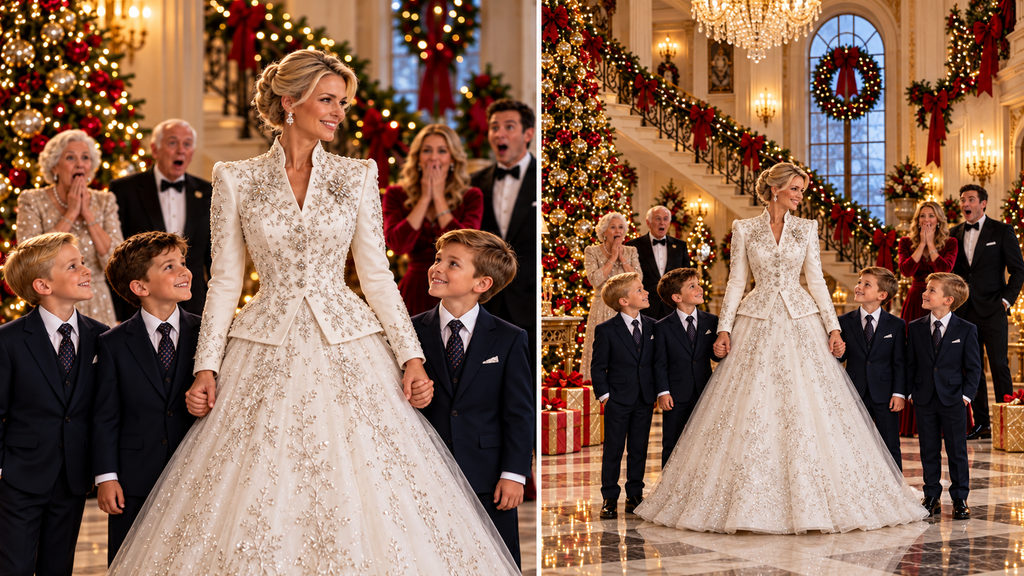
But I had never imagined that a small, worn photograph would bring one of the most self-assured men I had ever known to his knees.
“Mom,” Sam whispered, standing beside me in the snow, “should I give it to him?”
I looked down at my youngest son.
Sam had Ethan’s eyes.
The same dark blue eyes that had once looked at me across a crowded military ballroom and made me believe I had found the man I would grow old beside.
He also had Ethan’s stubborn chin and the peculiar little crease between his eyebrows that appeared whenever he was trying to solve a difficult problem.
But the courage in his expression belonged entirely to him.
“You don’t have to, sweetheart,” I told him softly.
Sam considered that.
Then he looked at Ethan again.
“I want to.”
Across the driveway, my former husband stood motionless.
Snowflakes settled on the shoulders of his expensive charcoal sweater.
Behind him, the enormous Caldwell estate glowed with Christmas lights.
A towering wreath hung above the front entrance.
Through the windows, I could see a magnificent Christmas tree, crystal chandeliers, and elegantly dressed guests gathering to understand what had interrupted their celebration.
It would have been a beautiful scene.
If it hadn’t been so painfully familiar.
Eight years earlier, I had stood inside that very house while Ethan’s mother informed me that my marriage was ending and that I should accept the situation with dignity.
Now I stood outside it with four living reminders of the truth her family had chosen to ignore.
Sam took one step forward.
Ethan didn’t move.
“Are you Major Caldwell?” Sam asked.
Ethan swallowed.
“Yes.”
Sam held out the photograph.
“My mom said you used to be really brave.”
The words seemed to strike Ethan harder than an accusation would have.
His mouth opened.
Nothing came out.
Sam continued.
“She said you helped people when they were scared. And that you were good at finding your way home.”
I felt my throat tighten.
I had told my sons stories about their father.
Not the cruel ones.
Not the nights I cried while folding their newborn clothes alone.
Not the lawyer’s letters or the humiliation of being accused of inventing a pregnancy.
I had told them about the young officer who once carried an injured dog three miles through freezing rain.
About the man who taught me to recognize constellations.
About the soldier who came home from his first deployment and cried quietly when he saw his aging grandfather waiting at the airport.
Those memories were real.
So was everything that happened afterward.
And I had never wanted my children to inherit hatred simply because their father had given me reasons to feel it.
Sam stretched out his arm.
Ethan reached for the photograph with a trembling hand.
It showed a much younger Ethan standing beside me in front of a small Christmas tree.
I was wearing a red sweater.
He had one arm wrapped around my waist.
We were laughing.
On the back, in my handwriting, were six words.
Our first Christmas. Our whole future.
Ethan turned the photograph over.
His face crumpled.
“Where did you get this?” he whispered.
“Mom keeps it in a box,” Sam answered. “With our baby bracelets and pictures from the hospital.”
Ethan looked up sharply.
“Hospital?”
“Yes.”
Sam glanced toward his brothers.
“We were all born in the hospital. Lucas came first. Then Henry. Then Jack. Then me.”
He paused.
“I was the smallest.”
Ethan stared at him.
“I almost didn’t make it,” Sam added matter-of-factly. “But Mom says I fought really hard.”
Something inside my chest twisted.
I had never heard Sam describe his birth that way to a stranger.
Especially not to the man who should have been standing beside my hospital bed.
Behind Ethan, a woman gasped.
I looked up.
His mother, Margaret Caldwell, stood on the porch.
For the first time in the twelve years I had known her, she looked genuinely speechless.
Her perfectly arranged silver hair framed a face drained of color.
Beside her stood Ethan’s father, Colonel Robert Caldwell, retired.
He was gripping the porch railing.
And behind them, wearing an elegant emerald-green dress, stood Natalie Harrison.
Ethan’s fiancée.
She was watching my sons.
Not with jealousy.
Not even with anger.
With the stunned expression of a woman realizing that the life she had been promised had been built on a story with missing chapters.
“Ethan,” she said quietly.
He didn’t answer.
“Ethan, who are these children?”
My former husband closed his eyes.
When he opened them, they were wet.
“I don’t know,” he whispered.
Lucas stepped forward.
My eldest son was the protective one.
The boy who checked that his brothers had their gloves before leaving home.
The boy who insisted on carrying grocery bags that were almost too heavy for him.
The boy who had once told me, at six years old, that I didn’t need a husband because I already had four helpers.
He looked directly at Ethan.
“Well,” Lucas said, “we know who you are.”
The silence that followed was enormous.
Then Ethan whispered the question that changed everything.
“Grace… are they mine?”
I had spent eight years preparing for those words.
And somehow, hearing them still hurt.
“They are your sons, Ethan.”
His knees nearly buckled.
Four boys.
Four faces.
Eight years.
And one truth he had refused to believe.
But the greatest shock of that Christmas afternoon was still waiting inside the Caldwell house.
Because Ethan wasn’t the only person who had lied.
And before the night was over, I would discover that someone in his family had known about my sons almost from the day they were born.
Someone who had watched them grow up from a distance.
Someone who had made sure their father never learned the truth.
And someone who was now terrified that the four little boys standing in the snow would reveal what she had done.
CHAPTER 2 — THE INVITATION THAT WAS NEVER ABOUT PEACE
“Grace.”
Ethan said my name as if he were afraid it might disappear.
I took Sam’s hand and drew him gently back toward me.
“Not here,” I said.
Ethan looked around.
His family stood frozen beneath the porch lights.
Several dinner guests had come outside.
At least two people were holding phones.
I immediately turned toward them.
“Please don’t photograph my children.”
My voice was calm.
But it carried.
One woman lowered her phone.
Another quickly slipped hers into her purse.
Colonel Caldwell cleared his throat.
“Everyone, inside,” he ordered.
Some instincts apparently survived retirement.
The guests hesitated, then retreated through the enormous front doors.
The Colonel came down the porch steps.
He was seventy-one now, his once-black hair completely white.
He had always been strict.
Formal.
Difficult to impress.
But unlike his wife, he had treated me with a certain quiet respect during my marriage.
His gaze moved from one boy to another.
Lucas.
Henry.
Jack.
Sam.
I watched recognition settle into his features.
Not recognition of people he had met.
Recognition of blood.
Henry had the Colonel’s ears.
Jack had his broad forehead.
Lucas carried the same serious expression that appeared in old Caldwell military portraits.
Robert stopped a few feet away.
“Grace,” he said slowly, “are these my grandsons?”
“Yes, Colonel.”
His lower lip trembled.
It was such an unfamiliar sight that I almost looked away.
He glanced at Ethan.
“Did you know?”
Ethan shook his head.
“Dad, I—”
“Did you know?”
“No.”
Robert turned back to me.
“May I ask their names?”
I placed a hand on Lucas’s shoulder.
“This is Lucas. He’s the oldest by three minutes.”
Lucas offered his hand.
“Nice to meet you, sir.”
Robert stared at that small hand.
Then he shook it.
“It’s… very nice to meet you too.”
“This is Henry,” I continued. “He loves astronomy and asks questions nobody can answer before breakfast.”
Henry pushed his glasses up his nose.
“Actually, most of my questions do have answers. Adults just don’t always know them.”
Despite everything, Robert let out a startled laugh.
“This is Jack. He’s our family’s inventor.”
Jack held up a small plastic device clipped to his backpack.
“I made a temperature sensor. It tells me when my backpack gets too cold.”
“And this,” I said, squeezing Sam’s hand, “is Samuel.”
Sam gave a shy wave.
Robert looked at him for a long moment.
“Hello, Samuel.”
“Hello.”
A silence followed.
Then Sam asked, “Are you our grandpa?”
Robert’s eyes filled.
“Yes,” he answered.
His voice broke on the single word.
“If you’ll let me be.”
Sam considered him seriously.
“Do you like pancakes?”
Robert blinked.
“I do.”
“Then probably.”
Jack giggled.
Henry smiled.
Lucas relaxed a fraction.
And something in Robert Caldwell’s face seemed to break open.
Behind him, Margaret remained on the porch.
She had not descended a single step.
I knew that expression.
She was calculating.
Even now.
Even with four grandchildren standing in front of her.
She was calculating what this meant for her family.
For their name.
For their carefully maintained reputation.
And perhaps for something else.
Something I couldn’t yet identify.
“Grace,” she said sharply, “surely you understand how extraordinary this is.”
I looked at her.
“Yes, Margaret. I do.”
“You arrive at our home in a military helicopter with four children and announce that Ethan is their father?”
“I didn’t announce anything. Your son asked me a question.”
“This is hardly the appropriate place for such a revelation.”
I almost smiled.
“You invited me to Christmas dinner.”
“We invited you,” she replied, emphasizing the singular word.
I glanced toward Ethan.
“Actually, Ethan invited me. And I told him I would be bringing my children.”
Ethan looked up.
Margaret turned toward him.
“You knew?”
He shook his head in confusion.
“She wrote that she would be bringing the children. I thought—”
“You thought what?” I asked.
His cheeks reddened.
“I thought you had remarried.”
“And had four eight-year-old sons who look exactly like you?”
He looked down.
“I didn’t know there were four.”
“Because you never asked.”
That silenced him.
Robert straightened.
“Everyone inside. It’s freezing out here.”
I hesitated.
He seemed to understand.
“Grace, I won’t pretend this is a normal Christmas dinner. But those boys shouldn’t stand outside in the cold while the adults sort through eight years of mistakes.”
He looked at Lucas.
“Would you boys like some hot chocolate?”
Jack immediately raised his hand.
“With marshmallows?”
Robert nodded solemnly.
“As many as the kitchen can find.”
Jack looked at me.
“Mom?”
I studied my sons.
They were excited.
Nervous.
Curious.
And much too young to understand the dangerous emotional territory into which we had just stepped.
I had not brought them here to punish Ethan.
Whatever he believed, whatever his parents believed, that had never been my purpose.
Three weeks earlier, when the invitation arrived, I had told my sons the truth.
Their father had invited us to Christmas.
They could choose whether to meet him.
I would support them either way.
Lucas had wanted answers.
Henry had wanted to know whether their father had his same blood type.
Jack had wanted to see the enormous Christmas tree he’d heard about.
And Sam had wanted to show Ethan the photograph.
Four different reasons.
Four different hearts.
I looked at Robert.
“Hot chocolate sounds good.”
Then I faced Ethan.
“But we’re not discussing our divorce in front of them. And no one is going to make them feel like they have done something wrong by being here.”
Ethan nodded quickly.
“Of course.”
I wasn’t finished.
“If any of the adults in this house makes one of my sons feel unwelcome, we leave.”
“Understood,” Robert said.
Margaret’s mouth tightened.
I took Lucas’s hand.
Together, we walked toward the house where my marriage had once been quietly dismantled.
And as we passed through the front doors, I noticed something strange.
Margaret wasn’t looking at the boys anymore.
She was looking at my handbag.
Specifically, at the slim leather folder tucked beneath my arm.
A folder containing eight years of evidence.
Medical records.
Birth certificates.
Copies of letters.
And something my attorney had discovered only four days earlier.
Something that had made me accept Ethan’s invitation in the first place.
CHAPTER 3 — FOUR LITTLE BOYS AT THE CALDWELL TABLE
The Caldwell dining room looked almost exactly as I remembered it.
The same twelve-foot mahogany table.
The same antique chandelier.
The same silver candleholders polished until they reflected the flames.
Only the Christmas decorations had changed.
Garlands draped across the windows.
Red velvet ribbons adorned the backs of the chairs.
And beneath the enormous tree stood a mountain of expensive presents wrapped in gold paper.
For a moment, I was twenty-six again.
A newly married woman trying desperately to impress people who had already decided she wasn’t impressive enough.
I remembered the first Christmas I spent there.
Margaret had asked what my parents did for a living.
When I explained that my father had repaired farm equipment and my mother was a public-school librarian, she had smiled in a way that made the answer feel embarrassing.
“How wonderfully modest,” she’d said.
At the time, I thought she meant it kindly.
It took me years to understand how often Margaret used kindness as a disguise for cruelty.
“Mom!”
Jack’s excited voice pulled me back.
“Look at that train!”
A beautifully detailed electric train circled the base of the Christmas tree.
Miniature mountains rose behind it.
Tiny houses glowed with warm yellow lights.
Jack crouched immediately.
“It’s got a switching track!”
Henry joined him.
“That’s a model of a narrow-gauge railway.”
“No, it isn’t,” Jack argued.
“Yes, it is.”
“Boys,” I warned gently.
They both looked up.
“Don’t touch anything without permission.”
A deep voice answered behind me.
“They can touch the train.”
I turned.
Robert had followed us inside.
He smiled at Jack.
“I built that layout myself.”
Jack’s face lit up.
“You did?”
“Over twenty years ago.”
“Does the switch actually work?”
Robert looked almost offended.
“Of course it works.”
Within seconds, he was kneeling beside my sons, explaining the controls.
I watched, stunned.
In six years of marriage, I had never seen Robert Caldwell kneel on the floor in his expensive trousers.
Not once.
Lucas remained beside me.
He was watching Ethan across the room.
His father was standing near the fireplace, speaking quietly to Natalie.
Ethan kept looking toward us.
His expression was a mixture of disbelief and something that resembled hunger.
As though he were trying to memorize four faces before they disappeared.
“Mom,” Lucas whispered.
“Yes?”
“Is he angry?”
I crouched beside him.
“Why would you think that?”
“He looks upset.”
“He’s surprised.”
Lucas studied Ethan again.
“Did we do something wrong?”
My heart broke a little.
“No, sweetheart. Not one thing.”
“Then why didn’t he know about us?”
I had prepared for that question for years.
But there was no answer that could make eight years of absence easy for a child to understand.
“Sometimes adults make decisions because they’re frightened or because they believe something that isn’t true,” I said carefully. “Your father made some very serious mistakes.”
Lucas lowered his eyes.
“Did he not want us?”
I swallowed.
“I don’t know what he would have wanted if he’d believed the truth. But I know this: the day you were born, you were wanted more than anything in the world.”
“By you.”
“Yes.”
He nodded slowly.
Then he whispered, “That was enough.”
I pulled him into my arms.
And for a moment, I couldn’t speak.
Because he meant it.
My boy, who had spent eight years living with the consequences of decisions he never made, was comforting me.
I kissed his hair.
“You have always been enough, Lucas.”
Across the room, I noticed Natalie watching us.
Her eyes were wet.
When I stood, she approached.
“Grace?”
“Yes?”
“I’m Natalie.”
“I know.”
She gave a small, sad smile.
“I suppose you do.”
We stood awkwardly for a moment.
Then she lowered her voice.
“I want you to know that I had no idea.”
I studied her.
“I believe you.”
Relief flickered across her face.
“Ethan told me there had been… difficulties during your divorce.”
“That is one way to describe it.”
“He said you had claimed to be pregnant.”
“I was pregnant.”
Natalie looked toward the boys.
“Yes. I can see that.”
She took a breath.
“He told me a doctor eventually confirmed it wasn’t true.”
The room seemed to tilt beneath my feet.
“What?”
Natalie frowned.
“He said there had been medical documentation. That the pregnancy claim had been disproven.”
I felt a chill move through me that had nothing to do with the snow outside.
“Who told him that?”
“I don’t know.”
“Did he say which doctor?”
Natalie shook her head.
“I never asked. It was years before we met, and I thought it was a painful subject.”
I stared at Ethan.
He was now speaking to his father beside the Christmas tree.
A hundred thoughts collided in my mind.
Ethan had accused me of lying.
His attorney had refused my attempts to provide medical evidence.
He had never responded to my messages.
But now Natalie was describing something I had never heard before.
A doctor who supposedly disproved my pregnancy.
No such doctor existed.
At least, not one who had ever examined me.
“Natalie,” I said quietly, “could I ask you something?”
“Of course.”
“Who told you that Ethan was inviting me tonight?”
She hesitated.
“His mother.”
Of course.
“Margaret said it would be a wonderful gesture,” Natalie continued. “She thought it would show everyone that Ethan had finally put the past behind him.”
I looked toward the far end of the room.
Margaret stood beside a display of family photographs.
Her hands were clasped tightly.
She was watching us.
I suddenly understood that the invitation might have been designed to humiliate me.
But I was beginning to suspect that wasn’t its only purpose.
Someone had expected me to arrive alone.
Someone had expected the old story to remain intact.
And someone had just realized that four living witnesses had stepped straight into the middle of it.
Then a household employee approached Margaret and quietly handed her an envelope.
Margaret looked at the writing.
Her face went white.
She opened it.
Read the first page.
And for the first time that evening, she looked genuinely frightened.
CHAPTER 4 — THE LETTER THAT NEVER REACHED HIM
Dinner was delayed.
Nobody officially announced it.
The household simply began moving around us in a carefully choreographed effort to pretend that nothing extraordinary had happened.
A cook brought hot chocolate.
A housekeeper found smaller chairs.
Robert opened a box of model-train accessories that had apparently been gathering dust for years.
And my sons settled into the strange magic of an unfamiliar Christmas.
Jack and Henry were fascinated by the train.
Sam sat near the fireplace, eating marshmallows one at a time.
Lucas watched everything.
Especially Ethan.
My former husband finally approached me near the library doors.
“Grace, we need to talk.”
“Yes,” I answered. “We do.”
“Privately.”
I looked toward my sons.
Robert seemed to anticipate my concern.
“I’ll stay with them,” he offered.
Natalie stepped closer.
“I can too.”
I studied her face.
There was nothing calculating in her expression.
Only shock and compassion.
“Thank you.”
Then I turned to Ethan.
“Ten minutes.”
He nodded.
We entered the library.
I remembered that room.
The dark wood shelves.
The leather chairs.
The enormous painting of Ethan’s grandfather above the fireplace.
It had been Ethan’s favorite room when we were married.
He used to sit by the window reading military history while I curled up beside him with medical journals.
There had been good evenings there.
Real ones.
That was perhaps the cruelest part of betrayal.
It didn’t erase the happy memories.
It contaminated them.
Ethan closed the door.
For several seconds, neither of us spoke.
Then he turned.
“Four?”
His voice cracked.
“Four sons?”
“Yes.”
“All boys?”
“Yes.”
He pressed a hand over his mouth.
“Dear God.”
I let him absorb it.
He walked toward the window.
Stopped.
Turned back.
“How premature were they?”
“Twenty-nine weeks.”
His face tightened.
“Twenty-nine?”
“Yes.”
“Were they…?”
He couldn’t finish.
I knew what he was asking.
“Lucas needed breathing support for several weeks. Henry had complications with feeding. Jack spent nearly two months in neonatal care.”
“And Sam?”
I looked down.
“Sam was the smallest.”
Ethan’s jaw tightened.
“How small?”
“Two pounds, one ounce.”
He made a wounded sound.
“Grace.”
“He had several serious complications. There were nights the doctors warned me he might not survive.”
Ethan sank into a chair.
I remembered those nights.
The monitors.
The fluorescent lights.
The exhaustion so profound that walking from one end of the hospital corridor to the other felt impossible.
I remembered placing one finger inside Sam’s tiny hand and feeling him hold on.
I remembered whispering, You can stay, sweetheart. Please stay.
And I remembered seeing other fathers arrive in the neonatal intensive care unit carrying coffee, blankets, and warm meals for their wives.
I used to turn away from them.
Not because I begrudged them their happiness.
Because watching a man hold his wife’s shoulders while they stared at their baby together made my loneliness feel physically unbearable.
“Why didn’t you tell me?” Ethan whispered.
I stared at him.
For a moment, I genuinely couldn’t speak.
Then I opened my handbag.
Removed the leather folder.
And placed it on the desk.
“I did.”
He looked at it.
“What is that?”
“Copies.”
“Of what?”
“Everything.”
I opened the folder.
The first page was a copy of the medical confirmation I had tried to give him.
His name appeared on the accompanying letter.
The second was a copy of an email asking him to contact my physician.
The third was correspondence from my attorney notifying his legal representative that I was carrying quadruplets.
The fourth documented the boys’ births.
The fifth contained their names and dates of birth.
And the sixth was a certified delivery receipt.
Ethan stared.
I turned the folder toward him.
“You were notified.”
He picked up the attorney’s letter.
His eyes moved rapidly across the page.
“That’s not possible.”
“Why?”
“Because I never saw this.”
I folded my arms.
“Your attorney received it.”
He shook his head.
“No.”
I showed him the acknowledgment.
“His office confirmed delivery.”
Ethan stood so suddenly that the chair scraped against the floor.
“I never received anything about quadruplets.”
“Then you should have asked your attorney why.”
“I did!”
His voice rose.
I held up a hand.
“Lower your voice. The boys are right outside.”
He shut his eyes.
When he spoke again, his tone was barely audible.
“Grace, I was told you withdrew the claim.”
My stomach dropped.
“What?”
He turned toward me.
“I was told your doctor admitted there had been a mistake. That there was no pregnancy.”
“That never happened.”
He looked at the papers again.
“Richard told me.”
“Richard?”
“My attorney.”
I remembered Richard Voss.
A polished man with a cold smile and a talent for making cruelty sound procedural.
“He said your lawyer had contacted him to confirm the claim was no longer being pursued.”
I felt my heartbeat quicken.
“Ethan, pregnancy isn’t something a lawyer pursues. It’s something that happens.”
“I know that now.”
“You could have called me.”
He looked away.
“You blocked my number.”
“After months of accusations. After your lawyer demanded that I stop contacting you directly.”
He ran a hand through his hair.
“I thought you had lied to keep me from leaving.”
“Because that was easier than believing you had abandoned your pregnant wife?”
He flinched.
I stepped closer.
“Do you want to know the worst part?”
He didn’t answer.
“I didn’t need you to stay married to me.”
His eyes lifted.
“By the time I found out I was pregnant, our marriage was already over. I knew that.”
My voice trembled despite my best efforts.
“I wasn’t asking you to love me again. I was asking you to acknowledge your child.”
“Grace—”
“I didn’t even know there were four yet. I just wanted you to know you were going to be a father.”
A tear slid down his cheek.
“I thought—”
“You thought the worst of me.”
He lowered his head.
“Yes.”
I let that single word settle between us.
For eight years, he had never admitted it.
Then I asked the question I had carried into that house.
“Who told you I wasn’t pregnant?”
“Richard.”
“And who told Richard?”
Ethan frowned.
“I don’t know.”
“Think.”
He looked toward the door.
Then back at me.
“My mother handled some of the communication while I was overseas.”
The silence became heavy.
I watched realization move slowly across his face.
“No,” he whispered.
I said nothing.
“No. She wouldn’t.”
I reached into the folder.
Removed one more document.
And slid it across the desk.
It was a copy of an email my attorney had obtained during a recent records review.
An email sent eight years earlier.
From Margaret Caldwell.
To Richard Voss.
The subject line read:
Regarding Grace Bennett’s alleged pregnancy.
Ethan stared at it.
His fingers shook as he read.
The message itself was brief.
Ethan has made his decision. I trust that no further personal allegations from Grace will be allowed to interfere with his assignment or his future. All correspondence concerning this matter should be directed through me.
Below it was Richard’s reply.
Understood. We will proceed as discussed.
Ethan looked up.
“What does ‘as discussed’ mean?”
“That,” I said, “is what I came here to find out.”
At that exact moment, the library door opened.
Margaret stood in the doorway.
And the first words out of her mouth told me she knew exactly what was in the folder.
“Grace, those documents were never meant to be in your possession.”
CHAPTER 5 — THE WOMAN WHO CONTROLLED EVERYTHING
Ethan turned slowly.
“Mother?”
Margaret stepped inside and closed the door behind her.
She looked composed again.
Almost.
Her hands betrayed her.
They were trembling.
“Before either of you makes this situation worse,” she began, “I suggest we remember that there are children in the house.”
I stared at her.
“Yes, Margaret. Four of them. Eight years old. Perhaps you remember hearing about them?”
Her mouth tightened.
“I will not be spoken to disrespectfully in my own home.”
Ethan stepped forward.
“Did you know?”
She looked at him.
“Know what?”
“That Grace was pregnant.”
Margaret drew a breath.
“Ethan, this is a complicated matter.”
“Did you know?”
Her silence answered more than words could.
Ethan’s face changed.
It was as if some invisible structure inside him had begun to collapse.
“Mother.”
“Your marriage was failing,” she said quickly. “You were about to leave on an important assignment. Your career was at a critical stage.”
“What does that have to do with my children?”
She stiffened.
“At the time, there were serious questions about the pregnancy claim.”
I stepped forward.
“Only because you kept calling it a claim.”
Margaret ignored me.
“Ethan, you were exhausted. You weren’t thinking clearly. Grace had become emotional, and—”
“Stop.”
The word came out like a command.
Margaret blinked.
Ethan pointed at the folder.
“Did you receive proof?”
She looked away.
“Medical paperwork was sent.”
My breath caught.
Even after everything I had suspected, hearing her admit it felt like a blow.
Ethan stared.
“You received medical proof.”
She hesitated.
“Yes.”
“And?”
“I had it reviewed.”
“By whom?”
“Our attorney.”
“Richard?”
“Yes.”
Ethan shook his head.
“You told me her doctor said she wasn’t pregnant.”
Margaret said nothing.
“You told me she had made it up.”
“I told you what I believed was in your best interest.”
His voice dropped.
“My best interest?”
“Your future was at stake.”
“My future?”
He pointed toward the door.
“My sons are standing in the next room.”
Margaret’s expression hardened.
“And at that time, I didn’t know whether they existed!”
“Then why didn’t you find out?”
She looked toward me with unmistakable resentment.
“Because your former wife was doing everything she could to make a clean separation impossible.”
Something in me went still.
For years, I had wondered whether Margaret regretted the way she treated me.
Whether she ever thought about the frightened young woman leaving her son’s marriage with a suitcase and a secret growing inside her.
Now I knew.
She had not been ashamed.
She had been irritated.
Because my pregnancy complicated the story she wanted to tell.
I leaned against the desk.
“Margaret, do you remember what you said to me the last time we spoke?”
She gave me a cold look.
“I’ve said many things over the years.”
“You told me that a woman who couldn’t keep a husband should at least have the decency not to ruin his future.”
Ethan stared at her.
“You said that?”
She lifted her chin.
“I may have expressed myself firmly.”
I almost laughed.
“Firmly.”
“Grace, I will not apologize for protecting my son.”
“Did protecting him include hiding his children?”
Her gaze flickered toward the door.
Then back to me.
And in that brief movement, I saw fear.
Not uncertainty.
Not embarrassment.
Fear.
I reached into my folder again.
“There’s something else.”
Margaret’s face tightened.
“Grace.”
I removed a small stack of photographs.
Four baby boys in an incubator.
Four toddlers wearing matching dinosaur pajamas.
Four preschoolers standing beneath a birthday banner.
Four kindergartners holding handmade snowflakes.
And a more recent photograph of my sons on their eighth birthday.
I spread them across the desk.
Ethan stared.
“Where did you get these?”
I didn’t look at him.
I was watching Margaret.
“These were mailed to someone,” I said.
Margaret went very still.
“Someone who never acknowledged receiving them.”
Ethan looked from the photographs to his mother.
“What are you talking about?”
I placed the final item on the desk.
A birthday card.
Its envelope was addressed to Margaret Caldwell.
Inside was a photograph of Lucas, Henry, Jack, and Sam on their first birthday.
On the back, I had written:
They are one today. Whatever happened between us, they deserve to know their family. Please tell Ethan they are healthy and loved.
Ethan’s face crumpled.
“You sent her pictures?”
“For several years.”
I swallowed.
“Until I realized I was sending them into silence.”
He turned toward Margaret.
“You knew?”
She stared at the card.
Her lips moved soundlessly.
Ethan spoke again.
Louder this time.
“You knew they were alive?”
Margaret gripped the back of a chair.
“I was trying to prevent a terrible mistake.”
“What mistake?”
“An impulsive decision that would have destroyed everything you worked for.”
Ethan took a step backward.
As though he no longer recognized the woman standing in front of him.
“You let me believe I had no children.”
Margaret’s voice sharpened.
“I raised you to become someone important.”
He stared at her.
“And being their father wasn’t important?”
She had no answer.
For a moment, I felt an unexpected surge of sadness.
Not for Margaret.
Not yet.
For the young man Ethan had once been.
The man who had always wanted his parents’ approval.
Who had spent his entire life trying to become the officer his father admired and the success his mother could display.
And who had never learned to distinguish loyalty from obedience.
Margaret looked at me.
“This is what you wanted, isn’t it?”
I frowned.
“What?”
“To come here and destroy my family.”
The words hung in the air.
Then I answered with the truth.
“No, Margaret.”
My voice was quiet.
“You destroyed something that belonged to your family eight years ago.”
I looked toward the door.
“And I spent every day since making sure my sons never felt the emptiness you helped create.”
A knock sounded.
The door opened before anyone answered.
Robert Caldwell stepped inside.
He looked at the photographs.
At Ethan’s tears.
At Margaret’s rigid posture.
Then he spoke.
“I heard enough.”
Margaret spun toward him.
“Robert, this is a private conversation.”
He shook his head.
“No.”
His voice was unusually soft.
“This stopped being private when you took away my grandsons.”
And then he said something none of us expected.
“Margaret, I asked you about those babies eight years ago.”
The room fell silent.
CHAPTER 6 — THE GRANDFATHER’S SECRET
I looked at Robert.
“What?”
He seemed to age ten years in the space of a breath.
“I knew Grace said she was pregnant.”
Margaret closed her eyes.
Ethan stared at his father.
“You knew?”
Robert nodded.
“Your mother told me.”
He approached the desk slowly, as if every step required a decision.
“She said Grace had become desperate after the separation. That there were allegations about a pregnancy.”
I felt my stomach twist.
“And you believed her?”
“At first.”
He looked directly at me.
“I owe you an apology for that.”
I said nothing.
He continued.
“Later, I saw a letter on Margaret’s desk. A letter from your attorney.”
Margaret’s face darkened.
“Robert.”
“I remember it because the envelope said it concerned the birth of four children.”
Ethan gripped the edge of the desk.
“Four?”
Robert nodded.
“I asked your mother about it.”
He looked at her.
“And you told me the children weren’t Ethan’s.”
Margaret said nothing.
“You said Grace had acknowledged another man was their father.”
I felt the blood drain from my face.
“I never said that.”
Robert’s eyes closed.
“I know.”
The words were so quiet I almost missed them.
“You know now?” I asked.
He looked at me.
“Yes.”
“And back then?”
He hesitated.
“I accepted what my wife told me.”
I held his gaze.
“So you knew there were four children.”
“Yes.”
“And you never contacted me.”
“No.”
“Not once.”
His eyes filled.
“No.”
I turned away.
I had spent years imagining the Caldwell family didn’t know my sons existed.
Now I was standing in a room with three people who had known enough to ask questions.
And none of them had.
Robert’s voice broke.
“I was wrong, Grace.”
I looked at him again.
He stood straight despite the tears in his eyes.
“I was so concerned about avoiding family scandal that I chose not to investigate something I should have investigated immediately.”
He paused.
“I have no excuse.”
That was more honesty than I had received from a Caldwell in eight years.
But it didn’t erase anything.
“Your grandchildren were in the neonatal intensive care unit,” I said. “They were fighting for their lives. I sat beside four incubators, wondering whether I would get to take all my babies home.”
Robert’s expression crumpled.
“I didn’t know.”
“You could have.”
He lowered his head.
“Yes.”
The silence stretched.
Then Ethan spoke.
“What else?”
Robert looked at him.
“What do you mean?”
“What else did Mom tell you?”
Margaret straightened.
“This is becoming absurd.”
Ethan ignored her.
“Dad, did she show you anything? Any proof? Any correspondence?”
Robert hesitated.
Then something shifted in his expression.
“There was a document.”
Margaret snapped, “Robert.”
He turned toward her.
“A medical statement.”
My pulse quickened.
“What kind of statement?”
Robert frowned.
“It was supposed to be a physician’s confirmation that there was no ongoing pregnancy.”
Ethan looked at me.
I shook my head.
“There was no such statement.”
Robert’s face went pale.
“I see that now.”
“Where is it?” Ethan demanded.
Robert looked toward Margaret.
“She kept it.”
Margaret crossed her arms.
“That was eight years ago. I don’t retain every piece of paperwork that passes through this house.”
Robert held her gaze.
“You retain everything.”
She looked away.
And I knew he was right.
Margaret kept receipts from twenty-year-old charity dinners.
She kept handwritten thank-you notes.
She kept newspaper clippings mentioning the Caldwell name.
She even kept seating charts from formal gatherings because, in her world, who sat beside whom could be more important than what anyone said.
Somewhere in that house, there might be records of exactly what had happened.
I looked at Ethan.
“Your mother has an office upstairs.”
Margaret took a sharp breath.
“You are not going through my belongings.”
“I wasn’t planning to.”
Ethan stepped toward her.
“Then you can show me.”
She stared at him.
“What?”
“The records.”
“Ethan—”
“If you did nothing wrong, show me.”
She looked toward Robert.
For the first time that evening, he didn’t come to her rescue.
“Margaret,” he said, “I suggest you tell the truth.”
She drew herself upright.
“I have done nothing except love my family.”
Robert’s voice turned cold.
“Then love them enough to stop lying.”
Something changed in the room.
I saw it in Ethan’s expression.
In Robert’s posture.
And in Margaret’s sudden awareness that the two men who had protected her from consequences for decades were no longer willing to stand between her and the truth.
She turned toward the door.
“Fine.”
Her voice was brittle.
“You want old papers? I’ll show you old papers.”
She opened the door.
And as we followed her into the hallway, I heard laughter coming from the drawing room.
My sons.
Four beautiful, unsuspecting boys.
They had no idea that the adults walking past them were about to uncover a secret that had shaped their entire lives.
Nor did I.
Because at that moment, I still believed Margaret had hidden photographs and letters.
I didn’t yet know she’d gone much further.
CHAPTER 7 — THE LOCKED DRAWER
Margaret’s office was on the second floor.
I remembered the room from my marriage.
Pale blue wallpaper.
White furniture.
A large desk beneath the window.
Shelves lined with leather-bound albums documenting the Caldwell family for generations.
At the center stood a locked mahogany filing cabinet.
Margaret walked directly to it.
For a moment, I thought she might refuse again.
Instead, she removed a small key from a chain beneath her blouse.
Ethan noticed.
“Do you always carry that?”
She didn’t answer.
The cabinet clicked open.
Inside were carefully labeled folders.
Property.
Investments.
Family Trusts.
Legal.
Personal Correspondence.
Margaret selected a folder from the bottom drawer.
Its label made my throat tighten.
E.B. — Marriage Dissolution.
Ethan stared at it.
“You kept a file on my divorce?”
“Of course.”
He looked at me.
I said nothing.
Margaret placed it on the desk.
“There. Everything.”
But she didn’t step away.
Her hand remained on the cover.
As if she could somehow control what it contained by refusing to release it.
Ethan reached for it.
She gripped it tighter.
“Ethan, before you look at any of this, you need to understand something.”
He met her eyes.
“No.”
She blinked.
“No?”
“I need to understand what happened. Not what you want me to believe happened.”
His voice was steady.
For the first time that evening, I heard the officer he had become.
Not the frightened son.
Not the arrogant husband.
A man finally willing to confront an unpleasant truth.
Margaret released the folder.
Ethan opened it.
The first pages concerned our divorce.
Property valuations.
Settlement discussions.
Attorney correspondence.
Then came medical paperwork.
I recognized my doctor’s signature.
My eyes filled immediately.
There it was.
The confirmation of my pregnancy.
The estimated due date.
The ultrasound report.
And a note advising that the pregnancy required close monitoring.
Ethan read it.
Then read it again.
He looked up at me.
“This says multiple gestation.”
“Yes.”
“Four fetuses.”
“Yes.”
His hand began to shake.
The report had been dated months before the boys were born.
Long before anyone could pretend there was confusion.
He turned another page.
An official hospital notice.
Then a letter from my attorney.
Then another.
All received.
All filed.
None of them reaching Ethan.
At the bottom of the stack lay the document Robert had remembered.
Ethan unfolded it.
His expression changed.
“What is this?”
I leaned closer.
The paper was designed to look like a medical letter.
It had a familiar clinic name.
A printed physician signature.
And a statement suggesting my earlier pregnancy confirmation was no longer valid.
But one detail immediately caught my attention.
The physician named on the letter had never treated me.
I stared.
“That’s not my doctor.”
Ethan looked up.
“What?”
“That’s not the physician who handled my pregnancy.”
Margaret reached for the paper.
“It’s been eight years. Perhaps you’ve forgotten.”
I pulled it away.
“No.”
My voice came out sharp.
“I have not forgotten the people who helped me bring four premature children into the world.”
I examined the document.
Something else was wrong.
The clinic letterhead was slightly different from the one on my actual records.
And the supposed physician’s title didn’t match the specialty listed in the clinic’s paperwork.
“This needs to be authenticated,” I said.
Ethan stared at his mother.
“Where did this come from?”
Margaret said nothing.
“Mother.”
“I was given it.”
“By whom?”
“Richard.”
I looked at her.
“You said you had the medical evidence reviewed.”
“I did.”
“Then who wrote this?”
She lifted her chin.
“Ask Richard.”
Ethan took out his phone.
Margaret’s composure cracked.
“What are you doing?”
“Calling him.”
“It’s Christmas.”
“He can answer tomorrow if he prefers.”
“Ethan, this is unnecessary.”
He held up the phone.
“Then tell me the truth.”
She stared at him.
He waited.
Finally, she sank into the chair.
And said something I would never forget.
“I only meant to delay things until your assignment was finished.”
Ethan went still.
“What things?”
Margaret covered her face.
“The pregnancy.”
My blood ran cold.
“What about it?”
She looked at me.
“I believed that once enough time passed, everyone would move on.”
I stared at her.
“Move on from four children?”
“I didn’t know there were four at the beginning.”
“That doesn’t answer the question.”
Her eyes flashed.
“You were supposed to accept the divorce!”
“I did accept the divorce.”
“No,” she snapped. “You kept finding reasons to remain connected to my son!”
I heard my own voice rise.
“Because I was carrying his children!”
Margaret flinched.
Ethan stepped between us.
“Enough.”
He looked at his mother.
“Did you arrange for a false medical letter?”
Margaret stared at the floor.
“Mother.”
She whispered, “Richard said it would make everything simpler.”
The words seemed to hang in the room.
For a moment, nobody moved.
Then Ethan asked, very quietly, “You knowingly gave me a false document?”
Margaret began to cry.
And I discovered something surprising.
I felt no satisfaction.
I had imagined this moment for years.
The truth exposed.
Margaret caught in her own lies.
Ethan forced to confront what had happened.
But seeing her cry didn’t repair the past.
It didn’t put him beside me in the hospital.
It didn’t bring him to the boys’ first birthdays.
It didn’t change the fact that Lucas had learned to ride a bicycle without his father holding the seat.
Or that Henry had once asked a teacher whether he could make a Father’s Day card for his grandfather who wasn’t there.
Or that Jack had tried to build a machine that could send messages to people who didn’t know where you lived.
Or that Sam had once whispered, “Maybe Dad would love us if he knew how good we are.”
No confession could undo those moments.
But perhaps it could finally stop the lies.
Ethan looked at his mother.
“You chose my career over my children.”
Margaret wiped her eyes.
“I chose the future you told me you wanted.”
He shook his head.
“No.”
His voice broke.
“You chose the future you wanted me to have.”
And then the strangest thing happened.
Margaret stopped crying.
She looked at Ethan with something almost like anger.
“You have no idea what I sacrificed for this family.”
Robert spoke from the doorway.
“Then perhaps it’s time we all found out.”
We turned.
He had been standing there longer than I realized.
In his hand was another envelope.
And on the front, written in Margaret’s handwriting, were two words.
Private Arrangement.
CHAPTER 8 — THE ACCOUNT NOBODY KNEW ABOUT
Robert set the envelope on the desk.
Margaret immediately stood.
“Where did you find that?”
“In the household records.”
“You had no right—”
“It’s my house too.”
His voice carried a finality that silenced her.
Ethan opened the envelope.
Inside were bank statements.
A series of payments.
And correspondence relating to an account administered through the Caldwell family office.
I watched his expression darken.
“What is this?”
Robert answered.
“I found references to payments made to Richard Voss’s consulting company.”
Ethan stared.
“Consulting?”
Robert nodded.
“Separate from the legal fees associated with your divorce.”
I looked at the statements.
The amounts were substantial.
Several payments had been made during the months surrounding my pregnancy.
Others had followed later.
“What were these for?” I asked.
Margaret folded her arms.
“Financial arrangements between adults.”
Ethan looked up sharply.
“What financial arrangements?”
“Confidential services.”
“What services?”
She said nothing.
Robert sighed.
“Margaret, the account was funded with money from our joint assets. I have every right to ask.”
Her face hardened.
“I was protecting our family.”
I was beginning to hate that sentence.
It seemed to excuse everything in her mind.
Lies.
Interference.
The deliberate isolation of children.
All under the banner of protection.
Ethan spread the statements across the desk.
One transfer was dated a week after my attorney sent the quadruplet ultrasound results.
Another followed the boys’ birth.
A third arrived shortly after their first birthday.
The last payment was made three years earlier.
I frowned.
“Why would the payments continue?”
Ethan looked at his mother.
“That’s what I’d like to know.”
Margaret pressed her lips together.
Robert lifted one page.
“There’s correspondence attached.”
He read silently.
Then his expression changed.
“Good Lord.”
“What?” Ethan demanded.
Robert looked at me.
“Grace, did you ever pursue a formal child-support order?”
The question caught me off guard.
“No.”
Ethan stared at me.
“Why not?”
I took a breath.
“Because the situation was complicated. Your attorney disputed paternity, and I was facing a dangerous pregnancy. Later, when the boys were born, they spent months in medical care.”
I glanced down at the photographs.
“By the time they came home, I was more concerned about keeping them alive and healthy than fighting another legal battle.”
Ethan’s face tightened.
“But you could have.”
“Yes.”
“Why didn’t you?”
“Because every time I tried to establish even basic communication, your legal representatives treated me as though I was pursuing you for money.”
He lowered his eyes.
“I never wanted that fight near my children.”
Robert looked at the document again.
“I think you need to see this.”
He handed it to me.
It appeared to be an internal memorandum between Richard Voss’s firm and the family office.
The language was careful.
Vague.
But the meaning was unmistakable.
Funds had been allocated for continued handling of what the document described as a potential paternity exposure matter.
My hands went cold.
I read the phrase twice.
Then a third time.
“Potential paternity exposure,” I repeated.
Ethan looked horrified.
“That’s how they described my sons?”
I handed him the paper.
“Apparently.”
Margaret looked away.
Robert spoke quietly.
“There is something else.”
I looked up.
“The family trust.”
Margaret spun toward him.
“Robert, don’t.”
He ignored her.
“My father established a trust for his descendants. It’s an old arrangement, and we’ve updated it several times.”
Ethan frowned.
“What does that have to do with this?”
Robert swallowed.
“The trust includes provisions for direct descendants of the family.”
I looked at him.
“And?”
“If Ethan had four children, that would have affected certain disclosures and the allocation of future benefits.”
Margaret’s face was white.
Suddenly, another piece of the puzzle clicked into place.
I looked at her.
“You weren’t just worried about Ethan’s career.”
She didn’t answer.
“You were worried about money.”
“No.”
“About control.”
“Grace—”
“About the possibility that four children you didn’t approve of might have rights within the family.”
Margaret stood rigid.
Robert looked devastated.
“I don’t know whether that was her motive,” he said carefully. “But the trust administrator should have been informed.”
I nodded.
It was important not to confuse suspicion with proof.
There were still questions.
Many questions.
And I had no intention of turning my sons’ lives into a public accusation based on assumptions.
But the documents were enough to establish that this was no simple misunderstanding.
Someone had deliberately managed information about their existence.
For years.
Ethan took the memorandum.
He read it.
Then folded it carefully.
“I want all of this preserved,” he said.
Margaret stared at him.
“For what?”
“For an independent investigation.”
Her eyes widened.
“You would investigate your own mother?”
He looked at her for a long time.
Then he answered.
“If someone interfered with my children’s rights, I will not pretend it didn’t happen.”
She shook her head.
“After everything I’ve done for you?”
His expression twisted.
“That’s the problem, Mother.”
He looked toward the hallway.
“You did too much.”
A small voice sounded behind us.
“Dad?”
We all turned.
Lucas stood in the doorway.
His face was pale.
And the look in his eyes told me he had heard more than any child should have.
CHAPTER 9 — THE QUESTION NO ADULT COULD ANSWER
“Lucas.”
I crossed the room immediately.
He stepped backward.
Not away from me.
Away from Ethan.
“Sweetheart,” I said, kneeling in front of him, “what are you doing upstairs?”
He held up a small knitted mitten.
“Sam dropped this. I was looking for you.”
I took the mitten gently.
“Thank you.”
His eyes moved past me.
Toward his father.
“Were you fighting?”
I swallowed.
“We were having a difficult conversation.”
Lucas nodded.
Then he asked Ethan a question that silenced the entire room.
“Did you know we were babies?”
Ethan looked as though someone had struck him.
“Lucas—”
“Did you know Mom had us?”
His voice trembled.
I reached for him.
But he didn’t look away from Ethan.
He needed an answer.
Not from me.
From the man who had missed his life.
Ethan slowly crouched.
Keeping several feet between them.
“No,” he said.
Lucas studied him.
“Mom said she told you.”
“She did.”
“Then why didn’t you believe her?”
Ethan lowered his head.
“Because I made a terrible mistake.”
Lucas frowned.
“What kind?”
Ethan took a shaky breath.
“The kind that happens when someone decides what they want to believe before they listen to the truth.”
Lucas was quiet.
Then he asked the question I had feared for eight years.
“Did you not want us?”
Ethan’s face crumpled.
I reached for Lucas’s shoulder.
“Sweetheart, we can talk about—”
“No, Mom.”
His eyes remained fixed on Ethan.
“I want him to tell me.”
There are moments when motherhood means protecting your child from an answer.
And there are moments when it means trusting your child enough to let him ask.
This was the second kind.
I stayed beside him.
Ethan swallowed.
“I didn’t know you were here.”
Lucas blinked.
“But if you knew?”
Ethan’s voice broke.
“If I had known, I would have wanted to meet you.”
Lucas looked at him for a long time.
Then asked, “Would you have helped Mom?”
Ethan began to cry.
Not quietly.
Not politely.
His shoulders shook.
He covered his face.
And my eight-year-old son watched him with an expression that was far older than eight years.
Because children understand more than adults think.
They understand when answers don’t fit.
When grown-ups are ashamed.
When someone is trying to say something important but doesn’t know how.
Lucas waited.
Finally, Ethan lowered his hands.
“Yes,” he whispered. “I should have helped your mother.”
“She’s really good at everything,” Lucas said.
Ethan nodded.
“I believe that.”
“She fixes stuff. And she knows medicine. And she makes pancakes shaped like dinosaurs.”
Despite his tears, Ethan smiled.
“That sounds like her.”
“But sometimes she’s tired.”
I felt my eyes fill.
“Lucas—”
He continued.
“Sometimes she thinks we’re asleep and she sits at the kitchen table looking at bills.”
I closed my eyes.
I hadn’t known he saw that.
“She always says everything’s okay,” he added. “But sometimes I think she’s worried.”
Ethan looked at me.
The shame in his expression was almost unbearable.
Lucas stepped closer.
“So if you’re really our dad, maybe you should say sorry to her first.”
Nobody spoke.
Then Ethan slowly stood.
He looked at me.
“Grace.”
I shook my head slightly.
Not because I didn’t want the apology.
Because I didn’t want Lucas to feel responsible for extracting it.
But Ethan seemed to understand.
He turned back toward our son.
“Lucas, you’re right that I owe your mom an apology. But that’s something I need to do because it’s right, not because you have to make me.”
Lucas considered that.
“Okay.”
Ethan breathed unevenly.
“And you need to know something else.”
“What?”
“None of this is your fault.”
Lucas stared at him.
“Or your brothers’.”
He nodded.
Ethan’s voice broke again.
“You don’t have to fix what the adults did.”
For the first time, Lucas’s expression softened.
“Okay.”
I held out my hand.
“Come on, sweetheart. Let’s go downstairs.”
He took it.
But before we left, he turned back.
“Major Caldwell?”
Ethan looked up.
“Yes?”
“Jack says your Christmas train is really cool.”
A fragile smile appeared.
“Thank you.”
“And Grandpa said we can help build another tunnel.”
Ethan nodded.
“That’s good.”
Lucas hesitated.
Then asked, “Do you like building stuff?”
Ethan swallowed.
“I do.”
Lucas glanced at me.
Then back at him.
“Maybe you could help.”
It wasn’t forgiveness.
It wasn’t reconciliation.
It wasn’t the magical healing of eight lost years.
It was a child offering a stranger the smallest possible opening.
And somehow, it was more generous than anything Ethan deserved.
CHAPTER 10 — NATALIE’S DECISION
By the time we returned downstairs, the atmosphere had changed.
The guests were still there.
The Christmas music still played.
The candles still burned.
But the easy confidence of the Caldwell family’s celebration had vanished.
People spoke in quiet groups.
Some stared openly.
Others pretended not to notice us.
I could almost feel the questions moving through the room.
Were the boys really Ethan’s?
Why hadn’t anyone known?
What did this mean for Natalie?
Would there be a scandal?
Would the engagement survive?
I didn’t care about any of it.
My concern was sitting on the carpet near the Christmas tree, explaining the workings of a model locomotive to his new grandfather.
Jack looked up when he saw me.
“Mom! Grandpa says we can make the tunnel longer!”
I smiled.
“That sounds wonderful.”
Robert looked at me.
There was something fragile in his expression.
Gratitude, perhaps.
Or shame.
Maybe both.
Sam ran over and wrapped his arms around my waist.
“Did you have your grown-up talk?”
“Yes, sweetheart.”
“Was it bad?”
I brushed snow-damp hair from his forehead.
“It was hard.”
He nodded knowingly.
“Like when Henry tells Jack he’s wrong?”
“Something like that.”
“Then you probably need hot chocolate.”
I laughed.
A real laugh.
For the first time since arriving.
“You might be right.”
Across the room, Natalie approached.
She carried two mugs.
“One for you,” she said.
I accepted it.
“Thank you.”
She looked toward the boys.
“They’re lovely.”
I smiled.
“They are.”
“And very different from one another.”
“Oh, you have no idea.”
She laughed softly.
Then her expression turned serious.
“Grace, could I speak with you for a moment?”
I glanced at my sons.
They were safely surrounded by their new grandfather and the train.
“Of course.”
We moved toward a quieter corner near the windows.
Outside, the snow was falling harder.
The helicopter that had delivered us was long gone, continuing its scheduled operations after our arrival at the property’s approved landing area.
Our return transportation was arranged separately.
I had wanted the boys’ first visit to their father’s family to feel special.
I hadn’t known just how unforgettable it would become.
Natalie set down her mug.
“Ethan and I have been engaged for four months.”
I nodded.
“He told me.”
“We’ve been together for almost two years.”
I waited.
She looked down at her hands.
“When we met, he told me his marriage ended because the two of you wanted different things.”
“That was partly true.”
“He said you didn’t support his career.”
I almost smiled.
“I supported his career for six years.”
Natalie’s eyes filled.
“I know that now.”
I said nothing.
She continued.
“He also told me you had become increasingly dishonest toward the end.”
I felt the familiar ache.
“I’m sorry.”
She shook her head.
“No. I’m the one who’s sorry.”
“For what?”
“For believing a story about you without ever asking whether it was fair.”
I studied her.
There was no defensiveness in her voice.
Only regret.
“Natalie, you weren’t there.”
“I know.”
“You trusted someone you loved.”
She looked toward Ethan.
He had just entered the room.
His face was pale.
His shoulders sagged.
For the first time in my memory, he looked uncertain of where he belonged.
Natalie watched him.
“I’ve spent two years thinking he was a man who had learned from his first marriage.”
She swallowed.
“And now I’m realizing I don’t know what he learned at all.”
I felt unexpected compassion for her.
She hadn’t asked to become part of this.
She had arrived expecting Christmas dinner.
A family celebration.
Perhaps a few awkward moments with her fiancé’s ex-wife.
Instead, she was discovering that the man she planned to marry had four sons he had never met.
And that he had allowed himself to believe terrible things about their mother.
“Whatever you decide,” I said gently, “please don’t make it because of me.”
Natalie looked at me.
“I won’t.”
She took a breath.
“But I need to ask you something.”
“Go ahead.”
“If Ethan had believed you eight years ago, would you still be married?”
The question surprised me.
I looked toward the fireplace.
Toward my boys.
Toward the life I had built without Ethan.
Then I answered truthfully.
“No.”
Natalie blinked.
“No?”
“Our marriage was already broken.”
I took a slow breath.
“His disbelief hurt me. It changed how I saw him. But even before that, we had stopped being partners.”
I looked back at her.
“Knowing about the boys wouldn’t have automatically made him a good husband.”
Natalie considered that.
Then nodded.
“Thank you.”
“For what?”
“For being honest.”
She paused.
“I think I needed to hear that.”
She walked toward Ethan.
I didn’t follow.
I didn’t need to.
Some conversations belonged to other people.
But from across the room, I saw her remove her engagement ring.
She held it in her palm.
Ethan stared.
Natalie spoke quietly.
He shook his head.
She said something else.
Then she placed the ring in his hand.
He didn’t try to stop her.
She touched his shoulder.
And walked away.
I watched her collect her coat from the foyer.
Before leaving, she came over to my sons.
“Thank you for showing me your train,” she told Jack.
He grinned.
“It’s Grandpa’s.”
“I know.”
She smiled.
“You four have a wonderful Christmas.”
Sam waved.
“You too!”
Natalie’s face softened.
Then she looked at me.
“Take care of them.”
“I will.”
She nodded.
“And take care of yourself.”
When the front door closed behind her, I felt a strange sadness.
Another life had changed because of the truth hidden eight years earlier.
But this time, at least, someone had been given the chance to make a decision with open eyes.
CHAPTER 11 — THE CHRISTMAS DINNER THAT ALMOST DIDN’T HAPPEN
At six forty-five, the household manager approached Robert.
“Sir, shall we serve dinner?”
Robert looked toward me.
It was such a small gesture.
A question.
A request for my opinion.
But after years of being treated as though my presence in the Caldwell family was a matter to be tolerated, it meant more than he knew.
I glanced at my sons.
They were hungry.
Excited.
And entirely unaware of the emotional wreckage surrounding them.
“Yes,” I said. “Let’s have dinner.”
Robert nodded.
“Then we’ll have dinner.”
Margaret was nowhere to be seen.
Ethan stood beside the fireplace.
He looked as though he hadn’t moved in twenty minutes.
The dining room filled slowly.
Guests took their places.
The household staff set out serving dishes.
Roasted turkey.
Glazed carrots.
Mashed potatoes.
Fresh bread.
And the enormous traditional Christmas pudding Margaret had insisted on serving every year.
Four additional chairs had been placed along one side of the table.
My sons sat together.
I sat beside Sam.
Robert took the chair at the head of the table.
And Ethan sat across from Lucas.
For a long moment, nobody spoke.
Then Jack looked at the place settings.
“Wow.”
Everyone turned.
He held up a silver fork.
“These are really heavy.”
Henry examined his.
“Probably sterling silver.”
Jack grinned.
“Can you imagine how much a whole box would weigh?”
Robert smiled.
“Quite a lot.”
Jack thought about that.
“Do you have to polish them?”
“Yes.”
“That sounds awful.”
A few guests laughed.
Real laughter.
It loosened something in the room.
Sam looked at the bread basket.
“Mom, can I have two?”
“Yes.”
“Three?”
“Two to start.”
He sighed dramatically.
“Negotiations have failed.”
Robert burst out laughing.
It startled the entire table.
I looked at him.
He was smiling at Sam as if the boy had given him the greatest gift imaginable.
The meal began.
And for several minutes, Christmas felt almost normal.
Henry explained how he’d become interested in astronomy.
Jack discussed engineering projects.
Sam described the time he’d convinced his brothers that the family dog could understand Spanish.
Lucas mostly listened.
But gradually, even he began to relax.
At one point, Robert asked him about school.
“What’s your favorite subject?”
“History.”
Robert smiled.
“Mine too.”
“Really?”
“Yes.”
Lucas considered him.
“Do you know a lot about military history?”
Robert looked almost delighted.
“I know a fair amount.”
Lucas leaned forward.
“Can I ask you something?”
“Anything.”
“Why did some armies use carrier pigeons when radios existed?”
Robert’s eyes lit up.
For the next five minutes, he explained wartime communications.
Lucas listened, fascinated.
And I watched eight years of missed possibility unfold before me.
This was what they could have had.
Conversations.
Birthdays.
Ordinary afternoons.
A grandfather answering questions.
A father helping with homework.
A family that didn’t require a Christmas miracle to remember its youngest members existed.
I felt tears gathering.
I lowered my eyes.
Then a small hand touched mine.
Sam.
“Mom?”
“Yes?”
“Are you sad?”
I smiled.
“A little emotional.”
He frowned.
“Good emotional or bad emotional?”
I thought about it.
“Both.”
He nodded seriously.
“That’s complicated.”
“It is.”
He squeezed my fingers.
“Do you want my last dinner roll?”
I laughed through tears.
“No, sweetheart. You eat it.”
He pushed it onto my plate anyway.
“You always give us yours.”
I stared at the bread.
Such a small thing.
A dinner roll.
But there was more love in that gesture than in every expensive present beneath the Caldwell Christmas tree.
I kissed his forehead.
“Thank you, darling.”
Across the table, Ethan watched us.
His eyes were wet again.
He hadn’t said much during dinner.
But when Sam looked up, Ethan managed a small smile.
Sam smiled back.
Then asked, “Do you have any allergies?”
Ethan blinked.
“No.”
“Good.”
“Why?”
“Because Henry’s allergic to peanuts and Jack doesn’t like mushrooms, and Mom says when you meet people you should learn important things about them.”
Ethan looked at me.
I looked away.
He cleared his throat.
“That’s very good advice.”
Sam nodded.
“Mom gives lots of it.”
For a moment, Ethan seemed unable to speak.
Then he answered.
“I wish I’d listened to more of it.”
The room fell quiet.
But before the silence became uncomfortable, Robert lifted his glass.
“I’d like to say something.”
Every conversation stopped.
Robert stood.
He looked around the table.
Then toward my sons.
“This has been an unexpected Christmas.”
A few guests smiled uncertainly.
He continued.
“There are times in life when a family is confronted with truths it should have faced long ago.”
My chest tightened.
Robert’s voice trembled.
“Today, I learned that I have four grandsons.”
He paused.
“Four extraordinary boys.”
Lucas sat a little straighter.
Jack grinned.
Henry looked embarrassed.
Sam reached for another potato.
Robert smiled.
“And I learned that my own failures helped keep me from knowing them.”
A murmur passed around the table.
Ethan lowered his head.
Robert continued.
“I cannot give back the birthdays I missed. Or the Christmas mornings. Or the ordinary days that make a family.”
His voice broke.
“But I can promise not to waste another opportunity I am given.”
He turned toward me.
“Grace, thank you for bringing the boys here.”
I swallowed.
He lifted his glass.
“To Lucas, Henry, Jack, and Samuel.”
Then he added, “And to their mother, who gave them a beautiful life.”
The table raised its glasses.
I felt my eyes fill.
But just as everyone began to drink, Margaret appeared in the doorway.
She had changed out of her elegant red dress.
She now wore a simple gray sweater.
Her makeup was gone.
And in her hand was an old leather-bound album.
“I believe,” she said quietly, “there’s something everyone should see.”
CHAPTER 12 — THE ALBUM OF LOST YEARS
Margaret stood at the end of the dining room.
Nobody moved.
Robert slowly lowered his glass.
“Margaret?”
She looked toward me.
Then toward the boys.
For the first time since our arrival, she seemed unable to find the right words.
I watched her carefully.
I wasn’t ready to trust a sudden change in her manner.
Not after what we had discovered upstairs.
But something about the album troubled me.
She held it against her chest as though it were heavy.
“May I?” she asked.
Robert nodded cautiously.
She approached the table.
Then placed the album in front of Ethan.
The cover was dark green leather.
Gold letters were stamped across the front.
The Caldwell Grandchildren.
My breath caught.
Ethan stared at it.
“Mother?”
She opened the album.
The first page showed a photograph of Lucas, Henry, Jack, and Sam as newborns.
Four tiny babies.
Four miniature knitted caps.
Four faces barely larger than my palm.
The photograph had been taken in the neonatal intensive care unit.
I remembered that day.
A nurse named Rebecca had arranged the boys’ blankets so their names could be seen.
I’d sent the photograph to the Caldwell family with a letter.
I hadn’t received a reply.
Ethan reached toward the page.
His hand stopped inches away.
He looked at me.
“You sent this?”
I nodded.
“Yes.”
Margaret turned the page.
The boys at six months.
Then their first birthday.
Their second Christmas.
Their first day of preschool.
Their first bicycles.
One of their kindergarten photographs.
Each picture had been carefully mounted.
Dated.
Labeled.
There were even handwritten notes.
Lucas — oldest.
Henry — wears glasses.
Jack — interested in building.
Samuel — youngest.
I stared in disbelief.
Margaret hadn’t thrown away the photographs.
She had kept them.
All of them.
For years.
Ethan flipped through the album.
His face collapsed.
“You watched them grow up.”
Margaret nodded slowly.
“Yes.”
“You knew their names.”
“Yes.”
“You knew what they looked like.”
Her lips trembled.
“Yes.”
He closed the album.
The sound made several guests jump.
“And you never told me?”
Margaret started crying.
This time, she didn’t seem angry.
Only exhausted.
“I told myself it was too late.”
Ethan stared.
“Too late for what?”
“To admit what I’d done.”
The room was utterly silent.
Margaret looked toward me.
“The first photograph came after their birth.”
Her voice was barely audible.
“I thought it might be another attempt to force the issue.”
I felt anger flare.
She continued before I could speak.
“Then the second photograph came.”
She looked down.
“And then the third.”
She pressed a trembling hand against the album.
“By the time I understood there were truly four little boys, I had already told Ethan so many things that weren’t true.”
Robert shook his head.
“Margaret.”
“I know.”
Her voice broke.
“I know.”
She looked at the boys.
Lucas had stopped eating.
Henry was staring at her.
Jack looked confused.
Sam was watching me.
Margaret’s expression crumpled.
“Every year, I told myself I’d explain.”
She wiped her cheeks.
“And every year it became harder.”
I felt something inside me harden.
“Harder for whom?”
She looked up.
“For me.”
I nodded.
“At least that’s honest.”
Her shoulders sagged.
I kept my voice steady.
“You had eight years to tell your son he had children.”
“Yes.”
“You had eight years to contact me.”
“Yes.”
“You had eight years to send a birthday card. To ask whether they needed anything. To acknowledge that they existed.”
Tears streamed down her face.
“I know.”
I looked at the album.
“You had photographs of my sons.”
My voice cracked.
“You watched them grow up on paper while their father believed they weren’t real.”
Margaret covered her mouth.
I stood.
The room blurred.
For years, I had assumed the photographs were thrown away.
Discarded.
Ignored.
But the truth was somehow worse.
She had kept them.
Looked at them.
Possibly loved the boys in her own complicated way.
And still chosen silence.
I pushed my chair back.
“Boys, we’re going to step outside for a moment.”
Lucas looked up.
“Mom?”
“It’s okay.”
He knew that voice.
The voice I used when I needed to hold myself together.
He stood immediately.
Henry followed.
Jack reluctantly put down his fork.
Sam reached for my hand.
As we walked toward the door, Margaret whispered, “Grace.”
I stopped.
But I didn’t turn.
“I’m sorry.”
Three words.
The words I had once dreamed of hearing.
And yet they arrived too late to feel like victory.
I looked back.
“I hear you, Margaret.”
Her face lifted hopefully.
“But forgiveness isn’t the same as pretending nothing happened.”
The hope faded.
I held Sam’s hand tighter.
“And right now, my sons need their mother more than your family needs a perfect Christmas.”
We left the dining room.
Behind us, the old Caldwell house fell silent.
And somewhere deep inside me, a grief I thought I’d already survived finally began to surface.
CHAPTER 13 — THE BOY WHO ASKED IF LOVE COULD BE LATE
We went into the smaller sitting room near the kitchen.
It was warm and quiet.
A little Christmas tree stood in the corner, decorated with handmade ornaments.
I remembered decorating that tree with Ethan during our first winter together.
For a moment, the memory hurt.
Then Jack climbed onto the sofa.
“Mom, are we leaving?”
I sat beside him.
“Not yet, unless you want to.”
Henry frowned.
“Did Grandma do something bad?”
I took a breath.
The boys had heard enough that pretending nothing happened would only confuse them.
“Your grandmother made some choices a long time ago that hurt our family.”
Lucas stared at me.
“Did she stop Dad from knowing about us?”
I looked at him carefully.
“She kept important information from him. Yes.”
Henry pushed his glasses up.
“That’s lying.”
“Yes.”
Jack frowned.
“Why?”
I shook my head.
“Sometimes people become so afraid of admitting they’re wrong that they keep making the same mistake.”
Sam leaned against me.
“Even grown-ups?”
“Especially grown-ups sometimes.”
He considered that.
“That’s silly.”
I smiled sadly.
“It is.”
Lucas remained standing near the window.
He looked troubled.
“Mom?”
“Yes?”
“If Dad didn’t know about us, does that mean he didn’t choose to leave us?”
The question struck me deeply.
I thought carefully before answering.
“He made the choice not to believe me when I told him I was pregnant. And other people kept important information from him afterward.”
Lucas nodded slowly.
“So he did something wrong.”
“Yes.”
“But Grandma did too.”
“Yes.”
He looked down.
“That’s a lot of wrong.”
I swallowed.
“It is.”
For a while, nobody spoke.
Then Sam climbed into my lap.
He was getting too big for it.
All four boys were.
Soon, they would be too tall to curl up against me the way they did when they were little.
But that evening, Sam fit himself against my chest and rested his head beneath my chin.
“Mom?”
“Yes, baby?”
“Can somebody start loving you when you’re already eight?”
My breath caught.
I looked down at him.
“What do you mean?”
He touched the photograph still tucked inside his coat pocket.
“If Dad didn’t know us when we were babies, can he love us now?”
The room seemed to grow very still.
Lucas turned from the window.
Henry stopped fidgeting.
Jack looked up.
All four boys were waiting.
I wrapped my arms around Sam.
“Yes,” I whispered.
“Really?”
“Yes.”
I kissed his forehead.
“Love doesn’t always arrive when it should.”
He considered that.
“But it can still come?”
I felt tears slip down my cheeks.
“Yes, sweetheart.”
I looked at all four of them.
“But you don’t have to earn it. You don’t have to be extra good or extra smart or extra brave to make someone love you.”
Henry lowered his eyes.
Jack leaned closer.
Lucas listened intently.
“You are already wonderful exactly as you are.”
Sam nodded.
“Okay.”
Then he asked, “Can we have dessert?”
I laughed through my tears.
“Yes.”
He grinned.
“Because I think chocolate cake can also come late.”
The other boys burst into laughter.
And just like that, the room felt lighter.
Children have a remarkable ability to return to the present.
To remind adults that even the most painful conversations eventually give way to ordinary needs.
Warmth.
Food.
Laughter.
Someone to sit beside.
I wiped my cheeks.
“Dessert sounds like an excellent idea.”
A soft knock came at the door.
Robert stood outside.
“May I come in?”
I nodded.
He entered carrying a tray.
Five bowls of chocolate pudding.
With whipped cream.
And small candy-cane decorations.
Jack gasped.
“Grandpa!”
Robert smiled.
“I understand this room was in need of reinforcements.”
Sam jumped off my lap.
“Dessert reinforcements!”
The boys crowded around him.
Robert set down the tray.
Then looked at me.
“Grace, may I speak with you?”
I hesitated.
He added quickly, “Right here. Nothing private.”
I nodded.
He stood beside the window.
His expression was solemn.
“I called the family attorney’s office.”
I stiffened.
“Robert—”
“Not Richard Voss. An independent firm.”
I relaxed slightly.
He continued.
“I told them we need the records reviewed. The payments. The correspondence. The questionable medical letter. Everything.”
I studied him.
“Good.”
“And Grace?”
“Yes?”
“If those boys have legal rights connected to our family, I want them identified and protected.”
I said nothing.
He glanced toward the children.
“I can’t promise that it will make up for the past.”
“No,” I whispered. “It won’t.”
“I know.”
He looked back at me.
“But I can stop the family from making the same mistake again.”
For a moment, we stood silently.
Then I asked him something.
“Robert, are you doing this because you love them?”
He looked startled.
“I—”
“Or because you’re ashamed?”
He considered the question.
Then answered quietly.
“Today, I barely know them.”
I appreciated the honesty.
“But I already want to,” he continued.
His eyes filled.
“And I think love may have to begin there.”
I looked toward my sons.
They were sitting together on the rug, sharing pudding and arguing about whose bowl contained the most whipped cream.
Four noisy little miracles.
Four lives built without the Caldwell family.
And perhaps, if the adults could behave responsibly, four lives that might now have room for something new.
I looked back at Robert.
“Then begin by showing up.”
He nodded.
“I will.”
“And understand something.”
“Yes?”
“Trust isn’t inherited with a family name.”
His expression grew solemn.
“It has to be earned.”
He nodded again.
“I understand.”
For the first time that evening, I believed he might.
CHAPTER 14 — THE MESSAGE FROM RICHARD VOSS
At eight fifteen, my phone vibrated.
I glanced at the screen.
A message from my attorney, Evelyn Brooks.
Grace, please call me when you have privacy. I’ve received something important.
My stomach tightened.
Evelyn had represented me during the final stages of my divorce and had later become one of my closest friends.
She was careful.
Methodical.
Not a woman who used the word important casually.
I stepped into the hallway.
Called her.
She answered immediately.
“Grace, where are you?”
“At the Caldwell estate.”
A pause.
“Are the boys with you?”
“Yes.”
“Are they safe?”
I frowned.
“Of course. Why?”
“Because Richard Voss’s former paralegal contacted our office this afternoon.”
My pulse quickened.
“What?”
“Her name is Olivia Mercer.”
I remembered the name vaguely.
A young woman who had once sat beside Richard during a divorce conference.
“What did she say?”
Evelyn hesitated.
“Grace, she says she has documents concerning what happened eight years ago.”
I gripped the phone.
“What kind of documents?”
“Internal communications. Notes. Draft letters.”
My heart began to pound.
“About my pregnancy?”
“Yes.”
I leaned against the wall.
For a moment, I couldn’t breathe.
Evelyn continued.
“She claims Richard’s office received authenticated medical documentation confirming your pregnancy and later the birth of the boys.”
“We know that.”
“There’s more.”
I closed my eyes.
“Tell me.”
“She says Richard prepared a communication for Ethan summarizing the new information.”
My breath caught.
“And?”
“It was never sent.”
“Why?”
Evelyn was quiet for a moment.
“According to her, Margaret instructed the office to hold all direct correspondence until Ethan returned from his assignment.”
I stared at the hallway.
“That doesn’t explain eight years.”
“No.”
Evelyn exhaled.
“Olivia says Richard then drafted a misleading status summary indicating the pregnancy issue had been resolved.”
My hand tightened around the phone.
“Was the false medical document involved?”
“We don’t know yet.”
I told her what we’d found upstairs.
The questionable letter.
The payments.
The album.
Evelyn listened without interrupting.
When I finished, she said, “Preserve everything. Don’t let anyone alter or destroy those records.”
“Ethan said he wants an independent investigation.”
“Good.”
I hesitated.
“Evelyn, why is Olivia coming forward now?”
Another pause.
“Richard died last month.”
I blinked.
“I didn’t know.”
“His former firm is being reorganized. Olivia says she found archived files while helping close out certain matters. She contacted us because she believed the records raised serious ethical questions.”
I stared at the carpet.
Eight years.
Eight years of silence.
And now, within hours of my arrival, old documents were surfacing from every direction.
Evelyn seemed to read my thoughts.
“Grace, none of this changes what happened. But it may help us establish who knew what, and when.”
I swallowed.
“Thank you.”
“There is one more thing.”
My stomach tightened.
“What?”
“Olivia mentioned a handwritten note.”
I closed my eyes.
“From whom?”
“She believes it was written by Ethan.”
I went still.
“Ethan?”
“Yes.”
“What did it say?”
“She didn’t quote it directly. But according to her, it concerned his willingness to undergo paternity testing if a child was born.”
For a moment, I couldn’t speak.
Then I whispered, “That doesn’t sound like the Ethan I knew at the end.”
“I understand.”
“What happened to it?”
“That’s what we need to find out.”
I looked toward the sitting room.
Through the open doorway, I could see Ethan entering.
He stopped a few feet away from the boys.
Waited.
Then asked whether he could sit.
Lucas nodded.
Ethan lowered himself onto the rug.
He didn’t touch them.
Didn’t try to hug them.
Didn’t claim a closeness he hadn’t earned.
He simply sat nearby and listened as Jack explained a complicated invention involving magnets and a bicycle bell.
Something in my chest shifted.
Not forgiveness.
Not trust.
But perhaps the first faint possibility of understanding.
“Evelyn,” I whispered, “I need to go.”
“Of course.”
“Can you arrange to obtain everything legally?”
“I’m already working on it.”
I thanked her and ended the call.
Then I stood alone in the hallway for a moment.
A handwritten note.
Ethan’s willingness to consider paternity testing.
A document that had apparently never reached me.
I had spent eight years believing he had rejected every opportunity to know the truth.
And he had.
In many ways, he had.
But if he’d eventually reconsidered and someone had interfered again, I needed to know.
Not because I wanted him back.
But because my sons deserved an honest history.
Even if it was complicated.
Even if it changed the story I had told myself to survive.
CHAPTER 15 — WHAT ETHAN WROTE BEFORE HE LEFT
When I returned to the sitting room, Ethan looked up.
“Grace.”
I nodded.
The boys were busy examining Robert’s model-train catalog.
“Can we talk?” Ethan asked.
I glanced at Lucas.
He looked at me and gave a small nod.
It startled me.
As if he understood we were trying to untangle something that belonged to all of us.
I led Ethan into the hallway.
He looked exhausted.
“I’m sorry about everything that happened upstairs.”
I folded my arms.
“Ethan, my attorney just called.”
His expression changed.
“About what?”
“Richard Voss.”
He went still.
I told him what Evelyn had learned.
About Olivia Mercer.
About the archived files.
About the draft communication.
About the handwritten note.
Ethan listened in silence.
When I finished, he leaned against the wall.
“I remember writing something.”
My heart began to race.
“What?”
He closed his eyes.
“It was during the first week of my assignment.”
I waited.
“I’d been angry when I left.”
“I remember.”
“I thought you were trying to stop the divorce.”
“Yes.”
He rubbed his forehead.
“But after I arrived, I started thinking about what you’d said.”
I stared at him.
“You never told me that.”
“I know.”
He looked toward the floor.
“I kept remembering how you looked when you showed me the pregnancy test.”
My throat tightened.
“I wasn’t acting.”
“I know that now.”
He shook his head.
“I told myself that if there was even a chance, I had to find out.”
“So you wrote to Richard.”
“Yes.”
“What did you say?”
He swallowed.
“I told him I wanted independent confirmation. And if a child was born, I wanted arrangements made for testing.”
I stared at him.
“Why didn’t you contact me?”
He looked ashamed.
“Because I was still angry. Because I was proud. Because I didn’t want you to think I was giving in.”
I closed my eyes.
There it was again.
Pride.
The small, ugly thing that had grown large enough to swallow an entire family.
“What happened afterward?”
“Richard sent me a summary.”
“What did it say?”
“That the issue had been resolved. That there was no verified pregnancy.”
I breathed out slowly.
“And you accepted that?”
“Yes.”
“Without calling the doctor?”
“Yes.”
“Without contacting me?”
He lowered his head.
“Yes.”
The silence stretched.
Then he whispered, “I had the chance to ask more questions. I didn’t.”
I studied him.
For the first time, I saw the difference between an excuse and an explanation.
He wasn’t trying to convince me he was innocent.
He was admitting that even if others had lied, he had still made choices that allowed the lies to continue.
“Ethan,” I said quietly, “I need you to understand something.”
He looked up.
“Your mother may have hidden the truth. Your attorney may have acted improperly. But you were my husband.”
His eyes filled.
“You knew me.”
He nodded.
“You knew how much I wanted a family.”
“Yes.”
“You knew I would never invent a pregnancy just to hurt you.”
His mouth trembled.
“And still, when things became difficult, you chose to believe I was capable of that.”
He looked away.
I continued.
“That part belongs to you.”
He nodded slowly.
“I know.”
I felt tears gathering.
“And I carried the consequences.”
His voice broke.
“I know.”
“No,” I whispered. “You don’t.”
He looked at me.
“You know about the NICU now. You know there were four babies. But you don’t know what it was like to bring four premature sons home and wonder whether I would be enough for them.”
I wiped my cheek.
“You don’t know what it was like to answer their questions about you.”
His eyes filled.
“Grace—”
“You don’t know how often I wanted to call you.”
I stopped.
Because the truth hurt.
Even now.
“There were nights,” I whispered, “when one of them was sick and the others were crying and I was so exhausted I couldn’t remember the last time I’d eaten.”
Ethan covered his mouth.
“And I would look at my phone and think, Maybe I should call him.”
My voice broke.
“Then I’d remember the way you looked at me when I told you I was pregnant.”
I shook my head.
“And I couldn’t bear to hear you accuse me again.”
Ethan began to cry.
“I am so sorry.”
I looked at him.
Really looked at him.
The man I had once loved.
The father of my children.
A stranger wearing a familiar face.
“I believe you’re sorry,” I said.
He looked up, hopeful.
“But that doesn’t mean we’re going backward.”
His expression changed.
I continued.
“We have children together. That matters. But our marriage ended for reasons that existed long before your mother hid those letters.”
He nodded.
“I know.”
“I’m not here to restart anything.”
“I understand.”
“I’m here because the boys asked to meet you.”
His eyes filled again.
“They did?”
“Yes.”
“All four?”
I smiled sadly.
“All four.”
He pressed a hand against his chest.
“Why?”
I thought about that.
Then answered.
“Because children have a capacity for hope that adults often underestimate.”
He closed his eyes.
“And because,” I added, “I refused to teach them that they had to hate someone in order to love me.”
Ethan looked at me as if he were seeing me for the first time.
“Grace, I don’t deserve—”
“No,” I interrupted gently. “This isn’t about what you deserve.”
I looked toward the sitting room.
“It’s about what they deserve.”
He nodded.
And for once, he didn’t argue.
CHAPTER 16 — A DNA TEST AND A PROMISE
At nine o’clock, the boys were beginning to grow tired.
Jack yawned so widely that Henry laughed at him.
Sam had curled up against my shoulder.
Lucas was still determined to stay awake because, as he put it, “It’s not every day you meet half your family.”
I smiled at that.
Then Robert approached.
“Grace, I’ve spoken with Ethan.”
I looked up.
“And?”
“He wants to arrange a paternity test.”
My stomach tightened.
Not because I doubted the result.
Because the request reopened an old wound.
Eight years earlier, I had practically begged Ethan to verify the pregnancy.
Now, surrounded by four boys who bore his face, he was finally ready.
I glanced at Ethan.
He stood a few feet behind Robert.
“I want to do this properly,” he said.
I studied him.
“Properly?”
“Yes. Through an accredited laboratory. With legal guidance. And only in a way that protects the boys.”
I nodded slowly.
“That makes sense.”
He swallowed.
“I want to establish everything officially. Their rights. My responsibilities.”
I folded my arms.
“Responsibilities don’t begin with a test result, Ethan.”
He lowered his eyes.
“I know.”
I continued.
“You already have enough evidence to understand that these children are yours. The test may be useful legally, but it won’t tell you who they are.”
He looked toward Lucas.
“I want to learn.”
I waited.
He turned back to me.
“And I’m prepared to accept that it will take time.”
I nodded.
“Good.”
Robert spoke quietly.
“I’d like to help too.”
I looked at him.
“Help how?”
“Whatever the boys need.”
I shook my head gently.
“They don’t need expensive presents.”
He smiled sadly.
“I suspected you might say that.”
“They need consistency.”
He nodded.
“Understood.”
“They need adults who keep promises.”
“Yes.”
“And they need to know that no one in this family will ever make them feel that their existence is inconvenient.”
Robert’s eyes filled.
“I promise.”
Ethan stepped forward.
“So do I.”
I looked at him.
“Don’t promise things you can’t guarantee.”
He stopped.
I continued.
“Promise that you’ll try. That you’ll communicate honestly. That when things are difficult, you won’t disappear.”
His voice was steady.
“I can promise that.”
I nodded.
“Then that’s where we start.”
From the sofa, Lucas spoke.
“Mom?”
We all turned.
He stood beside his brothers.
His expression was serious.
“Can I ask something?”
“Of course.”
He looked at Ethan.
“If the test says you’re our dad, does that mean we have to call you Dad?”
Ethan’s eyes filled.
“No.”
Lucas blinked.
“No?”
“You can call me Ethan. Or Major Caldwell. Or whatever feels comfortable.”
Lucas considered that.
“Even Mr. Caldwell?”
Ethan smiled through tears.
“Even Mr. Caldwell.”
Jack raised his hand.
“What about Captain Christmas?”
Everyone stared.
Then Sam burst out laughing.
Henry groaned.
“Jack!”
“What? He was a major, and it’s Christmas!”
Ethan laughed.
A startled, emotional laugh.
“You can call me that too.”
Jack grinned.
“Awesome.”
Lucas looked relieved.
Then he asked, “Can we still just be us?”
My heart tightened.
I crouched beside him.
“What do you mean?”
He gestured toward his brothers.
“Us. With Mom. At our house.”
I kissed his forehead.
“Of course.”
He looked at Ethan.
“Because I like our house.”
Ethan nodded.
“I wouldn’t want to take that away.”
Lucas studied him for a moment.
Then gave a small nod.
“Okay.”
And just like that, he accepted the first boundary of a relationship that would take years to build.
Not because adults demanded it.
Because he had been heard.
CHAPTER 17 — THE NIGHT ETHAN LEARNED WHAT HE HAD MISSED
Before we left, Ethan asked whether he could give the boys their Christmas presents.
I hesitated.
He must have seen the concern on my face.
“Nothing extravagant,” he said quickly.
“Ethan, you didn’t know they were coming.”
“I know.”
He swallowed.
“I thought perhaps I could give them something from when I was a child.”
I considered that.
Then nodded.
“As long as they’re comfortable.”
He disappeared upstairs.
A few minutes later, he returned carrying a small wooden box.
He placed it on the coffee table.
The boys gathered around.
“What’s that?” Jack asked.
Ethan opened it.
Inside were four old objects.
A brass compass.
A pocket-sized book of constellations.
A miniature wooden airplane.
And a small silver whistle on a braided cord.
“These belonged to me when I was young,” Ethan explained.
The boys listened.
He picked up the compass.
“My grandfather gave me this when I was ten. He taught me how to find north.”
Lucas’s eyes widened.
“Does it still work?”
Ethan held it out.
“Would you like to see?”
Lucas took it carefully.
The needle moved.
He smiled.
“That’s cool.”
Ethan picked up the astronomy book.
“I used to read this outside at night.”
Henry leaned forward.
“Does it have star charts?”
“Yes.”
“Real ones?”
Ethan smiled.
“Real ones.”
Henry accepted it with both hands.
“Thank you.”
The wooden airplane went to Jack.
He examined the wings.
“Did you build this?”
“With my father.”
Jack looked toward Robert.
“Grandpa?”
Robert nodded.
“Long before you boys were born.”
Jack grinned.
“Can we build one together?”
Robert looked at Ethan.
Ethan’s eyes filled.
“I’d like that.”
Finally, Ethan picked up the whistle.
Sam studied it.
“What does that do?”
Ethan smiled.
“My father gave it to me when I was little. He told me that if I ever got lost while hiking, I could use it to help people find me.”
Sam took it carefully.
“Did you ever get lost?”
Ethan hesitated.
Then he looked at me.
“Yes,” he said softly.
“I think I did.”
Sam turned the whistle over in his hand.
“Did somebody find you?”
Ethan’s throat moved.
“I’m trying to find my way back.”
The words were simple.
But the room went quiet.
Sam looked at him for a moment.
Then held up the whistle.
“Well, now you have us.”
I pressed my lips together.
Ethan’s eyes overflowed.
Sam continued cheerfully.
“We’re really good at finding stuff. Except Jack. He loses his shoes.”
“Hey!” Jack protested.
Everyone laughed.
Even Robert.
For one brief moment, the room held something I had never expected to feel inside the Caldwell estate.
Not reconciliation.
Not the erasure of betrayal.
Something gentler.
Possibility.
And possibility, I was beginning to understand, could be both beautiful and frightening.
Because hope required vulnerability.
It meant accepting that people might disappoint us again.
But it also meant recognizing that the future didn’t have to repeat the past.
I looked at my four sons.
They had already endured more than I wished they had.
Yet somehow, they had arrived at this house carrying curiosity instead of bitterness.
And I realized that perhaps the greatest victory of my life had never been building a successful career.
Or surviving the divorce.
Or returning to the Caldwell estate in a helicopter.
It was raising four boys who still believed people could become better.
CHAPTER 18 — THE WOMAN AT THE DOOR
We were preparing to leave when Margaret appeared again.
This time, she didn’t address Ethan.
Or Robert.
She looked at me.
“Grace, may I speak with you?”
I hesitated.
The boys were putting on their coats.
Robert was helping Jack find his missing glove.
Ethan stood near the Christmas tree.
I looked at Margaret.
“Briefly.”
She nodded.
We stepped into the foyer.
For several seconds, she stared at the floor.
Then she spoke.
“I know there’s nothing I can say that will make this right.”
I waited.
She continued.
“I thought if Ethan had children with you, he would never truly be free of the marriage.”
I looked at her.
“He wouldn’t have been free of being a father.”
She nodded.
“I know.”
“Do you?”
She met my eyes.
Her face was tired.
“I spent my life believing that family meant protecting the name.”
I said nothing.
“My mother taught me that appearances mattered. My grandmother believed the same thing. We were expected to keep every problem private.”
She looked toward the dining room.
“And somewhere along the way, I began confusing silence with loyalty.”
I studied her.
“That may explain why you behaved the way you did.”
She nodded.
“But it doesn’t excuse it.”
“No,” she whispered.
“It doesn’t.”
I looked at the staircase.
At the beautiful house.
At the portraits of ancestors who had spent generations creating the Caldwell legacy.
Then I looked back at Margaret.
“You know what’s strange?”
She shook her head.
“For years, I wondered what I could have done differently to make you accept me.”
Her eyes filled.
“I thought perhaps if I dressed better. Spoke differently. Earned more. Hosted the right dinners.”
I smiled sadly.
“I used to rehearse conversations with you in my car.”
Margaret covered her mouth.
“I didn’t know.”
“Of course you didn’t.”
I took a breath.
“Because you never really wanted to know me.”
She began to cry again.
I continued.
“And I spent far too long believing your approval would make me worthy.”
Margaret shook her head.
“Grace—”
“But I was worthy before I met your son.”
My voice grew stronger.
“I was worthy when I stood in this house wearing a dress from a department-store sale.”
I looked toward the sitting room.
“And I was worthy when I sat beside four incubators with no husband to hold my hand.”
Margaret couldn’t speak.
I stepped closer.
“My sons will never grow up thinking they have to become someone else to deserve this family’s love.”
She nodded through tears.
“I understand.”
“And if you want to know them, you’ll have to accept them as they are.”
“Yes.”
“Not as heirs.”
“Yes.”
“Not as extensions of the Caldwell name.”
“Yes.”
“As four little boys who love trains, science, pancakes, and bad jokes.”
A fragile smile appeared on her face.
“Jack’s jokes are rather terrible.”
Despite myself, I laughed softly.
“They are.”
Then my expression grew serious.
“Margaret, I don’t know whether I can forgive you.”
She lowered her eyes.
“I understand.”
“And I certainly don’t trust you.”
A tear slid down her cheek.
“I understand that too.”
“But I’m not going to teach my sons hatred.”
She looked up.
“That doesn’t mean you get unlimited access to them.”
She nodded.
“Of course.”
“It means that if you want a relationship, you must build it honestly. Slowly. With boundaries.”
“Yes.”
“And the first thing you need to do is cooperate completely with the investigation into what happened.”
She swallowed.
“I will.”
I held her gaze.
“Even if the truth is embarrassing.”
She nodded.
“Even then.”
For a moment, neither of us spoke.
Then Margaret whispered, “Grace, may I ask one thing?”
“What?”
“Did you ever tell the boys about me?”
I thought of all the questions they had asked over the years.
About grandparents.
About family names.
About relatives they had never met.
“Yes,” I said.
Her eyes widened.
“What did you tell them?”
I looked at her.
“That you were their grandmother.”
She began to cry.
“And that was all.”
I paused.
“Because I wanted them to meet you before deciding what kind of person you were.”
Margaret pressed her hands to her face.
I waited.
Then I added the most important part.
“Please don’t make me regret giving them that chance.”
She nodded.
“I won’t.”
I hoped she meant it.
But hope, I had learned, wasn’t the same as trust.
And trust would require much more than Christmas tears.
CHAPTER 19 — THE DRIVE HOME
The boys fell asleep before we reached the highway.
Our ride home was quiet.
Snow swept across the road in pale ribbons.
Christmas lights glowed from distant houses.
And the mountains rose dark against the winter sky.
I sat in the passenger seat while a trusted colleague drove.
Behind us, four exhausted boys slept beneath soft blankets.
Lucas held the brass compass.
Henry had the astronomy book tucked against his chest.
Jack’s wooden airplane rested on his lap.
And Sam clutched the whistle in one mittened hand.
I watched them in the rearview mirror.
My heart felt impossibly full.
And impossibly heavy.
Eight years.
For eight years, I had been the only parent they knew.
I had held every feverish forehead.
Signed every school form.
Packed every lunch.
Stayed awake through every thunderstorm.
Celebrated every milestone.
Now, suddenly, another person had stepped into the story.
Their father.
I wondered what that would mean.
Would he remain interested once the shock faded?
Would his family follow through?
Would the investigation reveal more painful truths?
Would my sons begin expecting things from people who might disappoint them?
I had no answers.
For the first time in years, I couldn’t plan my way around the uncertainty.
And that frightened me.
My phone vibrated.
A message from Ethan.
Thank you for bringing them today. I know I don’t deserve your trust. I won’t ask for it. I’ll work to earn it.
I read the message twice.
Then set the phone down.
A minute later, another arrived.
Would you tell the boys I loved meeting them? No pressure to respond.
I stared at the screen.
There was a time when those words would have made me cry with relief.
A time when I would have accepted almost anything from Ethan as proof that our marriage mattered.
But I wasn’t that woman anymore.
I had built something greater than my old longing.
A home.
A career.
Four children who knew they were loved.
A life in which my worth was no longer determined by whether Ethan Caldwell chose me.
I picked up my phone.
Typed carefully.
I will tell them. They had a good evening. We can discuss next steps with appropriate support after the holidays. Please remember that their well-being comes first.
I sent it.
Then turned off the screen.
Outside, the snow fell softly.
And for the first time that day, I allowed myself to breathe.
CHAPTER 20 — THE RESULTS
The weeks after Christmas were complicated.
There was no dramatic overnight transformation.
No magical reunion.
No instant forgiveness.
There were attorneys.
Appointments.
Conversations.
Difficult questions.
And a great deal of paperwork.
Ethan cooperated with an accredited paternity-testing process.
The boys’ participation was arranged appropriately, with explanations suited to their ages.
I made sure they understood that the test wasn’t a measure of love.
It was simply a way to document a biological relationship.
Lucas asked whether it would hurt.
I told him the cheek swab would feel like brushing the inside of his mouth.
Henry wanted to know how DNA testing worked.
Jack asked whether the laboratory could test dinosaur bones.
Sam wanted to know whether he’d get a sticker.
Three weeks later, the results arrived.
They confirmed what I had known for eight years.
Ethan Caldwell was the biological father of all four boys.
When I told him, he was silent for a long time.
Then he whispered, “Thank you.”
I frowned.
“For what?”
“For not giving up on telling the truth.”
I looked toward the kitchen, where the boys were arguing over a board game.
“I stopped trying to convince you years ago, Ethan.”
He swallowed.
“I know.”
“But I never stopped telling my sons the truth about who they were.”
His voice broke.
“I understand.”
The legal process continued.
The questionable medical letter was submitted for independent examination.
The surviving records from Richard Voss’s office were reviewed.
Olivia Mercer provided her account of the correspondence she remembered and the documents she had retained through proper channels.
The investigation did not produce a simple, satisfying answer to every question.
Some records were incomplete.
Some conversations had never been documented.
And Richard was no longer alive to explain his actions.
But the available evidence established that genuine medical notices had reached the legal office and the Caldwell household.
It also showed that Ethan had received misleading information about the status of my pregnancy.
Margaret eventually acknowledged that she had instructed communications to be routed through her and had failed to disclose the birth notices and photographs.
She also admitted that she had allowed Ethan to continue believing there were no children.
The family arranged independent reviews of its legal and financial obligations.
The trust administrator examined the relevant provisions.
Our attorneys addressed the boys’ interests separately from any dispute among adults.
I insisted on that.
My children were not bargaining chips.
They were not instruments of revenge.
And they were not prizes to be awarded to whichever adult had the most money or the deepest regret.
Ethan began meeting with the boys in carefully planned settings.
At first, the visits were short.
A museum.
A science center.
A public park.
I remained nearby.
He didn’t object.
He asked questions.
He listened.
He learned that Lucas hated being interrupted.
That Henry could identify more constellations than most adults.
That Jack became very quiet when something he built didn’t work.
And that Sam was brave about almost everything except loud thunderstorms.
He discovered that the boys didn’t all like the same foods.
Or the same books.
Or the same games.
He learned that being the father of quadruplets didn’t mean parenting four copies of one child.
It meant learning four separate personalities.
Four sets of hopes.
Four kinds of fear.
Four unique hearts.
And, slowly, he began to understand the enormity of what he had missed.
CHAPTER 21 — THE FIRST BIRTHDAY HE ATTENDED
Three months after Christmas, we celebrated the boys’ ninth birthday.
I had planned a small party at home.
A homemade cake.
Pizza.
A backyard treasure hunt.
Their school friends.
Nothing extravagant.
Ethan asked whether he could attend.
I spoke with the boys first.
Lucas said yes.
Henry said he didn’t mind.
Jack asked whether Ethan could help set up the treasure hunt.
Sam wanted to know if Grandpa was coming too.
So I invited both men.
Margaret was not included that day.
The boys weren’t ready.
And she was still working through the consequences of her decisions.
Robert arrived early carrying a box of carefully chosen books.
Ethan came with a bag of decorations and a notebook full of treasure-hunt clues.
He looked nervous.
More nervous than I’d ever seen him before a military briefing.
I opened the door.
“Hi.”
He smiled uncertainly.
“Hi.”
“You’re early.”
“I thought I could help.”
I stepped aside.
“Jack’s in the backyard. Ask him what he needs.”
Ethan nodded.
“Okay.”
He started toward the kitchen.
Then stopped.
“Grace?”
“Yes?”
“Thank you.”
I looked at him.
“For inviting me.”
I nodded.
“Don’t make me regret it.”
His expression grew serious.
“I won’t.”
For the next two hours, I watched something extraordinary.
Not grand.
Not cinematic.
Ordinary.
Ethan helped Jack hide treasure-hunt clues.
He listened while Henry explained a complicated astronomy fact.
He held a ladder steady while Lucas hung decorations.
And when Sam spilled orange juice across the kitchen counter, Ethan quietly helped him clean it up without making him feel foolish.
It was a glimpse of the father he might have become years earlier.
But I refused to romanticize it.
One good afternoon did not erase eight years.
Still, it was a good afternoon.
And my sons deserved to enjoy it.
When it was time for cake, nine candles burned above the chocolate frosting.
The boys crowded around the table.
Their friends sang loudly and badly.
Jack tried to blow out all the candles before the song ended.
Henry protested.
Lucas told everyone to wait.
Sam started laughing so hard he nearly fell off his chair.
Finally, the song ended.
“Make a wish!” someone shouted.
The boys closed their eyes.
Four faces.
Four wishes.
Four lives that had begun in a hospital room filled with fear.
They blew out the candles together.
Everyone cheered.
And as I began cutting the cake, I noticed Ethan standing near the doorway.
He was crying.
Quietly.
Trying not to draw attention.
I approached him.
“Are you okay?”
He nodded.
Then shook his head.
“I missed eight of these.”
I looked toward the boys.
“Yes.”
He wiped his face.
“I keep thinking about all the birthdays.”
I said nothing.
“All the Christmas mornings.”
“Yes.”
“The first words. First steps. First days of school.”
I looked at him.
“Ethan, you can’t spend the rest of their childhood mourning the years you missed.”
He stared at me.
“Why not?”
“Because then you’ll miss the years you still have.”
He closed his eyes.
The words seemed to settle inside him.
When he opened them, he looked toward the children again.
“You’re right.”
I smiled sadly.
“Then go have cake.”
He laughed through his tears.
“Okay.”
And he did.
He walked back into the noisy kitchen.
Sat beside his sons.
And let Jack explain why the biggest piece of cake should obviously belong to the person who had organized the treasure hunt.
It wasn’t a perfect family.
But it was a real moment.
And sometimes, real was enough.
CHAPTER 22 — THE LETTER I NEVER EXPECTED
Six months after Christmas, I received a handwritten letter.
It arrived on an ordinary Thursday.
No special delivery.
No dramatic announcement.
Just a cream-colored envelope in my mailbox.
The return address belonged to Margaret Caldwell.
I nearly put it aside.
But something made me open it.
Inside were three pages.
Written in careful blue ink.
I sat at my kitchen table and began to read.
Dear Grace,
I have started this letter more times than I can count.
Every version began with an explanation. Every version tried to tell you why I believed I was doing the right thing.
I have finally realized that explanations were what I used for eight years to avoid taking responsibility.
I paused.
Then continued.
I was cruel to you.
I judged you because you did not come from the kind of family I believed my son should marry into.
I treated your love for Ethan as something inferior to our family’s ambitions.
And when you told us you were pregnant, I saw your children not as people but as a complication.
My eyes filled.
I have spent months looking through the photographs
THE END! THANK YOU FOR READING!❤️