
 Reading Time: 32 minutes
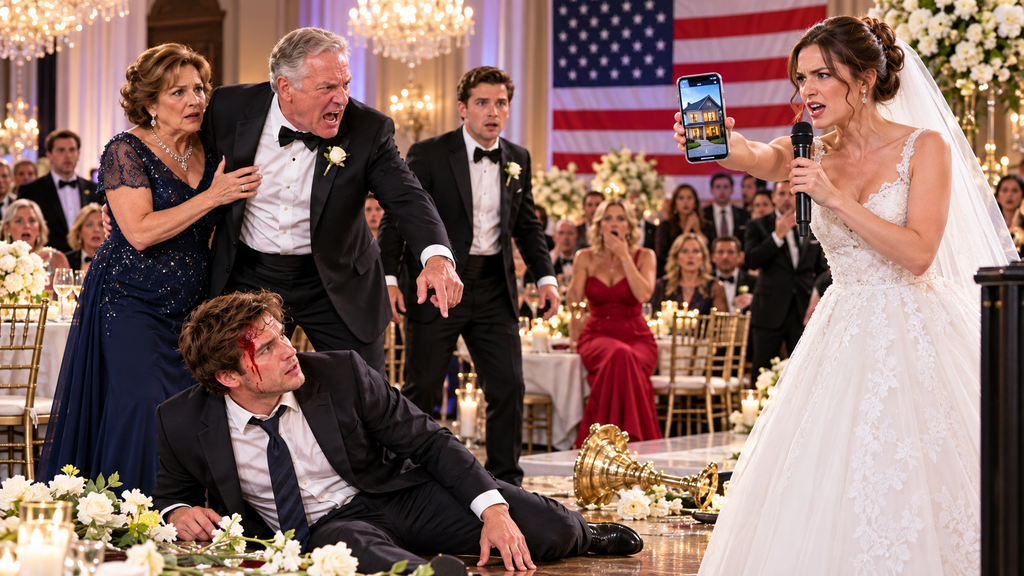
He was no longer shouting. He was staring at Victoria. “Put that microphone down,” he ordered. Victoria didn’t even look at him. “No.” It was the same word I had given him less than five minutes earlier. But coming from her, it sounded different.
It sounded like the beginning of something my father couldn’t control. Tristan stood beside the wedding cake in his expensive black tuxedo. His face had lost every trace of the confident smile he had worn all evening. He looked at his bride as though she had suddenly become a stranger.
“Victoria,” he said quietly, “whatever you think you’ve found, this isn’t the time.” She laughed once, without humor.
“Isn’t the time? Your father just struck your brother in front of two hundred people because he refused to give you a house he built with his own hands. When exactly would be a good time to discuss what you’ve done?”
My mother rushed toward the stage.
“Sweetheart, you’re upset. Weddings are stressful. You’ve had too much champagne, and Gideon has always been jealous of his brother. Please, let’s handle this privately.”
Victoria turned toward her.
“Don’t call me sweetheart.”
My mother stopped.
I had never heard anyone speak to Sylvia that way.
For twenty-nine years, my mother had mastered the art of making cruelty sound like concern. She could insult you while adjusting your collar. She could humiliate you while smiling for a family photograph. She could destroy your confidence and then tell everyone you were too sensitive to understand her intentions.
Victoria had just torn through that carefully maintained illusion.
She held up her phone.
“Three weeks ago, I hired a forensic accountant named Daniel Reeves. I wanted someone independent to examine the finances of the consulting company Tristan told me we would be building together after the wedding.”
Tristan shook his head.
“Stop talking.”
“No,” she replied. “You stop.”
She tapped the screen.
A photograph appeared on the ballroom’s large projection screen, where the wedding slideshow had been displaying pictures of the happy couple moments earlier.
It showed a document.
The heading read:
PRELIMINARY LOAN APPROVAL — COLLATERAL VERIFICATION REQUIRED.
Below it was a description of my property.
My name.
My address.
The estimated value: $500,000.
And beside the words proposed guarantor and property owner, someone had typed my name.
GIDEON HALE.
A murmur spread across the room.
I tried to lift my head, but the movement sent pain shooting through my skull.
A woman in a blue dress knelt beside me.
“Don’t move,” she whispered. “An ambulance is coming.”
I barely heard her.
All I could see was my name on that screen.
“I never signed that,” I said.
My voice came out weak, almost swallowed by the enormous room.
Victoria heard me anyway.
“I know,” she said.
Then she looked at Tristan.
“But somebody submitted it.”
Tristan took a step toward the stage.
“That document was only a draft. It doesn’t mean anything.”
Victoria pressed another button.
The screen changed.
This time, it showed a series of bank transfers.
The first was dated eighteen months earlier.
The second came three weeks after that.
The third was made six months later.
All of them were connected to a company called Hale Strategic Ventures.
My father’s company.
I recognized the name because Richard had spent years telling relatives that his business was thriving. He wore expensive watches, drove luxury cars, and made large charitable donations at public events.
He loved being seen as a successful businessman.
But Victoria’s next words shattered the image he had spent decades building.
“Daniel discovered that Tristan’s consulting company doesn’t have the contracts he claimed it had. It doesn’t have the clients he promised me. And most of the money that supposedly funded his business came from loans and transfers connected to Richard’s companies.”
Tristan’s jaw tightened.
“You don’t understand how business works.”
“Then explain it.”
He said nothing.
Victoria turned toward the guests.
“For the past two years, Tristan has been telling people that he’s building a business worth millions. He told my family he had secured major clients. He told my father that he had investors waiting to fund his expansion.”
She paused.
“Most of those claims were false.”
Someone near the head table gasped.
My mother covered her mouth.
Richard finally found his voice.
“This is a private financial matter. You have no right to broadcast confidential information at my son’s wedding.”
Victoria’s eyes flashed.
“Confidential? You made Gideon’s property part of a financial arrangement without his permission. You used his name. You told lenders his house would secure money he never agreed to borrow.”
She pointed toward the screen.
“And you were planning to make him sign the documents tonight because you knew he would be surrounded by family, embarrassed in front of your guests, and pressured into doing whatever you demanded.”
For the first time that evening, my father looked afraid.
Not angry.
Not offended.
Afraid.
I knew that expression.
It was the same expression he had worn when I told him I knew he had paid Derek to destroy my house.
It was the face of a man realizing that someone had finally collected enough evidence to make his denials meaningless.
But Victoria wasn’t finished.
She swiped to another file.
“This is the message Richard sent Tristan four days ago.”
The screen displayed a photograph of a text conversation.
I couldn’t read every word from the floor, but the message was large enough for the first few rows to see.
Get Gideon’s signature at the wedding. He won’t want to make a scene in front of everyone. Once the deed is transferred, we’ll have the collateral we need.
A second message appeared.
If he refuses, remind him how much this family has sacrificed for him.
Then a third.
Your mother will handle the emotional part. You just make sure he signs.
The ballroom erupted.
People began speaking over one another. Several guests stood. A man at the family table removed his glasses and stared at Richard as though he had never seen him before.
My mother lunged toward the screen operator.
“Turn that off!”
The operator hesitated.
Victoria looked at him.
“Please leave it on.”
He did.
Tristan turned toward me.
For a second, our eyes met.
There was no apology in his face.
There was resentment.
As if I had somehow caused this by refusing to surrender my home.
“You always do this,” he shouted at me. “You always have to make everything difficult!”
The woman kneeling beside me placed a hand on my shoulder.
“Don’t try to get up,” she warned.
I didn’t.
I couldn’t.
But I looked at my brother and managed to speak.
“What did I ever do to you?”
Tristan opened his mouth.
Nothing came out.
I had spent years asking myself that question.
When we were children, I had defended him when he broke a neighbor’s window. I had taken the blame when he crashed our father’s car into the garden wall. I had lent him money when his first business failed.
When our grandmother died, he had received the family jewelry collection she had promised him and a substantial sum from her investment accounts.
I had received two acres of hillside.
And I had never resented him for it.
Not once.
I had been proud of what I built.
I had thought that if I worked hard enough, my family would eventually respect me.
Instead, my success had become something they believed they were entitled to take.
Tristan stared at me.
Then he said the words that made the room go silent again.
“Because you were never supposed to keep that land.”
I felt the blood drain from my face.
Victoria lowered the microphone slightly.
“What did you just say?”
Tristan looked at our father.
Richard gave him a sharp warning glance.
But the damage had already been done.
My brother swallowed.
“Grandmother promised that land to Dad. Gideon was only supposed to hold it until we figured out what to do with it.”
I tried to sit up.
The woman beside me gently pushed me back down.
“That isn’t true,” I whispered.
But my voice was too weak for most people to hear.
Victoria raised the microphone again.
“Then why does the original will say something different?”
My father froze.
The question seemed to strike him harder than anything else that had happened that night.
Victoria reached into the small handbag she had carried with her throughout the reception.
She removed a folded document.
“This is a certified copy of Betty Hale’s last will and testament. Daniel obtained it through the appropriate public records. And according to the will, Gideon didn’t receive that property by accident.”
She unfolded the document.
“He was the only person named as its beneficiary.”
My father took a step backward.
Victoria continued.
“Your grandmother knew exactly what she was doing, Gideon. She left you those two acres because she believed you were the only person in this family who understood the difference between owning something and earning the right to possess it.”
I stared at the ceiling.
For years, I had believed the land was all she had been able to leave me.
Now I wondered whether it had been the most important thing she could have given me.
Victoria looked at Tristan.
“But that isn’t the secret I came here to reveal.”
Her voice dropped.
“And it isn’t the worst thing your family has done.”
She turned to the screen operator once more.
“Show them the recording.”
A new file appeared.
The room became so quiet that I could hear the air-conditioning humming above the chandeliers.
The recording was dated eleven days before the wedding.
It began with a familiar voice.
My father’s.
“Once Gideon signs, the property becomes part of the collateral package. The lender won’t ask too many questions if the paperwork is clean.”
Another voice responded.
Tristan’s.
“And if he doesn’t sign?”
There was a pause.
Then Richard answered.
“Then we make sure he understands he has no choice.”
My mother’s voice followed.
“He’ll do it for Tristan. He always does eventually.”
Tristan laughed.
“What if he actually refuses?”
My father answered without hesitation.
“Then we’ll find another way to make him cooperate.”
The recording ended.
For several seconds, nobody spoke.
Then Victoria said something that made my blood run cold.
“That recording was made during a meeting about Gideon’s property. But when Daniel traced the transactions connected to that proposed loan, he found something else.”
She looked directly at my father.
“The bank wasn’t the only party interested in that house.”
Richard’s lips parted.
Victoria took a breath.
“Someone had already promised the property to another buyer.”
The room erupted again.
My mother whispered, “No.”
Tristan looked at the floor.
I stared at him, unable to understand what I had just heard.
Another buyer?
My house wasn’t even for sale.
Victoria continued.
“According to the documents we found, the proposed collateral was part of a much larger financial arrangement. The plan was to use the house’s value to secure funds that would cover several outstanding obligations. Once the transfer was completed, the property was supposed to be refinanced, and the money would be distributed among several accounts.”
She paused.
“Some of those accounts belong to Richard. Some belong to Tristan.”
“And the buyer?” someone called from the crowd.
Victoria glanced at her phone.
“A property development company.”
My heart began pounding.
“What company?” I asked.
This time, my voice was loud enough to carry.
Victoria turned toward me.
“Northbridge Development Group.”
The name meant nothing to me.
But it meant something to my father.
His knees seemed to weaken.
He reached for the back of a chair.
And my mother, who had spent the entire evening pretending that the only thing that mattered was family reputation, began to cry.
Not the elegant tears she had used to manipulate relatives for years.
These were frightened tears.
Because Northbridge Development Group was not simply a property buyer.
It was the company that had been purchasing land throughout our county for a massive hillside redevelopment project.
My two acres sat directly beside a parcel the company had been trying to acquire for nearly three years.
If it obtained my property, the company could consolidate the entire hillside.
And suddenly, the true value of my grandmother’s land became clear.
The house was worth $500,000.
But the land beneath it, when combined with the surrounding parcels, could be worth far more.
My father hadn’t merely wanted to give my brother a place to live.
He had wanted to use my house to complete a deal that could rescue his failing business and make Tristan appear wealthy enough to impress his investors.
And they had planned to do it without my consent.
I looked toward the stage.
“Victoria,” I said, “how did you find all of this?”
For the first time that evening, her anger softened.
She looked at Tristan, and a tear slipped down her cheek.
“Because three weeks ago, I found a second phone in my husband’s desk.”
The word husband sounded strange in her mouth.
They had been married for less than three hours.
She continued.
“I wasn’t looking for evidence of a crime. I was looking for proof that the man I loved was telling me the truth. I wanted to believe him when he said he was building something real.”
She swallowed.
“But the messages on that phone weren’t about clients or investors.”
She looked toward the projection screen.
“They were about Gideon.”
My father suddenly moved.
He rushed toward the stage, pushing past a waiter.
“Give me that phone!”
Two security guards intercepted him before he reached the steps.
He struggled against them, shouting that Victoria had stolen private property and was destroying his family.
Victoria backed away.
“No,” she said. “You destroyed your family when you decided your sons were assets instead of people.”
Then she turned to the guests.
“And there is one more thing you need to know about the man standing beside me.”
She looked at Tristan.
“Because the financial fraud, the forged documents, and the attempted transfer of Gideon’s house were only part of what Daniel discovered.”
My brother’s face became completely white.
Victoria unlocked her phone again.
And when the next document appeared on the screen, I finally understood why she had waited until the wedding to reveal everything.
The next document carried my grandmother’s name.
And beneath it was a signature that should never have existed.
PART 3: THE WILL, THE LIE, AND THE HOUSE THAT BROKE THE FAMILY
For a long moment, I thought the pain in my head was making me see things.
The document on the screen looked old. Its edges were yellowed, and several paragraphs had been underlined in red.
At the top was my grandmother’s full name.
Elizabeth Margaret Hale.
Everyone in our family had called her Betty.
She had been the only person who ever made me feel that being quiet didn’t mean being weak.
When I was a boy, she would take me into her garden and show me how to build things from scraps of wood. She taught me to repair a broken chair instead of throwing it away. She taught me to listen before speaking and to finish whatever I started.
My father had always dismissed those lessons.
He believed respect came from money, connections, and the ability to make other people uncomfortable.
Grandmother believed respect was something people earned when nobody was watching.
The document on the screen appeared to be a deed transfer.
It claimed that Betty had agreed to transfer her two-acre hillside property to Richard Hale several months before her death.
The signature at the bottom looked remarkably like hers.
But there was a problem.
Grandmother had died before the date printed on the document.
I remembered the date clearly because it was the same week I had taken time off work to sit beside her hospital bed.
I had held her hand while she slept.
I had listened to her tell me, in a voice barely louder than a whisper, that she wanted me to build something lasting on the land.
She had never mentioned transferring it to my father.
Not once.
Victoria pointed toward the screen.
“Daniel discovered that this document was submitted as part of an earlier financing application. It was used to support the claim that Richard had an ownership interest in the property.”
She paused.
“The problem is that the date on the document is six weeks after Betty’s death.”
A wave of disbelief swept through the ballroom.
My father shook his head.
“This is ridiculous. That document has nothing to do with tonight.”
“Then why was it included in the financial records?” Victoria asked.
Richard said nothing.
She continued.
“Daniel consulted a document examiner. The signature requires further formal verification, but the preliminary findings raise serious questions about its authenticity. We also found evidence that the document was used to support representations made to potential lenders.”
My mother began shaking her head.
“No. No, you don’t understand.”
Victoria turned toward her.
“Then explain it to us.”
Sylvia looked at Richard.
For the first time in my life, I watched my mother look at my father as though she no longer knew him.
“Richard,” she whispered. “You told me the land had been transferred.”
He glared at her.
“Be quiet.”
“You told me Betty had signed everything before she died.”
“Sylvia!”
His voice cracked through the ballroom.
But she kept speaking.
“You told me it was all legal.”
He grabbed her arm.
She pulled away.
And something changed in her expression.
I saw it from the floor.
The woman who had spent years standing behind Richard’s decisions suddenly seemed to understand that obedience would not protect her from the consequences.
She turned toward the guests.
“I didn’t know about the forged document,” she said, her voice trembling. “I swear I didn’t know.”
My father stared at her with undisguised hatred.
“Sit down.”
She didn’t.
Instead, she began telling the story she had apparently spent years trying not to remember.
After Betty died, Richard had become obsessed with the hillside property.
At first, he claimed that the land was too valuable to leave in my hands. He argued that I was too young, too inexperienced, and too stubborn to manage it properly.
He said I would sell it for a fraction of its worth.
He said the family needed to protect the inheritance.
My mother believed him.
Or perhaps she chose to believe him because it was easier than admitting what he was trying to do.
When the will was read, however, the property was clearly left to me.
Richard was furious.
He had expected the land to become part of the family assets he controlled.
Instead, Betty had given him the suburban house, the jewelry, and the investment portfolio, while leaving the hillside to me.
He considered it an insult.
He told relatives that Betty had been confused in her final months.
He suggested that I had manipulated her.
He even tried to persuade Uncle Gregory to challenge the will.
But the will had been properly executed, and the property passed to me.
Richard couldn’t take it through inheritance.
So he began looking for another way.
“I thought he was just trying to convince you to sell,” my mother said, looking at me. “I didn’t know he had gone this far.”
I wanted to believe her.
Some part of me still wanted the mother I had spent my childhood trying to please to appear and tell me that she had made a terrible mistake.
But another part remembered her fingers digging into my shoulder as I lay bleeding on the floor.
I remembered her telling me to stop being dramatic while my father stood over me holding a brass weapon.
I looked away.
“Why didn’t you tell me?” I asked.
She began crying harder.
“Because I was afraid of him.”
Those words settled over the room.
For years, I had wondered why my mother never defended me.
Why she laughed when Richard mocked my work.
Why she accepted Tristan’s excuses while treating my mistakes as evidence of a defective character.
Why she always told me to be the bigger person whenever my brother took something from me.
Now she had given me an answer.
But an explanation wasn’t the same as forgiveness.
And fear didn’t erase the choices she had made.
Victoria stepped away from the microphone.
“I believe you were afraid,” she told Sylvia. “But Gideon was afraid too. He was the one who had to stand up to your husband. He was the one whose property was targeted. And tonight, he was the one who ended up on the floor.”
My mother covered her face.
For the first time, she had nothing to say.
Then Tristan spoke.
“You’re all acting as if I planned everything.”
Every head turned toward him.
He stood near the wedding cake, his hands trembling.
“Dad handled the property. Dad handled the lenders. I was supposed to run the company. I didn’t know about any forged signature.”
Victoria looked at him.
“You knew Gideon hadn’t agreed to transfer the house.”
Tristan didn’t answer.
“You knew the paperwork listed him as a guarantor.”
He looked away.
“You knew your father was planning to pressure him tonight.”
Tristan’s jaw tightened.
“I knew Dad wanted him to sign.”
“And what did you think would happen if he refused?”
He said nothing.
Victoria’s voice broke.
“Tell them what you told me two nights before the wedding.”
Tristan stared at her.
She read from her phone.
“’Once the house is secured, everything changes. Gideon won’t be able to interfere anymore. Dad can clear the debts, I can launch the company properly, and we can finally have the life we deserve.’”
She lowered the phone.
“Those were your words.”
Tristan looked at the guests.
Then at my father.
Then at me.
And I saw the truth in his face.
He might not have created every part of the scheme.
He might not have forged the document himself.
But he had known enough to understand that the house was mine, that I hadn’t agreed to give it away, and that his future depended on taking it from me.
He had chosen his own future anyway.
“I was trying to save the business,” he said.
I stared at him.
“Which business?”
He flinched.
“The company.”
“You told everyone you had investors. You told Grandmother’s friends you had contracts. You told Victoria you were building something worth millions.”
My throat hurt when I spoke, but I forced myself to continue.
“Did you ever build anything, Tristan? Anything that wasn’t bought for you, handed to you, or taken from someone else?”
His face twisted.
“You don’t know what it’s like being the son everyone expects to succeed.”
I almost laughed.
Almost.
Because I knew exactly what it was like to be the son everyone expected to fail.
“I worked ten-hour shifts and then built a house in the dark,” I said. “I drove nails through my hands. I froze in winter. I spent my savings on lumber and concrete. I watched people destroy what I was building, and I kept going.”
I took a breath.
“You were given money, opportunities, and every second chance Dad could buy. And somehow, you still convinced yourself that my house was the thing standing between you and success.”
Tristan’s eyes filled with tears.
For one brief moment, I saw the little boy I remembered.
The younger brother who used to follow me around the garden, asking me to show him how to use a hammer.
The child who cried when he broke his favorite toy and believed I could fix anything.
Then I remembered the man who had watched our father plan to take my home.
The boy I loved had grown into someone who believed love meant being given whatever he wanted.
And I couldn’t rescue him from that anymore.
The arrival that changed everything
The ballroom doors opened.
Two paramedics hurried inside carrying medical equipment.
Behind them came a hotel security manager and two uniformed police officers.
The woman who had been kneeling beside me identified herself as a guest with medical training and explained what had happened.
One of the officers looked at the brass centerpiece.
The other approached my father.
“Sir, I need you to step away from the table and place your hands where I can see them.”
Richard looked offended.
“Do you know who I am?”
“Yes,” the officer replied. “And I need you to step away.”
“My son attacked my family with lies! This is a private dispute!”
Several guests immediately contradicted him.
“I saw him hit Gideon,” a man near the dance floor said.
“So did I,” another guest added.
A woman near the head table raised her hand.
“He struck him from behind. Gideon wasn’t threatening anyone.”
The officer turned toward the witnesses.
“Please remain here. We’ll need statements.”
For the first time, my father had no control over the room.
He couldn’t silence two hundred people by threatening to remove them from the family.
He couldn’t make them forget what they had seen.
And he couldn’t turn the truth into a different story simply by repeating his version louder.
The paramedics carefully placed a neck support around me before helping me onto a stretcher.
As they lifted me, the room tilted.
Victoria appeared beside me.
Her wedding dress was stained where she had knelt near the blood on the floor.
She took my hand.
“I’m sorry,” she whispered.
I tried to speak, but my head throbbed too badly.
She squeezed my fingers.
“You don’t have to say anything. Just get through this.”
I wanted to ask her why she had married Tristan if she had discovered so much.
I wanted to ask whether she had ever loved him.
I wanted to know why she had waited until the wedding.
But before I could form the questions, the paramedics began wheeling me toward the doors.
As we passed the stage, I heard Tristan call her name.
“Victoria!”
She stopped.
For several seconds, she stood between the man she had married and the man his family had attacked.
Tristan walked toward her.
“Please. We can talk about this.”
She looked at him for a long time.
“I thought I was marrying a man who wanted to build a life with me,” she said. “I didn’t realize you wanted to inherit one from everyone around you.”
He reached for her hand.
She stepped back.
“You didn’t just lie to me, Tristan. You helped your father plan to take something from your own brother. And you expected me to stand beside you while you did it.”
“I love you.”
Her face crumpled.
“I believe you might love me in the way you understand love.”
She removed her wedding ring.
“But I don’t trust you with my future.”
She placed the ring on the edge of the stage.
Then she turned away.
The paramedics wheeled me through the ballroom doors.
The last thing I saw was Victoria standing beneath the chandeliers, alone in her wedding gown, while the guests who had come to celebrate her marriage watched the man she had married being questioned by police.
The wedding had lasted less than three hours.
The consequences would last much longer.
The truth that survived the hospital
I spent two nights in the hospital.
The doctors diagnosed a concussion and a deep laceration that required several stitches. They kept me under observation because of the force of the blow and the symptoms I had experienced.
The first morning, I woke to find Harrison sitting in the chair beside my bed.
He was wearing his old brown work jacket.
His gray hair was uncombed, and he had brought a thermos of coffee that the nurses refused to let him give me.
When I opened my eyes, he leaned forward.
“Well,” he said, “I always told you to wear a helmet when you were doing dangerous work.”
I tried to smile.
“Didn’t think I’d need one at a wedding.”
He shook his head.
“Apparently, you should have worn a hard hat to meet your father.”
For the first time since the attack, I laughed.
It hurt.
But it was real.
Then Harrison’s expression softened.
“How bad is it?”
“The doctors say I’ll recover.”
“I wasn’t asking about your head.”
I stared at the blanket.
He knew me too well.
I told him everything I remembered.
The demand.
The attack.
The documents.
The forged signature.
The revelation that my family had intended to use my house to rescue a failing business.
When I finished, Harrison remained silent for a long time.
Then he said something I have never forgotten.
“Gideon, you spent three years building a house. Don’t spend the next three years trying to rebuild people who chose to destroy it.”
I looked toward the window.
Outside, the city was beginning its ordinary morning.
Cars moved along the street. People hurried toward work. Somewhere, a delivery driver was arguing with a restaurant manager about an incorrect order.
The world had not stopped because my family had fallen apart.
And maybe that was a good thing.
For years, I had treated my family’s approval as the final inspection on everything I did.
I had believed that once the house was finished, my father would finally walk through the front door and tell me I had done well.
I had believed that if I proved myself enough, he would eventually stop comparing me to Tristan.
I had believed that my mother would one day defend me without needing to be asked.
None of those things had happened.
And now I understood that they might never happen.
My house had passed every inspection that mattered.
The foundation was sound.
The beams were properly supported.
The roof held against the rain.
The plumbing worked.
The electrical system had been checked.
The house was real.
The thing that had failed wasn’t the structure I had built.
It was the family I had spent my life trying to please.
Three days after the attack, a detective visited me.
He explained that several witnesses had already provided statements. The hotel’s security cameras had captured portions of the confrontation, and the footage was being preserved as evidence.
I gave my own statement.
I told him about the brass centerpiece.
I told him about my father’s threats.
I explained how Richard had attempted to force me to sign documents transferring my property.
I also told him about Derek.
The detective wrote down the details.
“We’ll look into the earlier property damage as well,” he said.
I nodded.
For months, I had kept the evidence of what Derek had done.
I had saved the text messages, photographed the broken windows, documented the damaged heating equipment, and written down every conversation I could remember.
I had never used those records to punish my father.
I had simply wanted to protect myself.
Now they would serve a different purpose.
Before leaving, the detective asked whether I intended to pursue the matter.
I looked at the stitches in my reflection on the darkened window.
“Yes,” I said.
It was not revenge.
It was accountability.
There was a difference, and I finally understood it.
The family that tried to rewrite the truth
The following weeks were ugly.
My father was released after the initial investigation while the authorities continued reviewing the evidence and determining the appropriate charges. He was later charged in connection with the assault, though the case would take months to work through the legal system.
The financial investigation proceeded separately.
The proposed transfer of my property was halted. The questionable documents were examined, and lenders were notified of the dispute. The transaction that depended on my house never closed.
My attorney also arranged for a formal title review to make sure no unauthorized claim had been placed against the property.
The preliminary results were reassuring.
The original will named me as the beneficiary.
The recorded ownership documents supported my title.
And the disputed transfer document did not establish that my father owned the land.
For the first time in months, I could breathe without wondering whether someone was secretly trying to take my home.
But the legal process was only one part of the aftermath.
The other part was the way my family tried to control the story.
My father called relatives and told them Victoria had manipulated the entire situation because she wanted to escape her marriage.
My mother claimed I had provoked Richard.
Tristan told people that the documents were preliminary business proposals and that everyone had misunderstood them.
Uncle Gregory sent me a long message explaining that families sometimes made mistakes under financial pressure.
He suggested that I should consider withdrawing my complaint to avoid embarrassing my parents further.
I read his message twice.
Then I put my phone down.
For years, I had been the one expected to absorb the damage so that everyone else could preserve appearances.
I had forgiven my brother for money he never returned.
I had accepted my mother’s excuses.
I had tolerated my father’s insults because I hoped one day they would become affection.
But I was finished sacrificing my peace to protect other people’s reputations.
I sent Gregory a short reply.
I didn’t create this situation. I won’t lie about it to make it easier for everyone else.
Then I stopped responding.
Some relatives supported me.
Others decided that refusing to forgive immediately was proof that I had become bitter.
I let them think whatever they wanted.
I had spent too many years trying to manage opinions I could never control.
I no longer had the energy for it.
The conversation with my mother
About a month after the wedding, Sylvia came to my house.
I was still recovering, and the stitches had only recently been removed.
She stood on the porch holding a covered dish.
It was a familiar gesture.
When I was a child, she used to bring food to neighbors after a death or an illness. She believed that a meal could make an apology unnecessary.
I opened the door but didn’t invite her inside immediately.
She looked past me toward the living room.
“I’ve never seen the house this way before,” she said.
“What way?”
“Quiet.”
I didn’t answer.
She stepped forward, then stopped.
“May I come in?”
After a moment, I moved aside.
She entered slowly.
Her eyes traveled across the reclaimed oak floors, the custom molding, and the river-rock fireplace.
The same things my parents had inspected before demanding the deed.
For the first time, my mother seemed to notice the work.
She ran her fingers over the edge of the mantel.
“You did all this yourself?”
“Most of it.”
She looked at me.
“Betty would have been proud.”
I felt something tighten in my chest.
My grandmother’s name had become a wound I didn’t know how to touch.
“Don’t use her to make this easier,” I said.
My mother withdrew her hand.
“I wasn’t trying to.”
“Then why are you here?”
She placed the covered dish on the kitchen island.
“I came to apologize.”
I waited.
She sat on one of the stools I had built.
“I should have protected you,” she said. “When Richard started talking about the land, I should have told him to stop. When he started pressuring you, I should have stood beside you. At the wedding, when you were lying on the floor, I should have called for help instead of worrying about what people would think.”
Her voice broke.
“I was wrong.”
Those were the words I had wanted to hear for most of my life.
And yet, hearing them did not make the years disappear.
I pulled out the stool opposite her and sat down.
“Why did you always defend him?”
She looked at her hands.
“Because I was afraid of losing the life I had.”
I waited for her to continue.
“Your father made every decision. The money, the house, the holidays, the people we saw. If I disagreed with him, he could make life miserable for everyone. I convinced myself that keeping the peace was the same as keeping the family together.”
She wiped her eyes.
“And when Tristan started getting into trouble, I kept protecting him because I thought he needed us more.”
I looked at her.
“What about me?”
She closed her eyes.
“I thought you were strong enough to manage on your own.”
I let the silence stretch between us.
That was the heart of it.
Tristan had been given help because he struggled.
I had been denied help because I endured.
His failures became emergencies.
My successes became proof that I didn’t need anyone.
My parents had mistaken my independence for permission to neglect me.
“You were right about one thing,” I said eventually. “I could manage on my own.”
She looked up.
“But that doesn’t mean I should have had to.”
She began crying again.
I didn’t reach across the table.
Not because I wanted to hurt her.
Because I didn’t know whether I was ready to comfort the person who had watched me suffer and asked me to be quieter about it.
“I am sorry,” she whispered.
“I believe you.”
Hope flickered across her face.
Then I continued.
“But I’m not ready to forgive you.”
The hope disappeared.
I saw the pain in her expression, and a part of me wanted to soften my words.
I didn’t.
“I don’t know what forgiveness will look like for me,” I said. “Maybe one day we’ll be able to talk without all of this sitting between us. Maybe not. But I won’t pretend nothing happened just because you’re sorry now.”
She nodded slowly.
“I understand.”
I wasn’t sure she did.
But for once, I wasn’t responsible for making sure she felt better about my answer.
When she left, she took the dish with her.
I watched her walk down the porch steps and get into her car.
Then I closed the door.
I stood in the quiet house for a long time.
It hurt to set a boundary with my mother.
But it hurt less than abandoning myself to keep her comfortable.
The brother who finally ran out of excuses
Tristan contacted me two months later.
His first message was short.
I didn’t respond.
A week passed.
Then another message arrived.
I’m not asking you to drop anything. I just want you to hear me out.
I considered ignoring him again.
Instead, I agreed to meet him at a small café near the industrial park.
I chose the location because it was public, and I told a friend where I would be.
Tristan arrived fifteen minutes late.
He looked different.
His expensive watch was gone. His suit was wrinkled, and there were dark circles beneath his eyes.
He ordered coffee but didn’t drink it.
For several minutes, neither of us spoke.
Finally, he said, “I lost Victoria.”
I looked at him.
“I know.”
“She filed for an annulment.”
“I heard.”
He stared at the table.
“She won’t even answer my calls.”
I could have told him that I understood why.
I could have reminded him that Victoria had discovered the truth before the wedding and had tried to give him opportunities to tell it himself.
Instead, I asked a simpler question.
“Why did you do it?”
He rubbed his face.
“Dad said the company was going to collapse. He said if we didn’t get the collateral, the lenders would come after everything.”
“So you decided to use my house.”
“He said it would only be temporary.”
“You knew I hadn’t agreed.”
Tristan nodded.
“Yeah.”
“Did you ever plan to tell me the truth?”
He didn’t answer.
That was answer enough.
He explained that the consulting company had never been as successful as he had claimed. Some of the contracts were preliminary discussions that he had presented as confirmed business. Several expected investments never arrived. Money from other accounts had been used to cover expenses, and the debts had grown.
He had borrowed against the future he wanted people to believe he already possessed.
Richard had promised to solve everything.
The house was supposed to be the final piece.
Once the property was included in the collateral package, Richard believed he could negotiate new financing, settle urgent obligations, and give Tristan enough money to present the business as stable.
Then Tristan would have his company.
His marriage.
His status.
His father’s approval.
And I would be left to start again somewhere else.
“You could have asked me for help,” I said.
He looked up.
“You would have said no.”
“Maybe.”
The answer seemed to surprise him.
I continued.
“But at least it would have been my choice.”
He stared at his coffee.
“I know.”
“No, Tristan. I don’t think you do.”
He looked at me again.
“You keep talking about the pressure Dad put on you. You keep talking about the business and the money. But you haven’t told me why my life was the thing you were willing to sacrifice.”
His eyes filled.
“I was jealous of you.”
I sat back.
For the first time, he spoke without blaming our father.
“You built something real. You didn’t have anyone giving you money or opening doors. You just worked. And every time Dad talked about you, he made it sound like you were a fool for doing things the hard way.”
He swallowed.
“But when the house was finished, everyone wanted to see it. People asked how you had built it. They respected you. Dad couldn’t stand it.”
Tristan looked away.
“And I couldn’t stand it either.”
The confession hurt more than I expected.
He continued.
“I thought if I got the house, Dad would finally stop comparing us. I thought having it would prove I was the successful one.”
I studied my brother’s face.
“You wanted my house because you thought it would make you into someone you weren’t.”
He nodded.
“I know how that sounds.”
“It sounds like the truth.”
He wiped his eyes.
“I’m sorry, Gideon.”
I believed he was sorry.
But remorse did not erase what he had done.
“You’re my brother,” I said. “I loved you before any of this happened. I helped you when you needed money. I defended you when Dad was angry. I would have helped you find a way through your business problems if you’d come to me honestly.”
He began to cry.
“But you decided that what I had was more important than what I meant to you.”
“I know.”
“I don’t know if I’ll ever trust you again.”
He nodded.
“I understand.”
I finished my coffee and stood.
He looked up at me.
“Is there any chance we can fix this?”
I thought about the question.
For years, I had believed that repairing a relationship was like repairing a house.
Find the damage.
Replace what was broken.
Strengthen the weak points.
Keep working until everything held together again.
But people weren’t timber.
And trust wasn’t something you could restore simply by replacing the parts that had failed.
“Maybe,” I said. “But not by pretending this never happened. And not by asking me to rescue you from the consequences.”
He nodded again.
I left him sitting at the table.
I didn’t feel triumphant.
I didn’t feel relieved.
I felt sad.
Because sometimes the hardest part of growing up is realizing that loving someone doesn’t mean you can keep giving them opportunities to hurt you.
What happened to the secret deal
The financial investigation continued for months.
The authorities examined the questionable property documents, the proposed collateral arrangement, the transactions involving Hale Strategic Ventures, and the communications between my father and my brother.
Some allegations remained disputed, and several financial matters required separate civil proceedings. But the evidence was serious enough that the lenders withdrew from the proposed transaction and the development company abandoned its effort to acquire my property through the arrangement.
My father eventually faced criminal proceedings connected to the assault.
The financial questions were handled separately, and the disputed documents became the subject of formal examination.
The house remained mine.
That was the part I cared about most.
Not because I had won a contest with my father.
Not because I wanted to watch him lose everything.
Because I had built the place with my own hands, and I had the right to decide what happened to it.
I also learned something about money that I wish I had understood sooner.
A person can look wealthy and still be drowning.
A business can have an impressive name and no solid foundation.
A man can spend decades teaching everyone to admire him while secretly depending on the people he claims to control.
My father had built his life around appearances.
When the appearances collapsed, he had tried to use my home as a support beam.
But the house was never his to use.
And neither was my life.
Months after the wedding, Uncle Gregory called.
He sounded tired.
“I owe you an apology,” he said.
I waited.
“I kept telling you to compromise because I thought that was how families survived. I didn’t stop to ask why you were always the one expected to give something up.”
I leaned back in my chair.
“Why now?”
“Because I finally understood that keeping the peace isn’t always the same as doing the right thing.”
We spoke for nearly an hour.
It was the first honest conversation I had ever had with him.
He didn’t ask me to forgive my father.
He didn’t suggest I should give Tristan another chance.
He simply admitted that he had been wrong.
I appreciated that.
Not every relationship could be repaired.
But some people could learn.
And I decided that I would leave room for that possibility without surrendering my boundaries to it.
The house became a home again
By the time spring arrived, the bruising had faded.
The scar near my hairline remained.
I stopped trying to hide it.
At first, I hated seeing it in the mirror. It reminded me of the wedding, the shouting, and the moment the world went white.
Then Harrison said something that changed the way I looked at it.
“Scars aren’t proof that someone defeated you,” he told me. “They’re proof that something happened and you survived it.”
I thought about that for a long time.
Then I went back to work.
I repaired the small things around the house that I had ignored while dealing with the investigation. I refinished a section of the oak floor. I adjusted a sticking door. I rebuilt a stone planter beside the front steps.
Ordinary work.
Honest work.
The kind that had always made me feel steady.
One Saturday morning, Harrison arrived with two cups of coffee and a bag of breakfast sandwiches.
He walked through the front door, looked around, and nodded.
“Still standing.”
“Better than ever.”
He grinned.
“Good. Now you need to do something with that empty room upstairs.”
I had left one bedroom unfinished because I had run out of money during construction. I had always planned to turn it into a workshop or perhaps a guest room.
Instead, I decided to build a proper study.
I installed shelves along one wall, made a heavy oak desk, and placed my grandmother’s old gardening notebook in a glass-fronted cabinet.
Her handwriting was small and slanted.
On the final page, she had written a sentence I had never noticed before.
Build a life that doesn’t require you to become someone else to deserve it.
I sat at the desk and read those words several times.
Then I understood why she had left me the land.
Maybe she had known that I would have to fight for it.
Maybe she had simply trusted me to do something worthwhile with what I received.
Either way, I no longer needed to prove that the house deserved to exist.
It already did.
I began inviting people over.
Not people who wanted to see the property’s appraised value.
Not people who wanted to discuss its potential resale price.
People who wanted to eat, talk, laugh, and stay long enough to help wash the dishes afterward.
Harrison came over most Sundays.
A few coworkers visited.
The neighbor who had lent me tools during construction brought his family for a barbecue.
We sat on the porch while the sun slipped behind the hillside.
For the first time, the house felt less like something I had built to prove a point and more like something I had built because I wanted a place where life could happen.
And that was enough.
Victoria’s final message
Nearly a year after the wedding, a letter arrived.
The envelope was plain.
My name was written across the front in careful handwriting.
Inside was a short note from Victoria.
She wrote that she had spent months rebuilding her own life. The annulment proceedings had been difficult, and the financial revelations had forced her to reconsider nearly everything she thought she knew about her marriage.
She was working again, helping manage a small design business with a friend.
She wasn’t writing to ask me for anything.
She simply wanted me to know that she was glad I had kept the house.
At the bottom of the letter, she had written:
I used to think courage meant standing beside someone you loved, no matter what they did. That night taught me that sometimes courage means refusing to stand beside them when they are wrong.
Then she added:
Your grandmother would have been proud of you.
I read the letter twice.
I wondered how she was doing.
I wondered whether she still remembered the ballroom, the microphone, and the look on Tristan’s face when she removed her ring.
I hoped she had found peace.
I wrote back and thanked her for telling the truth when it would have been easier to remain silent.
I told her that I hoped she would build a life she could trust.
We exchanged a few letters over the following months.
We never became inseparable friends, and we never tried to turn what happened into something romantic.
There was no need.
Sometimes a person enters your life for a short time and changes the direction of it simply by refusing to participate in a lie.
Victoria had done that for me.
I would always be grateful.
One year later
On the anniversary of the wedding, I woke early.
The sky was pale blue, and a thin layer of mist hung over the hillside.
I made coffee, opened the front door, and stepped onto the porch.
The oak floors creaked softly behind me as the house warmed in the morning sun.
For a moment, I remembered the ballroom.
The white roses.
The champagne.
The brass centerpiece.
My father’s voice demanding that I surrender everything I had worked for.
I remembered the terrible silence after I hit the floor.
And I remembered Victoria lifting the microphone.
There had been a time when I believed that moment was the end of my family.
In some ways, it was.
The family I had imagined—the one where my father would eventually respect me, my mother would finally defend me, and my brother would celebrate my success—had never truly existed.
I had been working for the promise of something that my family was unwilling to give.
But another family had begun to form around me.
It was smaller.
Less impressive from the outside.
Nobody in it cared what my house was worth.
Harrison still complained about my carpentry.
My coworkers still argued over whose turn it was to bring lunch.
My neighbors still borrowed tools and forgot to return them.
But when someone needed help, we showed up.
And when someone made a mistake, we talked about it instead of pretending it hadn’t happened.
That morning, I walked down the path toward the lower edge of the property.
I stopped beside the old foundation marker I had placed there when construction began.
The marker was simple: a flat stone with the year carved into it.
I had set it in the ground after pouring the first concrete footing.
Back then, I had been exhausted, broke, and terrified that I wouldn’t finish.
I had looked at those two acres and wondered whether my father was right.
Perhaps the land was useless.
Perhaps I was foolish to try.
Perhaps I would fail.
But I had built the house anyway.
Not because I knew I would succeed.
Because I wanted to find out what I could do if I refused to let someone else’s opinion become the limit of my life.
I placed my hand on the stone.
“Still standing,” I whispered.
Behind me, Harrison’s truck rolled into the driveway.
He climbed out carrying a toolbox.
“You going to stand there admiring that rock all day?” he called.
“Maybe.”
“Fine. Admire it while you help me fix your gate.”
I laughed.
Then I walked back toward the house.
The sun rose over the hillside, spilling gold across the roof, the windows, and the stone fireplace visible through the open front door.
For the first time in my life, I wasn’t waiting for my father to tell me I had done well.
I wasn’t waiting for my mother to explain why she had failed to protect me.
I wasn’t waiting for Tristan to become the brother I remembered.
I had stopped waiting for permission to be proud of myself.
My father had believed that the house was a symbol of my stubbornness.
My brother had believed it was an obstacle to his success.
My mother had believed that giving it away might preserve the family.
Victoria had seen what none of them wanted to admit.
The house was evidence.
Evidence that I could build something real without taking it from anyone else.
Evidence that a person could begin with almost nothing and still create something valuable.
Evidence that hard work did not make me indebted to the people who had refused to help.
And evidence that love without respect was not a reason to surrender what I had earned.
I had built that house with my hands.
I had protected it with my voice.
And when the people who should have loved me demanded that I give it away, I had finally learned that saying no was not cruelty.
It was self-respect.
I stepped through the front door.
The house smelled faintly of coffee, cedar, and the wood polish I had used on the floors the night before.
Everything was where it belonged.
The walls were solid.
The windows were clear.
The roof held.
And for the first time, I felt no need to defend the place to anyone.
My father had demanded the house.
My brother had expected to receive it.
My mother had asked me to sacrifice it for the sake of appearances.
But the final decision had always belonged to me.
I had chosen the house.
And in choosing it, I had chosen something far more important than two acres of land and a half-million-dollar structure.
I had chosen a life in which I no longer had to earn the right to exist on my own terms.
And that was the one thing my family could never take from me again.
💬THE END! THANK YOU FOR READING! ❤️🙏