
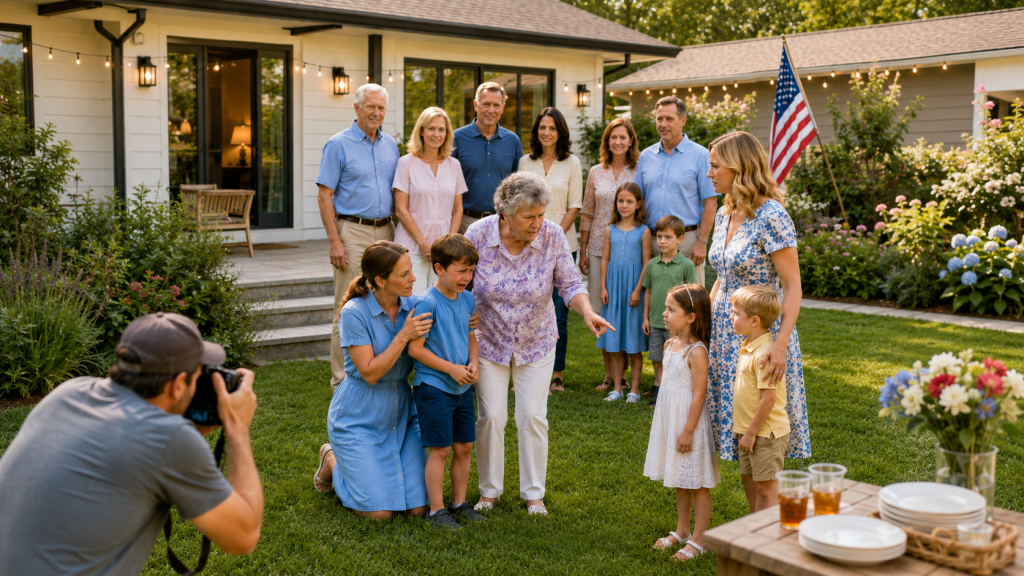
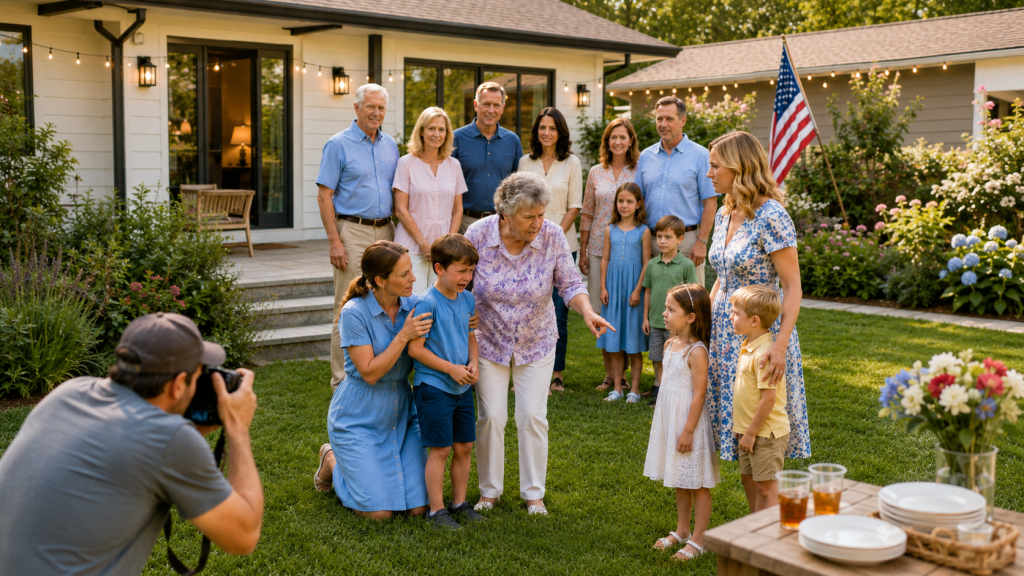
My son finally asked, “Did I do something wrong, Grandma?” The words were so quiet that I almost convinced myself I had imagined them. Almost.
We were standing in my mother’s backyard beneath a white canopy she had rented for our annual summer family gathering. The grass had been freshly cut, blue and silver balloons were tied to the fence, and a long table near the patio was covered with sandwiches, fruit trays, cupcakes, and sweating paper cups filled with lemonade.
Everyone had been laughing five minutes earlier.
My mother had hired a photographer because she wanted, as she had repeated at least a dozen times, “one beautiful picture of all the grandchildren together.”
My son, Noah, was eight.
He had spent most of the afternoon trying to stay out of everyone’s way.
That was something he had learned to do around my mother.
When the photographer called the grandchildren toward the large maple tree at the edge of the yard, Noah had followed his cousins.
My sister Emma’s children, Lily and Mason, were immediately placed in the center.
My brother Daniel’s daughters stood on one side.
Two younger cousins were positioned on the other.
Noah hovered near the end of the row, uncertain.
“Where should I stand?” he asked.
My mother ignored him.
The photographer adjusted his camera.
Noah tried again.
“Grandma?”
She sighed loudly.
He looked at the other children, then at me.
I had started walking toward him when he finally asked the question.
“Did I do something wrong, Grandma?”
Instead of answering, my mother grabbed his shoulder.
She pulled him completely out of the group.
“Stop ruining everyone’s day.”
Noah stumbled backward.
For one terrible second, he looked more confused than hurt.
Then his face collapsed.
He burst into tears in front of the entire family.
The photographer lowered his camera.
Ice shifted inside the paper cups on the backyard table, but nobody reached for them.
No one spoke.
I crossed the yard so quickly that I barely remembered moving.
I knelt beside Noah and pulled him against me.
His face was hot.
His fingers twisted the bottom of his T-shirt into a tight knot.
“Can we go home?” he whispered.
Before I could answer, Emma stepped out from behind the photographer.
“Lily. Mason. Come here.”
My mother frowned.
Emma’s children immediately left the arranged picture.
Lily was eleven.
Mason was nine.
They crossed the grass and stood beside Noah.
“If he doesn’t belong,” Emma said, “neither do we.”
My mother stared at her.
“What are you doing?”
Emma folded her arms.
“Exactly what I should have done a long time ago.”
“Put those children back,” Mom snapped. “You’re turning this into a spectacle.”
Emma stared at her.
“You planned the spectacle.”
Then she pulled out her phone.
She tapped the screen several times and held it where everyone could see.
The message had been sent that morning.
Come early. I want the grandchildren picture finished before they arrive.
Beneath it was another message.
Keep your kids in the middle. I’ll handle him if he makes a scene.
My stomach dropped.
Noah lifted his head from my shoulder.
He could read.
Not every word from where he stood, perhaps, but enough.
Definitely enough to understand that “him” meant him.
His crying stopped.
That somehow hurt worse.
He stared at my mother.
“This had nothing to do with anything he did today,” I said.
My mother’s expression hardened.
“He always looks miserable in pictures. He wanders around. He distracts the other children. Every gathering becomes more difficult when he’s here.”
“He asked where to stand.”
“I wanted one decent family photograph. Is that really such a terrible thing?”
She looked around as though expecting someone to agree.
No one did.
“He asked where to stand,” I repeated. “You answered by dragging him away.”
Lily walked over and took Noah’s hand.
“He is family.”
Mason moved beside them without being asked.
My mother rolled her eyes.
“Oh, for heaven’s sake. Children don’t need to be involved in adult disagreements.”
Emma laughed once, but there was nothing amused about it.
“You involved them when you decided one of them was disposable.”
Mom’s lips tightened.
I was suddenly exhausted.
Not physically.
It felt deeper than that.
For years, I had argued with my mother about little comments, changed seating arrangements, forgotten invitations, birthday presents that were somehow always more expensive for the other grandchildren, holiday traditions Noah never seemed to hear about until afterward.
Every incident had an explanation.
Every explanation had made me feel unreasonable for noticing.
So I stopped arguing.
I looked at Noah instead.
“Do you want to stay?”
He shook his head immediately.
“No.”
I stood.
“Then we’re leaving.”
Mom’s face changed.
“You are seriously leaving because I asked him to step out of one picture?”
“No. We’re leaving because you deliberately planned to exclude my son and humiliated him when he noticed.”
“I did not humiliate him.”
“You grabbed him.”
“Oh, don’t exaggerate.”
“I watched you.”
My voice was strangely calm.
Maybe because something inside me had finally snapped into place.
“You will not see Noah again until you apologize directly to him. Not to me. Not through Emma. Not in the family group chat. To him.”
Her jaw tightened.
“Anyone who walks out over this should not expect to come back for the holidays.”
Emma gathered her children’s jackets from a chair.
“Okay.”
Mom blinked.
“What?”
“You heard her,” Emma said. “We’re leaving too.”
My mother had expected me to go.
I saw that clearly.
She had probably already prepared whatever story she planned to tell after I left.
I was sensitive.
Noah was difficult.
I had overreacted.
That was how these things always worked.
What she had not expected was Emma.
Emma was Mom’s favorite daughter.
And Lily and Mason were unquestionably her favorite grandchildren.
Their photographs covered her hallway.
Their school portraits were framed beside the television.
Their handmade ornaments stayed on the Christmas tree every year.
When Lily was born, Mom had taken two weeks off work to help Emma.
When Noah was born three years later, she visited us for forty-five minutes.
Now Emma was helping Mason put on his jacket.
Mom’s voice softened instantly.
“Emma, don’t be ridiculous.”
Emma did not respond.
“This has nothing to do with your children.”
“It does now.”
“Think about what you’re doing.”
“I am.”
“You’re punishing Lily and Mason.”
Emma looked up.
“No. I’m teaching them that being favored doesn’t mean staying silent while someone else is treated badly.”
Lily squeezed Noah’s hand.
My mother’s face went pale.
We started toward the driveway.
That was when Emma caught my arm.
“You need to know something before we go.”
Something in her expression made me stop.
“What?”
She glanced toward Noah.
Then she lowered her voice.
“This isn’t the first family picture she tried to keep him out of.”
I stared at her.
“What do you mean?”
“Get in the car.”
We drove three blocks before Emma pulled into the parking lot of a small neighborhood park.
The children climbed out and sat at a picnic table where Emma gave them snacks from her bag.
Noah stayed close to Lily.
I watched him laugh weakly at something she said.
Only then did Emma open a folder on her phone.
“There’s something I should have told you a long time ago.”
She showed me photographs from birthdays.
Christmas dinners.
Easter brunches.
Thanksgiving.
A family reunion I had missed because Noah had been sick.
At first, I did not understand what I was looking at.
Then I saw it.
Noah was always on the edge.
Or blocked behind someone taller.
Or cropped out.
In several photographs, everyone else was looking at the camera while Noah appeared to be walking toward the group from somewhere outside the frame.
“This could be coincidence,” I whispered.
Emma gave me a sad look.
“That’s what I told myself.”
She swiped again.
Christmas two years earlier.
Mom sat beside the fireplace surrounded by grandchildren.
Lily was on her lap.
Mason leaned over her shoulder.
Daniel’s daughters sat beside her.
Noah was nowhere.
“I remember this,” I said. “He was upstairs looking for his sweater.”
Emma nodded.
“Because Mom sent him upstairs.”
The memory returned.
Mom had suddenly insisted Noah needed the green sweater she had bought him because his blue shirt “looked terrible against the decorations.”
I had helped search for it.
By the time we returned downstairs, everyone was eating dessert.
“She took the picture while we were upstairs?”
“Yes.”
My throat tightened.
Emma swiped again.
Another photograph.
Another missing Noah.
“I heard her tell the photographer to take one ‘real grandchildren’ picture after you went upstairs.”
I stared at her.
“When?”
“That Christmas.”
“And you said nothing?”
Emma lowered the phone.
“I know.”
“How long have you known?”
“Long enough that I should have told you.”
I looked away.
There was anger in me.
Not just at Mom.
At Emma.
At everyone who had seen something and decided silence was easier.
“Why didn’t you?”
“Because every time I thought about saying something, Mom gave me an explanation. Noah moved at the wrong time. Noah didn’t want to smile. Noah was tired. You left early. The camera battery died. There was always some reason.”
“You believed her?”
“At first.”
“And later?”
Emma swallowed.
“Later I was a coward.”
That answer stopped me.
She did not defend herself.
She did not tell me I was overreacting.
She simply looked ashamed.
“Last year I started saving screenshots,” she said.
“Screenshots of what?”
She opened another folder.
A group chat.
The title at the top was Family Planning.
My name was not in it.
Neither was my husband’s.
Mom was there.
Emma.
Daniel.
My aunt Patricia.
Two cousins.
And several other relatives.
I looked at Emma.
“There’s a family group chat without me?”
“It started because Mom claimed she wanted to plan your surprise birthday dinner three years ago.”
“My birthday dinner was three years ago.”
“I know.”
She handed me the phone.
The group had remained active.
Hundreds of messages.
Some ordinary.
Potluck arrangements.
Holiday schedules.
Gift ideas.
Then I saw my son’s name.
Mom had written two weeks earlier:
We need to start making the family albums look consistent.
A cousin asked what she meant.
Mom replied:
Noah is old enough to notice eventually, so be subtle.
Someone responded with a laughing emoji.
My stomach turned.
“Who sent that?”
Emma took the phone and scrolled.
My brother Daniel.
I felt something inside my chest go cold.
“He knew?”
“He thought Mom was joking.”
“That makes it better?”
“No.”
Emma looked toward the picnic table.
“There’s more.”
I almost told her I did not want to see it.
But I needed to.
She showed me a message from the previous Easter.
Mom had written:
Someone keep Noah busy during the porch picture.
Daniel replied:
Give him the tablet. Works every time.
Another message from Thanksgiving:
Can Sarah arrive after four? I want pictures while everyone still looks decent.
Aunt Patricia had replied:
Just tell her dinner starts later.
Then last Christmas:
Don’t post the mantle picture publicly if Noah is missing. Sarah watches everything.
I had not known.
But everyone else had.
Maybe not every relative understood the full pattern.
Maybe some thought it was harmless.
But enough people had participated.
Enough people had stayed quiet.
I sat at the picnic table across from my son and suddenly remembered every time he had asked me a question I had dismissed.
“Why doesn’t Grandma have my school picture?”
“Why did Grandma take everyone to the zoo when we were busy?”
“Why does she call Lily her little angel but not me?”
“Why didn’t Grandma save me a Christmas ornament?”
I had always tried to protect him from the answer.
Grandma loves you.
Grandma forgets things sometimes.
Grandma has lots of grandchildren.
Grandma didn’t mean it that way.
I thought I was protecting his relationship with her.
Instead, I had been teaching him not to trust what he saw.
Noah noticed me staring.
“Mom?”
I forced myself to smile.
“Yeah, buddy?”
“Are we in trouble?”
The question shattered me.
“No.”
He glanced at Emma.
“Is Aunt Emma in trouble?”
“No.”
“Is Grandma?”
I moved beside him.
“Grandma made some hurtful choices.”
He looked down at his shoes.
“She doesn’t like me.”
I wanted to deny it.
The words rose automatically.
Of course she likes you.
But I could not lie to him anymore.
So I chose something else.
“Grandma has treated you unfairly. That is her responsibility, not yours.”
“Why?”
“I don’t know.”
“Did I annoy her?”
“No.”
“Because I don’t smile right?”
“Noah.”
I touched his chin gently.
“You do not have to perform for someone to deserve a place in your family.”
His eyes filled again.
“But everybody else knew.”
Emma closed her eyes.
He had understood more than we realized.
Lily climbed off the bench and wrapped her arms around him.
“I didn’t.”
Mason joined them.
“I didn’t either.”
Noah looked at Emma.
She knelt.
“I knew some things,” she said. “And I should have told your mom sooner. I’m sorry.”
Noah studied her.
Then he asked something none of us expected.
“Why were you scared?”
Emma’s eyes filled with tears.
“Because Grandma gets angry when people disagree with her.”
Noah nodded slowly.
“She gets angry with me too.”
That sentence changed Emma’s face.
She covered her mouth.
After that, we went home.
My husband, Adam, was in the garage when we arrived.
He had skipped the gathering because he was working overtime and planned to meet us later.
One look at my face and he knew something had happened.
“What did she do?”
Not what happened.
What did she do?
That told me more than I wanted to admit.
I explained everything.
Adam listened without interrupting.
When I finished, he walked into the kitchen, placed both hands on the counter, and stared down.
“I knew she favored the others,” he said. “I didn’t know it was this deliberate.”
“Neither did I.”
He looked toward the living room where Noah was building something with blocks beside Lily and Mason.
“Actually,” Adam said quietly, “maybe we did know pieces of it.”
That hurt because he was right.
We had noticed.
We simply had not wanted to call it what it was.
My phone began buzzing.
Mom.
I declined the call.
She called again.
Then the family group chat lit up.
Not the secret one.
The regular one.
Mom wrote:
I hope everyone is pleased with themselves. What should have been a beautiful family day was destroyed by unnecessary drama.
Emma replied first.
You grabbed an eight-year-old child because you didn’t want him in a photograph.
Mom:
That is not what happened.
Emma:
I watched it happen.
Daniel:
Can everyone calm down?
I stared at his name.
Then typed:
Did you know Mom was deliberately keeping Noah out of family pictures?
Three dots appeared.
Disappeared.
Appeared again.
Finally:
I knew she preferred certain photos. I didn’t know she was serious.
Emma replied:
You helped distract him at Easter.
Daniel:
I thought it was a joke.
I wrote:
He wasn’t laughing.
Then I left the group chat.
Twenty minutes later, Daniel called.
I answered because I needed to hear what he had to say.
“Sarah, I’m sorry.”
“For what?”
“For not realizing.”
“You sent laughing emojis.”
Silence.
“You told Mom to give Noah a tablet so she could take pictures without him.”
“I didn’t think—”
“That’s the problem.”
“I know.”
“No. I don’t think you do.”
He exhaled.
“Mom always makes jokes about everyone.”
“No, Daniel. She makes excuses about Noah.”
“I’m not defending her.”
“You defended her by participating.”
He was quiet.
Then he said, “What do you want me to do?”
“Stop asking me what makes this easier for you.”
I hung up.
That evening, Mom came to our house.
Adam saw her through the front window.
“Do you want me to handle it?”
“No.”
I stepped outside and closed the door behind me.
She stood on the porch holding a plastic container.
“I brought Noah his favorite cookies.”
“No.”
Her eyes narrowed.
“What does that mean?”
“It means you don’t get to replace an apology with cookies.”
“I came here to talk.”
“Then talk.”
She looked toward the front window.
“May I come inside?”
“No.”
Her expression hardened immediately.
“So I’m being treated like a criminal now?”
“You’re being treated like someone who humiliated my child today.”
“I lost my patience.”
“You planned it.”
“That message was taken out of context.”
“What context makes ‘I’ll handle him’ acceptable?”
Mom crossed her arms.
“You’ve always been overly defensive when it comes to Noah.”
“Why shouldn’t I be?”
“Because children need to learn that not everything revolves around them.”
“He wanted to be in a picture with his cousins.”
“And he was sulking.”
“He was nervous because you kept moving him.”
“He makes everyone uncomfortable.”
There it was.
I stared at her.
“How?”
She hesitated.
“He’s sensitive.”
“So?”
“He watches people.”
“So?”
“He asks questions at inappropriate times.”
“He’s eight.”
“He never seems grateful when I give him something.”
“What does an eight-year-old need to do to look grateful enough for you?”
“You twist everything.”
“No. I’m listening carefully for the first time.”
Her face flushed.
“I treated all of you equally.”
I almost laughed.
“No, you didn’t.”
“This isn’t about your childhood.”
“Maybe it is.”
She went still.
Suddenly, I remembered being twelve years old and watching Emma unwrap the expensive doll I had asked for.
I remembered Mom telling me, “Emma appreciates things more.”
I remembered Daniel getting a new bicycle while mine came from a yard sale because he was “more responsible.”
I remembered learning that love in our house was something measured.
Something awarded.
Something that could be withdrawn.
And now she was doing it to my son.
“I spent most of my childhood trying to become easy enough for you to love,” I said.
Mom stared at me.
“And when I couldn’t, I convinced myself I was imagining the difference. I am not going to let Noah spend his childhood doing the same thing.”
Her eyes went cold.
“You’ve always been jealous of Emma.”
I almost smiled.
“That won’t work anymore.”
“What won’t?”
“Changing the subject.”
“I’m telling you the truth.”
“No. You’re trying to make me defend myself so we stop talking about Noah.”
For once, she had nothing to say.
I opened the door.
“You can leave the cookies or take them.”
“I’m not apologizing for wanting a nice photograph.”
“Then you won’t see him.”
“You can’t keep my grandson from me.”
“I absolutely can.”
She stared at me for several seconds.
Then she picked up the cookies and walked away.
Three days passed.
Then four.
Then a week.
Mom told relatives I had banned her from seeing Noah because she “asked him to smile.”
Aunt Patricia called me.
“You know your mother,” she said. “She’s particular about pictures.”
“So?”
“Was it worth tearing apart the entire family?”
“I didn’t create the secret group chat.”
Patricia went silent.
“You knew about that too.”
“It wasn’t meant to exclude you.”
“It literally excluded me.”
“It started for your birthday.”
“Three years ago.”
Silence again.
Then Patricia sighed.
“Your mother has always been complicated.”
“That is not an apology.”
“I’m not the one who needs to apologize.”
“You helped her.”
“I never touched Noah.”
“You helped lie about gathering times.”
“I didn’t understand what she was doing.”
“You understood enough to keep it from me.”
She became defensive.
“Sarah, families survive by letting certain things go.”
That sentence stayed with me.
Maybe that was how our family had survived.
By letting things go.
Cruel comments.
Favoritism.
Manipulation.
Humiliation.
Everyone dropped their hurt so Mom never had to carry any responsibility.
I was finished doing that.
A week later, Emma invited us over for dinner.
Daniel arrived unexpectedly.
The moment I saw him, I nearly left.
Emma stopped me.
“I invited him.”
“Why?”
“Because he asked to talk to you.”
Daniel looked uncomfortable.
His wife, Rachel, was beside him.
Their daughters were playing in the backyard.
“I owe you an apology,” he said.
I waited.
“No excuses.”
That surprised me.
He continued.
“I saw things that should have bothered me, and because they weren’t happening to my kids, I treated them like jokes.”
I folded my arms.
He looked toward Noah.
“I laughed at messages that were about excluding him. I helped Mom distract him. I told myself it didn’t matter because it was just photographs.”
His voice lowered.
“But photographs tell kids who belongs.”
I felt my throat tighten.
Rachel spoke next.
“I didn’t know about the messages until last week.”
She looked furious.
“When Daniel showed me, I asked our girls whether Grandma had ever said anything about Noah.”
My stomach dropped.
“What did they say?”
Daniel looked ashamed.
“Our oldest said Mom once told them not to mention a sleepover because ‘Noah gets jealous.’”
“What sleepover?”
No one answered immediately.
I knew.
“The Christmas sleepover?”
Daniel nodded.
Last December, Mom had told me she was too tired to host grandchildren overnight anymore.
I later found out Lily and Mason had slept there but assumed Emma needed emergency childcare.
Apparently Daniel’s daughters had been there too.
Every grandchild.
Except Noah.
“She told me she wasn’t hosting sleepovers anymore.”
“I know.”
“Why?”
Daniel shook his head.
“She said Noah had trouble settling down.”
“He has slept at friends’ houses.”
“I know.”
“She has never even let him try.”
“I know.”
Noah walked into the room just then.
Daniel stopped talking.
Noah looked at him.
“Uncle Daniel?”
“Yeah?”
“Are you mad at me too?”
The color drained from my brother’s face.
“No.”
He immediately crouched.
“Noah, I am not mad at you.”
“Grandma said I make stuff difficult.”
Daniel looked like someone had struck him.
“She was wrong.”
“Then why did you help her?”
Nobody moved.
Noah knew.
Maybe he had overheard.
Maybe Lily had told him.
Daniel swallowed.
“Because I made a bad choice.”
Noah stared at him.
“Did you think it was funny?”
Daniel’s eyes filled.
“At the time, I acted like it was.”
“Was it?”
“No.”
Noah nodded.
He did not hug Daniel.
He simply walked back outside.
Daniel stood slowly.
“I deserved that.”
“Yes,” I said.
He nodded.
A few days later, my mother sent me a text.
I am ready to put this nonsense behind us.
I did not respond.
Then:
I will apologize if that is what you need.
I replied:
It isn’t what I need. It’s what Noah deserves.
She wrote:
Fine. Bring him over tomorrow.
I stared at the message.
No.
If she wanted to apologize, she could do it somewhere neutral, and only if Noah wanted to hear it.
So I asked him.
“Grandma says she wants to apologize.”
Noah looked nervous.
“Do I have to see her?”
“No.”
“What happens if I don’t?”
“Nothing.”
“Will she be mad?”
“Maybe.”
“Will you be mad?”
“Never.”
He thought for a moment.
“I want to hear what she says.”
We arranged to meet at a quiet park.
Adam came with us.
So did Emma.
Mom arrived fifteen minutes late.
She wore sunglasses even though the sky was cloudy.
She looked annoyed when she saw Emma.
“I thought this was private.”
“Noah asked for Aunt Emma.”
Mom sighed.
Then she sat across from him at a picnic table.
“Well.”
Silence.
Noah looked at me.
Mom finally said, “I’m sorry you got upset at the family gathering.”
I closed my eyes.
There it was.
Not I’m sorry I hurt you.
I’m sorry you got upset.
Noah noticed too.
“You said I was ruining everybody’s day.”
Mom shifted.
“I was frustrated.”
“You pulled me.”
“I was trying to move you.”
“You didn’t want me in the picture.”
She looked at me.
I said nothing.
This was his conversation.
Mom sighed.
“I wanted one photograph where everyone looked happy.”
“Was I not family?”
The question seemed to irritate her.
“I never said that.”
“You took pictures without me.”
Her head snapped toward Emma.
“You’ve been filling his head with things.”
“No,” Emma said. “He asked you a question.”
Mom looked back at Noah.
“You are my grandson.”
“Then why didn’t you want me there?”
“I already explained.”
“No, you didn’t.”
His voice trembled, but he kept going.
“You said I make pictures bad.”
Mom’s expression changed.
For the first time, she seemed to realize an eight-year-old could remember exact words.
Could ask follow-up questions.
Could refuse the version of events adults offered him.
“I shouldn’t have said that.”
Noah waited.
Mom swallowed.
“I’m sorry.”
He stared at her.
“For what?”
I almost cried.
My son was asking for the thing I had never known how to ask for.
Specific accountability.
Mom looked cornered.
Then something unexpected happened.
Her shoulders dropped.
“I’m sorry I planned the picture without you.”
Noah listened.
“I’m sorry I sent messages about keeping you away from photographs.”
Emma looked at me.
Mom continued slowly.
“I’m sorry I grabbed your shoulder. And I’m sorry I told you that you were ruining the day.”
Noah’s eyes filled.
“Why don’t you like me?”
My mother’s face broke.
It happened so quickly that I almost missed it.
The irritation disappeared.
Something frightened replaced it.
“I do like you.”
“You like Lily more.”
Mom opened her mouth.
Then closed it.
“I have treated Lily differently.”
“Why?”
“I don’t know.”
It was the first honest thing I had heard from her.
Maybe she truly did not know.
Or maybe she did not yet know how to explain it.
Noah looked down.
“Am I allowed in pictures now?”
My mother covered her mouth.
“Yes.”
He shook his head.
“I don’t want to be if you have to let me.”
That sentence destroyed whatever defenses she had left.
Mom began crying.
Not dramatically.
No accusations.
No angry demands.
Just quiet tears.
Noah looked at me uncertainly.
“You don’t have to comfort her,” I told him.
Mom nodded.
“Your mom is right.”
She wiped her face.
“You don’t.”
Then she said something I had never heard her say in my entire life.
“I was wrong.”
Noah did not forgive her that day.
I was glad.
Forgiveness should never be a performance children are forced to give adults because the adult finally said the correct words.
We went home.
For the next month, Mom stayed away.
She sent Noah one letter.
Not a gift.
Not money.
A letter.
She wrote that she was sorry she had made him feel like he had to earn his place in the family.
She told him he did not have to answer.
He put the letter in his desk.
Two weeks later, he drew a picture.
It showed all the cousins standing together.
Grandma was far off to one side.
I asked what it meant.
“She’s not ready yet.”
I nearly smiled.
Kids understand boundaries better than adults sometimes.
Summer turned into fall.
For the first time in years, we stopped organizing our lives around keeping Mom happy.
Emma hosted Sunday dinners.
Daniel began coming regularly.
Sometimes things were awkward.
Sometimes Noah ignored him.
Daniel accepted that.
Once, when Noah asked Daniel to help build a model airplane, my brother looked like he had been handed something precious.
Trust returned slowly.
Mom began seeing a therapist.
Emma told me because Mom had given her permission to share it.
Apparently, during one session, Mom had admitted that she had always divided people into roles.
The successful child.
The difficult child.
The charming grandchild.
The sensitive grandchild.
Once she assigned someone a role, she interpreted everything they did through it.
Noah had been labeled difficult before he was old enough to understand the word.
Why?
Because he reminded her of me.
That revelation hurt.
But it also freed me from a question I had carried since childhood.
There had never been something uniquely wrong with me.
My mother had created a version of me in her head, and I had spent decades trying to prove that imaginary girl did not exist.
Noah would not inherit that job.
Three months after the backyard incident, Mom asked if she could attend Noah’s school science fair.
I asked him.
He thought for a long time.
“She can come.”
“Are you sure?”
“Yes.”
“But?”
He looked at me.
“She can’t tell me where to stand.”
I smiled.
“I think that’s reasonable.”
Mom came.
She stood quietly behind the other parents.
Noah had built a miniature water filtration system.
He explained every step.
Mom listened.
When he finished, she did not correct him.
She did not tell him to smile.
She did not compare him to anyone.
She simply said, “You worked hard on this.”
Noah shrugged.
“I like science.”
“I can tell.”
That was all.
It was small.
But sometimes repair starts small.
At Christmas, Emma hosted.
Mom was invited for two hours.
No one knew whether she would come.
She arrived carrying a plain bag of cookies.
No dramatic presents.
No speeches.
When it was time for photographs, something remarkable happened.
Nobody organized the children.
Nobody told them where to stand.
The cousins piled together naturally in front of the Christmas tree.
Lily pulled Noah into the middle.
Mason stood beside him.
Daniel’s daughters squeezed in.
The youngest cousin sat cross-legged on the floor.
Emma raised her phone.
Mom stood near the kitchen doorway.
Then Noah looked at her.
“Grandma?”
She froze.
“Would you take the picture?”
Her eyes filled.
“Are you sure?”
He nodded.
Mom took the phone.
She lifted it.
Then lowered it again.
“There’s one problem.”
Everyone went quiet.
For half a second, I felt the old fear.
Then Mom looked at me.
“I’m not in it.”
Emma smiled.
“I’ll take it.”
Mom hesitated.
Noah walked over.
He took her hand.
“You can stand by me.”
My mother looked down at him.
“Only if you want me there.”
“I do.”
Emma took the picture.
Nobody was centered perfectly.
Mason was blinking.
Daniel’s youngest daughter was laughing.
My hair looked terrible.
Mom’s eyes were red.
Noah was not smiling directly at the camera because he was looking sideways at Lily.
It was not a perfect photograph.
It became my favorite one.
Several weeks later, Mom gave every family member a printed copy.
There were no cropped versions.
No secret photographs.
No preferred arrangement.
Just one messy picture of people learning how to become a family again.
Not everyone changed.
Aunt Patricia still thought I had overreacted.
Two cousins eventually stopped attending gatherings because they said the atmosphere had become “too serious.”
I let them go.
That was another lesson I learned.
Healing a family does not always mean keeping every person in it.
Sometimes healing means refusing to preserve relationships that depend on one person swallowing all the pain.
Daniel and I never became as close as we had been before.
But we became more honest.
He stopped making jokes when he was uncomfortable.
I stopped pretending they did not bother me.
Emma and I became closer than we had ever been.
One night, almost a year after the backyard photograph, she sat beside me on my porch.
“I still feel guilty,” she said.
“For what?”
“Not speaking sooner.”
I looked through the window.
Noah and her children were playing a board game at the kitchen table.
“You did speak.”
“Eventually.”
“Yes.”
“I should have done it the first time.”
“Probably.”
She laughed softly.
“Thanks.”
“I’m not going to lie to make you feel better.”
“I know.”
I nudged her shoulder.
“But when it mattered most, you took your children out of that picture.”
Emma looked inside at Noah.
“I keep thinking about what would have happened if I hadn’t.”
I knew.
He would have left believing everyone agreed with Grandma.
Instead, he remembered something else.
His aunt stepping forward.
His cousins leaving the photograph.
Lily taking his hand.
Mason standing beside him.
Sometimes one person’s cruelty teaches a child that they are unwanted.
But one person’s courage can interrupt that lesson before it becomes permanent.
The next summer, Mom asked whether we wanted another family gathering.
Her message was careful.
No pressure. No photographer. Everyone invited at the same time.
I showed Noah.
“What do you think?”
He grinned.
“Can we have water balloons?”
I laughed.
“I’ll ask.”
Mom agreed.
The gathering was smaller than the previous year.
No rented canopy.
No professional photographer.
No elaborate decorations.
Just burgers on the grill, children running barefoot across the grass, music from someone’s phone, and a plastic tub filled with water balloons.
At one point, I realized Mom had disappeared.
Old instincts stirred.
I looked toward the house.
Then I saw her.
She was sitting on the back steps while Noah explained something about a bug he had found in the garden.
She was listening.
Actually listening.
He held out the bug container.
Mom leaned closer.
A year earlier, she would have complained about dirt.
Instead, she asked, “What kind is it?”
Noah launched into a long explanation.
She stayed there until he finished.
Later that afternoon, Emma pulled out her phone.
“Everybody together.”
Noah groaned.
“Do we have to?”
We all laughed.
Mom looked at him.
“No.”
Everyone stopped.
She smiled slightly.
“You never have to be in a picture you don’t want to be in.”
Noah considered that.
Then he ran toward the group.
“I want to.”
We gathered beneath the same maple tree.
The same place where he had cried a year earlier.
Nobody mentioned it.
We did not need to.
Noah stood exactly where he chose.
Right in the middle.
Mom stood behind him.
Just before Emma took the picture, Noah reached up and grabbed her hand.
Click.
That photograph sits in our living room now.
Not because everyone looks perfect.
We don’t.
It matters because every person in the frame is there by choice.
Every person belongs.
And whenever I look at it, I remember the moment my son asked a question no child should ever have to ask.
“Did I do something wrong, Grandma?”
The answer was always no.
He had done nothing wrong.
His only mistake had been assuming that adults automatically knew how to love children fairly.
Sometimes they don’t.
Sometimes families repeat old wounds until someone becomes brave enough to stop pretending those wounds are traditions.
My sister did that when she removed her own children from the photograph.
Noah did it when he refused to accept a fake apology.
And eventually, I did it when I stopped protecting my mother from the consequences of her own choices.
We did not save the family by keeping the peace.
We saved the parts worth saving by finally telling the truth.
And my son never again had to ask whether he belonged.
He knew.
💬THE END! THANK YOU FOR READING!