
 Reading Time: 21 minutes
My sister married my husband, thinking she was about to step into his $400 million life. A few days later, he passed away unexpectedly. After the memorial, she sat in the attorney’s office with a calm smile and said, “I’m his wife now. The estate belongs to me.” I stayed quiet. Then the attorney opened the will and read the first line. My sister’s smile disappeared when she heard what he had written beside my name.
The Letter He Left Behind
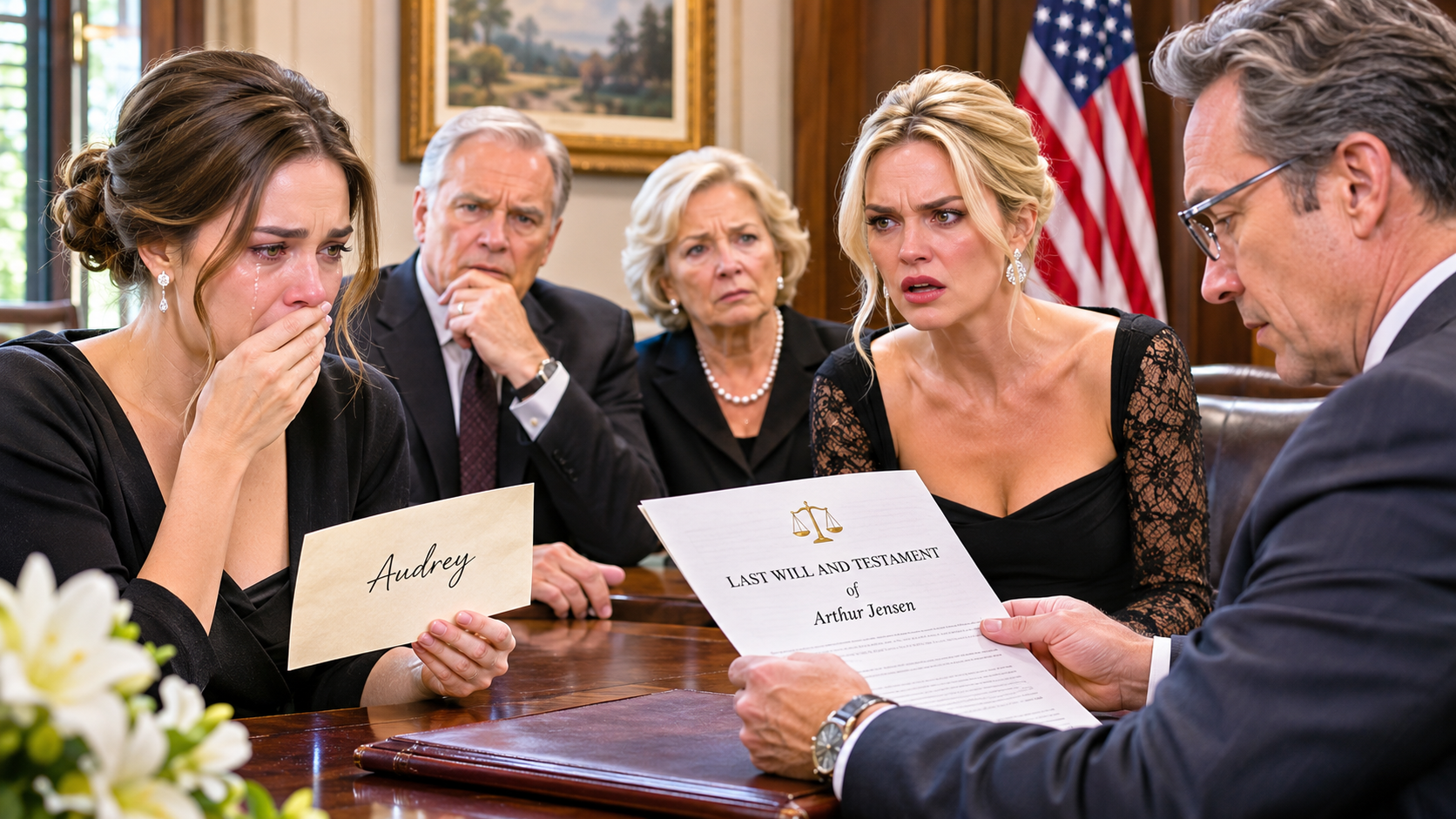
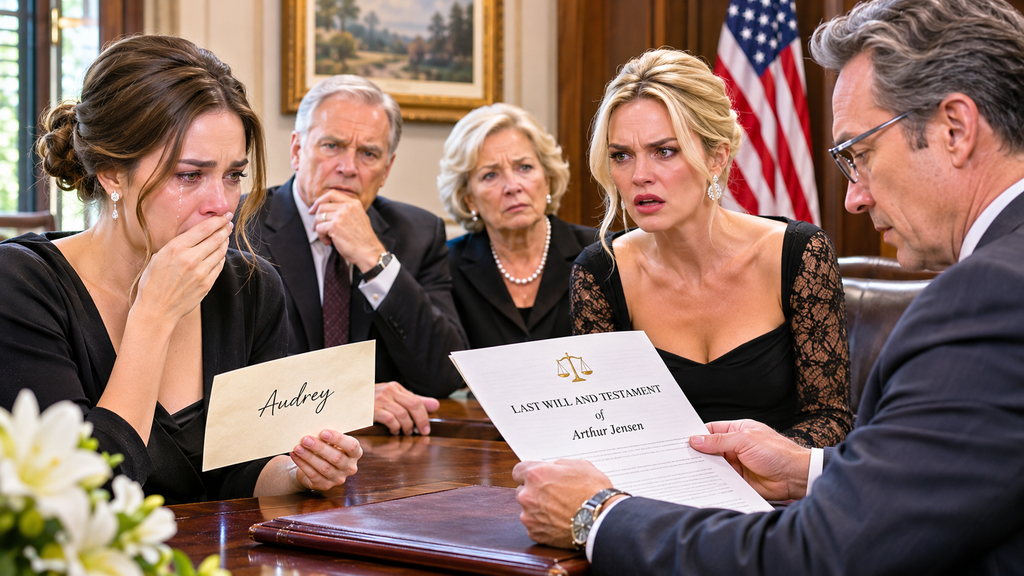
My sister was already smiling when the lawyer opened my dead husband’s will, because she thought the fortune was finally hers.
Beatrice sat at the far end of the mahogany conference table in a black silk dress that looked more expensive than grief should. A narrow veil covered half her face, though not enough to hide the shine in her eyes. My parents sat beside her, stiff and proud and frightened of looking anything less than loyal to the daughter they had always chosen first. Across the table, I sat with my hands folded in my lap, trying to breathe through the impossible fact that Arthur was gone.
Arthur Jensen.
My husband for ten quiet, beautiful years.
My ex-husband for four months.
My sister’s new husband for six days.
The lawyer, David Allen, placed a cream folder in front of him and adjusted his glasses. The room was twenty-five floors above downtown Dallas, with sunlight flashing off glass buildings and traffic moving silently far below. Everything in that office was calm. The shelves were lined with legal books. A silver clock ticked softly behind the desk. A pitcher of water waited untouched on a sideboard.
Beatrice glanced at me once.
It was the same look she had given me our entire lives. Half pity, half victory. As if I had shown up to witness the final proof of what she had always believed: that everything I loved would eventually find its way to her.
“Mr. Allen,” she said, placing one manicured hand over the black leather purse in her lap, “I think we all understand Arthur’s wishes. He and I were married. Whatever he left should be straightforward.”
David Allen did not look at her.
He looked at me.
That was the first moment the room shifted.
Not enough for anyone else to name it, maybe. But I felt it. A slight change in the air. A pause too deliberate to be accidental.
Then he reached into his drawer and removed a plain white envelope.
My name was written across the front in Arthur’s handwriting.
Audrey.
For one second, the world blurred around the edges.
Beatrice’s smile weakened.
“What is that?” she asked.
Mr. Allen slid the envelope across the table until it stopped in front of me.
“Arthur instructed that Audrey receive this before any portion of the will is read.”
The room went quiet.
I did not touch the envelope at first. I only stared at my name, written in the neat, familiar script that had once appeared on grocery lists, birthday cards, notes tucked into lunch bags, and little scraps of paper left on the kitchen counter.
Audrey, don’t forget your umbrella.
Audrey, I made coffee.
Audrey, I love the way you hum when you read.
That handwriting belonged to a life I thought had been destroyed. Now it sat in front of me like a door I was terrified to open.
Beatrice laughed softly.
“This is unnecessary,” she said. “Whatever he had to say to her can wait.”
Mr. Allen’s voice remained gentle.
“No. It cannot.”
That was when my sister stopped smiling entirely.
I was born nine minutes after Beatrice, and somehow my family treated those nine minutes like destiny had already made its preference known.
If Beatrice was the sun in our house, I was the moon: pale, quiet, visible only when her light happened to fall on me. She had come into the world loud and pink and furious, with a full head of golden hair and lungs strong enough to announce herself to the whole maternity ward. My mother loved telling that story. She said Beatrice arrived like a queen. Then, after a difficult pause, I arrived small and blue and silent enough to scare everyone.
“She was always fragile,” my mother would say whenever someone asked about us as babies, her hand resting proudly on Beatrice’s shoulder while I stood nearby pretending not to hear.
Fragile became my first name.
Quiet became my second.
Beatrice was the twin who climbed trees, led games, won races, collected applause. I was the one who sat on the porch swing with a book, coughing through winter colds that turned too easily into bronchitis, keeping an inhaler in my backpack, knowing exactly how to disappear when adults began comparing children.
Our parents did not mean to be cruel in the dramatic way people imagine cruelty. They did not lock doors or shout terrible things at midnight. Their favoritism was softer, more ordinary, and maybe that made it harder to fight. It lived in their smiles, in where they looked first, in whose stories they repeated at family dinners, in whose small victories counted and whose achievements became footnotes.
Beatrice scored the winning goal in sixth grade, and my father bought her a silver bracelet.
That same week, I won the class spelling bee and came home with a blue ribbon folded carefully in my pocket. It sat on the kitchen counter all evening while my parents discussed Beatrice’s game. When I finally pointed at it, my mother glanced over and said, “That’s nice, dear. But it was only your class, right?”
I still remember our eighth birthday.
The backyard smelled of cut grass and frosting. Kids from school ran through sprinklers while my father worked the grill and my mother carried out a sheet cake with both our names on it. Beatrice’s name was written in pink frosting, large and looping. Mine was in neat blue letters, smaller, tucked beneath hers.
When it came time for presents, my father wheeled out Beatrice’s first.
A candy-apple red Schwinn bicycle with silver tassels on the handlebars.
Everyone gasped. Beatrice screamed with joy and rode circles around the yard while our parents clapped. Her ponytail flew behind her like a flag.
Then my mother brought out my gift.
A leather-bound collection of classic poems.
It was beautiful. I know that now. But I was eight, and all I could see was the bike flashing red in the sun.
“This is more your speed, Audrey,” my mother said, patting my hair. “You can read inside while your sister plays.”
My father’s eyes were still on Beatrice.
That day, something in me understood before I had words for it.
I was not simply different.
In their eyes, I was the lesser twin.
For years, I accepted my place because children accept the weather of the homes they are born into. I loved Beatrice. Truly, I did. I admired her brightness, her bravery, her easy way of making people lean toward her. But loving her often felt like standing too close to a bonfire. Warm, yes. But always aware you could be burned.
College saved me.
Beatrice went east on an athletic scholarship to a university my parents mentioned as if they had founded it themselves. There was a going-away party for her, with banners and cake and a table full of gifts.
My acceptance letter to a smaller state school in Texas earned a distracted smile from my mother.
“Oh, that’s nice, dear.”
But for me, it was more than nice.
It was escape.
I packed my life into a faded Ford Escort and drove to Dallas with two boxes of books, a suitcase full of beige clothes, and a fear so large it felt like another passenger. The drive took all day. Static-filled country stations came and went. Gas station coffee kept me awake. When I crossed the Texas state line, I pulled onto the shoulder, turned off the engine, and cried.
Not because I was sad.
Because, for the first time in my life, no one around me knew I was Beatrice’s sister.
I was just Audrey.
My first apartment was on the third floor of a building that smelled like old carpet and fried onions. The walls were the color of weak tea. The air conditioner rattled. My downstairs neighbor played television too loud. The first night, I sat on the floor with a pizza box I barely touched and watched headlights slide across the ceiling.
I was terrified.
I was free.
Slowly, I built a life.
I studied elementary education because books had saved me, and I wanted to hand that kind of rescue to children who needed it. I was not loud in college, but I was steady. I became the girl people asked for notes, the one who remembered deadlines, the one who listened when someone was homesick or overwhelmed. In student teaching, I found my purpose. Children did not care if I was dazzling. They cared if I was kind. They cared if I knelt beside their desks and helped them sound out difficult words. They cared if I remembered which stories made them brave.
One little girl named Maria wrote me a note after I helped her read aloud for the first time.
You are the best teacher.
I folded that paper and kept it in my wallet for years.
It was the first trophy that had ever felt truly mine.
After graduation, I got a job at a small elementary school in a quiet Dallas suburb with wide sidewalks and oak trees shading the playground. My life became simple and predictable. Lesson plans. Parent conferences. Book fairs. Grocery runs. Saturday laundry. A little apartment full of thrift-store furniture and books stacked beside the bed.
Then Arthur came along and made my simple life feel like enough.
I met him through Carol, another teacher at my school, who had been trying to set me up for months.
“He’s quiet,” she said. “Like you. But not in a strange way. In a good way.”
“That’s persuasive,” I said.
“You know what I mean.”
His name was Arthur Jensen. He worked in real estate, though not the flashy, watch-tapping kind. He specialized in older homes, the ones with quirks and history and floors that settled at odd angles. Our first date was at a neighborhood Italian restaurant with checkered tablecloths and Chianti bottles used as candle holders. Within five minutes, I knocked over my water glass.
I froze, mortified.
Arthur laughed, not at me but with such warmth that embarrassment lost its grip.
“Well,” he said, grabbing napkins, “now the table can stop being nervous.”
That was Arthur.
He made rooms feel safe.
He had brown hair that curled at the edges when it rained and kind eyes that paid attention. Not performed attention. Real attention. At dinner, I talked too much about my students because I was nervous. I told him about reading groups, playground politics, a boy who insisted dinosaurs were still alive in Oklahoma. I expected his eyes to glaze over.
They didn’t.
“What book are you reading with them now?” he asked.
And later, “What do you think makes a child trust a teacher?”
No one had ever asked me that on a first date.
At the end of the night, while we waited for the check, he looked across the table and said, “You talk about those kids like they’re all carrying little lanterns and you get to help them keep the flame going.”
I blinked.
He smiled softly.
“You’re different, Audrey. In a good way. The kind of different that stays with a person.”
Those words went through me like water into dry ground.
He did not make my quietness feel like a flaw.
He made it feel like a place someone could rest.
We dated for two years before he proposed. There was no grand restaurant, no violin, no crowd to applaud. It was a rainy Tuesday night in our apartment. We were on the couch, my legs tucked beneath me, his hand resting over mine while rain tapped against the windows.
He turned to me suddenly, eyes shining.
“I never knew life could be this peaceful,” he said. “I never knew I could be this happy.”
Then he pulled a small box from his pocket.
The ring inside was simple, elegant, and perfect.
When I said yes, I cried so hard he laughed and cried with me.
For the first time in my life, I felt chosen.
Our marriage was not dramatic, and I loved that about it. We bought a small bungalow under oak trees with a porch just wide enough for two chairs. We painted the kitchen soft yellow. Arthur built crooked bookshelves that I loved more than expensive furniture because his hands had made them. We planted tomatoes in the backyard and killed two rosebushes before we learned what we were doing.
Saturday mornings belonged to the Blue Bonnet Diner, where Flo the waitress called us lovebirds and refilled Arthur’s coffee before he asked. Sunday afternoons were for reading on opposite ends of the couch, our feet touching under a blanket. We tried for children for a while, then cried, then stopped trying, then learned how to make a full life with the two of us.
Arthur made me feel capable. When I was offered a promotion to lead teacher and nearly turned it down out of fear, he stayed up late with me making a list of every reason I could do it.
“Your whole life,” he said, tapping the paper, “people confused quiet with weak. They were wrong.”
I believed him because he believed it first.
During those years, Beatrice called when she had news to perform. She was in New York by then, a marketing executive with designer luggage, sharp opinions, and a talent for making any room feel like a stage. She dated men with money, vacationed in places I had only seen in magazines, and spoke of my life with the gentle condescension of someone complimenting a child’s drawing.
“A little bungalow,” she once said over the phone. “That’s sweet. Very you.”
“Yes,” I said, looking at Arthur in the yard trying to rescue a leaning tomato cage. “It is.”
“And you’re still teaching?”
“I am.”
“Well,” she said, “as long as you’re happy with your simple little life.”
I was.
That was the miracle.
Her words could no longer reach me the way they once had because I had built something she could not understand. It was quiet, yes. Simple, yes. But it was rich in all the ways that mattered to me.
For ten years, I thought our peace was stronger than anything.
Then Arthur began to disappear while still living in the house.
It happened gradually. The tide moving out inch by inch. Late nights at work. Shorter answers. A distracted kiss on my forehead instead of a real conversation. His coffee mug no longer beside mine in the morning because he had left before I woke. The dining table growing quieter, my stories about students falling into the space between us like pebbles into deep water.
One evening, I made shepherd’s pie because it was his favorite. I had been waiting all day to tell him about a shy student who finally read aloud in class. Arthur came home close to nine, loosened his tie, opened the refrigerator, and grabbed a beer without looking at the table.
“I made dinner,” I said.
“Not hungry.”
The story died in my throat.
I tried to talk to him. Of course I did.
“Is something wrong at work?”
“It’s just work.”
“Are we okay?”
“We’re fine.”
“Arthur, please look at me.”
“I’m tired, Audrey.”
At night, he slept with his back to me. The distance between us in the bed felt colder than any empty apartment I had ever lived in. A childhood feeling returned, one I thought love had cured: the sense of being invisible in a room where I was supposed to belong.
The night he asked for a divorce was a Thursday.
I remember the sound of my fork touching the plate. A soft clink that seemed too loud in our quiet dining room. I had made chicken, though neither of us had eaten much. The yellow kitchen walls looked dull under the overhead light. Rain pressed against the windows.
“We have to talk,” I said.
Arthur looked up.
For the first time in months, his eyes were clear.
And cold.
“You’re right,” he said. “We do.”
The next four words ended the life I knew.
“I want a divorce.”
I stared at him.
There are moments when the body understands before the mind. My hands went numb. My lungs forgot their work. The room tilted slightly, as if the house itself had heard and shifted away from me.
“Why?” I whispered. “What did I do?”
“It’s over,” he said.
His voice was flat. Controlled. Practiced.
“That isn’t an answer.”
“It’s the only one I have.”
Before I could say anything else, the doorbell rang.
Bright. Cheerful. Absurd.
Arthur stood, wiped his mouth with his napkin, and walked to the front door.
I heard the lock turn.
Then heels on our hardwood floor.
Click. Click. Click.
Beatrice entered the dining room in a red dress that looked made to be seen. Her hair was perfect. Her makeup was flawless. Her smile was terrible.
She walked straight to Arthur and slipped her arm through his.
He did not pull away.
I gripped the table.
Beatrice looked me over, taking in my simple blouse, my pale face, my shock. Her smile widened.
“Arthur and I are getting married,” she said.
The words did not make sense.
My sister.
My husband.
The two pillars of my life standing together while the roof collapsed above me.
I looked at Arthur, searching for shame, regret, anything human. His face was a mask.
Beatrice leaned closer.
“You’ve lived in my shadow long enough, Audrey. Maybe now you’ll stay there.”
That sentence should have shattered me.
Maybe it did.
The weeks after that became gray and blurred. A courier delivered divorce papers the next day in a thick manila envelope. Arthur’s lawyer called and explained the settlement. It was generous, almost strangely so. I received most of our savings, retirement access, and enough to move comfortably. At the time, I thought it was guilt. I signed because I did not have the strength to fight.
Leaving the bungalow was like walking out of my own skin. Every object hurt. A grocery list in Arthur’s handwriting. A receipt from our first anniversary dinner tucked into an old novel. The crooked bookshelf we had built together. The soft sweatshirt of his I used to wear on Sundays.
I hired movers so I would not have to see him.
On my last day there, I left the key on the kitchen counter and closed the door without looking back.
My new apartment was clean, anonymous, and soulless. Beige walls. Gray carpet. A balcony that faced another building. For weeks, I lived among unopened boxes. I called in sick from school because I could not face the kind eyes of my colleagues or the children who would ask why my voice sounded different. Carol left voicemails I could not answer.
“Audrey, honey, we’re worried. Just call me back.”
I sat on the couch still wrapped in plastic and stared at the wall.
Meanwhile, Beatrice celebrated publicly.
Friends sent screenshots before I begged them to stop. Beatrice and Arthur clinking champagne glasses on a balcony. Beatrice standing beside him at a charity dinner. Beatrice captioning one photo: Finally, the life I was meant for.
I deleted every social media account that night.
About a month later, I ran out of food and forced myself to the grocery store. I came home carrying milk, bread, soup, and bananas, wearing sweatpants and a coat that did nothing to make me look less broken. As I fumbled with my keys outside the apartment building, a sleek black Mercedes pulled to the curb.
Beatrice stepped out.
Cream pantsuit. Gold earrings. Blonde hair catching the afternoon sun.
“Audrey,” she called brightly. “How have you been?”
I stood with a grocery bag cutting into my fingers.
“What do you want?”
She approached with a smile so false it seemed painted on.
“I wanted to check on you. This must be so hard.”
The audacity of it burned through the fog in my chest.
“You’re checking on me.”
“Of course.”
“You stood in my dining room and took my life apart.”
Her smile tightened.
“Don’t be dramatic.”
That word snapped something.
“Dramatic?” I said quietly. “You took my husband, my home, my peace, and now you want to stand here in an expensive suit and offer pity?”
Her mask dropped.
For the first time in years, I saw the real Beatrice without the performance.
Cold. Sharp. Empty.
“Fine,” she said. “Wallow, then. You were always fragile. Always weak. That’s why people leave you.”
She stepped closer.
“Arthur wanted a strong woman. Not a broken little bird.”
Then she turned and walked back to her car.
Her words hung there, poisonous and familiar.
Weak.
Fragile.
The old labels.
But this time, instead of making me collapse, they made me angry.
Not loud anger. Not wild anger.
A white, clean flame.
Beatrice had come to see me small. She had needed to see me ruined. My pain was part of her victory.
So I decided she would not have it.
The next Monday, I showered, put on a navy dress, and went back to school. The hallway fell quiet when I entered. Carol rushed toward me with tears in her eyes.
“Are you okay?”
I gave her the smallest smile.
“I will be.”
That week, I called a therapist named Dr. Evans. In her office, I sat on a soft gray couch and said nothing for twenty minutes. Then the words came. Childhood. Beatrice. My parents. Arthur. The red dress. The dining room. The apartment parking lot.
When I finished, Dr. Evans said, “Audrey, you have spent your life carrying other people’s definitions of you. Perhaps it is time to write your own.”
It was not magic.
But it was a beginning.
I went back every week. I joined a book club at the library. The first time I spoke up, my voice shook, but a woman across the table smiled and said, “That’s a really interesting point.”
Small things saved me. A student hugging my waist after reading a full page aloud. Carol bringing soup and refusing to leave until I ate. A Saturday morning walk where I realized I had gone an entire hour without thinking of Arthur. A tomato plant on my balcony producing one stubborn red fruit.
Three months passed.
Then the call came.
I was alone in my classroom after the final bell, straightening books on a shelf, when my phone rang with an unknown local number.
“Ms. Audrey Carter?” a man asked.
“This is she.”
“My name is David Allen. I’m an attorney with Allen and Associates. I’m calling regarding your ex-husband, Arthur Jensen.”
My hand tightened on the phone.
“Is something wrong?”
A pause.
A careful one.
“I’m very sorry to tell you Mr. Jensen passed away suddenly last night.”
The classroom tilted.
Arthur was healthy. Arthur was young. Arthur was gone.
“I don’t understand,” I whispered.
“A heart condition,” Mr. Allen said. “It appears to have been sudden.”
Why was I crying? He was no longer mine. He had chosen my sister. He had erased ten years with four words and a red dress in my dining room.
And yet grief rose anyway, immediate and terrible.
“Why are you calling me?”
“Arthur updated his will shortly after your divorce. He left very specific instructions that I contact you directly if anything happened to him. There are legal matters, but first, he left a letter for you.”
“A letter?”
“Yes,” he said. “He insisted you receive it before anyone else is told anything further.”
The next morning, I drove downtown in a blur. Allen and Associates occupied the twenty-fifth floor of a glass building that smelled of polished wood and money. I sat in a leather chair with my hands clasped so tightly my knuckles went pale, staring at the city below.
David Allen was in his late sixties, silver-haired, kind-faced, and formal in the way good attorneys are formal when emotion has already filled the room.
He led me into his office and shut the door.
“Ms. Carter,” he said gently, “I know this is difficult.”
I nodded because speaking seemed impossible.
He opened a drawer and removed a plain white envelope.
My name was written on it.
Audrey.
Arthur’s handwriting.
“He wanted you to have this first.”
I took the envelope with shaking hands.
For a long moment, I could not open it.
Then I tore the seal.
The letter was one page, written in blue ink. The handwriting was Arthur’s, though less steady than I remembered.
Dear Audrey,
If you are reading this, my time has run out.
There are a thousand apologies I owe you, but I only have time for the truth.
I am so sorry.
Everything I did looked cruel. It was cruel. I know that. I will spend whatever time I have left carrying the weight of your face that night at the dining table.
But I need you to know this.
I never stopped loving you.
Not for one second.
Six months before I asked for the divorce, I went to the doctor for what I thought was stubborn heartburn. It was my heart. The condition was advanced. The doctors were honest. I had months, maybe a year.
My first thought was you.
How could I leave you? How could I make you watch me fade? How could I let you spend the rest of your life tied to the mess I had just inherited?
My uncle’s estate was not the fortune people thought it was. Beatrice heard rumors and saw numbers without seeing what was behind them. She thought I was about to become unimaginably wealthy. But the estate was a trap: debts, claims, failing properties, obligations buried under beautiful words.
Beatrice wanted it. She wanted me because she thought I came with it.
So I made the worst decision of my life.
I let her believe she had won.
I pushed you away so the divorce would legally separate you from everything tied to my name. I gave you all the clean assets I could. The savings. The retirement. The insurance policy. I made sure those were yours before the rest collapsed around me.
Every cold word was a lie. Every late night was a performance I hated myself for. The night Beatrice came into our home, I thought I would break standing there beside her. I wanted to run to you. I wanted to tell you everything. But if I did, you would have stayed. You would have tried to save me. And she would have found a way to drag you into the wreckage.
I know this may not feel like love.
Maybe it was the wrong kind.
But it was the only protection I knew how to give.
Please live, Audrey. Please do not let my terrible choice become the end of your story.
You were never weak.
You were the peace of my life.
Always,
Arthur
I do not remember dropping the letter.
I remember a sound leaving my body, raw and unfamiliar. I remember Mr. Allen quietly pushing a box of tissues across the desk. I remember sunlight on the mahogany. I remember thinking that I had lost Arthur twice: once to the lie, and now forever to the truth.
When I could speak again, Mr. Allen explained the rest.
The divorce settlement had been structured to keep me separate from Arthur’s remaining estate. His life insurance and retirement beneficiaries had been updated in my favor before the final paperwork. Those funds were clean. Protected. Mine.
Beatrice, as his new wife and named claimant to the Jensen family estate assets, had attached herself to the very thing she thought would make her rich.
Mr. Allen’s expression was grave.
“The holdings are heavily encumbered. There are outstanding creditor claims, tax issues, failed development obligations, and multiple properties worth far less than their liabilities.”
“How much?” I asked.
“More than two million in exposure before legal costs.”
My sister had chased a fortune and caught a storm.
The will reading happened three days after the funeral.
I almost did not go.
But Mr. Allen called and said Arthur had requested my presence if I felt strong enough. Not because he wanted me to witness Beatrice’s pain, he said, but because he wanted the truth to be placed in the room where the lie had once stood.
So I went.
I sat at the conference table while Beatrice performed grief in black silk and our parents pretended not to look confused by my presence. My mother gave me a tight, disappointed glance, the same look she used when I failed to make someone else comfortable.
Beatrice spoke first.
“Let’s keep this simple. I’m his wife.”
Mr. Allen opened the folder.
“Arthur’s instructions are quite specific.”
Then he gave me the envelope.
And now, in that silent room, I finally opened it.
I did not read it aloud. Arthur had not asked me to. Some truths are not public property.
But when I finished, I folded the letter carefully and held it in my lap.
Mr. Allen began reading the will.
Arthur left me the personal policies. The clean accounts. The protected funds. Enough for a house, a new start, a life without debt tied to his final months.
Beatrice’s posture stiffened.
“That’s impossible,” she said.
Mr. Allen continued.
To Beatrice Jensen, he left the rights, claims, and obligations associated with the Jensen family holdings she had insisted on assuming through the marital estate agreement she signed after their wedding.
Mr. Allen placed a document in front of her.
She stared at it.
Her lawyer, a young man in a tight suit, leaned in and whispered something.
For the first time in my life, I watched Beatrice lose color.
“What obligations?” she asked.
Mr. Allen’s voice remained steady.
“The estate is insolvent. The assets you claimed are subject to creditor actions, liens, and pending settlements. Arthur disclosed this in the agreement you signed.”
“I didn’t read that,” she snapped.
Mr. Allen looked at her.
“You signed every page.”
The room changed.
My father shifted in his chair. My mother’s lips parted. Beatrice looked from the papers to me as if I had somehow moved the ground beneath her feet.
“You knew,” she said.
I held Arthur’s letter.
“No,” I said quietly. “But Arthur did.”
Her eyes sharpened with old hatred.
“You think this makes you special?”
I looked at her then, really looked. The golden twin. The chosen daughter. The woman who had spent a lifetime taking whatever proved she could.
For the first time, she did not look powerful.
She looked hungry.
And hunger, I realized, is not strength.
“No,” I said. “I think it makes me free.”
She stood so quickly her chair scraped the floor.
“This is fraud. This is manipulation.”
Mr. Allen folded his hands.
“You are welcome to have counsel review the documents.”
Beatrice’s lawyer was already reviewing them. His face told the rest of us what the papers had not yet said out loud.
Arthur had left her exactly what she came for.
The name.
The estate.
The illusion.
And everything hidden beneath it.
I walked out before the meeting ended.
Not dramatically. Not triumphantly. I simply stood, placed Arthur’s letter in my purse, and left the room where my sister’s victory had turned into paperwork.
Outside, Dallas was bright and hot. Cars moved along the street. People carried coffee. A woman laughed into her phone near the elevator bank. The world continued, indifferent to revelations.
I stepped onto the sidewalk and breathed.
For months, I had believed I was discarded.
The weaker twin.
The abandoned wife.
The woman left behind.
But the truth, complicated and painful as it was, had another shape.
I had been loved.
Imperfectly. Terribly. Quietly. Completely.
In the weeks that followed, Arthur’s clean inheritance arrived exactly as Mr. Allen promised. It did not feel like winning. It felt like responsibility. Every dollar carried the weight of what Arthur had chosen and what both of us had lost.
I bought a small bungalow on a tree-lined street not far from my school. Smaller than the first one. Cozier. It had a sunroom, a garden bed choked with weeds, and a front porch where morning light arrived gently.
I planted tomatoes first.
Then roses.
Then basil, because Arthur had always said store-bought basil tasted like disappointment.
Beatrice called for weeks.
At first, clipped voicemails.
Audrey, the lawyers are being confusing. Call me.
Then sharper ones.
This is ridiculous. Arthur was wealthy. You must know something.
Then texts.
You owe me an explanation.
You always play innocent.
You got the clean money, didn’t you?
Finally, an email arrived with the subject line Audrey.
We need to talk. I am your sister.
I stared at that last sentence for a long time.
I am your sister.
She had used those words my whole life like a key to doors she had no right to open.
The old Audrey would have answered. The old Audrey would have felt guilty. The old Audrey would have tried to soften the blow, explain the papers, help her find a way through the mess she had walked into wearing a smile.
But the old Audrey had been built by other people’s definitions.
Weak.
Quiet.
Fragile.
Less.
I moved the email to trash.
Then I emptied the trash.
A year has passed since the day Mr. Allen slid Arthur’s letter across his desk.
I still teach. My students still save me in small ways every day. Carol comes over on Fridays, and we drink wine in the sunroom while the roses grow wild outside the windows. I joined a book club. I joined a hiking group. Last month, I stood on a ridge outside town with dust on my shoes, sweat on my neck, and the whole world open in front of me. I felt small and powerful at the same time.
Arthur’s letter stays in a wooden box in my closet.
I do not read it often.
I do not need to.
I know what it says.
I know what it cost.
Some days I am still angry with him. Some days I forgive him. Most days I do both before breakfast and then go water the garden.
Love is not always clean. Sacrifice is not always fair. Truth does not always arrive in time to save what it explains.
But it can still free you.
As for Beatrice, I do not know where she is now. Last I heard, the estate lawyers were still untangling the holdings she had been so eager to claim. My parents called once to ask if I could “be compassionate.” I told them compassion was not the same as returning to my assigned place.
They did not understand.
That was all right.
I finally did.
For the first time in my life, I am not standing in my sister’s shadow.
I am not waiting for my parents to notice me.
I am not measuring my worth by whether someone chooses me loudly enough for others to hear.
My life is quiet again.
But now it is my quiet.
My house. My garden. My classroom. My books. My friends. My future.
And every morning, when sunlight fills the kitchen and the kettle begins to sing, I think of Arthur’s final words.
You were never weak.
Then I pick up my pen and keep writing the story myself.
💬THE END! THANK YOU FOR READING! ❤️🙏