
On Mother’s Day, my mother looked straight at me and said, “I wish you had never been my daughter.” I stood up calmly and answered, “Then live like you never had one.” Then I got into my SUV and left. By the next morning, my phone was ringing nonstop…
At 6:30 the next morning, I opened the banking app and confirmed what I already knew. Every automatic payment I had been covering for my mother was canceled.
Her mortgage.
Her homeowner’s insurance.
Her utilities.
Her cell phone.
The supplemental health policy she insisted was “too expensive” until I quietly started paying it.
Even the premium on the silver Lexus she loved telling people she had bought for herself.
For years, those expenses had left my account so regularly that I barely noticed them anymore.
Mortgage on the third.
Insurance on the seventh.
Phone on the twelfth.
Utilities scattered through the month.
I had built my mother’s financial stability so carefully that nobody in the family ever stopped to ask who was holding it together.
Including her.
Ethan sat beside me on the edge of the bed while Mark called again from Rachel’s phone.
I stared at the screen until the ringing stopped.
Then it started again.
“You don’t have to answer,” Ethan said.
“I know.”
The phone kept vibrating.
I answered.
Mark didn’t bother saying hello.
“Are you insane?”
His voice was so loud I pulled the phone away from my ear.
“Good morning to you too.”
“Mom is crying. The bank says her mortgage payment failed. Her insurance payment failed. Her phone company sent some kind of notice. What did you do?”
“I stopped paying.”
“You can’t just do that.”
I almost laughed.
Apparently, I could be wished out of existence as a daughter, but my checking account was still legally required to remain part of the family.
“Why not?”
“Because Mom depends on you.”
“That’s interesting.”
“What’s interesting?”
“Yesterday she said I barely remembered the family existed.”
“Claire, come on.”
“No. Explain it.”
He went quiet.
I stood and walked toward the bedroom window.
Morning light was beginning to spill across our backyard.
Ethan and I had bought the house three years earlier after saving for nearly a decade.
It wasn’t a mansion.
It was a comfortable brick home with four bedrooms, a small pool, a screened porch, and the first kitchen I had ever designed exactly the way I wanted.
Mom had spent the entire housewarming party criticizing it.
Too far from her.
Too modern.
Too expensive.
Too much space for two people without children.
Yet whenever something needed to be hosted, she volunteered my house.
Whenever relatives visited Charlotte, she offered them my guest room.
Whenever she wanted to brag about me, she called me “my daughter, the executive.”
Whenever she wanted obedience, I became the selfish child who had forgotten where she came from.
“Claire,” Mark said carefully, “you know Mom says things when she’s upset.”
“And people live with the things they say.”
“She didn’t mean it.”
“She said it twice.”
“She was emotional.”
“So was I.”
“You’re really going to punish her financially because of one argument?”
That sentence landed differently.
I looked at Ethan.
He had heard it too.
“I’m not punishing her,” I said. “I’m no longer subsidizing someone who publicly told me she wished I didn’t exist.”
“That’s the same thing.”
“No, Mark. Punishment would be taking something that belongs to her. I’m simply stopping the transfer of money that belongs to me.”
He exhaled hard.
“You know I can’t afford all that.”
“Then I guess Mom will need to adjust her lifestyle.”
“You make more than I do.”
“And?”
“And family helps family.”
I closed my eyes.
There it was.
The family motto.
Family helps family.
Except when the person needing help was me.
When I had pneumonia three winters earlier and could barely get out of bed, Mom had called to ask whether I could still log into her cable account.
When Ethan’s father died, Mark had complained that our trip to Ohio meant we would miss his daughter’s birthday dinner.
When I underwent surgery for endometriosis at thirty-one, Mom stayed at the hospital for twenty minutes before leaving because she didn’t like driving after dark.
Rachel had sent a heart emoji.
Mark had forgotten entirely.
Family helped family, apparently, when help moved in one direction.
Toward them.
“I’m done,” I said.
“With what?”
“All of it.”
“Claire—”
“No mortgage. No insurance. No utilities. No credit cards. No emergency transfers. No random Venmo requests. No fixing problems that somehow become mine.”
Mark lowered his voice.
“You’re being cruel.”
I felt something inside me settle.
Not break.
Settle.
For years, I had been terrified of becoming the difficult daughter.
The selfish sister.
The woman who “forgot family.”
It had controlled me more effectively than any threat ever could.
Now Mom had finally said the one thing so unforgivable that the fear had burned away.
“If you believe that,” I said, “you’re welcome to replace me.”
Then I ended the call.
Within ten seconds, Aunt Susan called.
I declined it.
Then Cousin Leah.
Then Rachel.
Then a number I didn’t recognize.
Then Mom’s neighbor, Denise.
By seven in the morning, Ethan’s phone had become the backup emergency hotline.
He turned it face down.
“You know what’s weird?” he said.
“What?”
“No one has asked how you are.”
I looked at him.
That was the part I had been trying not to name.
Not one message said:
Claire, what happened yesterday was horrible.
Claire, are you okay?
Claire, I’m sorry nobody defended you.
Every message was about money.
Every call was about fixing Mom’s crisis.
Nobody was afraid of losing me.
They were afraid of losing what I provided.
At 7:14, Ethan’s laptop chimed.
He was standing at the kitchen counter making coffee.
He glanced at the screen.
Then frowned.
“Claire.”
Something in his voice made me put down my phone.
“What?”
“Your mother emailed your company.”
My stomach tightened.
“What did she say?”
He turned the laptop toward me.
The email had been sent to the general corporate contact address and copied to two executives whose names Mom had apparently found online.
The subject line read:
CONCERN ABOUT EMPLOYEE ETHICS — CLAIRE MORGAN.
I read it once.
Then again.
Mom claimed I had “abandoned a dependent elderly parent without warning.”
She said I controlled family finances.
She said I had used money as “retaliation after a personal disagreement.”
She described herself as financially vulnerable.
Then she wrote that a company employing someone in a leadership role should “care about whether that person abuses financial power over others.”
For several seconds, I couldn’t speak.
Ethan’s face had gone completely still.
“She’s trying to get you fired.”
I shook my head slowly.
“No.”
“What do you mean, no?”
“She’s trying to scare me.”
“That can still damage your career.”
“I know.”
My phone rang again.
This time it was Mom.
Apparently she had found another number to call from.
I answered.
“Claire.”
Her voice was trembling.
But not with sadness.
With anger.
“You saw the email.”
“Yes.”
“You left me no choice.”
I actually laughed.
“You had no choice?”
“You cut me off without warning.”
“You told me you wished I’d never been your daughter.”
“And you’re proving exactly why I said it.”
That should have hurt.
Instead, it clarified everything.
“What do you want, Mom?”
“I want you to turn the payments back on.”
“No.”
“You’re going to ruin me.”
“No. Your expenses are going to ruin you.”
“I’m your mother.”
“You made it clear yesterday that you don’t want to be.”
“That was an expression.”
“Then this is mine.”
She went silent.
I continued.
“You wanted life without a daughter. You have it.”
Her breathing changed.
“You think Ethan put you up to this.”
Ethan heard her through the speaker.
His eyebrows lifted.
There was always someone else to blame when I stopped obeying.
My career.
My husband.
My friends.
My therapist.
Never the person hurting me.
“Ethan asked me for years to stop paying your bills,” I said. “I kept defending you.”
“That man has never respected this family.”
“He respected it enough to sit through yesterday without saying a word while you humiliated his wife.”
Mom snapped, “You embarrassed me first.”
“How?”
“You challenged me in front of everyone.”
“After you said you wished I had never been born.”
“That is not what I said.”
“It’s exactly what you said.”
“You twist everything.”
I closed my eyes.
That familiar sensation rose in my chest.
The instinct to explain.
To prove.
To produce evidence.
To argue until she admitted reality.
I had done it since childhood.
When I was eleven and she forgot to pick me up after choir practice, she told me I had never reminded her.
When I was sixteen and she read my diary, she said I shouldn’t have written things I didn’t want discovered.
When Dad gave me money for college books, she took half for household expenses and told me I was selfish for asking about it.
Reality in our house had always been whatever version protected Mom from accountability.
I wasn’t doing it anymore.
“I’m hanging up now.”
“Claire, don’t you dare—”
I hung up.
At eight thirty, I called my boss.
Her name was Priya Nanduri.
She was vice president of regional operations and one of the calmest people I had ever met.
I explained the situation before corporate communications could forward Mom’s email.
Priya listened without interrupting.
When I finished, she said, “Do you have documentation showing those payments came voluntarily from your account?”
“Years of it.”
“And there’s no legal guardianship arrangement?”
“No.”
“No formal dependency?”
“No.”
“No court order?”
“Nothing.”
“Then your mother’s personal finances are not our business.”
I let out a breath.
Priya continued.
“But sending accusations to your employer is concerning. Forward everything to HR and legal. Don’t engage with her about the company.”
“Understood.”
Then her tone softened.
“And Claire?”
“Yes?”
“I’m sorry.”
Two words.
That was all.
Yet they nearly undid me because nobody in my family had said them.
“I’m sorry.”
Not because Mom’s bills bounced.
Not because the morning was inconvenient.
Because what happened to me was wrong.
“Thank you,” I whispered.
By noon, Mom’s email campaign had expanded.
She contacted my company again.
Then Ethan’s office.
Then she posted a carefully edited message on Facebook.
She didn’t mention what she had said at brunch.
She wrote:
Sometimes children become successful and forget the parents who sacrificed for them. Please pray for me as I navigate an unexpected financial crisis caused by someone I loved and trusted.
The comments poured in.
Most were generic sympathy.
Then Aunt Susan added:
Families should never use money as weapons.
Mark liked it.
Rachel added a broken-heart emoji.
Ethan showed me the post while we ate lunch.
“What do you want to do?”
“Nothing.”
He studied me.
“Really?”
“For now.”
That afternoon, Aunt Susan called from a new number.
I answered because curiosity finally won.
“Claire, sweetheart.”
I almost smiled.
Sweetheart meant she wanted something.
“Hi, Aunt Susan.”
“Your mother is very distressed.”
“So I’ve heard.”
“She didn’t sleep.”
“Neither did I.”
Susan sighed.
“Your mother has always had a sharp tongue.”
Interesting.
Everyone suddenly acknowledged Mom was cruel as long as it came immediately before asking me to tolerate it.
“But she loves you.”
“She has an unusual way of showing it.”
“Claire, she’s sixty-seven.”
“And?”
“And this is a frightening time to suddenly worry about housing.”
“Then perhaps her son can help.”
“You know Mark has expenses.”
“So do I.”
“But you’re in a better position.”
I leaned against the kitchen island.
“Do you know how much I’ve paid toward Mom’s expenses in the last five years?”
Susan hesitated.
“No.”
“One hundred and forty-three thousand dollars.”
Silence.
That number surprised even Ethan.
I had totaled it that morning after years of avoiding the calculation.
Mortgage.
Insurance.
Repairs.
Property taxes.
Medical co-pays.
Car payments before the Lexus was refinanced.
Trips Mom told relatives she had paid for herself.
Emergency cash.
Renovations.
A new HVAC system.
Dental work.
The final total was $143,680.
And that did not include the money I had given Mark.
Aunt Susan cleared her throat.
“Well, your mother raised you.”
“There it is.”
“What?”
“The bill.”
“I didn’t say that.”
“You did. Every time anyone points out what I’ve done for her, someone reminds me she raised me as if parenting created a lifelong invoice.”
“You’re taking this the wrong way.”
“I spent years taking it your way.”
Susan’s voice sharpened.
“What are you trying to prove?”
“Nothing.”
“You’ll regret this if something happens to her.”
I looked toward the backyard.
That sentence had worked on me for decades.
What if she gets sick?
What if she dies?
What if this is the last conversation?
What if guilt lasts forever?
Fear of hypothetical grief had kept me trapped in guaranteed misery.
“I would regret continuing like this more.”
Then I hung up.
The next three days became a campaign.
Relatives called.
Mom cried.
Mark threatened.
Rachel pleaded.
Cousins sent paragraphs about forgiveness.
An uncle I had not spoken to since Christmas suddenly wanted to mediate.
Even our childhood pastor called.
He began with prayer and ended by asking whether I could “temporarily stabilize Linda’s finances while everyone cooled down.”
I asked whether he had spoken to Mom about what she said.
There was a pause.
“She acknowledges she spoke harshly.”
“Did she apologize?”
Another pause.
“She’s hurting too.”
That was always the trick.
Any harm Mom caused became secondary to the pain she experienced when consequences arrived.
On Thursday, Ethan came home holding a thick envelope.
“Certified mail.”
My mother had hired an attorney.
The letter accused me of financial exploitation.
I read it at the kitchen table.
Then laughed until tears came.
Ethan watched carefully.
“You okay?”
“No.”
I wiped my face.
“But I think I’m finally angry enough.”
The next morning, I hired my own attorney.
Her name was Danielle Brooks.
She specialized in family asset disputes and elder law.
I brought three binders.
Bank statements.
Mortgage transfers.
Insurance payments.
Texts where Mom asked me for money.
Emails where she thanked me for covering expenses.
The Lexus paperwork.
The home repair invoices.
Even a handwritten note from two years earlier that said:
Claire, I don’t know what I’d do without everything you take care of.
Danielle spent forty minutes reading.
Then she leaned back.
“Your mother’s attorney is going to hate this.”
“Why?”
“Because this is not exploitation.”
She tapped the binder.
“This is generosity.”
I laughed bitterly.
“Could have fooled my family.”
“She’s an adult homeowner. You’re not her guardian. The accounts were in her name. You voluntarily paid expenses and stopped. Unless there’s something you haven’t told me, she has no legal right to force you to continue.”
“There isn’t.”
“Then we respond once. Firmly.”
Mom’s attorney received Danielle’s letter Monday morning.
By Monday afternoon, Mom’s legal threat vanished.
But the family crisis didn’t.
The mortgage company had not begun foreclosure despite Mark’s dramatic messages.
Mom was nowhere near losing the house overnight.
She had savings.
Not much by her standards, but enough.
The real problem was that she didn’t want to use them.
For years, my money had allowed hers to remain untouched.
And once Danielle reviewed the documents, we discovered something else.
Mom had more resources than she claimed.
A savings account containing nearly $48,000.
A retirement account.
Dad’s small survivor pension.
Social Security.
She was not wealthy.
But she was not helpless.
She had simply organized her life around the belief that her daughter’s income was part of her own.
When Mark found out, he called Ethan.
“You knew?”
Ethan replied, “Knew what?”
“That she had savings.”
“No.”
“Then why didn’t Claire?”
“She probably didn’t know either.”
Mark was furious.
Not because Mom had misrepresented her situation.
Because now he had fewer arguments for why I should resume paying.
Two weeks after Mother’s Day, Mom showed up at our house.
I saw the Lexus through the front window.
She stood on the porch holding a grocery-store bouquet.
Ethan looked at me.
“I can ask her to leave.”
“No.”
I opened the door.
Mom gave me the flowers.
“I thought maybe we could talk.”
I did not invite her inside.
Her expression changed when she noticed.
“On the porch?”
“For now.”
She crossed her arms.
“I came all this way.”
“So did I, many times.”
She looked away.
For a moment, we stood in silence.
Then she said, “I’m sorry you misunderstood what I said.”
There it was.
The apology that wasn’t one.
“I didn’t misunderstand.”
“I was angry.”
“You were cruel.”
“You were criticizing me.”
“I asked what would make me a good daughter.”
“You always have to analyze everything.”
“Mom.”
“What?”
“Are you sorry you said it?”
She stiffened.
“I’m sorry the situation got out of hand.”
“That isn’t what I asked.”
Her lips pressed together.
“You’ve changed.”
I nodded.
“Yes.”
She clearly had not expected me to agree.
“Ever since you got that promotion—”
“No.”
“What?”
“This isn’t my promotion. This isn’t Ethan. This isn’t money. This is the fact that I finally believed you.”
Her eyes narrowed.
“Believed what?”
“That you meant what you’ve been showing me for years.”
She stared at me.
I continued.
“That my value in this family depended on how useful I was.”
“That’s ridiculous.”
“Is it?”
“Of course it is.”
“When I stopped paying your bills, how long did it take before you asked whether I was okay?”
Her mouth opened.
Then closed.
“You still haven’t,” I said.
Her face changed.
Just slightly.
For one second, I thought she understood.
Then she said, “You know I care about you.”
“Then tell me something about my life that has nothing to do with what I can do for someone else.”
She frowned.
“What kind of question is that?”
“A simple one.”
“I know plenty.”
“What project am I running at work right now?”
Silence.
“What was the medical test I had two months ago?”
Her eyes moved away.
“What anniversary did Ethan and I celebrate last month?”
“Claire, I don’t keep track of every tiny detail.”
“What book did I give you for Christmas?”
“That’s unfair.”
“What happened to me three years ago that made me start therapy?”
Her face hardened.
“Oh, here we go with therapy.”
That answered the question.
I nodded.
“Okay.”
“What do you want from me?”
“For the first time in my life, nothing.”
That sentence seemed to frighten her more than anger would have.
She stepped closer.
“I’m your mother.”
“Yes.”
“You only get one.”
“That doesn’t mean I have to accept anything from her.”
“You’re going to throw away your whole family?”
“No.”
I looked directly at her.
“I’m refusing to be thrown away and then expected to keep paying from the trash.”
Her eyes filled with tears.
Real tears, perhaps.
But I had spent too many years treating every tear as an emergency.
“I gave you everything,” she whispered.
“No, Mom. You gave me many things. Dad did too. You also hurt me. Both can be true.”
“You think I was a terrible mother?”
“I think you loved me in a way that required me to remain indebted.”
She recoiled as if I had slapped her.
“I never asked you for all that money.”
“No. Sometimes you hinted. Sometimes you complained. Sometimes you told me good daughters help their mothers. Sometimes you asked directly.”
“That isn’t the same.”
“It became the same.”
“What happens now?”
It was the first useful question she had asked.
“You take responsibility for your own finances.”
“And us?”
“I don’t know.”
“You don’t know?”
“I know I won’t go back.”
Mom stared at the closed door behind me.
“So I’m not welcome inside?”
“Not today.”
She handed me the bouquet again as if she had changed her mind about giving it.
Then she turned and walked toward her car.
At the driveway, she looked back.
“I hope you’re happy.”
I thought about that.
“I’m trying to be.”
Then she left.
For the next month, I heard almost nothing from my family.
The silence should have felt peaceful.
Instead, it felt strange.
My nervous system had been trained to expect crisis.
Every quiet evening made me think I had forgotten something.
Every time my phone buzzed, my shoulders tightened.
Ethan noticed.
“You’re waiting for the explosion.”
“I think so.”
“What if there isn’t one?”
“There’s always one.”
He smiled gently.
“Maybe that was the problem.”
Therapy helped me understand something I had never fully recognized.
I had not simply been generous.
I had been managing everyone.
Money was the most visible part.
But I also remembered birthdays.
Booked restaurants.
Arranged holiday travel.
Sent flowers after surgeries.
Mediated arguments.
Covered forgotten expenses.
Found contractors.
Reviewed Mark’s divorce paperwork.
Drove Mom to appointments.
Bought gifts in Mark’s name when he forgot.
Reminded Rachel about Mom’s birthday.
Ordered Dad’s cemetery flowers every year.
I had become the infrastructure of our family.
Nobody noticed infrastructure until it stopped working.
By July, things were falling apart everywhere.
Mom canceled her country club membership.
Then her cleaning service.
She sold the Lexus and bought a used Toyota.
Mark began paying part of her mortgage.
Rachel started bringing groceries every second weekend.
Aunt Susan helped with medical appointments.
Cousin Leah organized Mom’s birthday dinner.
For the first time, the responsibilities were distributed among the people who had spent years telling me family was everyone’s duty.
Apparently, they had meant mine.
Then something unexpected happened.
Rachel called me from her own number.
I had unblocked her weeks earlier but had not contacted her.
I answered.
“Hi.”
“Claire.”
Her voice sounded nervous.
“I owe you an apology.”
I said nothing.
She continued.
“For Mother’s Day.”
My hand tightened around the phone.
“I should have said something.”
“Yes.”
“I was scared of making Linda angrier.”
“I know.”
“That’s not an excuse.”
“No.”
Rachel exhaled.
“I’ve watched her speak to you like that for years.”
I leaned back in my office chair.
“And I told myself it wasn’t my place.”
“It became your place when you sat at the table.”
“I know.”
There was a long silence.
Then she said something I did not expect.
“Mark has been telling people you abandoned everyone. But the truth is, we all depended on you because it was easier.”
I closed my eyes.
“Thank you for saying that.”
“He’s furious at me for saying it.”
“I can imagine.”
“He didn’t realize how much you were doing.”
“I think he did.”
Rachel paused.
“You’re probably right.”
Then she told me something else.
Mom had recently asked Mark to cover a $4,600 property tax payment.
Mark refused.
They had screamed at each other for nearly an hour.
Mom accused him of being selfish.
Mark accused her of treating him like an ATM.
Rachel said the irony was so obvious she nearly laughed.
“Now he understands,” she said.
“Does he?”
“I think he’s starting to.”
That August, Mark asked to meet.
Just him.
No Mom.
No Rachel.
We met at a coffee shop halfway between our homes.
He arrived ten minutes late.
Typical.
He sat down across from me and looked older than I remembered.
“I’m not here to fight.”
“Good.”
He rubbed his palms together.
“I was angry.”
“I noticed.”
“When you stopped paying everything, Mom came to me.”
“I assumed she would.”
“I didn’t understand.”
“What?”
“How much.”
I took a sip of coffee.
“She showed me her bills. I thought maybe you paid one or two things.”
“I paid most of them.”
“Why?”
That question made me laugh.
“You were there for the answer.”
“What?”
“Family helps family.”
He looked embarrassed.
“I used to say that a lot.”
“You still do.”
“Yeah.”
We sat quietly.
Then Mark said, “Do you remember when Dad died?”
“Of course.”
“You handled everything.”
I remembered.
Hospital forms.
Funeral home.
Death certificates.
Insurance.
Obituary.
Reception.
Mom’s medications.
Relatives arriving from out of state.
Mark had stood beside me at the funeral and received equal praise for being “such a strong son.”
“I thought you liked being in charge,” he said.
“I liked knowing things wouldn’t collapse.”
“That’s different.”
“Yes.”
He stared at his coffee.
“I’m sorry.”
The words sounded awkward in his mouth.
But they were real.
“For what?”
“For Mother’s Day.”
I waited.
“For not saying anything,” he added. “And for telling you not to be dramatic.”
That one had stayed with me.
I nodded.
“Thank you.”
He looked up.
“And for all the years before that.”
My throat tightened.
“I don’t know how to fix this,” he said.
“You don’t fix years in one conversation.”
“I know.”
“But you can stop making it worse.”
He nodded.
“Mom wants us to get you to come back.”
“I’m not coming back to the old arrangement.”
“I figured.”
“She still thinks this is about money.”
Mark gave a humorless laugh.
“I know.”
“What do you think?”
He looked out the window.
“I think the money made everything visible.”
That was the first intelligent thing anyone in my family had said about the situation.
“Yes.”
He looked back at me.
“I started seeing how she talks to me too.”
I raised an eyebrow.
“Welcome.”
He laughed.
Actually laughed.
For the first time in months, I laughed too.
We did not become close overnight.
We did not hug dramatically in the parking lot.
But we started again.
Slowly.
With boundaries.
That Thanksgiving, Ethan and I hosted dinner.
Mom was not invited.
The decision created another wave of criticism.
Aunt Susan thought it was cruel.
Cousin Leah thought enough time had passed.
Mark surprised everyone by defending me.
“She’s allowed to decide who comes into her home,” he said.
That alone told me something had changed.
Mom spent Thanksgiving with Susan.
I sent no food.
No flowers.
No money.
For Christmas, I mailed her a card.
Nothing else.
She mailed mine back unopened.
It hurt.
But pain and regret were no longer the same thing.
Then January came.
One cold Tuesday afternoon, I received a letter.
Not an email.
Not a text.
A handwritten letter.
Mom’s handwriting covered six pages.
I almost threw it away.
Instead, I put it in a drawer.
Three days later, I read it.
The first page was defensive.
She explained her childhood.
Her mother had been harsh.
Her father drank.
She married young.
She sacrificed.
Money was always frightening.
She wanted security.
I nearly stopped reading.
Then halfway down page three, something changed.
She wrote:
I have spent months telling myself you overreacted because admitting otherwise would mean admitting I hurt you on purpose.
I kept reading.
She wrote that after I stopped paying the bills, she became furious because she felt abandoned.
Then she realized I had probably felt abandoned many times while still sitting right beside her.
She wrote about the Mother’s Day brunch.
For the first time, she repeated her exact words.
I wish you had never been my daughter.
Then underneath:
There is no excuse for saying that to my child.
I covered my mouth.
I read the sentence again.
She did not say “if you were hurt.”
She did not say “I was emotional.”
She did not say “you misunderstood.”
She wrote:
I said it because I wanted to hurt you badly enough that you would stop challenging me.
And I succeeded.
That was the apology I had been waiting for.
Not perfection.
Truth.
She also admitted that after Dad died, my money had become a form of control for her.
As long as I was paying, she believed I would remain connected.
She knew I was exhausted.
She knew she asked too much.
But she told herself I could handle it because I had more income.
Then she wrote:
When the payments stopped, I told everyone I was afraid of losing my house. The truth is I was afraid of losing my daughter, but I was too proud to say that.
By the final page, I was crying.
Ethan sat beside me quietly.
Mom ended with:
I do not expect you to trust me because I wrote a letter.
I do not expect money.
I do not expect holidays.
I am learning that an apology that demands something afterward is just another transaction.
I am sorry, Claire.
If the only thing you ever give me again is the knowledge that you are safe and happy somewhere, I will try to be grateful for that.
Love,
Mom.
I did not call her that night.
Or the next.
I took the letter to therapy.
I talked about it with Ethan.
I talked about it with Mark.
For weeks, I waited for the hidden demand.
None came.
No emergency.
No guilt.
No follow-up message.
No relative calling on her behalf.
Finally, in February, I drove to Mom’s house.
The same house whose mortgage I had paid for years.
The front garden looked different.
She had pulled out several expensive shrubs and replaced them with simple flowers.
The Lexus was gone.
The Toyota sat in the driveway.
She opened the door.
For the first time in my life, my mother looked afraid of me.
“Hi,” she said.
“Hi.”
She stepped aside.
“You can come in.”
I entered.
The house smelled like coffee.
We sat in the living room.
No flowers.
No dramatic speeches.
No audience.
Just us.
“I got your letter.”
She nodded.
“I wasn’t sure you would read it.”
“I almost didn’t.”
“I understand.”
I studied her.
“Did someone help you write it?”
She gave the smallest smile.
“My therapist.”
I blinked.
“You have a therapist?”
“Yes.”
That surprised me more than anything.
“How long?”
“Since June.”
“Why didn’t you tell me?”
“She said if I was going because I wanted credit from you, I was doing it for the wrong reason.”
I laughed despite myself.
“I like her.”
“So do I. Unfortunately.”
That sounded like Mom.
Not the defensive version.
Just Mom.
We talked for two hours.
I did not promise to resume financial support.
She did not ask.
I did not promise weekly calls.
She did not ask.
I told her trust would take time.
She said she understood.
Then, before I left, she said, “Can I ask you something?”
I braced myself.
“What?”
“How is your project at work going?”
For a second, I couldn’t answer.
“You remember I have one?”
She smiled sadly.
“I’ve been trying to remember the things I should have asked years ago.”
So I told her.
Not everything.
But some things.
That spring, Mom and I slowly rebuilt a relationship.
Not the old one.
Something smaller.
Healthier.
She called once a week.
If I didn’t answer, she waited.
She stopped asking relatives to pressure me.
She learned to pay her own bills online.
Mark helped when necessary, but only with specific things.
Mom refinanced the house into a payment she could comfortably manage.
She downsized her spending.
She complained about it occasionally.
Then corrected herself.
At Easter, she asked whether Ethan and I wanted to come for lunch.
Not demanded.
Asked.
I said yes.
During lunch, Aunt Susan made a joking comment.
“Well, Claire certainly taught everyone a lesson last year.”
The table went quiet.
I looked toward Mom.
Old Linda would have laughed.
New Linda put down her fork.
“No,” she said.
Susan looked surprised.
“No?”
“Claire didn’t teach us a lesson.”
Mom looked at me.
“I created a situation where she had to protect herself.”
Nobody spoke.
Mom continued.
“I said something unforgivable to her. Everyone heard it. Nobody defended her. Then we all became angry because she stopped doing things for us.”
Mark looked down.
Susan shifted uncomfortably.
Mom’s voice trembled slightly.
“That wasn’t her failure.”
Then she said the words I never thought I would hear.
“It was ours.”
I felt Ethan’s hand touch mine under the table.
I did not cry.
I didn’t need to.
For once, the truth had been spoken without me forcing it into the room.
A year after that Mother’s Day, we returned to the same restaurant.
Not intentionally.
Mark booked it without realizing.
When we arrived, Mom froze.
“So,” she said awkwardly, “this place.”
I almost laughed.
“Yes.”
The hostess seated us near the windows.
The same section.
Different table.
This time, Mom insisted on paying for her own meal.
When the bill arrived, Mark reached for it.
She slapped his hand away.
“I can pay for myself.”
He looked at me.
I raised both hands.
“Don’t involve me.”
Everyone laughed.
Real laughter.
Easy laughter.
There were still scars.
Mom and I were never going to become the kind of mother and daughter who spoke three times a day.
I no longer shared every detail of my life.
I never gave her unrestricted financial support again.
If I helped, it was a gift chosen freely.
Not an obligation purchased with guilt.
Mark and I became closer than we had been as children.
Rachel started speaking up when family conversations turned cruel.
Even Aunt Susan eventually admitted that “keeping the peace” had usually meant asking the most reasonable person to tolerate the unreasonable one.
And Ethan?
He never once said, “I told you so.”
Though he had earned the right.
One evening, nearly two years after the brunch that changed everything, Mom and I sat on my screened porch.
She had come over for dinner.
Ethan and Mark were outside arguing over the grill.
Rachel was laughing at something on her phone.
Mom watched them through the screen.
“I’ve thought about that day a thousand times,” she said.
“I know.”
“I really believed you would come back the next morning.”
“I know.”
“I thought you’d feel guilty.”
“I did.”
She looked at me.
“You did?”
“Terribly.”
“But you still stayed away.”
“Yes.”
“How?”
I thought about the answer.
Then I said, “I finally realized feeling guilty didn’t mean I was doing something wrong.”
Mom nodded slowly.
“That’s probably something I should learn too.”
We sat quietly.
A breeze moved through the trees.
Then she asked, “Do you ever wish you hadn’t answered me the way you did?”
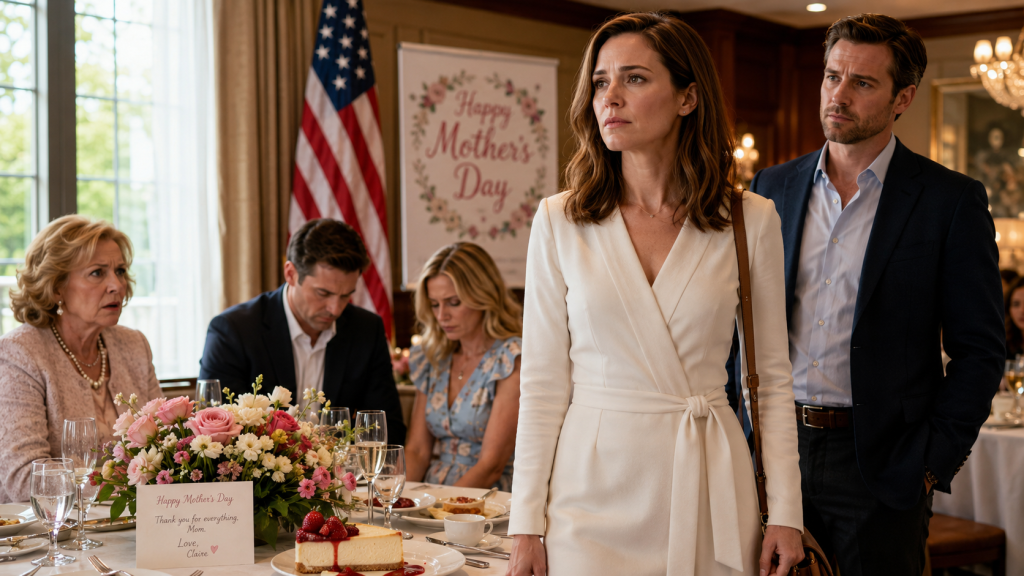
I remembered standing in that restaurant.
The untouched cheesecake.
Mark’s lowered eyes.
Rachel’s silence.
Mom’s face.
I remembered saying:
Then live like you never had one.
“No,” I said.
She nodded.
“I’m glad.”
I turned toward her.
“Really?”
“Yes.”
She looked down at her hands.
“Because if you hadn’t meant it, I don’t think I ever would have understood what I was doing.”
That was the strange truth.
Walking away had not destroyed my family.
Pretending everything was fine had been destroying it for years.
My leaving simply removed the structure that allowed everyone to avoid seeing the damage.
When I stopped paying, they had to see the bills.
When I stopped fixing, they had to see the problems.
When I stopped absorbing the cruelty, they had to see who was causing it.
And when I stopped accepting apologies without accountability, my mother finally had to decide whether she wanted control or a daughter.
She couldn’t have both.
Neither could I.
For most of my life, I believed love meant staying.
Staying through insults.
Staying through manipulation.
Staying through exhaustion.
Staying because people shared my blood.
Staying because someone might get sick.
Staying because holidays would be awkward.
Staying because neighbors might talk.
Staying because walking away would make me the bad daughter.
I know better now.
Sometimes love means staying.
Sometimes love means helping.
Sometimes love means forgiving.
But sometimes love means standing up from a table where you are being destroyed, picking up your purse, and walking out the door.
Not because you stopped caring.
Because you finally started believing your care should include yourself.
That Mother’s Day, my mother told me she wished she had never had a daughter.
For years, I would have begged her to take it back.
Instead, I gave her exactly what she asked for.
A life without access to me.
And it was only when she experienced that absence that both of us learned an important difference.
Being related to someone gives you a connection.
It does not give you ownership.
Being a mother deserves respect.
It does not grant permission to be cruel.
Being a daughter can include generosity.
It does not require self-erasure.
And forgiveness?
Forgiveness does not mean returning to the same place where you were hurt and pretending the furniture never moved.
Sometimes forgiveness means building an entirely different room.
With different rules.
A door you control.
And people who understand that being allowed inside is a privilege.
The morning after that awful Mother’s Day, my phone rang nonstop because everyone wanted me to fix what my absence had exposed.
A year later, my phone was quieter.
My bank account was healthier.
My marriage was stronger.
My relationship with Mark was more honest.
And my mother, for the first time, knew me as a person instead of a resource.
It wasn’t the ending I would have imagined.
It was better.
Because nobody rescued our family.
Nobody performed some miraculous act that erased the past.
We simply stopped lying about it.
Mom learned that apologies required change.
Mark learned that silence was a choice.
Rachel learned that avoiding conflict could still hurt someone.
I learned that boundaries were not cruelty.
And Ethan reminded me, every day, that love did not have to hurt in order to count.
The following Mother’s Day, Mom came to our house carrying a small potted lavender plant.
No expensive bouquet.
No dramatic card.
No guilt.
She handed it to me at the door.
“For your garden.”
“Thank you.”
Then she hesitated.
“I know you’re not a mother.”
I laughed.
“I had noticed.”
She smiled.
“I just thought maybe today could mean something different.”
“What?”
She looked at me.
“A day when I’m grateful I got to be yours.”
My throat tightened.
For a moment, neither of us spoke.
Then I hugged her.
Not because I had forgotten.
Not because everything was healed.
Not because she was my mother and therefore entitled to it.
I hugged her because I wanted to.
And that made all the difference.
Later that evening, after everyone left, I planted the lavender near the back porch.
Ethan came outside carrying two glasses of iced tea.
“You okay?”
I pressed soil around the roots.
“Yeah.”
He handed me a glass.
“Good Mother’s Day?”
I smiled.
“Better.”
We stood together beneath the fading Carolina sky.
My phone was silent inside the house.
No emergency.
No demands.
No guilt.
Just quiet.
For years, silence had terrified me because it meant someone was probably angry.
Now it meant peace.
I looked at the little lavender plant and thought about how strange rebuilding can be.
You don’t restore everything.
Some things shouldn’t be restored.
Sometimes you prune.
Sometimes you remove what has rotted.
Sometimes you move something into better soil and give it room to become different.
And sometimes, against every expectation, something new grows where the old thing ended.
My mother once told me she wished I had never been her daughter.
I believed her.
I walked away.
And because I did, she eventually learned that having a daughter was never the same thing as possessing one.
More importantly, I learned that being someone’s daughter never required me to disappear.
That was the lesson I carried forward.
Not revenge.
Not money.
Not the satisfaction of watching everyone panic when the payments stopped.
Freedom.
The freedom to help because I choose to.
To forgive when change is real.
To leave when respect disappears.
To return only when returning is safe.
And to never again confuse being needed with being loved.
Sometimes the sentence that breaks a family is also the sentence that finally forces it to become something healthier.
In our case, it began with six words.
“I wish you’d never been my daughter.”
And my answer changed everything.
“Then live like you never had one.”
For a while, she did.
And when we finally found our way back to each other, neither of us returned as the people we had been before.
That was the only reason it worked.
💬THE END! THANK YOU FOR READING!