
My Ex-Husband Invited His “Childless” Former Wife to Christmas Dinner at His Family Estate, Convinced Everyone Would See the Lonely Woman He Had Left Behind. He Expected Me to Arrive Alone. But What He Never Imagined Was a Military Helicopter Landing Right Outside the Estate…
The sound came from beyond the western ridge. At first, it was only a distant vibration beneath the Christmas music drifting from the open front doors.
Then the vibration grew into a heavy rhythmic thunder. Whump.
Whump.
Whump.
Every conversation on the front terrace stopped.
Guests turned toward the snow-covered fields beyond the estate.
Grant lowered his champagne glass.
His fiancée, Vanessa, looked toward the sky.
Even the boys forgot about the enormous house behind us.
Mason pointed.
“Mom.”
“I see it.”
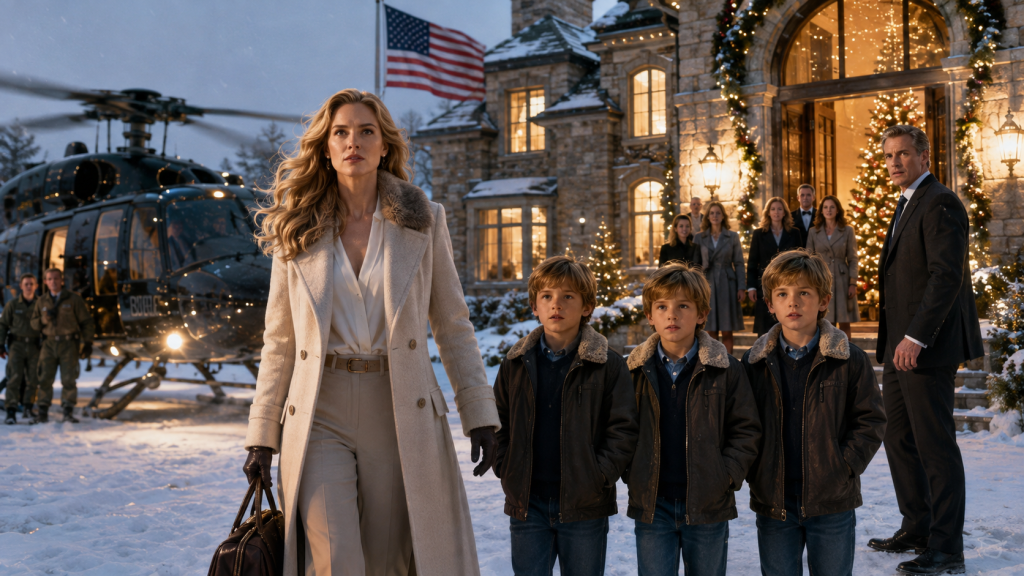
A military helicopter appeared above the tree line.
Dark against the pale winter sky, it moved steadily toward the Ashford property before circling once over the broad field beside the estate.
The reaction around us was immediate.
Several retired officers straightened instinctively.
Grant’s father, Colonel Richard Ashford, stepped away from the doorway and stared upward.
“What in the world?”
The aircraft descended.
Snow exploded outward beneath the rotor wash.
Guests covered their faces.
Loose powder raced across the lawn in white clouds while Christmas ribbons tied around the fence posts snapped violently in the wind.
Carter moved closer to me.
Owen grabbed my hand.
I squeezed his fingers.
Grant finally looked at me.
Not at the helicopter.
At me.
There was something different in his expression now.
The smug amusement he had worn when I arrived was gone.
He knew.
Or at least part of him knew.
The helicopter settled onto the landing area nearly two hundred yards from the main house.
The rotors continued turning.
A side door opened.
A tall man in uniform stepped down.
Then another.
And another.
The first man removed his flight helmet.
Lieutenant Colonel Nathaniel Brooks.
My older brother.
Uncle Nate to the boys.
The person who had been present for almost every major moment of their lives.
Grant stared at him.
Nate had served with Grant years earlier.
They knew each other.
More importantly, Grant knew exactly what Nathaniel Brooks represented.
My brother crossed the snowy field toward us while the helicopter powered down behind him.
Mason grinned.
“Uncle Nate!”
All four boys took off running.
“Careful!” I called.
Too late.
They raced across the snow.
Nate dropped to one knee just as they reached him.
Four children collided with him at once.
He laughed and wrapped his arms around them.
For a moment, the Ashford estate disappeared.
The guests disappeared.
Grant disappeared.
There was only my brother surrounded by four boys shouting over each other.
“You actually came!”
“You said you couldn’t!”
“Did you fly that?”
“Can we sit inside?”
Nate laughed.
“One question at a time, gentlemen.”
He stood and looked toward me.
Our eyes met.
I smiled.
“You’re dramatic.”
“Says the woman who brought quadruplets to an Ashford Christmas.”
That word traveled through the crowd like electricity.
Quadruplets.
Someone repeated it quietly.
Then someone else.
Grant’s mother, Margaret Ashford, gripped the railing.
“Quadruplets?”
The boys came running back toward me with Nate behind them.
Grant had not moved.
He looked from Carter to Mason.
Mason to Reid.
Reid to Owen.
Then back again.
His face had lost almost all color.
It was impossible not to see him in them.
I had spent years noticing those similarities.
Carter had Grant’s eyes.
Mason had the same crooked smile.
Reid had Grant’s habit of tilting his head when concentrating.
Owen had the exact small indentation in his chin that appeared in nearly every Ashford family photograph.
But standing there together?
It was overwhelming.
Four boys.
Four versions of the man staring at them.
Grant finally spoke.
His voice was barely audible.
“How old are they?”
Carter answered before I could.
“Eight.”
Grant swallowed.
His father looked sharply toward him.
Margaret’s hand rose slowly toward her mouth.
Vanessa stared between us.
Grant looked at me.
“Eight?”
“Yes.”
His eyes narrowed as though refusing to perform the calculation he had already completed.
“When is their birthday?”
“August nineteenth.”
The glass slipped from Grant’s hand.
It landed in the snow without breaking.
Nobody moved to pick it up.
His father stepped down one stair.
“Grant.”
Grant ignored him.
His entire attention remained fixed on me.
“You said you were pregnant.”
“Yes.”
“You said one baby.”
“I knew I was pregnant when I told you. I didn’t know there were four yet.”
His mother made a broken sound.
Grant shook his head.
“No.”
It was exactly the same word he had said eight years earlier.
No.
Back then, we had been standing in the kitchen of our small rental house near Fort Carson.
I had been holding a positive pregnancy test.
Grant had been holding divorce paperwork.
Our marriage had already been deteriorating for months.
Deployment stress.
Ambition.
His family’s constant pressure.
His growing friendship with someone from his unit that he insisted was “nothing.”
Then, finally, his announcement that he wanted out.
I had taken the test that morning because I had been exhausted and nauseated for days.
I remember staring at those two lines until my vision blurred.
For almost an hour, I had believed the news might change something.
Not save a broken marriage.
But at least make Grant stop.
Think.
Listen.
Instead, he laughed.
Not because he thought pregnancy itself was funny.
Because he thought I was lying.
“You expect me to believe this now?” he had said.
I placed the test on the counter.
“You don’t have to believe me. I’m telling you the truth.”
“Convenient timing.”
“I didn’t choose the timing.”
“You always wanted kids.”
“So did you.”
“Not like this.”
I remember the shame of that moment.
The disbelief.
The humiliation of realizing the person I had loved considered me capable of inventing a pregnancy to trap him.
I had offered to show him the appointment information.
He refused.
He told me he didn’t want another performance.
Then he walked out.
Three weeks later, the ultrasound technician went silent.
For one terrifying second, I thought something was wrong.
Then she smiled.
“You might want to take a deep breath.”
I gripped the edge of the examination table.
“What?”
She turned the monitor slightly.
“One.”
She pointed.
“Two.”
Another tiny shape.
“Three.”
My heart seemed to stop.
Then she pointed again.
“And four.”
I laughed.
Then cried.
Then laughed again.
My brother had been waiting in the parking lot.
When I climbed into his truck, I handed him the ultrasound photo without speaking.
Nate looked at it.
Looked at me.
Looked back at it.
Then said, “Is this four?”
I nodded.
He stared through the windshield for about ten seconds.
Then he started laughing so hard he hit the steering wheel.
Not because it was funny.
Because sometimes life becomes so enormous that laughter is the only place for the shock to go.
Grant never came to an appointment.
Not one.
My attorney sent notice of the pregnancy during the divorce proceedings.
Grant’s attorney responded that paternity would be addressed after birth.
Then Grant deployed for training.
By the time the boys arrived prematurely at thirty-two weeks, I had stopped expecting him to appear.
They were tiny.
Carter weighed three pounds, eleven ounces.
Mason three pounds, nine ounces.
Reid three pounds, six ounces.
Owen barely three pounds.
For weeks, my world became incubators, monitors, tiny knitted hats, pumping schedules, hospital cafeterias, and prayers whispered at two in the morning.
Nate visited whenever duty allowed.
My parents came.
Friends brought meals.
Nurses became family.
Grant never came.
I sent one message after the birth.
Four sons.
Born August 19.
Everyone stable.
He never replied.
Several months later, through attorneys, his side requested proof.
We provided medical records.
Then came questions.
Suspicion.
Suggestions that the children might not be his.
Eventually, I stopped participating in what felt like a trial where motherhood itself was being cross-examined.
The divorce finalized.
I relocated.
Grant signed documents acknowledging notice of the births but did not pursue custody or visitation.
His family, from what I later learned, was told a different version.
That I had claimed pregnancy during the divorce.
That nothing had ever been confirmed.
That perhaps there had been a miscarriage.
That perhaps there had never been a pregnancy at all.
Grant apparently allowed uncertainty to harden into fiction.
And I was too exhausted raising four premature babies to travel around correcting every relative who had decided to believe him.
Now eight years of fiction were standing in the snow wearing matching coats.
Grant took one step toward the boys.
Carter moved slightly in front of his brothers.
That tiny protective movement hit me harder than anything else.
Grant saw it too.
He stopped.
“What are their names?”
I looked at the boys.
They had every right to answer for themselves.
Carter spoke first.
“Carter Brooks.”
Grant flinched slightly at my last name.
“Mason Brooks.”
“Reid Brooks.”
Owen hesitated.
Then lifted his chin.
“Owen Brooks.”
Grant stared at them.
“My sons?”
The question made something inside me turn cold.
I answered carefully.
“Biologically, yes.”
Margaret descended the stairs.
She moved slowly, as though afraid any sudden motion might wake her from a dream.
She looked at Carter.
Then Mason.
Then Reid.
Then Owen.
Tears filled her eyes.
“My grandsons?”
Carter looked at me.
I nodded once.
Margaret covered her mouth.
“Oh my God.”
Colonel Ashford came down behind her.
Richard had always been difficult to read.
Even when Grant and I were married, he had rarely shown emotion openly.
He had spent thirty-six years in the Army.
He spoke in complete sentences.
He ironed jeans.
He considered arriving five minutes early dangerously close to late.
But when he reached the bottom step and saw the boys closely, his expression cracked.
He looked at Owen.
Then at a photograph visible through the open doorway behind us.
The photograph showed Richard himself at approximately eight years old, standing beside his father.
Same chin.
Same eyebrows.
Same ears.
Richard closed his eyes briefly.
Then he looked at Grant.
“What did you tell us?”
Grant’s jaw tightened.
“Dad—”
“What did you tell us?”
Guests began quietly moving away.
Not leaving.
Just creating distance.
Nobody wanted to appear as though they were listening.
Everybody was listening.
Vanessa finally spoke.
“Grant?”
He turned toward her.
She looked pale.
“You told me she lied about being pregnant.”
Grant rubbed one hand over his face.
“I thought she did.”
“You told me there was no child.”
“I didn’t know.”
I laughed once.
I couldn’t help it.
Grant looked at me.
“You didn’t know?”
His voice hardened.
“You disappeared.”
“No, Grant. I relocated after the divorce. My attorney had my address. Your attorney had my address. The hospital records existed. Birth certificates existed. You had every opportunity to know.”
“You never called me.”
“I did.”
He opened his mouth.
I continued.
“I called after the ultrasound.”
Grant froze.
His mother looked at him.
“You called?”
“Yes. Twice. He blocked my number shortly afterward.”
Grant looked toward the ground.
I remembered those calls.
The first had gone unanswered.
The second went to voicemail.
I left a message.
Grant, there are four babies.
I know you’re angry.
I know you don’t believe me.
But there are four.
Please call.
He never did.
Richard stared at his son.
“You blocked her?”
Grant’s voice lowered.
“I was trying to move on.”
Margaret stepped backward as though the words physically struck her.
“From your pregnant wife?”
“We were divorcing.”
“She was carrying your children!”
“We didn’t know they were mine.”
Nathaniel finally stepped forward.
His expression was controlled.
Dangerously controlled.
Grant noticed him.
“Nate.”
My brother gave a short nod.
“Grant.”
“You knew?”
“From the beginning.”
“You could’ve told me.”
Nate’s eyes narrowed.
“I did.”
Silence.
Grant stared at him.
“What?”
“I sent you an email when they were in the NICU.”
Grant’s face changed.
Nate continued.
“I sent photographs. Their weights. Their condition. I told you Elise nearly died from complications after delivery.”
Margaret looked at me sharply.
“You nearly died?”
“It was a difficult delivery.”
That was an understatement.
Blood loss.
Emergency surgery.
Three days before I could stand without help.
A week before I could hold all four boys at once.
I had never wanted their birth story defined by fear, so I rarely spoke about that part.
Nate looked back at Grant.
“You answered my email.”
Grant’s mouth opened.
No words came.
Richard asked, “What did he say?”
Nate held Grant’s gaze.
“Stay out of my divorce.”
The silence afterward felt heavier than the snow clouds above us.
Vanessa slowly removed her engagement ring.
Grant noticed.
“Vanessa.”
She stared at the ring in her palm.
“You told me she fabricated everything.”
“I believed that.”
“After photographs?”
“I thought Nate was taking her side.”
Nathaniel almost laughed.
“Four newborn babies were not a side, Grant.”
“I was angry.”
“You were a coward.”
“Nate.”
“No.”
My brother stepped closer.
“I’ve stayed out of this for eight years because Elise asked me to. She didn’t want those boys growing up surrounded by conflict. She never asked your family for money. She never demanded attention. She built a life.”
His voice remained calm.
“That doesn’t erase what you chose.”
Grant looked at the boys.
Owen had moved beside Mason.
Reid stared toward the helicopter.
Carter watched everything.
Too much.
I realized then that we had crossed a line.
Whatever Grant deserved to hear, my sons did not deserve to stand in the snow listening to adults reconstruct the worst year of their mother’s life.
I touched Carter’s shoulder.
“That’s enough.”
Richard looked at me.
“Elise—”
“The boys are cold.”
Margaret immediately reacted.
“Yes. Of course. Please. Come inside.”
I looked at the four faces beside me.
“Do you still want to?”
Carter considered the house.
Then his grandparents.
Then Grant.
“Yes.”
Mason nodded.
“Me too.”
Reid shrugged.
Owen whispered, “Is there hot chocolate?”
Margaret laughed through her tears.
“Yes.”
Owen considered this carefully.
“Then yes.”
For the first time that evening, everyone smiled.
We entered the house.
The Ashford estate looked almost unchanged from the last time I had visited nine years earlier.
The same broad staircase.
The same oil painting of Grant’s great-grandfather in uniform.
The same grandfather clock beside the library.
The same enormous fireplace built from Colorado stone.
But I had changed.
That made the place feel smaller somehow.
Guests resumed their conversations carefully.
Nobody asked questions immediately.
Margaret disappeared toward the kitchen with the boys.
Within minutes, she had marshmallows, whipped cream, cookies, and four mugs lined up like a military supply operation.
Richard stood near them pretending not to stare.
The boys noticed everything.
The photographs fascinated them most.
Carter pointed toward one.
“That’s you?”
Richard stepped closer.
The picture showed him as a young lieutenant.
“Yes.”
“You were really skinny.”
Richard blinked.
Then laughed.
“I suppose I was.”
Mason pointed toward another photograph.
“Is that Dad?”
The word Dad stopped the room.
Mason realized what he had said.
He looked at me.
Then Grant.
His face reddened.
“I mean…”
Grant stared at him.
It was the first time any of the boys had used that word in connection with him.
I knelt beside Mason.
“You don’t have to call anyone anything you don’t want to.”
He nodded.
Grant looked away.
The boys had never lacked father figures.
Nate.
My father before his death.
Coaches.
Teachers.
Friends.
I had never lied to them about Grant.
I told them their biological father and I had divorced before they were born.
As they became older, I added pieces.
He had not believed the pregnancy.
He had not been part of their lives.
I had always promised to answer questions honestly when they were ready.
Carter had become ready first.
That was why the invitation mattered.
Why I had accepted.
Not for revenge.
Not really.
I had spent years thinking Grant deserved consequences.
Eventually, I realized life was already giving them to him.
He had missed first words.
First steps.
First teeth.
First days of school.
Christmas mornings.
Birthday candles.
Broken arms.
Science fairs.
Soccer games.
Nightmares.
Bedtime stories.
Every ordinary miracle.
Nothing I could say at his family estate would equal what he had already lost.
The dining room opened at six.
Margaret had planned formal seating.
That arrangement collapsed almost immediately.
She insisted the boys sit near her and Richard.
The four of them looked suspiciously at the elaborate table settings.
Owen whispered to Reid, “Why are there three forks?”
Reid whispered back, “Different foods.”
“What if I use the wrong one?”
“Then probably jail.”
I covered a laugh with my napkin.
Richard heard them.
He leaned over.
“Gentlemen.”
They looked at him.
“Use whichever fork you want.”
Owen looked relieved.
“So no jail?”
Richard frowned.
“Not for forks.”
The boys relaxed.
Dinner began awkwardly.
Grant sat across from me.
Vanessa had taken a seat farther down the table near her sister.
She had not put the engagement ring back on.
Grant noticed.
Repeatedly.
The family chaplain offered grace.
He thanked God for family gathered together.
For unexpected blessings.
For truth.
At that word, Margaret began crying again.
Carter slid a tissue toward her.
She smiled.
“Thank you, sweetheart.”
“You’re welcome.”
After grace, food moved around the table.
Turkey.
Ham.
Roasted vegetables.
Potatoes.
Stuffing.
Dinner rolls.
The boys slowly became themselves.
Mason told Richard about baseball.
Reid described a science project involving magnets.
Owen announced that he was currently the best reader in his class, which prompted Carter to correct him.
“You’re tied with Amelia.”
“That still counts.”
“It literally doesn’t.”
Margaret laughed.
She looked younger when she laughed.
For years, I had imagined how she might react if she knew.
Anger.
Denial.
Blame.
I had not imagined this.
Grief.
She was grieving eight missing years in real time.
Every question revealed another loss.
“Did they walk early?”
“Carter did.”
“Who lost the first tooth?”
“Mason.”
“Any allergies?”
“Reid has mild seasonal allergies.”
“Who broke an arm?”
The boys all pointed at Owen.
Owen protested.
“The tree broke my arm.”
“You fell out of the tree,” Carter said.
“The branch failed structurally.”
Richard coughed into his napkin to hide a laugh.
Grant barely ate.
He watched them.
Every story was another door opening onto a room he had never entered.
Finally, he spoke.
“What school do you attend?”
Carter answered.
“Mountain Ridge Academy.”
Grant nodded.
“What grade?”
“Third.”
“All four?”
Mason stared at him.
“We’re the same age.”
Reid kicked him lightly beneath the table.
“What?”
Dinner continued.
After dessert, the guests moved into the great room.
A pianist began playing carols.
Several children gathered near the Christmas tree.
Margaret asked if she could give the boys gifts.
I hesitated.
“You bought gifts for them?”
“No.”
Her face fell.
“Of course I didn’t. I didn’t know.”
Then she looked toward a side table filled with wrapped boxes for nieces, nephews, cousins, and family friends.
“I have some things that might work, but I don’t want them to feel like an afterthought.”
Carter heard.
“It’s okay.”
Margaret looked at him.
“We didn’t come for presents.”
That nearly broke her.
She pulled him into a hug.
Carter stiffened at first.
Then hugged her back.
Richard turned away and stared into the fireplace.
I pretended not to notice him wiping his eyes.
Grant approached me near the library doors.
“Elise.”
I looked at him.
“Can we talk?”
I glanced toward the boys.
Nate stood nearby.
He caught my eye.
I nodded.
Grant and I entered the library.
He closed the door halfway.
Not fully.
I appreciated that.
For a moment, neither of us spoke.
The library smelled like cedar and old books.
Grant walked toward the window.
“I don’t know what to say.”
“That’s new.”
He almost smiled.
Almost.
Then his expression collapsed again.
“Why didn’t you make me understand?”
The question stunned me.
“Excuse me?”
“I mean…”
He rubbed his forehead.
“If there were four babies, why didn’t you come here? Why didn’t you tell my parents?”
“Because I was pregnant with quadruplets while going through a divorce.”
“I know.”
“No, you don’t.”
My voice remained quiet.
“I was hospitalized twice before delivery. I was working until my doctor ordered me to stop. I was fighting an insurance issue. I was trying to find housing. Then four premature babies spent weeks in intensive care.”
Grant looked down.
“I did not have the energy to conduct a public relations campaign convincing the Ashford family I wasn’t a liar.”
He leaned against the desk.
“My mother would’ve helped.”
“Your mother believed you.”
“She would’ve listened.”
“Maybe.”
I took a breath.
“But I wasn’t responsible for making your parents investigate their adult son’s choices.”
Grant nodded slowly.
“You’re right.”
That surprised me.
He sat in the chair behind the desk.
For the first time that night, he looked less like Major Grant Ashford.
Less like the polished officer.
Less like the man who had invited his ex-wife to Christmas because he expected her presence to flatter his new life.
He looked like a tired forty-year-old man realizing eight years could not be recovered.
“Are they healthy?”
“Yes.”
“All four?”
“Yes.”
“Any complications?”
“Early ones. Nothing major now.”
He nodded.
“Do they…”
He stopped.
“Do they hate me?”
I considered lying.
I didn’t.
“They don’t know you well enough to hate you.”
That hurt him more.
I could see it.
“They’ve asked questions.”
“What do you tell them?”
“The truth appropriate for their age.”
“Which is?”
“That you and I divorced before they were born. That you didn’t believe I was pregnant. That you have not been part of their lives.”
Grant looked toward the doorway.
“I sound terrible.”
“You want me to change the facts?”
“No.”
He rubbed both hands over his face.
“No.”
Voices drifted from the great room.
Owen laughing.
Mason shouting about something.
Grant closed his eyes.
“I missed everything.”
“Yes.”
“First steps.”
“Yes.”
“Birthdays.”
“Yes.”
“School.”
“Yes.”
He swallowed.
“Everything.”
I didn’t answer.
He already knew.
After a long silence, he said, “I want to know them.”
That was the sentence I had expected.
And feared.
I walked toward the fireplace.
“You don’t get to decide that tonight.”
“I’m their father.”
“Biologically.”
He flinched.
“You said that outside.”
“Because fatherhood is more than genetics.”
“I know.”
“Do you?”
“Yes.”
His voice sharpened.
Then he stopped himself.
He took a breath.
“I’m trying to.”
I studied him.
He did look changed.
But regret was not transformation.
A dramatic revelation at Christmas did not erase eight years.
“I won’t prevent them from knowing you if they want to.”
Grant looked up.
Hope flashed across his face.
I raised a hand.
“But it happens slowly.”
He nodded.
“With a family counselor.”
“Okay.”
“No surprise visits.”
“Okay.”
“No promises you can’t keep.”
“Okay.”
“No forcing them to call you Dad.”
Grant looked down.
“Okay.”
“And if they say stop, we stop.”
He hesitated.
Then nodded.
“Yes.”
I looked directly at him.
“They are not a second chance for you, Grant. They are four individual children. Their emotional safety matters more than your guilt.”
He absorbed that.
“You’ve thought about this.”
“For eight years.”
A knock sounded on the door.
Margaret stood outside.
“Elise?”
“Yes?”
“There’s something you should see.”
We followed her into the hallway.
Richard stood beneath the large Ashford family portrait wall.
Several relatives had gathered nearby.
One frame had been removed.
Grant noticed immediately.
“What are you doing?”
Richard looked at him.
“Correcting something.”
He held a framed photograph.
The picture had been taken three months earlier.
Me standing behind the boys during a hiking trip.
All four were grinning.
Nate must have sent it to him.
I looked at my brother.
He lifted both hands.
“Your mother asked.”
Margaret took the photograph.
She placed it temporarily in the empty space.
Among generations of Ashfords.
Officers.
Pilots.
Nurses.
Parents.
Children.
Four new faces joined them.
Richard looked at the boys.
“This wall is family.”
Grant stared at the photograph.
His father continued.
“For years, this house has been full of stories about duty.”
Richard’s voice became firm.
“Apparently we forgot that duty begins with truth.”
Grant lowered his head.
Nobody spoke.
Vanessa appeared near the staircase.
She still held the engagement ring.
“Grant.”
He turned.
“Can we talk?”
They went into the sitting room.
I tried not to listen.
I genuinely did.
But the estate carried voices.
“You made me part of this.”
Vanessa’s words were quiet but clear.
“I didn’t know.”
“You knew enough.”
“Vanessa—”
“You invited her tonight to humiliate her.”
Silence.
That was confirmation.
I had suspected.
Now I knew.
Vanessa continued.
“You told me she would come alone.”
Grant said something too low to hear.
“You wanted your family to see how happy you were compared with her.”
My stomach tightened.
Not because it surprised me.
Because hearing cruelty spoken plainly always lands differently.
“You made me participate without telling me.”
“I’m sorry.”
“You’re sorry because it failed.”
“That’s not fair.”
“No, Grant. What wasn’t fair was bringing your former wife here as entertainment.”
The room around us became very quiet.
Vanessa stepped back into the hallway several minutes later.
She looked at me.
“I owe you an apology.”
“You didn’t know.”
“I knew enough to understand he was trying to prove something.”
She looked ashamed.
“I came anyway.”
I nodded.
“You’re allowed to make your own decision about what that means.”
She looked toward the ring in her hand.
“I already have.”
Grant emerged behind her.
“Vanessa.”
She placed the ring on a side table.
Not dramatically.
No speech.
No slap.
Just a small click of metal against wood.
“I need time.”
Then she walked upstairs to collect her coat.
Grant stood frozen.
His mother looked at him.
“You planned this?”
He didn’t answer.
Margaret’s face hardened.
“Grant.”
“Yes.”
One word.
The truth.
Richard closed his eyes.
“You invited the mother of your children to Christmas dinner so you could humiliate her?”
“I didn’t know about the boys.”
“That makes it better?”
“No.”
Margaret’s voice shook.
“She could have arrived alone and still deserved kindness.”
Grant nodded.
“Yes.”
“You were raised better.”
“I know.”
Richard looked at him for several seconds.
“Do you?”
Grant did not reply.
The boys had moved to the far side of the room with Nate.
They were pretending not to listen.
Again.
Too much adult damage in one evening.
I walked toward them.
“Coats.”
Mason looked surprised.
“We’re leaving?”
“Yes.”
Owen looked at the dessert table.
“Can I take a cookie?”
Margaret immediately appeared with an entire tin.
“All of them.”
I laughed.
“Margaret.”
“What?”
“Owen does not need forty cookies.”
Owen raised his hand.
“I disagree.”
Richard laughed.
Even Grant smiled faintly.
Margaret reduced the cookie count to eight.
A diplomatic compromise.
Outside, the temperature had dropped.
The helicopter remained in the field.
Nate had arranged the flight as part of a scheduled training route and had received authorization for the brief landing.
The boys were still fascinated.
“Can we fly back with Uncle Nate?” Mason asked.
“No.”
“Why?”
“Because I enjoy having control over my blood pressure.”
Nate grinned.
“Maybe another time.”
Richard and Margaret walked us toward the SUV.
Grant followed several steps behind.
At the car, Margaret turned toward me.
“Elise.”
Her eyes filled again.
“I am so sorry.”
“You didn’t know.”
“I should have.”
I shook my head.
“You trusted your son.”
“That doesn’t mean I shouldn’t have asked questions.”
She looked at the boys climbing into the vehicle.
“May we see them again?”
I paused.
“They should decide how quickly this goes.”
Margaret nodded.
“Of course.”
“But I’m not closing the door.”
She exhaled.
“Thank you.”
Richard shook my hand.
Then apparently decided that was too formal and pulled me into an awkward hug.
I smiled against his shoulder.
“You’ve gotten sentimental, Colonel.”
“Absolutely not.”
“Obviously.”
He released me.
Then he crouched slightly beside Carter.
“It was an honor meeting you.”
Carter studied him.
“Are you always this formal?”
Richard blinked.
“No.”
Margaret answered for him.
“Yes.”
Carter grinned.
Richard sighed.
“I’m surrounded.”
Finally, Grant approached.
The boys became quiet.
He stopped several feet away.
“Merry Christmas.”
Carter looked at his brothers.
Then said, “Merry Christmas.”
Mason repeated it.
Reid too.
Owen waved.
Grant’s face softened.
He looked at me.
“Thank you for coming.”
I thought about the invitation.
His motives.
The helicopter.
The stunned faces.
The truth spreading through the estate.
“I almost didn’t.”
“I’m glad you did.”
“So am I.”
And strangely, I meant it.
Not because Grant had been embarrassed.
Not because Vanessa had removed her ring.
Not because the Ashford family finally knew I had told the truth.
I was glad because my sons had seen something important.
They had seen that adults could be wrong.
Families could fail.
Truth could be delayed.
And still, none of those things had to determine their worth.
We drove away shortly after eight.
Snow began falling harder.
The estate disappeared behind us.
For several minutes, nobody spoke.
Then Mason said, “That was weird.”
Reid nodded.
“Very.”
Owen opened the cookie tin.
“Good cookies though.”
Carter looked out the window.
“What do you think?” I asked him.
He considered.
“Grandma Margaret cries a lot.”
“She had a surprising evening.”
“Grandpa Richard talks like a principal.”
“That’s accurate.”
“Grant…”
He paused.
I waited.
“I don’t know.”
“You don’t have to.”
Carter nodded.
“Can we see Grandma and Grandpa again?”
“If you want.”
He looked at his brothers.
Mason nodded.
Reid nodded.
Owen’s mouth was full.
He gave a thumbs-up.
And so, slowly, we did.
The first visit after Christmas happened in February.
Neutral territory.
A restaurant.
Margaret arrived forty minutes early.
Richard brought four books.
Not random books.
He had called me beforehand to ask what each boy liked.
Carter received a book about aviation history.
Mason got one about baseball.
Reid received a science encyclopedia.
Owen got an illustrated book about wild animals.
He had written a short note inside each.
No speeches.
No pressure.
Just:
I hope we get many years to know one another.
Grandpa Richard.
The boys kept those books.
Even after the covers wore down.
Grant did not attend that first visit.
That had been intentional.
The grandparents needed their own relationship with the children.
Grant began counseling.
At first, alone.
Later, I joined two sessions.
Then Carter agreed to one.
The counselor explained that Grant’s guilt belonged to Grant.
Not to the boys.
Their job was not to forgive him.
Not to comfort him.
Not to repair anything.
Their only job was to decide what relationship, if any, felt safe.
Grant listened.
I will give him credit for that.
The first time he met the boys again, outside the chaos of Christmas, was at a park.
He arrived early.
No uniform.
No gifts.
No grand gesture.
Just coffee for himself and four footballs in the trunk, which he wisely left there until they asked to play.
For twenty minutes, conversation was painfully awkward.
Then Owen asked, “Were you good at math?”
Grant blinked.
“Yes.”
“How good?”
“Pretty good.”
Owen pulled a worksheet from his backpack.
“You can prove it.”
That broke the tension.
Grant laughed.
They spent half an hour arguing about fractions.
Mason eventually pulled out the football.
Reid asked Grant about helicopters.
Carter watched.
Always watching.
Trust came slowly.
As it should.
Grant attended a baseball game that spring.
He sat in the back row.
He did not introduce himself as their father.
He did not demand attention.
After Mason hit a double, he looked toward the bleachers.
He saw Grant clapping.
Something shifted.
Tiny.
But real.
Months passed.
Then a year.
The boys eventually began calling him Grant openly.
Owen once accidentally called him Dad while asking for a drink during a hiking trip.
Everyone froze.
Owen looked horrified.
Grant simply handed him the water bottle.
“Here.”
No celebration.
No claim.
No pressure.
Later, Owen used Grant again.
And that was okay.
Two years after that Christmas, Carter chose Dad.
Not because anyone requested it.
Because one afternoon Grant showed up during a snowstorm after Carter called saying he needed help with a school engineering project.
Grant drove almost an hour.
They worked until midnight.
When Grant left, Carter stood at the door and called,
“Thanks, Dad.”
Grant stopped on the porch.
He did not turn around immediately.
When he finally did, his eyes were wet.
“You’re welcome.”
Then he went to his truck and cried where Carter couldn’t see him.
I knew because he admitted it later.
Mason followed eventually.
Then Reid.
Owen took the longest.
That surprised everyone except me.
The most cheerful children are sometimes the most cautious with their deepest feelings.
He called Grant Dad for the first time nearly four years after that Christmas.
By then, it no longer felt dramatic.
It felt earned.
Vanessa did not marry Grant.
They ended their engagement permanently several weeks after Christmas.
I heard through Margaret that Vanessa later married someone else.
I was glad for her.
Grant remained single for several years.
Whether that was guilt, choice, or coincidence, I never asked.
Our relationship became something I once would have considered impossible.
Not friendship exactly.
Not at first.
Cooperation.
Then respect.
Eventually something gentler.
We could sit at a soccer field together.
Discuss school schedules.
Laugh when Mason forgot his cleats.
Argue about screen time.
Coordinate birthdays.
Normal things.
The extraordinary drama faded into ordinary parenting.
That, more than anything, proved change had occurred.
The Ashford family changed too.
Margaret filled eight years of missing photographs as best she could.
She created four albums.
Baby pictures.
First birthdays.
Halloween costumes.
School photos.
I shared copies.
Not because she was entitled to them.
Because the boys wanted her to have them.
Richard added four new frames to the military wall.
Not because he expected the boys to serve.
He made that very clear.
“This wall represents family history,” he told them. “Not career instructions.”
Mason immediately said, “Good, because I’m playing professional baseball.”
Richard answered, “Naturally.”
Reid became fascinated by aviation.
Nate took full responsibility for that.
Owen loved animals.
Carter loved engineering.
None of them became miniature versions of Grant.
That mattered.
They inherited his face.
Some of his mannerisms.
His stubbornness.
His competitive streak.
But they remained completely themselves.
Years later, when the boys were fourteen, Margaret hosted Christmas again at the estate.
By then, the house felt different.
Less like a monument.
More like a home.
There were basketball shoes near the entrance.
Half-finished mugs of cocoa on side tables.
A badly made gingerbread house collapsing near the kitchen.
The boys’ photographs covered an entire section of the hallway.
Grant stood near the fireplace arguing with Reid about whether some aircraft model was historically accurate.
Mason and Richard watched football.
Owen was feeding tiny pieces of turkey to Margaret’s elderly golden retriever beneath the table.
Carter helped Nate repair a broken drone in the library.
I stood near the same staircase where, six years earlier, four eight-year-old boys had walked into a family that did not know them.
Grant joined me.
“You’re thinking.”
“Dangerous habit.”
He smiled.
“What about?”
“That first Christmas.”
His smile faded into something quieter.
“I think about it every year.”
“I know.”
“I was awful.”
“You were.”
He laughed softly.
“Still no sugarcoating.”
“Never promised any.”
He looked around the room.
“I thought I invited you here to prove I’d won.”
I glanced at him.
“I know.”
“I thought you’d walk through that door alone.”
“You were very confident.”
“I was an idiot.”
“That too.”
He smiled.
Then his expression became serious.
“I lost eight years because I cared more about being right than finding out the truth.”
I said nothing.
He looked toward Carter.
“I used to think the punishment was everyone learning what I’d done.”
He shook his head.
“That wasn’t it.”
“No.”
“The punishment was realizing what I missed.”
“Yes.”
He exhaled.
“I’ll never get those years back.”
“No.”
“But I’m grateful you gave me the years after.”
I looked at him.
“I didn’t give them to you.”
He understood immediately.
“The boys did.”
“Yes.”
He nodded.
“You gave me the chance to earn them.”
“That’s closer.”
Across the room, Owen shouted.
“Dad!”
Grant turned automatically.
“What?”
“Grandma says you burned the rolls again.”
Grant frowned.
“I did not burn anything.”
Margaret appeared from the kitchen holding a blackened tray.
“Would you like to revise that statement, Major?”
Everyone laughed.
Grant shook his head.
“I’m surrounded by hostile witnesses.”
Richard raised his glass.
“Evidence appears conclusive.”
The boys laughed louder.
And I stood there smiling.
Not because our story had become perfect.
It hadn’t.
There were arguments.
Missed expectations.
Counseling sessions.
Difficult questions.
Years when the boys struggled with why Grant had not believed me.
Moments when anger returned.
Forgiveness, I learned, was not a door you walked through once.
It was a path.
Some days easier.
Some days steep.
Grant never asked me to erase what happened.
That was probably the most important thing he learned.
He apologized without demanding absolution.
He answered difficult questions even when the answers made him look terrible.
When Carter once asked, “Why didn’t you want us?” Grant did not hide behind excuses.
He said,
“I didn’t know you yet, but I failed you before I knew you. I was angry with your mother, and I let that anger become more important than finding out whether she was telling the truth. That was my failure. Not yours.”
Carter cried.
Grant cried.
I cried later, alone.
Because eight years earlier, I would never have imagined him capable of saying those words.
But people can change.
Not because consequences humiliate them.
Not because everyone discovers their mistakes.
People change when they stop defending the person they used to be.
That Christmas invitation had been intended as a performance.
Grant wanted me seated at his family table as proof of his success.
The lonely former wife.
The childless woman he had left behind.
A symbol.
Instead, four boys walked through the door carrying his face.
A helicopter landed in the snow.
Eight years of carefully preserved assumptions collapsed before dinner.
But the greatest shock was not the arrival.
It was what came afterward.
Truth forced everyone to choose.
Grant could defend himself or take responsibility.
His parents could blame me for the lost years or acknowledge they had accepted an incomplete story.
I could use the moment to punish them or decide what was healthiest for my sons.
The boys could close the door forever or open it carefully.
None of those choices happened once.
They happened repeatedly.
Over years.
That was how a family was built.
Not through blood alone.
Not through names on walls.
Not through medals, tradition, reputation, or perfectly arranged Christmas dinners.
Family was built through showing up.
Through uncomfortable conversations.
Through apologies that did not contain the word but.
Through patience.
Through giving children the freedom to decide who deserved space in their lives.
And through understanding that being related to someone gives you history.
It does not automatically give you a relationship.
Relationships must be earned.
On that later Christmas evening, after dinner, snow began falling outside.
The boys were teenagers now.
Too tall.
Too loud.
Constantly hungry.
Still competitive.
Still close.
Margaret insisted on taking a family photograph.
Everyone complained.
Naturally.
“Near the fireplace,” she ordered.
Richard sighed.
“Yes, General.”
“Richard.”
“Moving.”
People gathered.
Nate stood behind Carter.
Richard beside Mason.
Margaret pulled Owen close.
Reid complained that everyone was blocking him.
Grant stood at the edge.
Then Carter looked toward him.
“Dad.”
Grant turned.
“Get over here.”
Grant hesitated for half a second.
Then joined them.
I stood near the camera.
Margaret waved.
“Elise! What are you doing?”
“Taking the picture.”
“You’re in it.”
I laughed.
“I’m not an Ashford.”
Four voices answered at once.
“Mom.”
Carter rolled his eyes.
Mason pointed beside him.
Reid said, “Seriously?”
Owen added, “Get in the picture.”
Margaret smiled.
“You heard them.”
So I handed the camera to a family friend and joined the group.
Grant stood on one side.
I stood on the other.
The boys filled the middle.
Not a perfect family.
Not a traditional one.
But ours.
The camera flashed.
Somebody blinked.
Owen complained.
We took another.
Then another.
The final photograph became my favorite.
Not because everyone looked elegant.
We didn’t.
Mason was laughing.
Reid had turned his head.
Richard’s tie was crooked.
Margaret was holding the dog.
Grant was looking at the boys instead of the camera.
And I was smiling.
Years later, when someone asked Carter about the strange Christmas when he met half his family, he told the story much more simply than I ever could.
He said,
“We showed up, and everybody found out the truth.”
Then he shrugged.
“And after that, they had to decide what to do with it.”
He was right.
Truth does not automatically heal people.
It simply removes the place where lies were hiding.
What happens next depends on everyone involved.
Grant lost eight years because he refused to believe the truth.
He spent the years afterward proving he finally understood its value.
And me?
I learned that walking into that estate had never been about showing Grant what he had lost.
It was about showing my sons that they had never been something shameful to hide.
They were not evidence in a divorce.
They were not weapons in an argument.
They were not consequences.
They were four extraordinary children who deserved to know where they came from without allowing that history to control where they were going.
That was why, when Grant looked at them on that first Christmas night and asked whether they were his sons, I answered carefully.
Biologically, yes.
Because biology was only the beginning.
Fatherhood came later.
Grandparenthood came later.
Trust came later.
Family came later.
And when it finally came, it was not because of the Ashford name.
It was because people learned to deserve one another.
That night, after the later Christmas gathering ended, I stood outside the estate while snow settled quietly over the same field where the helicopter had landed years earlier.
Grant walked out carrying a box of leftovers.
“Your mother sent enough food for an infantry platoon.”
“My mother fears hunger.”
“She packed three pies.”
“See?”
He placed the box in my SUV.
Inside the house, the boys were still saying goodbye.
I looked across the field.
“Do you remember your face when that helicopter landed?”
Grant groaned.
“Please don’t.”
“It was impressive.”
“I thought the Secretary of Defense was arriving.”
“Instead, you got Nate.”
“Worse.”
My brother’s voice came from behind us.
“I heard that.”
Grant laughed.
Nate joined us.
For a moment, the three of us stood under the falling snow.
People who once could barely exist in the same room.
Now arguing over pie.
Life has a strange sense of symmetry.
Carter came outside first.
Then Mason.
Reid.
Owen.
They piled toward the car.
“Mom, Reid stole my charger.”
“It was in my bag.”
“You put it there.”
“Prove it.”
“Guys.”
Grant shook his head.
“Drive safely.”
Carter nodded.
“See you Wednesday, Dad.”
“Wednesday.”
Mason waved.
Reid was still defending himself.
Owen carried the cookie tin.
Some traditions survived.
I climbed into the driver’s seat.
Before closing the door, I looked once more toward the estate.
Grant stood beside his father.
Margaret waved from the entrance.
Nathaniel raised one hand.
Christmas lights glowed against the snow.
Years earlier, I had nearly deleted an invitation because I knew exactly why it had been sent.
Grant expected a lonely woman.
He expected silence.
He expected the past to arrive exactly the way he had rewritten it.
Instead, the truth arrived with four eight-year-old boys.
And after that, nothing in the Ashford family was ever the same.
Not because a helicopter landed.
Not because dozens of guests witnessed Grant’s shock.
Not because his fiancée removed her ring.
Those were only dramatic moments.
The real change came quietly afterward.
One visit.
One apology.
One baseball game.
One counseling session.
One birthday.
One Christmas.
One earned piece of trust at a time.
Sometimes the most powerful revenge is not revenge at all.
It is living so completely beyond someone’s version of you that the truth no longer needs defending.
I had built a life.
Raised four sons.
Created a home filled with noise, homework, broken furniture, sports equipment, mismatched socks, laughter, and love.
Grant had imagined I remained frozen at the moment he left.
I hadn’t.
I had moved forward.
The boys were proof.
Not of what he had lost.
Of what I had built.
And eventually, when he became worthy of knowing them, they allowed him into that life too.
Not because he was entitled to it.
Because they chose it.
That was the part Grant finally understood.
And that was the part I would never forget.
💬THE END! THANK YOU FOR READING!