
My dad threw my grandmother’s savings passbook into her grave and called it worthless. The very next morning, I walked into the bank carrying that mud-stained little blue book. The teller looked at the account number, turned completely pale, and reached for the phone.
“Manager,” she whispered. “I need you at window four.” Then, after glancing at me again, she added something that made my stomach twist. “And call security.”
My name is Chloe Henderson. I was twenty-seven years old when my grandmother, Margaret Henderson, died. To everyone else, she was Maggie.
To me, she was home.
Grandma Maggie raised me through the years my father was technically present but emotionally absent.
She made chicken noodle soup whenever I was sick.
She sat at the kitchen table helping me with multiplication while my father spent evenings at bars.
When I needed school shoes at eleven, she worked extra hours hemming curtains for neighbors.
When I got accepted to college, she cried harder than I did.
And whenever my father, Richard, became angry, Grandma somehow found a reason for me to sleep at her house.
She never called him dangerous.
She didn’t have to.
Some truths live in the way people lock doors.
Two nights before she died, Grandma was lying in a hospital bed with oxygen beneath her nose.
Her hands looked tiny under the blankets.
I thought she was asleep when her fingers suddenly tightened around mine.
“Chloe.”
“I’m here.”
Her eyes opened.
“Don’t let Richard find the blue book.”
“What blue book?”
“The passbook.”
I knew exactly which one.
A small blue savings passbook she kept wrapped in an embroidered napkin inside an old butter cookie tin beneath her bed.
I had seen it dozens of times growing up.
“Why?”
She struggled for breath.
“Because if he finds it, he’ll destroy what’s left.”
I leaned closer.
“What’s left of what?”
Her eyes filled with tears.
“Your mother.”
My mother, Anna, had supposedly abandoned me when I was three.
At least, that was the story I had been told my entire life.
According to Dad, she ran away with another man.
Grandma never directly contradicted him.
But whenever I asked about Anna, she would become quiet.
“Some stories are told by the person who benefits most from them,” she once said.
I was sixteen then.
I didn’t understand.
At the hospital, Grandma squeezed my hand again.
“Promise me.”
“I promise.”
She died the following morning.
At the funeral, I discovered how serious that promise was.
Oakfield Cemetery was soaked from overnight rain.
My cheap black flats sank into the mud as the pastor finished the final prayer.
My father stood on the opposite side of the open grave.
Richard Henderson was fifty-six, broad-shouldered, silver beginning to show at his temples.
People who didn’t know him thought he was charming.
People who did know him learned to watch his eyes.
My stepmother Susan stood beside him wearing designer sunglasses despite the gray sky.
My half-brother Tyler stared at his phone whenever the pastor wasn’t looking.
Dad had arrived at Grandma’s house the night she died.
By the time I got there, drawers had been opened.
Boxes had been moved.
Her bedroom looked as though someone had searched it.
Then, right before they closed Grandma’s casket, Dad reached inside his coat.
He pulled out the little blue passbook.
My heart stopped.
He had found it.
“There’s your inheritance, Chloe.”
He laughed.
Then he tossed the book onto Grandma’s chest.
It landed among the wilted flowers.
“That thing isn’t worth a dime. Let it rot with the old lady.”
Nobody spoke.
Not my uncles.
Not my cousins.
Not Susan.
She actually laughed.
“Poor Chloe,” she murmured. “Still hoping Grandma left her a treasure.”
Tyler leaned toward me.
“If there’s fifty bucks in it, burgers are on you.”
A few relatives chuckled.
I didn’t.
Because my father was smiling too hard.
If the book truly meant nothing, why had he searched Grandma’s house for it?
Why throw it into the grave instead of simply handing it to me?
Then I remembered Grandma’s words.
Don’t let Richard find the blue book.
When the burial ended, everyone began leaving.
Susan touched my shoulder with two fingers.
“Come on, Chloe.”
I stayed where I was.
Dad called from the path.
“Leave her. She likes playing the grieving orphan.”
His words hit harder than I expected.
Orphan.
My mother gone.
My grandmother dead.
My father standing twenty yards away acting as if I were an inconvenience he had inherited.
I waited until their cars disappeared.
Then I dropped to my knees.
The workers had already thrown several inches of earth over the casket.
I dug with my bare hands.
Mud pushed beneath my nails.
Stones scraped my skin.
I didn’t care.
After several minutes, my fingers touched wet cardboard.
Then leather.
I pulled the passbook free.
Its blue cover was stained dark with mud.
I wiped it against my dress.
On the first page was Grandma’s name.
Margaret Henderson.
Underneath, written in shaky blue ink, was a sentence I had never seen before.
“If Richard says it’s worth nothing, it’s because he already tried to cash it.”
I stopped breathing.
That night, I went to my apartment instead of Dad’s house.
I locked the door.
Then I shoved a chair under the knob.
Under the yellow kitchen light, I opened the passbook.
At first, the entries looked ordinary.
$50.
$120.
$300.
Occasionally $1,000.
Grandma had saved slowly.
Selling pies.
Doing laundry.
Mending clothes.
Cleaning offices.
Then the entries changed.
Large deposits began appearing twenty-four years earlier.
$18,000.
$41,500.
$63,000.
Then withdrawals.
Transfers.
Amounts Grandma could never have spent.
Beside several were handwritten initials.
R.H.
Richard Henderson.
My father.
Between two pages, I discovered a folded letter.
Chloe,
If you’re reading this, forgive me for waiting so long.
Your father didn’t only take money from me.
He tried to take something that belonged to you from the day you were born.
Do not go to the family.
Do not trust Susan.
Go directly to the bank.
Ask about the account marked with the red stamp.
I turned to the final page.
A faded red circle surrounded an account number.
Beneath it was a routing code.
And one more sentence.
Your mother did not abandon you.
I sat in silence until sunrise.
At eight the next morning, I walked into First Community Bank on Main Street wearing the same black dress from the funeral.
The teller’s name was Megan.
She was young, maybe twenty-four.
She gave me a polite smile.
“How can I help you?”
“My grandmother died yesterday.”
“I’m sorry.”
“She asked me to bring this here.”
I placed the passbook on the counter.
Megan opened it.
Typed the number.
Frowned.
Typed again.
Then she stopped blinking.
“Are you a direct relative of Margaret Henderson?”
“I’m her granddaughter.”
“Your full name?”
“Chloe Anne Henderson.”
Her fingers moved across the keyboard.
She looked at me.
Then back at the screen.
“Do you have identification?”
I handed her my driver’s license.
Her face lost its color.
She picked up the phone.
“Manager, I need you at window four.”
She looked at me again.
“And call security.”
My heart started pounding.
“What’s wrong?”
She didn’t answer.
A man in a gray suit appeared less than a minute later.
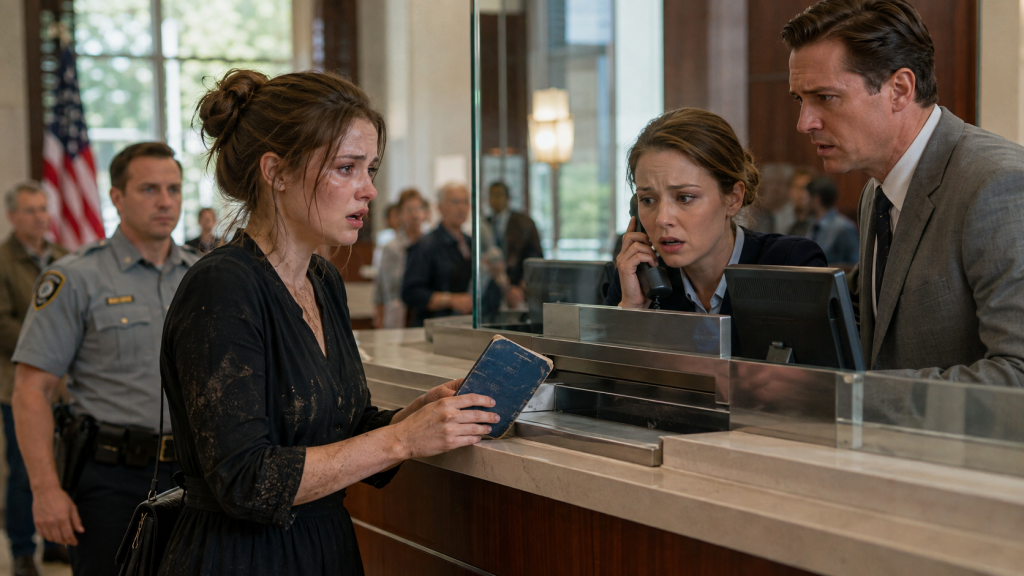
His name tag read DANIEL MORRIS — BRANCH MANAGER.
He closed Megan’s window.
Then he studied the passbook.
My license.
The computer.
Finally, me.
“Ms. Henderson, I need you to remain inside the bank.”
“Am I in trouble?”
“No.”
“Then why did you call security?”
“To keep someone else from reaching you before the police arrive.”
My knees weakened.
“What are you talking about?”
Behind him, Megan whispered:
“It’s her.”
Daniel turned.
She pointed at the monitor.
“The girl from the case file.”
Daniel’s jaw tightened.
“Ms. Henderson, please come with me.”
He led me into a conference room.
A security officer remained outside the door.
Daniel sat opposite me.
“Your grandmother opened this account twenty-four years ago.”
“That’s around when my mother disappeared.”
His expression changed.
“Yes.”
My hands went cold.
“What is this account?”
He folded his hands.
“It isn’t simply a savings account.”
He explained that the passbook corresponded to an old trust arrangement created through the bank’s predecessor.
The original funds had come from my maternal grandfather, Charles Whitmore.
I knew that name.
Barely.
My mother had once told Grandma Maggie that her father was wealthy.
Dad always dismissed it.
“Your mother came from people who thought money made them better than us,” he used to say.
Daniel continued.
Charles Whitmore had died shortly after I was born.
His will created a trust for me.
The original value was approximately $430,000.
I stared at him.
“That’s impossible.”
“Unfortunately, the story becomes more complicated.”
My father had apparently gained limited access to the trust when I was a minor.
Not as owner.
As guardian.
Over several years, he submitted withdrawal requests claiming the money paid for my education, medical treatment, and housing.
But the records contained obvious inconsistencies.
I attended public school.
Grandma paid many of my expenses.
And Dad had bought a lake boat, a pickup, and later a rental property during the same period.
“How much did he take?”
Daniel hesitated.
“According to the internal review, more than $270,000.”
I felt sick.
“That’s why Grandma kept the passbook.”
“She had been challenging transactions for years.”
“Why wasn’t he arrested?”
“Because the bank believed the matter had been resolved through a legal guardianship review.”
“Believed?”
Daniel pushed his glasses higher.
“Six years ago, your grandmother came here claiming documents had been forged.”
My heart began pounding again.
“What documents?”
“Documents supposedly signed by you after your eighteenth birthday, transferring remaining control of the trust.”
“I never signed anything.”
“We know.”
The room became silent.
“What do you mean, you know?”
“Last year, a forensic review discovered discrepancies.”
Someone had signed my name.
Not once.
Several times.
The signatures transferred control over remaining assets into an investment structure linked to Richard Henderson.
“Why didn’t anyone contact me?”
“We tried.”
Letters were sent to an address listed as mine.
It was Dad’s house.
Phone calls went to a number I had never used.
Daniel looked embarrassed.
“Your contact information had been changed in the file.”
“By whom?”
He didn’t need to answer.
I already knew.
Then the conference room door opened.
Two police officers entered with a woman in a dark suit.
She introduced herself as Detective Laura Bennett from the financial crimes unit.
She placed a recorder on the table.
“Chloe, before we continue, I want you to understand something. You are not suspected of committing any crime.”
I nodded.
“Then why am I here?”
“Because we have been investigating your father for eleven months.”
My stomach dropped.
Grandma had started the investigation.
She had brought copies of old statements.
Letters.
Signature samples.
She had even secretly recorded a conversation with my father.
“What conversation?”
Detective Bennett opened a folder.
“Your grandmother accused Richard of stealing from your trust.”
“And?”
“He threatened her.”
The room seemed to grow colder.
“What did he say?”
Bennett hesitated.
“Chloe, this recording may be upsetting.”
“I want to hear it.”
She pressed play.
Grandma’s voice filled the room.
Older.
Shaky.
But unmistakably hers.
“Richard, that money was Anna’s gift to Chloe.”
Then Dad.
“You should’ve stayed out of it.”
“I’ll tell her.”
“You tell Chloe anything and I’ll make sure she thinks you’re losing your mind.”
“She’ll believe me.”
“No. She believes what I’ve told her for twenty years.”
A pause.
Then Grandma:
“Anna didn’t leave willingly.”
I stopped breathing.
Dad’s voice lowered.
“Be careful, Mom.”
The recording ended.
I stared at Detective Bennett.
“What does that mean?”
She exchanged a look with Daniel.
“There’s more.”
“About my mother?”
“Yes.”
I felt as though my entire life had become a room where someone kept opening hidden doors.
Detective Bennett explained that while investigating the trust, they had found correspondence between Grandma Maggie and a private investigator.
Grandma had never stopped looking for Anna.
According to the documents, my mother left my father when I was three.
But she had not abandoned me.
She went to a domestic violence shelter.
My throat closed.
Dad had told everyone Anna ran away with another man.
She hadn’t.
She had been trying to escape him.
Anna filed for temporary custody.
She also contacted a lawyer about protecting my trust.
Three days before the custody hearing, she disappeared.
“What happened to her?”
“We don’t know yet.”
I stood so fast the chair scraped backward.
“No. You don’t get to say that and stop.”
Bennett raised her hands gently.
“We recently found evidence Anna may have survived.”
I stared at her.
“Survived what?”
“Your father told people she left the state. Your grandmother believed something happened to her. But six months ago, investigators located a woman living under another surname in Washington.”
My legs stopped working.
I sat again.
“Is it her?”
“We believe so.”
“Is she alive?”
“Yes.”
That one word shattered me.
My mother was alive.
The woman I had spent twenty-four years believing didn’t want me was alive.
“Why hasn’t she contacted me?”
Bennett’s voice softened.
“Because she believed Richard still controlled your life.”
I shook my head.
“That doesn’t make sense.”
“She was told you hated her.”
“By who?”
Again, nobody needed to answer.
Dad.
Everything came back to him.
Bennett slid a photocopy across the table.
A letter.
Dear Anna,
Chloe knows you left. She doesn’t want contact. Please let her live without reopening old wounds.
It was signed:
Margaret Henderson.
My grandmother.
Except Bennett pointed toward the signature.
“Forensic analysis determined Maggie didn’t write this.”
Dad had forged his own mother’s name.
I covered my mouth.
“Does my mother know?”
“She knows we found you.”
My eyes flooded.
“She knows?”
“She has been afraid to reach out directly.”
“Why?”
“Because your father spent years telling her that any attempt to contact you would result in legal consequences.”
I laughed through tears.
“That’s insane.”
“To someone who had been frightened and isolated for years, it was effective.”
The detective allowed me several minutes.
Then she asked about the funeral.
I told her everything.
Dad finding the passbook.
Throwing it into the grave.
Calling it worthless.
Her expression sharpened.
“He disposed of potential evidence.”
“He didn’t know I’d dig it back up.”
Bennett almost smiled.
“Apparently he underestimated you.”
My phone buzzed.
Dad.
Everyone stared at the screen.
Bennett said, “Answer if you feel comfortable. Put it on speaker.”
My hands trembled as I accepted.
“Hello?”
“Where are you?”
Dad sounded angry.
Not grieving.
Not worried.
Angry.
“I’m out.”
“Don’t play games, Chloe.”
“What do you want?”
“The passbook.”
My pulse jumped.
“What passbook?”
Silence.
Then:
“You dug it up.”
I looked at Bennett.
“How do you know?”
“I went back to the cemetery.”
My skin crawled.
“Why?”
“To make sure everything was handled.”
“You mean buried.”
“Where are you?”
“Why does it matter?”
“Because that book belongs to me.”
Yesterday, he called it worthless.
Now it belonged to him.
I heard Susan in the background.
“Ask if she went to the bank.”
Dad snapped, “Shut up.”
The detective wrote something on a pad.
Dad continued.
“Chloe, listen carefully. Grandma was confused toward the end.”
Exactly what he had threatened to say in the recording.
“She wrote things down that weren’t true.”
“Like what?”
“You know how old people get.”
I felt anger rise through the grief.
“Grandma knew exactly what she was doing.”
His tone changed.
“Come home.”
“No.”
“Don’t make this difficult.”
“For who?”
He became silent.
Then I asked the question I had carried all morning.
“Where is Mom?”
Nothing.
Not even breathing.
Finally:
“What?”
“Anna.”
“Your mother abandoned you.”
“No.”
The word came out stronger than I expected.
“She ran because she was afraid of you.”
Dad’s voice dropped.
“Who have you been talking to?”
I looked at Detective Bennett.
“Goodbye, Dad.”
“Chloe—”
I ended the call.
Less than an hour later, officers obtained authorization to seize records from Dad’s house and business office.
I remained at the bank nearly four hours giving a statement.
Before I left, Detective Bennett stopped me.
“Your mother asked whether she could speak to you.”
I froze.
“Now?”
“If you want.”
My hands started shaking again.
Bennett dialed from her phone.
It rang twice.
Then a woman answered.
“Hello?”
I knew her voice.
Not because I remembered it clearly.
Because some part of me did.
A sound escaped my throat.
“Mom?”
There was silence.
Then sobbing.
“Oh, Chloe.”
I started crying.
She said my name again.
And again.
As though she had waited twenty-four years to be allowed to say it.
Her name was now Anna Morrison.
She lived outside Tacoma.
She had remarried years earlier but never had another child.
She told me she kept every birthday in a journal.
Every Christmas.
Every school year.
“I wondered if you still loved strawberries,” she whispered.
I nearly collapsed.
When I was little, Grandma used to make me strawberry pancakes on my birthday.
“I do.”
Anna cried harder.
Dad had told her I refused every letter.
He sent some back unopened.
Others disappeared entirely.
She eventually believed reaching out would only hurt me.
Grandma secretly reconnected with her three years before she died.
They were planning to tell me everything.
Then Grandma became ill.
“I begged her not to confront Richard alone,” Anna said.
“She was protecting me.”
“She spent her whole life protecting people.”
Two days later, Anna flew to Oregon.
I waited at the airport with Detective Bennett nearby because Dad had been arrested that morning.
The charges were only the beginning.
Financial exploitation.
Forgery.
Fraud.
Evidence tampering.
Other charges would depend on what investigators uncovered.
Susan was questioned too.
Apparently several trust withdrawals had gone into an account she jointly controlled with Dad.
Tyler claimed he knew nothing.
For once, I believed him.
When Anna walked through the airport doors, I recognized her instantly.
Same eyes.
Same chin.
She stopped ten feet from me.
Neither of us moved.
Then she whispered:
“My baby.”
I crossed the distance.
She wrapped her arms around me.
I was twenty-seven years old.
But for several minutes, I felt three.
We cried against each other while strangers walked around us.
There was no magical repair.
Twenty-four years cannot be returned.
But there was truth.
Sometimes truth is the first brick in rebuilding what lies destroyed.
The investigation eventually revealed that Grandma had been smarter than Dad realized.
Years earlier, after discovering suspicious withdrawals, she persuaded the bank to place restrictions on the remaining trust.
Dad believed he had drained almost everything.
He hadn’t.
The original investments had grown.
After legal fees, recovery of several fraudulent transfers, and settlement with the bank over its failures to verify forged documents, the trust was worth just over $1.7 million.
When my attorney told me, I laughed.
Not because the money was funny.
Because I remembered Dad pointing toward Grandma’s grave.
There’s your inheritance. An old notebook.
He had thrown a $1.7 million trail of evidence into a coffin because he believed everybody around him was too frightened or too foolish to challenge him.
He was wrong.
The criminal case took fourteen months.
Dad eventually pleaded guilty to multiple fraud and forgery charges.
Susan avoided prison but lost nearly everything she had helped conceal.
The rental property was sold.
The boat disappeared first.
Then the vacation condo.
Then the expensive SUV Susan loved parking where neighbors could admire it.
Some relatives called me.
Not to apologize.
To complain.
“Chloe, he’s still your father.”
“You shouldn’t destroy the family.”
“Your grandmother wouldn’t want this.”
That last one always made me angry.
Grandma had spent her final months building the case.
She knew exactly what she wanted.
One uncle finally said:
“We all knew Richard could be difficult.”
I looked at him.
“No. You knew he hurt people. Calling him difficult made it easier to keep eating Thanksgiving dinner with him.”
He never called again.
I was fine with that.
Six months after the case ended, Anna and I visited Grandma’s grave together.
The cemetery looked different in spring.
Dry grass.
Birdsong.
Fresh flowers.
I carried the restored blue passbook inside a clear protective sleeve.
The original belonged in evidence archives for a while, but eventually it was returned to me.
Anna knelt beside the headstone.
“I should have come sooner.”
I touched her shoulder.
“So should a lot of people.”
She smiled sadly.
We placed strawberries beside Grandma’s flowers.
Then I took out the passbook.
For a moment, I considered leaving it there.
But I didn’t.
Grandma hadn’t saved it so it could be buried.
She saved it so someone would finally open it.
I used part of the trust to establish the Margaret Henderson Fund.
It helped older women facing financial abuse obtain legal representation without paying upfront.
The first year, we helped eleven people.
The second year, twenty-eight.
One woman reminded me of Grandma.
Seventy-three.
Tiny.
Polite.
Terrified of her own son.
When her case was resolved, she hugged me and said:
“I thought nobody would believe me.”
I told her the words Grandma once told me.
“A woman can be terrified and still stand her ground.”
Anna began volunteering with the fund.
We missed decades together.
We couldn’t pretend otherwise.
Sometimes she talked about a childhood memory I didn’t have.
Sometimes I mentioned Grandma raising me and guilt crossed her face.
We learned to stop apologizing for years neither of us could change.
And slowly, painfully, we became mother and daughter again.
Not the way we might have been.
The way we still could be.
As for Dad, I received one letter from prison.
I almost threw it away.
Instead, I opened it.
He wrote four pages explaining why none of it was really his fault.
Grandma interfered.
Anna provoked him.
Susan pressured him.
The bank made mistakes.
I misunderstood.
He ended with:
I hope someday you remember everything I did for you.
I stared at that sentence for a long time.
Then I wrote one reply.
I remember everything.
I never heard from him again.
The blue passbook now sits inside a small fireproof box in my apartment.
Not because of the money.
The money exists in accounts and investments now.
The passbook matters because of what it taught me.
For years, my father relied on one simple strategy.
Make everyone doubt what they saw.
Make Grandma seem confused.
Make Anna seem unstable.
Make me seem ungrateful.
Turn cruelty into family loyalty.
Turn theft into entitlement.
Turn silence into proof that nothing happened.
Then he made one mistake.
At Grandma’s funeral, he threw away the one thing he believed nobody would value.
A dirty little blue book.
Everyone watched it fall into her grave.
Everyone accepted his judgment that it was worthless.
Everyone except me.
Because Grandma had taught me something long before I understood why I would need it.
People who desperately insist something has no value are sometimes terrified you’ll discover how valuable it really is.
My father thought he was burying evidence.
Instead, he handed me the shovel.
And when I dug that passbook out of the mud, I didn’t just recover an inheritance.
I uncovered my mother.
I uncovered my grandmother’s courage.
And finally, after twenty-four years, I uncovered the truth about the man who had spent my entire life trying to bury all three.
THE END! THANKS FOR READING!