
My husband asked for a divorce and said flatly, “I want the house, the cars, the accounts—everything. You can keep the child.”
My attorney begged me to fight. I told her, “Let him have it all.” People thought I’d lost my sanity. At the final hearing, I signed everything away.
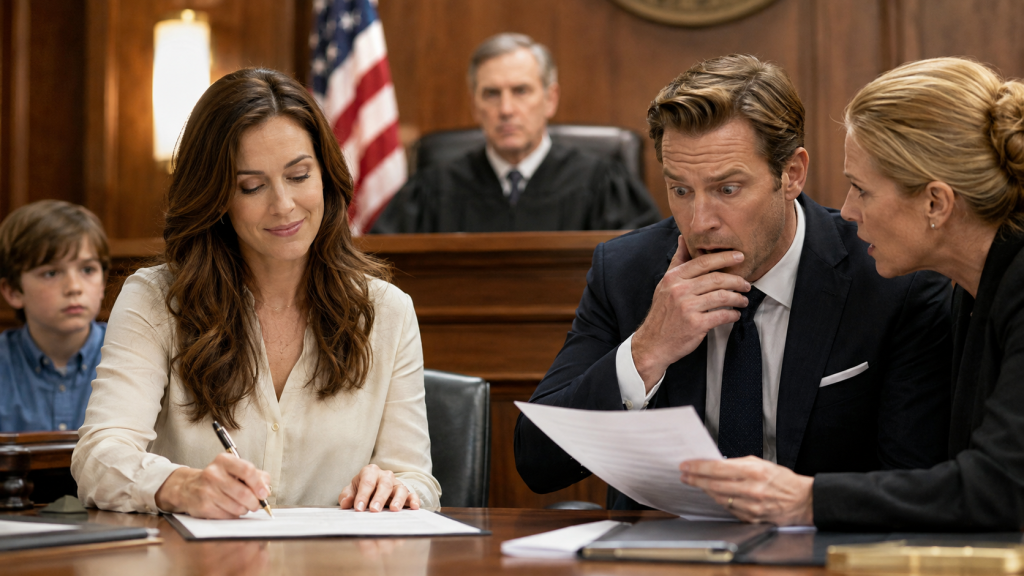
Daniel thought he had won until his lawyer leaned over, whispered something in his ear, and every trace of triumph disappeared from his face.
But to understand why, you have to understand what Daniel had never understood about me. For twelve years, he thought silence meant weakness.
He was wrong. When Daniel told me he wanted out, we were sitting at the kitchen island—the one I had helped design when we renovated the house six years earlier. It was a beautiful house.
Five bedrooms. Three fireplaces. A wide backyard with an oak tree Ethan climbed every summer. The kitchen had white stone counters, custom cabinets, and a skylight Daniel loved showing off whenever people came over.
He liked beautiful things. More importantly, Daniel liked people knowing he owned beautiful things.
That evening, he folded his hands on the counter as calmly as if he were discussing an insurance policy.
“I’ve spoken to an attorney,” he said.
I looked at him.
Daniel was forty-three, handsome in the polished way some men become after spending years studying exactly how they want the world to see them.
His shirts were tailored.
His shoes were always clean.
Even his watch seemed positioned deliberately when he rested his wrist on the counter.
“I want a divorce,” he said.
I had suspected it was coming.
There had been late meetings.
Weekend conferences that appeared suddenly.
A new password on his phone.
A woman named Lauren from his office who seemed to call only after dinner.
Still, hearing the words was different.
“How long have you known?” I asked.
“Known what?”
“That you wanted to leave.”
Daniel shrugged.
“A while.”
That shrug hurt more than the sentence.
Twelve years reduced to a shoulder movement.
Then he began describing what he wanted.
The house.
Both cars.
The joint savings.
The investment account.
The furniture.
Even the lake membership we barely used.
I listened without interrupting.
Then came the sentence I would remember for the rest of my life.
“You can keep the child.”
I stared at him.
“Our son has a name.”
Daniel sighed.
“Emma, don’t make this emotional.”
“He’s eight years old.”
“And he’s closer to you.”
“He’s your son.”
“I know that.”
“Then say his name.”
Daniel’s jaw tightened.
“This is exactly what I mean. You turn everything into drama.”
Upstairs, I could hear Ethan walking across his bedroom floor.
He was probably looking for the colored pencils he always misplaced during homework.
That ordinary sound nearly broke me.
I lowered my voice.
“Does Ethan know?”
“No.”
“Does Lauren?”
Daniel’s eyes flickered.
That was all the confirmation I needed.
He didn’t deny it.
Instead, he said, “This marriage has been over for a long time.”
“For you, maybe.”
He stood.
“I don’t want a war, Emma.”
I almost laughed.
He had just asked for nearly every visible thing we owned and spoken about our son like unwanted furniture.
But somehow, he considered himself reasonable.
“What exactly are you offering me?” I asked.
“Custody.”
“Of Ethan.”
“Yes.”
I waited.
Daniel looked irritated.
“And whatever personal belongings you want. Clothes. Jewelry. Your grandmother’s things. I’m not trying to be cruel.”
Not trying to be cruel.
I would hear those words many times during the months that followed.
Daniel always believed cruelty stopped being cruelty if he delivered it in a calm voice.
That night, after Ethan fell asleep, I sat on the edge of his bed and watched him breathe.
One arm was wrapped around a stuffed dinosaur he had owned since preschool.
Daniel had missed the school play three weeks earlier because of a “client emergency.”
He had missed Ethan’s last two baseball games.
He had forgotten the parent-teacher conference entirely.
Ethan had stopped asking when his father would come home.
Children notice when they become optional.
The next morning, I called Margaret Collins.
Margaret had handled my mother’s estate years earlier and later moved into family law.
She was sixty-one, sharp-eyed, practical, and incapable of pretending bad news was good news.
After I described Daniel’s demands, she removed her glasses.
“He wants all of that?”
“Yes.”
“And you’re considering agreeing?”
“Yes.”
Her pen stopped moving.
“Emma, absolutely not.”
“I want sole custody.”
“We can fight for custody without surrendering your entire financial position.”
“I know.”
“You contributed to that marriage for twelve years.”
“I know.”
“You helped pay for that house.”
“I know.”
“Your name is on the accounts.”
“Yes.”
She leaned back.
“Then tell me what I’m missing.”
I looked through the window behind her desk.
Cars moved slowly through afternoon traffic.
For a moment, I thought about telling her everything immediately.
Instead, I said, “I need Daniel to believe he’s getting exactly what he wants.”
Margaret frowned.
“Why?”
“Because if he thinks I’m fighting over money, he’ll fight over Ethan just to hurt me.”
She became very still.
That was something Daniel had done before.
Not with custody.
With smaller things.
If I wanted to visit my sister for Thanksgiving, suddenly Daniel wanted Thanksgiving at home.
If I cared about a vacation destination, he disliked it.
If I stopped caring, he stopped objecting.
He didn’t always want things.
Sometimes he simply wanted me not to have them.
Margaret tapped her pen once.
“So you think if you surrender the property, he won’t contest custody.”
“I know him.”
“And after?”
I finally looked at her.
“After, I rebuild.”
Her expression softened, but only slightly.
“Emma, rebuilding from nothing is harder at forty than it sounds.”
“I won’t be rebuilding from nothing.”
That was the first time I saw the question form in her eyes.
But she didn’t ask yet.
Instead, she said, “Bring me every financial document you have. Every account. Every loan. Every tax return. Everything.”
Two days later, I returned with three boxes.
Daniel believed I knew very little about our finances.
That was partly my fault.
For years, I let him believe it.
I handled Ethan’s school, doctors, schedules, groceries, birthdays, insurance renewals, and most of the household management.
Daniel handled what he called “the serious money.”
But I had grown up around serious money.
My father, Thomas Bennett, started a small commercial storage company when I was eleven years old.
At first, it was three old warehouses and an office with a leaking roof.
By the time I graduated college, Bennett Industrial Properties owned sixteen buildings across Texas.
By the time my father died, it owned forty-two.
Daniel knew about the company.
He just never respected it.
He called it “your father’s warehouses.”
He assumed my brother controlled everything.
He assumed I had received a sentimental inheritance and occasional distributions.
Daniel had never asked the right questions because asking would have required admitting that something existed outside his control.
My father had left my brother and me equal beneficial interests in a family trust established years before I met Daniel.
The trust owned commercial property, land, and shares in several operating companies.
My interest had always remained separate.
The distributions went into an account in my name only.
I never used those funds for the marital house.
Never paid Daniel’s debts with them.
Never deposited them into our joint accounts.
My father had insisted on that structure.
“Not because I think your future husband will be bad,” he told me once. “Because good planning should survive bad luck.”
Daniel knew a trust existed.
What he didn’t know was what it was worth.
For years, I hadn’t known the exact value either because I took modest distributions and left most earnings reinvested.
Then, six months before Daniel asked for divorce, a logistics company purchased a parcel of trust-owned land outside Fort Worth.
My share of the trust’s overall value rose substantially.
The independent valuation Margaret ordered put my beneficial interest at a little over $6.8 million.
Not cash sitting in a checking account.
Not money I intended to spend recklessly.
But mine.
Separate.
Protected.
And disclosed.
Nothing hidden.
Nothing illegal.
Nothing Daniel could claim he had been tricked about.
Margaret stared at the valuation for almost a full minute.
Then she looked at me.
“Does Daniel know?”
“He knows about the trust.”
“That isn’t what I asked.”
“No.”
“Does his attorney?”
“She will when we exchange disclosures.”
Margaret exhaled.
“Then why surrender hundreds of thousands in marital equity?”
“Because Daniel will see the house before he sees anything else.”
And that was exactly what happened.
At mediation, Daniel barely looked at the trust disclosure.
His lawyer, Rebecca Sloan, did.
I noticed her expression change.
Rebecca was experienced.
She understood instantly.
She whispered to Daniel.
He waved her off.
Later, I learned she had advised him to postpone mediation until they could obtain their own valuation and review whether any trust distributions had been commingled.
Daniel refused.
He was convinced he understood my finances better than I did.
He saw the house.
He saw the two luxury vehicles.
He saw the joint brokerage account.
He saw cash.
He saw trophies.
And most of all, he saw me agreeing to give them to him.
That made him careless.
“What about custody?” Margaret asked.
Daniel leaned back.
“Emma can have primary custody.”
“Primary or sole?”
His attorney turned toward him.
“Daniel, we discussed—”
“Sole,” he said impatiently. “Fine.”
Margaret’s eyes moved toward me.
I said nothing.
There were visitation provisions, school arrangements, holiday schedules, and child support based on statutory guidelines.
Daniel complained about the child support.
Of course he did.
“That number is ridiculous.”
Rebecca quietly said, “It’s calculated from your income.”
“I’ll already be paying for the house.”
“The house you asked to keep,” Margaret said.
Daniel glared at her.
Eventually, he agreed.
Then came the property division.
House to Daniel.
Cars to Daniel.
Joint investment account to Daniel.
Savings to Daniel.
Most furniture to Daniel.
He even wanted the wine collection.
I didn’t care.
When mediation ended, he walked out looking ten years younger.
Margaret stayed seated.
“Last chance,” she said.
“I know.”
“You could take half the equity and still protect Ethan.”
“I know.”
“So why not?”
I looked down at the photograph on my phone.
Ethan wearing his baseball cap backward, grinning with two missing front teeth.
“Because I want him out of our lives without a reason to keep fighting.”
Margaret studied me.
“You realize money doesn’t guarantee that.”
“No.”
“But greed makes Daniel predictable.”
She couldn’t argue with that.
The settlement paperwork took weeks.
During that time, Daniel moved into the guest room.
He came and went as he pleased.
Ethan noticed the distance.
One evening, while I was washing dishes, he appeared beside me.
“Mom?”
“Yes, sweetheart?”
“Is Dad mad at me?”
My hands stopped in the sink.
“No.”
“He doesn’t talk to me.”
I dried my hands and crouched so we were eye level.
“Your father is going through some grown-up problems.”
“Did I do something?”
“No.”
“Promise?”
I felt something crack inside me.
“I promise.”
He looked toward the staircase.
“Is he leaving?”
Children always know more than adults think.
I nodded.
“Yes.”
Ethan’s lower lip trembled.
“Are you leaving too?”
I pulled him into my arms.
“Never.”
He cried quietly against my shoulder.
Daniel came through the kitchen five minutes later.
He saw Ethan crying.
He saw me holding him.
Then he opened the refrigerator.
That moment ended whatever remained of my doubt.
Two weeks before the final hearing, Daniel moved into an apartment downtown “temporarily.”
Lauren helped him choose it.
I knew because Ethan saw her name appear on his father’s phone when Daniel stopped by for a suitcase.
Daniel promised Ethan they would go to a basketball game soon.
He never bought the tickets.
He promised to call on Wednesday.
He called Saturday.
He promised he would still come to school events.
He missed the science fair.
Each disappointment made Ethan quieter.
I started taking him to a counselor.
Not because he was broken.
Because children deserve somewhere safe to put feelings too heavy for their age.
The morning of the final hearing, I dressed in navy trousers and a cream blouse.
Nothing dramatic.
Nothing symbolic.
Ethan stayed with my sister.
Before I left, he hugged me.
“Is it over today?”
“I hope so.”
“Will Dad come home after?”
“No.”
He nodded.
Then he whispered, “Okay.”
Not sad.
Relieved.
That hurt more than tears would have.
The courtroom was smaller than I expected.
Daniel sat across from me in a charcoal suit.
Rebecca was beside him with two thick folders.
Margaret had warned me that judges sometimes rejected agreements they considered too unequal.
Judge Franklin reviewed ours carefully.
He looked at Daniel.
“Mr. Hayes, you are receiving the marital residence, two vehicles, the investment account, the majority of liquid savings, and substantial personal property. Correct?”
“Yes, Your Honor.”
He looked at me.
“Mrs. Hayes, you understand what you are waiving?”
“I do.”
“No one has pressured you?”
“No.”
“You have independent counsel?”
“Yes.”
“And you believe this agreement is in your best interest?”
I paused.
“More importantly, I believe it is in my son’s best interest.”
The judge studied me for several seconds.
Then he continued.
Daniel’s mouth curled slightly.
He thought my answer was emotional.
He thought I had sacrificed everything because I was weak.
Finally, the judge approved the agreement subject to the final signatures.
I signed first.
My hand didn’t shake.
Daniel signed next.
Then the attorneys reviewed the exhibits and financial schedules one final time.
Rebecca turned a page.
Then another.
She stopped.
Her expression changed.
It wasn’t shock exactly.
It was the look of someone realizing her client had ignored advice that was now impossible to recover.
She leaned toward Daniel.
At first, he smiled.
Then she whispered.
I couldn’t hear the first sentence.
But I heard the second.
“Her trust interest is valued at six point eight million dollars, Daniel. You waived any claim to tracing or appreciation issues when you insisted on accepting the settlement.”
Daniel’s face emptied.
“What?”
Rebecca lowered her voice.
“I told you we needed to review this.”
He grabbed the document.
His eyes raced across the page.
Then he looked at me.
For the first time in twelve years, Daniel looked at me without superiority.
He looked frightened.
“What is this?” he demanded.
Judge Franklin looked up.
“Mr. Hayes?”
Daniel stood halfway before Rebecca pulled at his sleeve.
“Sit down.”
He didn’t.
“Your Honor, I didn’t understand—”
Rebecca closed her eyes briefly.
The judge’s expression hardened.
“Your attorney represented that financial disclosures were exchanged.”
“They were,” Margaret said.
Rebecca nodded reluctantly.
“They were, Your Honor.”
“Mr. Hayes, were you advised to review them?”
Daniel said nothing.
Rebecca answered carefully.
“Yes.”
The judge looked at Daniel.
“Then sit down.”
Daniel sat.
His face had turned red.
He flipped through the documents.
“But that company is her father’s.”
“My father is dead,” I said quietly.
“You told me your brother handled it.”
“He does.”
“You said you barely made anything from it.”
“I said I took small distributions.”
“That isn’t the same thing.”
“No.”
His eyes widened.
“You knew I didn’t understand.”
Margaret immediately placed a hand on my arm, warning me not to respond emotionally.
But I didn’t need to.
Rebecca did it for me.
“Daniel, stop.”
He turned toward her.
“You knew?”
“I tried to explain it during mediation.”
“You said it was separate property.”
“It is separate property.”
“So why didn’t you tell me it was worth millions?”
Rebecca stared at him.
“I did.”
Silence.
Even Judge Franklin looked away for a moment.
Daniel’s breathing changed.
Then came the line I will never forget.
“But I gave her custody.”
Every muscle in my body tightened.
Not I gave up time with my son.
Not I lost Ethan.
Not What happens to my relationship with my child?
He said it like custody had been a chip he traded at a casino.
Judge Franklin’s voice became cold.
“Mr. Hayes, custody is not property exchanged for financial advantage.”
Daniel realized too late what he had said.
“I didn’t mean—”
“I strongly suggest you listen to your attorney.”
Daniel sat down.
The hearing ended ten minutes later.
Outside the courtroom, he followed me into the hallway.
“Emma!”
Margaret stopped beside me.
Daniel came closer.
“You planned this.”
I turned.
“No.”
“You knew I would take the house.”
“Yes.”
“You knew about the trust.”
“Of course.”
“You let me think you were walking away with nothing.”
“I never said I had nothing.”
“You manipulated me.”
That word almost made me smile.
For twelve years, Daniel had made assumptions because those assumptions pleased him.
Now he wanted them to be my responsibility.
“Your lawyer told you to review the disclosures.”
His jaw tightened.
“This isn’t over.”
“It is.”
“I’ll reopen the settlement.”
Margaret stepped forward.
“Daniel, I strongly recommend you speak with your attorney before making threats in a courthouse.”
He ignored her.
“You think you won?”
I looked at him.
“No.”
And I meant it.
Winning would have been Ethan having a father who treasured him.
Winning would have been my marriage surviving.
Winning would have been keeping the family I once believed we had.
“This isn’t winning,” I said. “This is leaving.”
Then I walked away.
The weeks after the divorce were strangely quiet.
Ethan and I rented a three-bedroom house ten minutes from his school.
It wasn’t impressive.
There was no skylight.
No custom wine room.
No marble entrance.
But Ethan chose the color for his bedroom walls.
He planted tomatoes in two wooden boxes behind the kitchen.
We ate pizza on the floor the first night because our table hadn’t arrived.
He laughed more that evening than he had in months.
Daniel kept the big house.
For a while.
What he had overlooked wasn’t only my trust.
The house was expensive to maintain.
Property taxes were enormous.
The mortgage was substantial.
The cars came with insurance, maintenance, and depreciation.
The investment account looked impressive, but markets moved.
The savings account wasn’t endless.
And unlike during our marriage, there was no wife quietly organizing every bill, appointment, renewal, repair, and deadline.
Six months later, Daniel sold one of the cars.
A year later, he sold the house.
Lauren moved in with him briefly.
Then she moved out.
I don’t know why.
I never asked.
Daniel remained Ethan’s father, and I refused to poison that relationship.
When he called, I handed Ethan the phone.
When he wanted scheduled visitation, I followed the agreement.
When he came to baseball games, I was polite.
But something had changed.
Children remember who shows up.
One Saturday afternoon, almost two years after the divorce, Daniel arrived at Ethan’s baseball game during the fourth inning.
Ethan was ten by then.
Taller.
More confident.
He had just hit a double.
Daniel sat three rows behind me.
After the game, he approached Ethan near the dugout.
“Great hit, buddy.”
“Thanks.”
“I thought maybe we could grab burgers.”
Ethan looked at me.
I nodded.
“It’s okay.”
But Ethan hesitated.
“I told Grandma I’d help her with her garden.”
Daniel’s face fell.
“You’d rather garden?”
Ethan shrugged.
“I promised.”
There was no anger in his voice.
Just certainty.
Daniel looked at me.
I could see the accusation forming.
I stopped it before he spoke.
“I didn’t tell him to say that.”
He believed me.
That was the sad part.
Later that evening, Daniel called.
Not Ethan.
Me.
For several seconds, neither of us spoke.
Then he said, “He doesn’t need me anymore.”
I sat at the kitchen table.
“He’s ten. Of course he needs his father.”
“He doesn’t act like it.”
“Daniel, needing someone and trusting them are different things.”
Silence.
“I made mistakes.”
“Yes.”
“I was angry.”
“I know.”
“I thought if I got everything, I’d feel like I hadn’t wasted twelve years.”
That surprised me.
Not because it was kind.
Because it was honest.
“And did you?” I asked.
“No.”
I looked through the window.
Ethan was outside with my sister, carrying a watering can toward the tomato plants.
“No house can tell you it loves you,” I said.
Daniel breathed out slowly.
“Do you hate me?”
I thought about it.
“No.”
It was true.
Hate requires energy.
I had spent mine rebuilding.
“But I won’t teach Ethan to chase someone who keeps walking away from him.”
Daniel was quiet.
“What do I do?”
“Show up.”
“That’s it?”
“No. Show up again. Then again. Then again when it’s inconvenient. Then again when nobody praises you for it.”
He didn’t answer.
So I continued.
“You spent years teaching Ethan that he came second. You don’t undo that with one basketball game.”
Daniel whispered, “I know.”
And for once, I believed he did.
He started trying.
Not perfectly.
He missed things.
He disappointed Ethan more than once.
But slowly, he became more consistent.
He attended school conferences.
He learned Ethan’s coach’s name.
He remembered birthdays without reminders.
He stopped bringing expensive gifts as substitutes for time.
I never remarried.
Not because Daniel destroyed love for me.
Because I discovered I liked the life Ethan and I built.
When Ethan turned thirteen, my brother and I took him to one of the old warehouses my father had purchased decades earlier.
It had been renovated into a modern distribution center.
We stood outside while trucks moved through the loading yard.
“This belonged to Grandpa?” Ethan asked.
“Part of the company did.”
“Dad said Grandpa left you a bunch of money.”
I smiled.
“Your grandfather left me responsibility.”
Ethan frowned.
“That sounds less fun.”
I laughed.
“It is.”
Then I explained the trust.
Not the dollar amount.
The purpose.
Education.
Security.
Opportunity.
Something to protect, not something to worship.
When Ethan eventually asked why I had given his father the house during the divorce, I told him the truth.
“Because your father wanted things more than I did.”
“And you wanted me?”
I turned toward him.
“Yes.”
He looked down.
Then smiled slightly.
“So you got what you wanted.”
I felt tears rise.
“Yes.”
I put my arm around his shoulders.
“I did.”
Years later, when Ethan graduated high school, Daniel and I sat in the same row.
Not together.
But close.
When Ethan walked across the stage, he looked toward us.
First at me.
Then at Daniel.
Then at my sister and brother.
He smiled.
Daniel wiped his eyes.
Afterward, we stood outside taking photographs.
At one point, Daniel and I ended up alone for a moment while Ethan laughed with friends.
Daniel had changed.
His hair was grayer.
His suits were cheaper.
Strangely, he looked more comfortable in them.
“You remember the courthouse?” he asked.
“I do.”
“I thought that was the worst day of my life.”
I said nothing.
“It wasn’t.”
I looked at him.
“The worst day was months later when Ethan wouldn’t cancel gardening with your mother to have lunch with me.”
I smiled faintly.
“That was a rough garden.”
Daniel laughed.
Then his face became serious.
“I really said you could keep the child.”
“Yes.”
“I’ve thought about that sentence a thousand times.”
“I hope so.”
“I don’t know how I became that man.”
I looked toward Ethan.
“You became him one choice at a time.”
Daniel nodded.
“And I suppose you stop being him the same way.”
“One choice at a time.”
He looked at me.
“Did you know, when you gave me the house and the cars, that I’d regret it?”
“I knew you’d regret believing they were everything.”
That answer stayed between us.
Because that was the real lesson Daniel learned.
He had walked into our divorce measuring victory in square footage, bank balances, leather seats, and signatures.
He believed the person who walked away with the most possessions had won.
I walked away with an eight-year-old boy holding my hand.
A boy who needed stability.
A boy who needed one parent to choose him without hesitation.
A boy who would eventually become a good man partly because he learned early that love is not what someone says when life is easy.
Love is what someone refuses to abandon when things become difficult.
Daniel got the house.
He got the cars.
He got the accounts.
He got everything he demanded.
And I got Ethan.
Years later, I understood something Daniel had needed much longer to learn.
I had never signed everything away.
I had simply recognized what was priceless before he did.
And by the time his lawyer leaned over in that courtroom and whispered the truth into his ear, the money was already the least important thing he had lost.
THE END! THANKS FOR READING!