
“…months.” That was the word I had been saving. Ten months of silence. Ten months of watching my son and his wife discuss me as if I were a leaking appliance they intended to replace.
Ten months of putting dinner on their table while knowing I could have bought the table, the dining room, and the entire street without touching half my winnings. The next morning, I woke at 5:12. I did not need an alarm.
My suitcase stood beside my bedroom door. It held enough clothes for two weeks, Harold’s photograph, my medications, three paperback mysteries, and the little ceramic bird my granddaughter Lucy had made for me when she was six.
Everything else could be collected later. I showered, dressed in navy slacks and a cream cardigan, and went downstairs. The house was quiet.
My house. That thought still felt strange. I filled the coffee maker, sliced bread, and scrambled eggs because habits do not disappear simply because you become a millionaire.
At 6:45, Daniel came downstairs.
He was forty-eight years old but still dragged one hand along the banister when he was tired, exactly as he had when he was twelve.
“Morning, Mom.”
“Morning.”
He poured coffee.
Renata appeared ten minutes later in a satin robe, carrying her phone.
“Dolores, did you finish packing?”
“Yes.”
“All of it?”
“Enough.”
She smiled approvingly.
“You really are handling this better than I expected.”
I buttered my toast.
“What did you expect?”
She exchanged a look with Daniel.
“Nothing bad. We just thought you might be emotional.”
“I am seventy-three, Renata. I have survived emotions before.”
Daniel cleared his throat.
“Sunrise Pines said check-in is at two. I can drive you after lunch.”
“That will not be necessary.”
He looked at me.
“What do you mean?”
“I arranged transportation.”
Renata frowned.
“Why would you pay for a taxi when Daniel can take you?”
“Because I want to.”
She opened her mouth, probably to lecture me about wasting money, but the doorbell rang.
Daniel looked toward the hallway.
“Who is that this early?”
I took another sip of coffee.
“The mail carrier sometimes brings certified letters before his regular route.”
Daniel stared at me.
“How do you know it’s certified?”
I shrugged.
“Guess.”
He went to the door.
I heard the latch.
Then muffled voices.
Then the scratch of a pen.
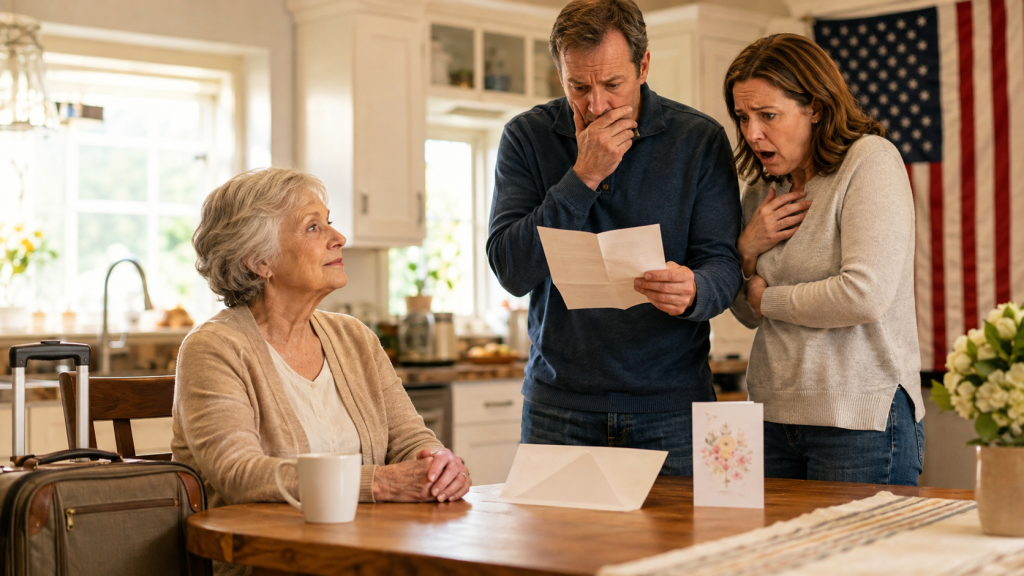
A minute later, Daniel returned holding a large white envelope.
H AND D BAIT AND TACKLE LLC was printed in the upper-left corner.
For half a second, he did not react.
Then his eyes narrowed.
He turned the envelope over.
“Why does that name sound familiar?”
I spread strawberry jam on my toast.
Renata leaned over.
“What is it?”
Daniel opened the envelope.
I watched him read the first page.
His forehead creased.
Then he stopped.
He read the first paragraph again.
Renata was impatient.
“Well?”
Daniel did not answer.
His eyes moved farther down the page.
Then he looked directly at me.
“Mom?”
There it was.
That voice.
Small.
Uncertain.
Seven years old again.
I set down my knife.
“Yes?”
“What is H and D Bait and Tackle?”
“You know what it is.”
He stared at me.
“Dad’s company.”
“Was.”
Renata snatched the paper from his hand.
Her lips moved as she read.
Then her mouth opened.
“This says the property was purchased in April.”
“Yes.”
“By H and D Bait and Tackle LLC.”
“Yes.”
She looked between Daniel and me.
“This is our landlord?”
I corrected her gently.
“Your landlord.”
Daniel lowered himself into a chair.
“Mom.”
I waited.
“Did you buy this house?”
“Yes.”
Renata laughed.
Not because anything was funny.
It was the kind of laugh people make when reality has become too inconvenient to accept.
“With what?”
I looked at her.
“That is a personal financial matter.”
Her face changed.
For four years, she had demanded to know whether I had spent six dollars too much at the grocery store.
Now she was hearing her own language returned to her.
Daniel rubbed his forehead.
“How could you afford this house?”
“I made an investment.”
“With what money?”
I took a sip of coffee.
“The letter explains the new lease terms.”
Renata looked back at the page.
Her face went pale.
The new monthly rent was market rate.
For nine years, their former landlord had charged nearly thirty percent below comparable homes because Daniel handled small repairs himself and had been a reliable tenant.
I had kept that rate after buying the property.
Until now.
The new lease would begin in sixty days.
The increase was significant.
Not cruel.
Not illegal.
Simply what every similar house on the street already rented for.
But that was not the part that made Renata grip the paper.
The second page explained that the current tenancy would not automatically renew beyond six months.
At that point, they could sign a new one-year lease at the market rate or vacate.
Daniel looked at me.
“Are you evicting us?”
“No.”
“It feels like it.”
“You were comfortable changing my housing arrangement without asking me.”
His eyes dropped.
Renata slammed the letter onto the table.
“That is completely different.”
“How?”
“You live with us.”
“I lived with you.”
“This is our family home.”
I looked around the kitchen.
“I know.”
“You cannot just buy someone’s home from underneath them.”
“I bought it from the owner.”
“You knew we lived here!”
“Yes.”
“That makes it worse!”
I folded my napkin.
“It made the purchase attractive.”
Daniel looked wounded.
“Mom, why didn’t you tell me?”
I could have been cruel.
I could have said because you do not tell me things either.
Instead I told him the truth.
“Because I wanted to know how you treated me when you believed I had nothing.”
The kitchen became silent.
Even Renata stopped talking.
Daniel stared at me.
“What is that supposed to mean?”
“It means I wanted to know whether your kindness depended on my usefulness.”
He looked away.
I continued.
“I cooked. I cleaned. I watched your children. I paid for my own prescriptions and clothes. And still I heard myself called a burden.”
Renata crossed her arms.
“I never called you that.”
“You did.”
“When?”
“Would you like the dates or just the rooms?”
She went still.
I had not planned that sentence.
It simply came.
Daniel whispered, “Mom.”
I looked at him.
“You said it too.”
His face fell.
“I was frustrated.”
“So was I.”
“I didn’t mean it.”
“I hoped you didn’t.”
Renata picked up the letter again.
“What does any of this have to do with Sunrise Pines?”
“Quite a lot.”
She frowned.
“You agreed to go.”
“I agreed that January first was soon.”
Daniel looked confused.
“You said it was for the best.”
“It is.”
His relief appeared for half a second.
Then I added, “For me.”
I stood.
My suitcase was waiting near the hallway.
Renata saw it.
“Where are you going?”
“Savannah.”
Daniel blinked.
“Georgia?”
“My sister Ruth lives there.”
“I know where Aunt Ruth lives. Why are you going there?”
“Because I bought a house twelve minutes from hers.”
Nobody spoke.
Then Renata laughed again.
“You bought a house?”
“Yes.”
“In Savannah?”
“Yes.”
“When?”
“June.”
“With what money?”
I smiled.
“We seem to keep returning to that question.”
Daniel stood.
“Mom, seriously. What is going on?”
I looked at my son.
I had imagined this moment many times.
In some versions, I told them immediately about the eleven million dollars.
In others, I never told them at all.
But my lawyer, Martin Greene, had taught me an important distinction.
Privacy was not the same thing as deception.
I owed them honesty about decisions affecting them.
I did not owe them my bank balance.
“I have more resources than you assumed,” I said.
Renata stared at me.
“How many?”
“Enough.”
“Did Aunt Ruth give you money?”
“No.”
“Did you inherit something?”
“No.”
“Then where did you get—”
Daniel suddenly stopped.
His face changed.
He looked toward me slowly.
“The scratch ticket.”
I said nothing.
Renata frowned.
“What scratch ticket?”
He stared at me.
“Your birthday.”
I lifted my coffee.
“The card was lovely.”
His mouth opened.
“Oh my God.”
Renata looked between us.
“What?”
Daniel whispered, “Mom, did that ticket win?”
I waited just long enough.
“Yes.”
Renata laughed.
“Okay.”
I smiled.
She looked at Daniel.
“She is messing with us.”
Daniel did not laugh.
“How much?”
“I won enough.”
“How much, Mom?”
“Enough to buy this house.”
Renata’s face lost all color.
“How much?”
I picked up my suitcase.
“Eleven million dollars.”
Nobody moved.
The refrigerator hummed.
A car passed outside.
Renata sat down slowly.
“You won eleven million dollars?”
“Yes.”
“Ten months ago?”
“Yes.”
“And you told nobody?”
“My lawyers knew.”
“Your lawyers?”
“Several people knew who needed to know.”
Her eyes sharpened.
“You lived here for ten months with eleven million dollars?”
“Yes.”
“You watched us struggle?”
That one almost impressed me.
“Struggle?”
“Yes!”
I looked around their granite kitchen.
Daniel drove a late-model SUV.
Renata leased a luxury crossover.
They took two vacations every year.
Their children had newer phones than mine.
“You were not struggling.”
“We have bills.”
“So does everyone.”
“You could have helped us.”
“I did.”
She stared.
“With what?”
“Childcare. Cooking. Cleaning. Groceries. Four years of unpaid help.”
“That isn’t what I mean.”
“I know.”
Daniel sank back into the chair.
“You bought the house.”
“Yes.”
“With the lottery money.”
“Yes.”
“And you’ve been collecting our rent?”
“Through the trust.”
His face twisted strangely.
“Why?”
“Because the property produces income.”
“No. Why us?”
I studied him.
“Because I wanted control over where I lived for the first time since your father died.”
“You didn’t have to buy our house for that.”
“I know.”
“Then why?”
I looked at Renata.
“Because people behave differently when they think they own the ground beneath your feet.”
Nobody responded.
The taxi pulled up at 7:18.
Right on time.
I wheeled my suitcase toward the door.
Daniel followed.
“Mom, wait.”
I stopped.
“Are you really leaving?”
“Yes.”
“You don’t have to.”
I almost smiled.
Ten minutes earlier, I had been scheduled for Sunrise Pines.
Now that they knew I had eleven million dollars, I did not have to leave.
Interesting.
“I want to.”
He looked genuinely hurt.
“What about us?”
“What about you?”
“The rent. The house. Everything.”
“You have sixty days before the new rent begins. Six months before you need to decide whether to sign a longer lease.”
Renata appeared behind him.
“You’re charging your own son market rent?”
“I am charging two employed adults market rent on a house they have occupied for nine years.”
“That’s heartless.”
I turned toward her.
“Then perhaps Sunrise Pines has a family discount.”
Daniel flinched.
I regretted the sharpness immediately.
Not because it was undeserved.
Because I did not want bitterness to become my new personality.
I looked at him.
“I am not trying to ruin you.”
“It feels like you are.”
“I am giving you notice, options, and time. You gave me thirteen days.”
His face changed.
He had no answer.
I stepped outside.
Lucy was standing on the stairs.
She was sixteen now.
She must have been listening.
“Grandma?”
I stopped.
She was barefoot, wearing pajama pants and an oversized sweatshirt.
“Are you leaving?”
“Yes, sweetheart.”
“For that old people place?”
“No.”
Her face brightened slightly.
“Where?”
“Georgia.”
“Why?”
“Because I bought a little house.”
She ran down the last two steps.
“You bought a house?”
“I did.”
She hugged me.
Tightly.
No question about money.
No question about lottery winnings.
Just, “Can I visit?”
My eyes filled.
“Anytime your parents approve.”
Renata’s younger son, Caleb, appeared next.
He was thirteen.
“Grandma, Dad says you won the lottery.”
I laughed.
“Apparently your father has decided to announce it.”
“Are you rich?”
“I am comfortable.”
“Eleven million sounds rich.”
“Finish school before forming financial opinions.”
He grinned.
Then his expression became serious.
“Are you mad at us?”
“No.”
“Even though we laughed at the scratch ticket?”
I touched his cheek.
“You laughed because your parents laughed.”
He looked embarrassed.
“I’m sorry.”
“I know.”
Daniel carried my suitcase to the taxi.
I let him.
Before I got in, he said, “Can I call you?”
“You are still my son.”
“That doesn’t answer me.”
“Yes, Daniel. You can call.”
His eyes filled.
“Are you ever coming back?”
“To Savannah or this house?”
“Here.”
I looked at the porch.
The house had served its purpose.
I no longer needed to live inside it to prove I could survive.
“I don’t know.”
He nodded.
Then he whispered, “I messed up.”
“Yes.”
He looked down.
I squeezed his hand.
“Now decide what kind of man that mistake makes you next.”
Then I got into the taxi.
My driver was named Franklin.
He had no idea an eleven-million-dollar woman was sitting behind him.
That felt wonderful.
At the airport, I bought myself a coffee without checking the price.
Not because the price mattered.
Because for decades, Harold and I had checked everything.
Coupons.
Gas prices.
Electric bills.
We lived carefully because careful living had kept us secure.
Winning money did not erase those habits.
But it did give me choices.
That was the true luxury.
Choice.
My Savannah house was not large.
Yellow siding.
White porch.
Three bedrooms.
A magnolia tree near the driveway.
The kitchen was painted pale cream, almost the color of butter.
Ruth cried when I arrived.
She is seventy-six and four inches shorter than me but somehow still hugs like a wrestler.
“You finally did it,” she said.
“I did.”
“You told them?”
“Eventually.”
“How bad?”
“Renata nearly swallowed her own tongue.”
Ruth laughed so loudly the neighbor’s dog barked.
That first night, I slept with my bedroom door open.
No one complained about the television volume.
No one asked whether I had used too much hot water.
No one reminded me that cereal cost eight dollars a box now.
The silence was not lonely.
It was mine.
For three weeks, Daniel called every few days.
At first, every conversation drifted toward money.
“Mom, Renata thinks maybe we could buy the house from you.”
“No.”
“What if we put down a large deposit?”
“No.”
“What if you loaned us the down payment?”
“No.”
“What if—”
“Daniel.”
He stopped.
“I am not discussing my winnings with you.”
He sighed.
“Okay.”
Eventually, he began calling about other things.
Lucy’s school concert.
Caleb’s soccer game.
A leak beneath the kitchen sink.
His job.
Those conversations felt more familiar.
Then Renata called me alone.
That had never happened before.
“Dolores?”
“Yes?”
“I think we got off on the wrong foot.”
“Four years is a long first step.”
Silence.
“I deserve that.”
I was surprised.
“What do you want, Renata?”
“I want to apologize.”
I waited.
“I was disrespectful.”
“Yes.”
“I treated you like… labor.”
I said nothing.
“And I know you heard things you shouldn’t have.”
“I heard things you should not have said.”
Another silence.
“You’re right.”
That surprised me more.
Then she said, “But I need you to understand something.”
There it was.
The apology’s little suitcase.
“But.”
“Daniel and I are scared.”
“About the rent?”
“Everything.”
“You make good money.”
“Yes, but our expenses are high.”
“Then lower them.”
She exhaled.
“It isn’t that easy.”
“It often is not.”
“We may have to pull Caleb from private school.”
“Then he can attend public school.”
“She’ll lose her car.”
“Who?”
“Lucy.”
“She is sixteen.”
“We promised her.”
“You also promised yourselves I would keep subsidizing the household indefinitely.”
“We never said that.”
“You didn’t have to.”
She became quiet.
Then she asked, “Would you ever consider giving Daniel some of the money early? As inheritance?”
There it was.
I closed my eyes.
“No.”
“Not even a little?”
“No.”
“Why?”
“Because I am alive.”
“That isn’t what I meant.”
“But it is what you asked.”
She grew defensive.
“Families help each other.”
“I agree.”
“Then why are you acting like we’re strangers?”
“Because help is given. It is not owed.”
She sighed.
“I knew this conversation was a mistake.”
“So did I.”
She hung up.
That evening, I called Martin.
“Is it terrible that I enjoyed saying no?”
He laughed.
“Depends. Did you enjoy hurting her or protecting yourself?”
I thought about it.
“Protecting myself.”
“Then you’re learning.”
Martin helped me set up several things over the next months.
A college trust for Lucy and Caleb.
They would not receive access until twenty-five, except for accredited education, medical needs, or a first-home contribution.
Daniel could not touch it.
Renata could not touch it.
I also created a scholarship at the public high school Harold had attended.
Not enormous.
Enough to help a few students each year study trades.
Harold would have liked that.
Then I did something my son never expected.
I sold his rental house.
Not immediately.
Six months after I moved.
A local couple bought it.
Daniel and Renata had decided not to sign a new lease at market rate.
Instead, they moved into a smaller townhouse fifteen minutes away.
Three bedrooms.
No formal dining room.
No marble island.
No extra den.
When Daniel called after moving day, he sounded exhausted.
“We have too much stuff.”
I laughed.
“Most people do.”
“We filled a dumpster.”
“Your father would be proud.”
He laughed too.
Then his voice changed.
“Mom?”
“Yes?”
“I’m sorry we made you feel like you took up too much space.”
I looked out at my roses.
He continued.
“I didn’t understand it until we moved. Renata kept saying the townhouse felt too small. And I suddenly heard myself telling you the same thing in a different way.”
I waited.
“I made you feel like there wasn’t room for you in my life.”
My throat tightened.
“Sometimes.”
“I’m sorry.”
This apology was different.
There was no request attached.
No money afterward.
No explanation.
Just regret.
“I forgive you,” I said.
He went quiet.
“Really?”
“Yes.”
“Renata too?”
“That one is still cooking.”
He laughed.
So did I.
Seven months after I moved to Savannah, Lucy came to visit alone.
Daniel put her on a flight during spring break.
She spent five days with me.
We planted tomatoes.
We walked by the river.
She helped me choose curtains for the guest bedroom.
On the third night, she sat beside me on the porch.
“Grandma?”
“Yes?”
“Mom says money changed you.”
I smiled.
“What do you think?”
She considered it.
“I think you were quiet before.”
“That’s true.”
“And now you say what you mean.”
“That is also true.”
“So maybe money didn’t change you.”
“What did?”
She looked toward the street.
“Having somewhere else to go.”
That child was smarter than every lawyer I hired.
“Yes,” I said. “That changed me.”
She leaned against my shoulder.
“Will you leave me money someday?”
I laughed so hard I nearly spilled my lemonade.
“Straight to business.”
“I’m serious.”
“I know.”
“What happens to eleven million dollars when you die?”
“That is a cheerful porch conversation.”
She grinned.
Then I told her something I wished someone had taught me at sixteen.
“Money is useful, Lucy. But what it buys best is not handbags or cars.”
“What then?”
“Time. Safety. Choices.”
She nodded slowly.
“And sometimes distance.”
“From Mom?”
“From anyone who forgets to respect you.”
She thought about that for a while.
Then she said, “I don’t want your money.”
“No?”
“Well, maybe a little.”
I laughed again.
“But I want your yellow house.”
I squeezed her hand.
“You may have to fight your brother for the porch.”
She smiled.
My seventy-fourth birthday arrived two months later.
Daniel, Renata, Lucy, and Caleb flew to Savannah.
It was the first time they had visited together.
Renata walked into my house carrying a large bakery box.
“No one is making you bake your own cake this year,” she said.
That mattered more than the bakery box.
Daniel gave me a framed photograph of Harold and me from our thirtieth anniversary.
Caleb gave me a tackle lure mounted in a shadow box with a little plaque.
GRANDPA HAROLD’S COMPANY.
Lucy handed me a card.
I opened it carefully.
Inside was a scratch ticket.
For one second, nobody moved.
Then Lucy panicked.
“It isn’t a joke! I swear. I thought it would be funny but nice funny, not mean funny.”
I started laughing.
Daniel covered his face.
Renata groaned.
“Lucy.”
“No,” I said. “It’s perfect.”
I took a coin from my pocket.
Everyone gathered around.
I scratched the ticket.
Nothing.
“Sorry, Grandma,” Caleb said.
I smiled.
“Good.”
They stared.
“Why good?” Lucy asked.
“Because one fortune is enough trouble.”
Daniel laughed.
Renata did too.
And this time, I laughed with them.
Not because I was the joke.
Because I was part of the room.
There is a difference.
After dinner, Renata helped me carry plates into the kitchen.
She dried while I washed.
For several minutes, we worked without speaking.
Then she said, “I really was awful to you.”
I glanced at her.
“You had your moments.”
“I thought having you there meant you owed us.”
“Yes.”
“And I think I resented you because Daniel always said you had nowhere else to go.”
My hands stopped beneath the water.
“He said that?”
“Not cruelly.”
“It doesn’t need to be cruel to be revealing.”
She nodded.
“I know.”
Then she placed the dish towel down.
“I’m sorry, Dolores.”
No “but.”
No request.
No explanation.
I dried my hands.
“I forgive you.”
She cried.
I did not.
Not because I felt nothing.
Because forgiveness felt surprisingly peaceful.
That night, after everyone went to bed, I sat alone on the porch.
I thought about the two-dollar ticket.
Eleven million dollars.
After taxes, lawyers, investments, the Savannah house, and everything else, there was less than eleven million now.
Still more than I would ever spend.
People like to imagine that winning money gives you a new life overnight.
It does not.
You still wake up with the same memories.
You still miss your husband.
Your knees still hurt before rain.
Your son is still the boy you once tucked into bed, even when he becomes a man who disappoints you.
Money did not make Daniel love me.
It did not make Renata apologize.
It did not repair four years of being treated like an inconvenient piece of furniture.
What money gave me was the ability to stop accepting those things out of fear.
That is different.
The morning after my birthday, Daniel joined me on the porch.
He handed me coffee.
“Mom?”
“Yes?”
“Why didn’t you tell me sooner?”
“About the ticket?”
“Yes.”
I thought about my answer.
“Because I wanted to know if you would treat me well when you believed I had nothing to offer.”
He looked down.
“And I failed.”
“For a while.”
He nodded.
“That’s going to bother me forever.”
“Good.”
He looked surprised.
I smiled.
“Not because I want you miserable. Because some mistakes should bother us enough that we don’t repeat them.”
He stared into his coffee.
“Do you trust me now?”
“More.”
“That isn’t yes.”
“Trust is not a light switch.”
He nodded.
Then he smiled faintly.
“I guess I deserved that.”
“You did.”
He leaned back.
“What are you going to do with all the money?”
“Spend some.”
“On what?”
“Travel.”
“Where?”
“Ireland first.”
“Dad always wanted to go.”
“I know.”
“What else?”
“Scholarships. The grandchildren. Maybe a new refrigerator.”
He laughed.
“You have millions of dollars and you’re excited about a refrigerator?”
“It makes ice in little round balls.”
He laughed harder.
I laughed too.
Then he asked, “And the rest?”
I looked toward the roses.
“The rest will take care of itself after I’m gone.”
He did not ask how much he would receive.
That was when I knew something had genuinely changed.
A year ago, I had been the old woman at the table holding a two-dollar joke gift.
Today I own my home outright.
I travel when I want.
I volunteer at the library twice a week.
I have lunch with Ruth every Thursday.
And once a month, a rent deposit from one of my remaining investments lands quietly inside the trust Harold’s initials helped name.
I still have the birthday card.
It sits inside a drawer in my desk.
The price sticker is still attached.
One dollar.
Every so often, I take it out and look at it.
Not because I am bitter.
Because I like remembering how small my life appeared to everyone that evening.
An old widow.
A cardigan.
A homemade cake.
A joke gift.
They saw a woman who needed their house, their transportation, their tolerance.
They did not realize I had already spent a lifetime learning how to survive.
The lottery did not teach me that.
Harold did.
Widowhood did.
Seventy-three years did.
The ticket simply gave me the opportunity to prove it.
And when my son finally looked up from that landlord letter and whispered, “Mom?” I picked up my suitcase and said the sentence I had waited ten months to say.
“You were right, Daniel.”
He stared at me.
“About what?”
“It was time I found somewhere better to live.”
Then I walked out of the house I owned and into a life that finally belonged entirely to me.
THE END! THANKS FOR READING!