
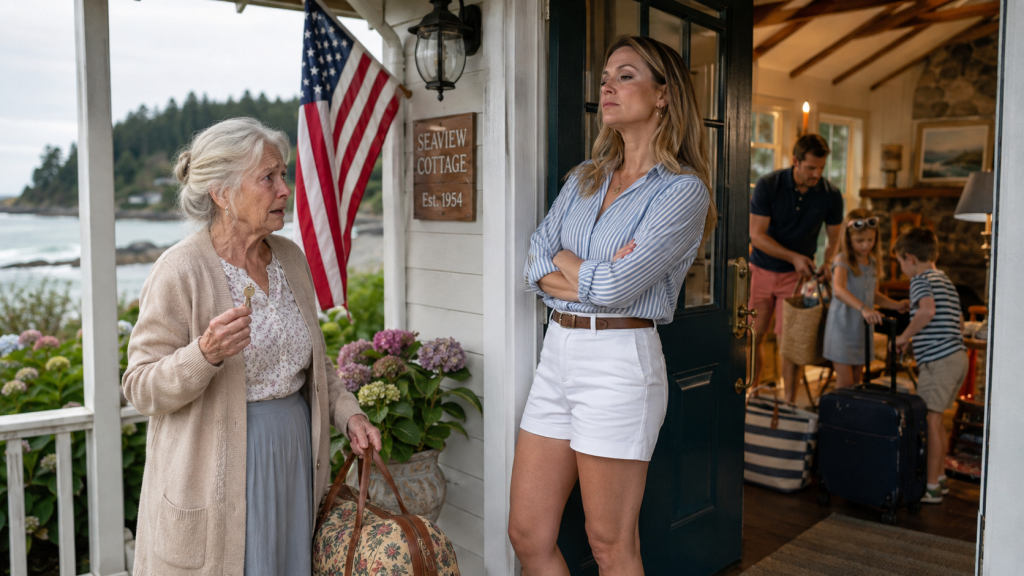
After my husband passed away, I raised my son single-handedly and spent years sewing late into the night until I finally saved up enough to buy and restore a little house by the sea. So when my daughter-in-law opened the front door and said, “There’s no room for you here,” while her family was already unpacked inside, I was too stunned to argue and drove to a motel.
The next morning, I came back to find my key no longer worked. Then I heard her mother ask from inside, “What if she puts up a fight?”
My daughter-in-law just laughed. “She won’t. Marcus says she always caves.” I stood completely still on my own front porch.
My hand was still wrapped around the useless brass key. For several seconds, I couldn’t breathe. Not because Vanessa had insulted me.
Not because her mother was sitting inside my house discussing me like I was some irritating neighbor.
It was because of those final five words.
Marcus says she always caves.
My son.
The boy I had raised after burying his father.
The teenager who used to make me tea at one in the morning because he worried I was sewing myself blind.
The grown man who once bragged to his friends that his mother bought a beach house with a sewing machine.
Apparently, that same son had been explaining my weaknesses to his wife.
I stepped quietly away from the door.
My first instinct was to knock.
My second was to scream.
Instead, I walked back to my car.
At seventy years old, you eventually learn that anger is expensive.
If you spend it too quickly, you have nothing left when you actually need it.
I sat behind the wheel and called Marcus.
He answered on the fourth ring.
“Hey, Mom.”
His tone was annoyingly casual.
“Where are you?”
“At home. Why?”
“Which home?”
There was a pause.
“What do you mean?”
“The cottage.”
Silence.
I looked toward my porch.
Through the living room window, I could see Vanessa’s sister walking around with a mug that belonged to my late husband.
“Did you change my locks?”
Marcus exhaled.
“Mom, don’t overreact.”
That told me everything.
“You changed my locks.”
“It was temporary.”
“Why?”
“Vanessa said you were upset yesterday.”
“I was told there was no room for me in my own house.”
“She probably phrased it badly.”
“No, Marcus. She phrased it very clearly.”
He groaned.
“Can we not do this first thing in the morning?”
I nearly laughed.
“You changed the locks on my house and you’re annoyed because I’m calling too early?”
“I changed one lock.”
“All my keys are useless.”
“We were going to give you new ones.”
“When?”
“Later.”
I leaned forward.
“What exactly is happening inside my house?”
“Nothing.”
“Then why did Vanessa’s mother just ask what happens if I put up a fight?”
Silence.
A long one.
This time, when Marcus spoke, his voice had changed.
“You were listening through the door?”
“I was standing on my porch.”
“Mom…”
“No. You don’t get to make me the problem. Tell me what is going on.”
He sighed.
“Vanessa’s family has had a rough year.”
“That has nothing to do with me.”
“Her mom’s lease is ending. Her sister is going through a separation. The cottage is sitting empty most of the year anyway.”
I stared straight ahead.
“My cottage is not sitting empty. I use it.”
“You’re there maybe four or five weeks a year.”
“That does not make it abandoned.”
“I didn’t say abandoned.”
“You didn’t have to.”
He was quiet.
Then he said something that changed our relationship forever.
“Mom, at some point you have to think realistically. You’re seventy. How much longer are you honestly going to keep driving three hours to the coast?”
I closed my eyes.
There it was.
Not concern.
Calculation.
“You think the house belongs to you eventually.”
“That’s not what I said.”
“It’s exactly what you said.”
“Mom, come on. I’m your only child.”
“And I’m still alive.”
He didn’t answer.
I gripped the steering wheel.
“Did you tell Vanessa she could move her family into my house?”
“I said we could discuss it.”
“That wasn’t my question.”
Another pause.
“Yes.”
I felt something inside me go very quiet.
Not broken.
Quiet.
There is a point where grief stops being confusion and becomes information.
I had reached it.
“Tell them to leave.”
“Mom.”
“Today.”
“That’s ridiculous.”
“No. What’s ridiculous is thinking I need permission to enter property I own.”
“They’ve unpacked.”
“That was their mistake.”
“Vanessa’s mom has nowhere else lined up.”
“Then you should have considered that before promising her my house.”
His voice sharpened.
“Why do you always have to make everything so difficult?”
I actually pulled the phone away from my ear and looked at it.
For decades, I had made everything easier for Marcus.
When his first car broke down, I paid for the repairs.
When he needed help with a college apartment deposit, I covered it.
When he and Vanessa got married, I gave them fifteen thousand dollars toward their wedding.
When their youngest child needed braces, I quietly covered the bill because Marcus said money was tight.
And now I was difficult because I wanted access to my own front door.
“I’ll give you one hour,” I said.
“For what?”
“To have everyone leave.”
“Or what?”
I looked toward the cottage.
“Or I stop handling this as your mother.”
Then I hung up.
My hands were trembling.
I hated that they were trembling.
I wanted to feel strong.
Instead, I felt old, betrayed, and terribly alone.
Then I remembered someone.
Five years earlier, one of my sewing clients had been a real estate attorney named Margaret Ellis.
I had altered three suits for her and rescued a wool coat she was certain had been ruined.
She once told me, “If you ever need legal help, call me before you panic.”
At the time, I laughed.
That morning, I called.
Margaret answered personally.
“Eleanor?”
“Yes.”
“It’s been forever.”
“I’m sorry to call on a Saturday.”
“You sound upset.”
I told her everything.
She didn’t interrupt once.
When I finished, she asked three questions.
“Is the cottage solely in your name?”
“Yes.”
“Have you ever signed a deed transferring any ownership interest to Marcus?”
“No.”
“Have you given him power of attorney?”
“No.”
“Good.”
That one word steadied me.
“What should I do?”
“First, don’t force your way inside while emotions are high. Second, document the changed lock. Third, call local law enforcement and explain that unauthorized occupants have changed the locks on your residence.”
“They’re family.”
“That does not give them ownership.”
I swallowed.
“What if Marcus says I gave them permission?”
“You gave them permission to visit?”
“Yes.”
“Not to take possession?”
“Absolutely not.”
“Then say exactly that.”
She paused.
“And Eleanor?”
“Yes?”
“Do not sign anything they put in front of you.”
A chill ran through me.
“Why would they put anything in front of me?”
“I don’t know yet. But people who change locks without permission often have plans beyond a weekend visit.”
I thought again about what I had overheard.
What if she puts up a fight?
I thanked Margaret and called the police.
Two officers arrived twenty-five minutes later.
One was a woman around forty named Officer Ruiz.
The other was a younger man named Officer Keller.
I showed them my driver’s license, property tax records on my phone, and the original photo I had taken the day I closed on the cottage.
Officer Ruiz examined the new deadbolt.
“You didn’t authorize this?”
“No.”
“Did anyone tell you they were replacing it?”
“No.”
She knocked.
Vanessa opened the door.
The color disappeared from her face when she saw the uniforms.
Then she noticed me.
Her expression hardened.
“What is this?”
Officer Ruiz spoke calmly.
“Ma’am, we need to clarify who has legal authority over this residence.”
Vanessa crossed her arms.
“We’re family.”
“That wasn’t my question.”
I liked Officer Ruiz immediately.
Vanessa glanced toward me.
“My husband’s mother said we could stay here.”
“For the weekend,” I said.
“You said we could use the house whenever.”
“I never said you could move your mother and sister in.”
Her mother appeared behind her.
“This is humiliating.”
I looked at her.
“You’re standing inside my house after changing my locks.”
She looked away.
Then Marcus pulled into the driveway.
He jumped out before the car had fully settled.
“Mom, seriously?”
Officer Keller stepped between us.
“Sir, are you Marcus Hale?”
“Yes.”
“Did you authorize the lock change?”
Marcus hesitated.
“Yes.”
“Are you an owner of the property?”
He looked at me.
Then he said, “Eventually.”
Officer Ruiz stared at him.
“That wasn’t the question.”
“No.”
“Do you currently own any portion of the house?”
“No.”
“Do you have written authorization from the homeowner to alter the locks?”
He rubbed the back of his neck.
“No.”
Officer Ruiz nodded.
“Then we have a problem.”
Marcus looked furious.
“Can’t families handle anything privately anymore?”
I almost spoke.
Officer Ruiz beat me to it.
“They can. But apparently your mother tried that yesterday and was told she couldn’t stay in her own home.”
Marcus glared at Vanessa.
Vanessa glared at me.
For once, I did not rescue anyone from discomfort.
Officer Ruiz explained that the family needed to leave unless they could show a valid rental agreement, ownership interest, or some other legal right to remain.
They had none.
Vanessa’s mother started crying.
Vanessa started arguing.
Her sister began frantically gathering children’s clothes.
Marcus pulled me aside.
“Please don’t do this.”
“You already did it.”
“Mom, Cynthia has nowhere to go.”
Cynthia was Vanessa’s mother.
“I have nowhere to go either, apparently.”
“You have your house in Portland.”
“And this one.”
“You don’t need two houses.”
I stared at him.
There are sentences you never forget because they reveal too much.
That was one.
“You think need determines ownership?”
“That’s not what I mean.”
“Yes, it is.”
He lowered his voice.
“Mom, you’re being selfish.”
I laughed.
It surprised both of us.
“Marcus, I spent thirty years setting myself on fire so you wouldn’t feel cold.”
His face changed.
“I never asked you to do that.”
“No. Children don’t ask. Mothers do it because they love them.”
I pointed toward the cottage.
“But I didn’t buy this house for you. I bought it for me.”
He said nothing.
“I earned every board in that porch. Every window. Every tile. I stitched hems at midnight while you slept. I skipped vacations. I wore the same coat for eleven winters. I packed lunches instead of eating out. I did those things because I wanted one thing in my life that proved I had survived.”
My voice broke.
“And you decided I didn’t need it anymore because I got old.”
“Mom…”
“No.”
I held up my hand.
“You don’t get to soften this now.”
Within two hours, Vanessa’s family was gone.
They did not leave gracefully.
Cynthia called me heartless.
Vanessa told me I would regret choosing property over family.
Her sister avoided eye contact entirely.
Marcus stayed behind after their cars disappeared.
He stood in the living room while I examined the damage.
Wet towels had stained part of the upstairs floor.
A ceramic lamp was cracked.
Someone had put a hot pan directly onto my dining table and left a pale ring in the finish.
My sewing basket had been dumped into a kitchen cabinet.
My late husband’s mug was sitting in the sink with a chip along the rim.
That almost undid me.
Marcus followed my eyes.
“I’ll replace it.”
“No.”
“Mom, I said I’ll replace it.”
“You can’t.”
“It’s a mug.”
“It was your father’s.”
His mouth closed.
I picked it up carefully.
For years, I had kept that chipped old mug because my husband used it every morning.
WORLD’S OKAYEST DAD.
Marcus had bought it for him at a school fundraiser when he was nine.
My son stared at it.
Then looked away.
“I didn’t know they were using that.”
“You didn’t know a lot.”
He sat down.
“I messed up.”
I waited.
“I thought you’d be mad, but then you’d get over it.”
There it was again.
You always cave.
“Why?”
He rubbed his hands over his face.
“Because you always forgive me.”
“I can forgive you without letting you continue hurting me.”
He looked up.
“What does that mean?”
“It means you are no longer getting a key.”
His face tightened.
“Seriously?”
“Yes.”
“You don’t trust me?”
“No.”
It hurt to say.
But it was true.
The next shock arrived Monday morning.
Margaret called me.
“I ran a title check.”
I had asked her to make sure nobody had filed anything strange.
“At the moment, title is clean,” she said.
“At the moment?”
“There’s something else you should see.”
She emailed me a document.
It wasn’t recorded.
It wasn’t legally valid.
But it made my stomach turn.
It was a draft property transfer agreement.
My name at the top.
Marcus and Vanessa listed beneath it.
The document proposed transferring the cottage into a family trust with Marcus as trustee.
“Where did this come from?”
“Marcus emailed it to a document preparation service three weeks ago.”
My mouth went dry.
“How did you get it?”
“The preparer contacted the title company after learning there was a dispute. Apparently Marcus had asked what documents would be needed if his mother planned to transfer a vacation property.”
I sat down.
“He was planning this.”
“Possibly.”
The last page contained a handwritten note scanned into the file.
Mom has verbally agreed. She doesn’t like paperwork, so keep it simple.
I stared at that sentence until the words blurred.
I had never agreed.
Not verbally.
Not casually.
Not ever.
I called Marcus.
He didn’t answer.
I drove to his house.
Vanessa opened the door.
“What now?”
I held up the papers.
Her face changed instantly.
“So you knew.”
She recovered quickly.
“It wasn’t a big deal.”
“You were preparing to transfer my house.”
“No one forged anything.”
“I didn’t say you did.”
“We were going to talk to you.”
“When?”
She crossed her arms.
“Eventually.”
“After you moved your family in?”
“Cynthia needed stability.”
“So you decided my property was the solution.”
She sighed dramatically.
“Eleanor, you are seventy years old. At some point, the house is going to Marcus anyway.”
I stared at her.
“You know what I find fascinating?”
“What?”
“You keep talking about my death as if it’s a scheduling inconvenience.”
Her mouth dropped open.
“I never said that.”
“You didn’t have to.”
Marcus appeared behind her.
He saw the documents in my hand and stopped.
“Mom.”
“I want to hear it from you.”
He looked at Vanessa.
Then at me.
“Whose idea was the trust?”
Neither answered.
“Marcus.”
He exhaled.
“Mine.”
That hurt more than I expected.
“Why?”
“Because you keep saying the cottage is getting hard to maintain.”
“I said the gutters are getting hard to clean.”
“You also said the stairs bother your knee.”
“So you decided I was incapable of owning property?”
“No.”
“Then why were you preparing transfer documents without telling me?”
“We were trying to make things easier.”
“For whom?”
Silence.
I nodded.
“That’s what I thought.”
Marcus stepped toward me.
“Mom, listen.”
“I have listened to you my entire life.”
He stopped.
“When you were fifteen, I listened when you cried because your father died.”
His eyes dropped.
“When you were eighteen, I listened when you were terrified about leaving for college.”
“Mom…”
“When you were twenty-seven, I listened when you thought your marriage was falling apart.”
Vanessa stiffened.
“When you were thirty-five, I listened when you thought you were failing as a father.”
His eyes watered.
“I listened because that is what mothers do.”
I placed the transfer papers on the table.
“But you stopped listening to me.”
Nobody spoke.
“You didn’t hear me when I said the cottage mattered.”
My voice was shaking now.
“You didn’t hear me when I said Vanessa was crossing boundaries.”
I looked at her.
“You didn’t hear me when I said I was coming that weekend.”
Then I looked back at my son.
“And somewhere along the way, you started treating my kindness like incompetence.”
Marcus sat down.
For the first time since this began, he looked ashamed.
“I’m sorry.”
“I believe you.”
He looked surprised.
“But being sorry doesn’t put everything back the way it was.”
That was the hardest lesson I ever taught my son.
For most of his life, apologies had been bridges.
He said sorry.
I hugged him.
We moved on.
But some damage should change the landscape.
The next week, I made several decisions.
I changed every lock on the cottage again.
I installed cameras.
I removed Marcus and Vanessa from the emergency contact list with the property management company.
I updated my will.
That last part caused the biggest explosion.
Marcus found out because I told him myself.
The cottage would no longer automatically go to him.
Instead, my will stated that after my death, the property would be sold unless I changed my mind beforehand.
A portion of the proceeds would go to Marcus.
The rest would fund vocational scholarships for widowed or single parents studying tailoring, design, nursing, bookkeeping, or other trades.
Marcus stared at me across my kitchen table.
“You’re giving away part of my inheritance?”
“No.”
He looked stunned.
“I’m deciding what happens to my property.”
“But I’m your son.”
“Yes.”
“I thought the house would stay in the family.”
“So did I.”
He understood what I meant.
Months passed.
Marcus and I barely spoke.
The silence hurt.
Some mornings, I almost called him.
Then I remembered that rebuilding trust is not the same as avoiding loneliness.
Vanessa never apologized.
Not really.
She sent one message.
I’m sorry everything got out of control.
I replied:
It didn’t get out of control. You made choices.
She never answered.
Cynthia moved into an apartment near Vanessa.
Apparently, there had always been another option.
It simply cost money.
That was the part that made me laugh.
My cottage had not been their only solution.
It had been their cheapest solution.
About six months later, Marcus appeared at my Portland house.
He was alone.
I almost didn’t answer the door.
Then I opened it.
He looked older.
Not physically.
Just heavier somehow.
“Can we talk?”
I let him in.
He sat at the same dining room table where I had sewn hundreds of dresses while raising him.
For a while, he just looked at the scratches in the wood.
Then he said, “I remembered something.”
“What?”
“When Dad died, you sold his truck.”
I nodded.
“We needed money.”
“You told me it wouldn’t start anymore.”
I smiled sadly.
“You loved that truck.”
“I would have tried to stop you.”
He swallowed.
“And you used the money to pay our mortgage.”
“Yes.”
He rubbed his eyes.
“I never knew.”
“You were fifteen.”
“I’ve been thinking about all the things I never knew.”
I said nothing.
“You made everything look easy.”
“No, I didn’t.”
“You did to me.”
He looked at me.
“Every crisis happened behind a closed door. Every bill got paid somehow. Every school trip happened. Every birthday happened.”
Tears filled his eyes.
“I think I grew up believing things just worked out because you always made them work out.”
My throat tightened.
“That still doesn’t explain what you did.”
“I know.”
He took a breath.
“I was wrong.”
I waited.
“Not just about the locks.”
He shook his head.
“I was wrong about you being old. About the house eventually being mine. About thinking I had a right to decide what was practical for you.”
That was the apology I had needed.
Not because it erased what happened.
Because he finally understood what happened.
“I don’t know if I can fix it,” he said.
“You can’t.”
His face fell.
“But you can build something new.”
A year after the lock incident, Marcus asked if he could visit the cottage.
He did not ask for a key.
That mattered.
“When?”
“Whenever you’re there.”
That mattered more.
He came out one Saturday in March.
Just him.
No Vanessa.
No luggage.
He fixed the porch step that had started wobbling.
Then he cleaned the gutters.
I sat in my reading chair and watched through the window.
At one point, he climbed down the ladder and came inside.
“You made tea?”
“I did.”
He handed me a cup.
For a moment, I saw the seventeen-year-old boy again.
The one who used to worry about my eyesight.
We sat in silence listening to the ocean.
Finally, Marcus looked around.
“I understand now.”
“What?”
“Why you love this place.”
I smiled.
“It took you long enough.”
He laughed.
Then he became serious.
“I was proud of you when you bought it.”
“I remember.”
“I don’t know when I stopped being proud and started treating it like something I was waiting to inherit.”
I looked at him.
“Maybe when you forgot there was a person attached to it.”
He nodded.
“Probably.”
Vanessa and I never became close again.
For holidays, we were civil.
For birthdays, polite.
Marcus stayed married to her.
That was his decision.
But something changed in their marriage too.
He stopped making me responsible for keeping peace with his wife.
When Vanessa wanted to use the cottage the following summer, she texted me herself.
Hi Eleanor. Would you be open to letting us use the cottage July 10–13? If not, we understand.
I read the message twice.
Then I replied.
No, I’ll be there that week.
Her response came a few minutes later.
Understood. Hope you have a nice trip.
No guilt.
No argument.
No family speech.
Boundaries had finally taught people what endless generosity never did.
Two summers after the incident, I sat on the restored porch watching the sun disappear over the Oregon coast.
My sewing machine sat inside by the window.
I still used it occasionally.
Not because I needed the money anymore.
Because I loved the sound.
That steady rhythm reminded me of every impossible year I had survived.
Marcus sat beside me.
His oldest daughter was in the yard embroidering little blue flowers onto a piece of fabric.
I had taught her the stitch that afternoon.
She held it up proudly.
“Grandma, look!”
“Beautiful.”
Marcus smiled.
“She gets that from you.”
I looked at my granddaughter.
Then at the house.
Then at my hands.
They were older now.
Veins more visible.
Knuckles thicker.
The fingers that had once moved effortlessly across silk and lace were slower.
But they were still mine.
So was the cottage.
People sometimes think stories like mine are about houses.
They aren’t.
A house is wood.
Glass.
Paint.
Nails.
What Marcus and Vanessa tried to take from me was not simply a building.
They tried to take my right to decide when my life was finished being mine.
They looked at my age and mistook it for surrender.
They looked at my generosity and mistook it for weakness.
They looked at decades of forgiveness and assumed there would never be a final boundary.
They were wrong.
I still love my son.
That never stopped.
But loving him no longer means giving him everything he asks for.
And forgiving him does not mean pretending the morning I stood outside my own house with a useless key never happened.
In some ways, I am grateful it did.
Because when Vanessa laughed and said, “Marcus says she always caves,” she accidentally gave me something valuable.
She told me exactly how they saw me.
And for the first time in my life, I decided to prove them wrong.
I did not cave.
I changed the locks.
I changed my will.
I changed the rules.
Most importantly, I changed the way I valued myself.
I spent half my life stitching torn things back together for other people.
Wedding gowns.
Jackets.
Curtains.
School uniforms.
A family after my husband died.
But eventually I learned that not every tear should be hidden.
Sometimes you need to leave the seam visible.
Not because the fabric is ruined.
Because the scar reminds you where it became stronger.
And every time I unlock the front door of my little house by the sea, I remember exactly who paid for it.
Not Marcus.
Not Vanessa.
Not anybody waiting for me to grow old enough to surrender it.
Me.
One stitch at a time.
THE END! THANKS FOR READING!