
My captain had just told 187 people we were going to die when I unbuckled my seat belt and stood up. “The aircraft is uncontrollable. Brace for impact.”
Captain Thomas Reed’s trembling voice echoed through the cabin, followed by the kind of silence that only happens when a room full of strangers suddenly understands they may have less than five minutes left to live.
Then the screaming began.
Friday afternoon over the Pacific Northwest had looked almost too perfect.
Southwest Flight 2891 had departed Las Vegas for Seattle under a sky so clear that the mountains looked painted against the horizon. The Boeing 737-800 was only five years old and had undergone a major maintenance inspection two weeks earlier.
Captain Thomas Reed was fifty-eight, with thirty-eight years of flying behind him and more than twenty-one thousand hours in the air.
Beside him sat First Officer Jennifer Parker, forty-two, a former Navy pilot who had logged nearly ten thousand hours herself.
We took off at 2:34 p.m.
For fifty-one minutes, nothing went wrong.
Children slept against their parents.
A college student across from me watched some superhero movie with the volume turned up too high.
Two rows forward, a newlywed couple argued quietly over which rental car they had booked.
Flight attendants pushed their carts through the aisle collecting cups and wrappers.
I sat in 14C.
Faded jeans.
Old work boots.
Plain black T-shirt.
Gray hair pulled into a loose knot.
The scars across my hands looked like old kitchen burns unless you knew what they really were.
Nobody did.
That was how I preferred it.
Thirty-two years earlier, those hands had been wrapped around the controls of aircraft most people were never supposed to know existed.
Back then, I was Lieutenant Colonel Sarah Mitchell.
Chief test pilot.
Edwards Air Force Base.
Call sign: Phoenix.
I had not heard that name spoken seriously in three decades.
Then Flight 2891 began banking right.
At first, barely anyone noticed.
Five degrees.
Then ten.
A few drinks slid sideways on tray tables.
At fifteen degrees, people looked up.
At twenty, the flight attendants abandoned their carts.
At thirty, passengers started screaming.
At thirty-seven degrees, overhead bins rattled violently, oxygen-mask compartments shook, and a little boy across the aisle began crying for his father.
I knew immediately that this was not turbulence.
The bank was too smooth.
Too persistent.
Too mechanical.
An aircraft experiencing turbulence fights the air.
This airplane wasn’t fighting anything.
It was obeying a command no one could cancel.
I felt the old instinct return before I consciously understood what I was doing.
My fingers tightened around the armrests.
I watched the wing.
Listened to the engines.
Counted seconds.
Felt the rate of descent in my chest.
Something had happened to the flight controls.
Something catastrophic.
Inside the cockpit, Jennifer Parker had already seen the first warning.
System A hydraulic pressure had fallen sharply.
Then System B.
Then the standby indication.
Every available pressure source was disappearing.
Captain Reed pulled the control column.
Nothing.
He turned the wheel left.
The aircraft continued right.
Jennifer reached for alternate systems.
Nothing responded normally.
“Hydraulic pressure zero.”
“Both?”
“All primary indications.”
“Standby?”
“Falling.”
The right bank deepened.
Reed transmitted the mayday.
“Mayday, mayday, mayday. Southwest 2891. Complete flight-control hydraulic failure. Aircraft uncontrollable.”
Air traffic control cleared the surrounding sky.
Emergency frequencies lit up.
Controllers offered headings Reed could not fly.
They gave him airports he could not reach.
They told him rescue crews were being positioned.
And then the bank passed forty degrees.
That was when Reed made the announcement.
“Ladies and gentlemen, this is Captain Reed.”
His voice cracked.
“I cannot control the plane.”
Several people stopped screaming just to listen.
“We are going to crash.”
A woman behind me whispered, “Oh, God.”
“I am sorry.”
Reed paused.
“Brace for impact. Tell your families that you love them.”
Then his microphone clicked off.
Seconds later, I heard his voice faintly through the cockpit transmission being relayed over one of the cabin radios.
“We are going down. Tell my wife I love her.”
My eyes opened.
Not because I had been asleep.
Because for thirty-two years, I had trained myself never to remember that day unless absolutely necessary.
Now it was necessary.
I unbuckled my seat belt.
The flight attendant nearest me, a young woman named Claire, shouted immediately.
“Ma’am! Sit down!”
I grabbed the top of the seat as the floor tilted under me.
“Get me to the cockpit.”
Her expression was pure disbelief.
“Sit down! Now!”
“I need to speak to Captain Reed.”
“No one is going into that cockpit.”
Another violent shudder moved through the aircraft.
Someone’s laptop flew across the aisle.
I caught myself on a seatback.
Claire crawled toward me, fighting the angle of the floor.
“Ma’am, we are preparing for impact. Get down!”
I leaned close enough that she could hear me.
“Tell Captain Reed Phoenix knows the manual reversion sequence for a total hydraulic loss.”
Claire stared at me.
I could see the calculation in her face.
Fear.
Confusion.
Anger.
Hope.
Mostly hope.
“What?”
“Say exactly that.”
“Phoenix?”
“Yes.”
She hesitated.
“Who are you?”
“Right now, that doesn’t matter.”
The aircraft dropped suddenly.
People screamed again.
I almost lost my footing.
I grabbed the seat.
“Tell him.”
Claire stumbled toward the forward galley using the seats as handholds.
For fifteen seconds, nothing happened.
Then the cockpit door opened.
Jennifer Parker appeared.
Her face had gone pale.
“Who said Phoenix?”
I raised my hand.
Jennifer looked at me like she expected someone else to be standing there.
“You?”
“Yes.”
“Move.”
I fought my way forward.
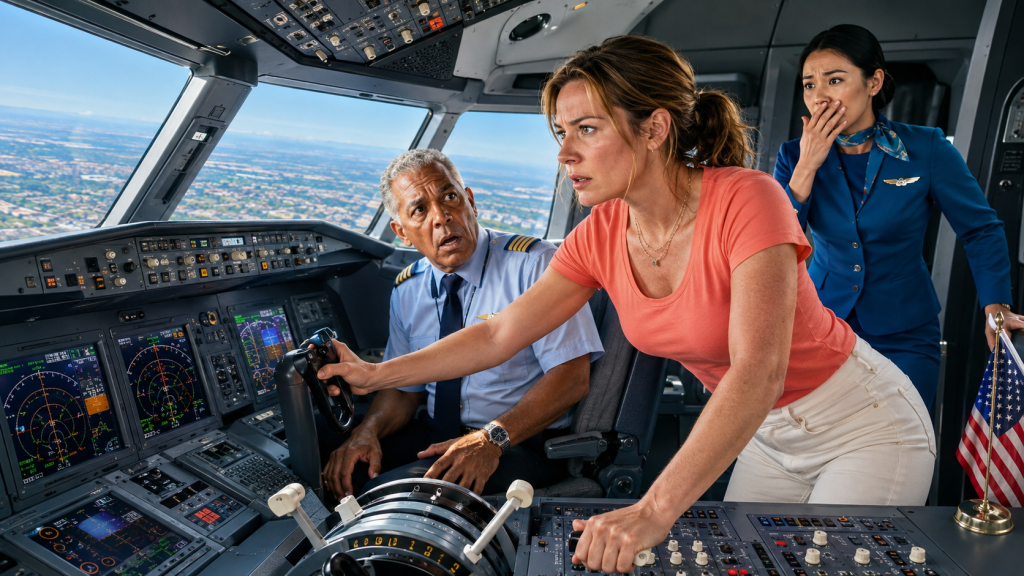
The cockpit looked worse than I expected.
Warning lights glowed everywhere.
Reed’s hands were clamped around the control column.
His knuckles were white.
Jennifer pushed the jump seat down.
“Sit.”
I remained standing long enough to look at the instruments.
Bank angle forty-one degrees right.
Altitude twenty-eight thousand feet and falling.
Airspeed increasing.
Hydraulic pressure nearly nonexistent.
Reed glanced at me.
“Who the hell are you?”
“Sarah Mitchell.”
Nothing.
Then I added, “Edwards.”
Jennifer froze.
Reed stared at me.
I could tell he recognized the name, but there wasn’t time to ask from where.
I pointed toward the overhead panel.
“Your hydraulics aren’t behaving like three independent failures.”
Reed’s jaw tightened.
“All pressure is gone.”
“I can see that.”
“Then you know we’re finished.”
“No.”
I pointed toward a small cycling indication.
“That valve is still moving.”
Jennifer followed my finger.
“It shouldn’t be.”
“Exactly.”
Reed shook his head.
“We’ve run every checklist.”
“I’m not asking about the checklist.”
His eyes flashed angrily.
“With all due respect, whoever you are—”
“Thirty-two years ago, I flew an experimental transport with a modified control architecture built around the same mechanical principles. We lost hydraulic assistance at twenty-nine thousand feet.”
Jennifer stared at me.
“What happened?”
“We landed.”
That got Reed’s attention.
“How?”
“Manual control. Stabilizer trim. Differential thrust. And we stopped trying to make the airplane behave like the hydraulics still worked.”
The cockpit went quiet except for alarms.
Reed stared at his dead controls.
“Manual reversion requires control movement.”
“Yes.”
“We have almost none.”
“Because you’re fighting the aerodynamic load at this speed.”
Jennifer understood first.
“Slow the aircraft.”
I nodded.
“As much as we safely can. Reduce the force on the surfaces.”
Reed looked at the airspeed.
“We’re descending in a forty-degree bank.”
“Then reduce thrust gradually, not all at once. Jennifer, trim nose up in short bursts. Captain, stop wrestling the wheel. You’re exhausting yourself.”
Reed’s expression hardened.
“This is my aircraft.”
“Yes, Captain.”
I held his gaze.
“And you are going to land it.”
Something in that sentence changed him.
Not much.
Just enough.
He nodded once.
“Tell me what you need.”
“Thrust back two inches.”
Jennifer moved the throttles.
The engines softened.
“Again.”
She reduced power.
Airspeed slowly decreased.
“Trim.”
Jennifer touched the electric trim switches.
Nothing.
“Manual wheel.”
She grabbed the large stabilizer trim wheel beside the center console.
It resisted.
“Both of us.”
I reached forward.
Thirty-two years vanished.
Suddenly I could smell smoke again.
Hear Colonel Ames screaming over the radio.
See desert spinning beyond the canopy.
My scarred hands closed around the wheel.
“Pull.”
Jennifer and I hauled together.
The trim wheel moved half an inch.
Then another.
The nose responded almost imperceptibly.
Reed saw it.
“I’ve got pitch response.”
“Good.”
The right bank remained.
“Now the hard part.”
Reed tried left control input again.
Almost nothing.
“Not enough.”
“It will be.”
I watched the airspeed.
“Wait.”
The number decreased.
Two hundred ninety knots.
Two seventy.
Two fifty.
The control forces should have been dropping.
“Now.”
Reed turned left.
The wheel moved slightly farther.
The aircraft hesitated.
The bank stopped increasing.
Jennifer gasped.
“Bank holding forty.”
“Again.”
Reed pulled harder.
The aircraft shook.
“Come on,” he whispered.
Thirty-nine degrees.
Thirty-eight.
Jennifer looked at me.
“It’s coming back.”
“Don’t celebrate.”
Reed kept the pressure steady.
Thirty-five.
Thirty-two.
Thirty.
From the cabin came a sound louder than screaming.
People cheering.
They had felt it too.
The floor was becoming level.
Reed exhaled slowly.
“We have partial manual roll.”
“Exactly.”
“What caused the lock?”
“I don’t know yet.”
“You said the hydraulics are trapped.”
“I said they’re behaving like they’re trapped.”
Jennifer pointed to the cycling valve.
“It’s still oscillating.”
I studied it.
The old memory returned.
Not the crash.
The investigation afterward.
An engineer named Harrison standing in a hangar at three in the morning, explaining how a seemingly unrelated pressure-control valve had caused fluid to bypass the actuators under an exact combination of load, temperature, and sensor failure.
A one-in-a-million chain.
The kind pilots hate because one-in-a-million events happen every day when enough airplanes are flying.
“Jennifer, pull the flight-control breaker for the auxiliary pressure management circuit.”
She hesitated.
“That’s not in the procedure.”
“I know.”
Reed looked at me.
“What happens if you’re wrong?”
“We lose a monitoring circuit that isn’t helping us anyway.”
“And if you’re right?”
“That valve stops cycling.”
Jennifer found the breaker.
Reed nodded.
“Do it.”
She pulled it.
The cockpit alerts changed instantly.
The cycling indication froze.
Three seconds later, the standby pressure needle twitched.
Jennifer leaned forward.
“Did you see that?”
“Again,” I said.
Pressure rose slightly.
Then fell.
Reed frowned.
“We’re still losing fluid.”
“Maybe.”
I watched the indication.
“No. It’s trying to build.”
Jennifer studied the reservoir quantity.
“Standby quantity is low but not empty.”
“Then we may have one surviving circuit isolated from the leak.”
Reed looked toward the emergency checklist.
“We already activated standby.”
“It couldn’t pressurize while that valve kept dumping the command.”
“Can we get it back?”
“Maybe enough for rudder.”
Jennifer reset the standby pump.
The pressure gauge climbed.
Slowly.
Painfully.
Five hundred psi.
Eight hundred.
Twelve hundred.
Reed touched the rudder pedals.
The airplane answered.
Not much.
But it answered.
He laughed once.
It sounded half insane.
“I have rudder.”
“Then you have options.”
Air traffic control called.
“Southwest 2891, Portland Center. Say status.”
Reed pressed the microphone.
“Portland Center, 2891. We have regained limited manual flight control and partial standby hydraulic pressure.”
There was a pause.
The controller’s voice sounded stunned.
“2891, confirm aircraft is controllable?”
Reed looked at me.
I shook my head.
“Limited.”
He repeated it.
“Limited control only.”
“2891, Portland International is sixty-one miles northwest. Runway two-eight left available. Emergency equipment standing by.”
I looked at the navigation display.
Portland was possible.
Seattle was not.
Reed glanced at me.
“Can we turn sixty miles?”
“Very gently.”
“And land?”
I looked at the instruments.
That was a different question.
Manual reversion at altitude was one thing.
Landing a crippled 737 meant getting low, slow, configured, aligned, and stopped without knowing which systems might disappear next.
“We can try.”
Reed actually smiled.
“That’s the first optimistic thing you’ve said.”
“I said try.”
Jennifer laughed nervously.
“Phoenix apparently doesn’t do reassurance.”
“Never did.”
She looked at me.
“You really were Phoenix?”
“Long time ago.”
“I heard stories about you at Pensacola.”
“Half of them were lies.”
“What about the test jet that lost primary flight controls over California?”
I said nothing.
Jennifer’s expression changed.
“That was you.”
Reed looked between us.
“You two want to save the reunion for the ground?”
“Absolutely,” I said.
Portland Center gave us a broad turn.
Normally, a twenty-degree bank would have been effortless.
Now Reed used both hands and his shoulders.
Jennifer adjusted thrust asymmetrically.
More power on the right engine helped push the nose left.
Less on the left reduced the resistance.
I coached them through it.
“Small changes. Let the aircraft answer before you make another.”
The airplane slowly turned.
Inside the cabin, Claire and the other attendants moved through rows that had transformed into scenes of raw human emotion.
One man was recording a video for his children.
A woman clutched a wedding ring in both hands and prayed.
The little boy across from my seat had stopped crying.
He was asking his mother whether airplanes could get tired.
She told him yes.
Sometimes airplanes got tired.
But good pilots helped them home.
I would learn about that later.
At twenty thousand feet, the standby pressure began dropping again.
Jennifer spotted it.
“Phoenix.”
I hated hearing the name now.
Not because I disliked it.
Because whenever people called me Phoenix, something was usually on fire.
“Quantity?”
“Still stable.”
“Pressure fluctuation?”
“Two hundred psi.”
“Temperature?”
“Rising.”
“Pump is overheating.”
Reed looked at me.
“Shut it down?”
“If it fails permanently, we lose what little rudder assistance we have.”
“If we leave it running, it may burn itself out.”
“Cycle it.”
Jennifer switched the pump off.
Immediately, rudder assistance disappeared.
Reed grunted.
“Aircraft wants right.”
“Use thrust.”
He increased power slightly on the right engine.
The nose returned.
We waited thirty seconds.
Jennifer switched the pump on again.
Pressure returned.
“Good,” I said. “We ration it.”
Reed stared ahead.
“You sound like you’ve done this before.”
“I told you I have.”
“No. Not something similar.”
I looked at him.
“The same.”
Neither pilot spoke.
Thirty-two years earlier, my aircraft had been called Raven Six.
Officially, it was a heavily modified transport platform used to test control systems for future military aircraft.
Unofficially, it was a flying laboratory.
We took it up over the Mojave Desert one Tuesday morning with six people aboard.
Twenty-three minutes into the flight, every powered flight-control system quit within nine seconds.
The aircraft rolled right.
Forty degrees.
Then fifty.
The ground filled the windshield.
The flight engineer told me to eject.
I refused because the four engineers behind me did not have ejection seats.
I stayed.
We discovered manual control became possible only after slowing dramatically and using asymmetric thrust.
We landed with twelve feet of one wing missing after striking runway lights.
The Air Force awarded me a medal.
The doctors gave me six surgeries.
The fire left scars across my hands and forearms.
Reporters never heard about it.
The project remained classified for years.
When it was finally declassified, almost nobody cared.
By then I had retired.
Married.
Buried my husband.
Raised two daughters.
Taught aviation safety seminars for a while.
Then disappeared into an ordinary life.
I thought Phoenix had died quietly.
Apparently not.
At fifteen thousand feet, Portland appeared through scattered clouds.
I could see the Columbia River.
The airport.
The long strips of runway.
Emergency vehicles were already lining the field.
Reed looked at the landing checklist.
“We need gear.”
Jennifer stared at him.
“Hydraulic extension may not work.”
“Alternate extension.”
I nodded.
“Gravity drop.”
Jennifer reached for the alternate gear system.
Nothing happened at first.
Then we heard a heavy thud under the floor.
One green indication.
Then another.
The nose gear light remained dark.
“Come on,” Jennifer whispered.
She cycled the release.
Nothing.
Reed’s voice became flat.
“Nose gear not confirmed.”
Portland Center asked for souls on board and fuel remaining.
Jennifer answered.
“One hundred eighty-seven souls. Approximately two hours fuel.”
Reed looked at me.
“Can we land without the nose gear?”
“Yes.”
Jennifer stared at me.
“You answered that fast.”
“I’ve done that too.”
She shook her head.
“Of course you have.”
I leaned toward the panel.
“But first we make sure it’s actually up.”
Jennifer requested a low approach for visual confirmation.
Air traffic control coordinated with the tower.
Reed turned slowly toward Portland.
Every movement required planning.
No quick corrections.
No aggressive turns.
No normal approach.
The aircraft was no longer something they commanded.
It was something they negotiated with.
At five thousand feet, we lined up several miles from the runway and descended toward the tower.
Airport firefighters watched through binoculars.
Tower controllers stood at the windows.
People along nearby roads pulled over after emergency alerts began spreading online.
News helicopters were ordered away from the airspace.
The 737 passed the tower at four hundred feet.
“Southwest 2891,” the tower called, “we have visual confirmation. Main gear appears down. Nose gear doors open. Nose gear appears partially extended but not locked.”
Jennifer closed her eyes briefly.
Reed whispered a curse.
I looked at the airspeed.
“We climb.”
Reed turned toward me.
“With what?”
“Thrust.”
“We barely made that approach.”
“And now we know what we have.”
He pushed the throttles forward carefully.
The engines roared.
The aircraft climbed.
Three hundred feet.
Five hundred.
Eight hundred.
Every foot was work.
At fifteen hundred feet, we leveled.
Jennifer examined the nose-gear procedure.
“If we can create enough negative load—”
“No.”
Reed looked at me.
“You didn’t even let her finish.”
“Because we are not pushing this airplane over to shake the nose gear down.”
“What would you do?”
I thought about it.
“Yaw.”
Jennifer immediately understood.
“Swing the nose.”
“Gently.”
“Use inertia.”
“Exactly.”
Reed frowned.
“With one partially functioning rudder system?”
“With thrust.”
Jennifer looked at him.
“If we alternate power, we might be able to shake the gear into lock.”
Reed considered it.
“That could also worsen the control problem.”
“Yes.”
Silence.
Then Reed nodded.
“Let’s do it.”
We moved away from the airport.
Jennifer shut the standby pump off to cool it.
Reed stabilized the aircraft manually.
Then we began.
Right engine power increased.
The nose moved left.
Power reduced.
Left engine increased.
The nose swung right.
Once.
Twice.
Three times.
Nothing.
Again.
On the fifth cycle, a metallic bang echoed beneath the cockpit.
Jennifer looked at the panel.
The nose-gear light turned green.
For half a second, nobody moved.
Then Jennifer slapped the panel.
“Three green!”
Reed shouted.
“Yes!”
I felt something loosen in my chest.
Not relief.
Not yet.
But something close.
The hardest problem remained.
Landing.
Reed asked the tower for the longest runway and the lowest crosswind.
Runway 28L.
Wind 270 at six knots.
Nearly perfect.
The weather, at least, had decided not to kill us.
We had another problem.
Flaps.
Without normal hydraulic power, full flap extension was uncertain.
Electric alternate extension would be slow.
Too much flap could create control forces we could not overcome.
Too little meant higher landing speed.
We needed the compromise.
“Flaps fifteen,” I said.
Reed looked at me.
“Normally forty.”
“Normally you have hydraulic controls.”
Jennifer ran performance numbers.
“At fifteen, landing speed will be significantly higher.”
“I know.”
“Brake pressure may be limited.”
“I know.”
“We could run out of runway.”
“If we go slower and lose manual authority in the flare, runway length won’t matter.”
Reed stared at the runway in the distance.
“Flaps fifteen.”
Jennifer selected alternate flap extension.
We waited.
One degree.
Five.
Ten.
Fifteen.
The aircraft began to balloon.
Reed fought it with trim.
“Manual wheel!”
Jennifer and I grabbed it again.
The wheel spun violently under my palms.
Pain shot through my scar tissue.
For one awful second I was back in Raven Six.
Flames licking through the cockpit.
The engineer behind me screaming.
My gloves melting.
“Sarah!”
Jennifer’s voice pulled me back.
I realized I had frozen.
“Sorry.”
She looked at me.
“You okay?”
“Yes.”
I wasn’t.
But being okay had nothing to do with it.
We stabilized at one hundred seventy knots.
Fast.
Very fast.
But controllable.
Tower cleared us to land.
Reed keyed the microphone.
“Portland Tower, Southwest 2891. We are committed. No go-around capability once below one thousand feet.”
“Southwest 2891, understood. Runway 28L cleared to land. Emergency services positioned.”
Reed glanced at Jennifer.
“You ready?”
“No.”
He laughed.
“Good answer.”
Then he looked at me.
“Phoenix?”
I watched the runway.
“Let’s go home.”
The descent began.
Three miles out, the cabin crew commanded the brace position.
Heads down.
Stay down.
Passengers leaned forward.
Some cried.
Some prayed.
Some simply held hands with strangers.
Two miles.
Reed made tiny corrections using wheel pressure and engine thrust.
Jennifer guarded the throttles.
I watched airspeed and bank.
“Two knots fast.”
Jennifer reduced power slightly.
“Bank right three.”
Reed corrected.
“One dot above glide path.”
“Hold it.”
One thousand feet.
The runway filled the windshield.
The tower disappeared beneath our nose.
“Stable enough,” Reed said.
It wasn’t stable by normal standards.
Nothing about us was normal anymore.
Five hundred feet.
“Standby pressure falling.”
“Leave it.”
“Three hundred.”
The aircraft drifted right.
Reed corrected left.
Nothing.
“More left thrust differential,” I said.
Jennifer increased the right engine.
The nose moved.
“Too much.”
She reduced it.
Two hundred feet.
The ground rushed toward us.
The main landing gear seemed absurdly small.
One hundred.
“Power coming back.”
Jennifer reduced thrust.
“Don’t idle yet.”
“Seventy.”
Reed began pulling.
The control column felt like it was embedded in concrete.
“Trim!” he shouted.
Jennifer and I spun the manual wheel.
“Fifty.”
The nose rose.
“Forty.”
The right wing dropped.
“Rudder!”
“No pressure!”
“Thrust! Left engine back, right engine forward!”
Jennifer moved the throttles.
The wing leveled.
“Twenty.”
Reed pulled with everything he had.
“Ten.”
The main gear hit the runway.
Hard.
The entire airplane slammed downward.
Oxygen masks dropped.
Ceiling panels cracked.
Luggage exploded from two overhead bins.
Passengers screamed.
But the gear held.
“Speed brakes!”
Nothing.
“Manual!”
Jennifer grabbed the lever.
The spoilers responded only partially.
Reed lowered the nose.
The nose gear struck the pavement.
For one terrifying second it shimmed violently.
Then stabilized.
“Reverse!”
Both pilots pulled reverse thrust.
The engines roared.
The airplane decelerated.
One hundred fifty knots.
One thirty.
The brakes were weak.
“Pressure?”
“Accumulator only!”
“One hundred.”
Runway disappeared beneath us at breathtaking speed.
Reed stood on the pedals.
“Come on.”
Eighty knots.
The end of the runway was getting closer.
Sixty.
Fire trucks raced beside us on the taxiway.
Forty.
Reed pulled harder on the brakes.
Twenty-five.
Then, after what felt like an entire lifetime compressed into seconds, Flight 2891 stopped.
We sat motionless.
Nobody spoke.
Not Reed.
Not Jennifer.
Not me.
Every warning light continued flashing as though the aircraft did not understand the emergency had ended.
Then Jennifer began laughing.
Not politely.
Not professionally.
She laughed until tears came down her face.
Reed bent forward and pressed his forehead against the control column.
His shoulders shook.
I looked out the windshield at the runway.
Firefighters surrounded us.
Airport vehicles approached.
The sky over Portland remained impossibly blue.
Reed finally lifted his head.
“Tower,” he said into the radio.
His voice broke.
“Southwest 2891 is stopped.”
The controller answered immediately.
“Southwest 2891, emergency crews are approaching. And, Captain…”
A pause.
“Welcome to Portland.”
Reed closed his eyes.
“Good to be here.”
Then the cabin erupted.
Even through the cockpit door, we could hear it.
Cheering.
Sobbing.
People shouting.
Clapping.
Someone chanting, “We made it!”
Jennifer opened the cockpit door after emergency personnel confirmed there was no fire.
Claire stood in the galley.
Her face was streaked with tears.
She looked at Reed.
Then Jennifer.
Then me.
“You did it.”
Reed immediately pointed toward me.
“She did.”
I shook my head.
“No.”
He turned.
“Sarah—”
“You flew the airplane.”
“You told us how.”
“Jennifer kept the systems alive.”
Jennifer shook her head too.
“You’re not walking out of this like some random passenger.”
I almost smiled.
“That was my plan.”
“Terrible plan.”
The cabin was chaos.
Passengers were hugging one another.
Phones appeared everywhere.
People who had spent the last half hour composing goodbye messages were now calling the same families to tell them they were alive.
When I stepped through the cockpit door, the people in the first rows saw me.
Claire must have told them something.
Or maybe they had heard enough through the door.
A man near the front started clapping.
Then another.
Within seconds, the whole cabin was on its feet.
One hundred eighty-six people applauded.
I stopped.
I had received medals.
Military commendations.
Awards presented by generals.
Nothing had ever felt like that cabin.
A little boy pushed past his mother and walked toward me.
He was the one who had asked whether airplanes got tired.
He looked at my scarred hands.
“Are you the lady who fixed the airplane?”
I crouched carefully.
“No.”
He looked disappointed.
“The pilots did that.”
His mother smiled through tears.
“But you helped them.”
I nodded.
“A little.”
The boy considered this.
“Are you a pilot too?”
“Once.”
“What was your airplane called?”
I looked at his mother.
She shrugged.
I smiled.
“People used to call me Phoenix.”
His eyes widened.
“Like the fire bird?”
“Exactly.”
“That’s cool.”
“Sometimes.”
He hugged me without warning.
I froze.
Then hugged him back.
Outside, television crews were already gathering beyond the airport fence.
The first videos from inside the cabin had reached social media before we even stopped rolling.
A passenger had recorded Captain Reed’s announcement.
Another had filmed me standing in the aisle.
Someone else captured Jennifer opening the cockpit door and shouting, “Who said Phoenix?”
By the time emergency stairs reached the aircraft, millions of people were watching fragments of our disaster online.
I knew nothing about that yet.
All I wanted was solid ground.
When my boots touched the tarmac, I stopped.
For thirty-two years I had dreamed about climbing out of Raven Six.
In the dream, I always looked back and saw fire.
This time I looked back and saw an intact airplane.
Passengers descending.
Firefighters smiling.
A little boy waving.
Jennifer appeared beside me.
“You disappeared after Edwards.”
“I retired.”
“People wondered what happened to you.”
“Life.”
“You realize the entire world is about to know.”
I sighed.
“That’s unfortunate.”
She laughed.
“You just helped save 187 people and your reaction is ‘unfortunate’?”
“I hate cameras.”
Captain Reed climbed down behind us.
He walked directly to me.
For a moment, I thought he was going to shake my hand.
Instead, he hugged me.
Hard.
“My wife would have buried me tomorrow.”
I swallowed.
“But she won’t.”
He stepped back.
“I told those passengers we were going to die.”
“You told them what you believed.”
“I gave up.”
“No.”
He looked at me.
“You made a mayday call. You ran the procedures. You fought the airplane until you thought you had nothing left.”
“I did have something left.”
“Yes.”
I smiled faintly.
“You had a stubborn old woman in 14C.”
Reed laughed so hard he had to bend forward.
The investigation began before sunset.
The aircraft was surrounded by engineers, investigators, airline representatives, and federal officials.
They found the first clue in the tail section.
A damaged pressure-management assembly had entered an abnormal cycling state after a sensor malfunction.
That alone should not have disabled the airplane.
But a maintenance-installed fitting had been improperly seated during the recent inspection.
Under ordinary pressure, it held.
Under the unusual cycling loads, it shifted.
Fluid began bypassing multiple control circuits through interconnected emergency components that were never supposed to experience that failure sequence.
One failure.
Then another.
Then another.
The probability was almost absurd.
But improbable was not impossible.
The breaker Jennifer pulled had stopped the cycle.
The standby pump then regained enough isolated pressure to help with rudder control.
Investigators later estimated we had fewer than six minutes before the remaining pump would likely have overheated completely.
Six minutes.
That was our margin between an impossible landing and a crater somewhere south of Portland.
News outlets wanted interviews.
I refused them all.
For twenty-four hours.
Then my oldest daughter, Amanda, called me.
She lived in Denver and had learned about the incident from television.
She did not say hello.
She shouted.
“Mom!”
I held the phone away from my ear.
“Hi, sweetheart.”
“Do not ‘hi, sweetheart’ me! You were on that airplane?”
“Yes.”
“You went into the cockpit?”
“Yes.”
“You nearly crashed?”
“Technically, everyone nearly crashed.”
“That is not helping!”
I smiled.
Amanda started crying.
My younger daughter joined the call from Boston.
“You told us you stopped flying because you got bored.”
“I simplified.”
“You got burned in a classified crash!”
“It was not technically a crash.”
“Mom!”
I sat at my kitchen table after finally returning home.
For the first time in years, I opened the old wooden box I kept inside the hallway closet.
My Air Force wings were inside.
A photograph of Raven Six.
A medal.
A newspaper clipping that mentioned an unnamed test incident without identifying anyone involved.
And one faded patch.
A red bird rising through gold flames.
PHOENIX.
I held it for a long time.
Three days after Flight 2891, Captain Reed and Jennifer visited me.
No reporters.
No cameras.
Jennifer carried a bottle of sparkling cider because she said she had been warned I barely drank.
Reed carried something wrapped in brown paper.
We sat on my porch as evening settled over the neighborhood.
Reed handed me the package.
Inside was a framed copy of Flight 2891’s passenger manifest.
One hundred eighty-seven names.
At the bottom, every surviving passenger and crew member had signed it.
I stared at the signatures.
There were messages written around the margins.
Thank you.
You gave me my father back.
My daughter turned seven today because you stood up.
I finished the call I thought would be my last.
You reminded us not to quit.
One note was written in thick blue marker.
AIRPLANES GET TIRED, BUT GOOD PILOTS HELP THEM HOME.
I laughed when I saw it.
“The kid?” Jennifer asked.
“The kid.”
Reed leaned back in his chair.
“The airline wants to offer you anything you want.”
“I don’t want anything.”
“I told them you’d say that.”
Jennifer smiled.
“The Air Force also called.”
I looked at her.
“Who?”
“General Whitaker.”
I almost dropped the frame.
“Danny Whitaker?”
“Apparently.”
“He was a lieutenant when I retired.”
“He’s not anymore.”
“What does he want?”
Jennifer grinned.
“He said, and I quote, ‘Tell Phoenix she has ignored my last three phone calls and I outrank her now.’”
I laughed.
For the first time in years, the sound came without effort.
Two weeks later, I went back to Edwards Air Force Base.
Not because anyone ordered me.
Nobody could anymore.
I went because I realized there was a difference between leaving the past behind and spending your life running from it.
They had restored one of the old test hangars.
Young pilots trained there now.
Men and women who had not even been born when Raven Six almost killed us.
General Daniel Whitaker met me near the flight line.
He was sixty now.
Gray-haired.
Broad-shouldered.
Still smiling like the twenty-four-year-old lieutenant who used to bring bad coffee into briefing rooms.
“Phoenix.”
“Danny.”
He saluted.
I stared at him.
“You cannot be serious.”
He kept his hand raised.
So I saluted back.
Then he hugged me.
“You old lunatic.”
“You outrank me now, apparently.”
“Damn right.”
He led me into a training auditorium.
Two hundred test pilots, engineers, and flight-control specialists were waiting.
I stopped at the doorway.
“What is this?”
“A safety seminar.”
“You tricked me.”
“Yes.”
“I hate public speaking.”
“You helped land a crippled airliner in front of the entire internet. You’ll survive PowerPoint.”
On the screen behind the stage was a photograph.
Not of Flight 2891.
Raven Six.
The old burned aircraft sitting beside the desert runway thirty-two years earlier.
Underneath were three words.
NEVER STOP FLYING.
I stood there for a long time.
Then I walked to the podium.
The room became silent.
I looked at the young faces.
Some nervous.
Some confident.
Some probably convinced skill would protect them from every mistake and every failure.
I remembered feeling that way.
“Thirty-two years ago,” I began, “I learned the most important lesson aviation ever taught me.”
Nobody moved.
“Machines fail.”
I looked across the room.
“Procedures fail.”
“Plans fail.”
“Sometimes even confidence fails.”
I paused.
“But as long as you still have altitude, time, movement, or one working system, you have something to use.”
Behind me, Raven Six remained frozen on the screen.
“I survived that flight because six frightened people kept thinking after the checklist ended.”
Then the image changed.
Flight 2891 sat safely on the runway in Portland.
“Last Friday, 187 people survived because Captain Thomas Reed and First Officer Jennifer Parker did the same thing.”
Afterward, one of the youngest pilots approached me.
“Colonel Mitchell?”
“Retired colonel.”
“Yes, ma’am.”
He hesitated.
“Is it true you weren’t afraid on Flight 2891?”
I laughed.
“Who told you that?”
“The news.”
“Then the news is wrong.”
He looked surprised.
“I was terrified.”
“But you stood up.”
“Yes.”
“How?”
I looked toward the runway outside.
Aircraft moved in the afternoon sun.
“Courage isn’t what happens when you stop being afraid.”
He waited.
“It’s what happens when being afraid stops being the most important thing in the room.”
Six months later, the final investigation report praised the crew’s extraordinary resource management and identified the rare mechanical chain that caused the emergency.
New inspection procedures were issued.
The faulty components were redesigned.
Training programs incorporated expanded scenarios for manual flight-control recovery.
Captain Reed returned to flying after several months.
His first flight back was Portland to Seattle.
He asked me to come.
I declined.
Then Jennifer called.
“Phoenix.”
“No.”
“I haven’t asked yet.”
“You’re going to ask me to fly with him.”
“Yes.”
“No.”
“Seat 14C.”
I hung up.
She called again.
I answered.
“What?”
“The little boy will be there.”
I sighed.
“You people fight dirty.”
A week later, I sat in 14C again.
Same type of aircraft.
Different registration.
Different day.
The little boy sat across the aisle with his mother.
When he recognized me, his face lit up.
“You came!”
“Apparently I make bad decisions.”
He didn’t understand the joke.
His mother did.
Before departure, Captain Reed stepped out of the cockpit.
He addressed the passengers.
“Ladies and gentlemen, welcome aboard. Some of you may recognize a passenger sitting in row fourteen.”
Every head turned.
I closed my eyes.
Reed continued.
“She has specifically asked me not to make a big deal about her being here.”
People laughed.
“So naturally, I’m going to completely ignore that.”
More laughter.
I pointed toward him.
“You’re going to regret this.”
He smiled.
“Probably.”
Then his expression softened.
“Six months ago, I made an announcement aboard another aircraft that I thought would be the last thing I ever said.”
The cabin went silent.
“Today I get to make a different one.”
He looked at me.
“We are going to Seattle.”
Applause broke out.
I shook my head.
But I was smiling.
Reed returned to the cockpit.
The doors closed.
The engines started.
As we accelerated down the runway, I expected fear.
Instead, I felt something I had not felt in thirty-two years.
Peace.
The airplane lifted into the sky.
The boy across the aisle pressed his face against the window.
“Phoenix!”
His mother whispered, “She has a real name, sweetheart.”
He looked embarrassed.
I leaned toward him.
“It’s okay.”
He pointed outside.
“We’re flying.”
“Yes.”
“Are you scared?”
I looked through the window.
Clouds drifted below us.
Mountains rose ahead.
The wings were level.
“No.”
“Why?”
I smiled.
“Because this time I’m just a passenger.”
He nodded as if that made perfect sense.
Then he went back to watching the clouds.
I rested my scarred hands in my lap.
For most of my life, I believed survival meant escaping the thing that almost destroyed you.
I was wrong.
Sometimes survival means returning to it without letting it own you anymore.
Thirty-two years ago, the Air Force called me Phoenix because I walked away from a burning airplane.
But that was never why the name mattered.
A phoenix is not remembered because it burns.
It is remembered because it rises.
And on the day 187 people were told they were going to die, an old pilot in seat 14C remembered how to rise one more time.
💬THE END! THANK YOU FOR READING!