
 Reading Time: 13 minutes
My name is Margaret, I am seventy-three years old, and for most of my life, I believed being a good mother meant always being available.
If one of my children needed money, I found a way.
If they needed a ride, I drove.
If they needed someone to watch the grandchildren, I rearranged my plans.
If they called at midnight because they were frightened, angry, heartbroken, or simply bored, I answered.
I never kept score.
That was my mistake.
I raised three children in Seattle: Victoria, Lucas, and Samantha.
My husband, Thomas, and I gave them everything we could.
We weren’t wealthy when they were young. Thomas worked long hours managing a construction company, and I worked part-time from home while raising the kids.
Our house was modest back then.
But it was warm.
Every Christmas, the dining room smelled like cinnamon and roast turkey. Every Thanksgiving, we squeezed too many people around one table. Every birthday ended with someone laughing so hard that everyone else started laughing too.
Those were the memories I carried with me.
After the children grew up, Thomas and I continued helping them.
We paid part of Victoria’s wedding.
We helped Samantha with her graduate school loans.
We gave Lucas $75,000 when he wanted to start a technology company.
When Lucas’s company struggled, Thomas and I quietly covered several months of his expenses.
When Victoria’s husband lost his job, we helped with their mortgage.
When Samantha’s daughter needed an expensive dental procedure, I paid the bill without asking for repayment.
I never complained.
They were my children.
What else was I supposed to do?
Then Thomas died.
He was sixty-six.
A heart attack.
One moment he was standing in the garage talking about repairing the old lawn mower, and the next moment my entire world had changed.
At his memorial, my three children stood beside me.
Victoria held my hand.
Lucas hugged me.
Samantha cried against my shoulder.
“We won’t let you be alone, Mom,” Victoria promised.
Lucas nodded.
“You have us.”
Samantha squeezed my hand.
“Always.”
For a while, they kept their promise.
Then life became busy.
At first, Victoria visited every Sunday.
Then it became every other Sunday.
Then once a month.
Lucas used to call three times a week.
Eventually, I realized I was the one making every call.
Samantha always said she was exhausted.
Victoria was always in meetings.
Lucas was always traveling.
I understood.
I told myself they were adults with responsibilities.
I didn’t want to be the mother who demanded attention.
So I accepted the distance.
Then one morning, I woke up with crushing pressure in my chest.
My first thought was Thomas.
I was suddenly terrified.
I called 911.
The paramedics took me to the hospital.
The doctors kept me overnight because my heartbeat was irregular.
Lying alone in that hospital room, I reached for my phone.
I called Victoria.
She answered several hours later.
“Mom, I’m in the middle of something. What happened?”
“I’m at the hospital.”
There was a pause.
“Are you okay?”
“I don’t know yet.”
“I’ll call you later.”
She never came.
Lucas texted that night.
Get some rest. Let me know what the doctor says.
Samantha replied the next morning.
Reach out if you need anything.
Nobody came.
The hospital discharged me the following afternoon.
I took an Uber home alone.
The driver walked me to my porch because I was unsteady on my feet.
He looked at me and said, “Are you sure someone is waiting inside?”
I looked at my empty house.
“Yes,” I lied.
The truth was, nobody was.
That evening, I sat at the kitchen table with my prescriptions in front of me.
And for the first time, I started paying attention.
Not to what my children said.
To what they actually did.
Victoria called two days later.
“Mom, how are your investments doing?”
I was quiet.
“My investments?”
“Dad’s trust. Did Richard send you the latest report?”
Richard Vance had been Thomas’s longtime wealth manager.
“Yes.”
“Good. You should probably make sure everything is organized.”
A week later, Lucas called.
“Have you updated your will?”
I stared at the wall.
“Why?”
“Because you’re getting older.”
That sentence hurt more than I expected.
Samantha was even more direct.
“You know, Mom, assisted living isn’t necessarily bad. There’s a really nice place near me.”
“I don’t want assisted living.”
“You can’t stay in that big house forever.”
“I can for as long as I want.”
She sighed.
“You’re being emotional.”
I finally asked the question that had been sitting in my heart.
“Do you three care about me, or do you care about what happens to my money?”
Nobody answered.
So I arranged a group call.
All three children joined.
I told them about the hospital.
“I was scared,” I said. “I thought I might die.”
Victoria sighed.
“Mom, please don’t make this dramatic.”
“I was alone.”
“We checked on you.”
“You sent texts.”
“What did you want us to do?” Lucas asked.
“Come.”
Silence.
Then Lucas said something I will never forget.
“Mom, we have our own lives to live.”
Samantha agreed.
“You can’t expect us to drop everything every time you’re worried.”
Victoria added, “You have plenty of money. Hire someone.”
I waited for one of them to say something kind.
Nobody did.
I ended the call.
Then I cried.
I cried until sunrise.
But when the sun came through the kitchen window, something inside me had changed.
I called David Sterling.
David had been Thomas’s estate attorney.
“I need to make some changes,” I told him.
“What kind?”
“All of them.”
For three weeks, David and I went through my estate.
We changed my medical proxy.
Victoria was removed.
Lucas was removed as successor trustee.
Samantha lost access to several financial authorizations.
I appointed an independent fiduciary.
I established educational trusts for my grandchildren.
I created charitable donations for organizations Thomas and I had supported.
And I protected my property.
My Seattle home was worth nearly $950,000.
My savings were around $500,000.
Thomas had also left me an investment trust that had grown to approximately $1.4 million.
But there was something my children didn’t know.
The trust wasn’t simply an account.
It was structured to protect the principal from outside control.
And David discovered something else while reviewing the records.
Several unusual transactions had been made from accounts connected to my household.
They weren’t enormous individually.
But together, they were concerning.
I called Richard Vance.
“Richard, I need a complete audit.”
He sounded surprised.
“Margaret, I’ve managed these assets for years.”
“I know.”
“Did something happen?”
“Yes.”
“What?”
“My children.”
There was a long pause.
“I understand.”
But his voice sounded different.
Too careful.
David noticed it too.
“We’re going to transfer management,” he told Richard.
Richard immediately became defensive.
“You don’t need to do that.”
“I think we do.”
We transferred the investments to a corporate trust service.
Then David reviewed the old records.
And that was when we found it.
A series of documents I had never seen.
Requests for beneficiary information.
Draft authorization forms.
A proposed property-management agreement.
And one document titled:
Family Asset Consolidation Proposal.
The document suggested transferring my house and several accounts into a structure controlled by a family representative.
That representative was Lucas.
I stared at the page.
“I never signed this.”
David nodded.
“You didn’t.”
“Then why does it exist?”
“I don’t know yet.”
But we would find out.
I changed my locks.
Changed the gate code.
Installed security cameras.
Added a monitored alarm system.
And most importantly, I stopped calling my children.
I didn’t announce it.
I didn’t send a dramatic message.
I simply stopped.
One week passed.
Then two.
Then four.
No calls.
No visits.
Nothing.
After two months, I realized something painful.
I wasn’t being ignored because I had done something wrong.
I was being ignored because I had stopped being useful.
Three months passed.
Then, two weeks before Christmas, my phone rang.
Victoria.
I answered.
“Mom!”
Her voice was unusually cheerful.
“We’re coming to your house on the twenty-third.”
I looked out the window.
“Why?”
“We’re bringing everyone.”
“Everyone?”
“The spouses. The kids. All of us.”
“That sounds nice.”
“It will be just like old times.”
I almost laughed.
“Why now?”
There was a pause.
“We’re worried about you.”
“I’ve been fine.”
“Mom, Lucas found a wonderful assisted-living community near Samantha.”
“I told Samantha I wasn’t moving.”
“You haven’t seen it.”
“I don’t need to.”
Victoria’s voice became sharper.
“You can’t live alone forever.”
“I can make my own decisions.”
“We’ll talk when we get there.”
“No.”
“What?”
“I don’t want you coming.”
She laughed.
“You can’t be serious.”
“I am.”
“We already made plans.”
“Then change them.”
The call ended.
That afternoon, I called my security company.
I wasn’t afraid of my children.
But I was no longer willing to pretend they respected my boundaries.
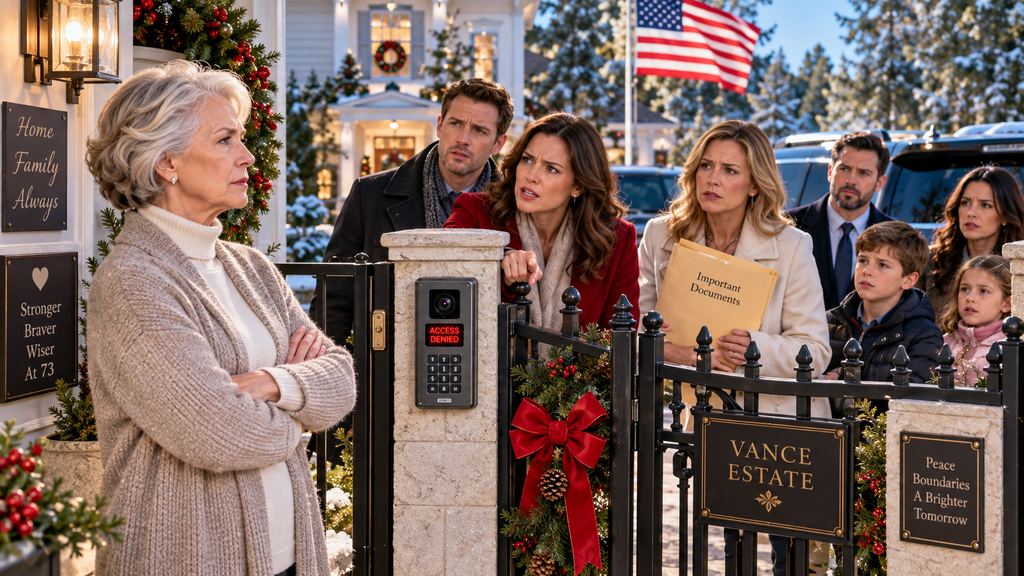
On December twenty-third, at exactly two in the afternoon, my security camera sent me an alert.
Three SUVs had stopped outside my gate.
Victoria stepped out.
Lucas followed.
Samantha was behind them.
Their spouses and grandchildren remained in the vehicles.
Lucas walked to the keypad.
He punched in the code he’d used for ten years.
The keypad blinked red.
Access denied.
He tried again.
Red.
Victoria looked at him.
“What happened?”
Lucas tried a third time.
Denied.
He looked toward the security camera.
Then he smiled.
“Mom probably changed it.”
Victoria pressed the intercom.
“Mom, open the gate.”
I didn’t answer.
She pressed again.
“Mom!”
I finally activated the speaker.
“What do you want?”
Victoria smiled.
“We’re here for Christmas.”
“I didn’t invite you.”
Her smile disappeared.
“That’s not important.”
“It is to me.”
Lucas stepped forward.
“Mom, this is ridiculous.”
“Why?”
“We need to talk.”
“About what?”
Samantha held up a manila folder.
“Routine paperwork.”
My stomach tightened.
“What paperwork?”
“Nothing serious,” she said.
“Then you can mail it.”
Victoria interrupted.
“We need your signature.”
“For what?”
Nobody answered.
I watched them through the camera.
Then I noticed something.
They weren’t dressed like people arriving for Christmas dinner.
They were dressed like people attending a business meeting.
Lucas carried a leather briefcase.
Victoria had another folder.
Samantha had her tablet.
And one of Lucas’s friends from his company was standing near the third SUV.
I called David.
“Can you come?”
“I’m already on my way.”
Twenty minutes later, David arrived with another attorney from his firm.
He walked outside with me.
I stood behind the locked gate.
Victoria saw him.
Her expression changed immediately.
“Mom, why is your lawyer here?”
“Because you brought paperwork.”
Lucas stepped forward.
“It’s just an authorization.”
“Authorization for what?”
“For managing certain things if you become unable to.”
“I already appointed an independent fiduciary.”
Lucas looked at Samantha.
Samantha looked at Victoria.
Then Victoria said,
“You don’t need lawyers between family members.”
David calmly replied,
“She does if family members are asking her to sign legal documents.”
Victoria’s face hardened.
“Mom, we’re trying to help.”
“No.”
“You’re being paranoid.”
“No.”
Lucas raised his voice.
“You can’t shut us out like this!”
I looked at him.
“You told me you had your own life.”
He froze.
“You said I called too much.”
“That isn’t what I meant.”
“You told me to hire someone.”
His face changed.
“I was frustrated.”
“So was I.”
Samantha stepped forward.
“Mom, please. We brought the grandchildren. Don’t ruin Christmas.”
I looked through the gate at my grandchildren.
They looked confused.
They hadn’t done anything wrong.
I loved them.
But I wouldn’t let their innocence become a weapon against me.
“I didn’t ruin Christmas,” I said. “You came here demanding something.”
Victoria’s voice became cold.
“Fine. We need your signature on the property management authorization.”
“No.”
“Why?”
“Because I read it.”
She stared at me.
“You read it?”
“Yes.”
Lucas looked uncomfortable.
David held up a copy.
“This document would give Lucas authority to make decisions regarding the property, including financial arrangements.”
Lucas immediately said,
“That’s not what it means.”
David turned the document around.
“It is exactly what it means.”
Victoria looked at Lucas.
“You told us it was just routine.”
Lucas didn’t answer.
That was when I knew there was more.
David said,
“Margaret, there’s another issue.”
He handed me a document.
“This is from Richard Vance’s records.”
I looked at it.
It was an email.
The sender was Lucas.
The recipient was Richard.
The subject line read:
Mother’s Capacity and Future Asset Planning.
My hands started shaking.
The email asked Richard to provide detailed information about my accounts and whether my trust could be restructured.
Lucas had written:
We need to know what can be moved before Mom changes her mind.
I looked at my son.
He went pale.
“You weren’t supposed to see that.”
I stared at him.
“That’s what you were doing?”
“No.”
“You asked Richard about my money.”
“I was trying to understand the estate.”
“Why?”
“Because you’re seventy-three.”
I felt something inside me break.
Not from anger.
From disappointment.
Then David pulled out another document.
“This one is worse.”
It was a draft letter.
It claimed I had become increasingly forgetful and emotionally unstable.
It recommended that the family assume greater control of my finances.
The document had never been filed.
But someone had prepared it.
And that someone was Victoria.
She looked at me.
“Mom, we were worried.”
“You called me dramatic.”
“I didn’t mean it.”
“You said I needed assisted living.”
“You do.”
“No,” I said quietly. “You need access.”
Nobody spoke.
Then Samantha began crying.
“Mom, that’s not fair.”
I looked at her.
“You asked me whether I’d updated my will.”
She wiped her eyes.
“I was just concerned.”
“No.”
I shook my head.
“You were waiting for the answer.”
David stepped closer.
“There is one more thing.”
He handed me a bank statement.
I stared at it.
It showed payments from my investment account.
Small monthly transfers.
I hadn’t noticed them because they were buried inside management fees.
David had traced them.
The payments went to a consulting company.
The owner was Lucas’s wife.
My children had been quietly charging my accounts for “family administrative services.”
Nearly $38,000 over two years.
I looked at Lucas.
“Did you know?”
He looked down.
“Yes.”
The word was barely audible.
I felt strangely calm.
“Why?”
“We needed help.”
“With what?”
“Our business.”
“You used my money.”
“I planned to pay it back.”
“When?”
He had no answer.
I looked at all three of them.
Victoria.
Lucas.
Samantha.
The children I had spent my entire life protecting.
Then I looked at the grandchildren sitting in the SUVs.
And I realized something.
I didn’t want my grandchildren to grow up believing love meant entitlement.
So I opened the gate.
Victoria looked surprised.
I stepped outside.
But I didn’t invite them into my house.
Instead, I walked to a small table David had brought onto the porch.
I placed the documents on it.
“I want you to sign something.”
Victoria frowned.
“What?”
“Acknowledgment.”
“Of what?”
“That none of you has authority over my property, finances, medical care, or estate.”
Lucas stared at the papers.
“You’re serious?”
“Yes.”
“You’re cutting us out.”
“No.”
I looked at him.
“I’m cutting you out of decisions that belong to me.”
Samantha began crying again.
“Do you hate us?”
I shook my head.
“No.”
“Then why?”
“Because I love you enough to stop enabling you.”
Nobody spoke.
I continued.
“You told me you had your own lives to live.”
I looked at Victoria.
“So live them.”
I looked at Lucas.
“Build your business without my money.”
Then Samantha.
“Raise your children without expecting me to finance your future.”
Victoria whispered,
“What about the grandchildren?”
“They will always have a place in my heart.”
I pointed to the documents.
“I created education trusts for them.”
Lucas looked up.
“You did?”
“Yes.”
“How much?”
“That isn’t your concern.”
David smiled slightly.
“That is the point.”
My children stared at each other.
Then Lucas asked,
“Why would you leave money for our kids but not us?”
“Because your children didn’t tell me they had their own lives to live.”
That sentence silenced all three.
Christmas dinner never happened that evening.
They left.
One by one, the SUVs disappeared down the street.
I stood at the gate until they were gone.
Then I went inside.
The house was quiet.
For the first time in months, I wasn’t crying.
I made myself a cup of tea.
I sat beside the Christmas tree.
And I realized I felt something I hadn’t felt in years.
Peace.
The following weeks were difficult.
My children stopped speaking to me again.
This time, I didn’t chase them.
I didn’t send birthday messages.
I didn’t ask whether they were angry.
I didn’t apologize for protecting myself.
David finalized everything.
The family trust was secured.
The property remained mine.
The fraudulent charges were recovered through the appropriate legal process.
Richard’s involvement was investigated, and his management relationship with my family ended permanently.
I hired a new financial team.
I also hired a part-time assistant to help me with practical things.
Not because my children were right.
Because I deserved help without having to beg my children for it.
Six months passed.
Then one afternoon, I received a letter.
It was from Lucas.
He apologized.
Not for losing access to my money.
For hurting me.
He wrote that after the confrontation, he had realized how much he had confused family with financial security.
He said his business had failed shortly afterward.
For the first time, he had to solve his problems without calling me.
It had been painful.
But it had also changed him.
I wasn’t sure whether I believed him.
But I appreciated the apology.
A month later, Samantha called.
She didn’t ask about my will.
She didn’t mention the house.
She simply said,
“Mom, can I come see you?”
I looked out the window.
“Yes.”
She came alone.
She sat at my kitchen table.
For twenty minutes, we talked about nothing important.
Then she started crying.
“I missed you.”
I reached across the table.
“I missed you too.”
“I was selfish.”
“Yes.”
She laughed through her tears.
“You could at least pretend to disagree.”
“I spent seventy-three years pretending.”
She smiled.
Then she said,
“I don’t want your money.”
I looked at her.
“Good.”
“I just want my mother.”
That was the first time one of my children said exactly what I had needed to hear.
Not what they wanted.
Not what they expected.
What they meant.
Victoria eventually came too.
It took longer.
She apologized for the paperwork.
She apologized for calling me dramatic.
She apologized for treating my age like an opportunity.
I accepted her apology.
But forgiveness didn’t mean returning control.
That part never changed.
My home remained mine.
My finances remained mine.
My medical decisions remained mine.
And my estate plan remained exactly as I had designed it.
The grandchildren still received their trusts.
They still received Christmas gifts.
They still came to my house.
But now their parents understood one important boundary.
Grandma’s love was unlimited.
Grandma’s bank account was not.
A year after the day they arrived at my gate, I hosted Christmas dinner.
This time, everyone came.
My children.
Their spouses.
My grandchildren.
And me.
Before dinner, I stood at the head of the table.
Everyone became quiet.
I raised my glass.
“To family.”
Victoria smiled.
Lucas nodded.
Samantha squeezed my hand.
I continued.
“But remember something.”
They all looked at me.
“Family isn’t the person who gets your money.”
I paused.
“Family is the person who shows up when you have nothing to give.”
The room became silent.
Then Lucas stood.
“To Mom.”
Everyone raised their glasses.
I looked around the table.
For years, I had been afraid that setting boundaries would make me lose my children.
Instead, it taught us how to become a family again.
I didn’t need them to manage my life.
I didn’t need them to protect my money.
I didn’t need them to visit because they expected an inheritance.
I simply wanted them to call because they missed me.
And if they ever forgot that again, I knew what I would do.
I wouldn’t beg.
I wouldn’t chase.
I wouldn’t argue.
I would simply remember the words they once gave me.
“We have our own lives to live.”
And I would quietly live mine, too.
Because at seventy-three, I finally understood something I should have understood decades earlier:
Being a mother does not mean becoming invisible.
Being generous does not mean becoming powerless.
And loving your children does not require you to surrender yourself.
Sometimes, the strongest thing a mother can say is no.
And sometimes, that little word is exactly what saves a family.
THE END! THANKS FOR READING!