

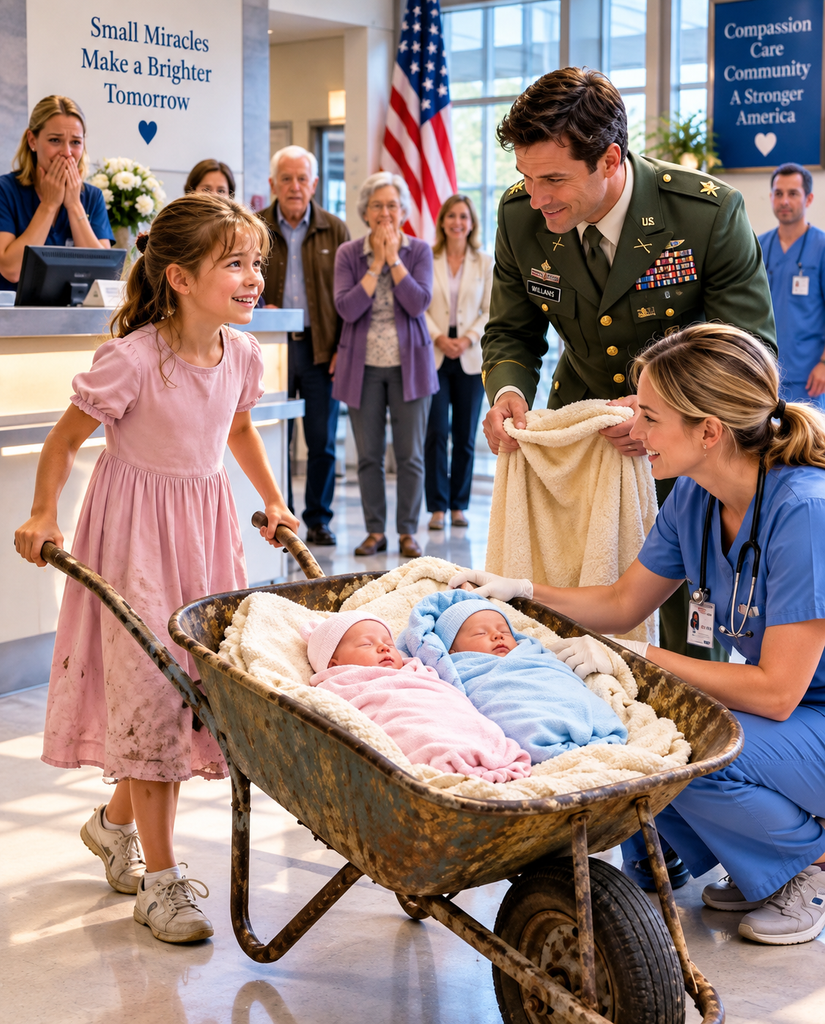
The mother was lying beside the kitchen chair, her body partially covered by an old blanket. She was breathing, but so faintly that from the doorway she had looked dead. Her skin was pale.
Her lips were dry. There were dark circles beneath her closed eyes. And beside her, on the floor, was a telephone with a dead battery. The first officer immediately called for an ambulance.
Then he noticed something else.
There were three empty baby bottles near the sink.
Three.
But the little girl had arrived at the hospital with only two newborns.
The officer’s stomach tightened.
“Where’s the other baby?”
His partner looked at him.
“What?”
“Three bottles.”
They searched the kitchen.
Then the living room.
Then the bedroom.
Nothing.
No third infant.
No crib.
No carrier.
No clothes.
Nothing.
The house was strangely quiet.
Not abandoned.
Not empty.
Just quiet in the way a house becomes quiet when something terrible has happened and nobody has been there to interrupt it.
The officer returned to the kitchen table.
The folded paper was still there.
He carefully opened it.
There were only six words written in shaky handwriting.
“If they come, don’t trust them.”
He read it twice.
Then a third time.
His partner stared over his shoulder.
“Who is ‘they’?”
“I don’t know.”
“Who wrote it?”
The officer looked toward the bedroom.
“The mother, probably.”
But something about the handwriting bothered him.
It looked hurried.
Almost desperate.
And beneath the six words was another line.
This one was written much smaller.
“My daughter knows where the truth is.”
The officer’s face changed.
He reached for his radio.
“We need detectives here. Now.”
At the hospital, nobody had told the little girl that her mother was alive.
Not yet.
The medical team was still working.
The mother had severe dehydration, dangerously low blood pressure, and signs of prolonged illness. She was unconscious, but her heart was beating.
The twins were alive too.
Barely.
One of them had a dangerously low body temperature.
The other had weak breathing and a blood sugar level that made the pediatrician immediately order additional tests.
The nurses moved quickly.
Warm blankets.
Oxygen.
Fluids.
Monitors.
Tiny fingers wrapped around adult hands.
Every few minutes, someone checked their breathing.
And every few minutes, someone looked toward the little girl sitting alone in the corner.
She had finally agreed to sit.
But she refused the hospital bed.
She sat on a plastic chair with her feet tucked underneath her.
A nurse had cleaned the blood from her heels and wrapped her palms in gauze.
Someone had given her a cup of apple juice.
She held it with both hands.
She hadn’t taken a sip.
“What’s wrong?” the nurse asked softly.
The girl looked at the cup.
“Is my mommy dead?”
The nurse’s throat tightened.
“No.”
The girl’s eyes immediately lifted.
“You know?”
“We found her.”
“Is she sleeping?”
“She’s unconscious.”
The girl stared at her.
“What does that mean?”
“It means she isn’t awake right now.”
“Can she hear me?”
The nurse hesitated.
“We don’t know.”
The girl looked toward the doors.
“Then I need to talk to her.”
“Why?”
“Because I forgot something.”
“What did you forget?”
The girl leaned closer.
“My mommy told me something before she stopped talking.”
The nurse pulled up a chair.
“What did she tell you?”
The girl looked around the room.
For the first time since arriving at the hospital, fear appeared in her expression.
Not fear for herself.
Fear that someone might overhear.
She whispered:
“She told me not to let anybody take the babies.”
The nurse frowned.
“Who would take them?”
The girl shook her head.
“I don’t know.”
“Did somebody threaten your mommy?”
Another shake.
“Did somebody come to your house?”
The girl looked down at her bandaged hands.
“Sometimes.”
“Who?”
“I don’t know his name.”
“What did he look like?”
The girl was silent.
Then she whispered:
“Like Daddy.”
The nurse froze.
“You said you don’t have a daddy.”
“I don’t.”
“Then who looked like him?”
The girl’s eyes filled with tears.
“I don’t know.”
At 4:11 p.m., the twins’ condition stabilized enough for the pediatrician to step away from the warmers.
She stood in the hallway and exhaled.
A social worker approached her.
“How bad?”
The doctor rubbed her forehead.
“They’re still critical. But they’re fighting.”
“Both?”
“Both.”
The social worker nodded.
“And the girl?”
The doctor looked through the glass.
The little girl was still sitting in the chair.
Someone had found her a pair of children’s socks.
She had refused them.
“I think she’s more frightened of leaving that chair than she is of anything else.”
“Why?”
The doctor didn’t answer.
Because she already knew.
Children who have lived through ordinary lives expect adults to solve things.
Children who have lived through extraordinary fear learn that adults sometimes disappear.
At 4:37 p.m., the detective arrived at the house.
He was an older man named Daniel Mercer, and he had spent more than twenty years investigating missing persons, domestic violence, and child neglect.
He had seen dead bodies.
He had seen abandoned children.
He had seen homes where poverty had swallowed every trace of dignity.
But when he entered this house, something immediately felt wrong.
Not because it was filthy.
It wasn’t.
The dishes had been washed.
The floor had been swept.
Baby clothes had been folded neatly on the couch.
Someone had tried very hard to keep this place functioning.
As though normal life had been performed here right up until the moment it became impossible.
Mercer walked into the bedroom.
There was a mattress on the floor.
Beside it was a stack of diapers.
A baby blanket.
An old photograph.
He picked up the photograph carefully.
It showed the mother smiling.
She looked younger.
Standing beside her was the little girl.
And behind them was a man.
Mercer stared at him.
Then he turned the photograph over.
There was writing on the back.
“Three years ago.”
Nothing else.
Mercer looked again at the man’s face.
Something about him seemed familiar.
He couldn’t place it.
Then his partner entered the room.
“We found something.”
Mercer followed him down the hallway.
They stopped beside a locked closet.
“What is it?”
“We haven’t opened it.”
“Why not?”
“Because the key was hidden under the mother’s pillow.”
Mercer looked at the small brass key in his partner’s hand.
He took it.
Inserted it into the lock.
Turned it.
Click.
The door opened.
Inside were dozens of boxes.
Baby clothes.
Medical records.
Old photographs.
Birth certificates.
And a stack of envelopes tied together with red string.
Mercer reached for the top envelope.
His name was not on it.
Nobody’s name was.
Only one word had been written across the front.
“TWINS.”
He opened it.
Inside was a photocopy of a hospital birth record.
Mercer read the names.
Then read them again.
His expression slowly changed.
“What’s wrong?” his partner asked.
Mercer didn’t answer.
He handed over the document.
The partner read it.
Then looked up.
“That can’t be right.”
“It says they were born here.”
“Then why doesn’t the hospital have them in the system?”
Mercer stared at the document.
“That’s exactly what I want to know.”
At 5:02 p.m., one of the twins cried.
It was a tiny sound.
Weak.
Barely more than a breath.
But the nurse heard it.
She turned immediately.
The baby’s fingers moved.
Then the tiny mouth opened again.
A second cry escaped.
The nurse smiled through tears.
“That’s it.”
Another nurse rushed over.
“He woke up.”
“No,” the first nurse whispered.
She looked at the other baby.