
 Reading Time: 13 minutes
We didn’t end in fire. We ended in quiet. Twenty-two years of marriage, and I can’t point to a single fight that destroyed us. There was no slammed door. No screaming match in the kitchen. No suitcase thrown down the stairs.
There wasn’t even another person. At least, not one I knew about. Sarah simply started going to bed earlier. I started staying later at the auto shop.
She stopped asking when I would be home. I stopped asking how her day had been.
One day, I looked across the kitchen table at the woman I had loved since I was twenty-five and realized we had become two polite people sharing a coffee maker.
That was how our marriage ended.
Quietly.
Almost respectfully.
And somehow, that made it hurt worse.
When Sarah finally asked for a divorce, we were sitting on the porch.
It was raining.
She had two cups of coffee between us, even though neither of us drank much anymore.
She held my hand.
That was the strangest part.
She held my hand while asking me to let her go.
“You deserve a full life, Ethan,” she said.
I looked at her.
“What does that mean?”
She stared at the rain.
“It means you deserve happiness.”
“I’m happy.”
She shook her head.
“No, you’re comfortable.”
There was a long silence.
Then she whispered, “There’s a difference.”
I wanted to argue.
I wanted to tell her that marriage wasn’t supposed to be perfect.
That people got tired.
That we could go to counseling.
That we could take a trip.
That we could start dating each other again.
But something in her face stopped me.
She looked exhausted.
Not angry.
Not bitter.
Exhausted.
So I signed the papers.
She moved to Austin to stay with her younger sister, Rachel.
I kept our house in Georgetown.
I kept the porch swing.
I kept the coffee maker.
And I kept the habit of making two cups every morning.
For months, I would make Sarah’s coffee automatically.
Then I would stare at it.
Eventually, I stopped making the second cup.
Three years passed.
I learned how to live alone.
I learned that grocery shopping for one person was strangely depressing.
I learned that laundry somehow multiplied even when nobody else lived in the house.
I learned that silence could become a companion.
I also learned not to ask too many questions about Sarah.
Rachel occasionally sent me photographs.
Sarah at Thanksgiving.
Sarah standing beside a Christmas tree.
Sarah smiling at a family barbecue.
Every picture made her look thinner.
But I told myself she was simply taking better care of herself.
Then came June.
Our godson, Daniel, was getting married.
His fiancée, Jessica, had known Sarah and me for years.
She insisted that we both attend.
“Please,” she told me over the phone. “You two are family.”
“We’re divorced.”
“So?”
“I don’t think Sarah wants to sit next to me.”
Jessica laughed.
“I already checked the seating chart.”
“That doesn’t make me feel better.”
“You’re at the same table.”
“Jessica.”
“You’ll survive.”
She was right.
I survived.
Barely.
The wedding was beautiful.
The reception was held at an old ranch outside Austin.
There were string lights across the courtyard, white flowers everywhere, and a band playing music beneath a wooden pavilion.
Then I saw Sarah.
For a moment, everything around me disappeared.
She stood near the entrance wearing a dark blue dress.
Her hair was shorter.
Her face was thinner.
But it was still Sarah.
My Sarah.
Or at least the woman who had once been my Sarah.
She saw me.
Neither of us moved.
Then she smiled.
Not the polite smile she had given me during the divorce.
A real smile.
The same smile I had fallen in love with twenty-five years earlier.
“Hi,” she said.
“Hi.”
“You look older.”
I laughed.
“You look beautiful.”
She raised an eyebrow.
“You were always a bad liar.”
I smiled.
“You were always my favorite person to lie to.”
Her smile faded for a second.
Then she looked away.
“Come on,” she said. “They’re going to make us sit together.”
We spent dinner talking.
At first, it was awkward.
Then it wasn’t.
We talked about Daniel.
We talked about the old neighborhood.
We talked about our dog, who had died years earlier.
We even laughed about the ridiculous green couch we had bought when we were newly married.
“You hated that couch,” I said.
“You loved it.”
“I thought it had character.”
“It smelled like wet dog.”
“It did not.”
“It absolutely did.”
For the first time in years, I forgot that Sarah and I were divorced.
Then the band started playing an old song.
Our wedding song.
I looked at her.
She looked at me.
Jessica had apparently requested it.
Sarah shook her head.
“She still has no boundaries.”
I laughed.
Then Sarah stood.
“One dance,” she said.
“For the old days?”
“For the old days.”
I took her hand.
We walked onto the dance floor.
Her hand rested on my shoulder.
Mine rested carefully around her waist.
For several seconds, neither of us spoke.
Then she whispered, “Do you remember our first dance?”
“Every second.”
“You stepped on my foot.”
“You stepped on mine first.”
“That is not how I remember it.”
“You’ve always had selective memory.”
She smiled against my shoulder.
Then she grew quiet.
“Ethan?”
“Yeah?”
“Do you ever regret it?”
I knew exactly what she meant.
“The divorce?”
She nodded.
I looked down at her.
“Every day.”
She closed her eyes.
I felt her fingers tighten slightly against my shoulder.
“I’m sorry,” she whispered.
“For what?”
She didn’t answer.
The song ended.
We stayed there another few seconds.
Then she looked at me.
“Can I come home with you?”
My heart stopped.
“Sarah…”
“I just want to talk.”
I nodded.
“Okay.”
That night, we drove separately.
When I opened the front door of our old house, Sarah stood behind me.
She looked around.
Nothing had changed.
The photographs were still on the walls.
The old bookshelf was still in the corner.
The porch swing was still outside.
She walked slowly into the kitchen.
Then she touched the coffee maker.
“You still have it.”
“Of course.”
“You never liked replacing things.”
“I never liked replacing you.”
She looked at me.
Neither of us spoke.
She walked over and sat at the kitchen table.
I made coffee.
Two cups.
For the first time in three years, I placed one in front of her.
She wrapped both hands around it.
“I missed this.”
“I missed you.”
Her eyes filled with tears.
“I know.”
We talked until after midnight.
About everything.
About the divorce.
About loneliness.
About the mistakes we had made.
About all the things we should have said.
“I thought you stopped loving me,” I admitted.
She looked down at her cup.
“I never stopped.”
“Then why did you leave?”
She didn’t answer immediately.
“I thought I was protecting you.”
“From what?”
She looked at me.
“From me.”
I didn’t understand.
“What does that mean?”
She shook her head.
“Not tonight.”
I wanted to push.
But she looked exhausted.
So I didn’t.
Around two in the morning, she stood.
“I should sleep.”
“You can take the guest room.”
She smiled.
“I remember.”
We walked upstairs.
At the bedroom door, she stopped.
“This used to be ours.”
“Still feels like it.”
She looked at me.
“Goodnight, Ethan.”
“Goodnight, Sarah.”
She went into the guest room.
I stayed awake for a long time.
Eventually, I heard her footsteps.
My bedroom door opened.
She stood there.
Neither of us spoke.
Then she crossed the room.
That night, we stopped pretending we were strangers.
We talked.
We cried.
We remembered.
And eventually, we fell asleep beside each other.
For a few hours, it felt like the last three years had never happened.
When I woke the next morning, sunlight was coming through the curtains.
Sarah was gone.
At first, I thought she was downstairs making coffee.
Then I noticed something on my pillow.
Her wedding ring.
The ring I had placed on her finger twenty-two years earlier.
I picked it up.
My hands began shaking.
There was no note.
No message.
Nothing.
I called her.
Straight to voicemail.
I called again.
Nothing.
I sent a text.
Where are you?
Then another.
Sarah, please call me.
Three hours later, she finally responded.
Please don’t make this harder, Ethan.
Be happy.
That’s the only thing I ever asked of both of us.
I stared at the message.
I wanted to drive to Austin.
I wanted to find her.
I wanted answers.
But something stopped me.
Maybe pride.
Maybe fear.
Maybe because some part of me believed she was asking me to let her go one final time.
So I did.
I put her ring inside the drawer beside my bed.
And I tried to continue living.
Two weeks passed.
Then, at 6:40 on a Tuesday morning, my phone rang.
The number had an Austin area code.
I almost ignored it.
Then I answered.
“Hello?”
“Is this Ethan Caldwell?”
“Yes.”
“My name is Megan. I’m a nurse at Mercy General Hospital.”
My stomach tightened.
“Why are you calling me?”
There was a pause.
“Sir, you’re listed as Sarah Caldwell’s emergency contact.”
I sat up.
“What happened?”
“She’s currently a patient here.”
My heart began pounding.
“Is she okay?”
Another pause.
“I think you need to come to the hospital.”
I was already standing.
“Is she conscious?”
“Yes.”
“Did she ask for me?”
The nurse hesitated.
“She specifically asked us not to call you unless her condition became serious.”
I grabbed my keys.
“What condition?”
The nurse was quiet.
“Mr. Caldwell, please come in.”
I drove to Austin without remembering most of the trip.
I remember red lights.
I remember the highway.
I remember gripping the steering wheel so tightly my hands hurt.
When I reached the hospital, the nurse met me near the reception desk.
She was younger than I expected.
Maybe thirty.
She held a clipboard against her chest.
“Mr. Caldwell?”
“Yes.”
She looked at me carefully.
“Are you her husband?”
I swallowed.
“Ex-husband.”
Her eyes dropped to the clipboard.
“That’s strange.”
“What?”
“Her chart lists you as her husband.”
I stared at her.
“She updated it herself?”
“Yes.”
“When?”
The nurse hesitated.
“Several months ago.”
I felt dizzy.
“Why would she do that?”
“I don’t know.”
She looked uncomfortable.
“There are some notes in her file.”
“What kind of notes?”
“She requested that you be contacted if her condition became critical.”
I closed my eyes.
“What is wrong with her?”
The nurse took a breath.
“Sarah has cancer.”
The hallway seemed to disappear.
“What?”
“She has been receiving treatment for several years.”
Several years.
My mind went back to the divorce.
The exhaustion.
The weight loss.
The way she had looked at me when she said I deserved a full life.
“You said several years?”
“Yes.”
“How long?”
“Her earliest treatment records go back more than three years.”
I leaned against the wall.
Three years.
The exact amount of time since our divorce.
Then everything began rearranging itself.
Sarah going to bed early.
Sarah losing weight.
Sarah avoiding vacations.
Sarah saying she was tired.
Sarah telling me I deserved a full life.
She hadn’t stopped loving me.
She had been sick.
And she had been trying to make sure I wouldn’t spend the rest of my life watching her disappear.
“Can I see her?”
The nurse nodded.
“But there is something else.”
She reached into a folder.
She handed me a sealed envelope.
My name was written across it.
Ethan.
I recognized the handwriting immediately.
Sarah.
My hands trembled.
“What is this?”
“She keeps it with her medical paperwork.”
“Why?”
“She gave us instructions.”
“What instructions?”
The nurse looked me directly in the eyes.
“She told us that if you ever came here saying you were her husband, we were supposed to give you that envelope before allowing you into the room.”
I stared at her.
“Why?”
“I don’t know.”
I opened the envelope.
Inside was a letter.
Ethan,
If you are reading this, then I failed.
I promised myself I would never let you see me like this.
I wanted you to remember me laughing in the kitchen.
I wanted you to remember our porch swing.
I wanted you to remember the woman who danced badly at our wedding.
Not the woman in a hospital bed.
I folded the letter down because my vision had blurred.
Then I kept reading.
I didn’t leave because I stopped loving you.
I left because I loved you too much to ask you to spend your life watching me get sick.
The doctors told me there was no guarantee.
They told me I could have months.
Maybe years.
Nobody could tell me.
I thought if I divorced you, you would eventually build another life.
I wanted you to meet someone.
I wanted you to laugh again.
I wanted you to have everything I thought I was taking away.
But I never stopped loving you.
Not for one day.
I remembered the sentence she had spoken three years earlier.
You deserve a full life.
Now I understood.
She wasn’t freeing herself from me.
She was trying to free me from her illness.
At the bottom of the letter, she had written:
And if you are standing in this hospital reading this, I’m sorry.
I’m sorry you found out.
I’m sorry I couldn’t keep you away.
But if you came anyway, maybe I was wrong about what you deserved.
The letter ended there.
I folded it carefully.
The nurse stood silently beside me.
“Can I see her?”
She nodded.
We walked down the hallway.
At the door, she stopped.
“Mr. Caldwell?”
“Yes?”
“There’s something you should know before you go in.”
I looked at her.
“Sarah didn’t just keep your name as her emergency contact.”
“What else?”
“She came here alone for every major appointment.”
My chest tightened.
“Every one?”
“Yes.”
“Why?”
“She said she didn’t want anyone to worry.”
I looked through the little window.
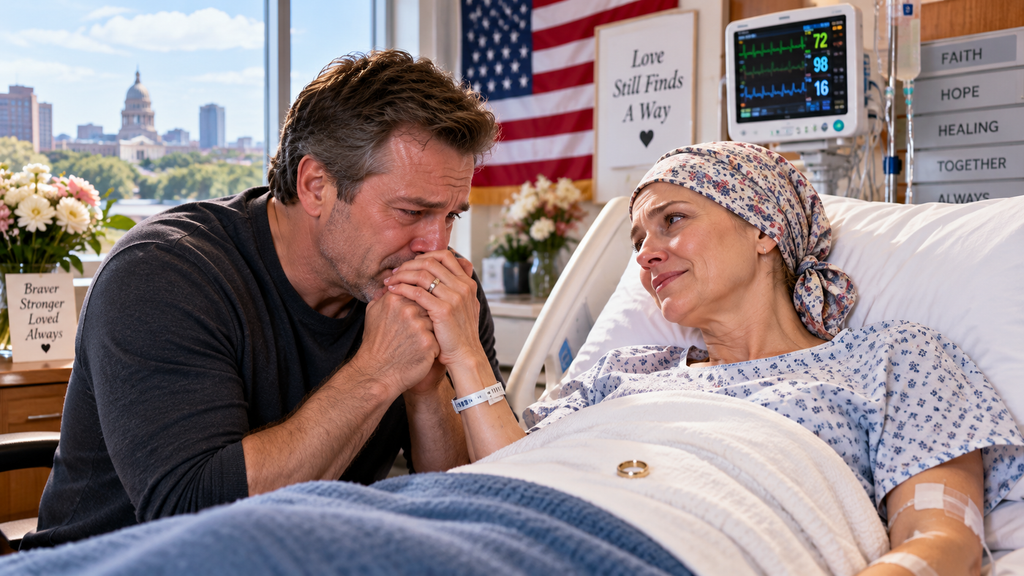
Sarah was lying in the hospital bed.
Her hair was shorter.
Her face was pale.
She looked impossibly small beneath the white blanket.
But she was awake.
And when she saw me through the glass, her eyes widened.
The nurse opened the door.
I stepped inside.
Sarah looked at me.
For several seconds, neither of us spoke.
Then she whispered my name.
“Ethan.”
I walked to her bed.
“You’re an idiot.”
Her lips trembled.
“I know.”
“You absolute idiot.”
“I know.”
I pulled a chair beside her.
She looked away.
“I didn’t want you to see me like this.”
“You should have let me decide that.”
Tears filled her eyes.
“I was scared.”
“So was I.”
“I thought you would spend every day waiting for me to die.”
“I would have spent every day with you.”
She closed her eyes.
A tear rolled down her cheek.
“I knew you’d say that.”
“Then why didn’t you tell me?”
“Because I knew you’d stay.”
I reached for her hand.
She hesitated.
Then she took mine.
Her fingers felt cold.
“I never stopped wearing your ring,” she whispered.
I looked at her.
“What?”
“The one I left on your pillow.”
She smiled faintly.
“I couldn’t wear it around doctors. It got caught on things.”
“So you left it for me?”
She nodded.
“I thought it was time.”
“No.”
She looked confused.
“No?”
“I don’t accept it.”
A weak laugh escaped her.
“You don’t get to decide.”
“Neither do you.”
She stared at me.
Then she smiled.
The same smile from the wedding.
The same woman.
Still Sarah.
Still my Sarah.
The doctor came in later and explained the situation.
Her cancer had progressed.
There were treatments available, but they couldn’t promise a cure.
There would be difficult decisions.
There would be appointments.
There would be uncertainty.
But there was also time.
Maybe months.
Maybe longer.
Nobody could promise us anything.
When the doctor left, Sarah stared at the ceiling.
“I don’t want you to spend your life in hospitals.”
“I don’t care.”
“You say that now.”
“I said it three years ago too.”
She turned her head.
I squeezed her hand.
“You thought you were giving me freedom.”
“I was trying to.”
“You didn’t understand something.”
“What?”
“I wasn’t trapped.”
She started crying.
I leaned forward and kissed her forehead.
“You were home.”
For the first time since I had entered the hospital, Sarah stopped looking afraid.
A week later, I brought her wedding ring back.
She was sitting near the window when I walked in.
I placed the ring in her palm.
“I thought you left this for me.”
“I did.”
“I don’t want it.”
Her eyebrows lifted.
“Then what do you want?”
I pulled a chair beside her.
“I want you to keep it.”
She stared at the ring.
“But we’re divorced.”
“I know.”
“So what does it mean?”
I smiled.
“It means twenty-two years happened.”
She laughed through her tears.
“You’re impossible.”
“You married me.”
“Unfortunately.”
“Still your best decision.”
She shook her head.
“Definitely not.”
We spent the next few months doing things we had postponed for years.
We drank coffee on the porch.
We drove to the lake.
We watched old movies.
We argued over the thermostat.
We laughed about things that weren’t funny.
Sometimes Sarah had enough energy to go out.
Sometimes she didn’t.
I learned that loving someone who was sick wasn’t about pretending everything was fine.
It was about being present when it wasn’t.
There were difficult days.
There were appointments.
There were test results that made us sit silently in the parking lot.
There were mornings when Sarah couldn’t get out of bed.
There were nights when I sat beside her and listened to her breathe.
But there were also good days.
One Saturday morning, she stood in the kitchen and watched me make coffee.
“You still make two cups.”
I looked at her.
“Habit.”
She smiled.
“I think I like that habit.”
I handed her the second cup.
She took it.
Then she reached across the counter and held my hand.
“Ethan?”
“Yeah?”
“If I had told you three years ago, would you have stayed?”
I didn’t hesitate.
“I would have stayed before you finished the sentence.”
She looked down.
“I wish I’d believed that.”
“So do I.”
She leaned against my shoulder.
For a long time, neither of us spoke.
Eventually, she whispered, “Maybe we don’t get to choose how much time we have.”
“No.”
“But maybe we get to choose what we do with it.”
I kissed the top of her head.
“That sounds like something you should have told me three years ago.”
She laughed.
“I was stubborn.”
“You still are.”
“I learned from you.”
Months later, we returned to the ranch where Daniel had gotten married.
Jessica had invited us to dinner.
When we arrived, she opened the door and froze.
She looked at Sarah.
Then at me.
Then at our joined hands.
“You two…”
Sarah smiled.
“It’s complicated.”
Jessica started crying.
“I knew it!”
We laughed.
That evening, we sat outside beneath the same string lights.
The band played softly in the distance.
Sarah leaned against me.
“You know what I regret most?”
“What?”
“Thinking love was something I had to protect you from.”
I looked at her.
“And I regret letting you make that decision alone.”
She nodded.
“I know.”
We sat quietly.
Then Sarah reached into her purse.
She pulled out her wedding ring.
I looked at it.
“You brought it?”
She smiled.
“Always.”
She placed it on the table between us.
“I don’t need this to prove anything.”
“I know.”
“But I don’t want to hide it anymore.”
I took her hand.
Neither of us knew how much time remained.
Maybe years.
Maybe less.
But for the first time in a long time, we weren’t pretending tomorrow was guaranteed.
We were simply grateful that today existed.
And sometimes that is the greatest gift life gives you.
Not certainty.
Not promises.
Just another morning.
Another cup of coffee.
Another conversation.
Another chance to hold the hand of the person you thought you had lost forever.
Sarah never asked me to remarry her.
I never asked her.
Our story had already become something bigger than a legal document.
We were divorced.
But we were also still family.
Still friends.
Still the two people who knew each other’s worst habits and favorite songs.
Still the couple who had once danced badly at a wedding.
And sometimes, late at night, Sarah would fall asleep with her hand resting on mine.
I’d look at her and remember that pillow.
The empty room.
The ring sitting where her head had been.
For three years, I thought that ring had been goodbye.
Now I understood.
It hadn’t been a period at the end of our story.
It had been a question.
And when I walked into that hospital room, I finally gave her the answer she had been too afraid to ask for.
I stayed.
Not because I felt obligated.
Not because I felt sorry for her.
Not because she was sick.
I stayed because I loved her.
I had loved her when we were twenty-five.
I loved her when we were thirty-five.
I loved her when we were divorced.
And I loved her when I found her in that hospital bed.
Some things don’t disappear simply because life becomes complicated.
Some love survives the silence.
Some love survives the distance.
And sometimes, after years of believing you’ve reached the end, you discover that what you thought was goodbye was really life giving you one more chance to say:
“I’m here.”
And this time, I meant it.
💬 THE END! THANK YOU FOR READING!