
 Reading Time: 13 minutes
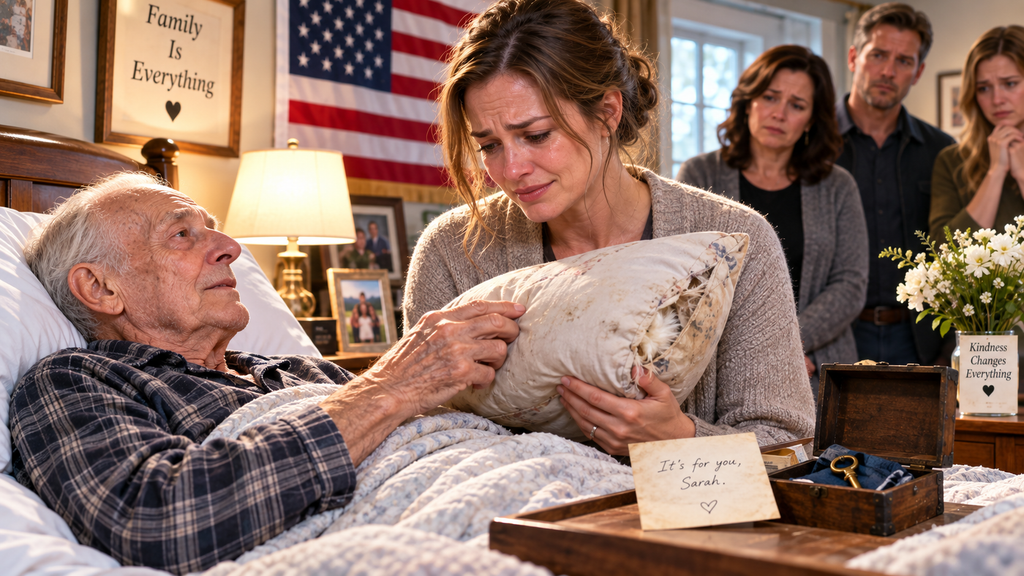
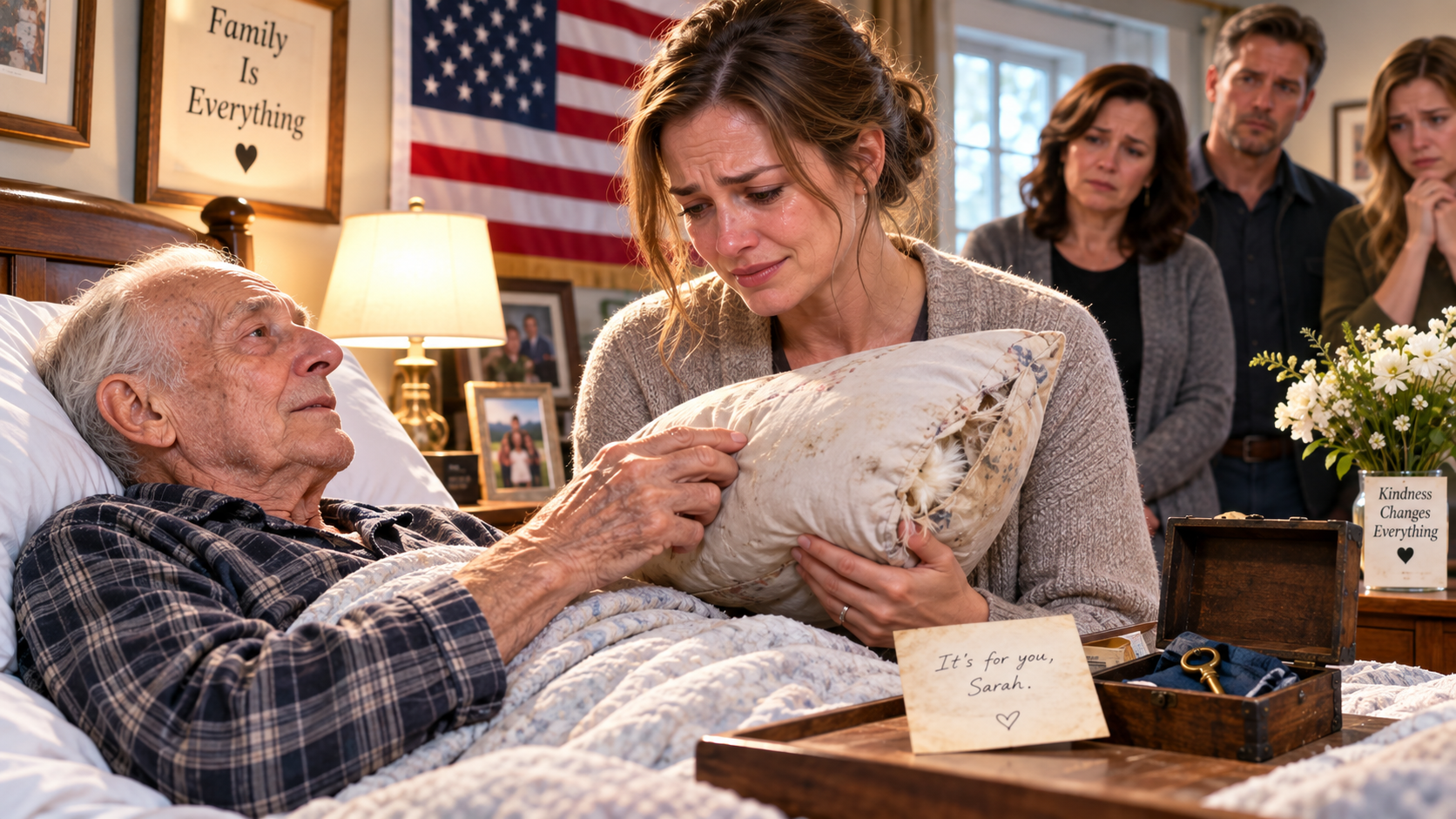
My fingers froze. For a moment, I was afraid to pull whatever it was out. The kitchen was dark except for the small light above the stove. Outside, snow tapped softly against the windows. Everyone else had gone to bed after the exhausting day of funeral arrangements, phone calls, casseroles, and tears.
I was alone. Just me and the pillow Arthur had held against his head for more than a decade.
I slowly pushed my fingers deeper into the torn seam.
There it was again.
Something hard.
Metal, perhaps.
My heart began beating faster.
I carefully pulled the stuffing apart until my fingers closed around a small object wrapped in a piece of faded blue cloth.
I drew it out.
It was a key.
An old brass key.
Attached to it was a tiny metal tag.
Three letters had been scratched into the surface.
A.R.H.
Arthur Raymond Hayes.
I stared at it.
“What’s this, Dad?”
The question escaped my lips even though I knew he wasn’t there to answer.
Then I noticed something else.
Inside the pillow, beneath the blue cloth, was a folded piece of paper.
The paper was yellow with age.
I unfolded it carefully.
There were only six words written across it in Arthur’s unmistakable handwriting.
Sarah knows where the truth belongs.
I read it three times.
My hands began to shake.
What truth?
And why had he hidden it inside his pillow?
I looked toward the hallway.
For a second, I imagined Arthur walking slowly toward the kitchen, leaning on his cane, telling me I was worrying about something that wasn’t my business.
He had always been like that.
Quiet.
Private.
Careful.
But he had never been mysterious.
Not with me.
I carried the pillow and key upstairs and placed them beside my bed.
I barely slept.
The next morning, my husband, Daniel, came into the kitchen before sunrise.
He looked exhausted.
His eyes were red.
He sat down without saying anything.
I poured him coffee.
“Daniel?”
He looked at me.
“What?”
“I found something in Dad’s pillow.”
His expression changed immediately.
“What?”
I placed the key on the table.
Daniel stared at it.
“Where did you get that?”
“Inside the pillow.”
He picked it up.
His fingers trembled slightly.
“I’ve never seen this.”
“I found a note too.”
“What did it say?”
I hesitated.
Then I handed it to him.
He read it.
His face became pale.
“What does that mean?”
“I don’t know.”
He stared at the key again.
“Maybe we should ask my siblings.”
I shook my head.
“Not yet.”
“Why?”
“Because your father gave this to me.”
Daniel looked at me.
“For you.”
He nodded slowly.
“Then we need to find out what it opens.”
That afternoon, while the others were at the funeral home, I sat at Arthur’s old desk.
It had been in the corner of his bedroom for years.
Nobody ever used it except him.
The drawers were filled with receipts, seed catalogs, old photographs, church bulletins, and handwritten notes about his farm.
I opened every drawer.
Nothing.
Then I noticed a small indentation beneath the desk.
I crouched down.
There was a narrow wooden compartment underneath.
I had never seen it before.
I ran my fingers along the edge.
A tiny keyhole.
My breath caught.
I took the brass key from my pocket.
It fit perfectly.
I turned it.
Click.
The compartment opened.
Inside was a leather-bound notebook.
Beneath it were several envelopes.
One was addressed simply:
SARAH
My hands went cold.
I opened it.
Inside was a letter.
Sarah,
If you are reading this, then I am gone.
I wish I could have told you everything while I was still sitting across from you at the kitchen table.
But there are things a man keeps quiet when he is trying to protect the people he loves.
For twelve years, you cared for me when my own children couldn’t be bothered.
You never asked what I owned.
You never asked what I would leave you.
You never complained when you had to choose between helping me and helping yourself.
That is why I know you are the only person I can trust with what comes next.
I had to stop reading.
Tears blurred the words.
I wiped my eyes and continued.
Twenty years ago, I sold most of my farmland.
I stared at the page.
That couldn’t be right.
Arthur still owned sixty acres.
At least, that’s what everyone believed.
I didn’t tell my children because I knew what money would do to them.
I invested what I received.
Very carefully.
The account grew.
My hands began trembling.
I turned the page.
There was a bank statement.
The balance was printed at the bottom.
I stared at the number.
$2,847,391.18
I actually laughed.
It wasn’t a happy laugh.
It was the kind that comes when your mind refuses to accept what your eyes are seeing.
Arthur had nearly three million dollars.
The man who wore the same work jacket for twenty years.
The man who repaired his own shoes.
The man whose children complained that he was “a financial burden.”
He had millions.
And apparently, he had hidden it from everyone.
I kept reading.
I watched my children grow up believing that money was the answer to every problem.
When their mother died, I promised myself I would never let money destroy the family she gave me.
Unfortunately, I failed.
A second document was attached.
It was a legal trust agreement.
I recognized the name of the attorney.
Thomas Bell.
I had met him once at Arthur’s house about eight years earlier.
Arthur had told me he was helping him with “some farm paperwork.”
Apparently, that had been a lie.
At the bottom of the document was a sentence that made my heart stop.
Upon Arthur Raymond Hayes’s death, the beneficiary of the Hayes Family Trust shall be Sarah Hayes, daughter-in-law, in recognition of extraordinary care and service.
I read it again.
Then again.
Sarah Hayes.
Me.
I leaned back in the chair.
“No.”
I whispered it.
“No, Dad.”
I couldn’t accept it.
He couldn’t have done this.
I had cared for him because he needed me.
Not because I wanted money.
I closed the folder.
I thought about throwing it back into the drawer.
Instead, I heard Arthur’s voice in my memory.
That’s exactly why, sweetheart.
That’s why the Lord is going to look at you differently.
I began crying.
Not because of the money.
Because suddenly I understood.
He had known.
He had known every sacrifice I had made.
Every night I stayed awake.
Every doctor’s appointment.
Every meal.
Every time I helped him shower.
Every time I rubbed his aching hands.
He had noticed everything.
And he had been preparing something quietly all along.
The door opened behind me.
I quickly wiped my face.
It was Daniel.
“Sarah?”
I closed the drawer.
“What’s wrong?”
“Nothing.”
He frowned.
“You’ve been crying.”
I looked at my husband.
For the first time since Arthur died, I realized something important.
Daniel didn’t know about the trust.
And I didn’t know what he would do if he did.
“I found some old paperwork.”
“What kind?”
“Farm documents.”
He nodded.
“Anything important?”
I looked at him.
“Maybe.”
Before he could ask more, his sister Rachel walked into the room.
“Daniel, Mom wants everyone downstairs.”
Then she noticed the desk.
“What are you two doing?”
“Nothing,” Daniel said.
Rachel looked suspicious.
She had always been suspicious.
Especially when money was involved.
At the funeral home that afternoon, everyone gathered around a table.
Arthur’s four children.
Daniel.
Rachel.
Mark.
Susan.
And me.
The attorney, Thomas Bell, sat at the end.
He placed a thick folder on the table.
“I have been instructed to read your father’s final wishes.”
Rachel immediately leaned forward.
“Is this about the farm?”
Thomas didn’t answer.
He opened the folder.
“Arthur Raymond Hayes created a revocable living trust twenty-one years ago.”
Mark frowned.
“Why didn’t we know about this?”
“Because you were not beneficiaries at that time.”
Rachel looked at me.
“Who was?”
Thomas glanced at me.
“Sarah.”
Everyone went silent.
My husband turned toward me.
“What?”
I swallowed.
“I found some papers.”
Rachel’s face hardened.
“What kind of papers?”
Thomas continued.
“Your father specifically requested that Sarah receive the majority of his estate.”
Rachel stood up.
“You’ve got to be kidding.”
“Sit down, Rachel,” Daniel said.
“No.”
She looked directly at me.
“You were his nurse for twelve years and now you’re getting everything?”
My heart hurt.
“I never asked him for anything.”
“Convenient.”
“Rachel.”
“No, Daniel. This is insane.”
Thomas raised his hand.
“Your father anticipated this reaction.”
He removed another document.
“He left a letter to all four children.”
Rachel sat down slowly.
Thomas began reading.
“My children, if you are hearing this letter, then I am no longer able to explain myself.
You may believe I have rewarded Sarah because she married my son.
You would be wrong.
I am rewarding the person who stayed.
When I could no longer walk, Sarah walked for me.
When I could no longer cook, Sarah cooked.
When I was afraid, she sat beside me.
When my children had reasons they couldn’t come, Sarah found reasons she could.
I never once asked her to do it.
She simply did.
My estate is not payment for caregiving.
It is my final expression of gratitude.
I hope one day you understand the difference.”
Nobody spoke.
Thomas continued.
“There is another reason I chose Sarah.
I know my children.
I know what money has done to them.
And I know what it could do if divided equally.
Sarah does not need money to love people.
That is precisely why I trust her with mine.”
Rachel began crying.
Mark stared at the floor.
Susan covered her mouth.
Daniel didn’t move.
Then Thomas said something that changed everything.
“Your father left the farm separately.”
Rachel looked up.
“The farm?”
“Yes.”
“The sixty acres?”
Thomas nodded.
“Those sixty acres were not sold.”
“What are they worth?”
Thomas paused.
“Approximately $4.2 million at current market value.”
Everyone gasped.
Rachel looked at me.
“What else?”
Thomas closed the folder.
“There’s a condition.”
“What condition?”
He looked at me.
“Sarah must decide what happens to the land.”
Rachel stood again.
“That should belong to the children.”
Thomas calmly replied, “Your father disagreed.”
The meeting ended shortly afterward.
Nobody spoke to me on the way out.
Except Daniel.
He followed me into the parking lot.
“Sarah.”
I turned.
“Did you know?”
“About the trust?”
He nodded.
“I found out yesterday.”
“Why didn’t you tell me?”
“Because I didn’t know what to do.”
He looked hurt.
“You could have told me.”
“I was afraid.”
“Afraid of me?”
I looked at him.
“I was afraid of what money would do to all of us.”
He looked away.
After a moment, he said quietly, “Dad was right about one thing.”
“What?”
“You stayed.”
I reached for his hand.
He held mine.
But not everyone accepted Arthur’s decision.
That evening, Rachel called.
“I want to talk.”
“Okay.”
“I don’t think Dad was thinking clearly.”
“He was sick, but he was mentally competent.”
“How do you know?”
“Because Thomas was there.”
“He was eighty-one.”
“He knew exactly what he was doing.”
Rachel was silent.
Then she said something that made my stomach tighten.
“Sarah, if you don’t voluntarily divide the estate, we’re going to challenge the trust.”
I closed my eyes.
“You can do whatever you believe is right.”
“You’d really keep everything?”
“I didn’t take anything.”
“You know what I mean.”
“I know.”
“Then prove Dad didn’t manipulate you.”
The line went dead.
The next morning, I called Thomas.
“Can they challenge the trust?”
“Anyone can challenge anything.”
“Will they win?”
“Not based on what I’ve seen.”
“What do I do?”
“Nothing.”
“Nothing?”
“Let them talk. Your father planned for this.”
He paused.
“There is one more thing you need to know.”
“What?”
“The trust contains a second provision.”
I waited.
“If any beneficiary attempts to invalidate the trust through harassment, intimidation, or fraudulent claims, their inheritance is forfeited.”
I sat back.
“Does that include his children?”
“Yes.”
“So if they fight me—”
“They could lose everything.”
I understood then.
Arthur hadn’t simply left me his money.
He had built a test.
And his children were already failing it.
Three days later, Rachel arrived at my house with Mark and Susan.
Daniel was at work.
They sat around the kitchen table where Arthur had eaten thousands of meals.
Rachel placed a folder in front of me.
“These are documents our attorney prepared.”
I didn’t touch them.
“What are they?”
“A proposed settlement.”
I almost smiled.
“You want me to pay you?”
“We want a fair division.”
“You mean you want part of what Dad left me.”
“He’s our father.”
“And he made his decision.”
Mark leaned forward.
“We’re not asking for everything.”
“How generous.”
Susan sighed.
“Sarah, please don’t make this ugly.”
“I haven’t.”
Rachel’s voice sharpened.
“You know what Dad always said? Family comes first.”
I looked at her.
“Where were you when he couldn’t get out of bed?”
She looked away.
“When he couldn’t remember whether he’d taken his medication?”
Silence.
“When he cried because he thought everyone had forgotten him?”
Nobody answered.
“When he couldn’t sleep and called for someone at two in the morning?”
Rachel’s eyes filled with tears.
“You think we didn’t love him?”
“I think you loved him.”
I swallowed.
“But loving someone and showing up are not always the same thing.”
Susan whispered, “We had our own families.”
“So did I.”
Nobody spoke.
I pushed the folder back.
“I’m not signing this.”
Rachel stood.
“Then we’ll see you in court.”
I nodded.
“Okay.”
They left.
That afternoon, I drove to Arthur’s farm.
Snow covered the fields.
The old barn stood exactly where it had stood when I first met him.
I walked through the house slowly.
His boots were still beside the back door.
His coat hung on the hook.
His reading glasses sat on the windowsill.
I sat in his chair.
For the first time since his death, I allowed myself to grieve without worrying about what came next.
“Dad,” I whispered.
“I don’t know what you want me to do.”
The wind moved through the bare trees.
Then I noticed a small envelope taped beneath the armrest.
My name was written on it.
I laughed through my tears.
“You really did think of everything.”
Inside was another letter.
Sarah,
If they fight you, don’t fight them back.
Give them the chance to show you who they are.
And if they surprise you, forgive them.
Money is temporary.
Family is not.
But family is only worth saving when people are willing to change.
There was one final paragraph.
The farm is yours.
But don’t keep it because I gave it to you.
Keep it if you can turn it into something that helps people.
I stared out at the snow-covered fields.
Then I knew what I wanted to do.
Two weeks later, I met with an architect.
Then a financial adviser.
Then a local nonprofit.
We developed a plan.
The farm would remain in the family.
But part of it would become a small community center for elderly residents who lived alone.
There would be gardens.
A kitchen.
A medical consultation room.
A few guest cottages for families who needed temporary housing while caring for sick relatives.
I named it:
The Arthur Hayes Family Care Center.
I paid for the initial development myself.
Not because Arthur had ordered me to.
Because I finally understood his last wish.
He hadn’t wanted his money to make me rich.
He wanted it to mean something.
Six months passed.
The legal challenge never happened.
Rachel’s attorney withdrew after reviewing the trust documents.
Mark stopped calling.
Susan sent me a birthday card.
And then, one rainy Saturday morning, Rachel came to my house alone.
She stood on the porch holding a small box.
I opened the door.
“Can I come in?”
I stepped aside.
She entered quietly.
She placed the box on the table.
“What is it?”
“Something Dad left for me.”
She opened it.
Inside was an old photograph.
Arthur stood between his four children.
They were all young.
Rachel was perhaps ten.
Mark was eight.
Susan was six.
Daniel was four.
Their mother stood beside them.
Rachel touched the photograph.
“He gave me this two years ago.”
“Why?”
“He told me to keep it.”
She looked at me.
“I didn’t understand.”
I waited.
“After he died, I found a letter taped to the back.”
My chest tightened.
“What did it say?”
She handed it to me.
I read it.
Rachel,
If Sarah receives my estate, don’t hate her.
Ask yourself why.
And if you ever feel angry about what she receives, remember that you were given something money cannot buy.
You had a father who loved you.
Don’t turn his death into a competition.
Rachel wiped her eyes.
“I was horrible to you.”
“You were grieving.”
“I was greedy.”
I didn’t correct her.
She continued.
“I kept thinking Dad chose you because he loved you more.”
“He didn’t.”
“How do you know?”
“Because he loved you too.”
Rachel looked down.
“Why didn’t he leave us more?”
“Maybe he knew you already had what you needed.”
She laughed sadly.
“I didn’t.”
“You still have each other.”
She looked toward the window.
“Do you think he’ll forgive me?”
“I think he already did.”
She started crying.
I walked around the table and hugged her.
For a few seconds, she was ten years old again.
Just a daughter missing her father.
Nothing more.
The next spring, we planted the first garden at the care center.
Daniel brought our son.
Mark came.
Susan came.
Eventually, even Rachel came.
We planted corn along the eastern field because Arthur had always said corn belonged there.
At sunset, I stood beneath the old oak tree and looked across the property.
The same land that had once been nothing more than rows of crops was becoming a place where people could come when they were tired, frightened, or alone.
I thought about the pillow.
The torn fabric.
The hidden key.
The secret account.
The three million dollars.
All of it had led me here.
But the greatest inheritance Arthur left me wasn’t money.
It wasn’t the farm.
It wasn’t the trust.
It was something much simpler.
He taught me that kindness does not always receive applause.
Sometimes it happens behind closed doors.
Sometimes nobody notices.
Sometimes the people you care for never say thank you.
But that doesn’t make it worthless.
One evening, almost a year after Arthur died, I returned to the old farmhouse.
The bedroom had been cleaned, but I had kept the pillow.
I placed it on the bed.
The seam was still torn.
I ran my fingers across it.
Then I noticed something I hadn’t seen before.
A tiny piece of paper was tucked beneath the lining.
I pulled it free.
There was only one sentence.
You were never just my daughter-in-law.
I closed my eyes.
Tears rolled down my cheeks.
Then I smiled.
Because finally, I understood why Arthur had whispered those last words.
“For you, Sarah.”
He hadn’t been giving me a pillow.
He had been giving me proof.
Proof that every quiet sacrifice mattered.
Proof that he had seen me.
Proof that I had not wasted twelve years of my life caring for an old man who had been forgotten by everyone else.
I had given him dignity when he was losing his strength.
And he had given me something I could carry for the rest of my life.
Not wealth.
Not land.
Not even security.
He gave me the knowledge that sometimes the people who seem to have nothing left to give are the ones who leave the greatest inheritance.
A year after his death, the Arthur Hayes Family Care Center opened its doors.
The first person through the entrance was an eighty-seven-year-old widow named Margaret who lived alone six miles away.
She looked around the kitchen and asked, “Who built this place?”
I smiled.
“My father-in-law.”
She nodded.
“Good man?”
I looked toward the fields outside.
“The best.”
She smiled.
And for the first time, I realized something Arthur had known all along.
His final gift had never been hidden inside the pillow.
The pillow only helped me find it.
His real gift was the twelve years.
The conversations.
The lessons.
The trust.
The love.
And the chance to turn all of it into something that would outlive him.
Years later, people would walk through those doors without ever knowing the story of a torn pillow.
They would simply know that there was a warm place where someone would listen.
A place where an elderly person could sit without feeling forgotten.
A place where exhausted caregivers could rest.
A place where families could remember that caring for someone is not a burden when love is involved.
And every December, when the first snow covered the fields, I would return to Arthur’s old bedroom.
I would sit on the edge of the bed.
I would hold that battered pillow against my chest.
And I would whisper the same words.
“Thank you, Dad.”
Because he had spent his final years believing his children had forgotten him.
But in the end, it was the daughter-in-law everyone assumed was simply “doing her duty” who carried his memory forward.
And every time someone asked me why I had devoted twelve years to caring for a man who wasn’t even my biological father, I gave them the answer Arthur himself had taught me.
“Because sometimes family isn’t about who you’re born to.”
“It’s about who stays.”
And Arthur had stayed with me, too.
Long after his heart stopped beating.
Long after his house became quiet.
Long after his chair was empty.
He stayed in every garden we planted.
Every elderly person we helped.
Every meal served at the center.
Every frightened caregiver who found a place to breathe.
And every time I saw that old torn pillow, I remembered the final thing he had given me.
Not an inheritance.
A purpose.
💬 THE END! THANK YOU FOR READING!