

“If it wasn’t for pity, no one would have invited you.”
Silverware stopped.
A waiter froze with a bread basket in both hands.
Margaret touched Gerald’s arm.
Not to stop him.
To make the scene look civilized.
I lifted my wine glass.
Took one slow sip.
And smiled.
“Funny thing about pity,” I said quietly. “The people who offer it usually need it the most.”
My father stared at me.
For the first time in fifteen years, he had no answer.
Then a chair scraped across the ballroom.
Across the room, Clare rose from the head table.
David leaned toward her.
He whispered something.
She nodded.
Then he stood and helped gather her train.
The band softened.
Conversation faded.
Clare walked toward the microphone carrying a kraft paper envelope.
Her face was pale.
Her shoulders were square.
My father leaned back in his chair.
He seemed to expect a tribute.
Margaret smiled.
Richard finished his drink.
Clare reached the microphone.
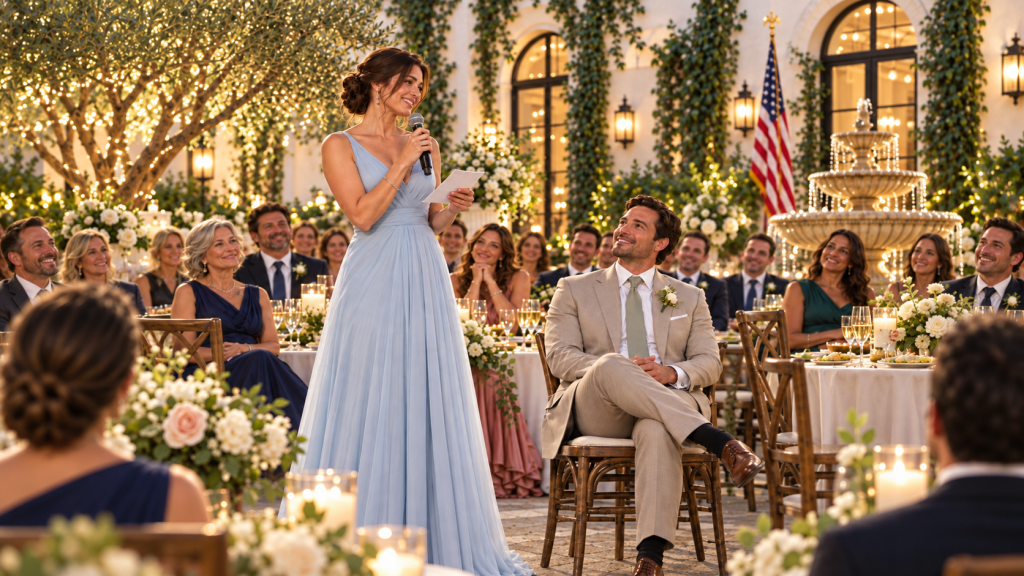
She adjusted it with one hand.
“I need to honor someone tonight.”
Her voice trembled slightly through the speakers.
“Someone this family tried to erase.”
A murmur rolled across the ballroom.
Gerald’s smile disappeared.
Clare lifted the envelope.
I recognized the seal immediately.
Department of the Air Force.
My fingers tightened around the stem of my wine glass.
Clare looked at me.
Then unfolded the paper.
“Fifteen years ago,” she began, “my sister left this family because she chose service over comfort.”
Gerald pushed his chair back slightly.
“Clare.”
She kept reading.
“We were told she was selfish.”
Silence.
“We were told she disappeared.”
My throat tightened.
“We were told she abandoned us.”
Now people were looking toward my father.
Clare’s voice steadied.
“None of that was true.”
Gerald stood.
“Clare, enough.”
David rose beside him.
He didn’t touch Gerald.
He simply stood between my father and the aisle.
Clare continued.
“My sister joined the United States Air Force at twenty-two years old. She served overseas. She flew rescue and transport missions. She led evacuation operations during disasters and combat deployments.”
Someone at table six whispered, “Wait.”
Clare looked directly at me.
“She became an officer.”
Another pause.
“A commander.”
My eyes burned.
“A brigadier general.”
Then Clare smiled.
“And this spring, she was confirmed for promotion to major general.”
The room changed.
I don’t know how else to describe it.
Not louder.
Still.
The way a room becomes still when everyone suddenly realizes the person they thought they understood is someone else entirely.
Clare folded the letter.
“Major General Evelyn Ulette has spent fifteen years doing exactly what our father said she would never do.”
Gerald’s face reddened.
Clare’s voice cracked.
“She built something.”
Richard stopped moving.
“She built a life.”
Margaret’s mouth tightened.
“She built a career.”
Clare looked at me.
“And more importantly, she built herself after this family tried to convince her she was nothing without us.”
I stared at my sister.
She raised her right hand.
Her fingers touched her brow.
The salute wasn’t technically necessary.
She wasn’t military.
It wasn’t formal.
But it was hers.
“To Major General Evelyn Ulette,” she said. “My sister. My hero. And the bravest person in this room.”
Then something happened I did not expect.
A man near table eight stood.
Then another.
Then a woman near the dance floor.
Then an older gentleman with gray hair and a cane.
Retired military.
Current service.
Veterans.
People Clare and David knew through work, church, friends, family.
One by one, they rose.
Some saluted.
Others simply stood.
David’s father raised his glass.
Rosa began clapping.
The applause spread.
I have stood in rooms where my name was announced before hundreds of people.
I have received decorations.
Promotions.
Commendations.
I have walked across stages while cameras flashed.
None of it felt like that.
Because those moments recognized what I had achieved.
Clare was recognizing what it had cost.
My father remained standing.
Not applauding.
Margaret sat rigidly beside him.
Richard looked as if someone had removed the floor beneath his chair.
I started to rise.
My legs felt strangely weak.
Clare lowered the microphone.
“I’m not finished.”
The applause faded.
She looked at our father.
“Dad, you told Evelyn that nobody here would have invited her without pity.”
Gerald’s jaw tightened.
“Do not do this.”
Clare reached into the envelope and removed a second document.
“This wedding is mine.”
“Clare.”
“And I invited her because she is my sister.”
She unfolded the second paper.
“And because I’m done letting you use money to decide who I’m allowed to love.”
My father laughed once.
It was sharp.
“You’re being emotional.”
“No.”
“You have no idea what you’re saying.”
“I know exactly what I’m saying.”
He stepped toward the stage.
David moved into the aisle.
“Gerald,” he said quietly, “stay where you are.”
That alone stunned the room.
Very few people spoke to my father like that.
Clare held up the document.
“This is confirmation from the bank that David and I closed on our own house yesterday.”
Gerald stopped.
Margaret blinked.
“You what?”
“We bought a house.”
My father stared.
“You have the condo.”
“The condo you own.”
“I gave it to you.”
“No. You let me live there.”
Clare’s voice remained calm.
“Every time I disagreed with you, you reminded me the lease was in your company’s name. Every time you wanted something, you mentioned the car payment. When I said I wanted Evelyn at my wedding, you threatened to cancel the venue deposit.”
Several heads turned.
Gerald looked around.
“Private family matters.”
Clare nodded.
“They were private until you humiliated my sister in front of two hundred and fifty people.”
Margaret stood.
“This is grotesque.”
Clare looked at her.
“You changed Evelyn’s place card.”
Margaret froze.
“You removed her name.”
“That is ridiculous.”
“The planner told me.”
A woman near the back of the ballroom looked down.
Clare continued.
“You also removed her from the family slideshow.”
Margaret’s cheeks flushed.
“I was protecting Gerald.”
“From what?”
No answer.
“Having two daughters?”
The silence that followed was brutal.
Gerald stepped forward.
“I paid for this wedding.”
Clare nodded.
“Some of it.”
“You wouldn’t be standing here without me.”
Clare looked toward David.
Then back at our father.
“Actually, that’s the other thing.”
She handed the microphone to David.
He took it.
“Three months ago,” he said, “Clare and I refinanced our plans.”
My father’s face hardened.
“We returned the unused portion of your wedding contribution this morning.”
Gerald stared at him.
David continued.
“The venue, catering, and remaining invoices are paid by us.”
“You can’t afford this.”
“We can.”
My father laughed.
“No, you can’t.”
David smiled faintly.
“We adjusted our honeymoon.”
Clare added, “And we would rather spend three days at a cabin we paid for ourselves than two weeks in Italy owned by your approval.”
A few people actually clapped.
My father turned toward me.
His eyes narrowed.
“You did this.”
I shook my head.
“I didn’t even know.”
“You poisoned her.”
“I haven’t spoken to Clare regularly in fifteen years because you made sure I couldn’t.”
“That was your choice.”
“No.”
My voice remained calm.
“That was yours.”
People were watching us now.
Not the general and the businessman.
A father and daughter.
Finally standing in the same room with nowhere for the story to hide.
Gerald pointed at me.
“You wanted to humiliate me.”
I looked around.
“At your daughter’s wedding?”
“You’ve always resented me.”
I almost laughed.
“Dad, I spent years resenting you.”
He seemed almost satisfied.
Then I continued.
“And then I got busy living.”
His expression changed.
“I stopped needing you to understand me a long time ago.”
“That’s not true.”
“It is.”
“You came here.”
“For Clare.”
“You wore the family name.”
“It’s my name too.”
His mouth opened.
Closed.
For once, there was no weapon available that I hadn’t already survived.
Then Richard spoke.
“Gerald, maybe we should go outside.”
My father snapped toward him.
“Stay out of it.”
Richard went silent.
Clare stepped down from the stage.
Her dress brushed across the floor as she walked straight toward me.
People shifted aside.
She stopped at my table.
“I’m sorry.”
I stood.
“For what?”
“For not finding you sooner.”
I looked at her face.
At the tears in her eyes.
“You were a kid.”
“So were you.”
That broke something open in me.
All those years, I had thought of myself as the adult.
Twenty-two.
Graduated.
Independent.
But Clare was right.
I had been young too.
Young enough to still believe parents could define your worth.
Young enough to confuse punishment with truth.
Young enough to carry shame that never belonged to me.
I put my arms around my sister.
She buried her face against my shoulder.
The ballroom disappeared.
There was only the girl at the upstairs window.
And the woman in the wedding dress.
“I missed you,” she whispered.
“I missed you too.”
“I’m sorry.”
“Stop apologizing.”
“You promise?”
“I promise.”
The applause started again.
Softly this time.
Not for rank.
Not for spectacle.
For us.
My father walked out before dessert.
Margaret followed.
Richard hesitated for a moment, then went after them.
The doors closed.
I expected the atmosphere to collapse.
Instead, the room exhaled.
Music returned.
People started talking.
Someone brought me another glass of wine.
David’s mother hugged me.
Rosa squeezed my hand.
A retired colonel introduced himself and told me he had heard my name years earlier during a humanitarian evacuation operation.
A young airman stationed nearby asked whether I really remembered every person under my command.
“I try.”
“Why?”
“Because they remember whether you remember them.”
He nodded like he was storing the sentence.
For the first time that evening, I relaxed.
Then something unexpected happened.
The DJ called for the bride’s family dance.
Clare stood in the center of the dance floor.
Her father was gone.
David touched her elbow.
“You okay?”
She nodded.
Then she looked at me.
“Dance with me.”
I laughed.
“I don’t think that’s how this works.”
“It is tonight.”
She held out her hand.
I stared at it.
Then took it.
The song was one we both knew.
A song our mother used to play on Sunday mornings before she died.
Clare was eleven when we lost her.
I was eighteen.
Gerald remarried less than two years later.
Our mother became another subject we were not supposed to discuss.
As the first notes filled the ballroom, Clare’s face crumpled.
“Oh no.”
“What?”
“I forgot this song was on the list.”
I smiled.
“No, you didn’t.”
She laughed through tears.
“No.”
We moved awkwardly.
Neither of us could dance properly.
Her train kept getting under my shoes.
At one point she nearly knocked into a waiter.
We laughed until both of us cried.
People formed a circle.
David eventually joined us.
Then his parents.
Then half the bridal party.
It turned into something less formal and more honest than anything else that night.
For the first time, the Ulette family looked nothing like the portrait my father had curated.
And I loved it.
Near midnight, Clare and I slipped outside.
The country club terrace overlooked a dark golf course.
Small lights lined the stone railing.
Inside, music shook the windows.
Clare had removed her shoes.
She sat on the edge of a bench with her gown pooled around her.
“I thought I was going to throw up when I took the microphone.”
“You looked calm.”
“I was dying.”
“That’s the secret.”
“What?”
“Everyone is terrified. Some people just keep moving.”
She smiled.
“Is that general advice?”
“Mostly sister advice.”
For a while, neither of us spoke.
Then she looked toward the lawn.
“Dad told me you never contacted me.”
I went still.
“He said you didn’t want to.”
I turned toward her.
“What?”
“He said you could have called anytime.”
I let out a slow breath.