

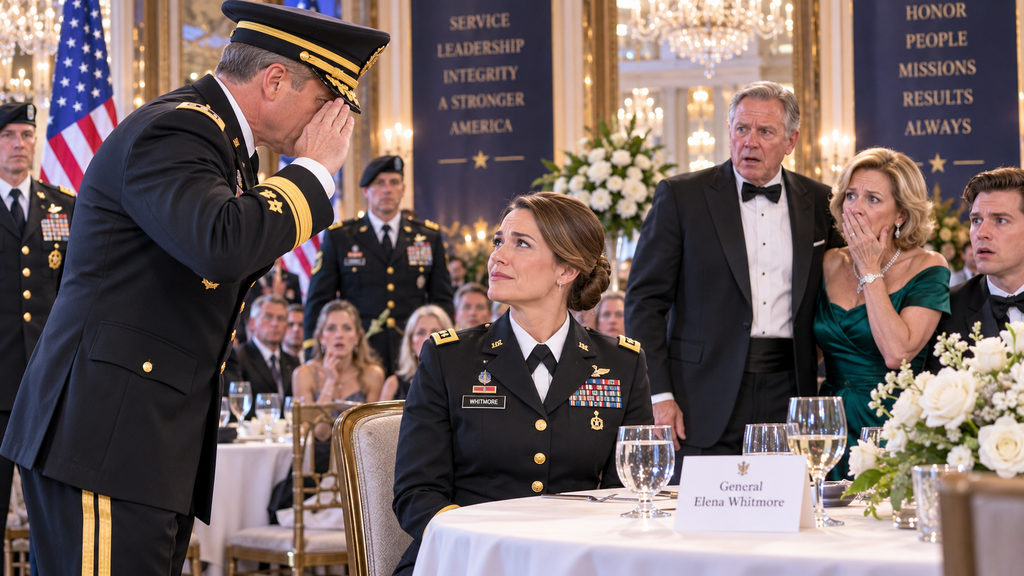
My father laughed before the whole ballroom and announced, “If my daughter is really a general, then I suppose I’m a ballerina.” The entire room joined in his laughter. For sixteen years, my family had removed my name, hidden everything I had achieved, and behaved as though I had vanished from their lives.
But only moments later, the ballroom doors burst open, military officers marched through them, and everyone who had laughed at me went completely still when they understood exactly who they had just insulted.
The ballroom inside the Westbridge Hotel sparkled beneath crystal chandeliers, gleaming silver, and the kind of carefully displayed wealth intended to make every guest believe they had entered someplace important.
As soon as I stepped inside, the conversations around me faded.
A staff member studied the seating chart twice before finally directing me toward Table 19 near the emergency exit, where the tablecloth was wrinkled and one of the water glasses had a cloudy mark along its rim.
My place card said Dr. Elena Whitmore.
No military rank.
No decorations.
No recognition of the sixteen years my family had spent treating my career like an embarrassing phase they expected me to eventually abandon.
On the opposite side of the room, my mother stood in an emerald silk gown beside my younger brother, Ethan, smiling as though the entire ballroom had been created for him.
The evening belonged to him.
He had recently been promoted to managing director at one of Chicago’s largest investment firms, and every new image projected across the ballroom walls appeared carefully chosen to demonstrate that the Whitmore family had raised exactly one successful child.
Ethan at his graduation.
Ethan shaking hands with senior executives.
Ethan standing beside my parents at the country club.
Ethan receiving an award at a charity gala.
Ethan posing outside the glass tower where he worked.
Not one photograph showed me.
I lowered myself into my chair, straightened my shoulders, and raised my water glass as the room applauded yet another picture of my brother.
Military intelligence had trained me to keep my expression unreadable whenever everyone around me was waiting to see how I would react.
My family had taught me why that ability was necessary.
I had almost refused the invitation.
When the cream-colored envelope arrived at my office two months earlier, I assumed it had been sent by mistake.
Inside was an engraved card announcing a celebration honoring Ethan Whitmore’s professional achievements and the Whitmore family’s “legacy of excellence.”
My name appeared nowhere except on the guest envelope.
No personal note.
No phone call.
No explanation for why the daughter they had barely spoken to in sixteen years had suddenly been invited.
Then, three days later, my mother called.
“Elena,” she said, as if we had spoken the previous week instead of nearly four years earlier, “your father thinks it would be appropriate for you to attend.”
Appropriate.
Not wanted.
Not missed.
Appropriate.
I almost laughed.
“Why?”
There was a brief silence.
“Well, people ask about you.”
That answer told me everything.
They were not inviting me because they wanted me there.
They were inviting me because absence had started creating questions.
My parents belonged to a world where appearance was currency, and an estranged daughter created an uncomfortable gap in the family portrait.
I should have said no.
Instead, I heard myself answer, “I’ll attend.”
Perhaps some stubborn part of me wanted to see them one final time.
Perhaps I wanted confirmation that I had stopped needing what they had never been able to give.
Or perhaps, after sixteen years, I still carried the smallest piece of the eighteen-year-old girl who had once stood in our front hallway with a military duffel bag at her feet, waiting for her father to say he was proud.
He never did.
My father, Richard Whitmore, had built his identity around respectability.
He wasn’t born wealthy, though he often behaved as if our family name had been carved into Chicago stone for centuries.
He had built a successful commercial real estate company from almost nothing and then spent the following thirty years ensuring nobody remembered where he started.
My mother, Catherine, had mastered the social half of that transformation.
Charity boards.
Country club committees.
Private dinners.
Fundraisers.
Everything had to look polished.
Everything had to look impressive.
Everything had to be explainable in one elegant sentence.
Our son works in finance.
Our daughter was supposed to become a doctor.
That had been the plan.
Their plan.
I excelled in school.
Chemistry.
Physics.
Mathematics.
Languages.
By seventeen, I had offers from several universities.
My parents imagined medical school, prestigious hospitals, society photographs, and a daughter they could mention over cocktails.
Instead, I told them I was joining the military.
My father stared at me across the dining room table for nearly a full minute.
Then he placed his fork down.
“No.”
I remember blinking.
“It isn’t a request.”
His face hardened.
“You’re throwing away your future.”
“I don’t think I am.”
“You have no idea what you’re doing.”
“I’ve already signed.”
My mother pressed her hand against her throat.
“You signed something without discussing it with us?”
“I discussed it with you for months. You just assumed I would eventually obey.”
My father stood.
“You think running around in boots makes you independent?”
“I think making my own decisions does.”
His palm slammed against the table hard enough to shake the glasses.
Ethan, who was fourteen then, stared down at his plate.
My mother began crying.
Not because she was afraid for me.
Because, as she said repeatedly that evening, “What are we supposed to tell people?”
That was the moment I understood.
My life was not mine in their eyes.
It was part of their presentation.
Three weeks later, I left.
My father refused to drive me.
My mother stayed upstairs.
Ethan stood near the front window and watched me put my duffel bag into a taxi.
I waited until the driver started the engine, convinced someone would come outside.
Nobody did.
For years, I told myself that moment no longer hurt.
That was not entirely true.
The ballroom music shifted.
A string quartet played near the stage while servers moved between tables carrying wine.
I had just started wondering how soon I could leave when Mara Jensen approached me.
We had attended high school together, back when she used to borrow my chemistry notes and pretend she had only come over to say hello.
Now she looked uneasy.
“Elena?”
I stood and hugged her.
“Mara. It’s been forever.”
She gave a strained smile.
“I almost didn’t recognize you.”
“Hopefully that’s a compliment.”
“It is.”
She looked toward my parents before lowering her voice.
“I didn’t know you were coming.”
“Apparently neither did whoever designed the slideshow.”
Mara’s expression tightened.
“That’s actually what I wanted to talk to you about.”
She glanced around.
Then, without taking a seat, she slid her phone across the table.
“You have to see this.”
An email covered the screen.
It had been sent sixteen years earlier.
The sender was my father.
The subject line stated:
REQUEST FOR REMOVAL FROM RECOGNITION.
My thumb froze above the water glass.
“Where did you get this?”
“My husband is on the alumni foundation board. They’ve been digitizing old correspondence. I saw your name.”
I read.
“Given Elena Whitmore’s decision to pursue an unconventional, non-civilian professional direction, we ask that she be removed from all future alumni recognition materials so they may more accurately reflect our family’s values.”
I read the paragraph twice.
Then a third time.
For one brutal second, the music, clinking silverware, and soft polished laughter filling the ballroom disappeared.
They had not simply forgotten me.
They had not misunderstood what I was doing.
They had chosen this.
Mara watched my face carefully.
“There’s more.”
I looked up.
“What?”
“Your father contacted several organizations.”
She swallowed.
“He asked the high school alumni committee to stop listing your achievements. He asked your mother’s charity foundation not to include your military commendation in a family profile. There was even correspondence with the country club newsletter.”
A quiet laugh escaped me.
Not because it was funny.
Because the absurdity was almost beautiful.
Sixteen years.
They had spent sixteen years actively erasing evidence that I existed.
Mara touched the edge of the table.
“I thought you knew.”
“No.”
“I’m sorry.”
I handed the phone back.
“Don’t be.”
She frowned.
“Elena—”
“I needed to see it.”
And I meant that.
Because suddenly, dozens of small mysteries made sense.
Why former teachers sometimes seemed surprised when I contacted them.
Why classmates thought I had dropped out.
Why old family acquaintances asked whether I had “ever finished that military experiment.”
Why my mother once told a distant cousin I was “working overseas” instead of explaining my actual career.
The truth was uglier than indifference.
My parents had curated my disappearance.
At eighteen, I had left home for basic training carrying a single duffel bag, while my father refused even to drive me to the station.
During the years that followed, I completed officer training, graduate study, intelligence specialization, and assignments I still could not discuss freely.
I spent nights in command centers where nobody cared what my surname was.
I helped design evacuation corridors through unstable regions.
I sat across from frightened young officers and taught them how to make decisions when every available option was terrible.
I learned three additional languages.
I finished a doctorate in strategic systems while deployed.
I briefed commanders.
I advised multinational task forces.
I received medals I never photographed for social media.
I attended memorial services for people whose names still lived in my phone years after they were gone.
I made mistakes.
I learned from them.
I earned every promotion.
And through all of it, some foolish part of me imagined my parents might eventually understand.
They never did.
My father’s voice rose above the room.
Apparently, one of Ethan’s colleagues had noticed Mara speaking to me and asked who I was.
“Oh, that’s Elena,” my father said.
The colleague smiled politely.
“Your daughter? I heard she was in the military.”
My father gave a theatrical groan.
“That story again.”
Several guests turned.
The colleague looked confused.
“I thought someone said military intelligence.”
My father lifted his whiskey.
“Military intelligence?”
He laughed.
“Come on.”
My mother smiled into her wineglass.
My shoulders went still.
Then my father raised his voice enough to ensure half the ballroom could hear.
“If Elena is a general, then I must be a ballerina.”
Laughter erupted.
It spread from his table outward.
Some guests laughed because they thought he was joking.
Others laughed because my father was wealthy, influential, and people had spent years learning that laughing with Richard Whitmore was safer than asking whether the joke was cruel.
My mother did nothing.
Ethan lowered his eyes.
That hurt more than I expected.
Because Ethan knew.
Maybe not everything.
But he knew enough.
He had seen photographs of me in uniform.
He had once sent a short message after my promotion to brigadier general.
Congrats. Dad says you’re still doing government work. Hope you’re well.
I had stared at that message for an hour before replying.
Thank you. I hope you’re well too.
That had been three years earlier.
Now he sat beneath a twelve-foot photograph of himself while our father mocked my life in front of two hundred people.
A server stopped moving, a tray balanced carefully against one palm.
One guest held a fork halfway between his plate and his mouth.
Ice rotated slowly inside my father’s whiskey as the chandelier light flickered across the glass.
Something inside me did not shatter.
It simply stopped begging for their acceptance.
I placed my water glass on the table.
The ballroom doors suddenly flew open.
Three officers in full dress uniform entered first, followed by two military security personnel whose polished shoes struck the marble floor with controlled, echoing steps.
Conversations vanished table by table as guests moved out of their path.
The most senior officer scanned the room.
His gaze settled on me at Table 19.
He walked forward without once glancing toward my father, my mother, or the enormous photograph of Ethan shining against the wall.
Then he stopped beside my overlooked chair.
His heels clicked together.
He snapped sharply to attention and delivered a salute so precise that several guests nearby visibly flinched.
“General Whitmore,” he said, his voice carrying across the ballroom, “the Secretary’s office has requested your immediate participation in the joint command briefing. We’ve secured the communications suite upstairs.”
Silence.
Absolute silence.
I stood.
“Thank you, Colonel.”
I returned his salute.
Only then did he lower his hand.
Behind him, another officer stepped forward carrying a sealed black folder marked with security classifications.
My mother rose halfway from her chair.
“Elena?”
Nobody laughed now.
I accepted the folder.
“Has the European team joined?”
“Yes, General. They’re standing by.”
“Casualty estimates?”
“Updated ten minutes ago.”
My father stared at the insignia on my uniform jacket, then at the officers around me, as though expecting someone to reveal the prank.
But I was not wearing a uniform.
I had come in a dark navy evening suit, deliberately understated.
That made his confusion worse.
He looked at the colonel.
“This is ridiculous.”
The colonel’s expression did not change.
My father pushed back his chair.