

My daughter-in-law pocket-dialed me at 7:15 this morning. She never knew I answered. For nineteen minutes I sat at my kitchen table with my tea going cold and listened to her and my son plan, in detail, what they were going to do with me by Christmas. They were in the car.
They were driving to my house. So I pulled my grocery notepad closer, clicked my pen, and started writing down every word.
My name is Dorothy Bennett.
I am seventy-three years old.
My husband Raymond has been gone four years now.
My son Mark calls me every Sunday at five, for exactly eleven minutes.
Not ten.
Not twelve.
Eleven.
He asks if I have groceries.
If the furnace is behaving.
If I remembered to take my blood pressure medication.
Then his wife, Alicia, usually calls from across the room, “Love you, Mother D,” in that sugary voice of hers, and Mark says he has to go.
That has been our relationship for the last few years.
Orderly.
Scheduled.
Polite.
Thin.
The phone rang at 7:15 that morning, and when Alicia’s name appeared on the screen, my first thought was that someone was in the hospital.
Nobody calls an old woman that early with good news.
I answered immediately.
“Alicia?”
No reply.
Road noise.
Turn signal.
A radio playing softly.
Then Alicia spoke.
Not to me.
“Did you bring the folder?”
“It’s in the back seat,” Mark said.
My son.
“And the brochure?”
“Glovebox.”
I opened my mouth.
I almost said, “Hello? You called me.”
Then Alicia laughed.
“Relax, Mark. She’ll sign. She signs whatever we put in front of her. Remember the flu shot forms? She didn’t read one line.”
I stopped breathing for a second.
Then I put my hand flat on the kitchen table.
Raymond used to say something whenever we had to deal with insurance companies, contractors, taxes, doctors, or anybody who thought age meant foolishness.
“Dot, when it matters, write it down.”
So I reached for the grocery pad beside the sugar bowl.
Clicked my pen.
And wrote:
7:19 a.m.
Mark: “What if she asks to read it first?”
Alicia: “Then you take her glasses to get ‘cleaned.’ Honestly, do I have to think of everything?”
I stared at the words.
My reading glasses were sitting three inches from my hand.
I picked them up.
Put them on.
Kept listening.
7:21.
The brochure had a name.
Silver Meadows.
I knew the place.
Everyone my age knew it.
A large assisted-living complex outside town with manicured hedges, beige hallways, scheduled bingo, and cheerful advertisements featuring elderly couples who looked suspiciously well-rested.
Alicia’s cousin worked there.
“Family discount,” she said.
Then both of them laughed.
Not cruelly.
That was almost worse.
Casually.
As though my removal from my own house was an administrative inconvenience they had solved before breakfast.
7:24.
Mark became quieter.
“It just feels fast.”
For one brief second, I heard the boy I had raised.
The child who once cried because he stepped on a beetle.
The teenager who sat beside Raymond in the garage pretending not to cry when his first girlfriend left him.
The young man who held my hand in the hospital when his father died.
“It just feels fast.”
I almost interrupted.
Almost said, “Mark, if something feels wrong, listen to it.”
Then Alicia answered.
“Fast? We have been paying for that house for four years.”
My pen stopped.
Now here is the thing you need to understand.
Nobody pays for my house.
Nobody ever has except Raymond and me.
We bought that house in 1974.
Three bedrooms.
One bath at the time.
Avocado-green refrigerator.
Ugliest carpet ever installed by human hands.
We raised Mark there.
Added a second bathroom.
Built the deck ourselves.
Replaced the roof twice.
Burned the mortgage papers in a coffee can in 1998 while drinking cheap champagne in the backyard.
I own that house to the last shingle.
What Alicia called “paying for that house” was actually something very different.
Four years earlier, after the twins were born, I handed Mark and Alicia forty thousand dollars.
They were renting a cramped townhouse then.
The twins were premature.
Alicia was not working.
Mark looked exhausted all the time.
They had found a small house near a good elementary school but did not have enough for the down payment.
Raymond had been gone only three months.
I was still walking around my own kitchen expecting to hear him cough.
Mark sat across from me and said, “Mom, I hate asking.”
So I wrote a check.
Forty thousand dollars.
No repayment agreement.
No strings.
A gift.
I told him, “Your father would want the babies to have a yard.”
He cried.
So did I.
Apparently, in Alicia’s mind, that gift had somehow become a debt I owed them.
7:26.
Alicia said, “And the minute she’s settled at Silver Meadows, we list her place. Bruce says one-eighty, easy. That’s the lake trip, that’s the boat, that’s everything.”
Bruce.
That name I knew too.
Bruce Calder.
Realtor.
Golfing friend of Mark’s.
Too-white teeth.
Too much cologne.
He had been in my living room twice.
The first time, Alicia told me he was “just admiring the crown molding.”
The second time, he stood in my dining room looking at the windows and said, “These old houses are coming back.”
I had thought he was being friendly.
Now I understood he had been appraising my life.
7:31.
Alicia said, “Let me do the talking. You just look sad. Can you manage sad?”
There was a pause.
Then Mark said, “Yeah.”
That “yeah” cost me more than everything else.
Because I knew Alicia was pushy.
I knew she liked control.
I knew Mark avoided conflict the way some people avoid dentists.
But a grown man letting his wife plan to take his mother’s house while he practiced looking sad was something else.
At 7:34, the call ended.
Probably her purse shifted.
I sat at the kitchen table for one full minute.
No crying.
No shouting.
No throwing cups.
At seventy-three, you learn something useful.
Panic wastes time.
I stood.
Rinsed my tea cup.
Then made two phone calls.
The first was to Eleanor Price.
My neighbor for forty years.
Eleanor had watched Mark learn to ride a bicycle on our street.
She knew every neighborhood scandal before the mailman.
She also owned the best phone camera in the county and understood privacy better than most lawyers.
She answered on the third ring.
“Dorothy?”
“Eleanor. I need your kitchen window and your phone camera for one hour.”
There was a pause.
Then she said, “Finally.”
I blinked.
“What does that mean?”
“I’ll tell you later.”
She hung up.
The second call went downtown.
To Theodore Halpern.
Raymond’s attorney.
Mine too.
Ted was eighty-one and refused to retire because, according to him, “retirement is how people trick you into organizing your garage.”
He had handled our mortgage paperwork, wills, Raymond’s estate, my trust, and the legal documents after Raymond died.
Ted answered himself.
“Dorothy.”
“Ted, I need you at my house at eight-forty.”
“That specific?”
“Yes.”
“Trouble?”
“My son is bringing papers for me to sign.”
Silence.
Then Ted’s voice changed.
“What kind?”
“I don’t know yet.”
“Do not sign anything.”
“I wasn’t planning to.”
“What do you need from me?”
“Bring copies of my deed, trust, power of attorney, and whatever shows who can sell my house.”
“Anything else?”
“Yes.”
“What?”
“Come through the front door like you own the place.”
He laughed.
“I can do that.”
Ten seconds.
That was all it took.
After hanging up, I put out the good cups.
The blue-and-white china my mother left me.
I sliced the banana bread Alicia always praised and never ate.
Set butter on a little glass dish.
Three places.
Then a fourth.
I placed my grocery pad under the newspaper beside my chair.
At 8:22, Eleanor texted me.
I’m ready.
At 8:40, a silver SUV turned into my driveway.
I watched from behind the living-room curtain.
Alicia checked her lipstick in the visor mirror.
Mark sat still for several seconds.
Then she touched his arm.
Said something.
He nodded.
Practiced looking sad.
I saw it.
Actually saw my son change his face.
The doorbell rang.
I counted to ten.
The way I used to when Mark was little and throwing a tantrum.
Then I opened the door.
“What a surprise!”
Alicia leaned forward and kissed the air beside my cheek.
“Mother D.”
Mark kissed my forehead.
Too quickly.
They came inside.
Alicia carried a leather folder against her chest.
Mark carried the Silver Meadows brochure.
I pretended not to notice.
“Come in. I even have banana bread.”
“Oh, you shouldn’t have,” Alicia said.
She had been planning to move me out of my home before Christmas and was still capable of criticizing my baking schedule.
People are remarkable.
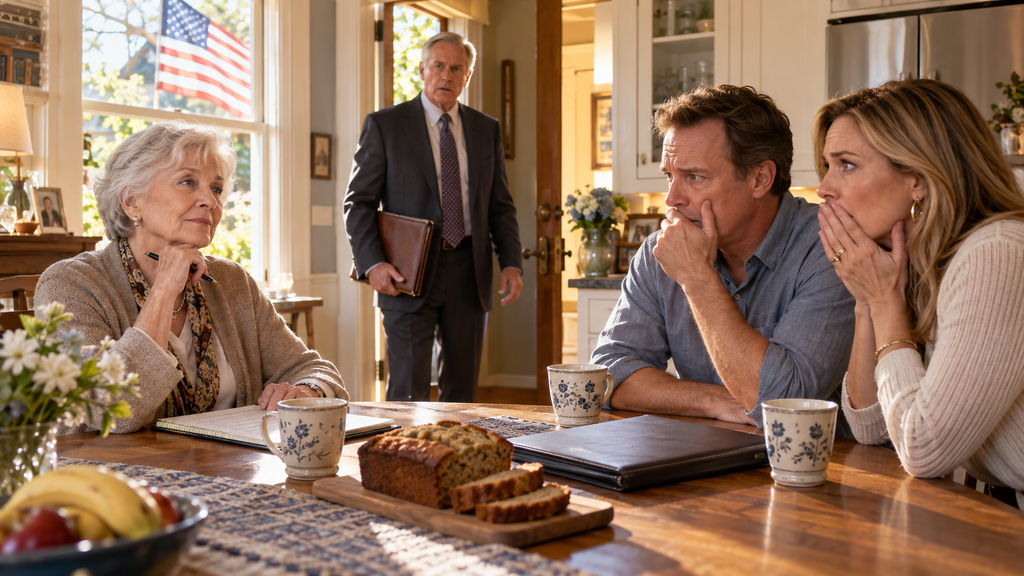
We sat at the kitchen table.
Mark would not look at me.
Alicia sat across from me and placed the folder beside the butter dish as casually as if it contained coupons.
I poured coffee.
She touched my wrist.
“Mother D, Mark and I have been thinking about what’s best for you.”
“I appreciate that.”
Her shoulders relaxed slightly.
“This house is a lot.”
“It certainly has a lot of dust.”
She laughed too hard.
“And stairs.”
“Oh, yes.”
“You shouldn’t be alone here.”
I looked around.
Sunlight through the lace curtains.
Raymond’s old clock ticking above the stove.
The little crack in the tile Mark made when he dropped a bowling ball at sixteen.
Forty-nine years of living in one room.
“I suppose not,” I said.
Mark finally looked up.
Alicia smiled.
“We found somewhere wonderful.”
She slid the brochure toward me.