

The clock on my nightstand read 5:02 AM. Thanksgiving morning. Outside, freezing rain tapped against the windows like fingernails. The wind pushed dead leaves across my porch, and the little American flag beside the front steps snapped sharply against its pole.
Inside, my kitchen still smelled like pumpkin pie, dark coffee, and cinnamon. I had been awake since four, preparing the side dishes Chloe loved because she and Marcus were supposed to come by for dessert after spending Thanksgiving dinner with his family. That had been the arrangement.
I had not liked it, but I had accepted it. Three years earlier, when my daughter married Marcus Hale, I promised myself I would not become the kind of mother who interfered every time her adult child made a decision she disliked.
So I had smiled when Marcus corrected Chloe in front of people.
I had remained quiet when he began checking her phone.
I had swallowed my anger when his mother, Sylvia, referred to Chloe’s engineering salary as “cute little money” despite the fact that my daughter earned more than most people in their neighborhood.
I had told myself Chloe was intelligent.
Capable.
Independent.
If she needed me, she would ask.
At 5:02 that morning, my phone began to ring.
Marcus.
I stared at his name for two full seconds before answering.
“Hello?”
His voice came without a greeting.
“Come pick up your garbage.”
My hand tightened around the edge of the kitchen counter.
“Where is Chloe?”
“Downtown bus terminal.”
I stopped breathing.
“What?”
“Your daughter decided last night was the perfect time for another hysterical episode. I’m hosting my CEO for Thanksgiving dinner, Eleanor. I have clients coming. I have neighbors coming. I don’t have time to babysit a woman who can’t control herself.”
In the background, someone laughed.
A woman.
Sylvia.
Marcus’s mother.
“Tell her about the rug,” Sylvia called.
Marcus sighed theatrically.
“And she destroyed my mother’s Persian rug. Five thousand dollars. I expect reimbursement.”
“Marcus,” I said carefully, “why is my daughter at a bus terminal before sunrise?”
“Because I put her there.”
For a moment, I thought I had misunderstood him.
“You did what?”
“I drove her downtown and left her there.”
Something cold moved through me.
It was not panic.
Not yet.
It was the kind of stillness I used to feel before walking into a courtroom where everyone expected me to lose.
“Is she injured?”
“She’s dramatic.”
“That is not what I asked.”
“I’m not doing this with you.”
Behind him, Sylvia said loudly, “Tell the old woman to collect her brat and keep her away from decent people.”
Marcus chuckled.
Then another female voice drifted through the phone.
Younger.
Sleepy.
“Marcus, where are the champagne glasses?”
I heard him cover the receiver.
“In the dining-room cabinet, Lauren.”
Lauren.
I knew that name.
Chloe had mentioned a Lauren from Marcus’s office several times during the past year.
Always casually.
Lauren needed a ride.
Lauren had joined their gym.
Lauren had started attending work events with Marcus.
Lauren had accidentally left an earring in Marcus’s car.
Every explanation had been reasonable when taken separately.
Together, they suddenly became something else.
“Who is Lauren?” I asked.
Marcus went silent for half a second.
Then he laughed.
“You need to mind your own business.”
“My daughter is my business when you abandon her at a terminal in freezing weather.”
“She’s an adult.”
“So are you.”
“I said come get her.”
The call ended.
I stood in my kitchen holding the phone long after the screen went dark.
For most of my professional life, anger had been a luxury I refused to indulge before gathering facts.
Juries did not convict because a prosecutor was furious.
Judges did not sign warrants because someone had a bad feeling.
Cases were built on timelines.
Witnesses.
Records.
Physical evidence.
Admissions.
Patterns.
I had spent decades teaching younger lawyers that the difference between revenge and justice was discipline.
I needed that discipline now.
I grabbed my coat and keys.
Then I stopped in the hallway.
At the back of the closet, behind old winter blankets and a box of Christmas decorations, sat a small black lockbox.
I had not opened it in almost four years.
I carried it to the table.
Inside were old credentials, commemorative coins, photographs from cases I had long ago stopped discussing, several business cards, and the identification I had once carried into federal buildings every morning.
Marcus had never seen any of it.
Neither had Sylvia.
To them, I was simply Eleanor Bennett, Chloe’s widowed mother.
They knew I had worked for “the government.”
Marcus once joked that I had probably spent thirty years filing tax forms.
I had let him believe it.
There had been no reason not to.
My career was over.
My daughter’s marriage was supposed to belong to her generation, not mine.
But as I looked at those old credentials, I remembered something one of my mentors had told me decades earlier.
Retirement ends your authority.
It does not erase what you know.
At 5:19 AM, I backed my SUV out of the driveway.
The streets were nearly empty.
Holiday decorations glowed behind dark windows. A bakery truck moved slowly through an intersection. A lone snowplow scattered salt over the bridge leading downtown.
I called Chloe three times.
No answer.
At 5:36, I called the terminal.
A tired employee answered.
“I’m trying to locate my daughter,” I said. “Twenty-eight years old. Brown hair. Her name is Chloe Hale.”
There was a pause.
“Is she wearing a gray sweater?”
My stomach dropped.
“Yes.”
“You need to get here.”
“What happened?”
“I don’t know, ma’am. She’s outside near Bay Six. Security tried to bring her in, but she keeps saying someone told her she wasn’t allowed inside.”
“Who told her that?”
“I have no idea.”
I pressed harder on the accelerator.
At 5:43, I pulled into the bus terminal.
Fluorescent lights buzzed over cracked pavement. The automatic doors opened and closed as workers prepared for the morning routes.
I saw a security guard standing outside.
Then I saw the bench.
Then I saw my daughter.
For one second, my mind refused to understand what my eyes were seeing.
Chloe was curled on the metal bench beneath a broken streetlight.
She had no coat.
One shoe was missing.
Her gray sweater was torn near the shoulder.
Her hair, usually neatly tied back, hung across her face.
Her lips were pale.
Her fingers looked blue.
I left the SUV running.
“Chloe!”
Her head moved slightly.
I dropped to my knees in front of her.
“Baby, look at me.”
Her eyelids fluttered.
“Mom?”
“I’m here.”
Her entire body shook so violently that her teeth clicked.
I removed my coat and wrapped it around her.
“What happened?”
Her hand closed weakly around my sleeve.
“They hurt me.”
My throat tightened.
“Who?”
“Marcus.”
She swallowed.
“And Sylvia.”
The security guard took a step closer.
I glanced at him.
“How long has she been here?”
He shook his head.
“I came on duty at five. She was already outside.”
“Why wasn’t she brought in?”
“We tried. She panicked when we touched her. Said her husband told her police would arrest her if she made trouble.”
Of course he had.
Fear was easier to maintain when the victim believed every door led to another punishment.
I turned back to Chloe.
“Tell me what happened.”
Tears filled her eyes.
“Marcus has been seeing Lauren.”
“I heard her on the phone.”
Chloe gave a tiny nod.
“I found messages Tuesday night. He told her Thanksgiving was going to be their ‘first real family dinner.’ I asked him about it last night after Sylvia arrived.”
“What happened?”
“Marcus said I was humiliating him.”
Her voice trembled.
“Sylvia said Lauren understood how to support a successful man. She said I had been holding Marcus back because I kept refusing to transfer my savings into the investment account he opened.”
That caught my attention.
“What investment account?”
Chloe looked confused.
“He said it was for our future. He wanted me to move my inheritance into it.”
My husband had left Chloe money when he died.
Not millions.
But enough to give her security.
“Did you transfer anything?”
“No.”
I exhaled quietly.
Good.
“Keep going.”
“They told me I needed to apologize to Lauren.”
“For your husband having an affair?”
Chloe almost laughed.
It came out as a broken sound.
“I said no. Marcus grabbed my phone. Sylvia took my purse.”
My anger sharpened.
“Then?”
“They wouldn’t let me leave.”
The security guard looked at me.
That sentence changed everything.
“Wouldn’t let you leave how?” I asked.
“Marcus stood in front of the door. Sylvia took my keys. They kept telling me to sign something.”
“What?”
“I don’t know. Some agreement. It said I was leaving voluntarily and giving Marcus temporary control over the house and our accounts.”
“Did you sign it?”
“No.”
For the first time, something like pride appeared in her exhausted expression.
“I told them I’d rather sleep outside.”
Her eyes filled again.
“Then Marcus said that could be arranged.”
The automatic terminal doors opened behind us.
Warm air rolled across the sidewalk and vanished.
“What happened to your face?”
Chloe touched her cheek.
“Marcus shoved me when I tried to get my phone back. I fell into the table.”
“And the torn sweater?”
“Sylvia grabbed me when I tried to run upstairs.”
I forced myself to keep my voice level.
“Anything else?”
“They put me in the garage for a while.”
“How long?”
“I don’t know.”
“Was the garage heated?”
“No.”
My chest tightened.
“She said cold air would calm me down.”
The security guard muttered something under his breath.
Chloe kept talking.
“Then Lauren came over.”
“What did she do?”
“She asked if I was still there.”
Chloe stared toward the empty bus lanes.
“Mom, she was wearing my robe.”
That detail hurt Chloe more than the cold.
I could hear it.
“Marcus told me I was making everyone uncomfortable. Sylvia said Thanksgiving was important for Marcus’s career because his CEO was coming, and Lauren would sit beside him instead of me.”
My hands felt numb.
“Then what?”
“They made me clean the dining room.”
“What?”
“Sylvia knocked a glass of red wine onto the rug and said I had done it. She filmed me trying to clean it.”
There it was.
Staging.
Manufacturing a narrative.
“They wanted video showing you damaging property.”
Chloe nodded.
“Marcus kept saying nobody would believe me because I’m emotional.”
“Are there cameras in the house?”
Her eyes lifted.
“Yes.”
“Where?”
“Front door. Garage. Kitchen. Dining room. Hallway.”
“Do they record continuously?”
“I think so.”
“Cloud storage?”
“Marcus installed the system.”
I leaned closer.
“Does Sylvia know?”
“I don’t think she remembers the dining-room camera. It’s inside a smoke detector housing.”
That was the first piece of evidence I could almost see.
“What happened after they filmed you?”
“Marcus made me get into his car. I thought he was taking me to a hotel.”
She started shaking harder.
“He took my coat before I got out.”
“Why?”
“He said it belonged to him because he bought it.”
“What about your shoe?”
“I lost it when he pulled me out.”
“Did he see it?”
“Yes.”
“What did he do?”
“He threw it into the car.”
The cruelty of that detail landed harder than I expected.
Then Chloe’s eyes rolled upward.
Her body went limp.
I caught her.
“Chloe!”
At 5:47, I called 911.
“I need Advanced Life Support at the downtown bus terminal, Bay Six. Adult female unconscious after prolonged cold exposure, possible assault, possible unlawful restraint. Send police.”
The dispatcher asked if the attacker was nearby.
“No.”
“Are you safe?”
“Currently.”
“Do you know who assaulted her?”
“Yes.”
“Who?”
“Her husband and possibly his mother.”
I looked toward the security camera above the terminal doors.
“And I need the terminal surveillance preserved immediately.”
The dispatcher paused.
“Ma’am?”
I opened the lockbox I had carried from the car.
“My name is Eleanor Bennett. I’m a retired federal prosecutor. I understand I have no current authority. I’m telling you that because I know precisely what evidence may disappear if this is treated casually.”
The dispatcher’s tone changed.
Not because I had power.
I did not.
But because I was telling her I understood the difference between accusation and preservation.
“Understood.”
“Please have responding officers document her condition before transport, preserve terminal video, identify the driver who left her if the cameras captured the vehicle, and note that there may be relevant electronic evidence at the residence.”
“I’ll relay that.”
“Thank you.”
The ambulance arrived four minutes later.
The paramedics moved quickly.
One cut Chloe’s sweater sleeve to attach equipment while another wrapped heated blankets around her.
“Temperature’s low.”
“How low?” I asked.
“Low enough that we’re going now.”
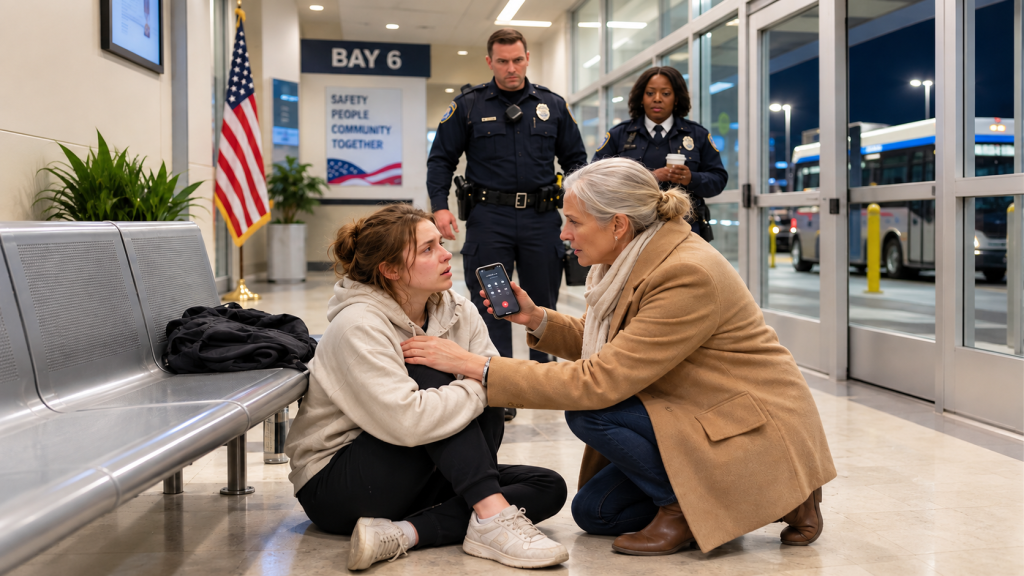
Police arrived before they loaded her.
A young officer approached me.
“Ma’am, I need a quick statement.”
“You’ll have one. First photograph her condition.”
He looked toward the ambulance.
“Our body cams are running.”
“Good. Make sure that remains preserved.”
His expression sharpened.
“You law enforcement?”
“Former federal prosecutor.”
“Former?”
“Very.”
That almost made him smile.
“Then you know I can’t just go kicking in a door because you say so.”
“I would be disappointed if you did.”
He nodded.
“Good.”
“I’m asking you to do this correctly.”
I gave him Marcus’s name, address, vehicle description, phone number, and Sylvia’s information.
Then I said, “There may be video inside the residence documenting what happened. If they know police are involved, there is a risk of destruction.”
He wrote that down.
“I’ll call my sergeant.”
“Also, Marcus may try to frame this as a marital argument. Please note her exposure, missing shoe, lack of coat, and current medical condition.”
“I have eyes, ma’am.”
“I know.”
I softened my voice.
“My daughter nearly stopped responding in my arms. Forgive me if I’m precise.”
His face changed.
“Understood.”
At the hospital, Chloe was taken immediately into treatment.
I sat outside with her remaining shoe in a clear property bag the officers had given me.
It was absurd what your mind chooses to focus on during catastrophe.
I kept staring at that shoe.
Black leather.
Size seven.
Small scratch near the heel.
I had bought her the pair for her birthday.