

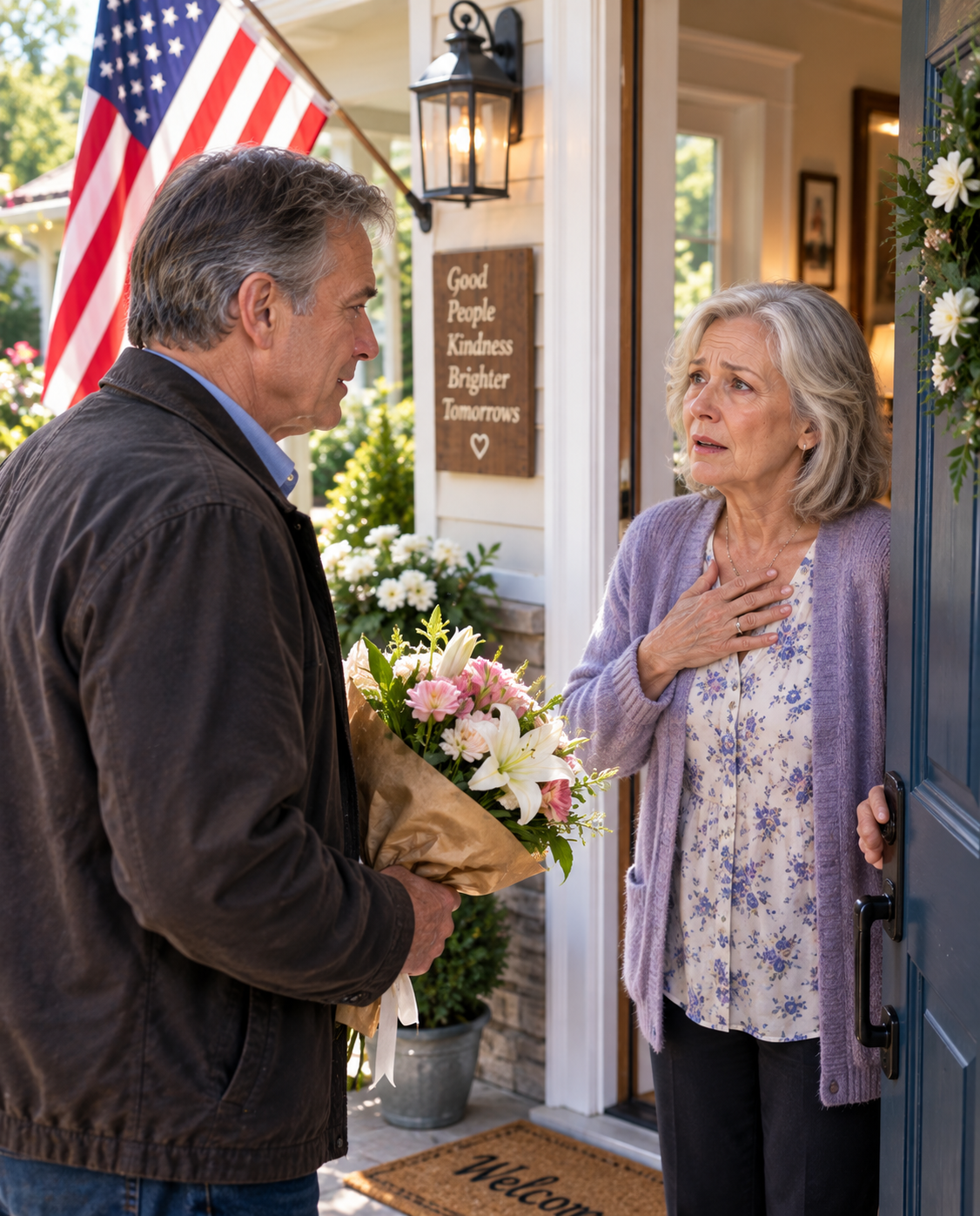
My dying wife asked me to find my first love as her final wish — and when I finally discovered why, my knees nearly gave out. Carol and I had been married for thirty-six years when the doctor told us the treatments were no longer working.
The cancer had spread to her liver, lungs, and bones. There would be no more chemotherapy. No experimental trial. No surgery. Only medication to keep her comfortable and whatever time we still had together.
The doctor spoke gently, but every word felt like a door closing. Carol sat beside me in the consultation room with a blanket over her knees.
She had lost so much weight that her wedding ring kept sliding around her finger.
I remember staring at that ring while the doctor talked.
I had placed it on her hand thirty-six years earlier in a little church filled with white flowers, nervous relatives, and a piano player who had accidentally started the wrong song.
Carol had laughed during our vows.
I had laughed too.
Back then, thirty-six years had seemed like forever.
Now it felt unbearably short.
On the drive back to the hospital room, Carol rested her head against the seat and watched the city pass outside the window.
Neither of us said anything.
What was there to say?
We both knew.
Our children knew too.
Matthew, our oldest, flew in from Denver two days later.
Claire brought her husband and children from Ohio.
Eric, our youngest, lived only forty minutes away, so he was at the hospital nearly every evening.
The grandchildren covered Carol’s room with drawings.
One of them drew a picture of Carol wearing a cape.
“Grandma is a superhero,” the child had written underneath in large blue letters.
Carol laughed when she saw it.
“Finally,” she whispered. “Recognition.”
Everyone laughed.
Then I went into the hallway and cried.
By the final week, Carol rarely had enough strength to sit upright.
I slept in the chair beside her bed.
Sometimes I woke during the night and simply watched her breathe.
I was terrified that if I closed my eyes for too long, she would be gone when I opened them again.
One evening, our children had gone home and the hospital was unusually quiet.
Rain tapped softly against the window.
Carol had been sleeping for hours.
At around eight-thirty, she opened her eyes.
“David?”
I stood immediately.
“I’m here.”
Her hand moved weakly across the blanket.
I took it.
She squeezed my fingers.
“You have to promise me something.”
I leaned closer.
“Anything.”
Her eyes filled with tears.
For several seconds, she seemed unable to speak.
Then she whispered a name I had not heard from her lips in decades.
“Find Anna.”
I stared at her.
“What?”
“Anna.”
My chest tightened.
There had only ever been one Anna who could make my heart react that way.
Anna Harper.
My first love.
The woman I had once planned to marry.
The woman I had not seen in almost forty years.
“Why are you talking about Anna?”
Carol closed her eyes.
“Please.”
“Carol, I don’t understand.”
“You will.”
I leaned over the bed.
“Why would you want me to find Anna?”
Her breathing became uneven.
“There’s something you deserve to know.”
“What?”
She looked at me with an expression I had never seen before.
It was fear.
Not fear of dying.
Fear of me.
“Please promise me.”
“I promise, but you have to tell me why.”
She swallowed.
“You’ll understand everything when you find her.”
“Understand what?”
Carol’s eyes filled with tears.
Then she whispered, “And please forgive me in advance.”
I felt a coldness spread through my body.
“Forgive you for what?”
She looked away.
“Carol.”
I stood.
“Tell me what you did.”
Before she could answer, the monitor beside her bed began beeping.
A nurse entered almost immediately.
Then another.
Carol’s breathing had changed.
One nurse checked the monitor while the other adjusted her medication.
“Mr. Keller, we need a few minutes.”
“I’m not leaving.”
“Please. We’ll call you right back in.”
I looked at Carol.
Her eyes were still open.
I bent down and kissed her forehead.
“I’ll be right outside.”
She nodded.
I stepped into the hallway.
Five minutes became twenty.
When they finally let me back inside, Carol was asleep.
She never really woke again.
She opened her eyes a few times over the next two days, but she was too weak to speak more than a word or two.
Three days after asking me to find Anna, Carol died with my hand wrapped around hers.
I had experienced loss before.
Both my parents were gone.
I had buried friends.
I had attended funerals for cousins, coworkers, and neighbors.
But nothing prepared me for losing the woman who had occupied nearly every ordinary day of my adult life.
The funeral happened in a blur.
People hugged me.
Neighbors brought food.
Our children handled phone calls because I couldn’t remember what anyone was saying.
People kept telling me how much Carol had loved me.
I knew they were right.
At least I believed they were.
But beneath the grief, another emotion had begun growing.
Confusion.
Find Anna.
Forgive me in advance.
Those words followed me everywhere.
After the funeral, the children stayed with me for a few days.
Then life forced them to return to their own homes.
Suddenly, I was alone.
Carol’s shoes were still beside the closet.
Her reading glasses were on the kitchen counter.
A half-used bottle of hand lotion sat beside the bed.
Her handwriting covered the grocery list attached to the refrigerator.
Milk.
Blueberries.
Dish soap.
Birthday card for Matthew.
I stared at that list for almost twenty minutes one morning.
Carol had written it before going into the hospital.
She had expected to come home.
I sat down at the kitchen table and cried until my chest hurt.
But even then, Anna’s name would appear in my thoughts.
At first, I tried to ignore it.
Searching for an old girlfriend just weeks after burying my wife felt wrong.
But this wasn’t curiosity.
It had been Carol’s final request.
So eventually, I opened my laptop.
Anna Harper.
The name produced hundreds of results.
I searched social media.
Alumni pages.
Old college newsletters.
I called the university where Anna and I had met.
The woman who answered couldn’t release personal information but suggested an alumni directory.
That led me to a retired professor.
He remembered Anna.
“She was one of my best students,” he said.
He thought she had become a teacher.
Another former classmate remembered that Anna had married someone named Collins.
That gave me something new.
Anna Harper Collins.
Eventually, I found a woman matching her age living about four hours away.
She had taught English at a public high school for almost thirty years.
Her husband had died several years earlier.
I found an address.
I wrote it on a piece of paper.
Then I left that paper on my desk for three days.
Every time I walked past it, my stomach tightened.
Anna had once been the center of my world.
We met during our second year of college.
I had been rushing through the library when I nearly tripped over her backpack.
She was sitting on the floor because every table was occupied.
Her books were spread around her.
She looked up and said, “If you break your neck, I’m not paying your medical bill.”
I laughed.
She offered me a cracker.
I sat down.
That was how it began.
We were twenty.
We had almost no money.
Our dates consisted of cheap pizza, campus concerts, and long drives with no destination.
Anna loved old black-and-white movies.
I loved loud rock music.
She put mustard on scrambled eggs, which I found horrifying.
I drank coffee so strong she claimed it could remove paint.
She wanted to teach.
I wanted to work in engineering.
At twenty-two, I was certain I wanted to marry her.
I bought a small ring with nearly everything I had saved.
I proposed beside a lake near campus.
There was no photographer.
No elaborate plan.
Just me, Anna, and the sunset.
She cried.
Then she said no.
I had accepted a job several states away.
Anna had been offered a graduate position close to her mother, who had recently become ill.
She said she couldn’t leave.
I told her I would turn down the job.
She refused to let me.
We fought about it for weeks.
Eventually she told me, “I love you too much to ask you to sacrifice your future.”
At the time, I hated those words.
I thought they were an excuse.
We separated.
I moved.
Eight months later, I met Carol.
Carol worked in the accounting department of the company where I had taken the job.
She was different from Anna in almost every possible way.
Anna was impulsive.
Carol planned everything.
Anna loved crowds.
Carol preferred small dinners.
Anna could forget where she put her keys three times before breakfast.
Carol knew where everyone’s keys were.
I didn’t fall in love with Carol instantly.
It happened slowly.
Coffee became lunches.
Lunches became dinners.
Eventually I told her about Anna.
Not everything.
But enough.
I admitted that I had once proposed to someone else.
Carol listened carefully.
“Do you still love her?” she asked.
I remember considering the question.
“I don’t know.”
Carol nodded.
“That’s honest.”
Maybe that was when I started trusting her.
Two years later, we were married.
For decades, Anna became little more than a memory.
Until Carol spoke her name from a hospital bed.
One Saturday morning, nearly a month after Carol’s death, I finally got into my car.
I drove four hours.
During the entire trip, I considered turning around.
What would I say?
Hello, Anna. My wife died and asked me to find you because apparently there’s some secret involving the two of you?
It sounded absurd.
When I reached the address, I parked across the street.
The house was small and brick with blue shutters and a garden that had clearly been cared for by someone patient.
I sat in my car for nearly twenty minutes.
Then I heard Carol’s voice in my head.
Find Anna.
So I got out.
My hands were shaking when I rang the bell.
Footsteps approached.
The door opened.
Forty years disappeared.
Anna’s hair was silver.
There were lines around her eyes.
She wore glasses.
But it was absolutely her.
She stared at me.
Her mouth opened slightly.
“David?”
Hearing my name in her voice nearly knocked the air from my lungs.
“Hello, Anna.”
She covered her mouth.
“Oh my God.”
“I know this is unexpected.”
“You’re standing on my porch.”
“I am.”
For several seconds, neither of us moved.
Then she asked, “How did you find me?”
“My wife.”
Anna’s expression changed.
“Carol?”
That startled me.
“You remember her?”
Anna looked down.
“Yes.”
A cold knot formed in my stomach.
“My wife died about a month ago.”
Anna’s hand moved to her chest.
“Oh, David.”
Her eyes filled.
“I’m so sorry.”
“Thank you.”
I hesitated.
“Before she died, she asked me to find you.”
Anna’s face went completely still.
Not confused.
Not surprised.
Afraid.
“She asked you to find me?”
“Yes.”
Anna looked past me toward the street.
Then she whispered, “I think I know why.”
My heartbeat became so loud I could hear it.
“She told me I would understand everything once I found you.”
Anna stepped backward.
“Come inside.”
I followed her into the house.
The living room was filled with photographs.
Children.
Grandchildren.
A man I assumed had been Anna’s husband.
She motioned toward the sofa.
“You should sit.”
I remained standing.
“Just tell me.”
Anna studied my face.
Then she walked toward a cabinet and removed a wooden box.
She placed it on the coffee table.
“What is that?” I asked.
“My past.”
She sat down.
Eventually, I did too.
Anna opened the box.
Inside were dozens of yellowed envelopes tied together with a ribbon.
My name was written on them.
David Keller.
I picked one up.
The handwriting was Anna’s.
“I never received this.”
“I know.”
I looked at her.
“What do you mean you know?”
Anna took a slow breath.
“After you left, I regretted everything.”
My throat tightened.
“You ended things.”
“I know.”
“You were very clear.”
“I was also terrified.”
She touched the envelopes.
“I thought I was making the responsible decision. You had your career opportunity. My mother was sick. I thought we could both move on.”
She laughed sadly.
“But I couldn’t.”
She removed one envelope.
“I wrote you two weeks after you moved.”
Another.
“Then again.”
Another.
“And again.”
I stared at the pile.
“I never got any of these.”
“Some were returned months later after you changed apartments.”
“What about the others?”
“I never knew.”
She looked at me.
“Eventually I stopped mailing them.”
I felt something inside me tighten.
“Then what happened?”
“About six months after you left, I called one of your college roommates.”
“Peter?”
“Yes.”
I hadn’t spoken to Peter in decades.
“He gave me your new address.”
My mouth went dry.
“You came looking for me.”
“Yes.”
“Here?”
“No. Your apartment.”
I already knew what was coming.
“Carol was there.”
Anna nodded.
The room suddenly felt too warm.
“What did she say?”
“I knocked. She answered.”
Anna looked at her hands.
“I asked for you.”
“And?”
“She asked who I was.”
Anna raised her eyes.
“I told her my name.”
My stomach tightened.
“She knew immediately.”
“How?”
Anna stared at me.
“You had told her about me.”
I remembered sitting across from Carol at a restaurant years earlier.
She had asked about my past.
I had told her Anna’s name.
“She said, ‘You’re Anna.’”
I stood.
“No.”
“I’m sorry.”
“What happened?”
Anna’s voice became quieter.
“She told me you were engaged.”
I felt as though the floor shifted.
“We weren’t.”
“I know that now.”
“When was this?”
“Several months before you actually proposed to her.”
I began pacing.
“What else?”
“She said you were happy.”
My jaw tightened.
“She said you had finally gotten over me.”
“Anna—”
“She told me I had hurt you badly.”
“I was hurt.”
“I know.”
“But I would have wanted to see you.”
Anna nodded.
“I know that now too.”
“What exactly did Carol say?”
Anna’s eyes filled with tears.
“She said you never wanted to hear from me again.”
I stopped moving.
“She said if I truly cared about you, I should leave.”
The room went silent.
I could hear the ticking of a clock.
“That doesn’t sound like Carol.”
Anna said nothing.
“That doesn’t sound like the woman I married.”
“I’m not telling you what she was like for thirty-six years.”
Anna’s voice was gentle.
“I’m telling you what happened that afternoon.”
I sat again.
“Why would she do that?”
“I think she was afraid I had come to take you back.”
“Had you?”
Anna looked directly at me.
“Yes.”
The answer hurt even after forty years.
“I came to tell you I had made a mistake.”
I covered my face.
For decades, I had believed Anna had simply let me go.
Now I was discovering she had tried to return.
“What happened after you left?”
Anna’s face became pale.
“That is the part Carol probably wanted me to tell you.”
I lowered my hands.
“What part?”
Anna looked toward the wooden box.
Then she removed another envelope.
“This was the first letter I wrote.”
She handed it to me.
The envelope had never been opened.
“Read it.”
My hands shook as I pulled out the paper.
The ink had faded.
Dear David,
I know I probably have no right to ask you to reconsider anything after what I did. I was afraid and convinced myself I was protecting both of us. But something has happened, and you deserve to know.
I stopped.
My eyes moved farther down the page.
Then I saw the sentence.
I am pregnant.
The letter fell from my hands.
For several seconds, I couldn’t speak.
“What?”
Anna’s eyes filled with tears.
“I found out about three weeks after you moved.”
I stared at her.
“You were pregnant?”
“Yes.”
“With my child?”
“Yes.”
The room tilted.
I gripped the edge of the couch.
“No.”
“I’m sorry.”
“No.”
My heart began pounding painfully.
“If you were pregnant, why didn’t you tell me?”
“I tried.”
She pointed to the letters.
“I wrote.”
“You could have called.”
“I did. Your number had changed.”
“My parents?”
“I was ashamed.”
“Your parents knew me!”
“My mother was extremely sick, and my father was furious that I was pregnant and unmarried.”
She wiped her face.
“I was twenty-three years old, David. I wasn’t thinking clearly.”
“You came to my apartment.”
“Yes.”
“And Carol knew you were pregnant?”
Anna hesitated.
My chest tightened.
“Did you tell her?”
“Yes.”