

I sent a message to our family group chat: “My flight lands at five. Can anyone come get me?” I had just returned from another country after burying my husband.
My brother answered first. “We’re busy. Take an Uber.” Then my mother added: “You should have planned this better.” I stared at the screen for several seconds before replying with only two words: “No problem.” But less than twenty-four hours later, when my family saw my house on the evening news, none of them knew what to say.
My name is Amelia Hart. I am thirty-five years old, and that morning I had stood beside my husband James’s grave in a country that had never truly felt like home to either of us.
James and I had traveled to Portugal because he was overseeing the final stage of a restoration project in a small coastal town. He was an architect who loved old buildings, forgotten histories, and the idea that something damaged could be made beautiful again without erasing what it had survived.
We had planned to stay for three weeks.
On the ninth morning, James collapsed in our hotel bathroom.
One moment he was standing at the sink, teasing me because I had used his toothbrush by mistake.
The next moment, the glass in his hand shattered against the floor.
He looked at me with confusion, tried to say my name, and fell.
The doctors told me it was a sudden brain aneurysm.
They performed emergency surgery, but there was too much bleeding.
James died before sunrise the following day.
He was thirty-eight years old.
I spent the next week moving through a blur of hospital corridors, government offices, funeral arrangements, and conversations conducted partly through translators.
Every decision felt impossible.
Which suit should he wear?
Did I want his wedding ring returned to me?
Would I bury him there or transport his body home?
James had once told me that if anything happened while we were abroad, he wanted to be buried near the ocean.
At the time, I had laughed and told him nothing was going to happen.
But standing outside the hospital with his ring clenched in my hand, I remembered every word.
I buried him on a hillside overlooking the Atlantic.
The morning of the funeral, the sky was pale gray and the wind carried salt from the water.
A few of James’s colleagues attended.
The hotel manager came.
So did an elderly couple who had met us only once at a café and remembered how James had helped carry the woman’s wheelchair down a flight of steps.
My family did not come.
My mother said international tickets were too expensive on short notice.
My father said he could not leave work during the quarterly inventory.
My brother Troy said traveling that far would be complicated because his daughter had a school performance.
I did not beg.
I told them I understood.
But when the coffin was lowered into the ground and the priest stepped aside, I looked at the empty place beside me and realized I had never felt more alone.
Afterward, I returned to the hotel room and packed James’s clothes into two black suitcases.
His shirts still smelled faintly of cedar and the cologne I had bought him for Christmas.
I folded each one carefully because it was the only thing I could still do for him.
The following morning, I boarded the flight home.
When the plane touched down at Portland International Airport, the tires struck the runway with a sharp screech.
Before we even reached the gate, I switched on my phone.
My hands were trembling.
It was not because of the cold.
A small, foolish part of me still hoped someone from my family might be waiting for me.
I opened the group chat and typed:
“My flight arrives at 5:00 p.m. Could someone please pick me up?”
The typing bubbles appeared almost immediately.
For one brief moment, I felt relieved.
Then my brother’s response appeared.
“Troy: Today is really busy. Just order an Uber.”
A few seconds later, my mother replied.
“Mom: Why didn’t you arrange transportation earlier? You know Tuesdays are difficult for everyone.”
I stared at her message until the words became blurry.
Arrange it earlier.
As though I had scheduled the moment James suffered a sudden brain aneurysm.
As though his death had been a family appointment I should have added to everyone’s calendar in advance.
I did not argue.
I did not remind them that I had spent the previous days identifying my husband’s body, signing unfamiliar documents, arranging a funeral overseas, and standing beside his grave without a single relative there to support me.
I simply typed:
“No problem.”
At the time, I had no idea those messages would appear on local television before the next day was over.
By the time I reached baggage claim, my phone vibrated again.
My father had joined the conversation.
“Dad: They’re predicting heavy rain tonight. Be careful getting home.”
Then my mother sent another message.
“Mom: Your father and I are having dinner with the Hendersons. We agreed to it weeks ago.”
I read the message twice.
Their dinner plans mattered more than meeting their daughter after she had buried her husband alone.
I locked the phone and pushed it deep into my coat pocket.
Eventually, two large black suitcases appeared on the carousel.
They contained nearly everything I had left of James.
His shirts.
His shoes.
His shaving kit.
The navy tie he had worn to our anniversary dinner.
I struggled to lift both cases onto a luggage cart and began pushing them toward the exit.
Then one of the wheels jammed.
The cart stopped abruptly.
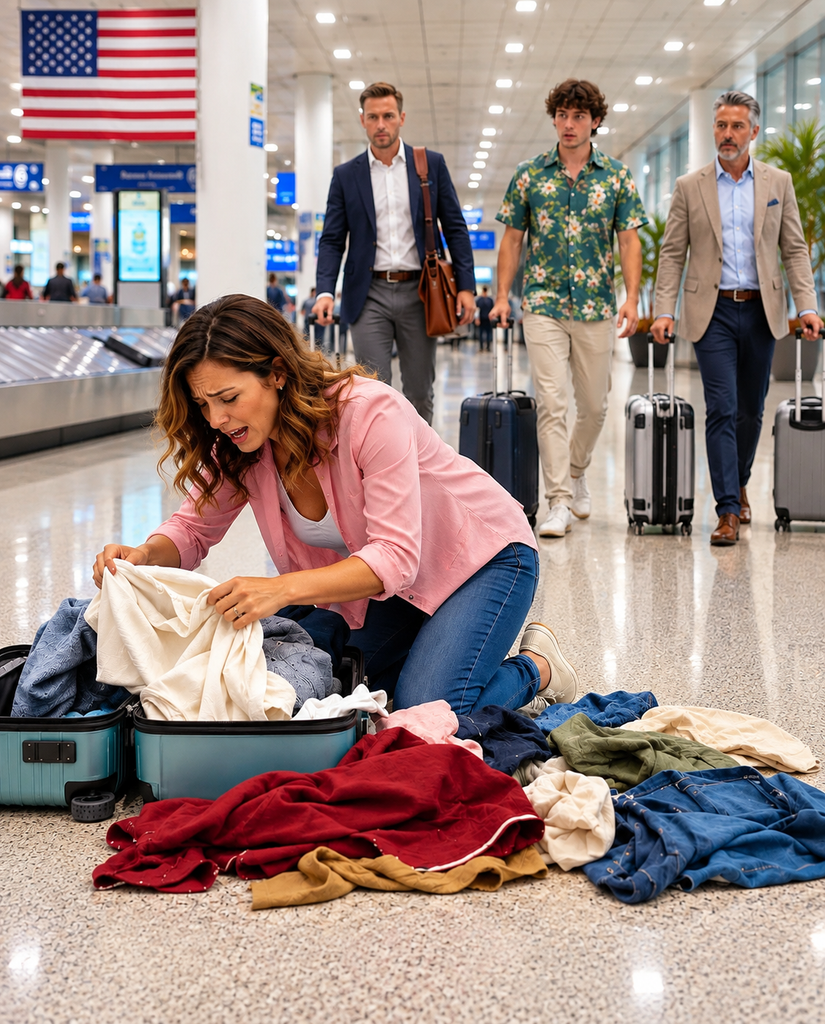
The suitcase on top fell to the floor and burst open.
James’s belongings scattered across the polished terminal tiles.
Socks.
Ties.
Neatly folded shirts that still carried the faint trace of his cologne.
Pieces of a life that had ended without warning.
Travelers stepped around me as I dropped to my knees and tried desperately to gather everything.
Tears filled my eyes.
My chest tightened so badly that breathing became difficult.
Finally, an airport employee knelt beside me.
She was a woman in her late fifties with silver threaded through her dark hair.
She did not ask what had happened.
She simply began folding James’s clothes.
When she picked up his shaving kit, she saw the hospital identification bracelet tucked inside.
Her expression softened.
“I’m sorry,” she whispered.
Those two words nearly broke me.
Not because they were unusual.
Because they were the first genuinely kind words anyone had spoken to me since I landed.
“My husband,” I managed to say. “He died.”
The woman placed one hand over mine.
“Is someone meeting you?”
I looked away.
“No.”
She helped close the suitcase and found a strip of airport tape to secure it.
Before I left, she wrote her name on the back of a receipt.
“Marianne,” she said. “I work here most evenings. If you need help getting to the rideshare area, I’ll walk with you.”
I thanked her, but my voice barely came out.
My family lived less than an hour away.
Not one of them was coming.
I ordered a rideshare and sat silently in the back seat while rain struck the windows.
The driver tried to start a conversation twice.
Both times, I pretended not to hear.
When we reached the house James and I had shared, every window was dark.
The driver carried my suitcases to the porch.
“You sure someone’s inside?” he asked.
I nodded even though I knew no one was there.
The moment I opened the front door, icy air wrapped around me.
The house smelled stale, like it had been closed for years instead of ten days.
I left the suitcases near the entrance and did not turn on a single light.
Instead, I curled into the armchair where James used to sit on Sunday mornings with a cup of coffee and the newspaper.
The silence inside the house was unbearable.
It seemed to close around me from every direction.
Every object reminded me of him.
His reading glasses rested on the side table.
A coffee mug sat upside down beside the sink.
His work boots were lined neatly against the wall.
On the mantel stood a photograph from our wedding.
James was laughing because the wind had blown my veil across his face.
I stared at the photograph until I could no longer see it clearly.
At some point, exhaustion pulled me into sleep.
I dreamed that James was calling me from another room.
At first his voice sounded normal.
Then it became distant.
Urgent.
“Amelia, wake up.”
I opened my eyes.
For several seconds, I did not know where I was.
Then I heard a clicking sound above me.
Click.
Click.
Click.
A sharp electronic chirp followed.
The smoke detector.
I sat upright.
The room was dark, but something faint and gray drifted near the ceiling.
Smoke.
I stood too quickly and nearly fell.
The smell hit me a moment later.
Burning plastic.
I followed it down the hallway toward the laundry room.
When I opened the door, sparks flashed behind the dryer.
A thin line of flame climbed the wall.
I screamed and stumbled backward.
James had always insisted on keeping a fire extinguisher beside the utility sink.
I grabbed it, pulled the pin, and aimed.
A weak cloud sprayed from the nozzle.
Then nothing.
I squeezed again.
The extinguisher sputtered and died.
The flame spread upward, catching the shelf above the dryer.
A bottle of cleaning solution fell and burst against the floor.
Fire raced across the spilled liquid.
Within seconds, the entire corner of the laundry room was burning.
I ran for my phone.
The smoke detector began shrieking.
I dialed 911 while trying to drag the suitcases toward the door.
The dispatcher answered.
“Emergency services. What is your location?”
“My house is on fire,” I said. “Please hurry.”
I gave her the address.
“Are you outside?”
“Not yet.”
“Leave everything. Get out immediately.”
I looked at the two suitcases.
James’s clothes.
His documents.
His wedding ring was inside the smaller case.
For one irrational moment, I thought I could save them.
Then something exploded in the laundry room.
The lights flickered.
A wave of black smoke rolled into the hallway.
I dropped the suitcase handles and ran.
Outside, cold rain struck my face.
I stood barefoot on the porch, coughing so hard that I could barely breathe.
My neighbor, Mr. Alvarez, opened his front door.
He was seventy-two and walked with a cane, but the moment he saw the smoke, he hurried across the street.
“Amelia!”
“Call the fire department!”
“They’re coming,” I said.
Flames appeared in the rear window.
Mr. Alvarez pulled off his coat and wrapped it around my shoulders.
His wife, Elena, came running behind him with a blanket and slippers.
Other neighbors emerged from their houses.
A young couple from two doors down dragged a garden hose across the lawn.
Someone moved a car away from our driveway.
Someone else shouted that the fire was reaching the attic.
Sirens screamed in the distance.
I stood in the rain, watching orange light pulse behind the windows of the home James and I had spent eleven years building together.
The first fire engine turned onto our street.
Then another.
Firefighters rushed toward the house carrying hoses and equipment.
One of them guided me toward an ambulance.
“Was anyone else inside?”
“My husband,” I said automatically.
The firefighter froze.
I closed my eyes.
“No. I’m sorry. He died last week. I was alone.”
A paramedic placed an oxygen mask over my face.
Through the rain, I watched firefighters break the laundry-room window.
Water blasted into the house.
Steam and smoke poured into the night.
Elena sat beside me inside the ambulance.
She held my hand although we had spoken only a few times before that night.
“You’re safe,” she kept saying. “That’s what matters.”
But I did not feel safe.
I felt as though James had died again.
First I had lost him.
Now I was watching our home disappear.
A reporter arrived before midnight.
The fire had spread through the attic, and strong wind was carrying sparks toward the neighboring houses. Emergency crews evacuated the homes on both sides of mine.
The reporter stood near the end of the street beneath a large umbrella.
A cameraman pointed his lens toward the flames.
I did not know they were filming me until a woman approached the ambulance.
“Mrs. Hart?”
I looked up.
“I’m Vanessa Cole from Channel Eight News. We understand you arrived home from overseas tonight. Would you be willing to speak with us?”
“No.”
She nodded immediately.
“Of course. I’m very sorry.”
Then Mr. Alvarez stepped forward.
“She buried her husband yesterday,” he told the reporter. “Her family wouldn’t even pick her up from the airport.”
I lowered the oxygen mask.
“Please,” I whispered.
Mr. Alvarez looked ashamed.
“I’m sorry, Amelia. I’m angry for you.”
Vanessa crouched beside the ambulance.
“Your family didn’t know you were here alone?”
“They knew.”
I should have stopped there.
But grief, exhaustion, smoke, and the sight of the burning house stripped away the careful silence I had maintained for years.