

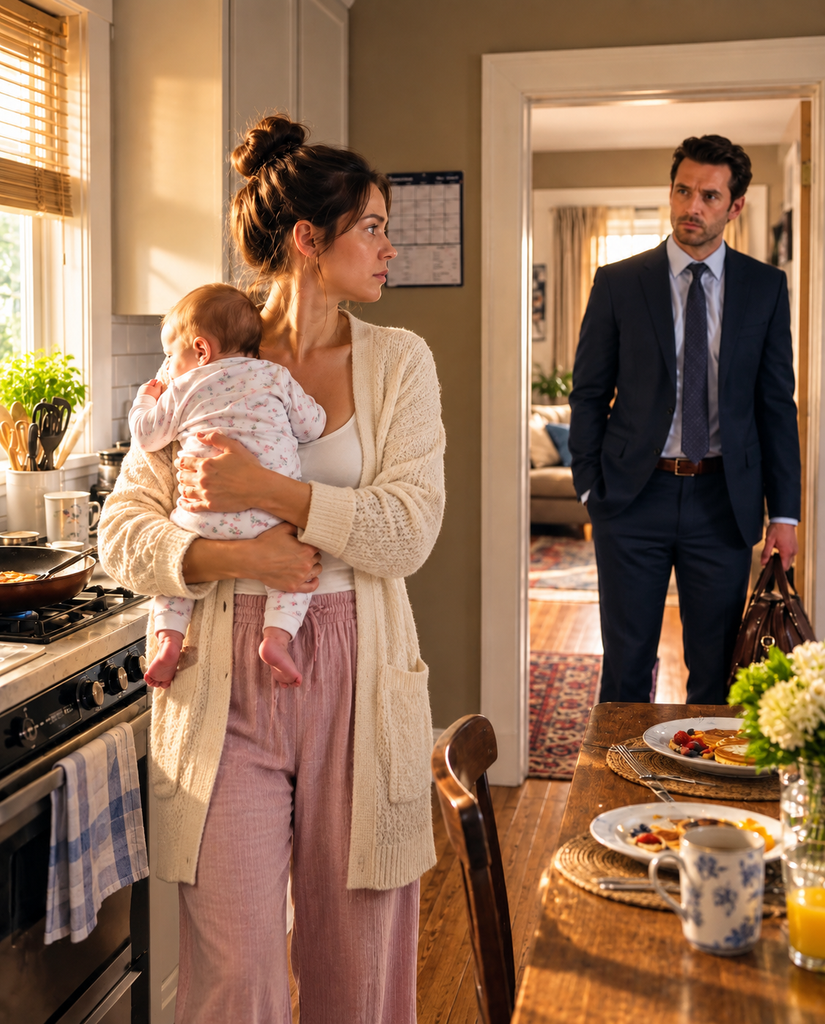
At 4:30 A.M., my husband came home, saw me holding our two-month-old baby while I cooked breakfast for his whole family, and said one word. “Divorce.” The kitchen tile was cold under my bare feet. Bacon grease clung to the air, sharp and heavy, mixing with burnt coffee and the sour little smell of a baby bottle warming too long in a mug of water.
I had been awake since midnight with our two-month-old son tucked against my chest, his breath dampening the front of my T-shirt while I cooked breakfast for Mark’s whole family.
His parents were arriving at eight.
His sister had texted at 1:17 a.m. to remind me that his mother liked her eggs soft and her toast dry, as if I were staff she had forgotten to tip.
The refrigerator hummed.
Mark’s key scraped in the lock.
My son had finally fallen asleep, one tiny fist curled into my shirt, and I remember tightening my arm around him before I even turned around.
Some part of me already knew that whatever had walked into that kitchen was not my husband coming home.
It was the end wearing his navy suit.
Mark stepped inside with his tie loose and his hair damp from the fog.
He looked at the table I had set.
The folded napkins.
The stack of clean plates.
The pan still hissing on the stove.
The bottle beside the coffee.
Then he looked at me like I was already furniture.
“Divorce,” he said.
No apology.
No explanation.
Just one word dropped into a kitchen where his wife was barefoot, exhausted, and holding his newborn son.
For one second, my heart hit my ribs so hard I thought the baby would wake.
But Oliver only sighed, warm and small, with milk on his breath and his cheek pressed against my collarbone.
I did not ask who she was.
I did not ask how long.
I did not ask whether his parents knew.
Women are taught to believe details make betrayal bearable.
They do not.
Details only give betrayal a floor plan.
So I reached over, turned off the stove, and tightened my arm around my son.
Mark blinked.
My silence bothered him more than my pain.
“Did you hear me?” he asked.
“I heard you.”
His face changed slightly, as if he had expected screaming.
Maybe he had planned for tears.
Maybe he had rehearsed walking past me while I begged him to remember our wedding vows, our baby, our mortgage, our life.
But I had spent two months learning how much pain a person could swallow without choking.
I had learned it during night feedings while Mark slept in the guest room because the baby’s crying “made him useless at work.”
I had learned it when his mother said childbirth had made me “dramatic.”
I had learned it when his sister told me I was lucky Mark had married me at all.
So I walked past him into the bedroom.
The room smelled like baby lotion and Mark’s expensive cologne.
His side of the bed was untouched.
Mine still held the dent from the twenty minutes of sleep I had stolen before Oliver woke again.
I pulled my old navy suitcase from the closet and placed it on the bed.
I packed like someone making an inventory.
Diapers.
Bottles.
Two sleepers.
My laptop.
My birth certificate.
Oliver’s hospital discharge papers.
Then the folder I had kept behind the loose back panel of my nightstand.
My hands did not shake.
That scared me more than crying would have.
Mark stood in the doorway with one hand on the frame.
“You’re being ridiculous,” he said. “I didn’t tell you to leave right now.”
I folded a small blue blanket and placed it on top of the folder.
“You said divorce.”
“Yes, divorce,” he snapped. “That doesn’t mean you run out like some kind of victim.”
I looked up at him.
“I am not running.”
He laughed once.
It was not a happy sound.
It was the sound of a man discovering that a door he assumed was locked had always been open.
“You have nowhere to go, Claire.”
That was the first mistake he made that morning.
He said it like a fact.
Like my life began with his last name.
Like I had not existed before him.
Like I had not built a career before I built his breakfast.
I zipped the suitcase.
Oliver stirred against my chest.
Mark glanced down at him, irritated, as if even his own baby had chosen the wrong moment to breathe.
“You’re not taking my son,” he said.
My hand tightened on the car seat handle.
“Our son is two months old. He needs to eat every two hours. You haven’t prepared one bottle since he was born.”
His jaw hardened.
“That’s not the point.”
“No,” I said softly. “It never was.”
By 4:52 a.m., I was standing in the driveway with Oliver strapped into his car seat, my suitcase beside my old SUV, and the porch flag tapping softly in the morning wind.
The neighborhood was still asleep.
The sky was the color of steel.
Mark leaned against the doorframe with his phone in his hand.
“Where are you going?” he asked, like I was being dramatic.
“Out.”
His mouth twitched.
He thought I meant my mother’s.
He thought I meant a cheap motel.
He thought I would be back before lunch because his family would arrive and somebody still had to serve breakfast.
Men like Mark do not fear quiet women.
They mistake restraint for permission.
I put Oliver in the back seat, loaded the suitcase, and drove away before Mark could decide whether he wanted to stop me.
The house disappeared in my rearview mirror.
I expected to cry then.
I expected the tears to come once the streetlights blurred and the silence filled the car.
But all I felt was a strange, clean emptiness.
Like a room after a storm has ripped the windows out.
At 6:08 a.m., I was sitting at the kitchen table of Mrs. Henderson, the retired partner who had trained me ten years earlier.
Her house smelled like peppermint tea and lemon furniture polish.
A small American flag sat in a jar by the window beside a stack of old tax journals.
She did not hug me right away.
That was why I trusted her.
She looked at Oliver asleep in his car seat, then at my face.
“He said it while you were holding the baby?” she asked.
I nodded.
“And you left?”
“I packed one suitcase.”
Mrs. Henderson smiled without warmth.
“Good. Let him think that was all you had.”
I looked down at my son sleeping by my foot.
“His family thinks I’m helpless.”
“No,” she said, sliding a yellow legal pad toward me. “They need you to be helpless. That’s different.”
At 7:31 a.m., Mark’s mother called.
I let it ring.
Then his sister.
Then Mark again.
By 8:04, he texted.
My parents are here. Don’t embarrass me.
I read it twice while Oliver made tiny sleeping sounds beside my ankle.
Then I opened my laptop.
Before I married Mark, before I learned which serving bowl his mother preferred and which shirts needed dry cleaning, I was a senior corporate auditor.
I knew how to read what men hid between line items.
I knew how shell companies breathed.
I knew how family money disappeared through “consulting fees,” “vendor advances,” and bank transfers scheduled at 2:13 a.m.
For eight months, I had documented everything.
Screenshots.
Account numbers.
Wire transfer ledgers.
A county clerk filing connected to a property Mark swore he never owned.
A folder labeled HOME EXPENSES that had nothing to do with our home.
Not suspicion.
Not jealousy.
Proof.
The first thing Mrs. Henderson did was call a forensic accountant she trusted.
The second thing she did was make me print every document twice.
At 9:46 a.m., Mark texted again.
You’ll get nothing if you make this ugly.
I stared at those words, then looked at the baby bottle cooling beside my coffee.
He still thought the marriage was the only thing I could lose.
Mrs. Henderson placed the first printed report in front of me.
“Start with the account he opened three weeks before the baby was born.”
I turned the page.
There was Mark’s signature.
There was the transfer I had never authorized.
And beside it, in black ink, was a name that made Mrs. Henderson stop breathing for half a second.
Evelyn Ward.
Mark’s mother.
For a moment, the kitchen went silent except for Oliver’s soft breathing and the scratch of Mrs. Henderson’s pen.
“Your mother-in-law is the beneficiary?” she asked.
I nodded, my throat tightening for the first time that morning.
Mark had not simply been hiding money from me.
His whole family had been helping him build an escape plan while I folded napkins, warmed bottles, and cooked breakfast like a grateful guest in my own marriage.
At 10:12 a.m., my phone rang again.
This time, it was Mark.
I answered on speaker.
“Where are you?” he snapped. “Mom is furious. Dad says you’re acting unstable.”
Mrs. Henderson raised one eyebrow.
I looked at the printed bank records spread across her table.
“Tell your mother I found the Ward Holdings account,” I said calmly.
The line went dead so fast I almost smiled.
Ten minutes later, Evelyn called me herself.
Her voice was no longer sharp.
It trembled.
“Sweetheart,” she said, suddenly soft, “let’s not involve lawyers.”
That was when I knew they were afraid.
I did not answer right away.
I let her hear Oliver fussing softly in the background.
For two months, Evelyn had complained that I held him too much, fed him too often, and “made motherhood look harder than it was.”
Now my son’s tiny cry was the only sound between her secrets and my silence.
“Claire?” Evelyn said. “Are you there?”
“I’m here.”
“Good. Good. Listen, sweetheart. Mark was tired. He said something foolish. Men say foolish things when they’re under pressure.”
I looked at Mrs. Henderson.
She wrote one word on the legal pad.
Pressure?
I almost laughed.
Pressure was waking up every ninety minutes with a newborn and then smiling at guests who inspected your housekeeping.
Pressure was pretending not to notice that your husband’s phone lit up with messages from a woman named Lila at midnight.
Pressure was stitching your dignity together while his family pulled at every seam.
“What kind of pressure?” I asked.
Evelyn exhaled.
“Well, business. Money. Family obligations. You know how complicated things are.”
“I know exactly how complicated they are.”
There was silence.
Then her voice lowered.
“What do you think you found?”
“Enough.”
“Enough for what?”
I looked at Oliver.
He had opened his eyes, dark and unfocused, staring up at a ceiling that was not ours.
I reached down and touched his tiny foot through his sock.
“Enough to understand why Mark wanted me gone before breakfast.”
Evelyn’s breath sharpened.
“That is a very dangerous thing to say.”
“No,” I said. “It’s a very dangerous thing to prove.”
Mrs. Henderson’s eyes lifted to mine.
She nodded once.