
 Reading Time: 30 minutes
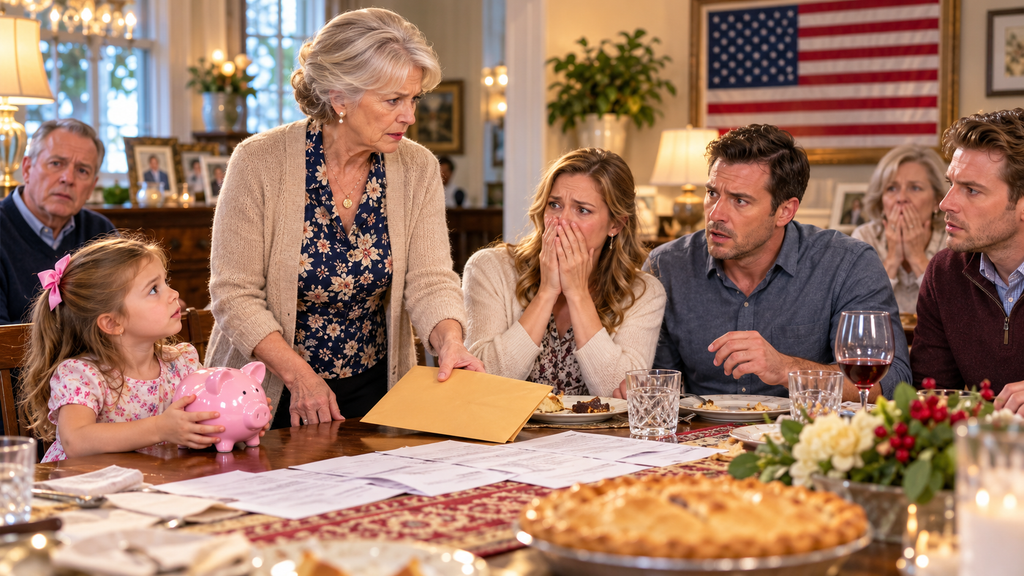
I put one finger on the envelope. “Before anybody counts her pennies,” I said, “somebody at this table is going to tell me which one of you signed my name on the receipts.”
Nobody answered. My granddaughter, Sophie, looked from one adult face to another. She was six. Six-year-olds notice silence differently than adults do.
They do not understand what is hiding inside it.
They only understand that the people they trust have suddenly stopped behaving normally.
Sophie pushed her pink piggy bank toward me.
“Nana?”
I looked at her.
“Yes, baby?”
“You can have it.”
That nearly broke me.
I crouched beside her chair.
“No, sweetheart. Nana doesn’t need your money.”
“But Mommy said—”
Emily moved so quickly her chair scraped against the floor.
“Sophie.”
It was too sharp.
Sophie flinched.
And something inside me hardened.
“Don’t,” I said.
Emily stared at me.
“Don’t what?”
“Don’t make her think she’s done something wrong because she repeated something she heard.”
Derek leaned back in his chair.
“Okay. Everybody needs to calm down.”
I looked at him.
“No.”
“Ma—”
“My name is Margaret.”
His eyebrows rose.
In fourteen years, I had never corrected him when he called me Ma.
Not once.
He understood immediately.
“Margaret,” he said.
“Better.”
He glanced toward Emily again.
That glance bothered me.
It was quick.
Almost nothing.
But after thirty years of teaching children, you learn that the smallest movements often tell you where the truth is sitting.
Derek was not looking at his wife for comfort.
He was looking at her for instructions.
I sat down again.
“Open the envelope.”
Emily whispered, “Mom, please.”
“Open it.”
Derek picked it up.
Inside were copies of twelve receipts.
Not all forty-eight.
I wasn’t foolish enough to show them everything I had.
Twelve was enough.
One from each quarter.
Four years represented by twelve sheets of paper.
Derek pulled out the first one.
His jaw tightened.
The second made his eyes narrow.
By the fourth, he stopped pretending he did not understand.
Emily did not touch them.
That told me something too.
“Where did you get these?” Derek asked.
“Does it matter?”
“Yes, actually, it does.”
“No. What matters is that my name is on them.”
“They’re childcare receipts.”
“I can read.”
“For Sophie.”
“I know who I’ve been babysitting.”
He put the papers down.
“All right.”
There it was.
The voice.
Not family-Derek.
Business-Derek.
The one who had once convinced a car dealership to replace an engine two months outside warranty.
The voice that turned every problem into a negotiation.
“Let’s not make this something it isn’t.”
I almost laughed.
“What is it?”
Emily covered her mouth.
Derek said, “The company has a dependent-care reimbursement program.”
“I know.”
His expression changed.
Only slightly.
But enough.
He had not expected me to know that.
“Okay,” he said. “Then you understand this isn’t like somebody stole money from you.”
“Whose signature is that?”
He looked down.
“Margaret—”
“Whose?”
Emily said quietly, “Mom.”
I turned toward her.
She was crying.
Not loudly.
Tears simply slid down her cheeks.
I wish I could tell you that seeing my daughter cry softened me.
Usually it would have.
When Emily was seven and fell off her bicycle, I carried her three blocks home even though she was perfectly capable of walking.
When she was sixteen and her first boyfriend broke her heart, I sat on the bathroom floor with her until two in the morning.
When she was twenty-nine and pregnant with Sophie and terrified that she would be a bad mother, I told her every good mother had wondered exactly that.
Her tears had always been a door I could not keep closed.
But this time there were forty-eight receipts sitting between us.
“Did you sign my name?”
She looked at Derek.
There it was again.
That glance.
“Emily.”
She swallowed.
“Some of them.”
The room changed.
I had prepared myself for Derek.
I had not prepared myself for her.
I thought of the signatures.
Two hands.
I had known one might belong to my son-in-law.
Some stubborn piece of my heart had refused to consider the obvious possibility for the other.
My daughter.
My Emily.
“How many?”
“I don’t know.”
“You don’t know how many times you forged your mother’s signature?”
“Mom, please don’t say it like that.”
I stared at her.
“How would you like me to say it?”
“It wasn’t—”
She stopped.
“Wasn’t what?”
Derek interrupted.
“It wasn’t intended as fraud.”
I turned toward him.
“Then why didn’t you tell me?”
He opened his mouth.
Nothing came out.
I nodded.
“That is what I thought.”
Sophie had gone very still.
I saw it then.
Her little shoulders were tight.
Her rabbit was pressed against her chest.
This was no longer a conversation that belonged in front of her.
I stood.
“Sophie, sweetheart, would you take your coloring things into Nana’s bedroom for a little while?”
“Am I in trouble?”
“No.”
“Is Mommy?”
Nobody spoke.
I walked around the table and kissed the top of her head.
“This is a grown-up conversation.”
She looked at her parents.
Then at me.
“Are you mad?”
“Yes.”
Children deserve the truth in sizes they can carry.
“But not at you.”
“Promise?”
“I promise.”
She hugged me around the neck.
Then she picked up her rabbit and crayons.
She started toward the hallway.
Halfway there, she turned around.
“You can still have my piggy bank.”
I had to close my eyes.
Just for a second.
“Thank you, baby.”
She disappeared down the hall.
I waited until my bedroom door clicked shut.
Then I turned back to my daughter and her husband.
“Now,” I said, “we can speak like adults.”
Derek rubbed his forehead.
“Fine.”
I pointed at the receipts.
“Start at the beginning.”
Emily whispered, “It was my idea.”
Derek looked at her sharply.
I saw that.
“So that’s how we’re doing this?” he asked.
She looked at him.
“What?”
“Nothing.”
“No. Say it.”
“Emily.”
“Say it, Derek.”
He pushed his chair back.
“This is exactly why I said we should talk about this before—”
“Before what?”
I asked.
Neither answered.
“Before I found out?”
Emily began crying harder.
“The benefit was going to expire.”
I waited.
She continued.
“When I went back to work after Sophie was born, HR explained the dependent-care account. I was putting money into it through payroll, and the company contributed too.”
I knew enough about the benefit to understand the broad outline.
But I wanted to hear her say it.
“All right.”
“The money could only be reimbursed for qualifying childcare.”
“And I was providing the childcare.”
“Yes.”
“For free.”
She closed her eyes.
“Yes.”
“So you decided to charge me without telling me?”
“No.”
That answer came quickly.
Too quickly.
“No, Mom. We weren’t charging you.”
“You submitted receipts saying I charged you.”
“We were just documenting the care.”
I leaned forward.
“Receipts for nine hundred eighty dollars a month.”
“The amount changed sometimes.”
“I noticed.”
Emily looked at the table.
“The program allowed reimbursement for care.”
“Care that was paid for.”
She said nothing.
“Was I paid?”
“No.”
“Then why did you submit receipts saying I was?”
Derek answered.
“Because otherwise the money would have been lost.”
There it was.
The justification.
The sentence people use when they have decided that unused money somehow belongs to them.
I looked at him.
“Lost to whom?”
“What?”
“You said the money would have been lost. Lost to whom?”
“The benefit account.”
“So not lost from your pocket?”
“Some of it came from payroll deductions.”
“And some didn’t.”
He exhaled.
“This is getting unnecessarily technical.”
“No, Derek. For the first time in four years, it is getting appropriately technical.”
Emily whispered, “Mom, we needed it.”
That hurt worse than I expected.
Not because they needed money.
I would have helped.
I had helped.
Their refrigerator died two years ago.
I paid for the new one.
Sophie needed dental work their insurance did not fully cover.
I wrote the check.
When Derek’s truck transmission went out, I loaned them three thousand dollars.
Loaned is perhaps too generous a word.
Nobody ever mentioned paying it back, and I never asked.
So when Emily said they needed the money, my first thought was painfully simple.
Why didn’t you ask me?
I said it aloud.
“Why didn’t you ask me?”
Emily looked up.
“Because you already do everything.”
That answer surprised me.
“So instead you forged my name?”
“We didn’t think of it like that.”
“That seems to be a theme tonight.”
Derek stood.
“I think we’re done.”
“No.”
His face hardened.
“Excuse me?”
“You may be done. I am not.”
“Margaret, this is between Emily and me too.”
“No. You put my name on paperwork. That made it between you and me.”
He reached for the receipts.
I put my hand over them.
“Those stay.”
“They’re copies.”
“Yes.”
“Then what’s the problem?”
“The problem is that you suddenly want them.”
He pulled his hand back.
For the first time that evening, I saw something behind his confidence.
Fear.
Small.
But real.
I had spent thirty years watching children realize the teacher knew more than they thought she did.
Adults make the same face.
They’re simply better at hiding it.
I sat again.
“There are forty-eight receipts.”
Emily looked up.
Derek froze.
“I have copies of all of them.”
Silence.
“And,” I continued, “I know there are two different people signing my name.”
Emily’s lips parted.
Derek looked toward her.
Neither spoke.
“I know one is Emily.”
I looked at him.
“Is the other you?”
“No.”
Too fast.
Emily stared at him.
That was interesting.
“Derek?”
He shook his head.
“I filled out forms. I didn’t sign your name.”
“Then who did?”
“I don’t know.”
“That’s a lie.”
“Mom,” Emily said.
I turned toward her.
She wasn’t looking at me.
She was looking at her husband.
“You told me you did the others.”
Derek’s face changed.
Only for a second.
But I saw it.
“What others?”
Emily pushed back from the table.
“The receipts.”
“I never said that.”
“Yes, you did.”
“No. I said I handled them.”
“You said—”
“I said I handled the paperwork.”
Emily stared at him.
Something was happening between them now that had nothing to do with me.
Or perhaps everything to do with me.
“Derek,” she whispered.
He picked up his water glass.
His hand was trembling.
“Who signed them?”
I asked.
He did not answer.
I stood.
“Dinner is over.”
Emily looked at me.
“Mom—”
“You can take Sophie home.”
“Please.”
“We will speak tomorrow.”
“Mom, please don’t do anything yet.”
That sentence stopped me.
“Anything?”
She realized her mistake.
I turned slowly.
“What exactly are you afraid I might do?”
“Nothing.”
“Emily.”
She wiped her face.
“I don’t know.”
“Yes, you do.”
Derek stepped between us verbally, if not physically.
“We should go.”
I looked at him.
“Yes.”
He called toward the hallway.
“Sophie!”
“No,” I said.
He stared at me.
“I’ll get her.”
I walked down the hallway.
My bedroom door was partly open.
Sophie was sitting on the floor beside my bed.
She wasn’t coloring.
She was listening.
Of course she was.
Six years old does not mean deaf.
I knelt beside her.
“Time to go home, baby.”
She whispered, “Daddy’s mad.”
“Yes.”
“Are you mad at Daddy?”
I considered lying.
Then I remembered what lies had already done to this family.
“I am upset with some choices the grown-ups made.”
“Mommy too?”
“Yes.”
She looked down at her rabbit.
“Because of Nana money?”
My throat tightened.
“Yes.”
She thought for a moment.
Then she said something I will remember until I die.
“I don’t like Nana money.”
Neither did I.
I helped her into her sweater.
At the front door she hugged me twice.
Emily could barely look at me.
Derek did not try.
They walked to their car.
I stood behind the screen door and watched Sophie wave through the back window.
I waved until the car turned the corner.
Then I locked the door.
I returned to the dining room.
Five plates.
Half a pie.
A pink piggy bank.
And twelve photocopied lies.
I sat at the table until the grandfather clock struck nine.
Then I opened the drawer beside the telephone and removed a yellow legal pad.
Teachers make lists.
We make lists when classrooms are chaotic.
We make lists when parents are angry.
We make lists when children are struggling.
We make lists because a problem becomes less frightening once it has lines and numbers.
At the top I wrote:
WHAT I KNOW.
- Forty-eight receipts.
- $11,760 reimbursed.
- My name listed as childcare provider.
- I received $0.
- At least two different signatures.
- Emily admits signing some.
- Derek denies signing any.
Then I added:
- Sophie called it “Nana money.”
I stared at that line.
Then I wrote one more.
- Derek is afraid of something.
My telephone rang at 9:17.
Emily.
I let it ring.
At 9:22, she called again.
At 9:31, a text arrived.
Please don’t call my work.
I read it twice.
Then another message appeared.
Please Mom. Let me explain tomorrow.
I did not answer.
At 9:44, Derek called.
I did not answer that either.
At 10:03, somebody knocked on my front door.
Three firm knocks.
I looked through the peephole.
Derek.
Alone.
I almost ignored him.
Then he knocked again.
“Margaret.”
I opened the door but kept the storm chain latched.
“What?”
“We need to talk.”
“We did.”
“Not with Emily.”
I stared at him.
That sentence told me more than he intended.
“What don’t you want to say in front of your wife?”
His jaw tightened.
“Can I come in?”
“No.”
He glanced toward the neighboring houses.
“Seriously?”
“Very.”
“I’m standing on your porch.”
“I know where my porch is.”
“Margaret.”
“What?”
He lowered his voice.
“You went to somebody at Emily’s company, didn’t you?”
I said nothing.
His eyes narrowed.
“Who?”
“Good night, Derek.”
He put his hand against the door before I could close it.
Not hard.
But enough.
I looked down at his hand.
Then up at him.
He removed it.
“Sorry.”
“No, you’re not.”
“Look, you don’t understand the situation.”
“Then explain it.”
He glanced behind him.
“Not here.”
“Here is all you have.”
For several seconds, he said nothing.
Then:
“The money wasn’t all for us.”
There it was.
The first crack.
“Who else?”
“I can’t tell you.”
“Then good night.”
I started closing the door.
“Wait.”
I stopped.
He looked miserable now.
Not charming.
Not confident.
Just cornered.
“You need to understand that Emily could lose her job.”
“Did Emily falsify company reimbursement documents?”
His silence answered.
“Then perhaps she should have thought about her job before doing that.”
“You’re her mother.”
“Yes.”
“And Sophie is your granddaughter.”
“Yes.”
“So think about what happens to Sophie if Emily gets fired.”
I stared at him.
It took me several seconds to accept what he had just done.
“You’re using my granddaughter to frighten me into silence.”
“No.”
“Yes.”
“I’m asking you to consider the consequences.”
“I have spent five years considering consequences for your family. Every weekday from seven fifteen until whenever one of you finally appears at my door.”
“That isn’t fair.”
I laughed once.
“You know what isn’t fair, Derek? A six-year-old emptying her piggy bank because she thinks her grandmother needs to be paid.”
His face softened for a moment.
Then hardened again.
“Just give us forty-eight hours.”
“For what?”
“To straighten this out.”
“What does that mean?”
“It means let me fix it.”
“By doing what?”
“I’ll pay the money back.”
That surprised me.
“All of it?”
“Yes.”
“You have eleven thousand seven hundred sixty dollars?”
He hesitated.
“I can get it.”
“How?”
“That’s my problem.”
“No. Apparently your problems have been appearing with my signature underneath them for four years.”
He closed his eyes.
Then he said:
“Please.”
It was the first sincere word I had heard from him all evening.
But sincerity does not turn a lie into truth.
“Who is the second signer?”
His eyes opened.
“I don’t know.”
“Then you still aren’t ready to fix anything.”
I closed the door.
This time he let me.
I locked it.
At 10:26, another text arrived.
Not from Emily.
Not from Derek.
Unknown number.
Mrs. Hale, this is Caroline Mercer. I believe you spoke with someone regarding dependent-care reimbursements connected to Emily. Please call me before you speak to anyone else.
I read it three times.
Caroline Mercer.
The name meant nothing to me.
I did not call.
Instead I wrote it on my yellow pad.
- Caroline Mercer.
Then I went to bed.
I did not sleep.
At 6:40 Monday morning, I made coffee.
At 7:15, nobody knocked.
That was the first weekday in five years Sophie had not arrived at my house.
At 7:32, Emily texted.
Keeping Sophie home today.
I stared at the message.
Then I typed:
Okay.
I erased it.
Typed:
We need to talk.
Erased that too.
Finally, I put the phone down.
At 8:10, Caroline Mercer called again.
This time I answered.
“Mrs. Hale?”
“Yes.”
“My name is Caroline. I work with Emily.”
“What department?”
Silence.
“Caroline?”
“Payroll.”
My fingers tightened around the phone.
“What do you want?”
“I think we should meet.”
“Why?”
“Because I think there’s something you need to know about those receipts.”
“Are you the second person signing my name?”
Silence.
Then I heard her breathe in.
“Yes.”
I sat down.
“Why?”
“Not on the phone.”
“Why not?”
“Because I could lose my job.”
I almost laughed at the repetition.
Everyone was worried about losing a job.
Nobody had worried about losing me.
“Where?”
She named a coffee shop across town.
“Ten o’clock.”
“I’ll be there.”
Caroline Mercer was already seated when I arrived.
She was perhaps forty.
Neat blond hair.
Gray cardigan.
No makeup except lipstick.
She had the exhausted face of someone who had spent the morning imagining every possible version of a conversation.
I recognized her.
Not well.
But enough.
“You’ve been to my house.”
She looked startled.
“Once.”
“Emily’s birthday.”
“Yes.”
Three years earlier.
Emily had invited coworkers.
Caroline had brought a bottle of wine.
I remembered because she had complimented my lemon bars.
I sat opposite her.
She had a folder.
Of course she did.
Everybody in this story seemed to have folders.
“I want you to tell me the truth,” I said.
“I will.”
“All of it.”
She nodded.
“I signed some of your receipts.”
“How many?”
“Maybe eighteen.”
“Maybe?”
“Seventeen or eighteen. I don’t remember exactly.”
“Why?”
She looked toward the window.
“Because Emily asked me to.”
“Why would someone in payroll sign a childcare provider’s name?”
She closed her eyes.
“Because the claims were getting flagged.”
There it was.
I said nothing.
She continued.
“The signatures weren’t consistent. At first nobody noticed. Then the benefit administrator changed systems and older claims were scanned for verification.”
“So?”
“So Emily panicked.”
“And you helped her.”
“Yes.”
“Why?”
Caroline’s eyes filled.
“Because she helped me first.”
I waited.
“My husband left me four years ago. I had two children. I was behind on rent. Emily showed me how to submit dependent-care claims.”
“False claims?”
Caroline nodded.
My stomach turned.
“So this was bigger than my daughter.”
“Yes.”
“How much bigger?”
“I don’t know.”
“Don’t lie to me.”
“I’m not. I genuinely don’t know.”
“Who taught Emily?”
Caroline looked down.
That was the moment.
The moment I understood Derek had been telling the truth about one thing.
He wasn’t the second signer.
But he knew who was.
“Who?”
Caroline whispered:
“Derek’s mother.”
I stared at her.
“Linda?”
She nodded.
My mind rejected it before reason could catch up.
Linda lived forty minutes away.
She saw Sophie perhaps once every two months.
She called herself “Grandma L.”
She had spent years making little comments about how lucky Emily was to have a mother who “didn’t have much going on.”
Linda.
“Explain.”
Caroline slid the folder toward me.
Inside were printed emails.
Emily’s name.
Caroline’s.
And another address I recognized as Linda’s.
The earliest was four years old.
Caroline said, “Linda used to work in benefits administration.”
I remembered.
Years ago.
Before retirement.
Not at Emily’s company, but at an insurance administrator.
“She knew how these accounts worked,” Caroline continued. “She told Emily that if you were providing childcare, the family should be reimbursed.”
“But I wasn’t charging them.”
“I know.”
“Did Linda know?”
“Yes.”
That hurt in an entirely different way.
“Then why use me?”
“Because you were real.”
I stared at her.
“What?”
“You actually provided the care. Sophie actually stayed with you. Your address was real. Your name was real. If anybody ever checked whether childcare existed, it did.”
I felt cold.
They had not invented a babysitter.
They had done something more efficient.
They had taken a real grandmother and invented a price.
“How did Linda benefit?”
Caroline hesitated.
“She charged them.”
“For what?”
“For helping.”
I almost did not understand.
Then I did.
“A percentage?”
“Yes.”
“How much?”
“Twenty percent, I think.”
I leaned back.
My daughter’s mother-in-law had been taking a cut of money claimed for childcare I provided for free.
The absurdity was so complete that for several seconds I could not speak.
“Did Derek know?”
Caroline nodded.
“From the beginning?”
“I don’t know.”
“Caroline.”
“I don’t. Emily told me he found out later.”
“When?”
“Maybe two years ago.”
“And what did he do?”
“Nothing.”
That sounded like Derek.
Not innocent.
Not mastermind.
Complicit.
Sometimes cowardice does almost as much damage as cruelty.
I looked at the emails.
One from Linda said:
M needs to sign each invoice. Don’t get sloppy.
Another:
Keep monthly amount under threshold.
Another:
If M ever asks, tell her it’s just for tax documentation.
M.
I was M.
Not Margaret.
Not Nana.
Not Mom.
A letter in somebody else’s little system.
I closed the folder.
“Why are you giving me this?”
Caroline began crying.
“Because they’re going to blame me.”
“Are you responsible?”
“Yes.”
The answer surprised me.
No excuse.
No immediate defense.
Just yes.
“I did it. I knew it was wrong. I kept telling myself everybody does little things with benefits and nobody was really being hurt.”
She looked at me.
“But then Emily called last night.”
“What did she say?”
“She said you knew.”
“And?”
“She said Derek wanted everyone to stick to the same story.”
I felt something inside me settle.
Not anger.
Clarity.
There comes a moment when betrayal becomes too complicated to keep feeling as one wound.
It becomes information.
Names.
Dates.
Choices.
Consequences.
“What story?”
“That you were paid in cash.”
I went very still.
“They’re going to say they paid me?”
Caroline nodded.
“And that you didn’t report it.”
There it was.
The final turn of the knife.
If they were questioned, they planned to protect themselves by making me part of the fraud.
I stood.
Caroline looked frightened.
“Mrs. Hale—”
“Thank you.”
“What are you going to do?”
“I don’t know yet.”
That was a lie.
For the first time in this entire mess, I knew exactly what I was going to do.
I went home.
At 12:14, I called Emily.
She answered immediately.
“Mom?”
“Come to my house at six.”
“Okay.”
“Bring Derek.”
Silence.
“Mom—”
“And Linda.”
That silence was different.
Longer.
“Why Linda?”
“Six o’clock.”
I hung up.
Then I called my attorney.
Not because I wanted revenge.
Because for four years, everyone involved had counted on one fact:
Margaret will not make trouble.
Margaret loves her family.
Margaret will forgive.
Margaret will think of Sophie.
Margaret will be embarrassed.
Margaret will stay quiet.
They had mistaken kindness for permission.
At six o’clock, all three arrived.
Emily first.
Derek behind her.
Linda last.
Linda entered my dining room carrying herself with the offended dignity of someone who had already decided she was the victim.
“This is ridiculous,” she said.
I almost admired the speed.
She hadn’t even removed her coat.
“Sit down, Linda.”
“I don’t appreciate being summoned.”
“You’re free to leave.”
She looked toward Derek.
He would not meet her eyes.
That interested me.
She sat.
I had removed the Sunday dishes.
In their place were four folders.
One for Emily.
One for Derek.
One for Linda.
One for me.
Derek saw them and swore under his breath.
Linda snapped, “What?”
Nobody answered.
I sat.
“Four years ago, childcare reimbursement claims began being submitted through Emily’s employer using my name as the childcare provider.”
Linda’s face did not move.
Good.
She was better than Derek.
“Forty-eight receipts were submitted. Total reimbursements were eleven thousand seven hundred sixty dollars.”
Linda said, “And?”
That one word told me she knew.
I looked at Emily.
My daughter was staring at her hands.
“I never charged for childcare. I never received those payments. I never signed those receipts.”
Linda leaned back.
“This sounds like something you should discuss with your daughter.”
“I am.”
I slid a page across the table.
“And with you.”
She glanced down.
It was one of her emails.
Her face changed.
Not dramatically.
Linda was too disciplined for that.
But her left thumb stopped moving.
She had been rubbing it against the side of her index finger.
Suddenly it froze.
“Where did you get this?”
“Does it matter?”
“This is private correspondence.”
“So were my signatures.”
Derek muttered, “Jesus.”
Linda turned on him.
“Be quiet.”
And there it was.
The family hierarchy.
I suddenly understood more than I wanted to.
Derek was not the cleverest person in this scheme.
He was the son of the cleverest person.
Linda looked at Emily.
“Did you give her these?”
“No.”
“Then who?”
I said, “That isn’t important.”
“It is absolutely important.”
“No. What’s important is that I have them.”
Linda read the page again.
Then she pushed it back.
“This proves nothing.”
“It proves you instructed Emily about the claims.”
“It proves I gave general guidance.”
“You wrote, ‘M needs to sign each invoice.’”
“Yes.”
“And when M didn’t?”
She stared at me.
I stared back.
Thirty years in elementary classrooms had prepared me surprisingly well for this moment.
Children test boundaries.
Adults do too.
The main difference is that adults hire lawyers afterward.
“Did you ever sign my name, Linda?”
“No.”
“Did you instruct someone else to?”
“No.”
“Did you receive part of the reimbursements?”
Silence.
Emily looked up.
“Linda?”
Linda’s eyes shifted toward her.
Emily whispered, “You told me it was a processing fee.”
Oh.
That was new.
Even Derek looked at his mother.
Linda said calmly, “It was compensation for the work I was doing.”
“What work?” I asked.
“Helping them navigate a complicated benefits system.”
“You took twenty percent?”
“I don’t remember the exact arrangement.”
“Interesting. Everybody remembers poorly when money becomes specific.”
Emily stared at Linda.
“You said the administrator charged it.”
Linda’s expression tightened.
Derek said, “Mom.”
“Not now.”
“No,” he said.
His voice was different.
“Now.”
Linda looked at him.
“You told us the percentage was an administrative fee.”
“It was.”
“Paid to you?”
“I was doing the administration.”
Derek stood.
“You said it was required.”
Linda’s composure cracked.
Barely.
“I said there were costs associated with—”
“You lied to us?”
I almost laughed at the irony.
Three people who had lied to me were now furious because one had lied to the other two.
Fraud, apparently, still required etiquette.
Emily began crying.
Again.
But this time I understood the tears differently.
She was not merely afraid.
She was watching the story she had told herself collapse.
That matters.
People rarely wake up and say, Today I will become dishonest.
They construct little bridges.
It’s technically allowed.
Nobody loses anything.
Mom doesn’t need the money.
The benefit would expire anyway.
Linda knows the rules.
We’ll stop next month.
Everybody does it.
One bridge becomes another.
Eventually they are standing somewhere they never imagined reaching.
But they still walked there.
Every step.
I looked at my daughter.
“Did you know Linda was keeping money?”
“I thought it was a fee.”
“Did you know the receipts were false?”
She closed her eyes.
“Yes.”
“Did you sign my name?”
“Yes.”
“Did you know that was wrong?”
A long pause.
“Yes.”
That was the first honest conversation we’d had.
I turned to Derek.
“Did you know?”
He stared at the table.
“Yes.”
“When?”
“About a year after it started.”
“What did you do?”
“Nothing.”
“Why?”
“Because we needed the money.”
I nodded.
Then Linda said the sentence that ended any remaining sympathy I might have had for her.
“Well, Margaret wasn’t exactly being exploited.”
We all looked at her.
She continued.
“She was watching her own granddaughter.”
I stared.
Linda lifted her chin.
“She wasn’t running a daycare. She wasn’t losing wages. She’s retired. Sophie gave her something to do.”
Emily whispered, “Linda.”
“No. Everybody is acting like Margaret was some employee being cheated out of salary. She volunteered.”
I could feel my heartbeat in my throat.
I stood slowly.
“Something to do?”
Linda shrugged.
“I didn’t mean it offensively.”
“Yes, you did.”
“Margaret—”
“For five years, I woke up at six every weekday.”
She looked away.
“No. Look at me.”
She did.
“I packed lunches. I wiped fevers. I sat through preschool pickup lines. I learned every song from that ridiculous cartoon with the talking puppies because Sophie loved it. I changed diapers. I washed sheets. I kept children’s Tylenol in my purse. I missed appointments because Emily was late. I canceled lunches because Derek forgot pickup. I sat beside that baby’s bed when she had pneumonia because her mother had used all her sick days.”
Emily was sobbing now.
I kept going.
“I did those things because I love my granddaughter.”
My voice broke.
I hated that.
But I let it.
“Do not confuse love with worthlessness.”
Nobody moved.
“I never asked to be paid. That was my choice.”
I pointed toward the receipts.
“But you took my gift, put a dollar amount on it, collected that dollar amount, and then told yourselves I was too old and useless to have lost anything.”
Linda looked down.
I had never seen her do that before.
Then Derek said:
“She’s right.”
Linda snapped her head toward him.
“Excuse me?”
“She’s right.”
“Don’t be dramatic.”
“Mom, shut up.”
Emily stared at him.
So did I.
Derek sat down.
He covered his face.
“I knew it was wrong.”
Linda said, “Oh, please.”
He dropped his hands.
“No. I knew.”
He looked at me.
“I knew, Margaret.”
His eyes were red.
“I found out after the first year. Emily told me. I was furious.”
Emily looked at him.
“You weren’t furious.”
“I was.”
“You said—”
“I was furious because I was scared.”
He turned toward her.
“And then Mom explained how it worked and told us nobody would ever check.”
Linda said, “That’s not what I said.”
“Yes, it is.”
“No.”
“You said Margaret was a legitimate provider and the paperwork was a technicality.”
Linda’s face hardened.
Derek continued.
“And I believed you because believing you meant I didn’t have to give the money back.”
That was perhaps the most truthful sentence he had ever spoken in my house.
He looked at me.
“I could have stopped it.”
“Yes.”
“I didn’t.”
“No.”
“I’m sorry.”
I believed him.
That did not mean everything was fixed.
Remorse and repair are cousins.
They are not twins.
I sat again.
Emily whispered, “What happens now?”
I opened my folder.
“I spoke to an attorney.”
Linda’s head came up.
“What attorney?”
“Mine.”
“You hired a lawyer?”
“I consulted one.”
“This is family.”
I almost smiled.
“So was my signature.”
Linda went silent.
“My attorney advised me to document that I did not sign the receipts and did not receive payment.”
Derek nodded slowly.
Emily whispered, “Are you reporting us?”
I looked at my daughter.
There are questions no mother imagines hearing.
That was one.
“I am correcting the record.”
Her face crumpled.
“Mom.”
“I will not let anyone claim I received money I never received.”
“We wouldn’t.”
I looked at Derek.
He closed his eyes.
Emily noticed.
“What?”
He said nothing.
“What?”
She turned toward him.
“Derek?”
I answered.
“Someone suggested saying I was paid in cash.”
Emily’s face went blank.
Then she turned toward her husband.
“You said what?”
Derek whispered, “I panicked.”
“You told me we’d explain it.”
“I was trying to protect you.”
“By blaming my mother?”
“I wasn’t going to—”
“You told Caroline?”
Silence.
Emily stood so fast her chair fell backward.
“You told Caroline to say Mom got cash?”
“Emily—”
“You son of a—”
“Sophie is in the living room,” I said.
Everyone froze.
Yes.
Sophie was there.
Emily had brought her because they could not find someone else on short notice.
The irony had not escaped me.
My granddaughter was watching television with headphones in the next room.
Emily lowered her voice.
“You were going to make my mother part of it?”
Derek looked ashamed.
“I didn’t know what else to do.”
“Tell the truth!”
He stared at her.
Then said quietly:
“We’re both a little late to start saying that like it’s easy.”
Emily recoiled.
It was cruel.
It was also true.
She sat down.
Nobody spoke for nearly a minute.
Then Linda stood.
“I’ve heard enough.”
I looked at her.
“Sit.”
“No.”
“Then leave.”
“I intend to.”
She grabbed her purse.
At the doorway she turned.
“You should think very carefully about what you’re doing, Margaret.”
I stared at her.
“I have.”
“You could destroy your daughter’s career.”
“No.”
I said it quietly.
“Your choices may damage my daughter’s career. Her choices may damage her career. Derek’s choices may damage their finances. My telling the truth does not become the cause simply because it happens last.”
Linda’s lips pressed together.
She left.
The front door slammed.
Sophie called from the living room.
“Nana?”
I went to her.
“Everything’s okay, baby.”
“Grandma L left mad.”
“Yes.”
“Did she forget dessert?”
Despite everything, I laughed.
“Yes, sweetheart. I think she did.”
“Can I have hers?”
“Absolutely.”
When I returned to the dining room, Emily was holding Derek’s hand.
That surprised me.
Then I understood.
They were still husband and wife.
Whatever happened next, that was theirs to decide.
I sat across from them.
“I am not calling your employer tonight.”
Emily breathed out.
“Thank you.”
“Don’t thank me yet.”
She went still.
“Tomorrow morning, you are going to HR yourself.”
Her eyes widened.
“Mom—”
“You will tell them the receipts were inaccurate.”
“I’ll be fired.”
“Maybe.”
“We could lose the house.”
“Maybe.”
“Sophie—”
“No.”
My voice sharpened.
“Do not put her between us.”
Emily began crying again.
I reached across the table.
For the first time that evening, I took my daughter’s hand.
She clutched mine.
“I love you.”
That made her cry harder.
“I love you enough not to help you become somebody you don’t want to be.”
“Mom.”
“You made a terrible choice.”
She shook her head.
“Lots of them.”
“Yes.”
I squeezed her fingers.
“But you are still here.”
She looked at me.
“So tomorrow you tell the truth.”
“What if they call the police?”
“I don’t know.”
“What if—”
“I don’t know, Emily.”
That was the hardest part.
Mothers are supposed to know.
We are supposed to have spare mittens.
Emergency numbers.
Answers.
But sometimes loving your child means standing beside her while consequences arrive.
Not removing them.
Derek said quietly, “I’ll go with her.”
I looked at him.
“You should.”
He nodded.
“And I will tell them what I knew.”
Emily stared at him.
“You don’t have to.”
“Yes.”
“You could lose your job too if—”
“Emily.”
He looked at her.
“We’re done lying.”
She started crying again.
This time he held her.
I watched them.
And despite everything, I hoped their marriage survived.
Not because Derek deserved immediate forgiveness.
Not because Emily did.
Because Sophie deserved parents who learned something from this.
At 7:42 the next morning, Emily called.
“I’m outside HR.”
I was standing at my kitchen window.
“Okay.”
“I feel sick.”
“I know.”
“Mom?”
“Yes?”
“Will you still love me when I come out?”
I closed my eyes.
“Oh, Emily.”
She began crying.
“Will you?”
“Yes.”
“Even if they fire me?”
“Yes.”
“Even if—”
“Yes.”
A long silence.
Then:
“Okay.”
“Go inside.”
She did.
Three hours passed.
At 10:51, she called.
Her voice was exhausted.
“They suspended me.”
I sat down.
“With pay?”
“No.”
“What else?”
“There’s an investigation.”
I waited.
“They asked about Linda.”
“And?”
“I told them.”
“Everything?”
“Yes.”
“Caroline?”
“Yes.”
“Derek?”
“Yes.”
“And me?”
Her voice cracked.
“I told them you didn’t know anything.”
I closed my eyes.
For the first time in days, I breathed fully.
“Thank you.”
“Mom?”
“Yes?”
“I’m sorry.”
“I know.”
“No. I don’t think you do.”
She was crying.
“I sat in that room and listened to them read your name over and over. And every time they said ‘provider Margaret Hale,’ I wanted to crawl under the table.”
I didn’t interrupt.
“I made you into paperwork.”
My throat tightened.
“You made my love into a receipt.”
She sobbed.
“Yes.”
There are apologies that ask to be excused.
And apologies that finally understand the injury.
That was the second kind.
“I forgive you,” I said.
She went silent.
“But forgiveness does not mean we pretend it didn’t happen.”
“I know.”
“And childcare is changing.”
Another silence.
“I know.”
That afternoon, I made a new schedule.
Three days a week.
Eight until five thirty.
Not seven fifteen.
Not six thirty.
No surprise evenings.
No automatic Saturdays.
Emily and Derek would arrange other childcare for the remaining time.
They objected at first.
Not angrily.
Fearfully.
Little Sprouts cost more than they could comfortably afford.
That was not my problem to solve completely.
I helped them research options.
I did not write a check.
There is a difference between helping someone stand and becoming the floor beneath them.
Two weeks later, Emily lost her job.
She came to my house afterward.
No makeup.
Hair pulled back.
She sat at the same kitchen table where the receipts had been spread.
“They fired me.”
I poured coffee.
“I’m sorry.”
“I deserved it.”
“Maybe.”
She looked surprised.
“You’re supposed to disagree.”
“No.”
That almost made her smile.
She wrapped both hands around the mug.
“They aren’t prosecuting me.”
I exhaled.
The company required repayment of improperly reimbursed amounts and referred the broader matter to the benefit administrator for review.
There were attorneys.
Letters.
Interviews.
Months of unpleasantness.
Linda hired a lawyer immediately.
Of course she did.
Caroline cooperated fully.
Derek did too.
Emily found temporary work at a medical office.
Less money.
Longer commute.
No fancy dependent-care benefit.
She told me once that she was grateful for that.
Derek sold his truck.
That surprised everyone.
Especially Derek.
He used the money to help repay what they owed.
He arrived at my house one Saturday in an eight-year-old sedan with a dented passenger door.
Sophie climbed out and announced:
“Daddy’s new car has a butt dent.”
Derek looked at me.
I looked at him.
We both laughed.
It was the first uncomplicated moment between us in months.
Then he handed me an envelope.
I frowned.
“What is this?”
“Open it.”
Inside was a check.
Nine hundred eighty dollars.
I stared at it.
“No.”
“Margaret.”
“No.”
“It isn’t childcare payment.”
“Then what is it?”
“The first installment.”
“Of what?”
“What we owe you.”
“You don’t owe me eleven thousand dollars.”
“We used your name.”
“Yes.”
“We benefited from your work.”
“Yes.”
“We lied.”
“Yes.”
He swallowed.
“So I’m paying you back.”
I handed him the check.
“No.”
His face fell.
Then I said:
“Open an account for Sophie.”
He stared at me.
“Put it there.”
“Margaret—”
“Every dollar you were going to give me.”
He looked toward the yard.
Sophie was drawing chalk flowers on my driveway.
“College?”
“College. Trade school. A business. Whatever she needs when she’s old enough to know who she wants to become.”
Derek’s eyes filled.
“You sure?”
“Yes.”
He nodded.
Then he said:
“I’m sorry.”
“I know.”
“I was a coward.”
“Yes.”
He almost smiled.
“You don’t make this easy.”
“You’ve had easy from me for fourteen years.”
That time he did smile.
“Fair.”
Things with Linda were different.
She never apologized.
Not really.
She sent me a three-page letter explaining herself.
It contained the phrases “misunderstanding,” “technical interpretation,” “family resources,” and “unintended consequences.”
It did not contain the words:
I was wrong.
So I did not answer.
Six months later, I saw her at Sophie’s school concert.
She sat on the opposite side of the auditorium.
Afterward, Sophie ran between us wearing a construction-paper sunflower around her face.
“Nana! Grandma L! Look!”
We both looked.
Because whatever existed between Linda and me did not belong on Sophie’s shoulders.
Linda and I stood six feet apart and applauded the same child.
Sometimes that is what peace looks like.
Not reconciliation.
Not friendship.
Simply refusing to make a child inherit a war.
A year passed.
Then another.
Emily eventually found a new job.
Derek got promoted.
Not because life rewards people for confessing.
Life is not that tidy.
He got promoted because he worked hard.
Emily paid me back for the refrigerator without being asked.
I tried to refuse.
She said:
“Mom, don’t steal my consequences.”
That shut me up.
I cashed the check.
Then I bought myself something completely unnecessary.
A blue ceramic birdbath.
It cost one hundred forty dollars.
For thirty-seven years, I had considered birdbaths the kind of thing people bought when they had run out of sensible purchases.
I loved it immediately.
Sophie helped me put it beneath the maple tree.
She was eight by then.
One afternoon we were sitting on the porch eating watermelon when a robin landed in it.
Sophie whispered:
“Nana.”
“What?”
“Don’t move.”
“I won’t.”
We watched the robin splash.
After a while, Sophie asked:
“Do you remember my piggy bank?”
I looked at her.
“Yes.”
“I thought you were poor.”
“I know.”
“Because Mommy said you were free.”
Children remember more than adults hope they will.
I set down my watermelon.
“Sophie, can I tell you something?”
She nodded.
“Free doesn’t mean worthless.”
She thought about that.
“What does it mean?”
“Sometimes it means somebody loves you enough to give you something without asking you to pay.”
She considered this.
“Like hugs?”
“Exactly like hugs.”
She smiled.
Then she leaned against me.
“Nana?”
“Yes?”
“How much do you cost now?”
I laughed.
Two years earlier, that question had opened a hole beneath my family.
Now it sounded different.
I wrapped my arm around her.
“Still one hug.”
She hugged me.
“That’s cheap.”
“Terrible business model.”
She giggled.
Then she grew serious.
“What did Mommy do with the Nana money?”
I looked toward the kitchen window.
Emily was inside making lemonade.
She had heard.
I could tell because she stopped squeezing the lemon.
For a second, neither of us moved.
Then Emily came outside.
She sat on Sophie’s other side.
She looked at me.
I nodded.
This belonged to her.
Emily took a breath.
“When you were little,” she said, “Mommy made a bad decision.”
Sophie listened.
“I told some people that Nana was charging us money to watch you.”
“But Nana didn’t.”
“No.”
“Why?”
Emily looked at me.
Then back at her daughter.
“Because I wanted money I wasn’t supposed to have.”
Simple.
True.
Age appropriate.
Sophie frowned.
“That’s stealing.”
Emily’s eyes filled.
“Yes.”
“Did you go to jail?”
“No.”
“Did Nana ground you?”
I covered my mouth.
Emily laughed through her tears.
“Kind of.”
“For how long?”
“I’m still not completely sure.”
Sophie looked at me suspiciously.
I shrugged.
“Grandmothers don’t discuss sentencing guidelines.”
She giggled.
Then she asked her mother:
“Did you say sorry?”
Emily nodded.
“A lot.”
“Did Nana forgive you?”
Sophie looked at me.
“Yes.”
“Then it’s okay.”
Emily and I looked at each other.
Children believe forgiveness finishes a story.
Adults know better.
Forgiveness doesn’t erase.
It changes what happens next.
“No,” Emily said gently. “It wasn’t okay. But Nana forgave me, and I learned not to do it again.”
Sophie thought about that.
Then nodded.
“Okay.”
And that was enough for her.
She ran toward the birdbath because the robin had returned.
Emily stayed beside me.
For a while, neither of us spoke.
Then she said:
“Do you ever think about those receipts?”
“Sometimes.”
“Do you still have them?”
“Yes.”
She looked surprised.
“Why?”
I smiled.
“Thirty years of teaching. I don’t throw away documentation.”
“Mom.”
“What?”
“You’re terrifying.”
“So generations of fourth graders have told me.”
She laughed.
Then her expression changed.
“I’m serious.”
“So am I.”
“Why do you really keep them?”
I looked through the yard at Sophie.
She was crouched beside the birdbath, whispering something to the robin as if negotiating a treaty.
“Because I need to remember something.”
“What?”
“That I helped create the problem too.”
Emily frowned.
“No, you didn’t.”
“Not the fraud.”
“Then what?”
“The expectation.”
She waited.
“I spent years saying yes before you finished asking.”
Her face softened.
“I wanted to make your life easier.”
“You did.”
“Too easy sometimes.”
“Mom—”
“I taught you that my time had no edges.”
She shook her head.
“That doesn’t excuse what I did.”
“I didn’t say it did.”
I looked at her.
“Two things can be true at once. You were wrong to take advantage of me. And I was wrong to make myself so endlessly available that none of us remembered availability was a gift.”
Emily looked toward Sophie.
“I do that with her sometimes.”
“You’re her mother.”
“I mean everything.”
I understood.
She said:
“I don’t want her growing up thinking love means you never say no.”
I smiled.
“Then don’t teach her that.”
Emily reached over and took my hand.
“I love you.”
“I love you too.”
A car pulled into the driveway.
Derek.
He climbed out carrying groceries.
He had gray in his beard now.
He waved.
“Ladies.”
Sophie ran toward him.
“Daddy! The robin came back!”
He dropped the grocery bag just in time to catch her.
I watched my son-in-law lift his daughter into the air.
For a long time after everything happened, I wanted the story to have a villain.
It would have been easier.
Linda, perhaps.
Derek.
Even Emily.
Stories feel cleaner when one person carries all the darkness.
Life rarely cooperates.
Linda created the scheme and profited from it.
Emily participated because money was tight and because she convinced herself no one was being harmed.
Derek discovered it, disapproved, then chose convenience over courage.
Caroline helped because she had already compromised herself and was afraid.
And me?
I had confused being needed with being loved.
Not because my family did not love me.
They did.
But being indispensable can become addictive.
There is power in being the person everyone calls.
The person who always says yes.
The person without whom everything collapses.
I had never charged for childcare.
But perhaps I had been collecting something else.
Importance.
That realization did not excuse anyone else’s behavior.
It simply helped me understand my own.
These days I keep Sophie two afternoons a week.
Not five days.
Not fifty-five hours.
Two afternoons.
On Wednesdays we bake.
On Fridays we walk to the library.
If Emily is late, she calls.
If Derek needs extra help, he asks.
Sometimes I say yes.
Sometimes I say no.
The first time I said no, Derek actually blinked.
Then he said:
“Okay. I’ll figure it out.”
And he did.
Imagine that.
The world kept spinning.
Sophie still loved me.
Emily still called.
Nobody died because Nana had plans.
I joined a gardening club.
I took a train trip with three retired teachers.
I started tutoring two neighborhood children in reading.
For money.
Real money.
The first mother who handed me a check made me laugh.
She looked worried.
“Is something wrong?”
“No.”
I looked at my name on the check.
“Nothing at all.”
I deposited it myself.
The next Saturday, Sophie came over.
She was nine.
She marched into my kitchen carrying the pink piggy bank.
The same one.
A little scratched now.
One ear had a chip.
She set it on the table.
“Nana.”
“Oh, no.”
She grinned.
“I have a business proposal.”
I nearly choked on my coffee.
“A what?”
“Daddy taught me.”
“That explains why I’m already suspicious.”
She ignored me.
“I want to hire you.”
“For what?”
“My school has Grandparents Day.”
“I believe grandparents traditionally attend that for free.”
“Wait.”
She opened the piggy bank.
Coins spilled across my table.
Pennies.
Nickels.
Quarters.
A folded five-dollar bill.
She counted carefully.
Then pushed one penny toward me.
“This is your fee.”
“One penny?”
“Yes.”
“For what?”
“For coming to Grandparents Day.”
I looked at her.
“And why am I charging one penny?”
She smiled.
“So you’re not free anymore.”
For one terrible second, I was back at that Sunday dinner.
Pot roast.
Pie.
An envelope.
My daughter going pale.
Derek’s wrong little laugh.
A six-year-old holding out her savings because the adults around her had taught her that free meant less valuable.
Then Sophie reached across the table.
She took the penny back.
“No.”
I raised an eyebrow.
“Negotiations collapsed quickly.”
She put the penny into her piggy bank.
“You cost a hug.”
I smiled.
“Who told you that?”
“You did.”
She walked around the table.
I opened my arms.
She hugged me.
Not the careless squeeze of a toddler anymore.
A real hug.
Long and deliberate.
I kissed her hair.
She whispered:
“Paid in full.”
I laughed so hard Emily came in from the hallway asking what had happened.
Sophie announced:
“I bought Nana!”
Emily froze.
I laughed harder.
“Please explain the contract before your mother faints.”
Sophie rolled her eyes.
“She costs hugs.”
Emily looked at me.
Something passed between us.
Memory.
Pain.
Forgiveness.
Years.
Then she smiled.
“Yes,” she said.
“She does.”
That afternoon, I found the old yellow legal pad in my desk.
The one from the night after Sunday dinner.
WHAT I KNOW.
Nine lines.
Forty-eight receipts.
$11,760.
Two signatures.
A frightened son-in-law.
A daughter I thought I understood completely.
At the bottom of the page, beneath everything I had written that night, I added one final line.
- Love is free.
Then underneath it:
Free is not the same as worthless.
I tore the page out.
For a moment, I considered throwing it away.
Instead, I folded it.
I put it into the envelope with the old receipts.
Not because I was still angry.
I wasn’t.
Not in the way I had been.
I kept them because sometimes evidence is not about proving what someone else did.
Sometimes it reminds you of what you learned.
My granddaughter had asked me how much I cost.
The adults in her life had taught her to ask.
It took us years to give her the right answer.
I do not cost nine hundred eighty dollars a month.
I do not cost eleven thousand seven hundred sixty dollars over four years.
I am not an invoice.
I am not a reimbursement.
I am not an unlimited resource because I am retired.
I am not valuable only when I am useful.
And neither are you.
Love can be given freely.
Time can be given freely.
Care can be given freely.
But the person giving them should never be treated as though they are free for the taking.
There is a difference.
It took forty-eight forged receipts, one pink piggy bank, a frightened little girl, a lost job, months of consequences, and several years of rebuilding for my family to understand it.
But we did.
And the strangest thing?
Once I stopped making myself endlessly available, my family did not love me less.
They learned to love me better.
They knocked instead of assuming.
They asked instead of announcing.
They thanked instead of expecting.
And I learned something too.
I learned that “no” is not the opposite of love.
Sometimes it is what keeps love from turning into resentment.
I learned that forgiveness does not require forgetting.
I learned that consequences are not cruelty.
I learned that a mother can love her grown daughter and still let her answer for what she has done.
Most importantly, I learned that being needed is not the same as being cherished.
Now, when Sophie asks whether she can stay an extra night, I sometimes say yes.
When Emily asks whether I can cover an appointment, sometimes I say yes.
When Derek calls because both their schedules have fallen apart, occasionally I rescue them.
But sometimes I say:
“I can’t today.”
And you know what happens?
They figure it out.
Then Friday comes.
At three fifteen, a little girl—who is not so little anymore—runs up my walkway with her backpack bouncing behind her.
She opens my front door and shouts:
“Nana!”
I shout back:
“Kitchen!”
She drops her backpack.
She steals whatever I am cooking.
She tells me everything that happened at school.
And eventually she wraps her arms around me.
One hug.
Paid in full.
Every single time.
💬THE END! THANK YOU FOR READING! ❤️🙏