
 Reading Time: 28 minutes
I had seen that wooden box before. But only once. About a year earlier, Kevin and I had been helping his father, Robert, clean out the attic after a pipe burst over the guest bedroom.
Kevin had found the box beneath a stack of old photographs. The moment Patricia saw it in his hands, she had crossed the room faster than I had ever seen her move.
“That’s nothing,” she’d said.
She had taken it from him.
Locked it inside a cabinet.
And changed the subject.
At the time, I hadn’t thought much about it.
Standing in the bridal suite on my wedding morning, however, I remembered every detail.
Especially Patricia’s face.
Because she was making that same face now.
Only this time, Kevin was holding the box.
And she couldn’t take it away.
“Kevin,” she whispered.
He looked at his mother.
“You remember this?”
Patricia glanced toward the bridesmaids.
Then toward me.
Her confidence had vanished.
“This isn’t the place.”
Kevin gave a small, humorless laugh.
“Interesting.”
His mother stiffened.
“What is that supposed to mean?”
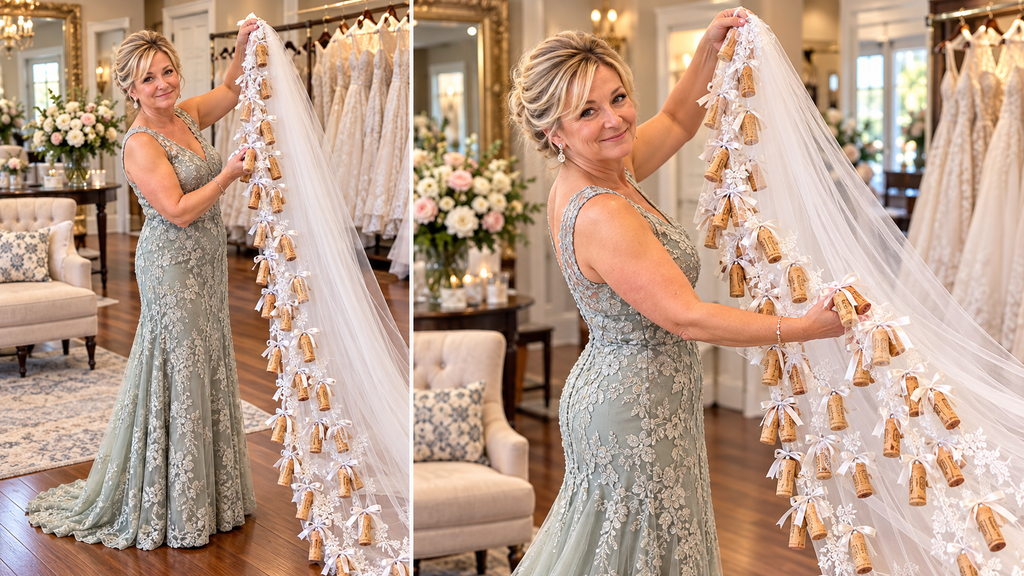
“You thought this was the place to decorate my fiancée’s wedding veil with wine corks.”
He held up the box.
“But suddenly this isn’t the place?”
Patricia’s eyes narrowed.
“Give me that.”
“No.”
The word wasn’t loud.
It didn’t need to be.
Patricia stared at her son.
I had known Kevin for five years.
I knew the different versions of his silence.
There was the distracted silence he had when working.
The peaceful silence he had when driving.
The uncomfortable silence he used when he didn’t want to argue.
This wasn’t any of those.
This was the silence of a man who had finally made a decision.
Patricia stepped toward him.
“Kevin, I said give it to me.”
He moved the box behind his back.
“No.”
Her cheeks flushed.
“Whatever you think you found—”
“I know exactly what I found.”
My heart started beating faster.
“Kevin?”
He turned toward me.
And suddenly his expression softened.
“I’m sorry.”
Those were the first words he said to me.
Not an explanation.
Not an excuse.
An apology.
“For what?” I whispered.
“For not telling you sooner.”
Patricia closed her eyes.
“Kevin.”
He ignored her.
“I found this three weeks ago.”
He placed the wooden box carefully on the vanity.
“I went to Mom and Dad’s house looking for my grandfather’s cuff links. Dad told me they might still be in the attic.”
His fingers rested on the lid.
“I found this instead.”
Patricia shook her head.
“You had no right.”
Kevin looked at her.
“You were going to humiliate the woman I’m marrying.”
His voice cracked slightly.
“And you’re worried about privacy?”
He opened the box.
Inside were photographs.
Several folded documents.
A hospital bracelet.
A faded newspaper clipping.
And a small velvet pouch.
But the first thing Kevin removed was a bronze-colored coin.
He held it between his fingers.
I recognized what it was immediately.
Anyone who had spent enough time around recovery probably would.
A sobriety medallion.
My stomach dropped.
Kevin turned it over.
Then he looked at his mother.
“Tell her.”
Patricia said nothing.
“Tell Emma.”
Her mouth tightened.
“That was a long time ago.”
My bridesmaid Rachel inhaled sharply beside me.
I couldn’t move.
Kevin held the coin out toward me.
I looked at the engraving.
Twenty years.
Then I looked at Patricia.
I genuinely thought I had misunderstood.
“You’re sober?”
Patricia’s expression hardened.
“I don’t use that word.”
Kevin stared at her.
“Of course you don’t.”
“Don’t speak to me like that.”
“Then tell her the truth.”
Patricia folded her arms.
“It was complicated.”
Kevin reached into the box again.
This time he removed the newspaper clipping.
My stomach tightened.
“What happened?”
Patricia immediately said, “Nothing that concerns you.”
Kevin’s eyes flashed.
“Everything you did this morning concerns her.”
He unfolded the clipping.
I could see the yellowed paper trembling slightly in his hands.
“My mother stopped drinking twenty-three years ago.”
Patricia looked toward the door.
“Kevin, stop.”
“After she crashed her car.”
The room became absolutely silent.
I looked at Patricia.
She stared at the floor.
Kevin continued.
“She had been drinking at a charity luncheon.”
“Stop.”
“She drove afterward.”
“Kevin.”
“There was an accident.”
Patricia’s voice sharpened.
“I said stop!”
Kevin finally raised his voice.
“And I said no!”
The force of it startled everyone.
Including him.
He lowered his voice again.
“But that’s what you’ve always depended on, isn’t it?”
Patricia looked at him.
“What?”
“Everyone stopping when you tell them to.”
His jaw tightened.
“Dad stopped talking about it.”
“Your grandmother stopped talking about it.”
“Your friends stopped talking about it.”
“You built an entire new version of yourself and expected everyone else to protect it.”
Patricia’s eyes glistened.
“You have no idea what you’re talking about.”
“Then explain it.”
She said nothing.
Kevin placed the newspaper clipping on the vanity.
I could see part of the headline.
LOCAL WOMAN CHARGED AFTER—
The rest was hidden beneath his hand.
I didn’t need to read it.
My eyes went to the veil.
The corks.
The ivory ribbons.
The little winery names.
And suddenly the cruelty of what Patricia had done felt different.
Not smaller.
Worse.
She hadn’t been ignorant.
She hadn’t made an insensitive joke because she didn’t understand addiction.
She understood.
She understood exactly what ten years meant.
Exactly what recovery cost.
Exactly how much shame could live inside a person.
And she had chosen that wound deliberately.
I looked at her.
“You knew.”
Patricia swallowed.
I stepped closer.
“All those times you offered me wine…”
She looked away.
“All those jokes about whether I’d relapse…”
“Emma—”
“You knew.”
Her shoulders dropped.
“Yes.”
One word.
That was all.
But it changed everything.
I felt something inside me go completely still.
“Why?”
Patricia looked toward Kevin.
Not me.
Kevin noticed.
“No,” he said.
“Look at Emma.”
His mother remained silent.
“Look at her and answer her.”
Slowly, Patricia turned toward me.
Her eyes were wet now.
But there was still something defensive in them.
Something proud.
Something that wanted desperately to remain in control.
“I didn’t think you were right for him.”
There it was.
Not an apology.
Not remorse.
The truth.
Kevin stared at her.
“You tried to make her relapse because you didn’t think she was right for me?”
“I did not try to make her relapse.”
“You repeatedly offered alcohol to someone you knew was in recovery.”
“I was testing her.”
My entire body went cold.
Kevin actually recoiled.
“Testing her?”
Patricia lifted her chin.
“Yes.”
“For what?”
“To see whether this was really behind her.”
I almost laughed.
Not because anything was funny.
Because sometimes cruelty is so absurd that your mind searches desperately for another response.
“You tested my sobriety?”
Patricia looked at me.
“I needed to know what kind of woman my son was marrying.”
Rachel muttered something under her breath that I won’t repeat.
Kevin stepped between us.
“Mom.”
Patricia looked at him.
“You need to leave.”
She blinked.
“What?”
“You heard me.”
“Kevin, don’t be ridiculous.”
“You’re leaving.”
“This is my son’s wedding.”
“Exactly.”
His voice was calm again.
“And I’m telling you to leave it.”
Patricia stared at him as though he had spoken another language.
Then she laughed.
A short, stunned sound.
“You’re throwing your mother out of your wedding?”
Kevin didn’t hesitate.
“Yes.”
“Because of a veil?”
“No.”
He picked up the veil.
One cork swung from its ribbon.
“Because this isn’t about a veil.”
He looked at her.
“This is about the fact that you took the most painful chapter of Emma’s life and turned it into entertainment.”
Patricia’s eyes widened.
“I was trying to make a point.”
“You did.”
Kevin nodded.
“You made it perfectly.”
He turned toward me.
“You showed me exactly what kind of husband I’d be if I allowed this.”
Something in my chest broke open.
Because for six months, I had been swallowing Patricia’s comments.
I had told myself they were annoying but harmless.
I had told myself not to put Kevin in the middle.
I had told myself every family had difficult people.
I had told myself I was strong enough to ignore her.
But standing there in my wedding dress, staring at those corks, I realized strength wasn’t supposed to mean accepting humiliation quietly.
And Kevin understood that before I even had to explain it.
Patricia shook her head.
“You’re going to regret this.”
Kevin’s expression didn’t change.
“No.”
“You’ll look at your wedding photographs in twenty years and realize your own mother isn’t in them.”
Kevin looked down for a moment.
When he raised his eyes again, there was sadness there.
Real sadness.
But no uncertainty.
“Then I’ll remember why.”
Patricia’s face crumpled for half a second.
Then anger replaced it.
She grabbed her purse.
“Fine.”
She walked toward the door.
But before reaching it, she stopped beside me.
For one terrible second, I thought she might apologize.
Instead, she whispered:
“I hope you’re worth this.”
Kevin heard her.
“So do I.”
Patricia turned.
Kevin continued.
“Because Emma spent ten years becoming someone she could respect again.”
He pointed toward the wooden box.
“You spent twenty-three years pretending the person you used to be never existed.”
Patricia went pale.
“That,” Kevin said quietly, “is the difference.”
She left.
The door slammed behind her.
Nobody spoke.
I stared at the closed door.
Then at Kevin.
Then at the veil.
Suddenly, I couldn’t breathe properly.
Not because I wanted alcohol.
I want to make that clear.
For people who have never experienced addiction, there is sometimes an assumption that every painful moment becomes a dramatic temptation.
That isn’t how it worked for me.
I didn’t look at those corks and think about drinking.
I looked at them and remembered who I had been.
The woman who woke up and checked her phone with shaking hands because she couldn’t remember what she had texted.
The woman who kept mints in every purse.
The woman who lied about headaches because she was hungover.
The woman who counted bottles in the recycling before taking them downstairs because she was terrified the neighbors might notice.
The woman who promised herself every morning that she wouldn’t drink that night.
And broke that promise before dinner.
Sobriety hadn’t erased her.
It had allowed me to forgive her.
Patricia had tried to drag her into my wedding.
I sat down.
Kevin immediately knelt in front of me.
“Emma?”
“I need a minute.”
“Take as long as you need.”
“The ceremony starts in forty minutes.”
“I don’t care.”
I looked at him.
He smiled faintly.
“We can get married at midnight.”
I laughed through my tears.
“We have 160 people downstairs.”
“They can eat cake.”
“Before dinner?”
“I’m the groom. I assume I have some authority.”
Rachel laughed.
Then I started crying.
Not graceful bridal tears.
Not the kind photographers capture.
I bent forward and covered my face.
Kevin wrapped his arms around me.
“I’m sorry,” he whispered.
“You didn’t do it.”
“I should have stopped her sooner.”
“You did stop her.”
“Not soon enough.”
I pulled back.
“Why didn’t you tell me about the box when you found it?”
His eyes dropped.
And that was when I knew there was more.
“Kevin?”
He looked toward the wooden box.
“Because there was something else inside.”
My bridesmaids went quiet again.
Kevin stood.
He reached into the box.
Under the newspaper clipping was an envelope.
On the front, written in faded blue ink, were two words.
FOR KEVIN.
He handed it to me.
“I found that three weeks ago too.”
“Did you read it?”
“Yes.”
“Who wrote it?”
“My father.”
I frowned.
“Robert?”
Kevin nodded.
“But your dad is downstairs.”
“I know.”
“Why would he put a letter to you in your mother’s recovery box?”
Kevin sat beside me.
“Because Dad knew eventually I’d find out.”
“Find out what?”
He took a breath.
“The accident wasn’t exactly what Mom told everyone.”
I looked toward the door.
“What happened?”
Kevin glanced at my bridesmaids.
Then back at me.
“Dad took the blame publicly for part of it.”
My stomach tightened.
Kevin continued.
“Mom had been drinking heavily for years. Apparently almost nobody knew how bad it had gotten.”
He stared at his hands.
“I was six.”
My anger disappeared for a moment.
Not because Patricia deserved forgiveness.
Because suddenly I wasn’t looking at Patricia the mother-in-law.
I was imagining Kevin as a six-year-old boy.
“Were you in the car?”
He nodded.
My hand flew to my mouth.
Rachel whispered, “Oh my God.”
Kevin swallowed.
“I don’t remember much.”
He looked at the hospital bracelet.
“That was mine.”
I couldn’t speak.
“The accident injured another driver,” he continued. “Not permanently, thankfully. Dad hired an attorney, paid restitution, and protected Mom from as much publicity as he could.”
“Why?”
“Because she agreed to treatment.”
Kevin picked up the sobriety medallion.
“She stayed sober.”
I looked at him.
“For twenty-three years?”
“Yes.”
“But she drinks wine.”
“No.”
That surprised me.
I thought about every family dinner.
Patricia always carried a wineglass.
Always.
Then I remembered something.
I had never actually watched her pour it.
Kevin gave a bitter little smile.
“Sparkling grape juice.”
I stared at him.
“She pretends?”
“She didn’t want people asking questions.”
I thought about all those dinners again.
The elegant bottles.
The crystal glasses.
The wine cellar Patricia proudly showed guests.
The jokes about expensive vintages.
It had all been theater.
“She hid her sobriety.”
“Yes.”
“Why?”
Kevin was quiet.
Then Robert’s voice came from the doorway.
“Because she was ashamed.”
We all turned.
Kevin’s father stood there.
His tie was crooked.
His eyes looked tired.
And beside him stood Patricia.
She had come back.
My body stiffened.
Kevin stood immediately.
“Dad.”
Robert looked at the veil.
Then at the wooden box.
He closed his eyes.
“Oh, Patty.”
Patricia looked furious.
But beneath the anger was something else.
Fear.
Robert entered the room.
Patricia remained near the doorway.
“I saw her downstairs,” he said. “She told me Kevin threw her out.”
“I did.”
Robert nodded.
“I assumed there was a reason.”
He looked at me.
Then he saw the corks again.
His face changed.
“What did you do?”
Patricia said nothing.
Robert walked toward the veil.
He touched one cork.
Then another.
“You did this?”
“It was supposed to be symbolic.”
“Of what?”
“Her journey.”
Robert stared at his wife.
Then he said something I will never forget.
“Patricia, you hid your own journey for twenty-three years.”
His voice was barely above a whisper.
“What gave you the right to turn hers into a costume?”
Patricia looked away.
For the first time since I’d met her, she seemed small.
Not physically.
Emotionally.
As though the elaborate version of herself she’d spent decades constructing had suddenly become too heavy to hold up.
Robert looked at Kevin.
“You found the box.”
“Yes.”
“And my letter?”
“Yes.”
Robert nodded slowly.
“I wondered when that day would come.”
Patricia’s head snapped toward him.
“You knew he might find it?”
“I hoped he would.”
“You promised me.”
“I promised I wouldn’t expose you.”
Robert’s voice hardened.
“I never promised I’d help you become cruel.”
Patricia flinched.
“I am not cruel.”
Robert pointed toward my veil.
“Then explain that.”
“I made a mistake.”
“No.”
Kevin’s voice came from beside me.
“You planned this.”
Patricia looked at him.
“You collected corks.”
“You tied ribbons around them.”
“You arranged for the seamstress pickup.”
“You attached them to Emma’s veil.”
“You carried it upstairs.”
“You showed it to her.”
“And then when she was hurt, you mocked her for being hurt.”
He shook his head.
“That’s not a mistake.”
Patricia’s eyes filled.
Kevin finished quietly.
“That’s a series of decisions.”
That landed harder than shouting could have.
Patricia sat down.
For several seconds, all we could hear was the distant sound of wedding guests downstairs.
Someone laughed.
A glass clinked.
Music played faintly through the floor.
Life continuing underneath the disaster happening upstairs.
Finally Patricia looked at me.
“I hated you.”
Robert closed his eyes.
Kevin stared at her.
I didn’t answer.
She continued.
“I didn’t hate you because you were an alcoholic.”
“Patricia,” Robert warned.
“She deserves the truth.”
She looked directly at me.
“I hated you because you weren’t ashamed.”
That stunned me.
I almost thought I had heard incorrectly.
“What?”
“You talked about recovery.”
Patricia’s voice trembled.
“You told people you didn’t drink.”
“You went to meetings.”
“You didn’t make excuses.”
“You didn’t hide.”
A tear slipped down her cheek.
“And everyone respected you for it.”
I stared at her.
Patricia laughed bitterly.
“Do you know what I did?”
“I spent twenty-three years making sure nobody knew.”
“I changed doctors.”
“I avoided certain neighborhoods.”
“I stopped speaking to two friends who knew what happened.”
“I let people think I simply didn’t like alcohol.”
“I hosted parties surrounded by bottles because I thought that proved something.”
Robert stared at her.
She looked at the wooden box.
“And then you came along.”
Her voice cracked.
“You said you were sober like it was something to be proud of.”
I finally understood.
Not completely.
Maybe I never would.
But enough.
“You weren’t testing me.”
Patricia looked at me.
“No.”
“You were punishing me.”
Her face crumpled.
“Yes.”
“Because I reminded you of yourself.”
She shook her head.
“No.”
Then, after several seconds:
“Because you reminded me of the person I might have been if I hadn’t spent half my life hiding.”
The anger inside me shifted.
It didn’t disappear.
Understanding someone doesn’t erase what they did.
Sometimes understanding simply gives cruelty a name.
Patricia wasn’t disgusted by my recovery.
She was jealous of my freedom.
And instead of confronting her own shame, she had tried to hand some of it to me.
I stood.
“Patricia.”
She looked up.
“I am sorry for what happened to you.”
Her lips trembled.
“But I will not carry your shame for you.”
She lowered her eyes.
“And I won’t let you use my past against me again.”
“I understand.”
“No.”
I shook my head.
“I don’t think you do.”
I walked to the vanity and picked up my veil.
The corks rattled softly.
“I fought for ten years to stop believing that the worst thing I’d ever done was the truest thing about me.”
Patricia began crying.
I continued.
“I lost friends.”
“I lost money.”
“I lost years.”
“I hurt my mother.”
“I scared people who loved me.”
“I woke up one morning and realized I didn’t recognize the woman in the mirror.”
My throat tightened.
“But I did something about it.”
“I asked for help.”
“I apologized.”
“I changed.”
“And every single day for ten years, I kept choosing that change.”
I held up the veil.
“You don’t get to turn that into a joke.”
Patricia covered her mouth.
I expected satisfaction.
I expected vindication.
Instead, I just felt tired.
Kevin took the veil from me.
Then he looked at Rachel.
“Do you have scissors?”
Rachel’s expression changed instantly.
“I have sewing scissors.”
“Perfect.”
She grabbed them from the emergency kit.
Kevin sat down.
And started cutting off the corks.
One by one.
Snip.
A cork fell onto the carpet.
Snip.
Another.
Patricia watched.
Nobody stopped him.
I sat beside him.
After the fifth cork, I reached for another pair of scissors.
Rachel handed them to me.
Together, Kevin and I began removing them.
My bridesmaids joined us.
Then Robert.
For several minutes, nobody said anything.
We simply cut.
Cork after cork fell onto the floor.
The sound was strangely satisfying.
Tiny wooden pieces bouncing against the carpet.
Little symbols of humiliation losing their power.
Eventually only the ribbons remained.
Rachel carefully trimmed them away.
The veil wasn’t perfect anymore.
A few stitches had been pulled.
Some of the lace was stretched.
One small section had torn.
My maid of honor, Melissa, examined it.
“I can fix this.”
“You have thirty minutes.”
She smiled.
“Then stop talking to me.”
That made everyone laugh.
Even me.
Melissa went to work.
Patricia stood.
“I’ll leave.”
Kevin didn’t answer.
She looked at him.
“Am I really not allowed downstairs?”
He looked at me.
I knew what he was asking.
The decision was mine too.
I thought about it.
Then I said:
“You can’t attend today.”
Patricia nodded.
Her eyes filled again.
“But I’m sorry,” she whispered.
“I believe you’re sorry.”
Hope flickered across her face.
I continued.
“That doesn’t mean there aren’t consequences.”
The hope disappeared.
But this time, she didn’t argue.
She picked up her purse.
Robert walked toward her.
“I’ll drive you home.”
“No.”
She shook her head.
“You should stay.”
“Patty—”
“Stay.”
She looked at Kevin.
“Please.”
Robert hesitated.
Then nodded.
Patricia walked to the door.
Before leaving, she turned toward me.
“Emma?”
“Yes?”
She looked at the sobriety medallion still sitting on the vanity.
“I haven’t had a drink in twenty-three years, seven months, and eleven days.”
I stared at her.
She wiped her cheek.
“I’ve never said that out loud before.”
Then she left.
The door closed.
This time quietly.
Nobody spoke for several seconds.
Then Rachel exhaled.
“Well.”
I looked at her.
She gestured toward my dress.
“I think we should probably still get you married.”
I laughed.
And somehow, that was exactly what I needed.
Thirty-two minutes later, I stood at the back of the chapel.
My veil had been repaired.
Not perfectly.
If you looked closely, you could see tiny places where the lace had been damaged.
Melissa apologized for that.
I told her not to.
I liked it better that way.
Perfect things can hide their history.
Mine didn’t.
The doors opened.
Everyone stood.
And at the far end of the aisle stood Kevin.
The moment he saw me, his face changed.
His eyes filled.
Mine did too.
I walked toward him.
Not thinking about Patricia.
Not thinking about corks.
Not thinking about alcohol.
I thought about ten years.
Three thousand six hundred and fifty mornings.
Thousands of ordinary decisions nobody applauded.
Birthdays.
Funerals.
Bad days.
Celebrations.
Lonely nights.
Vacations.
Work parties.
Arguments.
Heartbreak.
All experienced sober.
People sometimes imagine recovery as one heroic decision.
It isn’t.
It’s a thousand quiet decisions.
Then thousands more.
And that morning, walking toward the man I loved, I realized something.
I wasn’t walking away from my past.
I was walking forward with it.
There is a difference.
When I reached Kevin, he took my hands.
“You okay?” he whispered.
I smiled.
“I am now.”
Our ceremony wasn’t dramatic.
Nobody burst through the doors.
Patricia didn’t appear.
There was no final confrontation.
No shocking announcement.
No revenge.
We simply got married.
And somehow that felt like the greatest victory possible.
At the reception, something unexpected happened.
Robert asked to speak with me privately.
We stepped outside onto the terrace.
He looked older than he had that morning.
“I’m sorry,” he said.
“You didn’t do it.”
“No.”
He stared toward the gardens.
“But I helped create the conditions that allowed it.”
I waited.
“For twenty-three years, I thought protecting Patricia meant protecting her secret.”
He shook his head.
“Maybe I was protecting her shame instead.”
“You were trying to help your wife.”
“I know.”
He looked at me.
“But sometimes helping someone hide isn’t the same as helping them heal.”
That stayed with me.
Robert reached into his jacket.
He held out the wooden box.
“I think you should have this.”
I stepped back.
“No.”
“Not forever.”
He smiled faintly.
“Just tonight.”
“Why?”
“There is something Kevin hasn’t seen.”
My stomach tightened.
“What?”
Robert opened the box.
Beneath the documents was another envelope.
Smaller.
Newer.
My name was written across it.
EMMA.
I stared at him.
“Who wrote that?”
“Patricia.”
I couldn’t believe it.
“When?”
“About three months ago.”
“Before the veil?”
“Yes.”
That made absolutely no sense.
Robert handed me the envelope.
“She gave it to me and told me to destroy it.”
“Why didn’t you?”
“Because I’ve been married to that woman for thirty-eight years.”
A sad smile appeared.
“I know when she’s lying to me.”
“About what?”
“She didn’t want it destroyed.”
I opened the envelope.
Inside was a handwritten letter.
The first sentence stopped me cold.
Emma,
You frighten me.
I kept reading.
Not because I think you will hurt Kevin.
Because I think he loves you enough that eventually I will have to stop pretending I don’t understand you.
My hands started trembling.
The letter continued.
Patricia wrote about the accident.
Treatment.
The meetings she attended for seven years before quietly stopping.
The lies she told friends.
The elaborate explanations she invented for why she didn’t drink.
The sparkling grape juice she poured into wine bottles before parties.
The terror that someone would discover who she had been.
Then she wrote:
When Kevin told me you were sober, I expected to dislike you.
Instead, I envied you.
You say ten years with gratitude.
I say twenty-three years with silence.
You have somehow made peace with a version of yourself I have spent decades trying to erase.
I don’t know how to forgive you for making me see that.
I stopped reading.
Robert looked away.
“There’s more.”
I continued.
Sometimes I want to ask you how you did it.
Then I remember I’m supposed to be the mother-in-law who has everything together.
So instead, I say something cruel.
I know that makes no sense.
Maybe cruelty is easier than confession.
I don’t know whether I’ll ever give you this letter.
I probably won’t.
But if I do, perhaps it will mean I finally became brave enough to tell the truth.
I folded the paper.
My eyes were full of tears.
“She wrote that before today?”
Robert nodded.
“Then why the veil?”
“I think she panicked.”
He sighed.
“The closer the wedding came, the more permanent you became.”
I looked at him.
“And the more permanent you became, the harder it became for her to keep pretending.”
I looked back at the letter.
There are moments when someone hurts you so badly that discovering their pain feels almost insulting.
You want a villain.
Villains are simple.
They hurt you because they’re bad.
Human beings are harder.
Sometimes people hurt you because they’re terrified.
Sometimes because they’re jealous.
Sometimes because your healing exposes the places where they remain wounded.
None of that excuses what they do.
But it explains why revenge rarely fixes anything.
I folded the letter and returned it to the envelope.
“What should I do?”
Robert smiled gently.
“Whatever protects your peace.”
That was the best advice anyone gave me that day.
So I did nothing.
For three months.
Patricia called Kevin twice.
He spoke to her briefly.
She sent me one apology.
Not one of those apologies that secretly blame the person receiving them.
Not:
I’m sorry you were offended.
Not:
I’m sorry you misunderstood.
Not:
I’m sorry, but you have to understand—
Just:
Emma, what I did was cruel. I knew exactly why it would hurt you, and I did it anyway. There is no excuse. I am sorry. I understand if you do not want a relationship with me.
I didn’t respond.
Not because I wanted to punish her.
Because I wasn’t ready.
And sobriety taught me something extremely valuable.
You do not owe people immediate access to you just because they finally apologize.
Three months became four.
Then five.
Kevin never pressured me.
Neither did Robert.
Then one Saturday morning, something arrived in the mail.
A small padded envelope.
No return address.
Inside was Patricia’s twenty-year sobriety medallion.
And a note.
I told someone today.
That was all.
I called Robert.
He answered immediately.
“Did she send you something?”
“Yes.”
He was quiet.
“Who did she tell?”
“She went back to a meeting.”
I sat down.
“What?”
“Last Tuesday.”
My throat tightened.
“She walked into the same recovery center she attended twenty-three years ago.”
I didn’t know what to say.
Robert continued.
“She stood up and introduced herself.”
I closed my eyes.
“What did she say?”
His voice broke.
“She said, ‘My name is Patricia, and I’ve been sober for twenty-three years, but I think this is the first year I’ve actually stopped hiding.’”
I cried after we hung up.
Not because everything was fixed.
It wasn’t.
Not because I had suddenly forgotten the veil.
I hadn’t.
I cried because recovery is strange.
Sometimes the person who hurts you becomes part of the reason you understand yourself better.
And sometimes your existence forces someone else to finally confront themselves.
Six months after the wedding, Patricia asked if we could meet.
Just the two of us.
I chose a coffee shop.
Public.
Neutral.
She arrived early.
When I walked in, she was sitting at a corner table.
No makeup.
No pearls.
No perfectly styled hair.
Just Patricia.
Two cups sat on the table.
Coffee.
She stood when she saw me.
“Thank you for coming.”
I sat down.
“You’re welcome.”
For several seconds, neither of us spoke.
Then Patricia reached into her purse.
My body instinctively tensed.
She noticed.
Her face fell.
“I deserve that.”
She pulled out something small.
A wine cork.
I stared at it.
“This was the last one.”
I didn’t understand.
“Last one from what?”
“The veil.”
Apparently, after leaving the hotel, she had discovered one cork still caught inside her handbag.
“I almost threw it away.”
She rolled it between her fingers.
“Then I decided I should keep it.”
“Why?”
“To remember what shame turns into when you refuse to deal with it.”
That answer surprised me.
She placed the cork on the table.
“I spent years believing shame made me accountable.”
“It didn’t.”
“It made me dishonest.”
I didn’t say anything.
Patricia looked at me.
“I need to tell you something, and I don’t expect forgiveness afterward.”
“Okay.”
“I knew the comments bothered you.”
I felt my shoulders tighten.
“I knew every time.”
She swallowed.
“I watched your face.”
“And sometimes I deliberately went further.”
I stared at her.
“Why are you telling me that?”
“Because my counselor said apologies without full accountability are another kind of manipulation.”
That sounded like something a counselor would say.
Patricia continued.
“I wanted Kevin to choose me over you.”
There it was.
Another truth.
“I thought if I made you uncomfortable enough, eventually you’d react.”
“And then?”
“Then I could tell him you were unstable.”
The words hurt.
Even after everything.
“Did you want us to break up?”
She hesitated.
“Yes.”
“Why?”
Patricia looked toward the window.
“Because Kevin stopped needing my approval after he met you.”
I leaned back.
“That’s not my fault.”
“I know.”
“Does he know you felt that way?”
“Yes.”
“How?”
“I told him.”
That surprised me.
“How did that conversation go?”
For the first time, Patricia almost smiled.
“Poorly.”
I laughed before I could stop myself.
So did she.
It lasted about two seconds.
But something changed.
Not forgiveness.
Not yet.
Maybe simply the recognition that we were two imperfect women sitting across from each other without pretending.
Patricia became serious again.
“I don’t expect you to trust me.”
“Good.”
She nodded.
“I don’t expect you to invite me into everything.”
“Good.”
“I don’t expect things to go back to normal.”
I looked at her.
“There is no going back.”
“I know.”
“If there’s a relationship after this, it’ll be different.”
“I understand.”
“And if you ever use my sobriety against me again, we’re done.”
“I understand.”
“No third chance.”
“I understand.”
I studied her face.
Then I asked:
“How long have you actually been sober?”
Her eyes filled.
“Twenty-four years next month.”
“Then why did you send me the twenty-year coin?”
She smiled sadly.
“Because it was the last one I ever accepted.”
That broke something open inside me.
“You stopped collecting them?”
“At twenty.”
“Why?”
“I decided I didn’t deserve to celebrate something I was hiding.”
I reached into my purse.
I hadn’t planned to.
But earlier that morning, before meeting Patricia, I had placed something inside.
My ten-year medallion.
I set it on the table.
She stared at it.
“I carry it everywhere,” I said.
Patricia touched the edge carefully.
“Are you afraid you’ll relapse?”
“Sometimes.”
She looked surprised by my honesty.
“You still get afraid?”
“Of course.”
“But you’ve been sober ten years.”
“That doesn’t make me invincible.”
She looked down.
“I thought admitting fear meant I wasn’t strong enough.”
“No.”
I shook my head.
“For me, pretending I’m not vulnerable is much more dangerous.”
Patricia sat quietly.
Then she said:
“Would you come with me?”
“Where?”
“To my meeting.”
I hesitated.
“Why?”
“Next month.”
She swallowed.
“They’re giving me a twenty-four-year medallion.”
I stared at her.
“And I don’t know anyone who would understand what it means better than you.”
My first instinct was no.
She had hurt me.
Deeply.
And forgiveness isn’t supposed to erase instinct.
But then I remembered her letter.
You say ten years with gratitude.
I say twenty-three years with silence.
I thought about the woman I had been ten years earlier.
How desperately she needed someone to believe change was possible.
Then I looked at Patricia.
“I’ll think about it.”
She nodded.
“That is more than I deserve.”
“Probably.”
She laughed.
So did I.
One month later, I sat in the back row of a community-center meeting room.
Kevin sat beside me.
Robert sat on his other side.
Patricia stood at the front.
Someone handed her a small medallion.
Twenty-four years.
She held it tightly.
Then she looked toward us.
Her voice trembled.
“My name is Patricia.”
She paused.
“And I’m an alcoholic.”
Nobody gasped.
Nobody judged her.
Nobody laughed.
People simply answered:
“Hi, Patricia.”
She started crying.
So did Robert.
Kevin squeezed my hand.
Patricia continued.
“I used to believe recovery meant becoming someone who had never made the mistakes I made.”
She looked down at the medallion.
“So I spent twenty-three years pretending.”
“Then I met someone who had made peace with her past.”
Her eyes found mine.
“And instead of learning from her, I tried to make her ashamed.”
My chest tightened.
“She became my daughter-in-law anyway.”
A few people laughed gently.
Patricia smiled through her tears.
“She has not forgiven everything I did.”
She looked directly at me.
“And she doesn’t owe me that.”
I felt Kevin’s fingers tighten around mine.
“But she taught me something.”
Patricia raised the medallion.
“Recovery isn’t proving you were never broken.”
“It’s telling the truth about what happened…”
“…and choosing what you do next.”
The room applauded.
I didn’t stand.
I didn’t make a dramatic gesture.
I simply clapped with everyone else.
Patricia looked at me.
And nodded.
I nodded back.
That was enough.
Our relationship didn’t magically become perfect afterward.
I think that’s important.
Real endings usually aren’t perfect.
Patricia still had habits that irritated me.
I still had boundaries she occasionally struggled with.
Kevin sometimes had to remind her not to give unsolicited opinions about our lives.
She once criticized our kitchen renovation so relentlessly that I handed her a paint roller and told her she was welcome to finish it herself.
She stopped criticizing the kitchen.
But she never joked about my sobriety again.
Not once.
And every year, something quietly remarkable happened.
On my sobriety anniversary, Patricia sent me a card.
No jokes.
No corks.
No references to temptation.
Just:
Another year. Proud of you.
And on hers, I sent one back.
Another year. Proud of you too.
Three years after our wedding, Kevin and I hosted Thanksgiving.
Patricia arrived carrying dessert.
She placed a bottle on the counter.
For one second, my eyes went to it automatically.
Then I saw the label.
Sparkling apple cider.
Patricia noticed me looking.
“Old habits,” she said.
I smiled.
“Some are worth keeping.”
Later that night, after everyone left, Kevin and I cleaned the kitchen together.
He opened a drawer.
Inside was one wine cork.
The same cork Patricia had brought to our coffee meeting years earlier.
I had eventually taken it home.
Kevin held it up.
“You kept this?”
“Yes.”
“Why?”
I took it from him.
For a moment, I remembered the bridal suite.
The humiliation.
The veil.
Patricia laughing.
Kevin opening that wooden box.
Then I thought about everything that came afterward.
“I used to think this represented the worst thing your mother ever did to me.”
Kevin waited.
“And now?”
I turned the cork between my fingers.
“Now I think it represents the day everyone finally stopped pretending.”
He smiled.
Then he kissed my forehead.
We put the cork back into the drawer.
Not on display.
Not hidden.
Just there.
Years later, I still have my wedding veil.
It is folded carefully inside a preservation box.
You can see tiny marks along the lace if you look closely.
Places where the corks were attached.
The seamstress once offered to repair them properly.
I told her no.
I don’t want them repaired.
Because those little imperfections remind me of something I wish I’d understood much earlier.
Healing isn’t the absence of scars.
Recovery isn’t forgetting.
Forgiveness isn’t permission.
Understanding isn’t excusing.
And loving someone does not require allowing their pain to become your punishment.
Kevin proved something to me that morning too.
Before we married, I thought the greatest sign that someone loved you was that they stayed.
I don’t believe that anymore.
Sometimes love is staying.
Sometimes love is standing between someone you love and someone who is hurting them.
Sometimes love is looking at your own family and saying:
No.
You don’t get to do this.
Not to her.
Not anymore.
Kevin didn’t rescue me that morning.
I didn’t need rescuing.
I had already rescued myself ten years earlier.
What he did was different.
He stood beside me.
And sometimes that is the most powerful thing another person can do.
As for Patricia, she eventually stopped serving sparkling grape juice from wine bottles.
At her twenty-fifth sobriety anniversary, she hosted dinner.
When everyone arrived, there were ordinary glass pitchers on the table.
Water.
Lemonade.
Iced tea.
Nothing disguised as anything else.
Before dinner, she tapped her glass.
“I want to say something.”
Kevin groaned jokingly.
“Mom, please don’t give a forty-minute speech.”
Patricia gave him a look.
“I gave birth to you. I’ll speak as long as I want.”
Everyone laughed.
Then she looked at me.
“Twenty-five years ago, I thought getting sober was the hardest thing I would ever do.”
She paused.
“I was wrong.”
The room quieted.
“The hardest thing was allowing people to know I had needed to.”
Robert reached for her hand.
Patricia squeezed it.
“I wasted a lot of years confusing secrecy with dignity.”
Her eyes met mine.
“And I hurt someone because she possessed something I wanted.”
She looked down.
“Not my son.”
That made everyone laugh.
Even Kevin.
Patricia smiled.
“Freedom.”
I felt tears gathering.
“She was free to tell the truth about herself.”
“I wasn’t.”
“And for a while, I hated her for it.”
She lifted her glass.
“So this isn’t a toast to being perfect.”
She smiled.
“Thank God, because none of us qualify.”
More laughter.
“This is a toast to telling the truth before shame convinces you to hurt someone who never deserved it.”
We raised our glasses.
Patricia looked directly at me.
“To twenty-five years.”
I lifted mine.
“To twenty-five years.”
Then she smiled.
“And eleven for you.”
“Twelve.”
Her eyes widened.
“Twelve?”
“Last month.”
Patricia looked horrified.
“I missed it?”
“You sent the card.”
“Oh.”
She relaxed.
“Good.”
Kevin leaned toward me.
“You realize you two have become extremely strange.”
I whispered:
“You married into this.”
He stared at me.
“You married into mine.”
Fair point.
That night, while Kevin drove us home, I watched the lights passing outside the window.
“Do you regret letting her back into our lives?” he asked.
I thought about the question.
“No.”
Then I added:
“But I’m glad we didn’t do it immediately.”
He nodded.
“So am I.”
“People think forgiveness means reopening the door.”
“Doesn’t it?”
“Not necessarily.”
I watched another streetlight disappear behind us.
“Sometimes forgiveness is just deciding you’re no longer going to stand on the other side of that door feeling angry.”
Kevin smiled.
“That sounds annoyingly wise.”
“Marriage has improved me.”
“Obviously.”
I elbowed him.
He laughed.
And for the rest of the drive home, neither of us mentioned the wedding.
We didn’t need to.
The story had changed.
Not the facts.
Those remained exactly the same.
Patricia had deliberately decorated my veil with wine corks.
She had known I was ten years sober.
She had known exactly why it would hurt.
Kevin had discovered the truth about his mother’s own recovery.
He had confronted her.
He had removed her from our wedding.
Those things happened.
Forgiveness did not rewrite them.
It simply meant they were no longer the final chapter.
The final chapter came years later.
On Patricia’s thirtieth sobriety anniversary.
By then, Robert’s hair had gone completely silver.
Kevin and I had been married for almost seven years.
And Patricia had become someone I never would have imagined on my wedding morning.
Not perfect.
Not endlessly kind.
Definitely not quiet.
But honest.
She volunteered twice a month at the recovery center.
She spoke openly about addiction.
And she became especially protective of women who arrived ashamed and terrified.
One afternoon, she called me.
“Emma?”
“What happened?”
“Why do you assume something happened?”
“Because you never call me at two on a Tuesday unless something happened.”
She sighed.
“Fair.”
I waited.
“There is a young woman here.”
“At the center?”
“Yes.”
“She has six days.”
I understood immediately.
Six days sober.
“She wants to leave.”
“Why?”
“She thinks everyone is judging her.”
I closed my eyes.
I knew that feeling.
“What do you need from me?”
Patricia hesitated.
“Would you talk to her?”
Twenty minutes later, I arrived.
The young woman was sitting outside on a bench.
Maybe twenty-six.
Her eyes were swollen from crying.
Patricia sat beside her.
When I approached, Patricia stood.
“This is Emma.”
The woman looked at me suspiciously.
“Are you a counselor?”
“No.”
“Doctor?”
“No.”
“Then why are you here?”
I sat down.
“Because I once had six days.”
She looked at me.
“How many now?”
“Almost seventeen years.”
Her expression changed.
“Seriously?”
“Seriously.”
She looked toward Patricia.
“How many does she have?”
Patricia smiled.
“Thirty years.”
The young woman stared at us.
Then she started crying.
“I can’t do thirty years.”
I remembered thinking exactly the same thing.
So I told her what someone had once told me.
“Then don’t.”
She looked confused.
“Do today.”
“What about tomorrow?”
“When tomorrow gets here, you can decide what to do with it.”
She wiped her face.
“What if I screw up?”
Patricia answered before I could.
“Then you tell the truth.”
I looked at her.
She looked at me.
For a moment, neither of us was in that recovery-center courtyard.
We were back in the bridal suite.
A ruined veil between us.
A wooden box open on the vanity.
Two women carrying histories they were ashamed of.
One hiding hers.
One refusing to.
Thirty minutes later, the young woman went back inside.
Patricia and I remained on the bench.
“You remembered,” I said.
“What?”
“What I told you.”
She smiled.
“I remember most things you tell me.”
“That’s terrifying.”
“It should be.”
We sat quietly.
Then Patricia reached into her purse.
She handed me something.
A small wooden box.
The same one.
I stared at it.
“You kept it?”
“For thirty years.”
“Why are you giving it to me?”
“Open it.”
I did.
The old newspaper clipping was gone.
The hospital bracelet was gone.
The letters were gone.
The documents were gone.
Inside were only two things.
Her thirty-year sobriety medallion.
And a photograph.
Our wedding photograph.
Kevin and me standing beneath the flowers after the ceremony.
My repaired veil falling behind me.
I turned the picture over.
Patricia had written something on the back.
The day my son got married.
The day I finally stopped hiding.
I couldn’t speak.
Patricia looked toward the recovery center.
“I used to think that box contained everything I needed to hide.”
She touched the lid.
“Now I want it to hold something else.”
“What?”
She smiled.
“Proof that people can become better than their worst day.”
My eyes filled.
I placed the photograph back inside.
Then I returned the box to her.
She frowned.
“I want you to have it.”
“No.”
“Why?”
“Because you’re not finished filling it.”
Patricia stared at me.
Then she smiled.
She took the box back.
And that is where our story really ends.
Not with Patricia humiliated.
Not with me victorious.
Not even with Kevin throwing his mother out of our wedding.
It ends with three people learning different versions of the same lesson.
Kevin learned that boundaries sometimes cost you something.
Patricia learned that shame grows strongest in secrecy.
And I learned that surviving your past doesn’t mean pretending it never happened.
Ten years before my wedding, I thought sobriety meant giving something up.
Alcohol.
Parties.
A certain version of my life.
I know differently now.
Sobriety gave things back.
My mother’s trust.
My mornings.
My memory.
My self-respect.
My ability to love someone without wondering whether I had embarrassed myself the night before.
My future.
And eventually, strangely enough, it gave me Patricia.
Not the mother-in-law I expected.
Certainly not the mother-in-law I would have chosen that morning.
But the woman she eventually chose to become.
I never wore the cork-covered veil.
But I kept one cork.
And every once in a while, I open that drawer and see it.
I don’t think about wine.
I don’t think about humiliation.
I think about choices.
Patricia made a cruel one.
Kevin made a brave one.
I made a difficult one.
And afterward, all of us had to make hundreds more.
Because that’s the part people rarely tell you about change.
There is no single moment when you become good.
No single apology that repairs everything.
No single boundary that solves every problem.
No single anniversary that guarantees tomorrow.
You choose.
Then you choose again.
And again.
And again.
Maybe that’s why, when people ask me what happened after Kevin opened that wooden box on our wedding morning, I don’t tell them his mother was exposed.
I tell them the truth.
A secret was exposed.
There is a difference.
Because Patricia wasn’t destroyed by what came out of that box.
Eventually, she was freed by it.
And so was I.
The veil is still upstairs.
The wooden box is still at Patricia’s house.
Her thirty-year coin is inside.
So is our wedding photograph.
And somewhere in my kitchen drawer is one ordinary wine cork that once represented the cruelest wedding gift anyone had ever given me.
Now it reminds me of something completely different.
You can spend your entire life hiding from the person you used to be.
Or you can look at her.
Forgive her.
Learn from her.
And keep walking.
I chose to keep walking.
So did Patricia.
And on the morning I celebrated twenty years sober, my phone rang at exactly 7:03.
I already knew who it was.
“Twenty years,” Patricia said when I answered.
I smiled.
“You remembered.”
“Of course I remembered.”
There was a pause.
Then she asked:
“Do you have plans tonight?”
“Kevin is taking me to dinner.”
“Good.”
Another pause.
Then:
“Emma?”
“Yes?”
Her voice softened.
“I’m proud of you.”
Even after all those years, those words hit somewhere deep.
“Thank you.”
I swallowed.
“I’m proud of you too.”
She laughed softly.
“Look at us.”
“Don’t get sentimental.”
“Too late.”
I smiled.
“Goodbye, Patricia.”
“Happy twenty years, sweetheart.”
The call ended.
I stood alone in my kitchen for a moment.
Morning sunlight stretched across the floor.
Kevin was upstairs getting dressed.
Coffee was brewing.
Nothing dramatic was happening.
And that was exactly what made it beautiful.
Twenty years earlier, I had wanted nothing more than an ordinary morning I could remember.
Now I had thousands of them.
I opened the kitchen drawer.
The cork was still there.
I picked it up.
Turned it once between my fingers.
Then placed it back.
And closed the drawer.
Some things belong in the past.
Not because they should be forgotten.
But because they no longer deserve to control what happens next.
And that, more than any wedding, any apology, any confrontation, or any wooden box, was the greatest gift recovery ever gave me.
The power to decide what happens next.
💬THE END! THANK YOU FOR READING! ❤️🙏