
 Reading Time: 26 minutes
PART 2:
She Left Me Something the Will Couldn’t Explain “I need you to come to my office tomorrow morning,” the lawyer said. I was standing outside my apartment when he called. It was raining, and I had been holding a grocery bag against my chest because one of the handles had torn. Inside were two packets of instant noodles, a carton of eggs, and the cheapest coffee I could find.
For a moment, I didn’t understand what he was telling me. “I’m sorry,” I said. “You mean Eleanor left me something?”
“Yes.”
“But she left me nothing in the will.”
“I know.”
“And she specifically told me I wouldn’t receive anything.”
There was a pause.
“Mr. Carter, I read her will myself. I can assure you that Eleanor was very clear about her intentions. She left her estate to her children. Your name does not appear in the document.”
“Then what are we talking about?”
“I can’t explain that over the telephone.”
I laughed, although there was nothing funny about it.
“Look, if this is about some unpaid bill or a legal notice, just send it to me. I don’t have money for a lawyer. Her children already have one, and they’ve made it very clear that they intend to ruin me.”
“I am aware of the allegations being made against you.”
“Then you know why I’m asking.”
Another silence.
When he spoke again, his voice had changed. It wasn’t warmer exactly, but it was quieter.
“Eleanor anticipated that you might refuse to come. She asked me to tell you something if that happened.”
I stopped walking.
“What?”
He took a breath.
“She said, ‘Tell the boy that if he still thinks he has nothing left to say to me, he should come and listen one more time.’”
For several seconds, I couldn’t speak.
Those were her words. Not because they were particularly unusual, but because I could hear the way she would have said them. The little impatience in her voice. The way she used to tilt her head when she thought I was being stubborn.
I looked down at the grocery bag in my arms.
“When?” I asked.
“Tomorrow. Ten o’clock. Please bring identification.”
“And that’s all you’re going to tell me?”
“I’m afraid so.”
He gave me the address, thanked me for answering his call, and hung up.
I stood in the rain for another five minutes.
Then I went home, put the groceries away, and sat on the edge of my bed.
Eleanor had been dead for almost two months.
I had spent those two months trying to convince myself that I had done the right thing by loving her. I had told myself that I didn’t need anyone else to understand. That if the whole town wanted to believe I was a greedy young man who had manipulated a dying woman, I could live with that.
But there was one thing I hadn’t managed to do.
I hadn’t listened to her voice without hearing the last argument we ever had.
It had happened three days before she died.
She was tired that afternoon. Her breathing was shallow, and she kept closing her eyes in the middle of our conversations. I had brought her a book, but she told me to put it away.
“Tell me something,” she said.
“What?”
“Have you ever been happy?”
I remember looking at her, confused.
“Of course.”
“Don’t lie to an old woman. It’s insulting.”
I smiled.
She didn’t.
I told her that I had been happy sometimes. That I liked my placement, that I hoped to become a nurse one day, and that I wanted to find a little apartment where I could keep books without having to stack them on the floor.
She listened.
Then she asked, “And what happens when I’m gone?”
I tried to make a joke.
“I suppose I’ll have to find someone else who argues with me about novels.”
She didn’t laugh.
“You’ll find someone,” she said. “Someone your own age, perhaps. Someone who can give you the life you deserve.”
“I don’t want to talk about this.”
“You have to.”
“No, Eleanor. I don’t.”
She reached for my hand. Her fingers were so thin that I could feel the bones beneath her skin.
“Promise me something.”
“Anything.”
“Don’t turn me into the reason you stop living.”
I remember pulling my hand away.
Not because I didn’t love her, but because I couldn’t bear the thought that she was already saying goodbye.
“I won’t,” I told her.
It was the last promise I made to her while she was still able to answer me.
The following morning, I put on my only suit.
It had belonged to my father, and the sleeves were a little too short. I polished my shoes with an old cloth and stood in front of the mirror for a long time, wondering what Eleanor’s children would say if they saw me.
They would probably say I was dressing for the money.
That thought nearly made me take the suit off.
Instead, I buttoned the jacket and left.
The lawyer’s office was in a tall building downtown, on the fourth floor. Everything smelled of polished wood and expensive coffee. There were framed certificates on the walls and chairs so soft that I felt uncomfortable sitting in them.
A receptionist asked me to wait.
At ten past ten, a man in a grey suit came through a door at the end of the hallway.
He was older than I expected, perhaps in his late fifties, with silver hair and tired eyes. He introduced himself as Mr. Bennett, Eleanor’s solicitor.
He shook my hand.
Then he looked at me for a moment longer than necessary.
“You look younger than I expected,” he said.
“I get that a lot.”
“I imagine you do.”
He led me into his office.
There was a large desk, a bookcase, and a window overlooking the street. On the desk sat a brown envelope, a small black notebook, and a photograph in a silver frame.
The photograph was of Eleanor.
Not the Eleanor I had known in the facility, with her blankets and oxygen tubing and the tiredness she could never quite hide.
This was a photograph of her at perhaps forty years old. She was standing beside a lake, wearing a red scarf, with her head thrown back in laughter.
I had never seen her laugh like that.
I approached the desk without thinking.
“Where did you get this?”
“Eleanor gave it to me many years ago.”
I looked at the photograph again.
“She never showed me that one.”
“No,” he said. “She didn’t.”
He motioned for me to sit.
For the next twenty minutes, he explained what I already knew. The will had been properly signed. Her children were the beneficiaries. There was no additional inheritance for me, and he had no intention of suggesting otherwise.
I listened patiently.
Finally, I asked, “Then why am I here?”
Mr. Bennett placed his hands on the desk.
“Because Eleanor instructed me to give you something personally. She was very specific that it should not be sent through the post or delivered by anyone else.”
He pushed the brown envelope toward me.
My name was written on the front.
Not my full name. Just my first name, in Eleanor’s unmistakable handwriting.
I touched the envelope but didn’t open it.
“Is this money?”
“No.”
“Property?”
“No.”
“Then what is it?”
“Something she wanted you to have.”
I looked at him.
“You have to understand something. Her children believe I married her because I thought she was rich. They think I manipulated her. If you give me something valuable, even something she intended for me, they’ll use it against me.”
Mr. Bennett nodded slowly.
“I believe that is precisely why she made these arrangements.”
My stomach tightened.
“What arrangements?”
He opened a drawer and removed a second folder.
“Before we continue, I need to ask you a question. Did Eleanor ever tell you about a house she owned before she entered the care facility?”
I shook my head.
“She told me stories about her childhood. She told me about her husband. She told me about her children. She never mentioned owning a house.”
“Did she ever mention a woman named Margaret?”
“No.”
He looked down at the folder.
“And did she ever tell you why she stopped speaking to her daughter for several years?”
I felt something cold settle in my chest.
“No.”
Mr. Bennett leaned back in his chair.
“Then there are things about Eleanor’s life that you never knew.”
I almost laughed.
“Of course there are. I knew her for fourteen months. I wasn’t her entire life.”
“No,” he said. “But you may have been the only person she trusted with the truth about its final chapter.”
He turned the folder around.
Inside was a photograph of a small brick house with white window frames and a garden overgrown with roses.
I recognized the roses immediately.
Eleanor had described them to me once, on a quiet afternoon when we were reading a novel together. She had said that she used to grow roses in a garden that belonged to her mother.
I had assumed she was remembering a childhood home.
“That’s the house,” I whispered.
Mr. Bennett nodded.
“Eleanor sold it many years ago. Or, at least, that is what her children believe.”
I looked up sharply.
“What do you mean, they believe it?”
He didn’t answer immediately.
Instead, he took a key from his desk drawer and placed it beside the photograph.
It was an old brass key, attached to a small wooden tag. A number had been carved into the wood.
I stared at it.
“What does that open?”
“I can’t tell you yet.”
“Why not?”
“Because Eleanor asked me to let you discover that for yourself.”
I was beginning to lose patience.
“I’m not playing games. I loved that woman. She’s dead, and people are destroying her memory and mine. If she left me something, tell me what it is.”
Mr. Bennett’s expression softened.
“I understand.”
“Do you? Because everyone keeps telling me what Eleanor wanted, what she intended, what she supposedly said. She’s not here to explain herself anymore.”
My voice cracked on the last word.
I hated that it did.
For a moment, neither of us spoke.
Then Mr. Bennett opened the black notebook.
It was filled with Eleanor’s handwriting. Some pages contained lists. Others had dates, names, and short paragraphs written in the margins.
He turned to a page near the middle.
At the top, Eleanor had written my name.
Beneath it were three sentences.
He listens when I speak.
He never asks what anything costs.
If they come for him, make sure he knows the truth.
I read those words twice.
Then a third time.
My eyes blurred.
I pressed my fingers against the page, careful not to touch the ink.
“Why would she write that?”
“Because she was afraid,” Mr. Bennett said.
“Of her children?”
“Not exactly.”
He closed the notebook.
“She was afraid that after her death, people would tell you who she was. They would explain her decisions to you, question your motives, and make you doubt your own memories. She knew how easily that could happen.”
I swallowed.
“Then tell me the truth.”
Mr. Bennett looked at the envelope again.
“First, I want you to read her letter.”
I opened it carefully.
Inside were four pages, folded twice. The paper smelled faintly of the lavender soap Eleanor always used.
The first line nearly broke me.
My dear boy,
I stopped reading.
I had heard people call me many things over the past few weeks. A liar. A fool. A fortune hunter. A predator.
Nobody had called me her boy.
Not since she died.
I wiped my eyes and forced myself to continue.
If you are reading this, then I have finally done the one thing I have been avoiding for most of my life.
I have left someone else to explain me.
I am sorry for that.
You once asked me why I never talked about my family. I told you that old people are allowed a few secrets.
That was not entirely true.
The truth is that I was ashamed.
I paused.
Outside the window, a bus stopped at the traffic lights. People climbed aboard carrying shopping bags and umbrellas, going about their ordinary lives.
Inside that quiet office, the woman I loved was speaking to me from beyond the grave.
I spent most of my life believing that if I worked hard enough, loved deeply enough, and gave my children everything I had, they would eventually understand me.
I was wrong about some things.
I was wrong about what money could buy.
I was wrong about what a mother owes her children.
And I was wrong to believe that keeping the peace was the same as being loved.
My hands began to shake.
You must understand something, my dear boy. I did not leave you out of my will because I thought you deserved nothing.
I left you out because I knew exactly what they would do if your name appeared there.
They would drag your life through every courtroom they could afford. They would question every conversation we had, every book you read to me, every hour you sat beside my bed.
They would turn our quiet afternoons into evidence.
I could not stop them from talking.
But I could refuse to give them another weapon.
I put the letter down.
For months, I had wondered whether Eleanor had ever truly believed me when I said I wanted nothing from her.
Now I understood that she had believed me so completely that she had tried to protect me from the consequences of her own wealth.
I picked up the letter again.
There is something else I need you to know.
The house in the photograph was not simply my childhood home. It was the last place where I remember being happy before I spent the rest of my life trying to make everyone else happy.
I thought I had lost it forever.
I was wrong.
My eyes moved to the brass key.
If the key is still where I left it, you will find a small room that no one in my family has entered for more than twenty years.
Inside that room is the reason I never spoke about Margaret.
It is also the reason I need you to be very careful about whom you trust.
I stopped breathing for a moment.
Margaret.
The name Mr. Bennett had mentioned.
I returned to the letter.
I am not asking you to forgive me for my silence. I am asking you to understand that some silences are built one small fear at a time, until one day they become a wall.
I built that wall.
And I lived behind it for far too long.
The final paragraph was written in a shakier hand than the rest.
You gave me something in April that no one had given me in years.
You gave me a reason to look forward to the next morning.
I knew the ring would melt eventually. I knew you could not promise me a lifetime.
But when you placed it on my finger, I believed you.
Please do not let anyone convince you that what we had was a lie simply because they cannot understand it.
You were not my last chance at being loved.
You were the person who reminded me that I had never stopped deserving it.
With all my love,
Eleanor.
I lowered the letter.
For several minutes, I couldn’t do anything except cry.
Not the quiet kind of crying I had done in the bathroom at the facility after she died, with the tap running so nobody would hear me.
This was different.
This was the kind of grief that comes when someone gives you the words you needed after you have already spent weeks convincing yourself that you will never hear them.
Mr. Bennett waited without speaking.
When I finally looked up, I noticed that he had moved the photograph aside.
Beneath it was a document with an address.
The same house.
The same white windows.
The same overgrown garden.
“Why did you say she hadn’t sold it?” I asked.
“Because she transferred ownership years ago into a legal arrangement that remained separate from her estate. The exact terms are private, but I can explain the parts that concern you.”
“Does it belong to me?”
“No.”
The answer came so quickly that I almost laughed.
“Of course it doesn’t.”
“But Eleanor wanted you to have access to it.”
“Why?”
“Because of what is inside.”
I looked at the key again.
“What’s inside?”
Mr. Bennett folded his hands.
“I don’t know everything. Eleanor never showed me the contents of the room. She only told me that the key would be released to you after her death.”
“Then how do you know it’s important?”
“Because she came to my office three months before she died and made me promise that, if anything happened to her, I would make sure you received it immediately.”
Three months.
That meant Eleanor had made these arrangements before I proposed.
Before the gummy ring.
Before she knew whether I would ever ask her to marry me.
I had spent so much time wondering whether she had believed my intentions that I had never considered something else.
Perhaps she had been planning to protect me long before I understood that I needed protecting.
Mr. Bennett pushed the photograph toward me.
“There’s one more thing.”
I looked at him warily.
“Please don’t tell me there’s another envelope.”
For the first time that morning, he smiled.
“No envelope.”
He turned the photograph over.
On the back, Eleanor had written an address and a sentence.
If he comes, let him enter alone.
I read it aloud.
“Why alone?”
Mr. Bennett’s smile disappeared.
“Because Eleanor was very clear about that instruction.”
I stood up.
“I need to go there.”
“I thought you might.”
He placed the key in my palm.
It was colder than I expected.
“Take the letter. Take the photograph. And please, don’t discuss this with her children until you understand what Eleanor wanted you to see.”
I put everything into my bag.
At the door, I turned around.
“Mr. Bennett?”
“Yes?”
“Did she ever talk about me when she came here?”
He looked toward the window.
“Yes.”
“What did she say?”
He was silent for so long that I thought he wouldn’t answer.
Then he said, “She told me that you were the first person in a very long time who had never asked her to prove that she was worth the trouble.”
I left before he could see me cry again.
The house was forty minutes away by bus.
I had to walk the final stretch because I couldn’t afford a taxi, and the road leading to it was too narrow for the bus to continue.
By the time I arrived, the rain had stopped.
The garden was worse than it had looked in the photograph. Rose bushes had grown across the path, and weeds covered the stone steps. The paint was peeling around the windows, and one of the shutters hung crookedly from its hinges.
But the house was still standing.
I climbed the steps and tried the front door.
Locked.
The brass key didn’t fit.
I tried the side door.
Nothing.
Then I remembered the number carved into the wooden tag.
Seventeen.
There were seventeen narrow steps leading down to a basement door at the back of the house.
I counted them twice.
At the bottom, I found a rusted lock.
The key turned on the first attempt.
The door opened with a long, tired groan.
Inside, the air smelled of dust, old wood, and something faintly floral.
I used the flashlight on my phone to look around.
There were shelves against the walls, covered with boxes. An old chair sat beside a narrow table. A coat hung from a hook, its sleeves almost touching the floor.
On the table was a small tape recorder.
Beside it lay a sealed envelope.
My name was written across the front.
Underneath, in Eleanor’s handwriting, were four words.
Listen before you judge.
I stood there for a long time.
Then I reached for the envelope.
It was heavier than paper should have been.
Something small shifted inside.
I opened it.
A photograph fell out.
It showed Eleanor standing in front of the house, much younger than I had ever known her. Beside her was a woman with dark hair and a familiar smile.
On the back were two names.
Eleanor and Margaret.
And beneath them, a date.
The date was twenty-eight years earlier.
I stared at the photograph.
Then I looked at the tape recorder.
There was a cassette inside it, already positioned at the beginning.
A small strip of paper had been taped to the top.
For the person who loved me without asking why.
My fingers hovered over the play button.
I could hear the wind moving through the trees outside.
I could hear my own breathing.
And then, from somewhere beyond the basement door, I heard a car pull up outside the house.
A door slammed.
Footsteps crossed the gravel.
Someone tried the front door.
Then another voice called out.
“I know you’re in there.”
I froze.
I knew that voice.
It belonged to Eleanor’s eldest son.
And he had not come alone.
PART 3: The Secret Eleanor Took to Her Grave
Writing
“I know you’re in there.”
I stopped breathing.
I knew that voice. I had heard it only twice before, both times in the care facility. Eleanor’s eldest son, Richard, had a way of speaking that made every sentence sound like an accusation.
I switched off my phone’s flashlight.
The basement went dark.
Above me, the front door rattled.
“Come on,” Richard called. “I know you’ve been talking to Bennett. Don’t make this more difficult than it needs to be.”
Another voice answered him.
His sister, Claire.
“Richard, perhaps we should wait.”
“Wait for what? He’s been stealing from us since the beginning.”
I closed my eyes.
Stealing.
I had spent fourteen months bringing Eleanor books, sitting beside her when she couldn’t sleep, and holding her hand when she was frightened. I had learned which foods she could no longer tolerate, which songs made her smile, and which memories made her stare silently at the wall.
And somehow, in the minds of her children, every one of those moments had become evidence of a crime.
The footsteps moved across the house.
Then I heard the basement door creak.
“Hello?” Richard called.
I looked at the tape recorder on the table.
The cassette was still inside.
Listen before you judge.
I reached for it, but before I could press play, a light appeared at the top of the stairs.
Richard stood in the doorway.
He looked at the photograph in my hand, then at the envelope on the table.
His expression changed.
For the first time since I had met him, he looked frightened.
“Where did you get that?”
I didn’t answer.
He came down two steps.
“Give it to me.”
“No.”
His face hardened.
“You have absolutely no idea what you’re holding.”
“Then explain it.”
“I don’t owe you an explanation.”
“Neither do I owe you the photograph.”
For a moment, neither of us moved.
Then Claire appeared behind him. She was holding her phone, and her eyes were fixed on the photograph.
“Oh, God,” she whispered.
Richard turned sharply.
“Don’t.”
But Claire had already seen it.
She came down the stairs slowly, as though she were afraid the floor might disappear beneath her feet.
“Where did you find that?”
“In the envelope.”
She looked at her brother.
“You told me Mum had destroyed every photograph.”
“She had.”
“No,” Claire said. “You told me she had.”
Richard’s jaw tightened.
I looked between them.
“What is going on?”
Neither answered.
I placed the photograph on the table.
“I’m tired of everyone telling me what Eleanor wanted without explaining anything. Her lawyer sent me here because she left me a key. I found a letter, this photograph, and that tape recorder. Whatever happened between you and your mother has nothing to do with me.”
I picked up the cassette.
“But I’m going to find out what she wanted me to hear.”
Richard stepped forward.
“Put that down.”
I pressed the play button.
For two seconds, there was only static.
Then Eleanor’s voice filled the basement.
“If you’re listening to this, then I suppose I have finally run out of time.”
My knees weakened.
It was her.
Not a recording from the facility, where her voice had become thin and exhausted. This was Eleanor as I remembered her from our earliest afternoons together, when she could still argue for twenty minutes about a book and then insist that she had won.
She cleared her throat.
“I don’t know who is listening. Perhaps it’s my solicitor. Perhaps it’s one of my children. Perhaps it’s someone I have never met.”
A small laugh came through the speaker.
“But if it’s you, my dear boy, I hope you’ve found the roses.”
I pressed my hand against my mouth.
Eleanor continued.
“I need to tell you about Margaret.”
Claire sat down on the bottom step.
Richard remained standing, but his face had gone pale.
“Margaret was my younger sister. She was the only person who knew me before I became someone’s wife, someone’s mother, someone’s responsibility.”
“I was twenty-four when she died.”
I felt the room grow smaller.
“She had a little girl. Her name was Anna.”
The recording crackled.
“Anna was three years old when Margaret died. Her father had disappeared long before that, and there was nobody else willing to care for her. I took her into my home.”
I looked at the photograph again.
Eleanor and Margaret stood together in front of the house, laughing at something outside the frame.
“I raised Anna as my own. I loved her as my own. When I married, I brought her with me. When my children were born, I thought I could give all of them the same life.”
Her voice trembled.
“I was wrong about how simple love could be.”
Claire covered her face.
Richard stared at the recorder.
“Anna grew up believing I would always protect her. And for a long time, I did. But when my husband died, the family began to change. There were arguments about the house, about money, about what would happen to the property when I was gone.”
Eleanor paused.
“Richard was twenty-two then. He was angry with me because I refused to sell the house to pay for a business he wanted to start. He believed the money belonged to the family.”
Richard muttered, “That’s not how it happened.”
The tape continued.
“Anna was frightened. She had heard enough arguments to understand that she was becoming a problem. One night, she came to me and said she wanted to leave.”
Eleanor took a shaky breath.
“I told her she could stay as long as she needed. But I was afraid of losing my children, and I made a terrible mistake. I told Anna that perhaps it would be easier if she went away for a while.”
The silence that followed was unbearable.
“I thought she would come back.”
Eleanor began to cry.
“She never did.”
I looked at Claire.
Tears were running down her face.
Richard had stopped looking at the recorder.
“I spent years telling myself that Anna had chosen to leave. It was easier than admitting that I had helped push her away. And when I finally tried to find her, the letters came back unanswered.”
The recording continued.
“Then I discovered that someone had been intercepting them.”
A sharp sound came from the speaker.
Paper rustling.
A long silence.
When Eleanor spoke again, her voice was almost a whisper.
“I never proved who did it. I had my suspicions, but suspicion is not proof. I was afraid of accusing my own children of something I could not take back.”
Richard stepped toward the table.
“Turn it off.”
I moved the recorder away from him.
“Let it finish.”
He looked at me with hatred.
“You don’t understand anything.”
“Then help me understand.”
For a moment, I thought he might grab the recorder.
Instead, he stood perfectly still.
Eleanor’s voice filled the room again.
“I am telling you this because I don’t want another person to spend their life believing they were unwanted. I know what that feels like. I know what it does to you when the people who should love you make you feel like your presence is a burden.”
I felt those words somewhere deep in my chest.
I thought of my own childhood. The teachers who had called me serious, the classmates who had called me strange, and the years I had spent trying to become someone people would choose to keep around.
Then I thought of Eleanor.
She had never laughed when I told her those things.
She had listened.
“I cannot undo what happened to Anna,” she said. “I cannot make my children kinder than they have chosen to be. And I cannot ask the world to understand every decision I made.”
Her breathing became uneven.
“But I can tell the truth.”
There was a pause.
“The house was never meant to be divided among my children. It belonged to Margaret before she died, and I held it for Anna. I kept the legal documents separate from my estate because I wanted the property returned to her if she could ever be found.”
I looked at the photograph.
“So that is what the key was for,” I whispered.
Eleanor continued.
“Bennett has copies of the documents. The house is not yours, my dear boy. I want you to understand that. You have not inherited a fortune. You have not been given a secret fortune. I would never want you to carry that burden.”
I felt a strange, unexpected relief.
Even now, she was making sure I understood.
“I asked you to come here because I trust you to do something my own family may not be willing to do.”
Her voice broke.
“Find Anna.”
The cassette clicked.
For a moment, there was only silence.
Then another sound came through the speaker.
A younger voice.
A woman’s voice.
“Ellie? If you’re making another one of those tapes, please tell me you’ve remembered to buy milk this time.”
Eleanor laughed.
A real laugh.
The kind I had never heard in person.
The younger woman continued, “And stop worrying about me. I’ll be fine. You always think you have to rescue everyone.”
The recording ended.
Nobody moved.
I stared at the recorder.
The last voice belonged to Anna.
And suddenly, the house felt less like a secret and more like a place where two people had once loved each other enough to believe that love would be sufficient.
Claire was crying openly now.
Richard had turned toward the wall.
Finally, I asked the question that had been troubling me.
“Why did Eleanor give the key to me?”
Claire wiped her face.
“Because you listened.”
I looked at her.
She shook her head.
“You don’t understand. Mum used to tell us stories. About her childhood, about Margaret, about the house. We were children when all of this happened. As we grew older, the stories became arguments. We stopped listening because we thought we already knew what she was going to say.”
She glanced at Richard.
“And then we stopped asking.”
Richard turned around.
“That’s enough, Claire.”
“No,” she said. “It isn’t.”
For the first time, her voice was firm.
“We visited her twice in fourteen months. Twice. And both times we talked about documents and money. We didn’t even ask what she had been reading.”
She looked at me.
“And you were there every day.”
I wanted to tell her that she didn’t need to explain herself to me.
I wanted to tell her that I wasn’t interested in punishing anyone.
But I couldn’t.
Because the truth was that I had spent weeks wishing Eleanor’s children would feel some of the pain they had caused me.
I had imagined them standing in front of everyone who had called me a fortune hunter and admitting that they had been wrong.
Now, standing in that basement, I realized that their guilt would not bring Eleanor back.
And my anger would not make her less dead.
Richard finally spoke.
“Did she leave him anything else?”
The question was so abrupt that I almost laughed.
Even after everything we had heard, he was still thinking about what I might receive.
“No,” I said. “She left me a key, a letter, and a story she wanted someone to finish.”
He looked away.
“Then why are you here?”
I held up the photograph.
“Because she asked me to find Anna.”
Richard’s face changed.
“Anna is dead.”
Claire turned toward him.
“What?”
He closed his eyes.
“I was told she died years ago.”
“Who told you that?”
He didn’t answer.
“Richard!”
He looked at his sister.
“I don’t know. Someone who knew her. I don’t remember.”
I felt the old anger rising again.
“You don’t remember?”
“I was young!”
“You were old enough to understand what it meant when someone disappeared.”
He took a step toward me.
“Don’t you dare judge me.”
I stared at him.
“You came here to accuse me of stealing from your mother. You followed me to a house you apparently knew about. And now you’re telling me you don’t remember who told you that her niece was dead?”
He said nothing.
For a long moment, the only sound was the wind outside.
Then Claire spoke.
“We need to find out whether Anna is alive.”
Richard rubbed his face.
“And if she isn’t?”
“Then we find out what happened to her.”
I put the cassette back into its case.
“I’m going to speak to Mr. Bennett tomorrow. He said he had copies of the documents.”
Claire nodded.
“I’ll come with you.”
Richard looked as though he wanted to object.
But he didn’t.
That evening, I returned to my apartment with the photograph in my bag and Eleanor’s letter folded inside my jacket.
I didn’t sleep.
I read the letter again and again, trying to understand how a woman who had spent so much of her life being afraid of losing people had somehow become the person who knew how to make me feel less alone.
At six in the morning, I called Mr. Bennett.
He answered on the fourth ring.
“I was expecting your call,” he said.
“Did Eleanor tell you about Anna?”
“Yes.”
“Do you know where she is?”
“I have a possible lead. Eleanor received a letter several years ago from a woman who may have been Anna. The letter was returned, but the postmark gave us a city.”
“Why didn’t you tell me yesterday?”
“Because I needed to know that you had understood Eleanor’s instructions. She didn’t want the house to become another family dispute. She wanted someone to search for Anna without treating her like an inheritance.”
I closed my eyes.
“Then help me find her.”
Mr. Bennett agreed.
For the next three weeks, I used every spare hour I had to search for Eleanor’s niece.
I contacted local records offices. I called care homes, community organizations, and people whose names appeared in the old notebook. Claire helped me search through boxes of letters that had been stored in the house.
Richard did not join us.
But one afternoon, he sent Claire a message asking whether we had found anything.
It wasn’t an apology.
It was a beginning.
Eventually, we found a name that matched the postmark on the returned letter.
Anna Margaret Hayes.
She was living in a small coastal town nearly three hundred miles away.
I called the number listed in the public directory.
A woman answered.
“Yes?”
I had prepared a hundred sentences for that moment, but every one of them disappeared.
“My name is Daniel,” I said. “I’m calling because I knew Eleanor.”
There was a long silence.
Then the woman asked, “Is she dead?”
I swallowed.
“Yes.”
I heard her breathe in.
For a moment, I thought she might hang up.
Instead, she said, “Did she ever tell you about the roses?”
I looked at the photograph on my desk.
“Yes.”
The woman began to cry.
I didn’t know what to say, so I let her.
Finally, she whispered, “I planted them because she told me they would always find their way back.”
I pressed my hand over my eyes.
“Anna?”
“Yes.”
“My name is Daniel. Eleanor asked me to find you.”
She was silent for so long that I thought the call had dropped.
Then she said, “Why now?”
I looked at the letter beside the photograph.
“Because she wanted you to know that she never stopped loving you.”
Anna made a sound I will never forget. It was somewhere between a laugh and a sob.
“She could have told me that herself.”
“I know.”
“She had my address.”
“I know.”
“She could have written.”
I closed my eyes.
“I know.”
For a while, neither of us spoke.
Then Anna asked me to tell her everything.
So I did.
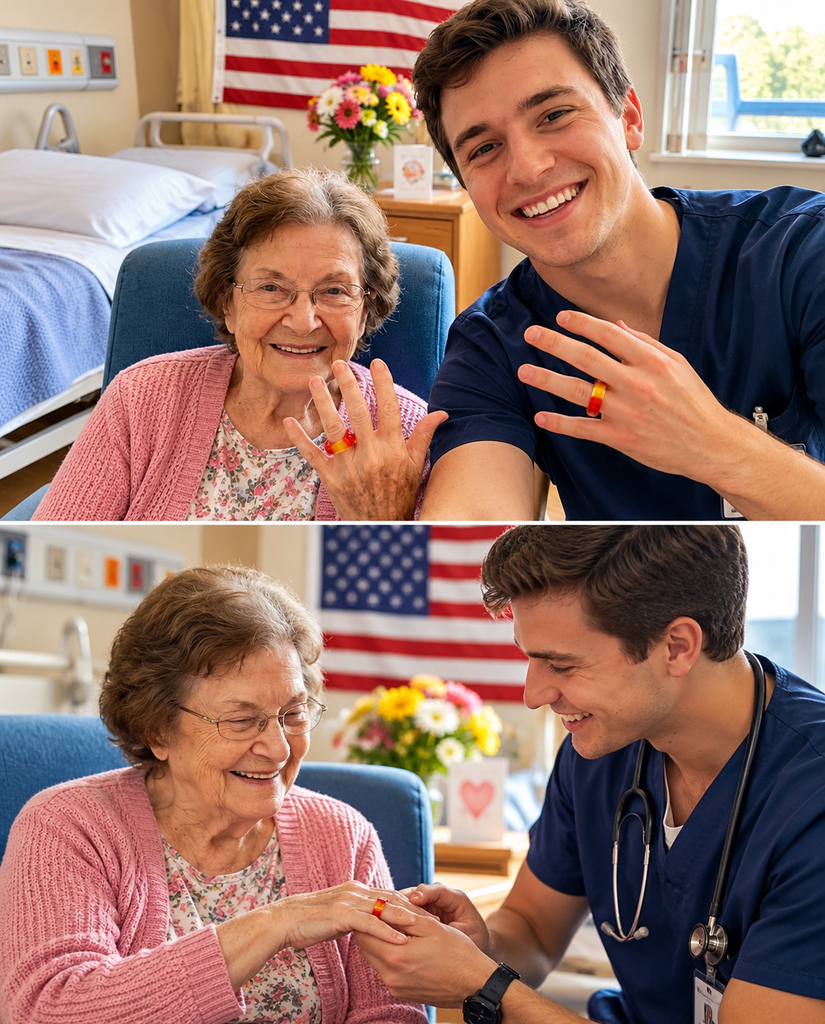
I told her about the facility, about the books, about Eleanor’s arguments and her stubbornness. I told her about the gummy ring and how she had worn it even when it began to lose its shape.
I told her that Eleanor had died with the knowledge that she had been loved.
And I told her that she had spent the last months of her life trying to make one thing right.
Anna listened.
When I finished, she said, “I want to see the house.”
We arranged to meet the following Saturday.
I arrived early.
The garden had changed very little in three weeks, but I had brought a pair of gardening gloves and a small shovel. I spent the morning clearing the path and cutting back the dead branches around the roses.
At eleven, a taxi stopped outside.
A woman stepped out.
She was in her late forties, with dark hair threaded with grey. She stood at the gate, looking at the house as though it might vanish if she moved too quickly.
I walked toward her.
“Anna?”
She nodded.
I didn’t know whether I should shake her hand or hug her.
She solved the problem by stepping forward and embracing me.
She held on for a long time.
Then she pulled away and looked at the house.
“Does it still smell the same inside?”
“I think so.”
She smiled through her tears.
“Then let’s go in.”
We spent the afternoon in the garden.
Anna told me about her life after leaving Eleanor. She had married, divorced, worked in a library, and raised a daughter. She had kept the photograph of the roses for years, but she had never known whether Eleanor had wanted to see her again.
“I thought she had chosen her children,” she said.
I looked down at the soil beneath my fingernails.
“Maybe she thought she had already lost you.”
Anna shook her head.
“That’s what happens when people stop talking. Everyone starts inventing a story about why the other person left.”
She looked at me.
“I’m glad you came.”
I thought of the gummy ring.
Of Eleanor’s letter.
Of all the people who had decided that our love must have been a transaction because they couldn’t imagine anything else.
“I nearly didn’t,” I admitted.
Anna took my hand.
“But you did.”
We sat beneath the roses until the light began to fade.
Before she left, Anna asked whether she could keep the photograph.
I gave it to her.
It belonged with her.
As she held it, she smiled at something in the picture.
“Margaret always hated having her photograph taken,” she said. “She used to tell me that one day she’d grow old enough to forget what she looked like.”
Anna looked toward the house.
“I suppose she didn’t.”
A week later, Mr. Bennett confirmed that the house could be transferred to Anna under the existing legal arrangement. The process would take time, but the documents were in order.
Eleanor’s children had no claim to it.
And I had no claim to anything.
For the first time, that didn’t feel like a loss.
It felt like the truth.
Richard eventually sent me a letter.
It was only one page.
He wrote that he had been angry with his mother for years. He wrote that he had convinced himself she was being manipulated because it was easier than admitting she had made choices he didn’t understand.
He said he was sorry for the things he had told people about me.
He did not ask me to forgive him.
I appreciated that.
Forgiveness is not a debt someone can collect simply because they have finally learned to feel ashamed.
I never became rich.
I never inherited a house or a fortune.
I finished my placement, continued my training, and eventually qualified as a nurse. I still live in a small apartment. My books still occupy more shelf space than I can reasonably afford.
And sometimes, when I am having a difficult day, I remember the old woman who used to argue with me about novels.
I remember the way she would close a book and say, “Well, young man, I suppose you have a point. But you’re still wrong.”
I remember her hands.
I remember the gummy ring.
I remember how she looked at me when I told her I loved her, as though she was trying to decide whether the world had finally offered her something she didn’t have to earn.
People still ask about our relationship.
Some believe I was foolish.
Others believe I was lying.
A few have apologized.
I’ve stopped trying to convince them.
Because the truth is not always something you can prove to people who have already decided what they want to believe.
Sometimes the truth is simply the life you lived when nobody was watching.
I know what happened in that room.
I know what Eleanor meant when she placed that little ring on her finger.
And I know that when she told me I would never receive a cent from her, she was not telling me that I meant nothing.
She was trying to make sure that nobody could put a price on what we had.
Anna now tends the roses at the old house. She sends me photographs every spring, when the first flowers open. Sometimes she writes a few lines about Eleanor, and sometimes she simply sends a picture without a message.
I keep them all.
On the anniversary of Eleanor’s death, I visited the cemetery.
I brought a book, a small bunch of roses, and a new gummy ring.
I placed the ring beside her headstone.
It looked ridiculous against the grey stone.
I laughed when I saw it.
Then I sat down and opened the book we had been reading together when she first became too tired to turn the pages herself.
I read until the light began to fade.
Before I left, I rested my hand against her name.
“You were right about one thing,” I whispered. “People are going to say whatever they want.”
The wind moved through the trees.
“But you were wrong about another.”
I smiled through my tears.
“I didn’t need a lifetime with you to know that what we had was real.”
I stood, brushed the dirt from my trousers, and turned toward the path.
For the first time since September, I didn’t feel as though I was leaving her behind.
I felt as though I was carrying something she had given me.
Not money.
Not a house.
Not a secret inheritance.
Something much harder to lose.
The knowledge that being loved is not the same as being paid, that kindness does not need an audience, and that the people who matter most to us are not always the people who understand us best.
Eleanor had been sixty-nine when she died.
I had been twenty-two.
The world looked at those numbers and decided it understood our story.
It didn’t.
Our story was never about her age, my poverty, or the things she could have left me.
It was about an old woman who had spent too much of her life believing she was a burden, and a young man who had spent too much of his believing he was difficult to love.
For fourteen months, we helped each other believe otherwise.
And when she died, she left me with no money, no property, and no promise that life would suddenly become easier.
She left me with a truth.
The greatest thing someone can leave you is not something you can own. It is something that changes the way you live after they are gone.
I never got a diamond ring.
I never got an inheritance.
But I got to love Eleanor.
And for the rest of my life, that will be enough.
THE END.