

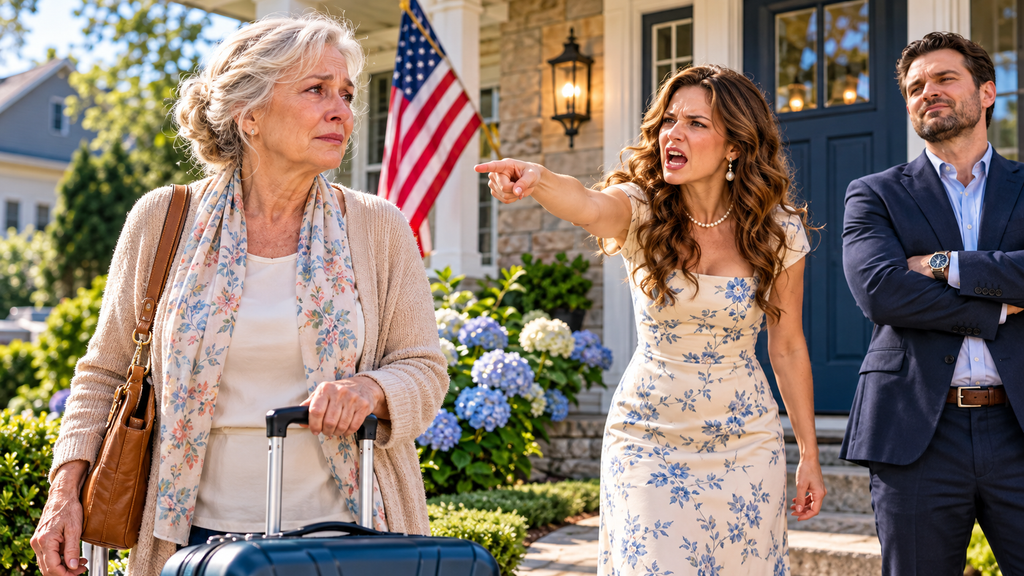
For 40 years, my sister Margaret kept a brass house key on her ring, even after Chloe changed the locks.
I watched her try it twice on the front door. The first time, she turned it hard. The second time, she checked the key as if she might have picked up the wrong one at the airport.
Then Chloe said, “You don’t have a home anymore, Mom.”
I was beside Margaret with my own suitcase. We’d just flown back from Hawaii, where I’d talked her into staying an extra four days because she seemed lighter there. I’d thought a week away might do her good.
I was wrong about that.
Jason stood behind Chloe with his arms crossed. He smiled when he saw Margaret’s key wouldn’t work. Chloe wore the pearl earrings Robert had given her mother for their thirtieth anniversary. I saw Margaret notice them. I saw her look away.
I didn’t say anything. I wish I had.
The blue door was the same one Robert and Margaret had painted together, though the lock was new and shiny. Chloe held a folder against her chest. Jason looked like a man who’d practiced the speech in a car.
“Move aside, please,” Margaret said.
“Mom, there’s no reason to make this ugly,” Chloe said.
“You changed my locks.”
“I sold the house.”
“You sold my house while I was away?”
Jason stepped in. “The paperwork’s done.”
I remember the sound of a delivery truck backing up somewhere down the block. Beep. Beep. Beep. It seemed so ordinary that I got mad at it.
Margaret looked at Chloe. “Who bought it?”
“That doesn’t matter now,” Jason said.
It mattered. We all knew it mattered. But Chloe wouldn’t answer.
I had flown to Hawaii expecting to help Margaret rest. I came home with her to find her own child standing behind a locked door. I could have grabbed Chloe’s sleeve, or asked what she’d signed, or put my body between them. Instead I stood there holding my suitcase handle.
That part still bothers me.
Margaret didn’t cry. She gave this little laugh, not because anything was funny, but because she was trying to stay calm.
Chloe’s mouth tightened. “Why are you smiling?”
“Because I know what your father left behind.”
Jason’s smile went away.
I’d never heard Margaret say that before. She looked at me, and I understood she wanted me to take her to Oak Hill Cemetery. She didn’t explain. I didn’t ask. I just picked up her suitcase.
A week earlier, we’d been in Maui. That’s where I should back up, although I hate giving Chloe the benefit of a clean story.
Margaret had been on her own since Robert died eight years ago. I lived in Virginia too, far enough away to be a help but close enough to make excuses. We spoke on the phone every Sunday. I visited when I could. Some months I let a missed call sit until Monday because I was tired, or busy, or didn’t want another conversation about the house.
Margaret had a way of bringing it up.
“Chloe asked if I’d thought about selling,” she’d say.
“And what did you tell her?”
“That I’m not leaving while I’m still breathing.”
I’d say, “Good.”
I knew Jason had money trouble. Margaret had told me he’d gotten into some kind of investment deal that went bad. She didn’t know the amount, and neither did I. She didn’t want to pry into her daughter’s marriage. That was how she put it.
“Chloe’s got enough to deal with,” she’d say.
I could have pushed harder. I could have asked Chloe myself. I didn’t. I told myself it wasn’t my place.
That’s the sort of thing people say when they don’t want a hard conversation.
Robert and Margaret had been married 42 years. When he died, Chloe was at the hospital three hours later. She hugged her mother, cried a little, then checked her phone. Margaret noticed. She told me she noticed. She also told me not to make Chloe sound bad.
“People do grief differently,” she said.
I let her defend Chloe. I helped her set out sandwiches after the funeral and didn’t mention how rarely Chloe came by after that.
At first Chloe brought groceries. Then she started asking about paperwork.
“Have you made a will yet, Mom?”
“Does the house need this much work?”
“Jason knows a good person who could look at the value.”
Margaret would answer the same way every time. “As long as I live here, it isn’t for sale.”
I heard her say it at least four times. Sometimes she laughed afterward, as though it was a small family disagreement. I could hear the strain in her voice, though.
Once, I told her she could stay with me if things got rough.
She said, “I’m not looking for a spare room, Helen. I’m looking for my daughter.”
I didn’t know what to say to that.
Three weeks before the trip, Chloe called and asked if she could bring coffee over. She sounded like the daughter Margaret missed. She asked about the flight, helped her find her medication list, and hugged her before she left.
“Have a wonderful time, Mom,” she said. “You’ve earned it.”
Margaret was so pleased she told me about it twice. She’d wanted to see me in Hawaii for years, and Chloe had even helped pay for part of the ticket.
I thought that was a good sign. That’s embarrassing now.
On the second day of our trip, Margaret sent Chloe a picture of the water from a bench near the beach. Chloe replied with a heart and, “Looks beautiful.”
The next day, Chloe asked where Margaret had put the folder with the house insurance papers. Margaret didn’t think much of it.
“It was probably just something Jason needed,” she told me.
I said, “You should call her and ask.”
“I don’t want to fuss over every little thing.”
I let it go. Then we went for lunch, and Margaret told me about a woman she’d met at the hotel who had been married for 50 years. She was happy that day. Not wildly happy. Just relaxed. She talked about what she and Robert used to do on Sundays, and I didn’t have the heart to remind her that Chloe had asked for the insurance papers.