

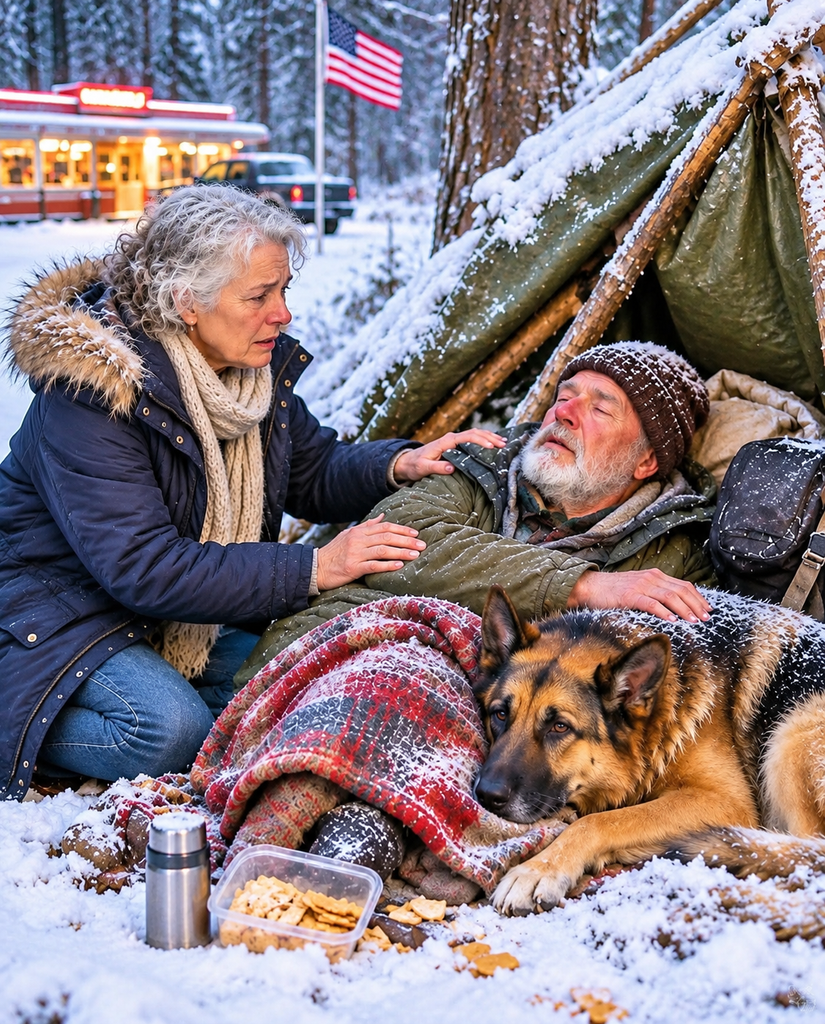
For several seconds, I forgot about the cold. Forgot about the snow soaking through the knees of my pants. Forgot about the dog pressed against the old man’s chest.
Forgot about the torn blue tarp snapping above us in the wind. All I could hear was that one word. “Birdie?” My heart seemed to stop. Nobody had called me Birdie in fifty-eight years.
Not my husband.
Not my mother.
Not a single person who had walked through the doors of my diner.
Only one boy had ever called me that.
And that boy had disappeared from my life when I was thirteen.
I leaned closer.
“Say that again,” I whispered.
The old man’s lips trembled.
His face was covered in gray whiskers, his cheeks hollow, his eyes buried beneath years of exhaustion.
But something about those eyes was familiar.
Something I had buried so deeply that I had almost convinced myself it had never existed.
“Birdie,” he breathed again. “You still… sing when you’re scared?”
A sound escaped my throat.
Not quite a sob.
Not quite a scream.
Because when I was a little girl, I used to sing whenever a thunderstorm frightened me.
And my older brother would sit beside my bed and tell me that frightened birds sang the loudest because they wanted the world to know they were still alive.
“Danny?”
The old man smiled.
It was barely a movement.
But I recognized it.
That crooked little smile.
The same one he’d worn when he stole strawberries from our mother’s garden and blamed the rabbits.
“My little bird,” he whispered.
Then his eyes rolled backward.
And he stopped answering me.
“Danny!”
I grabbed his shoulders.
“Danny, don’t you do this! Not again!”
The German shepherd lifted her head and whined.
I pressed two trembling fingers against my brother’s neck.
A pulse.
Weak.
But there.
I reached for my phone.
One bar.
I dialed 911.
The call failed.
I stood, stumbled toward the creek, and raised the phone above my head.
“Come on,” I whispered. “Please.”
The dog followed me, limping badly.
Finally, the screen changed.
One bar became two.
The dispatcher answered.
“911. What’s your emergency?”
“My brother,” I gasped. “He’s hurt. He’s in the woods near the old fire tower. He’s freezing. His leg’s broken, and I don’t know how long he’s been out here.”
“Ma’am, what’s your name?”
“Dorothy Kincaid.”
“Can you tell me your exact location?”
I looked around helplessly.
Pine trees.
Snow.
A narrow creek.
The remnants of an old logging road.
“About a mile and a half northeast of the highway. There’s an abandoned hunting shelter near the creek. I’m not sure of the coordinates.”
“Stay on the line. We’re sending help.”
I started crying.
“Please hurry. He’s eighty-something, and he’s barely breathing.”
“Ma’am, we need you to keep him warm, but don’t move his injured leg. Can you do that?”
“Yes.”
“You’re doing well, Dorothy.”
I almost laughed.
Because I wasn’t doing well.
I was seventy-one years old, kneeling in the frozen wilderness beside the brother I’d mourned for more than half a century.
And all I could think was that if I lost him again, something inside me would never recover.
I crawled back beneath the tarp.
The dog pressed against Danny’s chest.
I took off my coat and spread it across his body.
Then I wrapped my arms around his shoulders.
“Listen to me, Daniel Mercer,” I whispered against his ear. “You don’t get to disappear twice. Do you hear me?”
His breathing rattled.
“You owe me fifty-eight years of explanations.”
A tear slid down my cheek.
“And you haven’t even started.”
The dog lowered her head onto my knee.
I stroked the fur behind her ears.
“You brought me here,” I whispered. “You knew.”
She looked up at me.
And I swear, even now, there was something in those tired brown eyes that seemed to understand every word.
It took the rescue crew nearly forty minutes to reach us.
Forty minutes of wind and cold.
Forty minutes of watching Danny’s chest rise and fall.
Forty minutes of remembering a boy who used to carry me on his shoulders when the snowdrifts were too high.
I told him stories while we waited.
About the time he broke our kitchen window playing baseball.
About the little wooden bird he carved for my tenth birthday.
About the night he promised that no matter how big the world became, I would always have a brother.
And finally, through the trees, I heard voices.
“Over here!” I screamed.
Flashlights moved between the pines.
A rescue worker in an orange jacket appeared.
Then another.
Then a third carrying medical equipment.
“Ma’am, step back. We need room.”
I moved aside.
The German shepherd didn’t.
She positioned herself over Danny’s chest and bared her teeth.
“Easy, sweetheart,” I whispered.
She growled.
A deep, exhausted sound.
One of the rescuers froze.
“Can you control her?”
I knelt beside the dog.
“Listen to me, girl. They’re helping him.”
She looked at the rescuers.
Then at me.
Then back at Danny.
Slowly, she moved away.
But she never took her eyes off him.
Not once.
As they carefully lifted my brother onto the rescue sled, his eyes opened.
He saw the men around him.
And panic twisted his face.
“No,” he rasped.
“Sir, you’re safe,” one rescuer said.
Danny grabbed my wrist.
His fingers were like cold branches.
“Birdie.”
“I’m here.”
He pulled me closer.
His voice was barely audible.
“Don’t… tell Glen.”
My stomach tightened.
“What?”
His eyes widened with terror.
“Don’t let Glen know… I made it.”
Then he lost consciousness.
And every warm feeling in my body vanished.
Because Glen Hobart had been sitting in my diner that morning.
He had watched the dog pull my apron.
He had told me not to follow her.
And suddenly, I understood something that made the hairs on my arms rise.
Glen hadn’t sounded annoyed.
He’d sounded afraid.
THE MAN IN THE CORNER BOOTH
The ambulance took Danny to the hospital in Ely.
I rode behind it with one of the rescue volunteers.
The German shepherd came with us.
Nobody had the heart to leave her in the woods.
She lay on the floor of the truck with her head across my boots, trembling from exhaustion.
Her back leg was swollen.
One ear had a long, healing cut.
And the dried blood on her collar had worked its way deep into the leather.
I kept looking at it.
Eleven mornings.
Eleven biscuits.
Eleven trips through the freezing woods.
She hadn’t been begging for herself.
She had been feeding my brother.
A man I hadn’t seen since I was thirteen.
I rested my hand against her neck.
“What happened out there, sweetheart?”
She closed her eyes.
I knew she couldn’t answer.
But something told me the truth was already coming.
At the hospital, a doctor named Dr. Patel examined Danny.
He was severely dehydrated and hypothermic.
His left lower leg was fractured.
He had several infected cuts, a bruised shoulder, and evidence of an older head injury.
The doctor looked at me with an expression I didn’t like.
“How long was he outside?”
“I don’t know. At least eleven days, maybe twelve.”
Dr. Patel slowly shook his head.
“At his age, with these injuries, that’s extraordinary.”
“The dog kept bringing him food.”
“What kind of food?”
I swallowed.
“Biscuits.”
He stared at me.
“From my diner,” I explained. “One every morning.”
The doctor glanced toward the door.
Then back at me.
“That may have helped him survive. But shelter, water, and that dog providing warmth may have been just as important.”
I nodded.
“Can I see him?”
“We need to stabilize him first. His condition is serious.”
“He’s my brother.”
The words felt strange in my mouth.
After fifty-eight years, I was somebody’s little sister again.
Dr. Patel’s expression softened.
“We’ll do everything we can.”
I sat in the waiting room with the dog at my feet.
A veterinary technician who had come over from a nearby clinic examined her while I waited.
She found bruising around the dog’s back leg.
Not just an old injury.
Recent trauma.
“She’s been struck by something,” the woman said quietly.
I looked down.
The dog raised her tired eyes toward me.
Something hot and terrible moved through my chest.
“Someone hurt her?”
“That’s what it looks like. We’ll need X-rays to know more.”
I thought about Glen.
About his threats.
About the way he’d stared at the dog every morning.
And for the first time in thirty-two years of serving him coffee, I felt frightened of the man.
Not irritated.
Not insulted.
Frightened.
Around noon, a deputy sheriff approached me.
She was a young woman with dark hair pulled into a tight braid.
Her nameplate read ORTIZ.
“Mrs. Kincaid?”
“Yes.”
“I’m Deputy Leah Ortiz. I understand you found an injured man in the woods.”
“My brother.”
“Can I ask you a few questions?”
I nodded.
She sat beside me.
“Do you know how he ended up there?”
“No.”
“Has he been living outdoors?”
“I don’t know.”
“What’s his name?”
“Daniel Mercer.”
She wrote it down.
Then she looked up.
“Daniel Mercer?”
“Yes.”
“Was he staying in town recently?”
“I suppose so.”
She hesitated.
“Ma’am, I believe he’s been coming into your restaurant.”
I felt a strange coldness creep over my skin.
“What?”
“An older gentleman matching his description was seen at Dot’s Diner several Tuesdays over the past few months.”
The corner booth.
The quiet old man.
The one who ordered black coffee.
The one who always wore an Army cap pulled low over his face.
I remembered his hands.
How he would hold his cup with both hands, as though warming himself.
How he always sat where he could see the kitchen.
How he never stayed after the breakfast rush.
Then another memory came.
Every Tuesday, he ordered two biscuits.
One for himself.
And one wrapped in a napkin.
I had assumed he took the second home.
Deputy Ortiz was watching me.
“Mrs. Kincaid?”
I covered my mouth.
“Oh, my God.”
“What is it?”
“He was there.”
“Who?”
“My brother.”
My voice cracked.
“He sat twenty feet from me for months, and I didn’t know.”
A terrible thought struck me.
“Why wouldn’t he tell me?”
The deputy didn’t answer.
I stared through the waiting-room window at the falling snow.
I’d spent fifty-eight years believing my brother had abandoned me.
And he’d been sitting in my diner.
Watching me make coffee.
Watching me laugh with customers.
Watching me grow old.
I lowered my face into my hands.
Then I remembered something else.
Something that made me straighten abruptly.
“Deputy?”
“Yes?”
“When we found him, he told me not to tell someone he was alive.”
Her pen stopped.
“Who?”
“Glen Hobart.”
Something changed in her expression.
Not surprise exactly.
Recognition.
She closed her notebook.
“Mrs. Kincaid, I need you to tell me everything you know about Mr. Hobart.”
And that was when I realized this was no longer simply a story about a lost brother.
It was something much darker.
THE FIRST SECRET
Danny woke up at 4:18 that afternoon.
I know the time because I was staring at the clock when the nurse came for me.
“He’s asking for Dorothy.”
I stood so quickly my knees nearly gave out.
When I entered his room, he was lying beneath white blankets.
His injured leg had been stabilized.
A monitor beeped softly beside him.
His face was still gray.
But his eyes were open.
And when he saw me, he began to cry.
I’d never seen my brother cry.
Not when he broke his arm falling from a tree.
Not when our father yelled at him for wrecking the pickup.
Not even at Daddy’s funeral.
But now, this old man with trembling hands had tears running into his white beard.
“Birdie.”
I crossed the room.
For a moment, I simply looked at him.
All those years.
All those birthdays.
All those Christmas mornings.
All those times I’d wondered what I’d done wrong.
Then I reached out and touched his cheek.
“You got old,” I whispered.
He let out a weak laugh.
“So did you.”
“Watch your mouth.”
He smiled.
And that smile nearly broke me.
Because behind the wrinkles, behind the exhaustion, behind the beard and the years, my brother was still there.
I sat beside him.
For a while, neither of us spoke.
I held his hand.
And let the silence carry everything we couldn’t yet say.
Finally, I whispered, “Why?”
Danny closed his eyes.
I waited.
“Why did you leave me?”
His fingers tightened around mine.
“Birdie…”
“Don’t.”
My voice shook.
“Don’t call me that until you answer.”
He opened his eyes.
I felt tears spilling down my face.
“I waited for you.”
“I know.”
“No, Danny. You don’t know.”
I leaned forward.
“I waited at the window every night. I kept the porch light on. I asked Mom if you’d called. I wrote letters.”
His face changed.
“Letters?”
“Dozens.”
“She told me you didn’t want anything to do with me.”
I stared at him.
“What?”
He swallowed.
“Your mother said you hated me.”
“Our mother,” I corrected automatically.
He looked away.
“Yes.”
I could barely breathe.
“She told me you stole the money Daddy left us.”
Danny’s face crumpled.
“Oh, Birdie.”
“She said you took it and ran. That you didn’t care if we lost the house.”
He turned toward the window.
For a long time, he said nothing.
Then he whispered, “I never stole a penny.”
I closed my eyes.
I’d wanted to hear those words for fifty-eight years.
And yet they hurt more than I expected.
“Then tell me what happened.”
He looked back at me.
“Do you remember the fire?”
I nodded slowly.
Everybody in Ely remembered the old Hobart timber mill fire.
It happened when I was thirteen.
My father worked there.
So did Danny.
One bitter November night, flames spread through the west processing building.
Three men died.
My father was one of them.
The newspaper called it an electrical accident.
The mill closed temporarily.
Our family fell apart.
A week after Daddy’s funeral, Danny disappeared.
Mother said he’d taken the insurance money.
She said he’d left because he didn’t want to support us.
I believed her.
What else could a little girl believe?
Danny stared at the ceiling.
“The west exit was chained shut,” he whispered.
My stomach dropped.
“What?”
“The night of the fire. Your father tried to get the men out through the west exit. But Hobart had ordered it chained.”
“Walter Hobart?”
Danny nodded.
Glen’s father.
The man who had owned the mill.
“The fire inspector had warned him about that door,” Danny continued. “Walter was afraid workers were stealing tools, so he locked it from the outside.”
I felt sick.
“Daddy died because he couldn’t get out?”
Danny’s eyes filled.
“He got two men through a loading window. Went back for the third.”
His voice broke.
“He never came out.”
I pressed my hand against my mouth.
“I told the sheriff what happened,” Danny said. “I told the insurance investigator. I told anyone who would listen.”
“What happened?”
“Walter Hobart happened.”
The bitterness in his voice was unmistakable.
“He had friends in the county office. Friends at the bank. Friends everywhere. Within three days, people were saying I was responsible for the fire.”
“Why?”
“Because I was the one who’d been complaining about the safety violations. He made it sound like I had a grudge.”
Danny took a painful breath.
“Then Walter came to see Mom.”
I leaned closer.
“He told her that if I kept talking, he’d make sure I was charged with sabotage. He said he’d take back the company loan on our house. He said she would lose everything.”
My chest tightened.
“And she believed him?”
“She was terrified.”
“Then why did you leave?”
Danny stared at me.
“Because Walter offered her a choice.”
I couldn’t speak.
“He said he’d arrange enough money to keep the house if I signed a statement saying I hadn’t seen the exit chained and left town.”
I shook my head.
“No.”
“I signed it.”
“Danny…”
“I was twenty-three. I thought I was saving you.”
A tear slid down his face.
“I thought if I stayed away, you and Mom could survive.”
I gripped his hand.
“But why didn’t you come back later?”
He looked ashamed.
“At first I tried. I sent letters from basic training. Then from overseas. Some came back unopened. Others never received a reply.”
“Mom told me you never wrote.”
“I know that now.”
“Why didn’t you come home when you got older?”
His voice became very quiet.
“Because after a while, being afraid turned into being ashamed.”
I stared at him.
He continued.
“I kept telling myself I’d come when I had money. Then when I finished my service. Then when I got married. Then when the children were older.”
He looked at our joined hands.
“And every year I waited made the next year harder.”
His eyes met mine.
“Your mother kept us apart at first, Birdie. But I let the silence continue. That’s on me.”
I began to cry harder.
“Do you know how much I needed you?”
He nodded.
“I know.”
“No. You don’t.”
“I know.”
I pulled my hand away.
“I got married without you. I buried Mom without you. I buried Ed without you.”
His face twisted.
“I know.”
“And you were sitting in my diner?”
He covered his eyes.
“I wanted to tell you.”
“Then why didn’t you?”
His voice came out broken.
“Because you looked happy.”
I stared at him.
He swallowed.
“You were laughing with customers. You had your own place. People loved you. I thought maybe you had built a good life because you’d finally forgotten me.”
I shook my head.
“You stupid old man.”
He let out a trembling breath.
“You think people forget someone they love just because they learn how to live without them?”
Danny began to sob.
And I did something I hadn’t planned.
I leaned over the hospital bed.
Wrapped my arms around him.
And held him.
Not because everything was forgiven.
Not because fifty-eight years could disappear in one embrace.
But because my brother was alive.
And I wasn’t going to waste the first day I had him back pretending I didn’t still love him.
For several minutes, we cried together.
Then he whispered something against my shoulder.
“There’s more, Birdie.”
I pulled back.
“What?”
He looked toward the closed door.
“You need to understand why Glen wants your diner.”
I wiped my eyes.
“What does my diner have to do with this?”
Danny’s expression darkened.
“Your restaurant sits on the one piece of property he still can’t control.”
I frowned.
“That’s ridiculous. I don’t own the building.”
“I know.”
“Then what are you talking about?”
He reached weakly toward me.
“Listen carefully.”
I leaned in.
“That dog saved more than my life.”
And then he said something that made the entire room seem to tilt.
“There’s something hidden in her collar.”
I stared at him.
“Her collar?”
Danny nodded weakly.
“Underneath the leather. There’s a little seam.”
“What did you put there?”
He glanced toward the door again.
“Proof.”
“Proof of what?”
He swallowed.
“That Glen Hobart is doing exactly what his father did.”
A chill ran down my spine.
“Making people disappear?”
Danny’s silence was answer enough.
THE TWELFTH BISCUIT
The veterinary clinic was already closed when I called.
But the technician who’d examined the dog agreed to bring her back to the hospital.
She arrived forty minutes later with the shepherd resting in the back seat of her car.
The dog’s injured leg had been treated and bandaged.
She looked exhausted.
But the instant she saw me, her tail moved.
Just once.
I crouched beside her.
“Hello, sweetheart.”
She pushed her nose against my hand.
I wanted to cry all over again.
“Your daddy’s alive,” I whispered.
Her ears lifted.
“He’s alive because of you.”
Deputy Ortiz joined us in a small hospital consultation room.
I explained what Danny had told me.
The deputy carefully examined the collar.
It was old brown leather.
Cracked along the edges.
Stained with blood.
There was no name tag.
No identification.
But underneath the leather lining was a narrow section sewn with black thread.
The stitches were newer than the rest of the collar.
Ortiz looked at me.
“Do you mind if I open this?”
“Please.”
She photographed the collar, then carefully cut the threads.
Inside was a tiny plastic pouch.
And inside that pouch was a memory card.
My mouth went dry.
“What is it?”
“Looks like a microSD card,” she said.
“What’s on it?”
“We’ll need to examine it.”
She placed it in an evidence envelope.
Then she looked down at the dog.
“What’s her name?”
I shook my head.
“I haven’t asked Danny.”
The dog was watching the envelope.
As though she knew it contained something important.
I scratched her ears.
“Whatever your name is, sweetheart, you’re the bravest creature I’ve ever met.”
Then my phone rang.
Rudy.
I answered.
“Dot, where in God’s name are you?”
“At the hospital.”
“Are you hurt?”
“No.”
“Then what’s going on? You’ve been gone all day. And Glen’s been asking questions.”
My heart tightened.
“What questions?”
“Where you went. Whether you found anything. Whether that dog came back.”
“Did you tell him?”
“I told him you’d gone home.”
“Good.”
There was a pause.
“Dot, he didn’t believe me.”
“What do you mean?”
Rudy lowered his voice.
“He came behind the counter looking for your address book. Said he needed to speak to you about the building.”
I went cold.
“Did you let him?”
“Hell no. I told him to get out of my kitchen.”
I almost smiled.
Then Rudy said something that erased it.
“Dot, he was carrying a photograph.”
“What photograph?”
“An old picture of a man.”
My fingers tightened around the phone.
“What kind of man?”
“Gray beard. Army jacket. Looked like that old fellow who used to sit in the corner booth.”
I closed my eyes.
Glen knew Danny.
And he’d known exactly who was missing.
“Rudy,” I whispered, “listen carefully.”
“What’s wrong?”
“Lock the doors when you close. Don’t let Glen inside again. And don’t tell anyone where I am.”
“Dot, you’re scaring me.”
“I’m scared too.”
I looked through the glass wall at Deputy Ortiz.
“But I think my brother was almost murdered.”
Silence.
Then Rudy whispered, “Your what?”
“My brother.”
I swallowed.
“He’s alive.”
I heard Rudy sit down.
The chair creaked.
For a moment, neither of us spoke.
Then he said, “Well, I’ll be damned.”
His voice softened.
“Dot, honey… are you okay?”
I looked toward Danny’s hospital room.
“No,” I admitted. “But I think I might be.”
WHAT DANNY SAW IN THE WOODS
By the following afternoon, investigators had recovered the files from the memory card.
They were recordings from a small trail camera.
Danny had placed it beside the old logging road.
The camera had captured three nights of activity.
Trucks.
Excavation equipment.
Men wearing heavy coats and reflective vests.
And Glen Hobart.
I watched a portion of the footage with Deputy Ortiz.
The screen showed a truck backing toward a clearing near the creek.
Two workers unloaded several metal drums.
One had a bright orange hazard label.
Another had a faded chemical warning.
Then an excavator began digging.
The men lowered the drums into the ground.
Covered them.
Flattened the soil.