
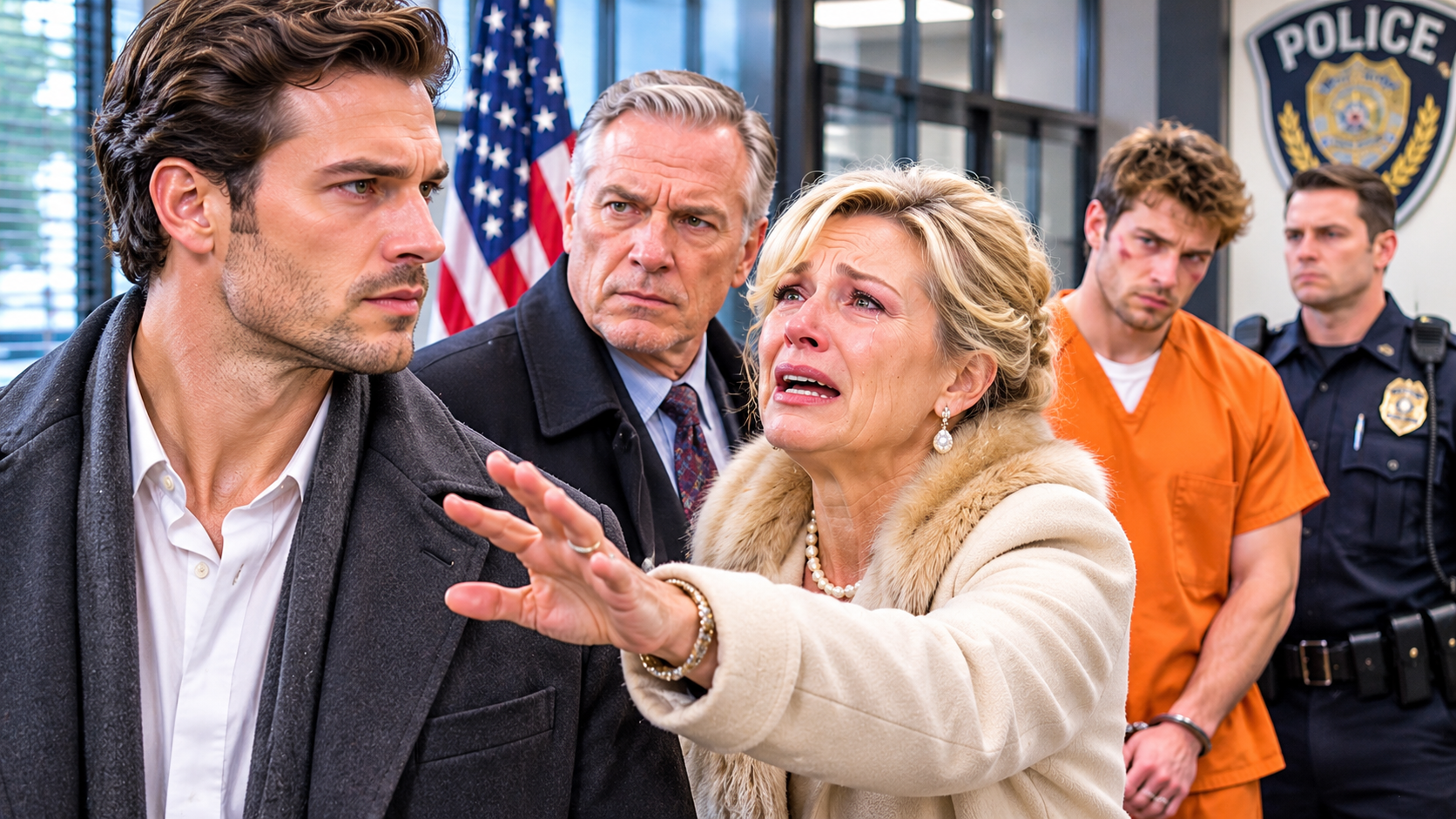
The confidence was gone.
The man who had once believed every problem could be solved with another phone call now understood that consequences were real.
When I was called to testify, I walked to the witness stand.
The prosecutor asked me to explain how I discovered the identity theft.
I told the story from the beginning.
The private jet photograph.
The luxury hotel.
The Lamborghini.
The two o’clock phone call.
The twenty-thousand-dollar demand.
The detective’s call on Christmas morning.
The forged documents.
The fraudulent accounts.
The planned loan.
I tried to keep my voice steady.
But when the prosecutor showed the jury the text messages between my parents and Tanner, I felt my throat tighten.
There they were.
My mother’s words.
I’ll handle him. He always caves when I mention family.
My father’s words.
If he refuses, tell him we’ll never speak to him again. He’ll panic.
I had read them before.
But hearing them read aloud in a courtroom made them feel different.
They weren’t private family arguments anymore.
They were evidence.
The prosecutor asked me one final question.
“Mr. Hayes, did you authorize your brother, father, or sister to use your personal information to obtain money or credit?”
“No.”
“Did you authorize the casino transactions?”
“No.”
“Did you authorize the loan application?”
“No.”
“Did you send the twenty thousand dollars your mother requested?”
I looked directly at the jury.
“No. And I’m grateful I didn’t.”
The prosecutor paused.
“Why?”
I swallowed.
“Because I would have been paying to help the people who were stealing from me.”
The courtroom became completely silent.
I returned to my seat.
My mother was crying.
My father stared straight ahead.
Tanner looked at the floor.
For the first time, I didn’t feel responsible for comforting any of them.
The evidence was presented over several days.
Financial records showed the movement of money.
Messages revealed the planning.
Electronic records connected the fraudulent applications to devices used by Tanner and Skyler.
The fake business loan showed that the scheme had been developing long before the Las Vegas trip.
My father’s attorney argued that he had never intended to permanently deprive me of anything.
He described the transactions as temporary family borrowing.
The prosecutor asked him a question that seemed to silence the entire courtroom.
“If it was temporary family borrowing, why did you forge your son’s signature?”
My father had no convincing answer.
The court eventually found Tanner guilty of multiple financial offenses connected to the identity theft and fraud.
My father was also convicted on charges arising from his role in the scheme.
My mother faced consequences for her involvement in the fraudulent arrangement and attempted deception.
Skyler’s cooperation and the evidence against her resulted in a separate legal resolution. She was required to repay funds connected to her participation and comply with the court’s conditions.
The judge made it clear that being related to someone did not give anyone permission to steal from them.
Tanner received a substantial prison sentence.
My father received a separate sentence related to his role in the fraud.
My mother’s punishment was less severe, but it was still a criminal consequence she would carry.
Skyler avoided the same outcome as Tanner because of her cooperation, but she lost the lifestyle she had been pretending to afford.
The Porsche was surrendered.
Her apartment was gone.
The designer bags disappeared.
And for the first time, she had to find work and pay her own bills.
I didn’t celebrate.
There was no satisfaction in watching my family fall apart.
But I also didn’t feel guilty.
They had made their decisions.
I had simply stopped protecting them from the consequences.
The financial recovery took longer.
Some of the fraudulent transactions were reversed after the investigation. Other losses required separate recovery efforts.
The financial institutions eventually removed several unauthorized accounts from my credit history.
The fraudulent loan application was stopped before funding.
I kept my attorney involved until the remaining disputes were resolved.
One afternoon, several months later, Margaret called with good news.
“Joshua, your credit file has finally been corrected. The major fraudulent accounts have been removed, and the loan application is no longer affecting your record.”
I leaned back in my office chair.
For the first time in months, I could breathe.
“Thank you.”
“You did the hard part,” she said. “You refused to ignore what happened.”
After we hung up, I looked out the window.
Denver was beginning to turn green again.
Winter had finally ended.
I thought about that Christmas Eve.
The lonely apartment.
The little tree.
The cold takeout.
The phone vibrating at 2:14 a.m.
For years, I had believed being a good son meant being available whenever my family needed something.
I had confused love with obligation.
And I had mistaken their dependence on me for affection.
I wasn’t going to make that mistake again.
Seven months later, Skyler showed up at my apartment.
I almost didn’t recognize her.
She wore jeans, a simple sweater, and inexpensive sneakers.
No designer handbag.
No expensive sunglasses.
No carefully staged luxury lifestyle.
She stood outside my door holding a paper bag.
“Hi, Josh.”
I didn’t invite her in immediately.
“What do you need?”
She looked down.
“Nothing.”
I raised an eyebrow.
She gave a small, uncomfortable smile.
“I brought you something.”
She handed me the bag.
Inside was a small Christmas ornament.
It was a wooden house painted white, with two little windows and a red door.
A tiny message was written across the bottom.
Home is where you’re safe.
I stared at it.
“Why?”
Skyler swallowed.
“Because I remembered how you used to decorate the tree when we were kids.”
I didn’t say anything.
She continued.
“I know you probably hate me.”
“I don’t hate you.”
Her eyes filled.
“Really?”
“I’m disappointed. There’s a difference.”
She nodded.
Then she told me that she had started working at a local accounting office.
She was renting a small apartment and paying her own bills.
She had sold most of her belongings to repay the money she owed.
“I used to think you had everything because you were successful,” she said. “I didn’t understand how much work went into it. I just thought you could always make more.”
I looked at her.
“Money doesn’t grow back just because you spend it.”
“I know.”
She paused.
“Joshua, I’m sorry.”
It was the first apology I had heard from anyone in my family that didn’t include a request.
No mention of Tanner.
No mention of our parents.
No request for money.
Just an apology.
I wasn’t ready to forgive her completely.
But I nodded.
“Thank you for saying that.”
She looked at the apartment behind me.
“Can I come in?”
I hesitated.
Then I stepped aside.
We sat at the kitchen table for nearly an hour.
For the first time in years, we talked about things that had nothing to do with money.
She told me about her new job.
I told her about a building project I had recently completed.
We talked about childhood memories and the Christmas dinners we used to have before everything became complicated.
When she left, she hugged me.
I didn’t pull away.
But I also didn’t promise that everything would return to the way it had been.
Some relationships can be repaired.
Others have to be rebuilt from the foundation.
And rebuilding takes time.
My mother wrote to me almost a year after the arrest.
It was a handwritten letter.
I recognized her handwriting immediately.
I left it on the kitchen counter for three days before opening it.
The first page was filled with memories.
My first day of school.
The time I broke my arm riding my bicycle.
The Christmas morning when I was eight and cried because I thought Santa had forgotten my present.
She wrote that she missed me.
She wrote that the house felt empty.
She wrote that she regretted what had happened.
Then came the sentence I had been waiting for.
I knew Tanner was using your information, and I let it happen because I thought you would always forgive us. I told myself it was temporary. I told myself we were protecting your brother. But I was protecting the life we had built around your money. I was wrong.
I read that paragraph twice.
Then I reached the last page.
I don’t expect you to forgive me. I only want you to know that when I said you were dead to me, I was angry because you finally refused to do what I wanted. You deserved a mother who protected you instead of asking you to protect everyone else. I’m sorry, Joshua.
I sat at the table for a long time.
I had imagined receiving an apology from my mother countless times.
But now that it was finally in front of me, I didn’t feel the sudden relief I expected.
An apology could acknowledge the damage.
It couldn’t erase it.
I folded the letter and placed it in a drawer.
I didn’t call her that night.
I didn’t send money.
I didn’t promise anything.
But I didn’t throw the letter away either.
Maybe someday we could have a relationship again.
Maybe not.
That decision belonged to me now.
Another Christmas Eve arrived.
This time, I wasn’t alone because my family had abandoned me.
I was alone because I had chosen peace.
My apartment looked different.
The old drugstore tree had been replaced by a beautiful artificial pine with warm white lights.
There were ornaments from my travels, photographs of friends, and a few handmade decorations.
The wooden house Skyler had given me hung near the top.
I had invited Lauren and two friends from work for Christmas dinner the following afternoon.
For once, I had made plans without worrying about whether someone would call asking for money.
At 2:14 a.m., my phone vibrated.
I froze.
For a moment, my body remembered everything.
The screaming.
The accusations.
The twenty-thousand-dollar demand.
The words that had made me feel like a terrible son for protecting myself.
I picked up the phone.
It was a message from Skyler.
Merry Christmas, Josh. I hope you’re happy and safe. No need to reply. I just wanted you to know I’m thinking of you.
I smiled faintly.
Then I placed the phone on the table.
I didn’t need to answer immediately.
I didn’t need to rescue anyone.
I didn’t need to prove that I was a good person by sacrificing my peace.
I walked toward the Christmas tree and adjusted the little wooden house.
Then I made myself a cup of coffee and sat beside the window.
Snow was falling over Denver.
The city was quiet.
And for the first time in my adult life, Christmas felt like Christmas.
Not a financial emergency.
Not a family obligation.
Not another opportunity for someone to remind me how much I owed them.
Just a holiday.
Just peace.
Just a life that belonged to me.
I thought about the words my mother had screamed into the phone that night.
You’re dead to me.
For months, those words had hurt.
But now I understood something.
I hadn’t lost my family because I refused to send twenty thousand dollars.
I had discovered that the love I thought I had was conditional on how much I was willing to give.
And once I stopped paying, the truth became impossible to hide.
I had spent thirty-two years trying to earn a place in a family that treated me like a bank account.
I would spend the rest of my life building a home where love didn’t come with an invoice.
At sunrise, I received one final notification.
It was an email from the credit bureau confirming that the last disputed fraudulent account had been removed from my report.
I read it twice.
Then I closed my laptop.
I didn’t feel victorious.
I felt free.
And that was better.
THE END.