

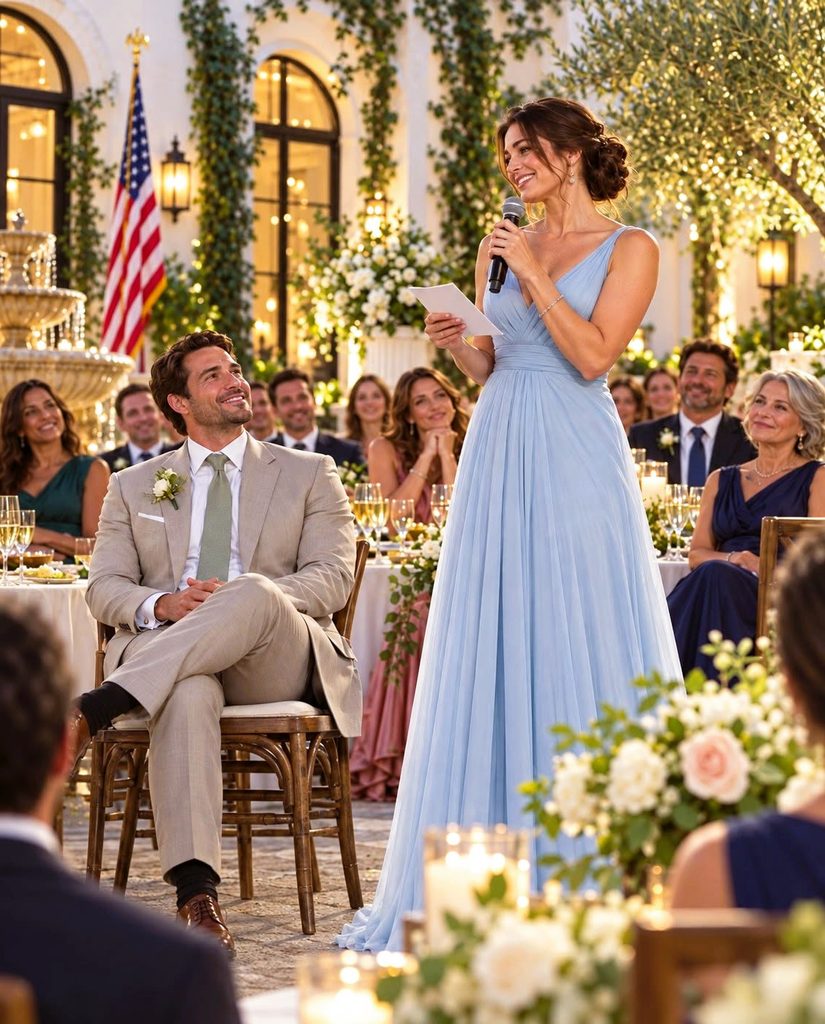
Fifteen years after my dad threw me out, I saw him again at my sister’s wedding. Dad sneered, “If it wasn’t for pity, no one would’ve invited you.” I took a sip of wine and smiled. Then the bride took the microphone, saluted me, and said, “To Major General Evelyn…” The entire room turned toward me.
The first insult came before dinner. My father found me beside the cocktail tables with a glass of Pinot Noir in my hand and fifteen years of silence standing between us.
Gerald Ulette looked older than I remembered, but no gentler.
The same silver hair.
The same expensive suit.
The same expression that said every room belonged to him if he stood in it long enough.
For most of my childhood, people described my father as commanding.
Successful.
Disciplined.
Traditional.
No one ever used the word controlling.
At least, not where he could hear them.
“I didn’t realize Clare’s guest list included charity cases,” he said.
Margaret, his second wife, appeared beside him in a red dress and pearls, smiling as if she had been waiting all evening to see whether my face would break.
I kept my voice steady.
“Hello, Dad.”
His eyes moved over my navy dress, paused at the silver earrings I had bought myself in Germany twelve years earlier, then drifted toward the ballroom where two hundred and fifty guests were drinking champagne beneath crystal chandeliers.
“If you embarrass this family tonight,” he said, “I’ll make sure Clare regrets inviting you.”
There it was.
The threat.
Smooth enough to pass as concern.
That was the thing about my father.
Money was never just money.
It was a leash.
Clare’s apartment.
Her car.
Half the wedding.
Her trust account.
Even the down payment he had promised for her first house.
Everything Gerald paid for became something he could tighten whenever he wanted control.
He could turn generosity into obedience before breakfast.
Fifteen years earlier, I had stood on the front porch of his house with one suitcase after telling him I was joining the Air Force instead of entering the family insurance business.
I still remembered the autumn wind cutting through my sweatshirt.
I remembered the porch light humming overhead.
I remembered Clare peering through the curtains upstairs.
I remembered my father standing in the doorway and telling me I had humiliated him.
“You made your choice,” he said.
I had been twenty-two.
Just graduated.
Terrified.
Excited.
And completely unprepared for the fact that disagreeing with my father could cost me my entire family.
I thought he would cool down.
He didn’t.
By the end of that week, the locks had been changed.
My health insurance was gone.
My phone plan had been canceled.
My bank access had disappeared.
The car he had given me for graduation was reported as belonging to the company and collected from my apartment.
Every photograph of me started disappearing from the house.
Clare was fifteen.
She called me from a friend’s phone because Gerald had checked her messages.
She cried so hard I could barely understand her.
“I’m sorry,” she kept saying.
“You didn’t do anything.”
“He says I’m not supposed to talk to you.”
I closed my eyes.
“Then don’t get yourself in trouble.”
“But you’re my sister.”
“I know.”
“I don’t want you to disappear.”
That sentence stayed with me longer than anything my father had said.
Because Gerald didn’t just kick me out.
He erased me.
At Christmas, my stocking was gone.
On family holiday cards, people were told I had “moved away.”
At reunions, relatives whispered that I was unstable.
Ungrateful.
Difficult.
One aunt told me years later that Gerald claimed I had abandoned everyone because I “couldn’t tolerate responsibility.”
It almost would have been funny if it hadn’t cost me so much.
I was the one who chose responsibility.
Just not his version of it.
My father wanted me in a corner office with Ulette Assurance Group stamped on the glass.
I wanted something else.
I wanted to fly.
I wanted to serve.
I wanted to know whether I could build a life that belonged to me rather than inherit one that came with invisible chains.
I had no idea where that decision would lead.
No idea that I would one day command people.
No idea I would spend nights staring at weather radar while lives depended on choices I made in seconds.
No idea I would become the kind of woman the twenty-two-year-old version of me desperately needed.
But on that porch, I was just a daughter hearing her father say, “If you walk away from this family, don’t ever expect to come back.”
I looked at him and said, “I’m not walking away from my family. I’m choosing my life.”
He closed the door.
Fifteen years later, Clare was the bride.
She had sent the invitation herself.
Handwritten.
No return address.
One line beneath the printed card made me drive three hours to Greenfield Country Club.
Please come. I need you there.
I almost didn’t.
I sat in my car outside the venue for thirteen minutes with both hands around the steering wheel.
I had faced emergency landings with less anxiety.
The country club was exactly the sort of place Gerald loved.
White columns.
Stone fountains.
Valet parking.
Manicured hedges cut into perfect geometric lines.
A place where everyone seemed to know which fork to use and how much not to say.
I had barely made it inside when Clare saw me.
She was standing near the bridal suite in her wedding dress with three bridesmaids around her.
The second our eyes met, her mouth opened.
Then she ran.
Actually ran.
In a Vera Wang gown.
Across polished marble.
One bridesmaid squealed because Clare nearly stepped on her own train.
She didn’t care.
She wrapped both arms around me so tightly the beading on her bodice pressed into my shoulder.
“You came.”
Her voice broke.
I hugged her back.
“Of course I came.”
She pulled away only enough to look at my face.
For a second, she was fifteen again.
The braces were gone.
The frightened eyes weren’t.
“Dad doesn’t know I sent it,” she whispered.
“Clare…”
“Margaret tried to stop it.”
I glanced down the corridor.
“Then maybe I should leave after the ceremony.”
“No.”
“Your wedding is not the place to start a war.”
“I’m not starting one.”
“Your father won’t see it that way.”
“My father sees disagreement as war.”
That stopped me.
Clare squeezed my hands.
“No matter what Dad says tonight, please stay.”
There was something different in her voice.
Something firm.
I knew that tone.
I had heard it in briefing rooms.
In command centers.
In the voices of people who had finally made a decision and accepted the consequences.
I looked into her eyes and saw resolve.
So I stayed.
Even when the welcome sign near the entrance read:
THE ULETTE FAMILY
ESTABLISHED 1988
That was the year I was born.
Yet the framed photographs beneath it showed Gerald, Margaret, Clare, family vacations, charity galas, graduations, ski trips, and holiday portraits.
Not one included me.
I stood there longer than I should have.
A teenage hostess walked over.
“Ma’am, can I help you find something?”
I smiled.
“No. I found it.”
My absence.
Perfectly curated.
Inside the ballroom, a place card waited for me at table twenty-two beside the kitchen doors.
It did not say Evelyn Ulette.
It said:
GUEST OF THE BRIDE.
For some reason, that hurt more than the sign.
Not because I needed the name.
I had built a career without it.
I had served under it without shame.
I had even learned to pronounce it on official introductions without hearing my father’s voice inside my head.
What hurt was realizing someone had intentionally removed it.
Later, I learned Margaret had personally changed my card.
At the time, I just sat down.
The people at my table were mostly distant cousins, vendors, and two older women from David’s church.
They were kind enough.
One introduced herself as Rosa and asked how I knew the bride.
“I’m her sister.”
Rosa blinked.
“You’re Evelyn?”
Before I could answer, Margaret appeared behind me.
“This is Gerald’s older daughter,” she said brightly.
The women smiled politely.
Margaret placed one hand on the back of my chair.
“She left the family years ago to do something with planes.”
“I’m in the Air Force,” I said.
Margaret tilted her head.
“Right.”
Then she smiled.
“Still just you and the uniform?”
The woman across from me looked uncomfortable.
I understood the question.
No husband.
No children.
No traditional markers Margaret could count.
“I’ve been busy.”
“With work?”
“With life.”
Margaret gave a tiny laugh.
“Well, Gerald always said you were independent.”
Independent.
In my father’s vocabulary, that word meant disobedient.
Margaret moved on.
She introduced me to three more people that evening using some variation of the same line.
“She left.”
“She went military.”
“She preferred that life.”
Every sentence was built to make my absence sound like abandonment.
I stopped correcting her.
Not because she was right.
Because I had learned years ago that some people do not misunderstand you.
They understand perfectly.
They just prefer the version that benefits them.
Dinner began at seven.
My father made sure his version of the family history reached the microphone before anyone else’s.
He stood near table one, lifted his Bordeaux, and spoke about loyalty.
About legacy.
About children who understood sacrifice.
About how a family succeeded when everyone remembered where they came from.
Then his gaze drifted toward table twenty-two.
Toward me.
Only for a second.
Long enough.
A few guests followed his eyes.
I took a sip of wine.
Fifteen years ago, that speech would have shattered me.
I would have gone to the restroom.
Locked myself in a stall.
Cried into a hand towel.
Then hated myself for still wanting the approval of a man who had made love conditional.
But I was not twenty-two anymore.
I had flown through sandstorms.
Landed in zero visibility.
Spent thirty hours awake during emergency evacuations.
Sat beside airmen who were afraid they had failed.
Called families after accidents.
Walked into rooms where everyone turned toward me because someone had to decide what happened next.
My father still believed I was the daughter who ran.
He had no idea how many people I had brought home.
After dinner, Margaret’s brother Richard found me.
Richard Hail.
My father’s business partner.
Thick-necked.
Expensive watch.
Voice always half a volume louder than necessary.
“Military, huh?” he said.
“Still.”
“What do you fly?”
“These days, mostly a desk.”
He laughed.
“Well, that happens.”
I smiled politely.
“I’ve flown several airframes.”
“Combat?”
“Yes.”
He looked surprised.
Then dismissive.
“Good for you. Somebody has to do it.”
He took a sip of scotch.
“I just prefer people who actually build something, not simply follow orders.”
The table went quiet.
Rosa lowered her fork.
A man beside her stared into his plate.
Then my father arrived.
As if the conversation had been rehearsed.
Soon the three of them stood around me.
Gerald on my left.
Margaret behind me.
Richard across from me.
A small tribunal dressed in formalwear.
Gerald leaned close enough for his cologne to crowd the air.
“You see all these people?”
“Yes.”
“Every one of them knows you’re the daughter who abandoned her family.”
I looked at him.
He smiled.
“You’re still searching for something you’ll never get.”
“What’s that?”
“My approval.”
There it was.
The old wound.
Named out loud.
Displayed between the wine glasses.
He expected something from me.
Tears.
Anger.
A raised voice.
Proof that underneath the medals and titles and years away, I was still his difficult daughter.
I gave him silence.
It unsettled him.
He straightened.
Raised his voice just enough for nearby tables to hear.