

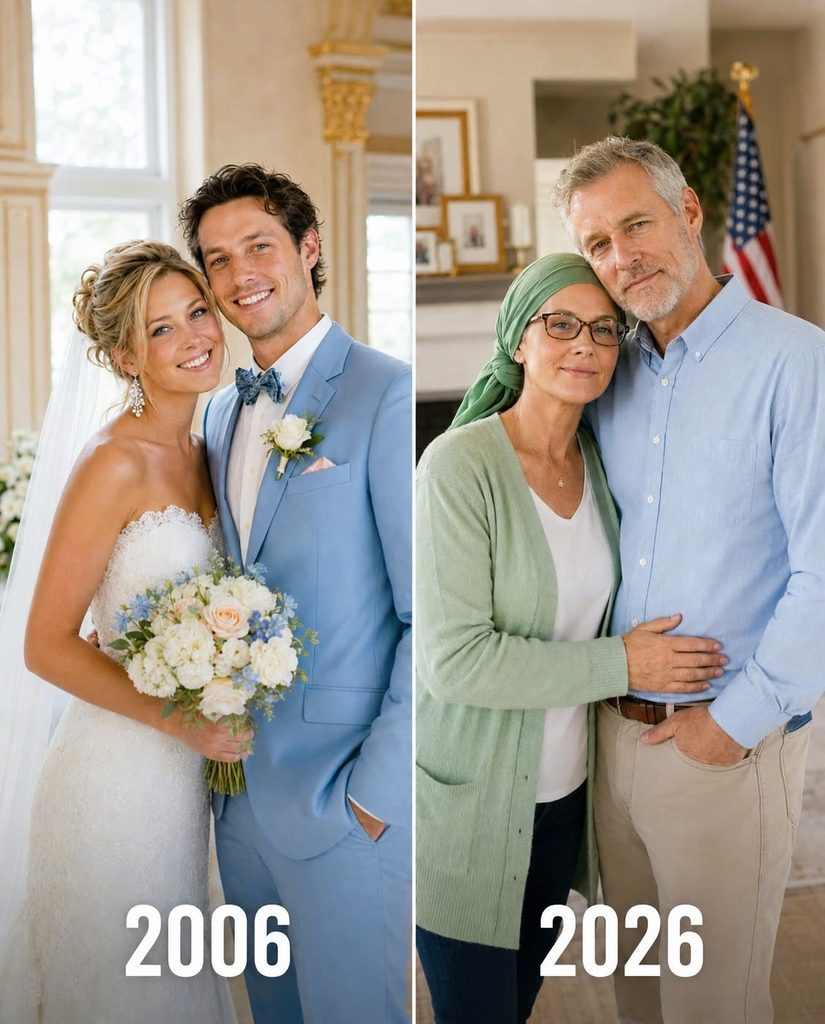
For our twentieth anniversary, I wanted one weekend when my husband, Jeffrey, didn’t have to ask whether I had taken my medication. I wanted one morning when he didn’t study my face before asking how I felt.
I wanted one dinner where he didn’t automatically choose the chair closest to the restroom in case nausea hit me suddenly. More than anything, I wanted to feel like his wife again.
Not his patient.
Not the woman whose appointments filled our calendar.
Not the woman he had driven to chemotherapy every Thursday morning for months while pretending he wasn’t terrified.
I had finished chemotherapy five months earlier.
My doctors were cautiously optimistic. My scans were clear. My bloodwork was improving.
Everyone kept telling me I should be celebrating.
But surviving something and feeling alive again were not the same thing.
Before cancer, I had thick auburn hair that reached the middle of my back. I complained about how long it took to dry and spent ridiculous amounts of money trying to tame the curls.
Then, one morning during treatment, I stood in our bathroom and watched handfuls of it come away between my fingers.
Jeffrey found me sitting on the tile floor surrounded by strands of hair.
He didn’t say anything.
He simply sat beside me.
The next day, when I finally asked him to shave what remained, he brought a chair into the kitchen, wrapped a towel around my shoulders, and used the clippers as gently as if he were handling glass.
When he finished, I couldn’t look in the mirror.
Jeffrey could.
He kissed the top of my bare head.
“You’re beautiful, Claire.”
I wanted to believe him.
But I didn’t.
Cancer had taken more than my hair.
It took weight from places I didn’t want to lose it and added swelling where I didn’t want it. Surgery left a scar along my side that I avoided touching. Steroids changed my face. Exhaustion changed the way I walked.
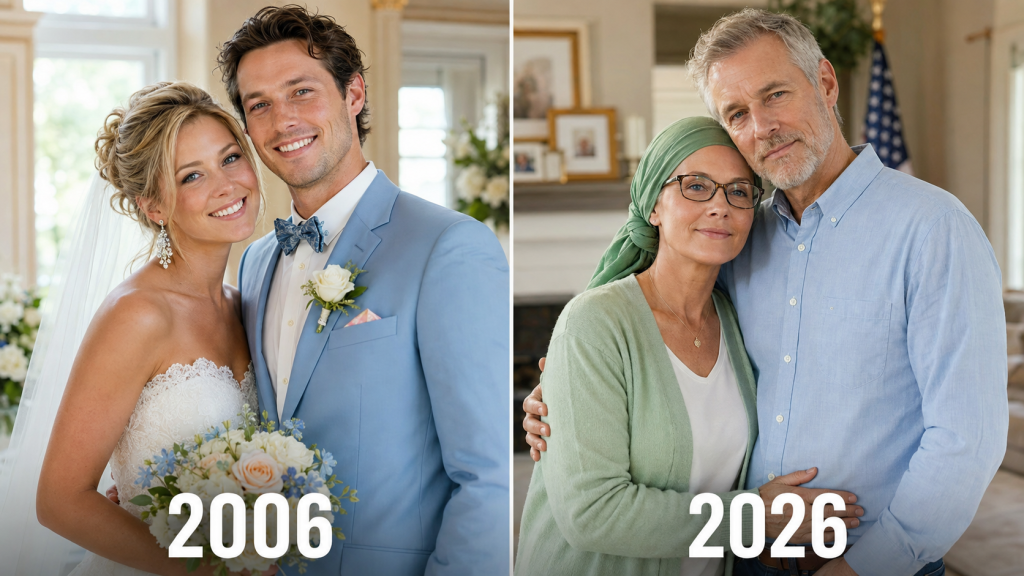
The woman in our wedding photographs looked fearless.
The woman I had become inspected herself under harsh bathroom lights and wondered if her husband ever secretly missed the person he had married.
Jeffrey never gave me a reason to think that.
That almost made it worse.
He was too good.
He cooked.
He cleaned.
He remembered every prescription.
He slept in uncomfortable hospital chairs.
He learned the names of nurses.
He kept crackers beside the bed because they were sometimes the only thing I could eat.
If I woke at three in the morning afraid I was going to die, Jeffrey woke too.
He never complained.
Not once.
And somewhere inside me, gratitude became tangled with guilt.
I started wondering whether he stayed close because he loved me or because leaving a sick wife would have made him a monster.
I hated myself for thinking that.
So when our twentieth anniversary approached, I decided to do something spontaneous.
Twenty years earlier, we had spent our honeymoon at a small mountain hotel overlooking a lake in Vermont.
Back then, we had been twenty-seven years old, broke, and so completely in love that we spent half the trip laughing about the fact that our “luxury mountain-view room” mostly overlooked a parking lot and one very determined pine tree.
The hotel had been renovated since then.
It was nicer now.
More expensive too.
I secretly booked two nights.
When I told Jeffrey I had planned a surprise weekend, his expression shifted strangely.
For just a second, I thought I saw worry.
Then he smiled.
“A surprise?”
“No hospitals,” I told him. “No doctors. No pill organizers on the table.”
“You still have to bring the pills.”
I rolled my eyes.
He kissed my forehead.
“Then yes. Absolutely.”
I bought a dress for the trip.
It was dark green, soft around the waist, with sleeves long enough to hide how thin my arms had become.
I spent almost an hour in the store deciding whether I looked elegant or ridiculous.
Eventually a saleswoman around my age came over.
“Anniversary?” she asked.
I stared at my reflection.
“Twenty years.”
She smiled.
“Then buy the dress.”
So I did.
I imagined wearing it to dinner.
I imagined Jeffrey looking up and seeing me instead of cancer.
For the first time in months, I allowed myself to feel excited.
The drive into the mountains took three hours.
It was early October, and the trees were turning red and gold along the highway.
Jeffrey drove with one hand on the steering wheel.
Normally, his other hand would have rested on my knee.
It didn’t.
I noticed.
I told myself not to.
“You’re quiet,” I said.
“Just enjoying the drive.”
“You hate driving in mountains.”
“I’m evolving.”
I laughed.
He smiled, but it didn’t reach his eyes.
When we reached the hotel, I almost cried.
The old sign was gone, replaced with an elegant stone entrance, but the lake was exactly as I remembered.
The same dark blue water.
The same mountains reflected on its surface.
Jeffrey stood beside me while the bellman unloaded our bags.
“Recognize it?” I asked.
He looked at the building and then at me.
His face softened.
“You remembered.”
“Of course I remembered.”
He kissed my temple.
For one beautiful second, everything felt normal.
Then we entered our room.
There was a fireplace.
A balcony.
A bottle of sparkling cider chilling beside two glasses because I still wasn’t supposed to drink alcohol.
And one enormous king-size bed.
Jeffrey stopped in the doorway.
His entire body became rigid.
His eyes went directly to the bed.
“There’s only one bed?”
I laughed because I thought he was teasing me.
“That’s usually the idea on an anniversary.”
He didn’t laugh.
“Claire.”
Something in his voice made my smile disappear.
“What?”
He looked toward the bathroom, then the balcony, then back at the bed as though searching for an escape route.
“I need another room.”
For a moment, I honestly believed I had misunderstood him.
“You need what?”
“Another room.”
“Why?”
He rubbed a hand over his face.
“I just do.”
I stared at him.
“Jeffrey, we’ve been married for twenty years.”
“I know.”
“We have slept in the same bed for twenty years.”
“I know.”
“So what exactly happened during the three-hour drive that suddenly makes that impossible?”
“Nothing happened.”
“Then stay here.”
He couldn’t look at me.
That hurt more than anything he could have said.
“I can’t.”
Two words.
That was all.
I felt something inside me collapse.
Of course.
Of course he had reached his limit.
Maybe he hadn’t wanted to say it at home because home was where sickness lived.
Maybe this trip had forced him to remember what an anniversary was supposed to mean.
Romance.
Desire.
Intimacy.
And maybe looking at me in a hotel room with one bed made him realize that whatever he had once felt was gone.
I folded my arms over my chest.
“Fine.”
“Claire—”
“I said fine.”
He stepped toward me.
I stepped away.
His face tightened.
“I’ll explain.”
“When?”
“I just need some time.”
That was worse.
There was nothing to explain when a husband couldn’t bear to share a bed with his wife.
He took his suitcase downstairs.
Twenty minutes later, he returned for his toiletry bag.
“Room 317,” he said quietly. “If you need me.”
I didn’t answer.
He stood near the door for several seconds.
Then he left.
The moment the door clicked shut, I sat on the edge of the bed and cried.
Not dramatically.
Not loudly.
Just quietly.
The kind of crying that makes you feel ashamed because you know you are grieving something nobody else can see.
I thought about all the times he had called me beautiful.
All the kisses on my forehead.
All the nights he had held my hand.
Had I mistaken kindness for desire?
Maybe Jeffrey loved me.
I didn’t doubt that.
But perhaps he loved me the way someone loves a wounded person they have promised not to abandon.
I opened my suitcase.
The green dress lay carefully folded beneath a sweater.
I took it out.
For a few seconds, I held it against myself in the mirror.
Then I put it back.
At seven, Jeffrey texted.
Dinner?
I stared at the message.
I wanted to throw the phone.
Instead, I wrote that I wasn’t hungry.
He replied immediately.
Are you feeling sick?
That question broke something in me.
Not: Are you upset?
Not: Can we talk?
Are you feeling sick?
Patient.
Always the patient.
I turned off my phone.
At nine, someone knocked.
I didn’t answer.
A few seconds later, Jeffrey’s voice came through the door.
“Claire?”
I pulled the blanket higher.
“I know you’re angry.”
Silence.
“I’m sorry.”
I shut my eyes.
His footsteps eventually disappeared.
At 11:30, there was another knock.
This time it was softer.
I almost ignored it.
Then he said my name.
There was something different in his voice.
Something frightened.
I got out of bed and opened the door.
Jeffrey stood in the hallway.
His eyes were red.
He wore dark pajama pants and a long-sleeved button-down shirt that was fastened all the way to his throat even though the hallway was warm.
“I’m sorry,” he whispered.
“For what?”
He opened his mouth.
I couldn’t stop myself.
“For finally admitting you can’t stand looking at me?”
His face changed completely.
“What?”
“You heard me.”
“Claire, no.”
“Then tell me the truth.”
“I’m trying.”
“Try harder.”
My voice cracked.
“I bought a dress for you.”
He stared at me.
“I brought makeup I haven’t worn in almost a year. I spent forty minutes trying to figure out whether my hair was long enough to style. I brought the perfume you gave me on our tenth anniversary because I wanted one weekend where I felt like the woman you married.”
“Claire—”
“And then you walked into our room, saw one bed, and looked horrified.”
“I wasn’t horrified by you.”
“Then what were you horrified by?”
He stood motionless.
I wiped my face angrily.
“Just say it, Jeffrey. Please. If you don’t want me anymore, I can survive hearing it. I survived worse.”
His eyes filled.
“God, Claire.”
He stepped inside and closed the door.
Then he locked it.
“I didn’t get another room because I didn’t want you.”
He swallowed.
“I got it because there’s something I’ve been hiding from you since your third round of chemo.”
His hands moved toward his collar.
He opened the first button.
Then the second.
I stopped breathing.
“Jeffrey?”
He continued.
Third button.
Fourth.
Then he pulled the shirt apart.
A scar ran down the center of his chest.
It was long.
Still pink in places.
Another smaller mark appeared near his ribs.
For several seconds, my brain refused to understand what I was seeing.
I had seen medical scars all year.
I knew what surgical scars looked like.
But this one was on my husband.
“What happened?”
Jeffrey lowered his eyes.
“I had heart surgery.”
The room seemed to tilt.
“What?”
“Four months ago.”
Four months.
I stared at him.
Four months earlier I had still been recovering from my final rounds of chemotherapy.
“Heart surgery?”
He nodded.
“What kind of heart surgery?”
“A valve repair.”
My mouth went dry.
“You had open-heart surgery?”
“Yes.”
“And you didn’t tell me?”
His jaw tightened.
“No.”
I slapped my hand over my mouth.
Suddenly I remembered things.
Jeffrey telling me he had pulled a muscle and couldn’t lift grocery bags.
Jeffrey sleeping in the recliner because his back hurt.
Jeffrey wearing loose shirts in July.
Jeffrey insisting that my sister take me to two appointments because he had “work meetings.”
I had never questioned any of it.
I had been too busy surviving.
“When?”
I whispered.
“When did this start?”
“The day of your third chemotherapy cycle.”
He sat carefully in the chair near the window.
“I dropped you off at the infusion center that morning. You remember?”
I did.
Barely.
I had been nauseated before treatment even began.
“My sister came later.”
He nodded.
“Because I collapsed in the parking garage.”
My knees weakened.
I sat on the edge of the bed.
“Someone found me next to the car. They took me to the emergency department downstairs.”
“And I was in the same hospital?”
“Yes.”
“Jeffrey.”
“I know.”
“You were in the emergency department while I was upstairs?”
“Yes.”
Tears blurred my vision.
“They ran tests. I had known for years that I had a mild valve problem, but it had gotten worse. Much worse. The cardiologist said I couldn’t keep ignoring it.”
“You knew you had a heart problem?”
“Mild. At least it was mild the last time I had it checked.”
“When was that?”
He hesitated.
“About six years ago.”
I stared at him in disbelief.
“You lecture me if I’m twelve minutes late taking medication.”