

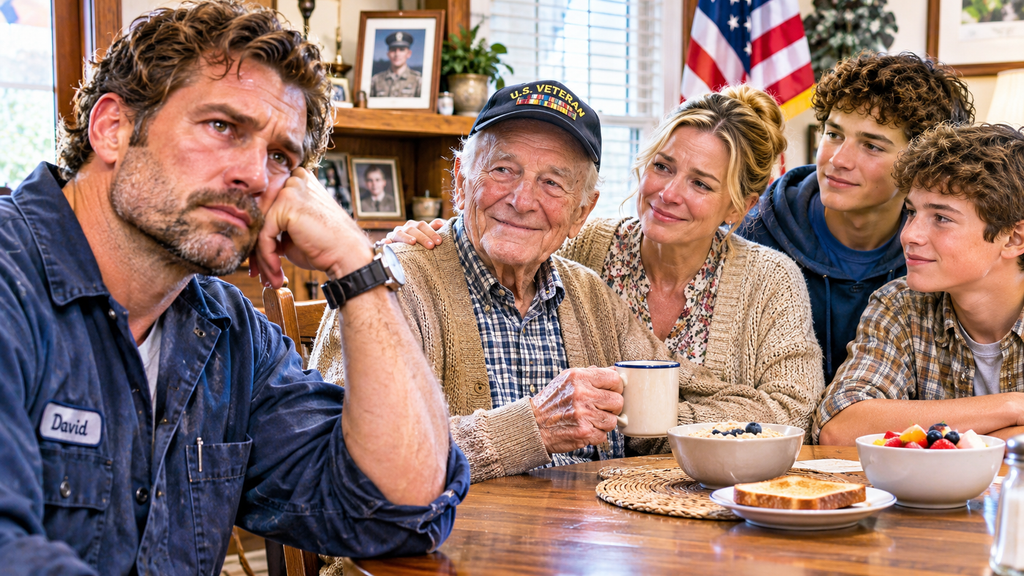
For twenty years, my eighty-nine-year-old father-in-law ate at my dining table without contributing a single dollar. I called him a burden. I never said those exact words to his face, but I thought them often enough that I eventually became ashamed of myself.
Every other Friday was payday, and every other Friday I watched our grocery shelves empty a little faster than they should have.
Milk.
Eggs.
Bread.
Coffee.
Cereal.
Fresh fruit.
His blood pressure medication.
The list never seemed to end.
And there was always another bill.
Another prescription.
Another repair.
Another reason my wife would quietly remind me that her father had nowhere else to go.
His name was Arthur Henderson.
He lived in the back bedroom of our house, directly beside the laundry room.
It wasn’t a large room.
A narrow bed.
A small dresser.
An old television.
One wooden chair beside the window.
A shelf filled with books he rarely touched.
And on the wall was a faded photograph of my wife, Sarah, when she was about eight years old.
Arthur had kept that photograph for decades.
I noticed it every time I walked past his room.
For some reason, I never noticed anything else.
I noticed the cost.
I noticed the inconvenience.
I noticed the extra food disappearing from the refrigerator.
I noticed the electricity bill.
I noticed the heating bill.
I noticed how my two sons had to share a bedroom because the spare room belonged to their grandfather.
But I never noticed the man sitting quietly inside that room.
Arthur was not cruel.
He was not demanding.
He never shouted.
He never threatened anyone.
He simply existed.
And somehow, that made my resentment worse.
Because I couldn’t point to one terrible thing he had done and justify hating him.
He was simply old.
Quiet.
Stubborn.
And dependent.
At least, that was what I believed.
Every morning, Arthur woke before everyone else.
I’d sometimes hear the slow shuffle of his slippers across the hallway before sunrise.
He would enter the kitchen, make himself black coffee, and prepare oatmeal.
Then he would sit at the table near the window and listen to the radio.
He never turned the volume high.
He never complained if someone was sleeping.
He never asked anyone to serve him.
Still, whenever I opened the refrigerator and saw another container of food disappearing, irritation would rise inside me.
One morning, I walked into the kitchen and found Arthur spreading butter over toast.
He looked up.
“Morning, David.”
“Morning.”
He smiled.
“Cold today.”
I looked toward the window.
“Yeah.”
He nodded and went back to his toast.
That was our conversation.
It lasted maybe ten seconds.
But somehow, even those ten seconds bothered me.
I opened the refrigerator.
The milk was nearly empty.
I stared at the carton.
Arthur noticed.
“I can buy some later.”
I turned around.
“With what?”
He looked down.
“I’ll figure it out.”
I immediately felt guilty.
But instead of apologizing, I closed the refrigerator.
“Forget it.”
I grabbed my coffee and left for work.
That was how most of our relationship worked.
I would become irritated.
Arthur would become quiet.
Sarah would eventually notice.
And then she would defend her father.
“He’s my dad, David.”
“I know.”
“He doesn’t have anywhere else to go.”
“He has us.”
“Then what’s the problem?”
“The problem is that we can’t afford to keep doing this forever.”
Sarah’s eyes would fill with tears.
And I would immediately regret saying anything.
But regret never lasted as long as resentment.
For twenty years, I worked at a transmission shop in Austin, Texas.
It wasn’t glamorous work.
I came home with grease under my fingernails.
My shoulders hurt.
My knees hurt.
My back hurt.
Some nights I could barely keep my eyes open long enough to eat dinner.
And almost every night, I would walk through the front door and see Arthur sitting in my favorite recliner.
The same faded brown recliner I had bought after our second son was born.
Arthur would sit there listening to talk radio.
Sometimes he would have a mug of coffee.
Sometimes a plate of cookies.
And sometimes a book resting unopened on his lap.
I hated that chair.
Not because of the chair.
Because it reminded me that the house I had worked so hard to maintain no longer felt entirely like mine.
One evening, I came home after a fourteen-hour shift.
I dropped my keys on the counter.
Arthur was in the recliner.
“Long day?” he asked.
I didn’t answer.
He looked at me.
“You hungry?”
“No.”
He nodded.
After a moment, he said quietly:
“Thank you, son.”
I stopped.
“For what?”
“For letting me stay.”
I looked at him.
Then I walked away.
I wish I could tell you I understood what he meant.
I didn’t.
I thought he was manipulating me.
I thought those words were designed to make me feel guilty.
I thought everything about his presence was another responsibility I hadn’t asked for.
I was wrong.
I just didn’t know it yet.
For twenty years, Arthur watched our family grow.
He watched my sons take their first steps.
He watched them learn to ride bicycles.
He attended their school concerts.
He sat quietly in the back row during their graduations.
He never demanded attention.
He never took credit.
He was simply there.
When my oldest son broke his arm playing baseball, Arthur sat beside him in the emergency room for four hours while Sarah and I dealt with insurance paperwork.
When my younger son struggled with math, Arthur helped him every night.
When my wife was sick with pneumonia, Arthur cooked for the entire family.
I remembered those things.
But somehow I never connected them to the larger picture.
Instead, I remembered the bills.
The sacrifices.
The things we had gone without.
When our roof started leaking, I delayed the repair.
When my truck needed new tires, I bought used ones.
When my youngest son wanted to attend an expensive summer program, I told him we couldn’t afford it.
And every time, somewhere in the back of my mind, I blamed Arthur.
I blamed the old man in the back bedroom.
I blamed the extra mouth at the table.
I blamed the person who, I believed, contributed nothing.
There was one sacrifice I especially resented.
My beloved Chevy Silverado.
I’d owned it for almost fifteen years.
It wasn’t new.
But it was mine.
I had worked overtime to pay it off.
I loved that truck.
Then Arthur needed cataract surgery.
The insurance didn’t cover everything.
The remaining bill was more than we could comfortably handle.
I sold the Silverado.
I drove it to the dealership myself.
I handed over the keys.
On the way home, I cried in the truck that replaced it.
I told myself Arthur owed me.
I told myself my wife owed me.
I told myself I was the only one sacrificing.
I never asked Arthur what he thought.
When I got home that evening, he was sitting at the kitchen table.
He looked at me.
“You sold the truck.”
I nodded.
He lowered his eyes.
“I’m sorry.”
I hated those words.
“I’m sorry.”
Every time he said them, they made me feel like the villain.
“I’m sorry.”
“I’m sorry.”
“I’m sorry.”
One night, after another argument with Sarah, I walked into the kitchen and found Arthur standing beside the sink.
He had heard everything.
“David.”
“What?”
“I know you think I’m a burden.”
I froze.
He didn’t look angry.