

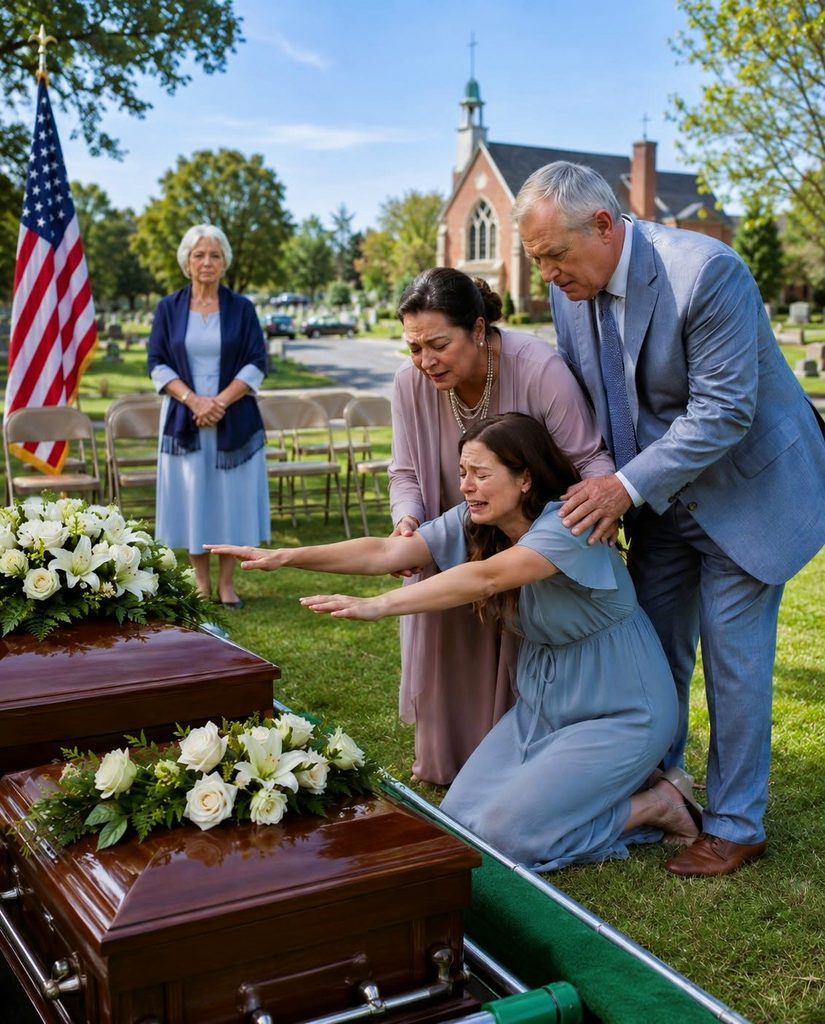
Three days after the funeral, my mother finally texted me. Not to ask whether I had eaten. Not to ask whether I had slept. Not to ask how I was surviving in a house where Lily’s purple rain boots were still beside the back door and Noah’s toy fire engine was parked beneath the coffee table exactly where he had left it.
Her message said: “Melissa was very hurt that you didn’t wish her a happy birthday.” I read it twice because I honestly believed grief had damaged my ability to understand words.
Then another message appeared. This one was from my father. “Grief doesn’t excuse disrespecting family.”
I stared at my phone until the screen went dark. For thirty-seven years, I had been trained to explain my pain in ways that would not inconvenience anyone else.
Melissa had always been the one whose feelings filled the room.
When we were children, if she cried because I received a better grade, my mother told me not to brag.
If Melissa wanted the bedroom with the larger closet, I was expected to move.
When I got engaged first, my parents spent half the dinner discussing how difficult it must be for Melissa to watch her older sister “move ahead.”
Even at my wedding, my father disappeared for almost an hour because Melissa had broken up with her boyfriend and needed someone to comfort her in the hotel bar.
Ethan noticed.
Of course he noticed.
He noticed everything about me.
That night, after our wedding reception, when I finally admitted that I was embarrassed by my family’s behavior, Ethan took my face gently between his hands and said, “Claire, one day you’re going to stop begging people to choose you.”
I laughed then.
I told him that sounded dramatic.
He kissed my forehead.
“I hope I’m there when you do.”
Standing alone in our kitchen after his funeral, I remembered those words.
Then I blocked my parents’ numbers.
I blocked Melissa too.
For the first time in my life, I did not explain myself.
The silence that followed should have felt lonely.
Instead, it felt clean.
The weeks after the funeral barely resembled time.
Days became a collection of necessary tasks.
Death certificates.
Insurance forms.
Police reports.
Calls from investigators.
Meetings with attorneys.
Boxes delivered from Lily’s elementary school containing her notebooks, pencils, artwork, and the cardigan she had forgotten on the back of her chair.
Noah’s preschool teacher brought me a paper bag filled with finger paintings.
One had three uneven people standing beneath a giant yellow sun.
He had written DADDY, MOMMY, ME in crooked letters.
Lily was missing from the picture.
His teacher cried when she explained that Noah had been angry with his sister that morning because she had hidden one of his dinosaurs.
“He said he was going to draw her tomorrow instead,” she whispered.
Tomorrow.
I learned to hate that word.
Tomorrow was where everything I had expected to have was buried.
Margaret and Robert, Ethan’s parents, became the people who carried me through those first months.
They never told me to be strong.
They never said everything happened for a reason.
They never told me Ethan, Lily, and Noah were “in a better place.”
Margaret came over without asking and sat quietly at my kitchen table while I stared at nothing.
Robert changed the porch light when it burned out.
Sometimes he mowed the lawn even though winter was coming and there was barely anything to cut.
They had lost their son and grandchildren too, yet somehow they still found enough strength to keep me from disappearing.
One afternoon, almost six weeks after the funeral, Margaret found me sitting on the floor of Lily’s bedroom.
I had been holding one of her sweaters for nearly two hours.
“I can’t do this,” I whispered.
Margaret lowered herself beside me.
She did not ask what I meant.
Living.
Packing.
Breathing.
Any of it.
She simply took my hand.
“You don’t have to do your whole life today,” she said. “Just this hour.”
So I survived one hour.
Then another.
Eventually, Marcus Reed called.
Marcus had been Ethan’s closest friend since college and his business partner for almost nine years.
I had seen him at the funeral, standing near the back of the church with his wife, looking like someone had removed half his body.
Afterward, he had hugged me and said only, “When you’re ready, there are some things Ethan wanted you to know.”
I had forgotten about that sentence.
When Marcus called again in December, he asked if he could come over.
I almost refused.
Anything connected to Ethan’s company felt unbearable.
Ethan had spent years building Aureline Medical with Marcus, developing emergency diagnostic systems designed to help paramedics detect internal bleeding before patients reached a hospital.
He had talked about it endlessly.
At dinner.
In bed.
During long drives.
He believed the technology could save thousands of lives, especially children injured in car accidents.
The irony of that nearly destroyed me.
Marcus arrived carrying a leather portfolio.
He sat across from me in the dining room while I poured coffee neither of us drank.
“There’s no good way to do this,” he said.
“Then just do it.”
He nodded.
“Ethan changed his estate documents last summer.”
I frowned.
I knew we had updated our wills after Noah was born, but Ethan handled most of the business paperwork himself.
Marcus opened the portfolio.
“Aureline received two acquisition offers last year. Ethan rejected both. After the second offer, our attorneys told us we needed stronger succession planning.”
He pushed several documents toward me.
I looked down.
My name appeared again and again.
Claire Bennett.
Voting rights.
Shares.
Intellectual property.
Board authority.
I looked back at Marcus.
“I don’t understand.”
“You own Ethan’s interest in Aureline.”
“I assumed that.”
“You don’t understand how much he owned.”
Marcus paused.
“Ethan was the largest individual shareholder.”
I stared at him.
“How large?”
“Forty-one percent.”
My hands went cold.
Aureline was not some neighborhood business.
It had offices in three states, nearly four hundred employees, several patents, and contracts with major hospital networks.
Still, Ethan had always lived simply.
We had a comfortable house and savings, but there had been no private jets, sports cars, or obvious fortune.
Most of his wealth existed on paper inside the company.
Marcus continued.
“With voting agreements Ethan signed with two early investors, his shares carry controlling authority in several circumstances. Those rights transferred to you.”
I actually laughed.
It was not amusement.
It was disbelief.
“Marcus, I was a school counselor.”
“You still are Claire.”
“I resigned.”
“Then you’re a school counselor who owns forty-one percent of a medical technology company.”
I pushed the paperwork away.
“I don’t want it.”
“I know.”
“Sell everything.”
“We could.”
“Do it.”
Marcus did not move.
“There’s something else.”
Of course there was.
He removed a sealed envelope from the portfolio.
My name was written across it in Ethan’s handwriting.
I stopped breathing.
Marcus looked away while I opened it.
Claire,
If you’re reading this because something happened to me, I’m sorry.
Those were the first words.
I pressed my hand over my mouth.
The letter was not long.
Ethan explained that he had structured his ownership so that if anything happened to him, I would have the final voice over what happened to Aureline.
He said Marcus could run the company.
He said the lawyers could handle the technical details.
But there was one thing he did not trust anyone else to decide.
Whether Aureline remained what they had intended it to be.
Toward the end, he wrote:
I know you never cared about the valuation. That’s why I trust you with it.
People who want money will eventually sell the purpose to get more of it.
You won’t.
If an offer ever comes that protects the people, keeps the technology affordable, and gives you the freedom to live whatever life comes next, take it.
If it doesn’t, tell them no.
And Claire?
Stop letting people make you audition for love.
You already have mine.
I read that sentence until the ink blurred beneath my tears.
Marcus stayed almost four hours.
By the time he left, I had not agreed to run Aureline.
I had not agreed to keep the shares.
I had agreed only to read.
So I read.
For weeks.
I read company reports Ethan had once tried to explain to me over breakfast while I nodded and reminded Lily to finish her cereal.
I read investor agreements.
Clinical trials.
Patent filings.
Financial projections.
Hospital contracts.
Ethan’s handwritten notes.
The deeper I went, the more I understood what he had been building.
Aureline’s newest device was called Beacon.
It was small enough to be carried in an ambulance and capable of identifying certain types of internal trauma rapidly through a combination of ultrasound imaging and predictive software.
Ethan had wanted rural emergency teams to have access to it.
The problem was cost.
A global healthcare corporation called Dorian Health had offered to acquire Aureline eight months before Ethan died.
Ethan refused because Dorian intended to increase licensing prices and prioritize large metropolitan hospital systems.
There was another potential buyer.
Halcyon Medical.
Their offer was lower, but their proposal included manufacturing expansion, grants for rural emergency departments, and employment guarantees for Aureline’s staff.
Ethan had been negotiating with them when he died.
For the first time since the accident, I felt something other than grief.
Purpose was too large a word.
It was more like a thread.
Something thin enough that I could hold it between two fingers.
I met Halcyon’s executives in January.
They expected Marcus.
They did not expect me.
The lead negotiator, a man named Gregory Shaw, spent most of the first meeting speaking toward Marcus even when I asked the questions.
Finally, after the third time he did it, I closed the proposal.
“Mr. Shaw.”
He looked at me.
“The person whose signature you need is sitting here.”
The room went very quiet.
Marcus hid a smile behind his coffee cup.
Gregory never made that mistake again.
Negotiations lasted eleven weeks.
I learned faster than anyone expected.
Mostly because I did not care about impressing anyone.
Money sounded abstract after standing between three caskets.
Once you have chosen flowers for your children’s funeral, there are very few conference rooms capable of intimidating you.
Halcyon raised its offer.
I rejected it.
They raised it again.
I demanded permanent funding provisions for rural access.
They offered five years.
I demanded fifteen.
They offered employment protections for eighteen months.
I demanded four years.
They wanted Aureline’s headquarters consolidated in Boston.
I insisted the Richmond research division remain open.
Marcus warned me privately that I might kill the deal.
“Then we kill it,” I said.
His eyebrows rose.
“You sound exactly like Ethan.”
I looked out the conference-room window.
“No. Ethan liked negotiating.”
Marcus smiled.
“Fair.”
The final agreement valued Aureline at six hundred and eighty million dollars.
My shares, once taxes, obligations, and various restrictions were considered, were worth more money than I could emotionally comprehend.
But that was not what made me sign.
Halcyon agreed to establish the Ethan Bennett Emergency Access Program, guaranteeing discounted Beacon systems for small and rural emergency departments.
They also agreed to fund a separate charitable foundation.
I named it after Lily and Noah.
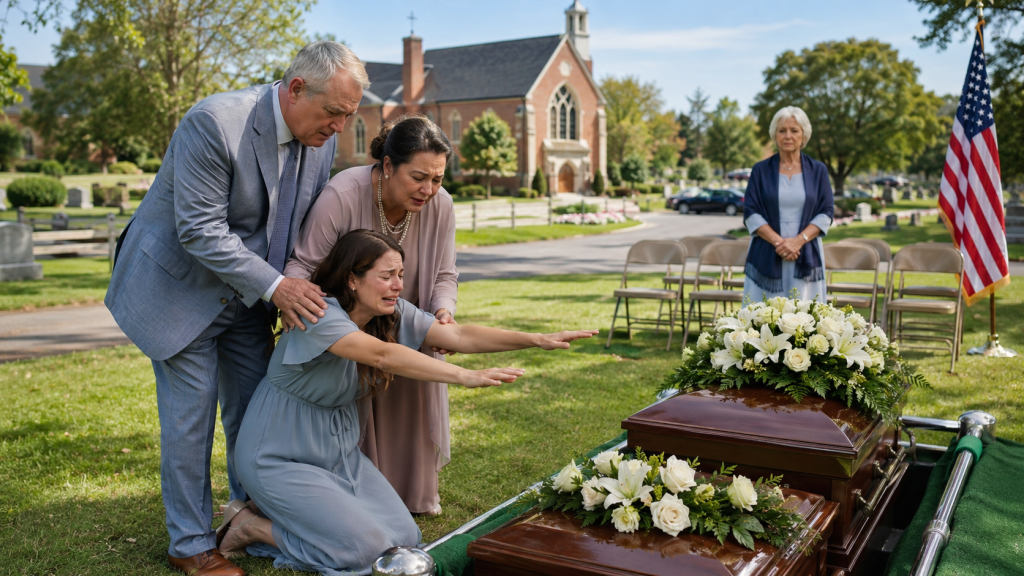
The Lily & Noah First Response Foundation would provide pediatric trauma equipment and training grants to volunteer rescue organizations across Virginia and neighboring states.
When I signed the final document, I went to the bathroom afterward and vomited.
Then I sat on the tile floor and cried because Ethan should have been there.
I called Margaret before anyone else.
She answered on the second ring.
“It’s done,” I told her.
She knew what I meant.
There was a long silence.
Then she asked, “Would he be proud?”
“I hope so.”
“He would.”
Two days later, at 6:17 in the morning, my name appeared on the front page of a national financial website.
By eight, it had spread everywhere.
The headline read:
“WIDOW CLAIRE BENNETT APPROVES $680 MILLION AURELINE MEDICAL ACQUISITION, LAUNCHES $40 MILLION FOUNDATION IN MEMORY OF HUSBAND AND CHILDREN.”
There was a photograph of me leaving Halcyon’s Richmond office.
I looked thinner than I remembered being.
My hair was pulled into a low knot.
I wore Ethan’s wedding ring on a chain around my neck.
Under the photograph, the article described me as Aureline’s controlling shareholder.
It estimated my personal proceeds from the transaction.
The number was wrong.
But it was large enough to change everything.
I was making tea when my phone started vibrating on the counter.
Unknown number.
I ignored it.
Another number called.
Then another.
My email began filling.
By 8:30, Margaret called.
“Have you looked online?”
“I have.”
“You might want to turn your phone off.”