
 Reading Time: 21 minutes
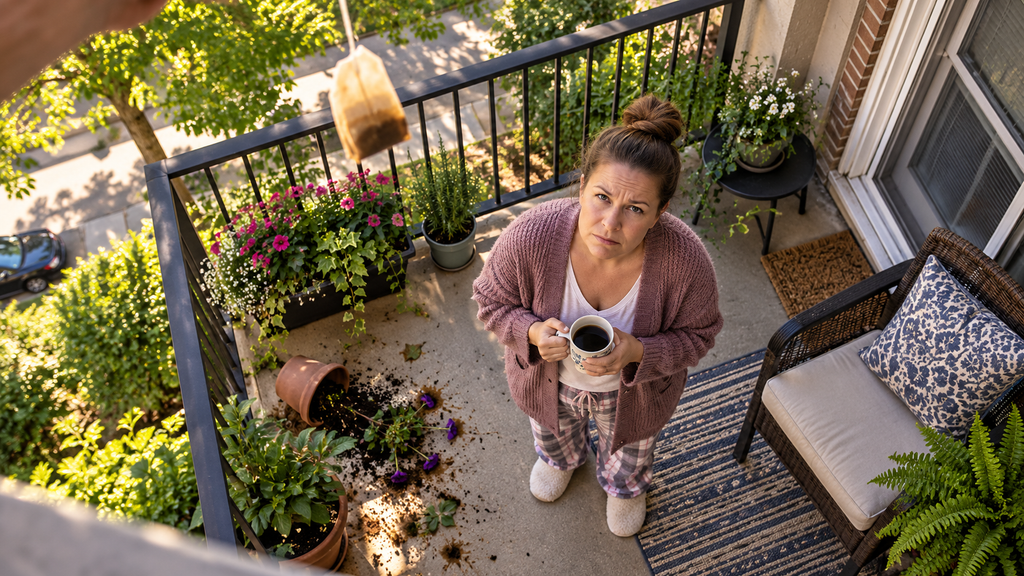
Suddenly, he wasn’t laughing anymore. I stayed on my balcony with my coffee cooling between my hands. Above me, footsteps crossed the floor of apartment 4B.
Then came the unmistakable sound of his front door opening. “What’s this about?” His voice carried down the stairwell. The property manager, Mrs. Alvarez, answered calmly.
“Mr. Carter, we need to discuss a complaint concerning objects being thrown from your balcony.”
There was a pause.
Then he laughed.
Not the confident laugh he had given me before.
This one sounded forced.
“You came up here because of tea bags?”
“Not only tea bags.”
Another silence.
I stood.
My heart had started beating faster.
Mrs. Alvarez had told me the previous afternoon that she would speak to him.
What she had NOT told me was that she would arrive at seven in the morning.
And she definitely hadn’t mentioned anything about security footage.
I moved closer to my balcony door.
Mr. Carter’s voice became sharper.
“What security footage?”
“May we come inside?”
“We?”
That single word made me freeze.
There was someone else with Mrs. Alvarez.
A man’s voice answered.
“Building maintenance.”
I didn’t recognize him.
For the next several minutes, I heard only muffled conversation.
Then something heavy scraped across the floor above me.
A chair, perhaps.
Another scrape followed.
Then footsteps.
Fast footsteps.
Mr. Carter suddenly shouted.
“Don’t touch that!”
Everything went quiet.
I slowly placed my coffee on the table.
Something was wrong.
This was no longer about tea bags.
I stepped inside and locked my balcony door.
Five minutes later, my phone rang.
Mrs. Alvarez.
I answered immediately.
“Hello?”
Her voice was strangely controlled.
“Are you inside your apartment?”
“Yes.”
“Stay there.”
My stomach tightened.
“Why?”
Another pause.
“Just stay inside for a few minutes, please.”
Then she hung up.
I stared at my phone.
That was when I heard the first siren.
At first, it sounded distant.
Then it grew louder.
And louder.
Until it stopped directly outside our building.
I walked toward my front window.
Two police cars had pulled into the parking lot.
Four officers entered the building.
I couldn’t move.
For weeks, I had been dealing with a childish neighbor who couldn’t be bothered to throw his garbage into a trash can.
At least, that was what I thought.
Now police officers were climbing the stairs.
And suddenly I remembered something he had said.
“You should probably be grateful it’s only tea.”
Could be worse.
At the time, I had assumed he was simply being obnoxious.
Standing beside my window that morning, I heard those words differently.
Could be worse.
What exactly had he meant?
Ten minutes passed.
Then twenty.
No one came downstairs.
I tried reading.
Impossible.
I tried washing dishes.
I washed the same plate twice.
Eventually, I heard footsteps in the hallway.
Several people descended the stairs.
I looked through the peephole.
Two officers walked past my apartment.
Then another.
Then Mrs. Alvarez.
Behind them came Mr. Carter.
His hands were behind his back.
For one unbelievable second, I thought I was imagining it.
Then I saw the handcuffs.
Mr. Carter turned his head as they passed my door.
Our eyes met through the narrow glass of the peephole.
Of course, he couldn’t see me.
But something about his expression made me step backward.
He wasn’t smug anymore.
He wasn’t laughing.
He looked furious.
And afraid.
The officers escorted him outside.
I watched from behind the curtain as they placed him in the back of a patrol car.
Mrs. Alvarez remained on the sidewalk speaking with another officer.
Then she looked toward my window.
Twenty minutes later, she knocked.
I opened the door cautiously.
Her face looked pale.
“What happened?”
She stepped inside.
“May I sit down?”
That question frightened me more than anything else.
Mrs. Alvarez was normally the kind of woman who could discuss a flooded basement while eating lunch.
Nothing rattled her.
Now her hands were shaking.
I poured her some water.
She drank half the glass before speaking.
“You remember when you emailed me the photographs yesterday?”
“Yes.”
“And you told me this had been happening twice a day?”
“Usually.”
“Morning and evening?”
“Yes.”
She placed the glass down.
“When you said that, something bothered me.”
“What?”
“We had another complaint.”
I stared at her.
“About him?”
“Not exactly.”
She opened her phone.
“About things appearing below balconies.”
She showed me a photograph.
It had been taken behind our building.
Near the maintenance entrance.
There were several small dark objects scattered beside the wall.
Tea bags.
Dozens of them.
I looked at her.
“Those are his?”
“We don’t know.”
“But why would he throw them behind the building too?”
“That’s what bothered me.”
She swiped to another photograph.
A small plastic packet lay among the tea bags.
My stomach turned.
“What is that?”
“We’re letting the police determine that.”
I handed the phone back.
Mrs. Alvarez continued.
“The maintenance worker checked the exterior camera this morning. It doesn’t show your balcony clearly, but it shows enough of the fourth floor to establish a pattern.”
“What pattern?”
Her expression changed.
“He wasn’t simply throwing tea bags.”
I waited.
“He was watching where they landed.”
A cold sensation moved across my shoulders.
“What do you mean?”
“Every time he threw something, he remained at the railing.”
I remembered mornings when I had walked outside in pajamas.
Evenings when I had watered my plants.
Times when I had bent down to pick up his garbage.
All while assuming the balcony above me was empty.
“You mean he was watching me?”
“We can’t know exactly what he was watching.”
That wasn’t reassuring.
Mrs. Alvarez continued carefully.
“When we went upstairs this morning, I expected an argument about the lease. That’s all.”
“What happened?”
“The maintenance supervisor noticed something attached beneath Mr. Carter’s balcony table.”
I stopped breathing for a moment.
“What?”
“A camera.”
The room seemed to become very quiet.
I looked toward my balcony.
“No.”
“Police are examining it.”
“Pointed where?”
Mrs. Alvarez didn’t answer immediately.
That told me everything.
“Toward my balcony?”
“Yes.”
I sat down.
Suddenly, every tea bag felt different.
Every morning.
Every evening.
Every little plop.
They hadn’t necessarily been careless acts.
They might have been invitations.
A reason to make me walk outside.
A reason to make me stand in one predictable place.
My skin crawled.
Mrs. Alvarez reached across the table.
“I’m sorry.”
I barely heard her.
Then another thought struck me.
“The second woman.”
Mrs. Alvarez frowned.
“What woman?”
“I heard someone upstairs a few nights ago.”
“When?”
“Late. Maybe midnight.”
“What did you hear?”
“Not much. A woman speaking. Then something dropped. I assumed he had company.”
Mrs. Alvarez immediately stood.
“What exactly did she say?”
I tried to remember.
The memory came slowly.
I had been reading in bed.
There had been footsteps overhead.
Then a woman’s voice.
Then Mr. Carter.
I hadn’t paid attention because hearing neighbors through ceilings was normal in an apartment building.
“I think she said, ‘You promised you’d stop.’”
Mrs. Alvarez stared at me.
“Anything else?”
“I don’t remember.”
“Try.”
I closed my eyes.
Footsteps.
A muffled voice.
Something hitting the floor.
Then—
My eyes opened.
“She said my name.”
Mrs. Alvarez went completely still.
“What?”
“I thought I imagined it.”
“What did she say?”
“I think she said, ‘Leave her alone.’”
Mrs. Alvarez immediately called the officer who had just left.
That afternoon, the police returned.
They asked me questions for almost two hours.
Had Mr. Carter ever entered my apartment?
No.
Had he ever asked about my schedule?
Not directly.
Had he ever photographed me?
Not that I knew.
Had he ever threatened me?
I repeated his words.
“You should probably be grateful it’s only tea.”
The detective wrote that sentence down.
His name was Detective Marcus Hale.
He was probably in his late forties, with tired eyes and the patient manner of someone accustomed to frightened people remembering details slowly.
“Anything else?”
I thought.
Then remembered the packages.
“I used to accept deliveries for him.”
“How often?”
“Last winter? Maybe six or seven times.”
“What kind of deliveries?”
“Boxes.”
“Large?”
“Some.”
“Did he ever ask you to open them?”
“No.”
“Did you ever notice the sender?”
“No.”
Then I remembered one.
“There was one from a camera company.”
Detective Hale looked up.
“Do you remember which company?”
“No.”
“When?”
“December, maybe.”
He wrote something down.
Then asked the strangest question yet.
“Did he know you lived alone?”
My stomach tightened.
“Yes.”
“How?”
“Everyone in the building knows.”
Detective Hale nodded.
He closed his notebook.
“We’re going to examine what we recovered from his apartment.”
“What exactly did you recover?”
“I can’t discuss everything yet.”
“Am I in danger?”
He hesitated.
“I don’t believe you’re in immediate danger.”
Immediate.
That word did not comfort me.
“Detective.”
“Yes?”
“Were there recordings of me?”
His expression softened slightly.
“We’re still examining the devices.”
That meant yes.
Or at least maybe.
For the first time since the entire ridiculous tea-bag situation had begun, I wished I had screamed at him.
I wished I had caused a scene.
I wished I had called management after the first week.
But regret doesn’t travel backward.
It only sits beside you.
That night, I slept with every curtain closed.
At 7:04 the following morning, I woke suddenly.
Silence.
No plop.
No sliding balcony door.
Nothing.
I lay there listening.
For months, I had hated that sound.
Now its absence felt almost worse.
Because silence gave my imagination room.
Three days passed.
Mr. Carter didn’t return.
Police kept his apartment sealed.
Mrs. Alvarez changed the lock on the building’s exterior door.
I installed an inexpensive camera facing my balcony entrance.
For the first time in eleven years, I considered moving.
Then, on the fourth afternoon, someone knocked.
A woman stood outside.
Early forties.
Dark hair.
Gray coat.
She looked exhausted.
“Are you the woman from 3B?”
“Yes.”
Her eyes filled with tears.
“My name is Rebecca.”
I waited.
“I used to live with Daniel.”
Daniel.
Until that moment, I had always thought of him as Mr. Carter.
The upstairs neighbor.
The tea-bag man.
Giving him a first name somehow made everything more disturbing.
Rebecca looked down the hallway.
“Can we talk?”
I almost said no.
Then she whispered:
“I’m the woman you heard upstairs.”
I let her inside.
She refused coffee.
Refused water.
She sat on the edge of my sofa as though she planned to leave at any second.
“I saw the police cars,” she said. “Then Mrs. Alvarez called me.”
“You know her?”
“I lived here before you knew Daniel.”
“How long ago?”
“Three years.”
My mind raced.
“Why did you come back that night?”
Rebecca rubbed her hands together.
“Because he contacted me.”
“Why?”
“He said he needed help.”
“With what?”
“You.”
The word landed heavily.
I said nothing.
Rebecca continued.
“He told me the woman downstairs was harassing him.”
I almost laughed.
“Harassing him?”
“He said you kept coming upstairs, complaining about tiny things, watching him, trying to get him evicted.”
“That’s not true.”
“I know that now.”
She looked toward the balcony.
“When I arrived, there were photographs on his laptop.”
My throat tightened.
“Of me?”
“Yes.”
“How many?”
“I don’t know.”
“Tell me.”
“Hundreds.”
I stood.
I couldn’t remain seated.
“Hundreds?”
“Most were through the balcony.”
My hands went cold.
Rebecca’s voice cracked.
“I’m sorry.”
“You didn’t take them.”
“No.”
“Then why are you apologizing?”
“Because I should have warned someone years ago.”
I turned.
“What happened years ago?”
She looked down.
“When Daniel and I lived together, we had a neighbor across the courtyard named Melissa.”
I waited.
“He became obsessed with her routines.”
“What does that mean?”
“He knew when she left for work. When she came home. When she exercised. When she watered her plants.”
My stomach tightened.
“How?”
Rebecca looked directly at me.
“Little things.”
I already knew what she was going to say.
“He would drop things near her window.”
My mouth went dry.
“Tea bags?”
“No.”
“What?”
“Bottle caps.”
I sat down again.
Rebecca continued.
“He said it was funny because Melissa always came outside to pick them up.”
My skin prickled.
“He was watching her.”
“Yes.”
“Did she know?”
“Eventually.”
“What happened?”
“She moved.”
“Was that all?”
Rebecca hesitated.
“No.”
There was more.
Of course there was more.
“One evening Melissa confronted him in the parking lot. She told him she’d found a camera.”
“Where?”
“Outside her window.”
I stared at Rebecca.
“What happened after that?”
“Daniel convinced everyone it wasn’t his.”
“How?”
“There wasn’t enough proof.”
“And you believed him?”
“For a while.”
Her voice became smaller.
“Until I found photographs.”
The apartment felt suddenly too small.
“What photographs?”
“Melissa. Other women. Women from his office. Women at cafés. Mostly ordinary pictures.”
“Ordinary?”
“People walking. Sitting. Reading.”
She looked ashamed.
“But they were organized into folders.”
“By name?”
“By routine.”
I felt sick.
Morning.
Evening.
Balcony.
Gym.
Work.
The tea bags suddenly made horrifying sense.
They weren’t garbage.
They were markers.
Experiments.
Would I come outside?
How quickly?
What would I be wearing?
Would I look up?
Would I bend down?
Would I become predictable?
Rebecca wiped her eyes.
“I confronted him.”
“What did he say?”
“He laughed.”
Of course he did.
“He said I was making something innocent sound creepy.”
The same strategy.
It’s just tea.
Things fall.
You’re overreacting.
Rebecca continued.
“I left him.”
“Why didn’t you report him?”
“I tried.”
“What happened?”
“Nothing significant. Most of the photographs had been taken from places where he was legally allowed to stand. The camera near Melissa’s window couldn’t definitively be tied to him. Daniel knew exactly where the lines were.”
She looked at me.
“That’s what made him dangerous.”
Not that he didn’t understand boundaries.
He understood them perfectly.
He simply enjoyed standing one inch away from them.
I thought about his smile.
“You should probably be grateful it’s only tea.”
Maybe that hadn’t been a joke.
Maybe it had been a promise.
Rebecca stood.
“There’s something else.”
My stomach dropped.
“What?”
“The night I came here, he wasn’t asking me for help.”
“But you said—”
“He lied to get me upstairs.”
“Why?”
“He wanted to show me something.”
She reached into her handbag.
My entire body tensed.
She pulled out an envelope.
“He gave me this.”
Inside was a photograph.
My balcony.
Empty.
On the back, written in black ink, were four words.
SHE FINALLY STOPPED ASKING.
I stared at it.
Rebecca continued.
“He was proud.”
My fingers trembled.
“What did you say?”
“I told him he needed help.”
“What did he do?”
“He laughed.”
Again.
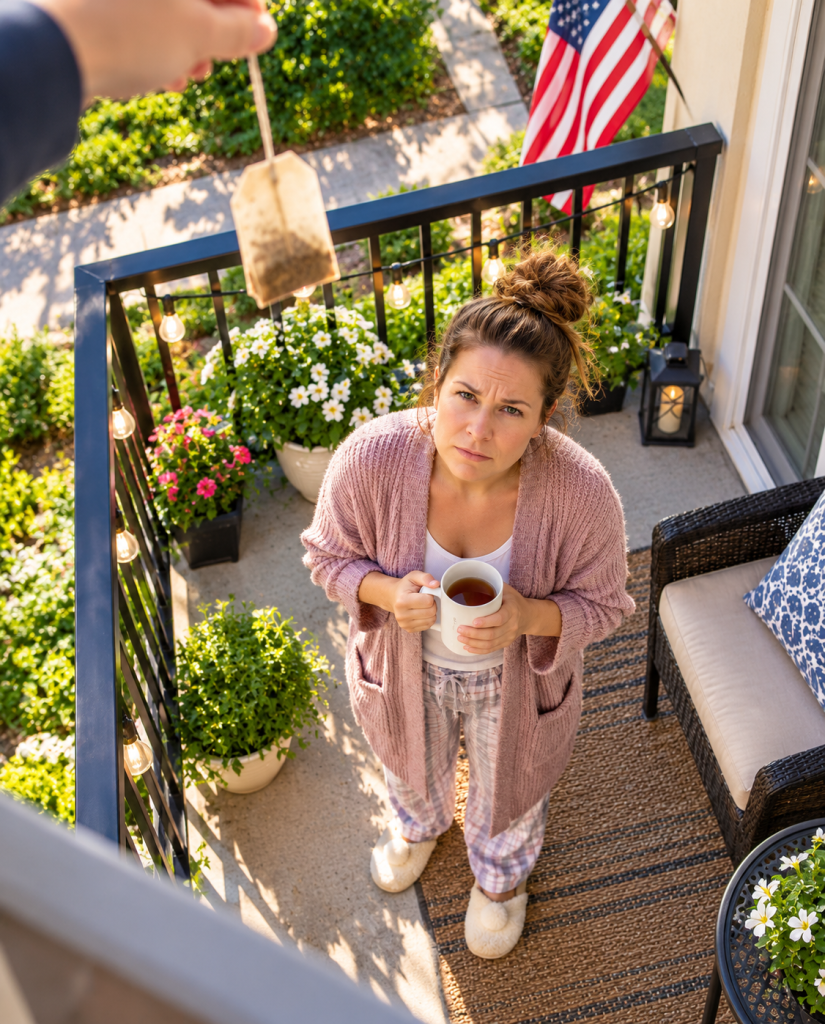
Always the laugh.
“I told him to leave you alone. That’s what you heard.”
“And then?”
“He became angry.”
“Did he hurt you?”
“No.”
She paused.
“But he said something.”
“What?”
Rebecca looked directly into my eyes.
“He said, ‘Tomorrow morning, she’ll understand.’”
I felt every hair on my arms rise.
Tomorrow morning.
That had been the morning before I prepared my little plan.
“What was supposed to happen?”
“I don’t know.”
“Rebecca.”
“I swear.”
She started crying.
“I don’t know.”
That evening, I called Detective Hale.
He came immediately.
Rebecca gave him the photograph.
He asked her to repeat everything.
Then he made a phone call from my kitchen.
Twenty minutes later, officers returned to 4B.
They searched for nearly four hours.
At 11:37 p.m., Detective Hale knocked on my door.
His expression told me they had found something.
“May I come in?”
I let him inside.
He remained standing.
“We found several storage devices.”
I waited.
“And?”
“Some contain recordings.”
“Of me?”
“Yes.”
The word was almost gentle.
It still felt like being struck.
“How long?”
“We’re determining that.”
“What was supposed to happen that morning?”
He hesitated.
“We found a document.”
“What document?”
“A schedule.”
My stomach dropped.
He opened his notebook.
“There are dates and times corresponding with many of the objects thrown onto your balcony.”
“Why?”
“We believe he was recording your reactions.”
I felt sick.
“But there is an entry for yesterday morning.”
“What does it say?”
Detective Hale looked at me.
“Final test.”
The room disappeared for a second.
“What does that mean?”
“We don’t know.”
“You must have some idea.”
“We don’t want to speculate.”
“What did you find?”
He paused.
“A second object prepared beside his tea.”
“What object?”
“A key.”
I stared at him.
“What key?”
He didn’t answer immediately.
Then he said:
“A copy of your apartment key.”
Everything inside me went cold.
“No.”
“We’re investigating how he obtained it.”
“No. That’s impossible.”
“Did you ever lend him your key?”
“Never.”
“Did maintenance ever access your apartment while he was present?”
I thought.
Then remembered.
Six months earlier.
A leaking pipe.
Maintenance had needed to inspect the ceiling.
I had been at work.
Mrs. Alvarez had called.
They used the management key.
Mr. Carter had been there because the leak originated upstairs.
My stomach turned.
“Could he have copied it?”
“We don’t know yet.”
“What was he going to do?”
“We don’t know.”
I stared toward my front door.
Suddenly, it didn’t feel like protection anymore.
Detective Hale noticed.
“We’ll have the lock replaced tonight.”
Mrs. Alvarez arranged it immediately.
At one in the morning, a locksmith changed both locks.
I watched every screw go into place.
I didn’t sleep.
The next day brought another twist.
The key didn’t fit my current lock.
It fit my old one.
The lock had been changed eight months earlier after it started sticking.
That meant Daniel had obtained the key before then.
Maybe long before the tea bags started.
The realization frightened me more than anything.
The tea bags weren’t the beginning.
They were simply the first thing I noticed.
Police continued examining the devices.
Over the following weeks, more information emerged.
Daniel had photographs of several residents.
Not just me.
A woman in 2A.
A college student who had lived in 5C the previous year.
A woman who worked at a bakery two streets away.
None of the images, individually, looked dramatic.
That was the unsettling part.
A person carrying groceries.
Someone checking mail.
Someone walking a dog.
Someone reading on a balcony.
Ordinary life.
Captured without context.
Organized into routines.
Morning.
Work.
Return.
Alone.
Visitors.
Weekend.
That final category made me shudder.
ALONE.
My name had its own folder.
I never asked how many photographs were inside.
I didn’t need that number living in my head.
But the story still wasn’t finished.
Three weeks after Daniel’s arrest, Mrs. Alvarez called.
“Can you come downstairs?”
I found her inside the management office.
A cardboard box sat on the desk.
“What is that?”
“Things from the lost-and-found storage room.”
“Why am I looking at them?”
She opened the box.
Inside were packages.
Old packages.
Some had been opened.
Several had my name on them.
I stared.
“These are mine.”
“I know.”
I picked up one.
It was dated almost two years earlier.
I remembered ordering the item.
The tracking page had said delivered.
I had assumed it was stolen from the lobby.
Another package contained gardening gloves.
Another was empty.
Then I saw a padded envelope.
My name.
My apartment number.
Opened neatly along one side.
“Where did you find these?”
Mrs. Alvarez looked uncomfortable.
“Behind a loose panel in the fourth-floor storage closet.”
Fourth floor.
Near Daniel’s apartment.
My knees weakened.
“Why would he keep these?”
“We don’t know whether he did.”
But we both knew.
At the bottom of the box was something that made my stomach twist.
A Christmas card.
Addressed to me.
From my sister.
Two years old.
I opened it.
The card itself was still inside.
But the family photograph my sister always included was missing.
I called Detective Hale.
He collected everything.
Two days later, he confirmed that several items recovered from Daniel’s apartment appeared to match things missing from the packages.
Including my sister’s photograph.
That was the moment I stopped thinking about moving.
Not because I felt safe.
Because I was angry.
For weeks, fear had been making decisions for me.
Don’t sit outside.
Close the curtains.
Check the lock twice.
Listen for footsteps.
Avoid the balcony.
Maybe leave the building.
Then I realized something.
Daniel had already taken enough.
He had taken ordinary mornings and turned them into evidence.
He had taken my balcony and turned it into a stage.
He had taken kindness and interpreted it as access.
He wasn’t getting my home too.
So I stayed.
I replaced the stained cushion.
Bought new flowers.
Washed the balcony floor.
Then I did something that felt surprisingly difficult.
I sat outside.
The first morning, I lasted seven minutes.
Every sound above me made my shoulders tense.
The second morning, fifteen.
A week later, I drank an entire cup of coffee outside.
At 7:04, nothing fell.
I looked up.
Empty railing.
Blue sky.
Silence.
And for the first time, silence felt peaceful again.
Months passed.
Daniel never returned to apartment 4B.
His lease was terminated.
The legal process moved slowly.
Painfully slowly.
There were interviews.
Statements.
More questions.
Rebecca testified about what she had seen years earlier.
Melissa—the woman from the old building—was eventually located.
She agreed to speak with investigators too.
Apparently, she had kept photographs of the camera she found.
One tiny decision she had made years earlier suddenly mattered.
Save the evidence.
That phrase stayed with me.
Because that was ultimately what had changed everything.
Not revenge.
Not screaming.
Not throwing garbage back.
Evidence.
Photographs.
Dates.
Messages.
Patterns.
I had originally spent that afternoon preparing what I thought would be a simple lesson.
I had placed a large clear container beneath the spot where the tea bags usually landed.
Beside it, I had taped a sign to the inside of my balcony railing.
THANK YOU.
ALL FUTURE TRASH WILL BE DOCUMENTED.
I had positioned my phone to record the drop.
That was it.
That was my grand plan.
I had imagined Daniel looking down, seeing the container, realizing I was recording him, and finally becoming embarrassed enough to stop.
Maybe management would fine him.
Maybe he would apologize.
Maybe we’d spend the next year avoiding eye contact in the hallway.
I had no idea that my silly little plastic container would become the final piece needed to expose something much larger.
The strangest moment came almost six months later.
I was watering my flowers when someone moved into 4B.
A young couple.
Emma and Luis.
They had a little girl named Sophie who carried a stuffed rabbit everywhere.
Mrs. Alvarez introduced us.
Emma looked embarrassed.
“We heard there was some trouble with the previous tenant.”
I smiled.
“You could say that.”
Luis pointed upward.
“We promise not to throw anything off the balcony.”
I laughed.
A real laugh.
It surprised me.
“That’s an excellent beginning.”
Two weeks later, I heard something.
Plop.
My entire body froze.
I looked toward the balcony.
For half a second, I was back there.
Daniel.
Tea.
Watching.
Then I stepped outside.
A pink stuffed rabbit was lying beside my chair.
I looked up.
A tiny face appeared between the balcony rails.
Sophie.
Her eyes were enormous.
“My bunny!”
Her mother rushed outside behind her.
“Oh my goodness. I’m so sorry!”
I picked up the rabbit.
For one ridiculous second, I nearly cried.
Then I laughed.
“Things fall,” I said.
Emma looked mortified.
“I’ll come downstairs.”
“No need.”
I placed the rabbit into a reusable shopping bag.
Then I carefully tossed the bag upward.
Luis caught it.
Sophie cheered.
And that should have been the end of the story.
Except life sometimes saves its strangest twist for after you think the ending has already arrived.
Nearly one year after that first tea bag stained my towel, I received a letter.
No return address.
My hands shook when I opened it.
Inside was one sheet of paper.
The message was short.
I’M SORRY I DIDN’T BELIEVE YOU.
—4A
Apartment 4A.
The unit beside Daniel.
An elderly man named Mr. Harris had lived there.
I barely knew him.
I carried the letter upstairs.
He answered after my second knock.
When he saw the paper in my hand, his face fell.
“You got it.”
“Yes.”
He stepped aside.
“Come in.”
His apartment smelled like coffee and old books.
We sat at his kitchen table.
“What didn’t you believe?”
Mr. Harris stared at his hands.
“You.”
“We never talked about Daniel.”
“No.”
“Then what do you mean?”
He sighed.
“He talked about you.”
A familiar coldness returned.
“What did he say?”
“That you were unstable.”
I almost laughed.
Of course.
“He said you kept accusing him of throwing things.”
“He was throwing things.”
“I know that now.”
“What else?”
Mr. Harris looked ashamed.
“He said you watched him.”
The irony was almost unbearable.
“He told me you had some fixation on him.”
“And you believed that?”
“At first.”
“Why?”
“Because he was convincing.”
I said nothing.
Mr. Harris continued.
“He’d mention little things. Say you’d been standing outside when he left for work. Say you’d looked up at his balcony. Say you’d complained about harmless accidents.”
Every one of those events had been engineered by Daniel.
He threw something.
I walked outside.
I looked up.
Then he told someone I was watching him.
The manipulation was almost elegant in its ugliness.
“He was creating a story about me.”
“Yes.”
“Why?”
“I think he was preparing.”
“For what?”
Mr. Harris looked at me.
“In case you complained.”
That was the final piece.
Daniel hadn’t merely been watching me.
He had been building his defense before I even understood there was something to defend against.
If I reported him, I was obsessed.
If I confronted him, I was unstable.
If I noticed him watching, I was paranoid.
Every reaction became proof of the story he had already started telling.
Mr. Harris wiped his eyes.
“I should have questioned it.”
“You didn’t know.”
“I heard you knock on his door that second time.”
I remembered.
The stained cushion.
“It sounded like an argument.”
“It wasn’t.”
“I know.”
He swallowed.
“After you went downstairs, Daniel knocked on my door.”
“What did he say?”
“He laughed.”
There it was again.
That laugh.
“He said, ‘See what I deal with?’”
I felt something inside me finally settle.
Not fear.
Understanding.
For months, I had wondered why his dismissiveness bothered me so deeply.
Now I understood.
The laughter wasn’t spontaneous.
It was part of the mechanism.
Make the other person feel ridiculous.
Make the complaint sound petty.
Reduce everything to something harmless.
It’s only tea.
It’s only a joke.
It’s only a photograph.
It’s only a coincidence.
Until the person being harmed begins asking the most dangerous question:
Am I overreacting?
Mr. Harris looked at me.
“Can you forgive me?”
I thought carefully.
“I don’t think there’s anything for me to forgive.”
His eyes filled.
“But I believed him.”
“You believed the version you were given.”
“I should have asked you.”
“Yes.”
He nodded.
“Yes. I should have.”
We sat quietly for a while.
Before leaving, I stopped at his door.
“Mr. Harris?”
“Yes?”
“Thank you for telling me.”
He smiled sadly.
“I should have done it sooner.”
Maybe.
But sooner wasn’t available anymore.
Only now.
And sometimes now has to be enough.
That evening, I sat on my balcony.
Above me, Sophie was laughing while her parents ate dinner.
Someone nearby was playing music.
A dog barked in the parking lot.
Cars passed.
Ordinary sounds.
Beautifully ordinary.
I looked toward the corner where the first tea bag had landed.
For months, I had thought this story was about disrespect.
Then I thought it was about harassment.
Eventually, I understood it was about something much simpler and much more important.
Boundaries.
People imagine boundaries as dramatic things.
Locked doors.
Police reports.
Court orders.
But most boundaries begin quietly.
Please don’t do that.
That’s mine.
Stop.
You’re making me uncomfortable.
Respect my space.
Sometimes the person on the other side apologizes.
Sometimes they didn’t realize.
Sometimes people genuinely make mistakes.
But occasionally, someone hears your boundary and laughs.
That laugh tells you something.
Not always something dangerous.
But something worth noticing.
Because decent people don’t need you to explain your discomfort four times before they care.
I had asked Daniel three times.
The first time, he apologized.
The second time, he dismissed me.
The third time, he laughed.
After that, I stopped asking.
For months, I wondered whether I should have done something differently.
Should I have reported him immediately?
Should I have installed a camera earlier?
Should I have stopped accepting his packages?
Should I have noticed him watching?
But those questions eventually lost their power.
I couldn’t change what I hadn’t known.
What mattered was what I did once I understood.
I documented.
I spoke.
I trusted the pattern.
And most importantly, I stopped needing his agreement before I treated my own boundary as legitimate.
A week after my conversation with Mr. Harris, I replaced one final thing.
The white towel.
The original one had remained folded beneath my kitchen sink.
Brown stain in the center.
I don’t know why I kept it.
Evidence, perhaps.
Or anger.
I took it outside.
Looked at the stain.
Then threw the towel away.
Not dramatically.
No ceremony.
Just into the trash.
Some things don’t deserve a permanent place in your life simply because they once hurt you.
The next morning, I bought another white towel.
I hung it over the balcony chair.
Bright.
Clean.
Almost defiantly ordinary.
At 7:03, I stepped outside with coffee.
At 7:04, nothing happened.
At 7:05, Sophie appeared above me.
“Good morning!”
I smiled.
“Good morning.”
“I’m having pancakes!”
“Lucky you.”
She disappeared.
A second later, her mother leaned over.
“Coffee?”
I lifted my cup.
“Already prepared.”
Emma laughed.
Then something dropped from their balcony.
My heart jumped.
It landed beside my flowerpot.
A folded piece of paper.
I stared at it.
Then looked upward.
Emma’s face appeared.
“Oh no!”
“What is this?”
She started laughing.
“Sophie made you something!”
I unfolded the paper.
It was a drawing.
Three stick figures stood on two balconies.
One tiny figure upstairs.
One downstairs.
A giant yellow sun filled half the page.
At the bottom, in crooked purple letters, Sophie had written:
GOOD NAYBOR.
I laughed so hard that tears came.
Not because it was funny.
Because sometimes healing doesn’t announce itself.
Sometimes it arrives as a badly spelled drawing falling from the exact place where something ugly used to fall.
I taped Sophie’s picture to my refrigerator.
It’s still there.
And every morning when I make coffee, I see it.
I see the crooked sun.
The balconies.
The purple letters.
And I remember the strange chain of events that began with something as ridiculous as a wet tea bag.
People sometimes ask what happened to Daniel.
The legal case took time.
There were charges connected to unlawful surveillance and other conduct investigators uncovered.
I attended the proceedings I needed to attend.
Rebecca did too.
So did Melissa.
I won’t pretend there was some cinematic moment where Daniel looked at me across a courtroom and suddenly understood everything.
People like to imagine endings like that.
The villain realizes what he did.
The victim gives a perfect speech.
Everyone applauds.
Life is rarely so tidy.
Daniel mostly stared at the table.
Once, while leaving the courthouse, he looked toward me.
For the first time since I had known him, he didn’t smile.
He didn’t laugh.
He simply looked away.
And strangely, I didn’t feel victorious.
I felt finished.
That was better.
Because victory still ties you to the person you defeated.
Being finished means you get to go home.
So I did.
I went home.
I unlocked my door.
I put my purse on the chair.
I made coffee.
And I stepped onto my balcony.
The afternoon sun warmed the railing.
My flowers had grown wildly that summer.
Geraniums spilled over one planter.
Basil crowded another.
The chair cushion was clean.
The white towel moved gently in the breeze.
Above me came the ordinary sounds of a family living their life.
No watching.
No calculated drops.
No laughter designed to make someone doubt themselves.
Just life.
I sat down.
For eleven years, this apartment had been my home.
For several months, one man had managed to make me feel like I needed permission to feel safe inside it.
He didn’t get to keep that power.
Nobody did.
I drank my coffee slowly.
Then I noticed something beside the flowerpot.
A tea bag.
For one terrifying heartbeat, I couldn’t move.
My hand tightened around the mug.
Impossible.
Daniel was gone.
I stood carefully.
The tea bag was dry.
Unused.
Still wrapped.
Attached to it was a tiny note.
I picked it up.
The handwriting was unfamiliar.
Then I looked upward.
Mr. Harris was leaning over his balcony from 4A.
He raised his mug.
“Peace offering,” he called.
I looked at the tea bag.
Then at him.
“What flavor?”
“Chamomile.”
I laughed.
“Terrible choice.”
“What?”
“I hate chamomile.”
He stared at me.
Then started laughing.
Not Daniel’s laugh.
Not cruel.
Not dismissive.
Just human.
“Well,” he shouted, “throw it away!”
I looked at the tea bag.
Then at the trash can beside my balcony door.
And smiled.
“No.”
I carried it inside.
I still have that tea bag too.
It’s sitting in a kitchen drawer beneath Sophie’s crayons and a collection of takeout menus I never use.
Not because tea bags became precious.
Not because every bad experience needs to become some beautiful lesson.
Some experiences are simply bad.
But I kept that one because it reminds me of the difference.
The same object.
A completely different intention.
One was thrown because someone believed my space didn’t matter.
The other was offered because someone finally understood that it did.
And maybe that’s the real ending.
Not what happened to Daniel.
Not the police.
Not the cameras.
Not the hearings.
Not even the moment the handcuffs clicked around his wrists.
The ending is that I still sit on my balcony.
I still hang white towels outside.
I still water my flowers.
I still help neighbors with packages.
I didn’t allow one person’s misuse of kindness to convince me that kindness itself was foolish.
But I learned something.
Kindness and boundaries aren’t opposites.
You can be generous and still say no.
You can be patient and still document what is happening.
You can forgive mistakes without repeatedly volunteering to become the target of them.
And when someone laughs at a reasonable boundary, you don’t necessarily need to shout louder.
Sometimes you simply stop arguing.
You save the evidence.
You make the call.
You protect your space.
And you let consequences speak in the language that person refused to hear from you.
The next spring, I replanted everything.
New flowers.
New herbs.
A small tomato plant Sophie insisted I needed.
She helped me dig the hole.
Mostly she spilled dirt everywhere.
Emma apologized.
I looked at the mess.
Then at the little girl.
“It’s just dirt.”
We both started laughing.
Later that afternoon, after everyone went upstairs, I sat alone.
A breeze moved through the leaves.
Somewhere across the courtyard, a kettle whistled.
I smiled.
Funny.
There had been a time when the smell of tea made my stomach tighten.
Now it was simply tea again.
That’s how I knew the story was finally over.
Not when Daniel left.
Not when the police finished searching.
Not when the lock changed.
Not when the hearings ended.
It ended when ordinary things became ordinary again.
A balcony was a balcony.
A morning was a morning.
A sound overhead was simply a neighbor moving a chair.
And tea—
Tea was just tea.
I lifted my coffee toward the empty sky.
Then I whispered the sentence I wish I had understood from the very beginning.
“My home doesn’t become less mine simply because someone lives above it.”
And this time, nobody laughed.
💬THE END! THANK YOU FOR READING! ❤️🙏